Corresponding Author :
(Takifugu rubripes) Heterobothrium
Heterobothrium Infection of Tiger puffer, Takifugu rubripes Cul- tured in Ponds on Land
Sung-Woo Park and Gi-Chun Park
Department of Aquatic life Medicine, Kunsan National University, Kunsan, 573-701, Korea
Diseased tiger puffer (Takifugu rubripes) showed anorexia and severe anemia in the gills. In wet mount preparations Heterobothrium sp. with 4 sets of clamps on the opisthohaptor attached to the gill filaments of the diseased fish. From the drum-shaped filter for filtration of the culturing water and the sediment of aquar- ium held the diseased fish in the laboratory, their eggs forming long strings through connection of the bipo- lar filaments could be easily collected. The parasites with 4 pairs of clamps on the opisthohaptor were 2.38 mm in length and 0.71 mm in width, but had no isthmus which was separated the opisthohapor from the body proper. The parasites could be easily distinguished from Heterobothrium tetrodonis and H. okamotoi in the absence of distinct isthmus, and resembled H. yamagutii described from the gills of Takifugu xan- thopterus in Japan.
Their eggs were yellowish spindle in shape and 180-200 x 5-6 in size, which were pointed at both ends. The eggs were linked to adjacent egg shells like a string of beads by the filaments. Onchomiracidia, ciliated larvae spawned from the eggs were 133 (120-146 ) x 75 (68-80 ) in size. The length of the ciliates was 12 in the anterior part of the larvae and 14 in the posterior part.
Round or leaf-shaped young parasites attached on the secondary gill lamellae. There was a tendency that most of round smaller parasites without an opisthohaptor were found in the middle part of the gill lamellae while leaf-shaped larger ones with a opisthohaptor attached on the distal part of the gill filaments. Each clamp of mature parasites grasped one secondary gill filament which resulted in bending of the filaments and hyperplasia of the epithelium and mucous cells.
In the branchial cavity around the pseudobranch, mature parasites grasped the adjacent ones by means of the clamps, and the epithelia of the branchial cavity around the parasites showed severe irregular hyperpla- sia and erosion with strongly PAS-positive mucous cells.
Key words: Tiger puffer, Takifugu rubripes, Heterobothrium, Histopathology.
, Heterobothrium okamotoi
(Ogawa & Inouye, 1997a).
3 -1
(Ogawa & Inouye, 1997; Chigasaki et al.,
2000). (5-7 )
(Ogawa & Inouye, 1997a, 1997b),
(Ogawa & Inouye, 1997b, 1997c).
Corresponding Author : Sung-Woo Park, Tel : 063-469-1884, E-mail : [email protected]
99
(opisthohaptor) 4 (haptor or clamp)
(isthmus) (Ogawa, 2002).
(Ogawa, 1996).
, 15-25 oncomiracidium
(Ogawa, 1998),
(Chigasaki et al., 2000).
(Ogawa & Yokoyama, 1998) ,
(Okamoto, 1963).
17% ,
.
(Wang et al, 1997)
.
,
. 2004 3
. Heterobothrium
.
2004 3 6
(18 m 18 m
1.2m) 15.3
(12.5-18.5 ), 108 g (50-225 g)
15 .
22.5-23.0 ,
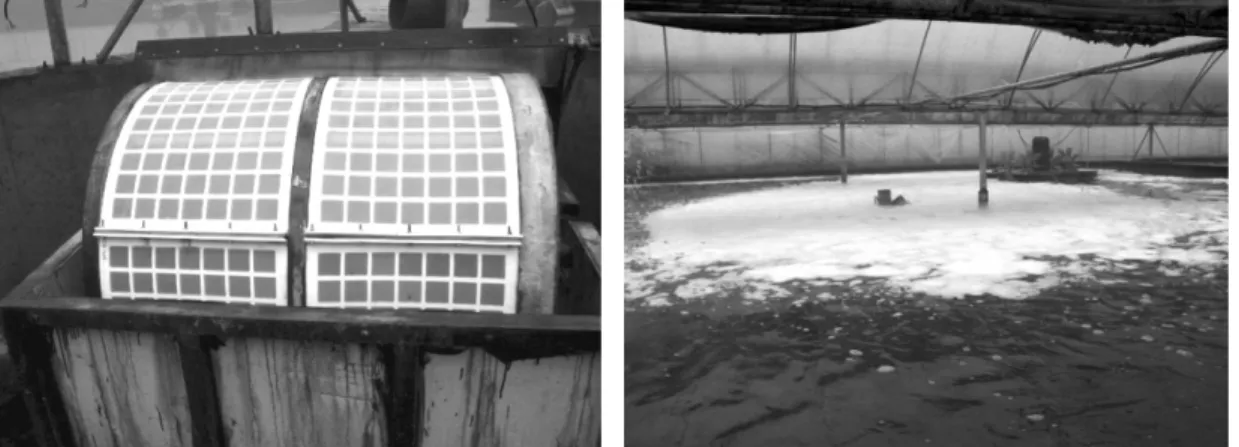
. Fig. 1
,
Fig. 1. A drum-shaped filter used for filtration of the culturing water (left) and many foams floating on the water surface of the pond where the disease occurred.
.
, 23 .
MS-222
(Hb) (Ht)
.
(Hawksley & Sons Ltd.) 5 Adams micro-hematocrit reader
(%) .
5 ml
25 30
540 nm
.
2 .
AFA (70% : : acetic acid = 20:1:1) .
.
. AFA
1 70%
. 70%
1
5 alum carmine (carmine 2 g, 5%
potassium alum 100 ml, thymol 1 g) 12 .
1% 70%
. 70%-80%-90%-
100% 10
mounting medium (Leica) .
(90 30
33 ) 50 nylon mesh
.
20
Lugol's iodine solu- tion
.
10%
Mayer hematoxylin &
eosin (H&E) PAS .
.
. Fig. 2
,
.
.
.
Fig.
3
.
. (opisthohaptor) 4
(clamp) .
(isthmus) .
2.38 , 0.71 ,
0.88 0.88 , 0.25
.
3.20 , 0.67 ,
1.10 0.92 , 0.2
4 .
Fig. 4
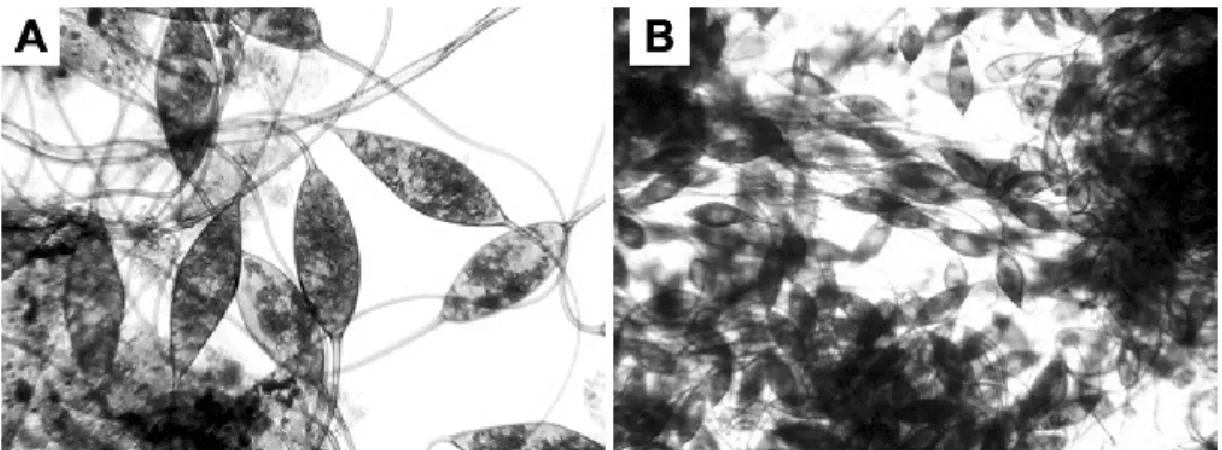
. 180-200
, 5-6
4-5
(string of beads) .
, Fig. 2. Gill of the diseased tiger puffer (Takifugu rubripes) cut off the operculum.
Fig. 3. Heterobothrium sp. attached to the gill filaments of the diseased tiger puffer. Note characteristic 4 pairs of clamps on the both sides of the opisthohaptor. A, wet mount; B, AFA fixation, alum carmine stain. Bars indicate 1 mm.
.
. (n=6) Ht
8% (4-11%) , Hb 1.13 g/100
(0.87-1.80 g/100 ) . (n=4)
Hb 4.32 g/100 ml (3.58-5.13 g/100 ml) .
Fig. 5 133 (120-
146 ), 75 (68-80
)
. 12 ,
14 .
6 : 4 .
(6 ) .
Fig. 5 .
, 2 . 2
. 2 . 2
1 1 2
, 2
,
body proper 2
. 1 1
2
. 2
.
(Fig. 6A).
, 2
Fig. 5. Oncomiracidium of Heterobothrium sp. mounted in a drop of Lugol's iodine solution. Bar indicates 50 .
Fig. 4. Eggs of Heterobothrium sp. taken from the sediment of an aquarium for acclimatization of diseased tiger puffer (A) and the drum-shaped filter in the culturing pond (B). Note the egg shape and threads used for linkage to adjacent egg shells and attachment to fish or other objects. Wet mount.
, 1 1
2 (Fig. 6. B-D).
2
(Fig. 6. C, E).
2
.
Neo- heterobothrium hirame (Anshary & Ogawa, 2001) Fig. 6. Microphotographs of gill of tiger puffer (Takifugu rubripes) infected with Heterobothrium. A, young parasites attached on the middle or distal parts of the secondary gill lamellae with a clamp; B, young parasites attached to the distal parts of the secondary gill lamellae with two clamps; C, a mature parasite attached to folded secondary gill lamellae; D. a mature parasite on the gill with each calm grasping one secondary lamella; E, gill filaments showing mild epithelial hyper- plasia and vacant capillaries in absence of the parasite; F, two young parasites between gill filaments showing hyperplasia of the epithelium and mucous cells. A to E, HE; F, PAS. Bars indicate 50 .
Torguigener pleurogramma
Heterobothrium elongatum (Williams &
Lethbridge, 1990)
2
2
. N. hirame
.
N. hirame (Anshary & Ogawa, 2001)
. N. hirame .
2
2 Anshary & Ogawa (2001)
N. hirame 2
. 2
,
.
pharengeal wall
,
. Fig. 7. A, four mature parasites around the pharenhgeal wall of pseudobranch; B, high magnification of A showing each par- asite grasping the adjacent parasites by means of the clamps; C, severe irregular hyperplasia and erosion of the epidermis; D, strongly PAS-positive mucous cells in the epithelia of the operculum. A-C, HE; D, PAS. Bars indicate 200 in A to C, and 100 in D.
(Fig. 7. A, B).
pharengeal wall
(Fig.
7C), PAS
(Fig. 7D).
.
,
.
Ogawa (1991) Hetero-
bothrium 1976
Bychowsky (Taki-
hugu alboplumbes) (Tak-
ifugu sp.)
Heterobothrium bychowskyi H. tetrodonis .
Heterobothrium
, (T. pardalis) H.
tetrodonis, H. okamotoi ,
(T. xanthopters) H. yamaguchi H. shi- nagawai
. H. tetrodonis (H. bychowskyi)
H. okamotoi , H.
yamaguchi H. shinagawai .
H. yamaguchi H.
shinagawai .
,
3
H. omkamotoi .
, Het-
Fig. 8. Four species of Heterobothrium found on the gill of puffer species. A, Heterobothirum tetrodonis; B, H. okamotoi; C, H. yamagutii; D, H. shinagawai. Bars indicate 3 mm in A and B, 2 mm in C and D. (Adapted from Ogawa, 1981)
erobothrium sp. H. yamaguchi .
15 9.1 ,
20 7.3 , 25 4.7
(Ogawa, 1998).
,
oncomiracidium ,
.
praziquantel caprylic
acid H.
okamoti
(Hirazawa et al., 2000),
.
.
1
4 Heterobothrium
sp. .
.
2.38 , 0.71
. 180-200 5-6
, 133 (120-146 )
75 (68-80 ) , 12-14
.
2 ,
2
,
1 1
2 .
.
.
.
W .
Chigasaki, M., Ogawa, K. and Wakabayashi, H.:
Standardized method for experimental infec- tion of tiger puffer, Takifugu rubripes with oncomiracidia of Heterobothrium okamotoi (Monogenea: Diclidopophoridae) with some data on the oncomiracidium biology. Fish Pathol., 35: 215-221, 2000.
Hiraza, N., Ohtake, T. and Hata, K.: Challenge trials on the anthelmintic effect of drugs and natural agents against the monogenean Het- erobothrium okamoti in the tiger puffer Tak- ifugu rubripes. Aquaculture, 188: 1-13, 2000.
Ogawa, K.: Egg hatching of the monogenean Het- erobothrium okamotoi, a gill parasite of cul- tured tiger puffer (Takifugu rubripes). with a description of its oncomiracidium. Fish Pathol., 33: 25-30, 1998.
Ogawa, K.: Integrated control-an example: Hetero-
bothrium of tiger puffer. Symposium (C) Parasitology International. 47 (suppl.): 85, 1998.
Ogawa, K.: Impacts of diclidophorid monogenean infections on fisheries in Japan. Intl. J. Para- sitol., 32: 373-380, 2002.
Ogawa, K. and Inouye, K.: Heterobothrium infec- tion of cultured tiger puffer (Takifugu rubripes)-A field observation. Fish Pathol., 31: 1-14, 1997.
Ogawa, K. and Yokoyama, H.: Parasitic diseases of cultured marine fish in Japan. Fish Pathol., 33: 303-309, 1998.
Wang, G., Kim, J. H., Sameshiam, M. and Ogawa, K.: Detection of antibodies against the
monogenean Heterobothrium okamotoi in tiger puffer by ELISA. Fish Pathol., 32: 179- 180, 1997.
Williams, A. and Lethbridge, R. C.: The subcuta- neous attachment of the monogenean Heter- obothrium elongatum (Diclidophoridae) in the gills of Torquigener pleurogramma (Pices: Tetraodontidae). Intl. Parasitol., 20:
769-777, 1990.
:
3: 17-27, 1963.
Manuscript Received : July 12, 2006 Revision Accepted : August 1, 2006 Responsible Editorial Member : Ki-Hong Kim (Pukyong Univ.)