Molecular Docking Affinity Comparison of Curcumin and Nano-micelled Curcumin with Natural Sea Salt on Transthyretin
Dong-Chan Kim1,2* and Pyo Song3
1Department of Biomedical Laboratory Science, Gimcheon University, Gimcheon 39528, Korea
2Institute of Heath Science Research, Gimcheon University, Gimcheon 39528, Korea
3Institute of Living Science, MY Co. Ltd., Sungnam 13202, Korea
Received January 19, 2016 /Revised February 4, 2016 /Accepted February 12, 2016
In this study, nano-micelled curcumin was produced with natural sea salt with a view to comparing the in silico molecular binding affinity of pure curcumin compound to the active site of transthyretin.
Using an optical light microscope and an electron microscope, it was found that the structure of the surface and the cross-section of nano-micelled curcumin was significantly different from natural sea salt. In particular, the crystal structure and nano-components in the nano-micelled curcumin were united, and the layer was more strongly stabilized than untreated salts. In the virtual 3D structure, in silico molecular docking study, the ligand binding affinity of nano-micelled curcumin to the trans- thyretin active site was found to be higher than that of pure curcumin. In addition, a nano-micelled curcumin formula interacted with more amino acid residues of transthyretin domains. The pharmaco- phore feature of the nano-micelled curcumin also showed more condensed and constrained features than normal curcumin. These results suggest that nano-micelled curcumin may effectively bind to and stabilize transthyretin, thereby regulating transthyretin-related physiological diseases. Collectively, the nano-micelled curcumin process suggests that normal curcumin can be modified more efficiently into the novel bio-functional chemical formula to stabilize the transthyretin structure. Therefore, the nano-micelled curcumin process can be applied to the field of the regulation of Alzheimer's disease.
Key words : Binding affinity, curcumin, in silico study, nano-micelling, transthyretin
*Corresponding author
*Tel : +82-10-4527-3736, Fax : +82-54-420-4461
*E-mail : [email protected]
This is an Open-Access article distributed under the terms of the Creative Commons Attribution Non-Commercial License (http://creativecommons.org/licenses/by-nc/3.0) which permits unrestricted non-commercial use, distribution, and reproduction in any medium, provided the original work is properly cited.
Journal of Life Science 2016 Vol. 26. No. 2. 253~258 DOI : http://dx.doi.org/10.5352/JLS.2016.26.2.253
서 론
트랜스티레틴(Transthyretin; TTR) 단백질은 3차원 구조에 서 베타 평면(beta-sheet) 구조를 이루고, 동일한 4개의 단량체 (14 kDa tetramer)로 구성된 전체 분자량 55 kDa(508 아미노 산)의 단백질이다[1, 19]. 우리 몸의 간(liver)과 뇌량(choroid plexus)에서 생성된 TTR은 각각 혈액과 뇌척수액(cerebrospi- nal fluid: CSF)으로 분비되며, L-티록신(T4) 및 레티놀(비타민 A)의 전달자 역할을 한다. TTR은 레티놀과 레티놀-결합 단백 질(retinol-binding protein; RPB) 복합체에 결합하여 안정화시 키고, 간으로부터 원하는 세포까지 레티놀을 운반하는 간접 운반자의 역할을 수행한다[26]. 또한 TTR은 알츠하이머병 (Alzheimer’s disease) 환자의 뇌 조직의 신경섬유뭉치(neuro- fibrillary tangle)와 초로성 반점(neurotic plaques)에서 발견되 며, 베타-아밀로이드에 결합하여 이의 섬유화를 차단한다[15].
TTR을 뇌의 해마(hippocampus)에서 과발현시킬 경우 알츠하 이머병-유사 신경퇴행(AD-like neurodegeneration)이 감소되 었고[17] TTR 유전자 발현을 증가시킴으로써 알츠하이머병의 발병 위험을 낮춘다는 사실도 보고 되었다[20].
울금(Curcuma Longa)의 주요 성분인 curcumin ((1E,6E)- 1,7-Bis(4-hydroxy-3-methoxyphenyl)-1,6-heptadiene-3,5-di- one)은 동서고금을 막론하고 질병 치료에 널리 활용된 생리 활성 물질이다[2, 16]. 2016년 1월 현재까지 Pubmed에서 검색 이 되는 curcumin 관련 연구 보고서는 8,503편, PMC (Pub- MedCentral) 에서는 12,450편에 이른다. 그만큼 curcumin에 약리학적, 의학적 효용성은 전세계적 관심을 받고 있다. Rao 등은 Curcumin이 베타-아미로이드에 결합하는 가능성을 제 시하였고[14], Pullakhandam 등은 curcumin이 TTR에 결합하 여 TTR단백질의 테트라머(tetramer)구조를 안정화 시킨다는 것을 최초 보고 하였으며[14], Ferreira 등은 curcumin 이 다른 polyphenol 성분들 보다 훨씬 강력하게 TTR 테트라머 구조를 안정화 시키고 TTR단량체(monomer)로의 분해를 억제하여 알츠하이머병을 유발하는 신경섬유뭉치 형성을 저해함을 증 명하였다[4].
그러나 curcumin의 약리적으로 활용되는데 가장 큰 장애는 바로 curcumin의 화학적 성질이 지닌 수용액에 대한 불용성 이다. 이러한 curcumin의 불용성를 해결하기 위한 다양한 시 - Note -
도가 있었으며 최근까지 484편의 보고서가 발표되었다. 특히 나노마이셀링(nano-micelling) 또는 나노포뮬레이션(nanofor- mulation) 방법으로 수용액에 대한 curcumin용해도를 현저히 증가시키고 항암 효능과 다양한 약리학적 기능을 개선시킨 연구들이 Zheng 또는 Yallapu 등에 의해 보고되었다[12, 25, 27]. 이러한 관점에서, 본 연구에서는 기존의 curcumin 나노포 뮬레이션 합성 방법[12]에 천일염(natural sea salt)을 추가한 나노마이셀링 기술을 적용하여[7-9, 18, 24], 수용액에 대한 curcumin의 용해도과 전기적 반응성을 높인 나노마이셀링 천 일염 결정 nano-micelled curcumin (NMC) 조성물을 구축하 여, TTR단백질의 curcumin 결합 부위에 대한 리간드 결합 친 화도(docking energy)와 pharmacophore 패턴을 비교 분석을 통한, NMC의 TTR 단량체 생성 억제 효능 및 알츠하이머병 치료제로의 활용 가능성을 확인하였다.
재료 및 방법
나노 마이셀링 염화 커큐민(NMC) 조성물 제조
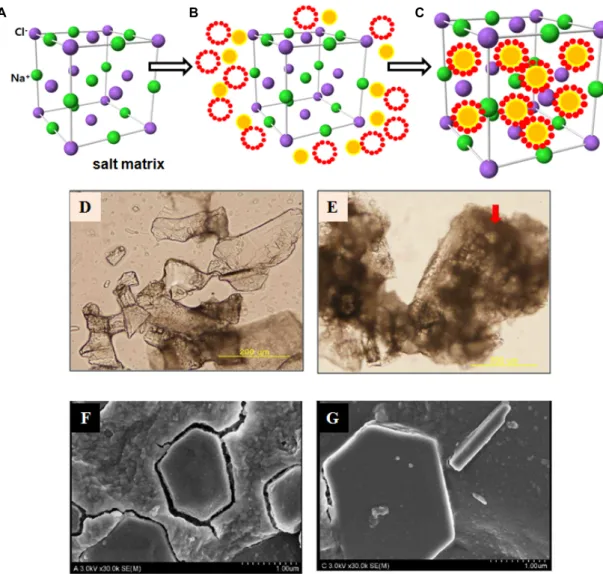
천일염은 전라남도 신안군 염전에서 생산된 천일염을 사용 하였다. 0.45 μm pore nitrocellulose 여과 필터(Millipore, USA)를 사용하여 유기용매(ethanol 또는 methanol)에 녹인 curcumin용액(100 mg/ml) 과 증류수에 녹인 천일염 용액(100 mg/ml)을 혼합 한 후, 나노마이셀링(nano-micelle) 시스템 (nanoformulation system)을 이용하여 nano-micelle formular (NMF) 용액 NX-NMF (NEURONX Inc. Korea)과 최종적으로 nano-fixation 시켰다. 나노 마이셀링 process는 선행 연구 방 법[7-9, 18, 24]에 따라 주식회사 NEURONEX에서 제공하는 nanoformulation시스템(NEUORNEX. Inc. Korea)을 사용하 였다. 간략하게 나노 마이셀링 시스템의 process를 기술하면, 천일염 용액 20 ml과 curcumin 용액 30 ml을 NMF 용액 150 ml과 혼합하여 최종 200 ml의 부피로 맞추고 5분간 vortex로 1차 혼합한 후 40,000 Hz의 주파수로 3분간 초음파 (Ultrasonic) 자극 후 2분 동안 마이셀링 입자 안정화 과정을 liposofast (Avestin, Canada) nano extruder를 활용하여 총 12회 반복하고, 80∼100 V, 60 mA로 15분간 전기 자극을 가한 후, 섭씨 900도~1,100도에서 25분~35분간 가열 후, 7시간 동안 nanoformulation시스템 공정기에 연결된 건조기로 진공 건조 시켰다. NMC 형성을 위한nano-micelling의 3가지 반응 step 은 Fig. 1(A)~Fig. 1(C)에 기술 된 모식도에 따라 진행되었다.
NMC의 현미경학적 관찰
일반 천일염과 NMC 결정은 광학현미경(BX41TF, Olym- pus, Japan)과 전계방사형 주사전자현미7경(FE-SEM, 모델명 S-4800) 을 이용하여 관찰하였다[22]. 특히 전자현미경 관찰의 경우 깨끗한 샘플을 SEM sample holder에 소량 덜어내어 살 짝 바른 후 전기 오븐에 넣어 약 45도에서 5~6시간 정도 건조
후 측정하였으며, 측정 전압은 3 kv의 저전압으로 샘플과 렌즈 사이의 거리(wd) 8mm로 측정을 하였다[6].
TTR에 대한 in silico molecular docking 분석
일반 curcumin과 NMC의 TTR 단백질 결합 부위에 대한 in silico molecular docking 비교 분석을 위해 사용한 software 는 기존 선행 연구의 방법을 바탕으로, 3D 구조 분석에 Autodock Vina (http://pyrx.sourceforge.net/home) [10, 21]
와 Discovery Studio 4.0 (DS4.0) version [11]을 활용하였다.
TTR의 3D 구조는 www.rcsb.org에 등록되어 있는 3D 구조 (PDB ID: 4PMF)를 활용하였다[3]. TTR에 결합하는 curcumin 의 X,Y,Z 좌표(Grid) 값은 DS 4.0에서 X=19.337, Y=42.037, Z=35.848 으로 확인되었으며 이 grid지수를 기준으로 curcu- min과 NMC의 TTR에 대한virtual affinity profiling에 적용하 였다. Curcumin의 화학구조는 Pubchem compound에서 제공 하는 3D 구조(Pubchem CID : 969516)를 활용하였으며 NMC 의 3D구조는 Accelrys Symyx Draw 4.0를 활용하였다. Virtual affinity profiling은 Autodock Vina PyRx software를 활용하 여 binding affinity를 분석하였으며, molecular dynamics 상 호 작용 분석 및 curcumin또는 NMC와 TTR 아미노산 residue 들과의 결합 visualization은 DS 4.0를 활용하였으며 각 do- main의 amino acid 번호는 DS 4.0 cell panel에 표기된 각 ami- no acid 번호로 표시하였다.
통계 처리
본 연구의 자료 분석은 SPSS (Statistical Package for the Social Science) WIN 18.0 프로그램 이용하였으며, 반복 분석 실험을 통하여 얻은 모든 측정값은 Mean ± SEM (Standard Error of Mean)으로 나타내었고, 분석된 실험 데이터는 t-test 를 실시하여 유의성을 검증하였으며 통계적 유의성 판정을 위한 유의 수준은 p<0.05로 하였다(*로 표시).
결과 및 고찰
일반 천일염과 NMC결정을 광학 현미경과 전자현미경으로 결정 구조를 비교 분석을 하였을 때, Fig. 1(D)과 1(F)의 일반천 일염에 비하여 Fig. 1(E)와 1(G)의 NMC 결정에 curcumin성분 이 효율적으로 침투된 것을 확인할 수 있었다. NMC결정구조 는 Yallapu 등이 기존에 제안한 curcumin나노포뮬레이션의 결정 구조와 높은 유사성을 나타냈다[24, 25].
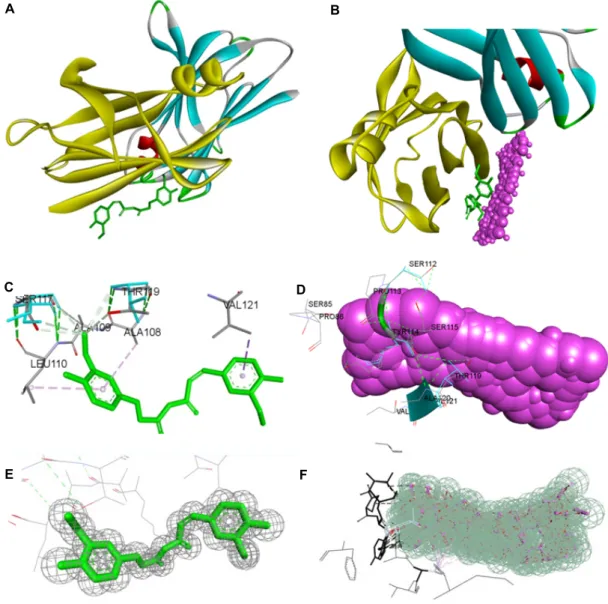
Curcumin과 NMC의 TTR에 대한 molecular docking을 진 행하였을 때, curcumin은 TTR domain A부위에 위치하는 ALA108, ALA109, LEU110, SER117, THR119과 TTR domain B 부위에 VAL121 총 6개의 아미노산과 상호작용을 하는 것으 로 분석되었다(Fig. 2A and 2C). Curcumin의 TTR 활성 부위 에 대한 molecular docking pattern은 총 9개의 결합 mode가
A B C
Fig. 1. Schematic diagram of the nano-micelling procedure to produce NMC (A) 1st step : crystal structure (salt matrix) of the natural sun dried sea salt. Green sphere represents sodium ion and purple sphere depicts chloride ion (B) Crystal structure of the intermediate step during NMC production. Curcumin compounds (yellow color) are located outside of the sodium chloride crystal. Red colored circles are nano-micelle formular (NMF) (C) Final step : Nanoformulated curcumin compounds are effectively penetrated into the salt matrix. NMC are successfully constructed via all three steps. Light microscopic picture of the normal natural sea salt (D) and nano micelling processed NMC (E). Red arrow means penetrated NMC curcumin compounds. Electron microscopic surface view of the normal natural sea salt (F) and NMC (G).
Table 1. Docking energy for the binding of the curcumin and NMC on the TTR active site
Ligand Best docking energy (kcal/mol)
Average docking energy (kcal/mol) Curcumin
NMC
-8.2 -14.4*
-7,82(n=9) -13.50(n=8) n=numbers of binding modes
*p<0.05 도출 되었으며 9개 결합 모드 가운데 최대 결합 친화도
(binding affinity) 정도를 나타내는 docking energy는 최대 -8.2 kcal/mol, 평균 -7.82 kcal/mol 로 확인되었다(Table 1).
반면, NMC는 TTR 단백질 domain A에 위치하는 LYS7, THR111, ALA112, VAL113, VAL115와 TTR domain B에 위치 하는 SER112, PRO113, TYR114, SER115, ALA120, PHE121총 11개의 아미노산과 상호작용을 하였다(Fig. 2B and 2D). NMC 의 TTR 대한 molecular docking pattern은 총 8개의 결합 mode가 도출 되었으며 8개 결합 모드 가운데 최대 결합 친화 도인 docking energy는 -14.4 kcal/mol, 평균 -13.50 kcal/mol 로서, NMC가 TTR 단백질의 curcumin결합 부위에 현저하게
우수한 결합 친화도를 나타내었다(Table 1). 또한 약리작용단 (pharmacophore) pattern을 비교했을 때, curcumin과 NMC
A B
C D
E F
Fig. 2. (A) 3D molecular binding pattern of curcumin compound (green color) into active site of the TTR (domain A, yellow color) (B) 3D molecular binding superimposed pattern of NMC (purple color) with curcumin (green color) into the TTR protein.(C) 3D molecular interacting pattern between curcumin and TTR amino acid residues. (D) 3D molecular interacting pattern between NMC and TTR amino acid residues. (E) 3D pharmacophore modeling pattern of the curcu- min on the TTR active site. (F) 3D pharmacophore modeling pattern of the NMC on the TTR active site.
의 약리작용단 모델의 모양과 TTR 결합 동일 grid에서 두 물 질의 분포 범위에 확연하게 차이가 나는 것으로 확인 되었다 (Fig. 2E and 2F). 다만, 본 연구의 결과는 분자모델링을 통한 시뮬레이션 결과이므로, 향후 Biacore 또는 fluorescence quenching을 사용하여 TTR과 NMC간의 결합 친화력과 NMC 의 구조적 안정성을 실제로 비교 측정하여 시뮬레이션 결과의 신뢰성을 추가적으로 확인 할 필요가 있다고 판단된다.
생리 활성 단일 성분을 소금에 혼합 또는 침투시키는 제조 기술은 단순히 식물성 성분을 분쇄 건조한 후 소금과 일정 비율로 혼합하여 제조하거나, 염수에 식물성 성분의 농축액을 혼합한 다음 이를 가열 및 건조하여 제조하는 방법으로 단순 한 물리적 혼합에 불과하였다. 따라서, 종래의 제조 방법으로
제조된 식물성 성분이 함유된 소금은 색상 및 질감과 성분에 있어서 전체적 및 부분적으로 균질하지 못하고, 식물성 성분 이 소금의 결정 내부에 충분히 침투되지 않아 소금과 쉽게 분리되며, 보관하는 기간이 경과함에 따라 불균질화가 심화되 어 상품화 및 안전성이 떨어지는 문제점이 있었다. 뿐만 아니 라 이러한 효능 성분이 효율적으로 천일염 결정에 안정화 되 고 장기간 보존이 되는 구조를 지닌 기능성 소금에 대한 학술 적 연구가 수행된 구체적인 사례도 없었다. 종래의 연구에서 초음파(Ultrasonic sound)를 기반으로 하여 특이적 합성 또는 생리 활성 효능을 지닌 약물을 micelle 제형으로 설계하여 특 정 부위로 송달하거나 생리 활성 물질을 원하는 표적 부위로 전달시키기 위해 표적 지향적 전달체를 사용해 비 특이적 분
포를 억제하여 비표적 부위를 보호하고 표적 부위로만 약물을 전달하는 nano micelle 구조 기반 전달체 개발이 활발히 진행 되고 있다[5, 23]. 난용성 curcumin의 약물 제형으로서의 효율 적 침투 및 전달을 위한 연구는 나노포뮬레이션 방법 뿐 아니 라 Kittitheeranun 등에 의해서 lipophilic curcumin을 poly- electrolyte multilayers에 적층하여 새로운 형태의 formular도 제안되었다[9]. 또한 본 연구에서 NMC 조성물 제조 process에 서 일반 정제염 보다 천일염을 사용하였을 때 NMC 조성물 형성 효율이 상대적으로 높게 나왔다. 이는 천일염에 포함 된 다양한 미네랄들이 NMC 조성물 형성 효율을 높이는 데 긍정 적 영향을 준 것이라 예상이 된다.
결론적으로, 본 연구에 제시된 천일염 첨가NMC 조성물 process를 통하여 인체 섭취가 가능한 원료를 바탕으로 약물 전달 정확성과 효율을 높일 수 있는 고효율 curcumin 나노포 뮬레이션 개발이 가능하였으며, 향후 curcumin과 유사한 난 용성 물질들은 수용액에서의 용해도를 개선할 수 있는 제형 개발법으로 다양하게 적용할 수 있을 것으로 판단된다. 또한 NMC가 TTR 단백질의 curcumin 결합 부위에 curcumin보다 훨씬 더 안정적으로 결합 할 수 있는 가능성을 확인함과 동시 에 NMC가 TTR 단백질 tetramer구조 안정성 향상을 통하여 알츠하이머병을 효율적으로 억제할 수 있는 효능 물질로도 활용 할 수 있는 것으로 사료된다.
감사의 글
본 연구는 김천대학교 교내 연구과제(과제번호 gc15028)로 수행되었습니다. 또한 nanoformulation 시스템을 활용할 수 있도록 협조해 주신 주식회사 NEURONEX 연구진 분들께도 감사를 드립니다.
References
1. Blake, C. C., Geisow, M. J., Oatley, S. J., Rerat, B. and Rerat, C. 1978. Structure of prealbumin: secondary, tertiary and quaternary interactions determined by Fourier refinement at 1.8 A. J. Mol. Biol. 121, 339-356.
2. Chen, J., He, Z. M., Wang, F. L., Zhang, Z. S., Liu, X. Z., Zhai, D. D. and Chen, W. D. 2015. Curcumin and its promise as an anticancer drug: An analysis of its anticancer and anti- fungal effects in cancer and associated complications from invasive fungal infections. Eur. J. Pharmacol. 772, 33-42.
3. Ciccone, L., Tepshi, L., Nencetti, S. and Stura, E. A. 2015.
Transthyretin complexes with curcumin and bromo-estra- diol: evaluation of solubilizing multicomponent mixtures.
N. Biotechnol. 32, 54-64.
4. Ferreira, N., Saraiva, M. J. and Almeida, M. R. 2011. Natural polyphenols inhibit different steps of the process of trans- thyretin (TTR) amyloid fibril formation. FEBS Lett. 585, 2424-2430.
5. Husseinil, G. A., Kherbeckl, L., Pitt, W. G., Hubbell, J. A.,
Christensen, D. A. and Velluto, D. 2015. Kinetics of ultra- sonic drug delivery from targeted micelles. J. Nanosci.
Nanotechnol. 15, 2099-2104.
6. Khanmohammadi, M., Elmizadeh, H. and Ghasemi, K. 2015.
Investigation of size and morphology of chitosan nano- particles used in drug delivery system employing chemo- metric technique. Iran. J. Pharm. Res. 14, 665-675.
7. Kim, D. C. and Lee, C. E. 2013. NXCL-4950, a novel compo- site applicable to peripheral skin, is capable of increasing skin temperature by enhancing capillary circulation. Clin.
Exp. Dermatol. 38, 244-250.
8. Kittitheeranun, P., Sanchavanakit, N., Sajomsang, W. and Dubas, S. T. 2010. Loading of curcumin in polyelectrolyte multilayers. Langmuir 26, 6869-6873.
9. Lu, Y. and Park, K. 2013. Polymeric micelles and alternative nanonized delivery vehicles for poorly soluble drugs. Int.
J. Pharm. 453, 198-214.
10. Masbuchin, A. N., Rohman, M. S., Putri, J. F., Cahyaning- tyas, M. and Widodo. 2015. 279(Val-->Phe) Polymorphism of lipoprotein-associated phospholipase A2 resulted in changes of folding kinetics and recognition to substrate.
Comput. Biol. Chem. 59 Pt A, 199-207.
11. Mohan, M., James, P., Valsalan, R. and Nazeem, P. A. 2015.
Molecular docking studies of phytochemicals from Phyllan- thus niruri against Hepatitis B DNA Polymerase. Bioinforma- tion 11, 426-431.
12. Naksuriya, O., Okonogi, S., Schiffelers, R. M. and Hennink, W. E. 2014. Curcumin nanoformulations: a review of phar- maceutical properties and preclinical studies and clinical da- ta related to cancer treatment. Biomaterials 35, 3365-3383.
13. Pullakhandam, R., Srinivas, P. N., Nair, M. K. and Reddy, G. B. 2009. Binding and stabilization of transthyretin by curcumin. Arch. Biochem. Biophys. 485, 115-119.
14. Rao, P. P., Mohamed, T., Teckwani, K. and Tin, G. 2015.
Curcumin Binding to Beta Amyloid: A Computational Study. Chem. Biol. Drug. Des. 86, 813-820.
15. Saelices, L., Johnson, L. M., Liang, W. Y., Sawaya, M. R., Cascio, D., Ruchala, P., Whitelegge, J., Jiang, L., Riek, R. and Eisenberg, D. S. 2015. Uncovering the Mechanism of Aggre- gation of Human Transthyretin. J. Biol. Chem. 290, 28932- 28943.
16. Sordillo, L. A., Sordillo, P. P. and Helson, L. 2015. Curcumin for the Treatment of Glioblastoma. Anticancer. Res. 35, 6373- 6378.
17. Stein, T. D., Anders, N. J., DeCarli, C., Chan, S. L., Mattson, M. P. and Johnson, J. A. 2004. Neutralization of transthyretin reverses the neuroprotective effects of secreted amyloid pre- cursor protein (APP) in APPSW mice resulting in tau phos- phorylation and loss of hippocampal neurons: support for the amyloid hypothesis. J. Neurosci. 24, 7707-7717.
18. Suh, W. H., Suslick, K. S., Stucky, G. D. and Suh, Y. H.
2009. Nanotechnology, nanotoxicology, and neuroscience.
Prog. Neurobiol. 87, 133-170.
19. Sunde, M., Richardson, S. J., Chang, L., Pettersson, T. M., Schreiber, G. and Blake, C. C. 1996. The crystal structure of transthyretin from chicken. Eur. J. Biochem. 236, 491-499.
초록:울금의 주요 성분인 커큐민과 나노 마이셀링 기법 적용 염화 커큐민의 트랜스타이레틴 활성 부위 에 대한 결합 친화도 비교분석
김동찬1,2*․송 표3
(1김천대학교 임상병리학과, 2김천대학교 보건과학연구소, 3주식회사 엠와이 생활과학연구소)
본 연구에서는 울금의 주요 성분인 커큐민과 나노 마이셀링 기법을 적용한 신규 조성물인 염화 커큐민(NMC) 의 트랜스타이레틴(TTR) 단백질 활성 부위에 대한 in silico 분자 결합 친화도를 비교 분석하였다. 우선 NMC신규 조성물의 결정학적 구조를 광학 및 전자현미경을 활용하여 관찰하였을 때, 나노 마이셀링 적용 NMC 결정은 일반 천일염에 비하여 색상 및 질감이 전체적으로 균일화 되었고, 천일염과 NMC성분이 강하게 일체화되어 기간이 상당히 경과 되더라도 쉽게 분리가 되지 않는 고기능성 안전성 구조물이 형성되었다. TTR단백질의 3차원 구조 활성 부위에 대한 in silico 분자 결합 친화도는 NMC가 일반 커큐민에 비하여 상대적으로 높은 결합 친화도를 나타나었고, pharmacophore 모델링 분석에서도 NMC가 일반 커큐민에 비하여 TTR 활성 부위에서 현저하게 pharmacophore 각도의 차이가 나타났었으며 패턴 또한 밀집된 특징을 나타내었다. 결론적으로, 나노 마이셀링 적용 NMC가 일반 커큐민에 비하여 상대적으로 우수하게 TTR 단백질의 활성 부위에 결합하는 것을 확인하였고, 이는 TTR 활성에 의해 유도되는 질병 조절 물질로의 적용 가능성이 있다고 판단된다. 결론적으로 일반 커큐민과 같은 생리 활성 효능 성분에 나노 마이셀링 기법을 적용하므로서 효율적인 결합 타깃 단백질 활발 조절 및 이러한 성분을 활용한 기능성 식품 산업에 나노 마이셀링 기법을 효율적으로 적용할 수 있음을 확인하였다.
20. Tang, Y. P., Haslam, S. Z., Conrad, S. E. and Sisk, C. L.
2004. Estrogen increases brain expression of the mRNA en- coding transthyretin, an amyloid beta scavenger protein. J.
Alzheimers. Dis. 6, 413-420.
21. Trott, O. and Olson, A. J. 2010. AutoDock Vina: improving the speed and accuracy of docking with a new scoring func- tion, efficient optimization, and multithreading. J. Comput.
Chem. 31, 455-461.
22. Turnbull, E. R., Kaunda, K., Harris, J. B., Kapata, N., Muvwimi, M. W., Kruuner, A., Henostroza, G. and Reid, S. E. 2011. An evaluation of the performance and accept- ability of three LED fluorescent microscopes in Zambia: les- sons learnt for scale-up. PLoS. One. 6, e27125.
23. Xia, H., Zhao, Y. and Tong, R. 2016. Ultrasound-mediated polymeric micelle drug delivery. Adv. Exp. Med. Biol. 880, 365-384.
24. Yallapu, M. M., Ebeling, M. C., Chauhan, N., Jaggi, M. and Chauhan, S. C. 2011. Interaction of curcumin nano- formulations with human plasma proteins and erythrocytes.
Int. J. Nanomedicine 6, 2779-2790.
25. Yallapu, M. M., Nagesh, P. K., Jaggi, M. and Chauhan, S.
C. 2015. Therapeutic applications of curcumin nano- formulations. AAPS J. 17, 1341-1356.
26. Zheng, W., Lu, Y. M., Lu, G. Y., Zhao, Q., Cheung, O. and Blaner, W. S. 2001. Transthyretin, thyroxine, and reti- nol-binding protein in human cerebrospinal fluid: effect of lead exposure. Toxicol. Sci. 61, 107-114.
27. Zheng, Z., Sun, Y., Liu, Z., Zhang, M., Li, C. and Cai, H.
2015. The effect of curcumin and its nanoformulation on adjuvant-induced arthritis in rats. Drug. Des. Devel. Ther. 9, 4931-4942.