Plant Biomass Degradation and Bioethanol Production Using Hyperthermophilic Bacterium Caldicellulosiruptor bescii
Han-Seung Lee1,2*
1Department of Food Biotechnology, College of Medical and Life Sciences, Silla University, Busan 617-736, Korea
2Research Center for Extremophile and Marine Microbiology, Silla University, Busan 617-736, Korea
Received November 19, 2015 /Revised December 22, 2015 /Accepted December 28, 2015
To overcome the depletion of fossil fuels and environmental problems in future, the research and pro- duction of biofuels have attracted attention largely. Thermophilic microorganisms produce effective and robust enzymes which can hydrolyze plant biomass and survive under harsh bioprocessing conditions. Caldicellulosiruptor bescii, which can degrade unpretreated plants and grow on them, is the one of the best candidates for consolidated bioprocessing (CBP). C. bescii can hydrolyze pectin effi- ciently as well as the major plant cell wall components, cellulose and hemicelluloses. Many glycosyl hydrolases and carbohydrate lyases with multidomain structure play an important role in plant bio- mass decomposition. Recently genetic tools for metabolic engineering of C. bescii have developed and bioethanol production from unpretreated biomass is achieved in C. bescii. Here, we review the recent studies for biomass degradation by C. bescii and bioethanol production in C. bescii in order to provide information about metabolic engineering of themophilic bacteria and biofuel development.
Key words : Bioethanol, Caldicellulosiruptor bescii, consolidated bioprocessing (CBP), pectin, plant biomass
*Corresponding author
*Tel : +82-51-999-6308, Fax : +82-51-999-5176
*E-mail : [email protected]
This is an Open-Access article distributed under the terms of the Creative Commons Attribution Non-Commercial License (http://creativecommons.org/licenses/by-nc/3.0) which permits unrestricted non-commercial use, distribution, and reproduction in any medium, provided the original work is properly cited.
Journal of Life Science 2015 Vol. 25. No. 12. 1450~1457 DOI : http://dx.doi.org/10.5352/JLS.2015.25.12.1450
서 론
머지 않은 미래에 닥칠 화석 연료 고갈과 화석 연료 사용에 따른 온실 효과 등의 심각한 환경 문제를 경감하기 위하여 재생에너지로서의 바이오연료(biofuel)에 대한 관심은 날로 증가하고 있다. 일반적으로 바이오연료는 다양한 바이오매스 를 이용하여 생물학적 처리 과정을 통해 얻는 연료를 뜻하는 데 바이오에탄올(bioethanol)이나 바이오부탄올(biobutha- nol) 등의 알코올류, 바이오디젤(biodiesel), 바이오수소(bio- hydrogen), 메탄 가스 등을 포함한다[20]. 그 중에서 가장 활발 한 연구가 진행되고 있으며 실제 산업적으로 사용하고 있는 바이오연료는 바이오에탄올인데, 인류는 오랜 옛날부터 효모 를 이용하여 알코올 발효를 통해 술을 만들어 왔기에 옥수수 나 사탕수수 등을 원료로 사용하여 손쉽게 바이오에탄올을 생산할 수 있었다.
하지만 바이오에탄올의 원료로 사용하는 옥수수나 사탕수 수의 양이 지속적으로 증가함에 따라 세계적인 곡물 가격 상 승의 문제가 발생하게 되었고 좀 더 값싼 비식량자원 바이오
매스로부터 바이오에탄올을 생산하는 기술이 요구되었다[29].
셀룰로스(cellulose)와 해조류는 비식량자원 바이오매스의 대 표로서 현재 활발한 연구가 진행 중에 있는데 우리나라와 일 본 등 아시아권 연구진들은 해조류나 미세조류의 바이오매스 를 이용한 바이오연료 개발에 더욱 역점을 두고 있는 반면[26], 미국을 중심으로한 연구진들은 비식용 식물성 바이오매스를 이용하려는 다각적인 시도를 하고 있다. 미국 에너지부 (Department of Energy: DOE)는 바이오연료의 생산과 이에 필요한 기초 원천 기술 개발을 위해, 2007년 다양한 연구자들 의 컨소시엄으로 3개의 연구센터, Bioenergy Science Center (BESC), Joint Bioenergy Institute (JBEI), Great Lakes Bioener- gy Research Center (GLBRC)를 개소한 바 있다[39]. 이들 연구 센터들은 유전자 변형 및 품종 개량을 통한 분해하기 쉬운 작물의 개발, 고효율 효소의 개발, 대사공학을 통한 고효율 발효균주의 개발 등에 힘써 왔는데 최근 가장 활발한 연구 성과를 내고 큰 주목을 받는 것이 초고온성 극한미생물 Caldicellulosiruptor bescii을 이용한 식물성 바이오매스의 분해 와 바이오연료의 생산이다.
옥수수와 같은 전분질이나 사탕수수의 설탕(sucrose) 등은 미생물이 분해하기 쉬우므로 발효가 간단하고 쉽지만 식물성 바이오매스는 구조가 복잡하고 단단하여 생물학적 처리방법 에 대한 저항성(recalcitrance)을 갖고 있기 때문에[25] 화학적 전처리가 필요하며, 당화와 알코올 발효까지 세가지 단계를 거쳐야 한다. 그런데 최근 C. bescii의 유전공학적 기법들이 개 발됨에 따라 이 세 단계를 통합할 수 있는 통합바이오공정 - Review -
(consolidated bioprocessing; CBP)이 큰 주목을 받고 있다[12].
따라서 본 총설에서는 초고온성 세균인 C. bescii를 이용한 식 물성 바이오매스의 분해와 바이오에탄올의 생산에 대한 최신 연구결과를 소개하고 향후 전망에 대해 논해보고자 한다.
본 론
식물성 바이오매스와 고온성 극한미생물
나무나 풀을 구성하는 비식용 식물성 바이오매스는 1세대 바이오에탄올의 원료인 옥수수나 사탕수수와 달리 그 구조가 매우 견고하고 복잡하다. 식물성 바이오매스를 구성하는 3대 주요 성분은 셀룰로스, 헤미셀룰로스(hemicelluloses), 리그닌 (lignin)인데 각각의 식물종에 따라 그 구성비가 상당히 다르 다[32]. 일반적으로 식물성 바이오매스에서 가장 풍부한 성분 이자 상대적으로 단순한 구조를 이루고 있는 물질은 포도당의 β-1,4-결합물질인 셀룰로스인데 단단한 결정을 이루고 있기 때문에 그 구조를 화학적 처리로 무너뜨리지 않고서는 cellu- lase에 의해 쉽게 분해되지 않는다. 헤미셀룰로스는 자일로스, 갈락토스, 아라비노스 등의 다양한 당으로 구성된 이형다당 (heteropolysaccharides)이기 때문에 한두 개의 효소로 완전한 분해가 어렵고 다양한 효소들의 복합작용을 이용한 당화가 필요하다. 그리고 지용성 페놀고분자인 리그닌은 일반적으로 에탄올 발효에 방해가 되기 때문에 화학적 전처리 과정을 통 해 제거해야 하는데 생물학적 방법으로는 그 분해가 어렵고 비용을 증가시키는 원인이 되는 물질이다[10]. 이외에도 식물 에서 구조적으로 중요한 역할을 하는 성분은 펙틴(pectin)인데 전체 바이오매스 성분 중의 함량은 10% 이내로 적지만 식물 세포벽과 세포벽 사이의 라멜라층에 주로 분포하면서 세포들 을 연결시켜주는 역할을 하는 것으로 알려져 있다[34].
이렇듯 식물성 바이오매스는 다양한 성분이 견고한 구조를 이루어 생물학적 처리 방법에 저항성(recalcitrance)를 갖고 있 기 때문에 당화와 알코올 발효 이전에 전처리(pretreatment) 과정이 부가적으로 필요하다. 일반적으로 전처리 과정은 열 처리와 화학적 처리를 동시에 진행하는데 산, 알칼리, 유기용 매 등이 사용되며[44] 바이오연료 생산 과정 중에서 가장 비용 이 많이 들고 환경에 유해한 폐기물들이 생산되는 공정이다.
따라서 식물 유전학자들은 리그닌 합성을 억제하거나 세포벽 의 구조를 느슨하게 만드는 유전자변형(Genetically modified;
GM) 작물을 개발하여 수율을 높이고자 다양한 방법으로 노력 하고 있다[10, 32].
하지만 최근 고온성 극한미생물을 이용하여 전처리 없이 효과적으로 리그노셀룰로스로부터 바이오연료를 생산할 수 있을 것으로 기대를 모으고 있다[5]. 호열성 세균들은 강력하 고 효과적인 다당류 분해효소를 생산하며 가혹한 바이오프로 세스 과정 중에도 견디는 높은 안정성을 보인다. 또한 고온 조건은 오염의 가능성이 적고 탄수화물의 용해도가 높아지며
생산된 알코올 회수가 용이한 장점이 있기 때문에[5] 셀룰로스 분해능이 있는 호열성 세균에 대한 연구가 주목을 받아 왔다.
그 중에서 최근 가장 큰 주목을 받는 균주는 Clostridium ther- mocellum과 Caldicellulosiruptor bescii인데 C. thermocellum은 최 적 생육 온도가 55에서 60°C 정도이고 cellulosome이라는 단 백질 복합체를 통해 셀룰로스를 효과적으로 분해하지만[2] 자 일로올리고당 transporter가 없다는 단점이 있다. 반면 C. bes- cii는 최적 생육 온도가 80에 가까운 초고온균으로서 다양한 multidomain 효소들을 분비하고 5탄당과 6탄당을 모두 영양 원으로 사용하며 최근 genetic system이 개발되어 많은 대사 공학적 연구가 진행되고 있는 실정이다[14, 42].
Caldicellulosiruptor bescii를 이용한 바이오매스의 효과 적인 분해
Caldicellulosiruptor bescii는 1990년 러시아 캄차카 반도의 게 이저(Geysers) 계곡에 있는 온천에서 처음 분리되었고 처음엔 Anaerocellum thermophilum이라고 명명되었으나 후에 C. bescii 로 재분류된 그램 양성 호열성 세균이다[42]. C. bescii의 생육 가능한 온도 범위는 42-90°C까지이고 생육 최적 온도는 78-80°C로 초호열성의 경계에 있으며 glucose, fructose, gal- actose, arabinose, cellobiose, lactose, maltose, mannose, me- libiose, rhamnose, cyclodextrin, xylan 등의 다양한 당류 뿐만 아니라 결정형 셀룰로스(Avicel and sigmacell-20), filter pa- per (Whatman), xylan (beechwood, birchwood, and oat spelts), pectin 등 다양한 식물성 바이오매스 성분까지 이용할 수 있는 능력을 가지고 있다. 하지만 바이오연료 생산에 있어 서 C. bescii가 주목을 받는 가장 큰 이유는 전처리하지 않은 바이오매스를 분해하면서 생육이 가능하기 때문인데 Yang 등 [41]은 전처리하지 않은 poplar (Populus)와 switchgrass (Panicum virgatum)에서 C. bescii가 바이오매스를 분해하며 생 육하는 것을 확인하였다. 목본류(wood)인 poplar와 초본류 (grass)인 switchgrass는 성장 속도가 빠르고 단위 경작 면적당 바이오매스 생산량이 뛰어나 현재 미국에서 바이오연료의 원 료로 가장 주목을 받는 식물들이다[1].
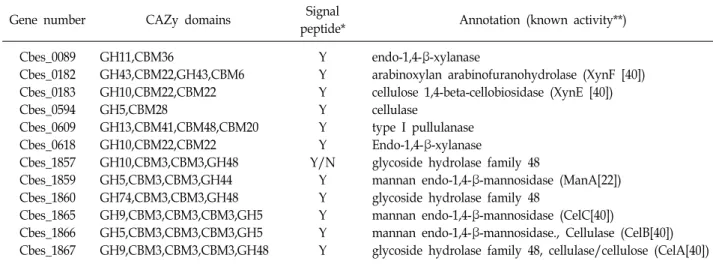
Caldicellulosiruptor bescii가 효과적으로 전처리하지 않은 식 물성 바이오매스를 분해할 수 있는 이유는 다양하고 독특한 분해효소들을 갖고 있기 때문인데 C. bescii의 genome se- quencing 결과에 따르면 C. bescii에는 무려 92개의 carbohy- drate-active enzyme (CAZy) 유전자를 갖고 있으며 이중 탄수 화물 가수분해효소(glycosyl hydrolase)가 53종, 탄수화물 전 이효소(transferase)가 29종, 탄수화물 에스테르화효소 (esterase) 5종, 탄수화물 분해효소(lyase) 3종이며, binding module만 갖고 있는 유전자도 2종이 있다[28]. 다른 미생물 유래 효소와 달리 C. bescii 유래 세포외 효소들(S-layer or ex- tracellular enzymes)의 매우 독특한 특징은 이 효소들의 mul- ti-domain 구조이다(Table 1). 특히 결정형 셀룰로스에서 키웠
Table 1. Extracellular glycosyl hydrolases with multiple domains
Gene number CAZy domains Signal
peptide* Annotation (known activity**)
Cbes_0089 Cbes_0182 Cbes_0183 Cbes_0594 Cbes_0609 Cbes_0618 Cbes_1857 Cbes_1859 Cbes_1860 Cbes_1865 Cbes_1866 Cbes_1867
GH11,CBM36
GH43,CBM22,GH43,CBM6 GH10,CBM22,CBM22 GH5,CBM28
GH13,CBM41,CBM48,CBM20 GH10,CBM22,CBM22 GH10,CBM3,CBM3,GH48 GH5,CBM3,CBM3,GH44 GH74,CBM3,CBM3,GH48 GH9,CBM3,CBM3,CBM3,GH5 GH5,CBM3,CBM3,CBM3,GH5 GH9,CBM3,CBM3,CBM3,GH48
Y Y Y Y Y Y Y/N
Y Y Y Y Y
endo-1,4-β-xylanase
arabinoxylan arabinofuranohydrolase (XynF [40]) cellulose 1,4-beta-cellobiosidase (XynE [40]) cellulase
type I pullulanase Endo-1,4-β-xylanase
glycoside hydrolase family 48
mannan endo-1,4-β-mannosidase (ManA[22]) glycoside hydrolase family 48
mannan endo-1,4-β-mannosidase (CelC[40])
mannan endo-1,4-β-mannosidase., Cellulase (CelB[40]) glycoside hydrolase family 48, cellulase/cellulose (CelA[40])
*Signal peptide analysis is the result from SignalP program [35]. Y means yes (there is a signal peptide) and N means no (there is not signal peptide). Y/N means that it is not enough to decide whether signal peptide exist or not.
**Known activity means the confirmed enzyme activity of the enzyme or orthologs in other Caldicellulosiruptor strains.
을 때 가장 많이 분비되는 중요 cellulase인 CelA의 경우엔 다섯개의 도메인으로 구성되어 있는데 glycosyl hydrolase family 9 (GH9)와 48 (GH48)의 활성 도메인이 각각 N-말단과 C-말단에 존재하며 그 사이에 type III cellulose-binding mod- ules (CBM3) 3개가 반복적으로 연결되어 있다[19]. 이러한 CelA의 구조는 결정형 셀룰로스의 분해에 매우 효과적이며 현재 상업적으로 바이오매스를 당화시키는데 이용되는 Trichoderma reesei 유래의 Cel7A exoglucanase와 Acidothermus cellulolyticus 유래의 Cel5A endoglucanase의 혼합물보다 Avicel에 대한 활성이 7배나 뛰어나다[7]. 이렇게 CelA가 효과 적으로 결정형 셀룰로스를 분해할 수 있는 이유는 3개의 bind- ing domain (CBM3)들을 이용하여 셀룰로스에 결합한 후 두 개의 활성 도메인(GH9과 GH48)가 셀룰로스에 구멍(cavity)을 내는 방식으로 셀룰로스를 분해하기 때문인 것으로 확인되었 다[7]. C. bescii에 의한 식물성 바이오매스의 분해에는 CelA (Cbes_1867) 이외에도 다양한 효소들이 함께 작용하는 것으로 추정되는데 Dam 등[19]은 마이크로어레이와 프로테오믹스 기법을 이용하여 up- regulated 유전자들과 단백질을 분석하 였다. 그 결과 Cbes_ 0182, Cbes_0183, Cbes_0618 등의 xylan 분해 효소들, xyloglucanase cluster의 효소들(Cbes_1857, Cbes_1859, Cbes_1860), 셀룰로스 분해효소인 Cbes_1865 (CelC)와 Cbes_1867 (CelA) 등이 복합적으로 작용할 것으로 추정하였고 이들의 역할에 대한 대사공학적 연구가 진행되고 있다.
식물성 바이오매스 분해에서 펙틴 분해의 중요성
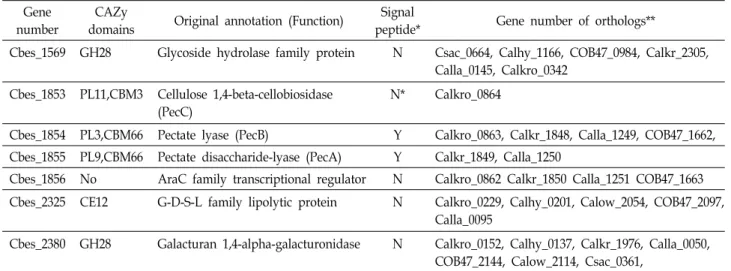
Table 2에서 보듯이 Caldicellulosiruptor bescii의 genome에 는 펙틴 분해효소 유전자가 5개 이상 있을 것으로 추정되며 그 중 3개는 하나의 cluster를 이루고 있었는데[6] tran-
scriptomics data로부터 얻은 가장 의외의 결과는 가장 높이 up-regulated된 유전자들이 펙틴을 분해 관련 cluster의 유전 자들(Cbes_1853, Cbes_1854, Cbes_1855)이었다는 것이다[27].
이들 유전자 서열로부터 유추한 단백질은 모두 pectate lyase (PL) domain과 carbohydrate binding module (CBM)을 하나 씩 가지고 있었는데 특히 PecB (CMB66-PL3)는 탄소원으로 포도당을 주었을 때와 비교해서 switchgrass에서 생육시켰을 때 51-fold가, PecA (CBM66-PL9)는 27.9-fold가 up-regulation 되었다. 이들 두 효소는 N-말단에 signal peptide를 갖는 것으 로 추정되어 세포외 단백질로 추정되며 이들 효소에 의해 분 해된 oligogalacturonate들을 세포내에서 대사할 것으로 추정 되는 Rhamnogallacturonan lyase PecC (PL11-CBM3)도 포도 당 배지에서보다 switchgrass에서 생육시켰을 때 9.6-fold나 up-regulation되었다.
식물 세포 사이의 접착제 역할을 하는 펙틴은 식물성 바이 오매스에서 상대적으로 비중이 낮은 구성물이고 결정을 형성 하지도 않는 유연한 구조물이기 때문에 과거 바이오매스 연구 자들이 크게 주목하지 않았던 물질이었다. 하지만 펙틴의 분 해가 식물성 바이오매스 분해에 중요한 역할을 한다는 것이 점차 밝혀지고 있으며[4] 유전자 조작을 통해 펙틴의 구성 성 분인 homogalacturonan의 methyl기를 제거한 Arabidopsis는 바이오매스 당화에 더욱 효과적이라는 보고[30]가 있었다.
Caldicellulosiruptor 속의 균주들은 대부분 pectin 분해 관련 효소를 하나 이상 갖고 있지만 지금까지 complete genome sequencing이 끝난 Caldicellulosiruptor 8균주 중에 위의 펙틴 클러스터 속 3가지 pectin 분해 효소(PecABC) ortholog들을 모두 갖고 있는 균주는 하나도 없고 C. kronotskyensis, C. krist- janssonii, C. lactoaceticus는 2개의 ortholog만 갖고 있다 (Table 2). 펙틴은 rhamnogalactouronan I 과 II (RG-I와 RG-II), xylo-
Table 2. Genes possively involved in pectin degradation Gene
number
CAZy
domains Original annotation (Function) Signal
peptide* Gene number of orthologs**
Cbes_1569 GH28 Glycoside hydrolase family protein N Csac_0664, Calhy_1166, COB47_0984, Calkr_2305, Calla_0145, Calkro_0342
Cbes_1853 PL11,CBM3 Cellulose 1,4-beta-cellobiosidase (PecC)
N* Calkro_0864
Cbes_1854 PL3,CBM66 Pectate lyase (PecB) Y Calkro_0863, Calkr_1848, Calla_1249, COB47_1662, Cbes_1855 PL9,CBM66 Pectate disaccharide-lyase (PecA) Y Calkr_1849, Calla_1250
Cbes_1856 No AraC family transcriptional regulator N Calkro_0862 Calkr_1850 Calla_1251 COB47_1663 Cbes_2325 CE12 G-D-S-L family lipolytic protein N Calkro_0229, Calhy_0201, Calow_2054, COB47_2097,
Calla_0095
Cbes_2380 GH28 Galacturan 1,4-alpha-galacturonidase N Calkro_0152, Calhy_0137, Calkr_1976, Calla_0050, COB47_2144, Calow_2114, Csac_0361,
*Signal peptide analysis is the result from SignalP program [29]. Y means yes (there is a signal peptide) and N means no (there is not signal peptide).
**Gene umber denotes Celdicellulosiruptor strains as below. Csac, C. saccharolyticus; Calhy, C. hydrothermalis; COB47, C. obsidiansis;
Calkr, C. kristjanssonii; Calla, C. lactoaceticus; Calkro, C. kronotskyensis; Calow, C. owensensis.
galactouronan (XGA), homogalacturonan (HG) 등의 복잡한 구조를 갖는 이형다당류이므로[34] 펙틴의 효과적 분해를 위 해서도 역시 다양한 기질 특이성을 갖는 효소들의 복합적 작 용이 필요할 것으로 생각되는 바, C. bescii가 전처리 하지 않은 식물성 바이오매스를 효과적으로 분해하는 데에는 이러한 다 양한 펙틴분해효소들의 작용이 더 효율적일 것으로 추정되며 genetic tool을 이용한 pectin 분해 효소의 역할 연구가 진행되 고 있다.
Caldicellulosiruptor bescii의 genetic tool 개발과 metabolic engineering
고온성 극한미생물의 연구에 있어서 가장 어려운 점은 대사 공학을 위한 genetic tool이 거의 없다는 점이다. 일반적으로 genetic tool을 개발하기 위해서는 Restriction-Modification (RM) 시스템의 극복, replication origin을 포함한 셔틀 벡터의 구축, 형질전환 방법의 확립, selection marker의 선정의 과정 을 거쳐야 하며 이를 통해 유전자의 deletion이나 insertion이 가능해야 한다. 지금까지 고온성 고균(archaea)의 경우는 nat- ural competency가 있는 균주의 발견[31]과 3-hydroxy-3- methylglutaryl coenzyme A (HMG-CoA) reductase 저해제인 simvastatin을 이용한 선별법이 개발[37]되어 대사공학적 연 구가 활발하게 진행되고 있으나 고온성 세균의 경우는 meval- onate pathway가 없는 관계로 simvastatin을 사용할 수 없고 마땅한 항생제 내성 유전자도 없다. 물론 몇몇 Thermotoga 등 고온성 세균에서 genetic tool이 개발되었다는 보고[23, 24]가 과거 있었으나 가능성의 수준에서 그쳤고 활발한 연구가 진행 되지 않고 있는 실정이다. 하지만 최근 C. bescii의 genetic tool 이 개발되면서 현재 가장 활발하게 C. bescii의 대사 공학적
연구가 진행되고 있다.
일반적으로 genetic tool을 개발하기 위해서는 selection marker의 선정이 선행되어야 하는데 특정 유전자 결실 균주 (auxotroph)를 이용하거나 항생제 내성 유전자를 이용하는 방 법으로 나뉜다. 고온에서 안정하며 활성이 있다고 알려진 항 생제 내성 유전자가 보고[33]된 적은 있지만 C. bescii의 생육 온도에서는 배양 시간에 따라 artifact colony가 많이 생겨 실 제로 사용할 수 없었기 때문에 C. bescii의 경우엔 특정 대사 유전자를 결손시킨 후 complementation 시키는 nutritional selection 방법이 시도되었다. 현재까지 가장 많이 알려졌고 고온성 고균에서 검증된 nutritional selection 방법은 피리미 딘 생합성 경로에 관여하는 orotidine 5-phosphate de- carboxylase (pyrF) 결실 균주를 이용하여 uracyl auxotroph로 서의 성질과 5-fluoroorotic acid (5-FOA) 저항성을 동시에 이 용하는 선별법이다[38]. 따라서 orotate phosphoribosyl- transferase (pyrE) 또는 pyrF가 결실된 uracil auxotroph를 만 들기 위하여 casein과 yeast extract를 뺀 modified DSMZ 516 배지에 temperature shock을 주어 mutation stress를 준 후 uracil이 포함된 minimal 배지에 5-fluoroorotic acid (5-FOA) 를 농도별로 첨가하여 자라는 콜로니로부터 genomic DNA를 분리하여 pyrE 또는 pyrF가 결손된 균주를 탐색한 결과 pyrB (Cbes1375)의 N-말단부터 pyrF (Cbes1377)의 C-말단까지 결 실된 C. bescii JWCB002 (ΔpyrBCF) 균주를 얻었다[13]. 이 후 uracil이 없는 최소배지(low osmolarity defined growth me- dium, LOD) 조성을 확립하였고[21] 좀 더 selection이 용이한 ΔpyrFA 균주인 C. bescii JWCB005를 확보하여[11] 형질전환 host로 사용하였다.
대장균와 C. bescii에서 복제 가능한 셔틀 벡터를 만들기 위
해 C. bescii가 갖고 있는 두 개의 플라스미드[18] 중 크기가 작고 replication origin을 갖고 있는 pBAS2에 uracil auxo- troph complementation 용 pyrF 유전자를 삽입하였고 대장균 의 low copy replication origin PSC101과 apramycin resistant gene cassette (AprR)를 연결하여 pDCW89를 구축하였다[11].
유전자의 결실이나 도입을 위해 외래 DNA를 형질전환 시켰 을 때 가장 큰 장애물 중 하나는 외래의 DNA가 들어 왔을 때 DNA의 methylation의 차이를 인식해서 균주 내부의 re- striction system에 의해 도입된 DNA를 분해하는 restriction- modification (R-M) system인데 위에서 구축한 pDCW89 셔틀 벡터를 전기충격법(electroporation)으로 형질전환 시키면 그 효율이 매우 낮은 단점이 있다. Chung 등[17]은 HaeIII와 유사 한 활성을 보이는 새로운 고온성 제한효소 CbeI을 C. bescii에 서 클로닝하고 특성을 밝힌 후, cbeI (Cbes_2438)과 이웃한 α- class N4-cytosine methyltransferase (M.CbeI, Cbes_2437)이 R-M system의 상대역이라는 것을 확인하였고[13] 대장균에서 클로닝한 M.CbeI을 형질전환용 셔틀 벡터 DNA에 처리한 결 과 효과적인 형질전환이 일어나는 것을 확인하였다. 이러한 과정을 통해 cbeI 유전자의 위치에 pyrF 유전자를 삽입시킨 후 1차 selection을 하고, 최소 배지에 5-FOA를 첨가하여 dou- ble-crossover mutant를 counter selection 하는 방식으로 cbeI 유전자를 deletion 시킨 C. bescii JWCB018 균주를 확보하는데 성공함으로써 향후 형질전환에 있어서 번거로운 methyl- transferase 처리를 하지 않아도 되었다[14].
Caldicellulosiruptor bescii 대사공학을 이용한 바이오연 료의 생산
하나의 균주로 식물성 바이오매스의 분해, 당화, 알코올발 효의 세가지 단계를 단번에 통합적으로 수행하는 통합바이오 공정(consolidated bioprocessing; CBP)은 바이오연료 생산의 궁극적인 목표이다. 다양한 C. bescii의 대사공학적 연구가 CBP를 더 높은 효율로 이루기 위해 진행되고 있다. 먼저 가장 중요한 세포외 단백질인 CelA의 중요성을 확인하기 위하여 celA를 deletion 시킨 결과[43], Avicel에서 생육시켰을 경우, 균주의 생육이 80% 가까이 급격하게 감소하는 것을 확인하였 고 환원당의 생산도 15-fold 감소하였다. 화적적으로 전처리하 지 않은 poplar, switchgrass, Arabidopsis에서는 균주의 생육이 Avicel에 비해 상대적으로 크게 감소하지는 않았는데(30% 내 외) 이는 cellulose 이외의 다른 다당류를 분해해서 이용했기 때문으로 생각된다.
또한 transcriptomics에서 가장 높은 up-regulation을 보였 던 pectin의 영향을 검토하기 위하여 pecABC cluster를 모두 deletion 시켜 바이오매스의 분해 정도를 확인한 결과[15], 화 학적 전처리를 하지 않은 poplar와 switchgrass에서는 각각 34%와 27%의 생육이 감소되었고 Arabidopsis에서는 61%나 생 육이 감소되었다. 이는 식물성 바이오매스의 이용에 펙틴의
분해가 중요하다는 것을 다시 한 번 보여주는 결과이다.
이러한 바이오매스 분해 효소들은 주로 세포외 단백질이기 때문에 이 유전자들의 과발현에 관한 연구는 signal peptide의 절단과 glycosylation 같은 post-translational modification으 로 인해 어려움이 있었다. 하지만 최근 Chung 등[16]은 C. bes- cii의 내부에서 스스로 복제가능한 플라스미드 벡터를 개발하 였고 CelA를 성공적으로 발현하는데 성공하였다. 이러한 발 현 기술은 원하는 효소의 과발현뿐만 아니라 생리적 특성을 밝히는데 앞으로 더욱 큰 도움이 될 전망이다.
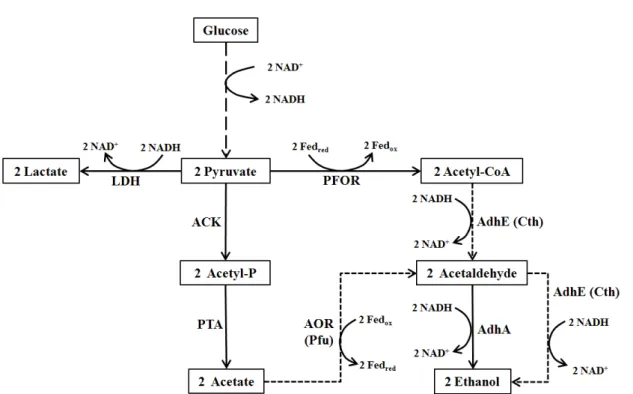
이렇게 대사공학을 통하여 얻은 C. besci 변이체를 통합바이 오공정(consolidated bioprocessing; CBP)에 적용하려는 시도 도 계속되고 있는데 그 첫번째 연구는 lactate dehydrogenase (ldh)의 deletion을 통하여 전자의 흐름을 젖산이 아닌 acetate 쪽으로 유도하여 알코올이나 수소 생산을 증대시키기 위한 것이었다(Fig. 1). Cha 등[9]은 C. bescii의 ldh 결실 변이주 (JWBC017)를 0.5% switchgrass가 첨가된 LOD 배지에서 120 시간 키웠을 때 40%의 acetate가 더 생성되고 수소 발생량도 70%나 증가함을 확인하였다.
이렇게 분해된 당류가 젖산 쪽으로 대사되는 것을 막은 후 에 바이오에탄올을 생산하기 위하여 몇가지 알코올 대사 효소 유전자를 발현하여 CBP의 가능성을 탐색하였다. 첫번째 방법 은 Clostridium thermocellum의 bifunctional acetaldehyde/al- cohol dehydrogenase 유전자(Cthe-adhE2) [36]를 이용하여 acetyl-CoA로부터 직접 ethanol을 생산하는 방법인데(Fig. 1) Chung 등[12]은 adhE 발현을 통하여 2% switchgrass로부터 직접 에탄올을 생산하는데 성공하였다. C. bescii 야생주는 에 탄올 생산을 하지 못하지만 C. bescii JWCB032 (ΔpyrFA ldh::
ISCbe4 Δcbe1::PS-layer Cthe-adhE2/(ura/5-FOAR))균주는 발 효 생성물의 70% 정도가 ethanol이었고 농도는 12.8 mM이었 다.
Acetyl-CoA로부터 ethanol을 생산하는 경로는 adhE를 통 해 acetyl-CoA로부터 직접 생산하는 방법 이외에 acetalde- hyde를 거쳐 에탄올을 생산하는 경로도 존재하는데 bacterial alcohol dehydrogenase (AdhA)는 acetaldehyde로부터 에탄 올을 생산하는 효소이다[8]. 그런데 Basen 등[3]은 초고온성 아키아인 Pyrococcus furiosus에 Thermoanaerobacter strain X514 의 adhA를 삽입한 결과 놀랍게도 adhE를 단독으로 또는 함께 삽입했을 때보다 훨씬 더 많은 에탄올 생산이 이루어지는 것 을 확인하였다. 이는 P. furiosus의 aldehyde ferredoxin oxi- doreductase (AOR)이 acetate를 acetaldehyde로 전환시키기 때문인 것으로 밝혀졌는데 AOR은 여러 알데하이드에 활성을 보이므로 butyrate를 buthanol로 전환시킬 수도 있어서 에탄 올뿐만 아니라 고가의 다른 알코올 생산에도 활용이 가능할 것으로 생각된다. 현재 이 pathway는 P. furiosus에서만 확립 이 되어 있으나 C. bescii에 이런 효소 유전자들을 도입하면 좀 더 효율적인 CBP에 한 발 더 나아갈 수 있을 것으로 기대를
Fig. 1. Metabolic pathways for ethanol fermentation from glucose. Broken line is simplified modified glycolysis and dotted lines are missing pathways in C. bescii. Abbreviation of enzymes are as following: LDH, lactate dehydrogenase; ACK, acetate kinase; PTA, phosphotransacetylase; PFOR, pyruvate ferredoxin oxidoreductase; AOR, aldehyde ferredoxin oxidoreductase;
AdhA, alcohol dehydrogenase A; AdhE, bifunctional acetaldehyde/alcohol dehydrogenase. Pfu and Cth designate Pyrococcus furiosus and Clostridium thermocellum, respectively.
모으고 있다.
향후 연구 전망
고온성 세균으로서는 매우 드물게 Caldicellulosiruptor bescii 의 유전공학적 기법이 개발되었고 이를 통해 대사공학 연구 결과가 계속 발표되고 있지만 좀 더 정교한 genetic tool의 개 발이 필요한 실정이다. 특히 고발현을 위한 프로모터의 개발 과 heterologous expression을 위한 좀 더 고효율 replicating vector의 개발이 필요하다. 또한 uracil auxotroph를 이용한 nutritional selection 방법은 5-FOA를 이용한 counter se- lection이 필요하므로 좀 더 시간과 노력을 단축시킬 수 있는 새로운 항생제 선별기법도 필요할 것이다. 하지만 현재까지의 방법으로도 여러 유전자의 deletion과 insertion이 가능하므로 다양한 glycosyl hydrolase의 과발현 및 조절유전자의 조작을 통해 전처리하지 않은 바이오매스를 더 고효율적으로 분해하 는 변이주를 개발하려는 시도가 계속될 것이다. 특히 경제성 있는 수준의 CBP를 위해서는 고농도(high load) 바이오매스 의 분해가 가능해야 하는데 그러기 위해서는 바이오매스 분해 로 발생하는 유독물질의 저감이 필요하며 C. bescii의 낮은 알 코올 내성도 높여야 하는 문제가 남아 있다.
References
1. Ai, J. and Tschirner, U. 2010. Fiber length and pulping char- acteristics of switchgrass, alfalfa stems, hybrid poplar and willow biomasses. Bioresour. Technol. 101, 215-221.
2. Akinosho, H., Yee, K., Close, D. and Ragauskas, A. 2014.
The emergence of clostridium thermocellum as a high utility candidate for consolidated bioprocessing applications. Front.
Chem. 2, 66.
3. Basen, M., Schut, G. J., Nguyen, D. M., Lipscomb, G. L., Benn, R. A., Prybol, C. J., Vaccaro, B. J., Poole 2nd, F. L., Kelly, R. M. and Adams, M. W. 2014. Single gene insertion drives bioalcohol production by a thermophilic archaeon.
Proc. Natl. Acad. Sci. USA 111, 17618-17623.
4. Biswal, A. K., Soeno, K., Gandla, M. L., Immerzeel, P., Pattathil, S., Lucenius, J., Serimaa, R., Hahn, M. G., Moritz, T. and Jönsson, L. J. 2014. Aspen pectate lyase PtxtPL1-27 mobilizes matrix polysaccharides from woody tissues and improves saccharification yield. Biotechnol. Biofuels 7, 11.
5. Blumer-Schuette, S. E., Brown, S. D., Sander, K. B., Bayer, E. A., Kataeva, I., Zurawski, J. V., Conway, J. M., Adams, M. W. and Kelly, R. M. 2014. Thermophilic lignocellulose deconstruction. FEMS Microbiol. Rev. 38, 393-448.
6. Blumer-Schuette, S. E., Lewis, D. L. and Kelly, R. M. 2010.
Phylogenetic, microbiological, and glycoside hydrolase di- versities within the extremely thermophilic, plant biomass- degrading genus caldicellulosiruptor. Appl. Environ. Microbiol.
76, 8084-8092.
7. Brunecky, R., Alahuhta, M., Xu, Q., Donohoe, B. S., Crowley, M. F., Kataeva, I. A., Yang, S. J., Resch, M. G., Adams, M.
W., Lunin, V. V., Himmel, M. E. and Bomble, Y. J. 2013.
Revealing nature's cellulase diversity: The digestion mecha- nism of caldicellulosiruptor bescii CelA. Science 342, 1513- 1516.
8. Carere, C. R., Rydzak, T., Verbeke, T. J., Cicek, N., Levin, D. B. and Sparling, R. 2012. Linking genome content to bio- fuel production yields: A meta-analysis of major catabolic pathways among select H2 and ethanol-producing bacteria.
BMC Microbiol. 12, 295-2180-12-295.
9. Cha, M., Chung, D., Elkins, J. G., Guss, A. M. and Westphel- ing, J. 2013. Metabolic engineering of caldicellulosiruptor bescii yields increased hydrogen production from ligno- cellulosic biomass. Biotechnol. Biofuels 6, 85.
10. Chen, F. and Dixon, R. A. 2007. Lignin modification im- proves fermentable sugar yields for biofuel production. Nat.
Biotechnol. 25, 759-761.
11. Chung, D., Cha, M., Farkas, J. and Westpheling, J. 2013.
Construction of a stable replicating shuttle vector for caldi- cellulosiruptor species: Use for extending genetic method- ologies to other members of this genus. PLoS One 8, e62881.
12. Chung, D., Cha, M., Guss, A. M. and Westpheling, J. 2014.
Direct conversion of plant biomass to ethanol by engineered caldicellulosiruptor bescii. Proc. Natl. Acad. Sci. USA 111, 8931-8936.
13. Chung, D., Farkas, J., Huddleston, J. R., Olivar, E. and Westpheling, J. 2012. Methylation by a unique alpha-class N4-cytosine methyltransferase is required for DNA trans- formation of caldicellulosiruptor bescii DSM6725. PLoS One 7, e43844.
14. Chung, D., Farkas, J. and Westpheling, J. 2013. Overcoming restriction as a barrier to DNA transformation in caldicellu- losiruptor species results in efficient marker replacement.
Biotechnol. Biofuels 6, 82.
15. Chung, D., Pattathil, S., Biswal, A. K., Hahn, M. G., Mohnen, D. and Westpheling, J. 2014. Deletion of a gene cluster en- coding pectin degrading enzymes in caldicellulosiruptor bescii reveals an important role for pectin in plant biomass recalcitrance. Biotechnol. Biofuels 7, 147.
16. Chung, D., Young, J., Bomble, Y. J., Vander Wall, T. A., Groom, J., Himmel, M. E. and Westpheling, J. 2015.
Homologous expression of the caldicellulosiruptor bescii CelA reveals that the extracellular protein is glycosylated.
PLoS One 10, e0119508.
17. Chung, D. H., Huddleston, J. R., Farkas, J. and Westpheling, J. 2011. Identification and characterization of CbeI, a novel thermostable restriction enzyme from caldicellulosiruptor bescii DSM 6725 and a member of a new subfamily of HaeIII-like enzymes. J. Ind. Microbiol. Biotechnol. 38, 1867- 1877.
18. Clausen, A., Mikkelsen, M. J., Schröder, I. and Ahring, B.
K. 2004. Cloning, sequencing, and sequence analysis of two novel plasmids from the thermophilic anaerobic bacterium anaerocellum thermophilum. Plasmid 52, 131-138.
19. Dam, P., Kataeva, I., Yang, S. J., Zhou, F., Yin, Y., Chou, W., Poole 2nd, F. L., Westpheling, J., Hettich, R., Giannone, R., Lewis, D. L., Kelly, R., Gilbert, H. J., Henrissat, B., Xu, Y. and Adams, M. W. 2011. Insights into plant biomass con- version from the genome of the anaerobic thermophilic bac- terium caldicellulosiruptor bescii DSM 6725. Nucleic Acids Res. 39, 3240-3254.
20. Demirbas, A. 2008. Biofuels sources, biofuel policy, biofuel economy and global biofuel projections. Energ. Convers.
Manage. 49, 2106-2116.
21. Farkas, J., Chung, D., Cha, M., Copeland, J., Grayeski, P.
and Westpheling, J. 2013. Improved growth media and cul- ture techniques for genetic analysis and assessment of bio- mass utilization by caldicellulosiruptor bescii. J. Ind.
Microbiol. Biotechnol. 40, 41-49.
22. Gibbs, M. D., Elinder, A. U., Reeves, R. A. and Bergquist, P. L. 1996. Sequencing, cloning and expression of a β-1, 4-mannanase gene, manA, from the extremely thermophilic anaerobic bacterium, caldicellulosiruptor Rt8B. 4. FEMS Microbiol. Lett. 141, 37-43.
23. Han, D., Norris, S. M. and Xu, Z. 2012. Construction and transformation of a thermotoga-E. coli shuttle vector. BMC Biotechnol. 12, 2-6750-12-2.
24. Han, D., Xu, H., Puranik, R. and Xu, Z. 2014. Natural trans- formation of thermotoga sp. strain RQ7. BMC Biotechnol. 14, 39.
25. Himmel, M. E., Ding, S. Y., Johnson, D. K., Adney, W. S., Nimlos, M. R., Brady, J. W. and Foust, T. D. 2007. Biomass recalcitrance: Engineering plants and enzymes for biofuels production. Science 315, 804-807.
26. Jones, C. S. and Mayfield, S. P. 2012. Algae biofuels:
Versatility for the future of bioenergy. Curr. Opin. Biotechnol.
23, 346-351.
27. Kataeva, I., Foston, M. B., Yang, S., Pattathil, S., Biswal, A.
K., Poole II, F. L., Basen, M., Rhaesa, A. M., Thomas, T.
P. and Azadi, P. 2013. Carbohydrate and lignin are simulta- neously solubilized from unpretreated switchgrass by mi- crobial action at high temperature. Energy Environ. Sci. 6, 2186-2195.
28. Kataeva, I. A., Yang, S. J., Dam, P., Poole 2nd, F. L., Yin, Y., Zhou, F., Chou, W. C., Xu, Y., Goodwin, L., Sims, D.
R., Detter, J. C., Hauser, L. J., Westpheling, J. and Adams, M. W. 2009. Genome sequence of the anaerobic, thermo- philic, and cellulolytic bacterium "anaerocellum thermophi- lum" DSM 6725. J. Bacteriol. 191, 3760-3761.
29. Kim, S. and Dale, B. E. 2004. Global potential bioethanol production from wasted crops and crop residues. Biomass Bioenergy 26, 361-375.
30. Lionetti, V., Francocci, F., Ferrari, S., Volpi, C., Bellincampi, D., Galletti, R., D'Ovidio, R., De Lorenzo, G. and Cervone, F. 2010. Engineering the cell wall by reducing de-meth- yl-esterified homogalacturonan improves saccharification of plant tissues for bioconversion. Proc. Natl. Acad. Sci. USA 107, 616-621.
31. Lipscomb, G. L., Stirrett, K., Schut, G. J., Yang, F., Jenney Jr, F. E., Scott, R. A., Adams, M. W. and Westpheling, J.
초록:고온성 세균 Caldicellulosiruptor bescii를 이용한 식물성 바이오매스의 분해와 바이오에탄올의 생산
이한승1,2*
(1신라대학교 의생명과학대학 바이오산업학부 식품공학전공, 2신라대학교 해양극한미생물연구소) 화석 연료의 고갈과 환경 문제를 극복하기 위하여 식물성 바이오매스를 이용한 바이오연료의 생산이 큰 주목 을 받고 있는 가운데 화학적 전처리를 하지 않은 바이오매스를 직접 분해할 수 있는 그램 양성 초호열성 세균 Caldicellulosiruptor bescii에 대한 관심이 높아지고 있다. C. bescii는 식물 세포벽을 구성하는 셀룰로스, 헤미셀룰로 스 등의 분해 뿐만 아니라 세포벽을 연결시켜주는 pectin도 효율적으로 분해할 수 있는데 최근 C. bescii의 genetic tool이 개발되면서 바이오매스 분해에 관여하는 효소의 특성 규명과 아울러 대사공학적 방법으로 바이오에탄올을 생산하는 통합바이오공정(consolidated bioprocessing; CBP)의 개발이 가능케 되었다. 본 총설에서는 초고온성 세 균인 C. bescii를 이용한 식물성 바이오매스의 분해와 바이오에탄올의 생산에 대한 최신 연구결과를 소개하고 향후 전망에 대해 논하고자 한다.
2011. Natural competence in the hyperthermophilic archae- on pyrococcus furiosus facilitates genetic manipulation:
Construction of markerless deletions of genes encoding the two cytoplasmic hydrogenases. Appl. Environ. Microbiol. 77, 2232-2238.
32. Loque, D., Scheller, H. V. and Pauly, M. 2015. Engineering of plant cell walls for enhanced biofuel production. Curr.
Opin. Plant Biol. 25, 151-161.
33. Mai, V., Lorenz, W. W. and Wiegel, J. 1997. Transformation of thermoanaerobacterium sp. strain JW/SL-YS485 with plasmid pIKM1 conferring kanamycin resistance. FEMS Microbiol. Lett. 148, 163-167.
34. Mohnen, D. 2008. Pectin structure and biosynthesis. Curr.
Opin. Plant Biol. 11, 266-277.
35. Petersen, T. N., Brunak, S., von Heijne, G. and Nielsen, H.
2011. SignalP 4.0: Discriminating signal peptides from trans- membrane regions. Nat. Methods 8, 785-786.
36. Riederer, A., Takasuka, T. E., Makino, S., Stevenson, D. M., Bukhman, Y. V., Elsen, N. L. and Fox, B. G. 2011. Global gene expression patterns in clostridium thermocellum as de- termined by microarray analysis of chemostat cultures on cellulose or cellobiose. Appl. Environ. Microbiol. 77, 1243- 1253.
37. Sato, T., Fukui, T., Atomi, H. and Imanaka, T. 2003. Targeted gene disruption by homologous recombination in the hyper- thermophilic archaeon thermococcus kodakaraensis KOD1.
J. Bacteriol. 185, 210-220.
38. Sato, T., Fukui, T., Atomi, H. and Imanaka, T. 2005. Improved and versatile transformation system allowing multiple ge- netic manipulations of the hyperthermophilic archaeon ther- mococcus kodakaraensis. Appl. Environ. Microbiol. 71, 3889-
3899.
39. Uppugundla, N., da Costa Sousa, L., Chundawat, S. P., Yu, X., Simmons, B., Singh, S., Gao, X., Kumar, R., Wyman, C.
E. and Dale, B. E. 2014. A comparative study of ethanol production using dilute acid, ionic liquid and AFEX™ pre- treated corn stover. Biotechnol. Biofuels 7, 72.
40. VanFossen, A. L., Ozdemir, I., Zelin, S. L. and Kelly, R. M.
2011. Glycoside hydrolase inventory drives plant poly- saccharide deconstruction by the extremely thermophilic bacterium caldicellulosiruptor saccharolyticus. Biotechnol.
Bioeng. 108, 1559-1569.
41. Yang, S. J., Kataeva, I., Hamilton-Brehm, S. D., Engle, N.
L., Tschaplinski, T. J., Doeppke, C., Davis, M., Westpheling, J. and Adams, M. W. 2009. Efficient degradation of ligno- cellulosic plant biomass, without pretreatment, by the ther- mophilic anaerobe "anaerocellum thermophilum" DSM 6725.
Appl. Environ. Microbiol. 75, 4762-4769.
42. Yang, S. J., Kataeva, I., Wiegel, J., Yin, Y., Dam, P., Xu, Y., Westpheling, J. and Adams, M. W. 2010. Classification of 'anaerocellum thermophilum' strain DSM 6725 as caldicellu- losiruptor bescii sp. nov. Int. J. Syst. Evol. Microbiol. 60, 2011-2015.
43. Young, J., Chung, D., Bomble, Y. J., Himmel, M. E. and Westpheling, J. 2014. Deletion of caldicellulosiruptor bescii CelA reveals its crucial role in the deconstruction of ligno- cellulosic biomass. Biotechnol. Biofuels 7, 142.
44. Zhang, Y. H., Ding, S. Y., Mielenz, J. R., Cui, J. B., Elander, R. T., Laser, M., Himmel, M. E., McMillan, J. R. and Lynd, L. R. 2007. Fractionating recalcitrant lignocellulose at modest reaction conditions. Biotechnol. Bioeng. 97, 214-223.