• 검색 결과가 없습니다.

Integrative analysis of cellular responses of Pseudomonas sp. HK-6 to explosive RDX using its xenA knockout mutant

N/A
N/A
Protected

Academic year: 2021

Share "Integrative analysis of cellular responses of Pseudomonas sp. HK-6 to explosive RDX using its xenA knockout mutant"

Copied!
11
0
0

로드 중.... (전체 텍스트 보기)

전체 글

(1)

Integrative analysis of cellular responses of Pseudomonas sp. HK-6 to explosive RDX using its xenA knockout mutant

Bheong-Uk Lee

1

, Moon-Seop Choi

2

, Ji-Won Seok

2

, and Kye-Heon Oh

2

*

1

Division of Biological Sciences and Chemistry, Kosin University, Busan 49104, Republic of Korea

2

Department of Life Science and Biotechnology, Soonchunhyang University, Asan 31091, Republic of Korea

Pseudomonas sp. HK-6의 xenA 돌연변이체를 이용하여 RDX 폭약에 노출된 세포반응들의 통합적 분석

이병욱

1

・ 최문섭

2

・ 석지원

2

・ 오계헌

2

*

1

고신대학교 의생명과학과,

2

순천향대학교 생명시스템학과

(Received July 25, 2018; Revised September 10, 2018; Accepted September 10, 2018)

*For correspondence. E-mail: [email protected];

Tel.: +82-41-530-1353; Fax: +82-41-530-1493

Our previous research demonstrated the essential role of the xenB gene in stress response to RDX by using Pseudomonas sp.

HK-6 xenB knockout. We have extended this work to examine the cellular responses and altered proteomic profiles of the HK-6 xenA knockout mutant under RDX stress. The xenA mutant degraded RDX about 2-fold more slowly and its growth and survival rates were several-fold lower than the wild-type HK-6 strain. SEM revealed more severe morphological damages on the surface of the xenA mutant cells under RDX stress. The wild-type cells expressed proportionally-increased two stress shock proteins, DnaK and GroEL from the initial incubation time point or the relatively low RDX concentrations, but slightly less expressed at prolonged incubation period or higher RDX.

However the xenA mutant did not produced DnaK and GroEL as RDX concentrations were gradually increased. The wild-type cells well maintained transcription levels of dnaA and groEL under increased RDX stress while those in the xenA mutant were decreased and eventually disappeared. The altered proteome profiles of xenA mutant cells under RDX stress also observed so that the 27 down-regulated plus the 3 up-regulated expression proteins were detected in 2-DE PAGE. These all results indicated that the intact xenA gene is necessary for maintaining cell integrity under the xenobiotic stress as well as performing an

efficient RDX degradation process.

Keywords: Pseudomonas sp. HK-6, xenA gene, proteomic analysis, RDX stress

Hexahydro-1,3,5-trinitro-1,3,5-triazine (RDX) is one of the most powerful and commonly used military explosives and is released into ecosystems principally as the result of military activities (Juhasz and Naidu, 2007). RDX is s toxic compound that threatens public health as a consequence of this contami- nation, and has been proposed as a possible human carcinogen (McLellan et al., 1992). The widespread contamination by RDX necessitates the remediation processes of contaminated soil and groundwater. Studies have reported on the biodegradation of RDX in water and soil (Kitts et al., 1994; Ronen et al., 2008).

Many bacterial and fungal isolates, including Pseudomonas sp., Stenotrophomonas sp., and Rhodococcus sp., are known to be capable of metabolizing RDX, and many different types of intermediates and end products have been identified (Binks et al., 1995; Fuller et al., 2010; Lee et al., 2013).

Extensive researches on the biodegradation of RDX have

been performed over the last decades. Most of the researches

(2)

were carried out anaerobically on environmental samples such as soil, sewage sludge, horse manure compost, and so on (Osman and Klausmeiser, 1973; McCormick et al., 1981; Kitts et al., 1994). Relatively small numbers of aerobic RDX degradation have been reported (Binks et al., 1995). Although most researches have focused on the ecological and metabolic aspects of the RDX-degrading isolates, several enzymes (especially xenobiotic nitroreductase) that are involved in RDX biodegradation have been the target of considerable interest for the development of cost-effective biological alternatives, such as the construction of transgenic microorganisms or plants (Jackson et al., 2007;

Fuller et al., 2009; Lorenz et al., 2012).

The degradation of RDX (Fuller et al., 2009) and TNT (Pak et al., 2000) by xenobiotic reductase (XenA or XenB) from the Ps. putida II-B and Ps. fluorescens I-C has been explored in detail. Both XenA and XenB belong to the Old Yellow Enzyme (OYE) family of flavoprotein oxidoreductases, which have been found in bacteria, yeast, and plants (Williams and Bruce, 2002). These enzymes were known to more quickly transform RDX or other energetic compounds under anaerobic conditions compared to aerobic conditions (Fuller et al., 2009). However, very little data is available on the characteristics of the involve- ment of xenobiotic reductase A (XenA) in the biodegradation of RDX. We previously reported the characterization of the xenB mutant under RDX stress (Lee et al., 2015). In many aspects, the results obtained from the xenA mutant were quite similar to those of the xenB mutant, yet it would be worthy of comparing of them.

In order to investigate the role of xenA gene in RDX degra- dation process and under RDX stress condition, the Pseudomonas sp. HK-6 xenA mutant was constructed by a homologous recombination with a partial xenA gene fragment lacking start and stop codons. Several aspects of the xenA mutant were compared with the wild-type strain in order to elucidate the role of this gene in RDX biodegradation and the stress response.

The RDX degradability by the xenA mutant was measured and compared to the wild-type bacteria under aerobic conditions.

The survival rates and the expression levels of the stress shock proteins (SSPs) DnaK and GroEL under RDX stress were examined. In addition, mRNA expression levels of xenA mutant and wild-type cells were examined under RDX stress. Furthermore, scanning electron microscopy (SEM) analysis was carried out

to see the morphological changes occurred in the cell envelope of both strains after RDX exposure. Finally, the different proteome profiles of the wild-type HK-6 strain and the xenA mutant under RDX stress were compared.

Materials and Methods

Bacterial strains, culture conditions and molecular manipulation of the xenA gene

For RDX degradation, HK-6 cells were grown in liquid medium composed of 25 –75 µM RDX, 10 mM K

2

HPO

4

, 5 mM NaH

2

PO

4

, 1 mM MgSO

4

・7H

2

O, 0.07 mM CaCl

2

・2H

2

O, 0.04 mM FeCl

3

・6H

2

O, 0.0005 mM MnCl

2

・4H

2

O, and 0.00035 mM ZnSO

4

・7H

2

O and 2 mM fructose as a supplemental carbon source. The aerobic cultivation and maintenance of Pseudomonas strains have been previously described in detail (Chang et al., 2004).

The xenA knockout mutant was constructed by integration of a 931-bp internal DNA fragment into the HK-6 xenA original locus. An internal DNA fragment of xenA was amplified with the primers 5'-AATTCAAGCTTGCTGCCGTGCCGACGAAG-3' and 5'-AATTGAATTCTCGTTCAGTGGCGCATCC-3'. The partial xenA DNA product was inserted in pBGS18 and trans- formed into HK-6 cells, and its integration in the original xenA locus was confirmed by another PCR with chromosomal DNA as a template. Other molecular manipulation techniques were performed as described by Miller (1972).

Survival test

The wild-type and xenA mutant cells grown on Luria-Bertani (LB) media were harvested by centrifugation at 2,000 × g for 10 min. These cells were washed three times with 10 mM phosphate buffer (pH 7.0), and then inoculated to approximately 10

7

cells/ml of liquid basal medium in 100 ml Erlenmeyer flasks containing 25, 50, or 75 µM RDX. The cell survival was examined by removing aliquots of cells at selected intervals during 60 days of incubation; then, the colonies were counted by plating them on LB agar incubated at 30°C.

SDS-PAGE, western blot, and real-time qPCR analyses

RDX-treated cells were analyzed to analyze for the expression

(3)

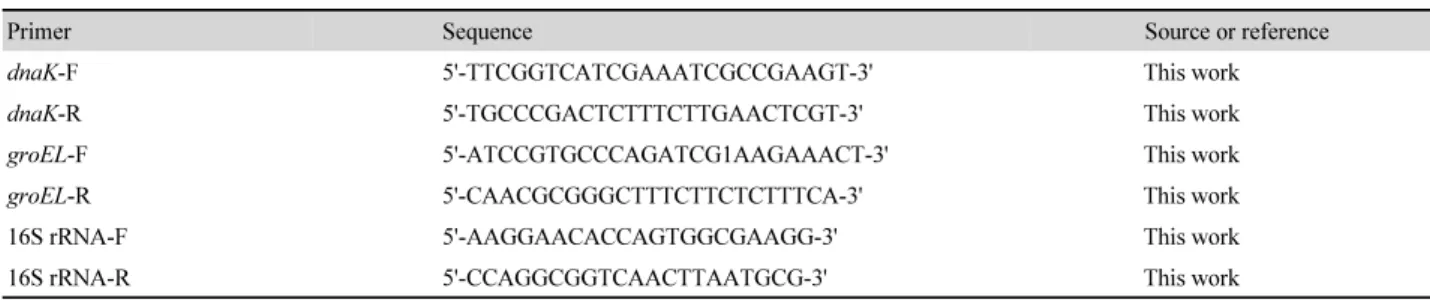
Table 1. PCR primers used in this study

Primer Sequence Source or reference

dnaK-F 5'-TTCGGTCATCGAAATCGCCGAAGT-3' This work

dnaK-R 5'-TGCCCGACTCTTTCTTGAACTCGT-3' This work

groEL-F 5'-ATCCGTGCCCAGATCG1AAGAAACT-3' This work

groEL-R 5'-CAACGCGGGCTTTCTTCTCTTTCA-3' This work

16S rRNA-F 5'-AAGGAACACCAGTGGCGAAGG-3' This work

16S rRNA-R 5'-CCAGGCGGTCAACTTAATGCG-3' This work

of the SSPs, DnaK, and GroEL by Western blot technique with anti-DnaK and anti-GroEL monoclonal antibodies (StressGen Biotechnologies Corp.), which were induced by heat shocking Escherichia coli (70 kDa for DnaK and 60 kDa for GroEL).

Isolation of the SSPs from the HK-6 wild-type and xenA mutant strains was performed using 12% acrylamide for the separating gel and 5% acrylamide for the stacking gel according to the methods described by Bollag et al. (1996). Western blot analysis was performed by methods with some modification, described by Lee et al. (2000).

Total RNA was extracted from the wild-type and xenA mutant cells with an RNA extraction kit (Macherey-Nagel Inc.) according to the manufacturer’s instructions. Then, total RNA was treated with RNase-free DNase and quantified at 260 nm with a Tecan Multi-Reader spectrometer (Männodorf). For RT-qPCR analysis, we used dnaK-F/dnaK-R, groEL-F/groEL- R and internal control primers 16S rRNA-F/16S rRNA-R (Table 1). RT-qPCR analysis was performed using an iScript

TM

One-Step RT-qPCR kit with SYBR Green (Bio-Rad) in a Bio-Rad CFX96 RT-PCR System. RT-qPCR samples were run in triplicate, and the data were analyzed using the Bio-Rad CFX Manager software.

SEM analysis

Colonies of wild-type HK-6 and the xenA mutant grown on LB agar plates for 24 h were excised as small agar blocks. The agar blocks that containing a colony were then exposed to 50 µM RDX in minimal salt medium for 8 h. Both wild-type and xenA mutant cells were fixed, dehydrated, air dried, and coated with gold and examined under a Hitachi S-2500C scanning electron microscope (SEM) (Hitachi) as previously described (Ng et al., 1985).

Proteomic analysis

Two-dimensional electrophoresis (2-DE) was performed with the proteomes from the wild-type and xenA mutant cells treated with 50 µM RDX. A 2-DE analysis was conducted according to previously described methods (Heukeshoven and Dernick, 1985; Kim et al., 2002). The protein spots were excised from the silver-stained 2-D gels and digested with trypsin in accordance with the previously described technique (Ho et al., 2004). The MALDI fingerprint data were analyzed using MS-Fit (http://prospector.ucsf.edu/prospector/4.0.8/html/

msfit.htm) against the NCBI database (Perkins et al., 1999).

Results and Discussion

Construction of the xenA knockout mutant

The complete 1,092 bp xenA gene was amplified from the HK-6 strain using PCR primers 5'-ATGGATCCACCACGCT TTTCGATCCGATC-3' and 5'-ATCCCTGCAGTCACAACC GCGGATAATCGATG-3' which were designed based on the previously reported xenA gene sequences in GenBank. The deduced amino acid sequences of XenA from HK-6 showed 99% and 94% identity to those from Ps. putida KT2440 and Ps.

fluorescens, respectively (data not shown). The preliminary crystal structure of XenA from Ps. fluorescens I-C was deter- mined to a 2.3 Å resolution (Orville et al., 2004) and the substrate-binding amino acid residues of XenA have been determined (Spiegelhauer et al., 2010). A multiple sequence alignment of 40 previously reported OYEs revealed two con- served active sites (HG and YGGS) (Nizam et al., 2014), which were also present in the HK-6 XenA protein (data not shown).

However, the amino acid residues that are essential for the

catalytic reactions of XenA require further elucidation.

(4)

(A) (B) (C)

Fig. 1. Bacterial growth (open symbol) and RDX degradation (closed symbol) of wild-type (circle) and the xenA knockout mutant (square) of Pseudomonas sp. HK-6. The growth rate was measured as the optical density at 600 nm, and the rate of RDX degradation was determined by HPLC every 10 days throughout the 60-day incubation period. In this experiment, RDX was initially supplied at concentrations of 25 (A), 50 (B), and 75 µM (C), respectively. The error bars indicate the standard deviations of the means.

To construct the xenA null mutant, a 931 bp-long internal xenA gene fragment lacking both initiation and termination codons was amplified and inserted into pBGS18 and transformed into the HK-6 strain. The transformed internal xenA fragment was integrated into its original locus via single crossover homologous recombination. This event resulted in the generation of two nonfunctional partial xenA genes: one that did not have the start codon and another that did not have the stop codon.

The integration of the partial xenA fragment also conferred kanamycin-resistance, which was attributed by the presence of the simultaneously integrated pBGS18 plasmid. To verify the proper integration of the plasmid harboring the partial xenA DNA fragment, the entire chromosome of the putative xenA mutant was purified and subjected to PCR with primers that targeted a portion of the plasmid DNA sequence. In the xenA mutant, the amplified DNA fragment from the inserted plasmid was detected; however, it was not detected in the wild-type strain (data not shown).

Comparative degradation of RDX between HK-6 wild- type and its xenA mutant

A previous study reported that XenA of Ps. Fluorescens I-C was able to transform RDX under aerobic and anaerobic conditions, although the degradation rate was always faster under anaerobic conditions (Fuller et al., 2009). To examine the role of xenA in a RDX degradation process, the residual

RDX in the supernatants of aerobic cultures of the HK-6 and the xenA mutant cells was measured (Fig. 1). HK-6 was shown to completely degrade 25 and 50 µM RDX in 40 and 50 days, respectively (Fig. 1A and B). However, the xenA mutant degra- ded less than 30% of the RDX over the same time period. Even after 60 days of aerobic incubation, the xenA mutant achieved only approximately 27% and 21% degradation of 25 and 50 µM RDX, respectively. About 52% of the RDX was still remained in the supernatant of HK-6 aerobic culture which contained 75 µM RDX (Fig. 1C). Taken altogether, XenA appeared to be an important enzyme in the RDX degradation pathways, yet it was not the only enzyme involved in the process since the xenA knockout mutant also more or less showed an ability to reduce The concentration of RDX. This means that there are at least more than two degradation pathways of RDX exist in the HK-6 strain. No metabolic intermediates during RDX degradation were detected by HPLC in this work.

Survival rates and scanning electron microscopy

The survival rates of the xenA mutant were 10

2

–10

4

-fold

lower than the rates of the HK-6 strain in the presence of 25, 50,

and 75 µM RDX (Fig. 2A and B). It may need a further

investigation to find precise reasons of this higher lethality of

xenA mutant. However it may be partly caused by a higher

concentration of RDX in the media due to the slower degrada-

(5)

(A) (B)

Fig. 2. Survival rates of wild-type (A) and xenA mutant (B) Pseudomonas sp. HK-6 following exposure to RDX. The cells were exposed to concentrations of 25 (circle), 50 (square), and 75 µM (triangle) RDX. At intervals, the number of colonies (CFU/ml) was measured. The error bars indicate the standard deviations of the means.

(A) (B)

Fig. 3. Scanning electron micrographs of the wild-type (A) and its xenA mutant (B) of Pseudomonas sp. HK-6 treated with 50 µM RDX for 8 h. The upper left in each micrograph includes the control strains.

tion rate of the xenA mutant.

Several studies reported that aromatic hydrocarbons at high concentrations induced toxic effects on the cells due to the disruption of membrane components (Ramos et al., 1995;

Sikkema et al., 1995), ultimately leading to cell death. We also previously showed that toxic chemicals have substantial cytotoxic impacts on target cells, causing perforations and changes in shape; these changes can be observed under scanning electron microscopy (Chang et al., 2004; Lee et al., 2008a). To observe morphological cellular changes after exposure to RDX, the wild-type and xenA mutant cells were cultured in LB broth supplemented with 50 µM RDX for 8 h. Both wild-type cells

and xenA mutant cells grown in LB medium without RDX exhibited a typical rod shape with a smooth surface (data not shown). Obvious morphological change was little observed in wild-type cells treated with 50 µM RDX for 8 h (Fig. 3A).

However significant morphological changes were shown in the xenA mutant cells under the same conditions (Fig. 3B). The xenA mutant had several destructive openings and a higher frequency of irregular rod forms with wrinkled cell surfaces.

These results indicated that the removal of toxic RDX by XenA

might not be a sole reason to keep cell integrity; nonetheless, it

probably did help it. In addition to this, two stress shock proteins

(SSPs), DanK and GroEL appeared not to be sufficiently expressed

(6)

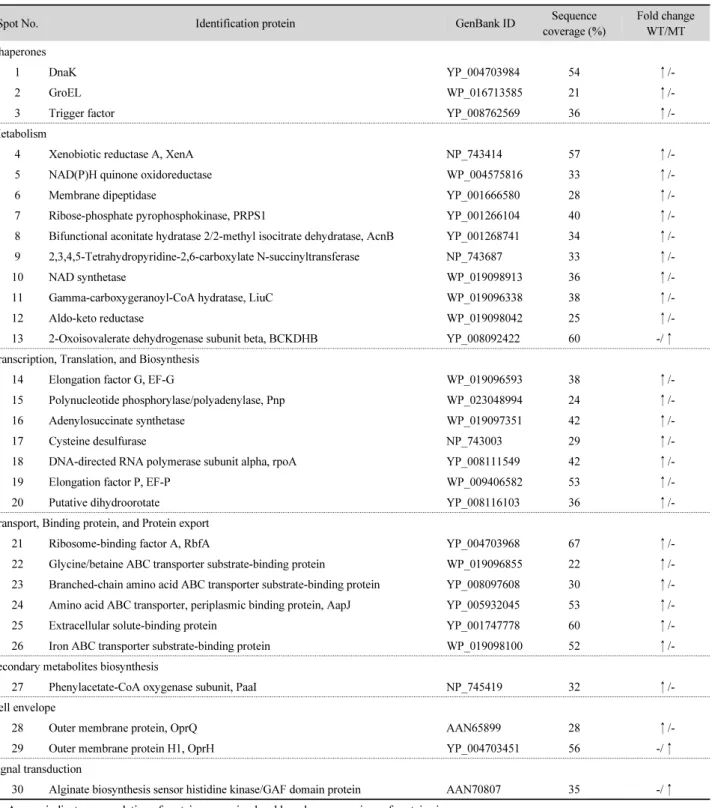
Table 2. Comparative analysis of RDX-induced proteins in Pseudomonas sp. HK-6 and its xenA mutant strain by MALDI-TOF fingerprinting

Spot No. Identification protein GenBank ID Sequence

coverage (%)

Fold change WT/MT Chaperones

1 DnaK YP_004703984 54 ↑/-

2 GroEL WP_016713585 21 ↑/-

3 Trigger factor YP_008762569 36 ↑/-

Metabolism

4 Xenobiotic reductase A, XenA NP_743414 57 ↑/-

5 NAD(P)H quinone oxidoreductase WP_004575816 33 ↑/-

6 Membrane dipeptidase YP_001666580 28 ↑/-

7 Ribose-phosphate pyrophosphokinase, PRPS1 YP_001266104 40 ↑/-

8 Bifunctional aconitate hydratase 2/2-methyl isocitrate dehydratase, AcnB YP_001268741 34 ↑/-

9 2,3,4,5-Tetrahydropyridine-2,6-carboxylate N-succinyltransferase NP_743687 33 ↑/-

10 NAD synthetase WP_019098913 36 ↑/-

11 Gamma-carboxygeranoyl-CoA hydratase, LiuC WP_019096338 38 ↑/-

12 Aldo-keto reductase WP_019098042 25 ↑/-

13 2-Oxoisovalerate dehydrogenase subunit beta, BCKDHB YP_008092422 60 -/ ↑

Transcription, Translation, and Biosynthesis

14 Elongation factor G, EF-G WP_019096593 38 ↑/-

15 Polynucleotide phosphorylase/polyadenylase, Pnp WP_023048994 24 ↑/-

16 Adenylosuccinate synthetase WP_019097351 42 ↑/-

17 Cysteine desulfurase NP_743003 29 ↑/-

18 DNA-directed RNA polymerase subunit alpha, rpoA YP_008111549 42 ↑/-

19 Elongation factor P, EF-P WP_009406582 53 ↑/-

20 Putative dihydroorotate YP_008116103 36 ↑/-

Transport, Binding protein, and Protein export

21 Ribosome-binding factor A, RbfA YP_004703968 67 ↑/-

22 Glycine/betaine ABC transporter substrate-binding protein WP_019096855 22 ↑/-

23 Branched-chain amino acid ABC transporter substrate-binding protein YP_008097608 30 ↑/- 24 Amino acid ABC transporter, periplasmic binding protein, AapJ YP_005932045 53 ↑/-

25 Extracellular solute-binding protein YP_001747778 60 ↑/-

26 Iron ABC transporter substrate-binding protein WP_019098100 52 ↑/-

Secondary metabolites biosynthesis

27 Phenylacetate-CoA oxygenase subunit, PaaI NP_745419 32 ↑/-

Cell envelope

28 Outer membrane protein, OprQ AAN65899 28 ↑/-

29 Outer membrane protein H1, OprH YP_004703451 56 -/ ↑

Signal transduction

30 Alginate biosynthesis sensor histidine kinase/GAF domain protein AAN70807 35 -/ ↑

↑, Arrows indicate up-regulation of protein expression level based on comparison of protein sizes -, not significantly changed

in xenA mutant background (Table 2). This probably contributed a lower survival rate as well as more damages on cell surface of xenA mutant.

Western blot and RE-qPCR analyses

Environmental stresses including explosives such as RDX,

induce SSPs. The expression levels of the 70-kDa DnaK and

(7)

(A) (B) (C)

(D) (E) (F)

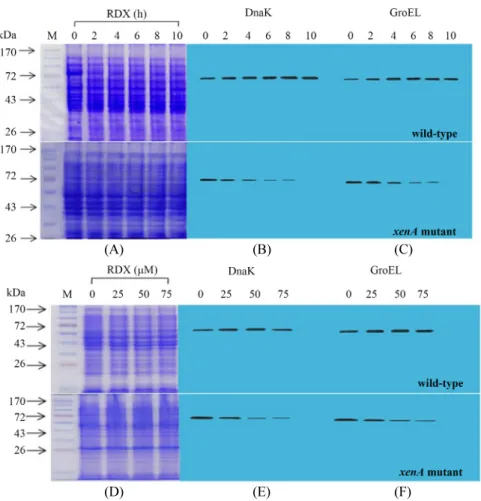
Fig. 4. Induction of stress shock proteins (SSPs) in wild-type and xenA mutant Pseudomonas sp. HK-6 treated with 50 µM RDX for different exposure times (A, B, and C), and for different RDX concentrations (D, E, and F). The SSPs were analyzed by SDS-PAGE (A, D) and western blot with anti-DnaK (B, E) and anti-GroEL (C, F) monoclonal antibodies. The initial colony-forming units per ml (CFU/ml) were approximately 1.46 × 10

8

, and samples with equal amounts of protein (40 µg) were subjected to western blotting.

60-kDa GroEL proteins under RDX stress conditions in the HK-6 wild-type and the xenA mutant were compared using SDS-PAGE and western blotting with anti-DnaK and anti-GroEL monoclonal antibodies (Fig. 4). In the wild-type, the two SSPs were induced by RDX and were found to increase in proportion to the length and concentration of the RDX treatment, which is consistent with previous observations (Fig. 4A, B, and C) (Chang et al., 2004). However, the fates of the two SSPs in the xenA mutant appeared to be quite different. Both DnaK and GroEL were more highly expressed in the xenA mutant in the absence of RDX (Fig. 4D, E, and F). However, the levels of the two SSPs began to decrease in proportion to the elapsed treatment time in the presence of 50 µM RDX. Interestingly, DnaK and GroEL exhibited a small amount of expression in the presence of 50 and 75 µM RDX, while their expression appeared to be enhanced in the presence of 25 µM RDX. The levels of

relative gene expression measured by RT-qPCR were consistent with the western blotting results (Fig. 5). The expression of the dnaK and groEL genes was reduced in the XenA genetic background. These results indicated that increased lethality and other phenotypic changes might occur in the presence of RDX stress due to the limited expression of these SSPs. Many SSPs, such as DnaK and GroEL, are chaperone proteins that assist in the proper folding of essential enzymes under environ- mental stress conditions.

Analysis of the proteome profiles

The proteomic profiles of the wild-type and xenA mutant

cells cultured in LB medium in the presence of RDX were

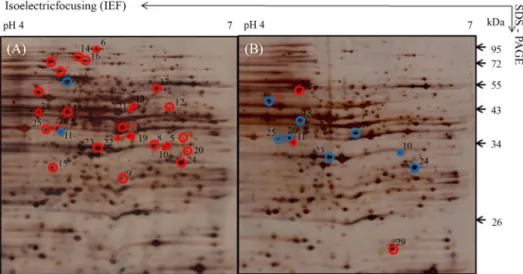
compared (Fig. 6). A total of 30 unambiguous spots were

extracted, digested with trypsin, and analyzed by MALDI-TOF

MS. The MALDI-TOF MS analysis was independently conducted

(8)

(B) (A)

Fig. 5. Analysis of dnaK (A) and groEL (B) gene expression under RDX stress conditions. Induction of the dnaK and groEL genes in cells treated with 0, 25, 50, and 75 µM RDX for 8 h. The DnaK and GroEL concentrations were analyzed using western blotting with the anti-DnaK and anti-GroEL monoclonal antibodies, and dnaK and groEL gene expression was measured using RT-qPCR of the wild-type (square) and xenA (shaded square) mutant cells. The numbers on the x-axis of the RT-qPCR graph and above the western blot photos indicate the time points for the samples collected. The numbers on the y-axis represent relative gene expression.

(A) (B)

Fig. 6. 2-DE patterns of total proteins in wild-type (A) and xenA mutant (B) of Pseudomonas sp. HK-6. Numbers associated with the spots identified by MALDI-TOF are listed in Table 2.

at least three times. The total proteins were classified into 7 groups based on function: chaperone, metabolism, transcription and translation, transport and binding protein, secondary meta- bolite biosynthesis, cell envelope, and signal transduction. The MS analysis showed 27 proteins with decreased expression or no expression in the xenA mutant (Table 2). Interestingly, there was little or no expression of the SSPs (e.g., DnaK, GroEL, and the trigger factor) in the xenA mutant under RDX stress despite the fact that SSPs are usually induced by stress. In fact, TNT stress was reported to cause the accumulation of the chaperones

GroEL and RpoH; also these proteins were more highly accu-

mulated in the algA mutant, which did not produce alginate, a

matrix to potentially protect cells exposed to stresses (Lee et

al., 2008b). Furthermore, the gene AAN70807, which is

related to alginate biosynthesis, was highly induced under

RDX stress conditions (Table 2). It remains unclear whether

the increased expression of this gene was directly connected to

the production of alginate. However, the xenA mutant cells

would produce more alginate if they needed stronger

protection against the higher concentrations of RDX.

(9)

Outer membrane (OM) proteins are involved in many aspects of growth and development of the bacterial cell (Hancock and Brinkman, 2002). In particular, OM proteins of Ps. aeruginosa play a significant role in membrane permeability, nutrient uptake, antibiotic resistance, and virulence at the infection site (Arhin and Boucher, 2010). Our MS analysis identified 2 OM proteins:

up-regulated OprH and down-regulated OprQ. In our proteome analysis, OprH, which might be necessary for cell survival in harsh environments such as RDX exposure, was highly expressed in the xenA mutant. OprH has been reported to stabilize the OM by increasing its protection from membrane perturbation (Edrington et al., 2011). In contrast, OprQ was down-regulated and not detected in the xenA mutant. OprQ has been reported to participate in nutrient uptake from the environment and is involved (directly or indirectly) in the regulation of other proteins/porins that are important for Ps. aeruginosa growth.

OprQ is also required for survival under conditions where Ps.

aeruginosa is exposed to adverse growth conditions (Arhin and Boucher, 2010). Based on previous reports, these results indicate that the xenA mutant cells exposed to RDX demonstrated reduced survival due to a lack of OprQ production.

Previous comparison of proteome profiles between the wild- type and the xenB cells revealed 22 differently-expressed proteins (Lee et al., 2015). Among them, 13 proteins were consistent with those of 2-DE gels from the xenA mutant cells while 9 proteins were not identical in the profile of the xenA mutant proteome. 17 proteins from 2-DE gel in this xenA mutant study were newly identified. The exact roles of these differently- expressed proteins under RDX stress in xenA or xenB genetic background would not be totally understandable. However, accumulation of proteome profiles from the independently- performed analyses will generate more valuable data regarding proteins involved in xenobiotics stress responses.

The XenA protein had not been extensively studied in Pseudomonas species. However, there have been an increasing number of reports regarding the biodegradation or bioremediation of the RDX and TNT explosives using the XenA and XenB enzymes. A broader and more intensive understanding of the involvement of XenA in RDX biodegradation will create more opportunities for a variety of biotechnological applications.

The enzyme can be improved by mutagenesis or genome shuffling techniques for a more efficient bioremediation process

(Ronen et al., 2008). Additionally, studies of XenA, XenB, or related enzymes involved in the microbiological degradation of xenobiotics may provide information that can be used to improve the degradation function of these enzymes. Furthermore, a more powerful strain with a greater capability for RDX degradation can be developed by the introduction of the genes derived from these enzymes into a single strain, enabling the construction of transgenic microorganisms or plants that can be used for RDX bioremediation.

적 요

이전 연구에서 우리는 RDX (hexahydro-1,3,5-trinitro-1,3,5- triazine) 분해세균 Pseudomonas sp. HK-6에서 xenobiotic reductase B 를 암호화하는 xenB 유전자의 돌연변이 균주를 이 용하여 RDX 스트레스에 대한 xenB 유전자의 역할에 관하여 연구를 보고하였다[Lee et al. (2015) Curr. Microbiol. 70(1):

119–127]. 본 연구에서는 Pseudomonas sp. HK-6 xenA 돌연변

이 균주로 연구 범위를 확대하여 RDX 스트레스 조건에서 세

포반응과 프로테옴 프로필의 변화를 분석하였다. RDX 첨가

배지에서 xenA 돌연변이 균주는 야생균주와 비교하여 RDX

를 약 2배 정도 느리게 분해하였으며, RDX 스트레스 하에서

xenA 돌연변이 균주의 생장률과 생존율은 야생균주와 비교하

여 낮았다. RDX 스트레스에 의한 심한 형태적 손상이 xenA 돌

연변이 균주의 세포 표면에 발생하는 것이 주사전자현미경을

통해서 확인되었다. RDX 스트레스 하에서 야생균주에서 발

현된 충격단백질인 DnaK 및 GroEL의 양은 배양 초기 혹은 상

대적으로 낮은 RDX 농도에서는 증가하였으나, 배양시간이

길어지거나 높은 RDX 농도에서는 다소 감소하였다. 그러나

xenA 돌연변이 균주에서는 DnaK와 GroEL의 발현양은 RDX

농도가 증가함에 따라 점차 감소되었다. RT-qPCR에 의해 측

정된 야생균주에서 dnaA와 groEL의 전사 수준은 RDX 스트

레스가 증가된 상태에서 잘 유지되었으나, xenA 돌연변이 균

주에서는 점차 감소되어 결국에는 소멸되었다. RDX 스트레

스에서 xenA의 돌연변이에 의한 프로테옴 프로필의 변화를

2-DE PAGE를 통해서 관찰한 결과에 따르면 27개 단백질이

감소하고 3개가 증가한 것으로 나타났다. 이들 결과로 보아,

정상적인 xenA 유전자는 RDX 스트레스 하에서 세포의 온전

한 형태 유지와 효율적인 RDX 분해 과정을 수행하기 위해서

필요하다는 것을 의미하였다.

(10)

Acknowledgements

This research was supported by the Basic Science Research Program through the National Research Foundation of Korea, funded by the Ministry of Education, Science, and Technology (2011-0026690), and by the Soonchunhyang University Research Fund. We thank the ROK Agency for Defense Development for providing the RDX used in this study.

References

Arhin A and Boucher C. 2010. The outer membrane protein OprQ and adherence of Pseudomonas aeruginosa to human fibronectin.

Microbiology 156, 1415–1423.

Binks PR, Nicklin S, and Bruce NC. 1995. Degradation of hexanydro- 1,3,5-trinitro-1,3,4-triazine (RDX) by Stenotrophomonas maltophilia PB1. Appl. Environ. Microbiol. 61, 1318 –1322.

Bollag DM, Rozycki MD, and Edelstein SJ. 1996. Protein methods. 2

th

ed. Wiley-Liss, New York, USA.

Chang HW, Kahng HY, Kim SI, Chun JW, and Oh KH. 2004.

Characterization of Pseudomonas sp. HK-6 cells responding to explosive RDX (hexahydro-1,3,5-trinitro-1,3,5-triazine). Appl.

Microbiol. Biotechnol. 65, 323–329.

Edrington TC, Kintz E, Goldberg JB, and Tamm LK. 2011. Structural basis for the interaction of lipopolysaccharide with outer membrane protein H (OprH) from Pseudomonas aeruginosa. J. Biol. Chem.

286, 39211 –39223.

Fuller ME, McClay K, Hawari J, Paquet L, Malone TE, Fox BG, and Steffan RJ. 2009. Transformation of RDX and other energetic compounds by xenobiotic reductases XenA and XenB. Appl.

Microbiol. Biotechnol. 84, 535 –544.

Fuller ME, Perreault N, and Hawari J. 2010. Microaerophilic degra- dation of hexahydro-1,3,5-trinitro-1,3,5-triazine (RDX) by three Rhodococcus strains. Lett. Appl. Microbiol. 51, 313–318.

Hancock RE and Brinkman FSL. 2002. Function of Pseudomonas porins in uptake and efflux. Annu. Rev. Microbiol. 56, 17–38.

Heukeshoven J and Dernick R. 1985. Simplified method for silver staining of proteins in polyacrylamide gels and the mechanism of silver staining. Electrophoresis 6, 103 –112.

Ho EM, Chang HW, Kim SI, Kahng HY, and Oh KH. 2004. Analysis of TNT (2,4,6-trinitrotoluene)-inducible cellular responses and stress shock proteome in Stenotrophomonas sp. OK-5. Curr.

Microbiol. 49, 346–352.

Jackson RG, Rylott EL, Fournier D, Hawari J, and Bruce NC. 2007.

Exploring the biochemical properties and remediation applications of the unusual explosive-degrading P450 system XplA/B. Proc.

Nat. Acad. Sci. USA 104, 16822 –16827.

Juhasz AL and Naidu R. 2007. Explosives: fate, dynamics, and ecological impact in terrestrial and marine environments. Rev.

Environ. Contam. Toxicol. 191, 163 –215.

Kim SI, Kim SJ, Nam MH, Kim S, Ha KS, Oh KH, Yoo JS, and Park YM. 2002. Proteome analysis of aniline-induced proteins in Acinetobacter lwoffii K24. Curr. Microbiol. 44, 61 –66.

Kitts CL, Cunningham DP, and Unkefer PJ. 1994. Isolation of three hexahydro-1,3,5-trinitro-1,3,5-triazine-degrading species of the family Enterobacteriaceae from nitramine explosive-contaminated soil. Appl. Environ. Microbiol. 60, 4608 –4711.

Lee BU, Choi MS, and Oh KH. 2013. Comparative analysis of explosive RDX-induced proteomes in the Pseudomonas sp.

HK-6 wild-type strain and its rpoH mutant strain. Biotechnol.

Bioprocess Eng. 18, 1224 –1229.

Lee BU, Choi MS, and Oh KH. 2015. Characterization and proteomic analysis of the Pseudomonas sp. HK-6 xenB knockout mutant under RDX (hexahydro-1,3,5-trinitro-1,3,5-triazine) stress. Curr.

Microbiol. 70, 119–127.

Lee BU, Park SC, Cho YS, Kahng HY, and Oh KH. 2008a. Expression and characterization of the TNT nitroreductase of Pseudomonas sp. HK-6 in Escherichia coli. Curr. Microbiol. 56, 386 –390.

Lee BU, Park SC, Cho YS, and Oh KH. 2008b. Exopolymer biosynthesis and proteomic changes of Pseudomonas sp. HK-6 under stress of TNT (2,4,6-trinitrotoluene). Curr. Microbiol. 57, 477 –483.

Lee DC, Stenland CJ, Hartwell RC, Ford EK, Cai K, Miller LC, Gilligan KJ, Rubenstein R, Fournel M, and Petteway Jr SR.

2000. Monitoring plasma processing steps with a sensitive western blot assay for the detection of the porin protein. J. Virol.

Methods 84, 77–89.

Lorenz A, Rylott EL, Strand SE, and Bruce NC. 2012. Towards engineering degradation of the explosive pollutant hexahydro- 1,3,5-trinitro-1,3,5-triazine in the rhizosphere. FEMS Microbiol.

Lett. 340, 49 –54.

McCormick NG, Cornell JH, and Kaplan AM. 1981. Biodegradation of hexahydro-1,3,5-trinitro-1,3,5-triazine. Appl. Environ. Microbiol.

42, 817 –823.

McLellan W, Hartley WR, and Brower M. 1992. Hexahydro-1,3,5- trinitro-1,3,5-triazine (RDX), pp. 132–180. In Roberts WC and Hartley WR. (eds.), Drinking water health advisory: Munition, Lewis Publishers, Boca Raton, USA.

Miller JH. 1972. Experiments in molecular genetics, Cold Spring Harbor Laboratory, New York, NY, USA.

Ng LK, Sherburne R, Taylor DE, and Stiles ME. 1985. Morphological forms and viability of Campylobacter species studied by electron microscopy. J. Bacteriol. 164, 338 –343.

Nizam S, Gazara RK, Verma S, Singh K, and Verma PK. 2014.

Comparative structural modeling of sox Old Yellow Enzymes (OYEs) from the necrotrophic fungus Ascochytarabiei: insight into novel OYE classes with differences in cofactor binding, organization of active site residues and stereopreferences. PLoS One 9, e95989.

Orville AM, Manning L, Blehert DS, Fox BG, and Chambliss GH.

2004. Crystallization and preliminary analysis of xenobiotics

reductase B from Pseudomonas fluorescence I-C. Acta Crystallogr.

(11)

D Biol. Crystallogr. 60, 1289 –1291.

Osman JL and Klausmeier RE. 1973. Microbial degradation of explosives. Dev. Ind. Microbiol. 14, 247 –252.

Pak JW, Knoke KL, Noguera DR, Fox BG, and Chambliss GH. 2000.

Transformation of 2,4,6-trinitrotoluene by purified xenobiotic reductase B from Pseudomonas fluorescens I-C. Appl. Environ.

Microbiol. 66, 4742–4750.

Perkins DN, Pappin DJ, Creasy DM, and Cottrell JS. 1999. Probability- based protein identification by searching sequence databases using mass spectrometry data. Electrophoresis 20, 3551 –3567.

Ramos JL, Duque E, Huertas MK, and Haidour A. 1995. Isolation and expression of catabolic potential of a Pseudomonas putida strain able to grow in presence of high concentrations of aromatic

hydrocarbons. J. Bacteriol. 177, 3911 –3916.

Ronen Z, Yanovich Y, Goldin R, and Adar E. 2008. Metabolism of the explosive hexahydro-1,3,5-trinitro-1,3,5-triazine (RDX) in a contaminated valdose zone. Chemosphere 73, 1492 –1498.

Sikkema J, de Bont JAM, and Poolman B. 1995. Mechanisms of membrane toxicity of hydrocarbons. Microbiol. Rev. 59, 201 – 222.

Spiegelhauer O, Werther T, Mende S, Knauer SH, and Dobbek H.

2010. Determinants of substrate binding and protonation in the flavoenzyme xenobiotic reductase A. J. Mol. Biol. 403, 286 –298.

Williams RE and Bruce NC. 2002. ‘New uses for an old enzyme’-the

old yellow enzyme of flavoenzymes. Microbiology 148, 1607 –

1614.

수치

Table 1. PCR primers used in this study
Fig. 1. Bacterial growth (open symbol) and RDX degradation (closed symbol) of wild-type (circle) and the xenA knockout mutant (square) of Pseudomonas sp
Fig. 2. Survival rates of wild-type (A) and xenA mutant (B) Pseudomonas sp. HK-6 following exposure to RDX
Table 2. Comparative analysis of RDX-induced proteins in Pseudomonas sp. HK-6 and its xenA mutant strain by MALDI-TOF fingerprinting
+3

참조

관련 문서