• 검색 결과가 없습니다.

The Characteristics and Biomass Distribution in Crown of Larix olgensis in Northeastern China

N/A
N/A
Protected

Academic year: 2021

Share "The Characteristics and Biomass Distribution in Crown of Larix olgensis in Northeastern China"

Copied!
9
0
0

로드 중.... (전체 텍스트 보기)

전체 글

(1)

204

F OREST S OCIETY

The Characteristics and Biomass Distribution in Crown of Larix olgensis in Northeastern China

Dongsheng Chen and Fengri Li*

School of Forestry, Northeast Forestry University, Harbin 150040, P. R. China

Abstract : This study was performed in 22 unthinned Larix olgensis plantations in northeast China. Data were collected on 95 sample trees of different canopy positions and the diameter at breast height (d

1.3

) ranged from 5.7 cm to 40.2 cm. The individual tree models for the prediction of vertical distribution of live crown, branch and needle biomass were built. Our study showed that the crown, branch and needle biomass distributions were most in the location of 60% crown length. These results were also parallel to previous crown studies. The cumulative relative biomass of live crown, branch and needle were fitted by the sigmoid shape curve and the fitting results were quite well. Meanwhile, we developed the crown ratio and width models. Tree height was the most important predictor for crown ratio model. A negative competition factor, ccf and bas which reflected the effect of suppression on a tree, reduced the crown ratio estimates. The height–diameter ratio was a significant predictor. The higher the height–diameter ratio, the higher crown ratio is. Diameter at breast height is the strongest predictor in crown width model. The models can be used for the planning of harvesting operations, for the selection of feasible harvesting methods, and for the estimation of nutrient removals of different harvesting practices.

Key words : Larix olgensis plantations Crown ratio Crown width Crown biomass

Introduction

Larix olgensis is one of three main coniferous timber species in northwestern China. The area of Larix olgen- sis plantation is about four million ha and occupies 70%

of the plantation in northeastern China. The understand- ing of dynamics of Larix olgensis is important for forest conservation, management and timber yield in these regions.

Tree crown plays an essential role in tree productivity because crown is the location of many physiological processes such as principal photosynthesis, respiration and transpiration which are related to growth and devel- opment of the tree. Crown dimensions have an effect on physiological processes (Jahnke and Lawrence, 1965), seed production and forest regeneration (Hale, 2004), stem form (Larson, 1963), wildlife use potential (Mohren et

al ., 1987), behavior under wind stress (Moore, 2002), and wood quality (Maguire et al ., 1991). Therefore, crown dimension is an important component of forest growth and yield models and is used in many tree and crown level growth modeling systems (Cole and Lorimer, 1994; Valentine et al ., 1994). Monserud and

Sterba (1996) applied tree crown as one of the predictors in diameter and height growth equations, and Vanclay (1994) showed that tree crown can be considered when simple competition indices are not able to adequately predict recovery from competition when a competitor is removed such as by thinning.

Crown size is usually described as crown length and crown width. Crown length is the difference between total height and the height to the crown base. Crown size has been considered related to tree vigor and is a mea- sure of photosynthetic potential (Daniels and Burkhart, 1975). A dimensionless measure of crown size is crown ratio, which is defined as crown length divided by total tree height. Monserud (1975) found that crown ratio is a good indicator of the ability of a tree to utilize available resources for growth. Daniels et al . (1979) considered both crown length and crown ratio to reflect the poten- tial of a released tree to utilize available resources such as increased growing space. When total tree height is measured, it is very easy to obtain the height to the crown base. Crown length and crown ratio have become widely measured tree characteristics in forest inventories in the past. Monserud and Sterba (1996) found that the logarithm of crown ratio is highly significant for pre- dicting the basal area increment of all Austrian forest species.

*Corresponding author

E-mail: [email protected]

(2)

Crown width has been used in calculating distance dependent competition indices such as area overlap index (Biging and Dobbertin, 1992). There are two kinds of crown width models-models for open-grown trees and models for stand-grown trees. Equations for predicting the dimensions of crowns in open locations consider maximum biological potential, while those for stand- grown trees which generally have a smaller crown due to competition are called LCW (Largest Crown Width) equations (Hann, 1997). LCW models predict the actual size of tree crowns in forest stands, and have many applications including estimations of crown surface area and volume in order to assess forest health (Zarnoch et

al ., 2004), tree-crown profiles and canopy architecture (Hann, 1999; Marshall et al ., 2003), forest canopy cover (Gill et al ., 2000) and the arrangement of trees in forest visualization programs (Habus and Hann, 1998). When modeling crown diameter relationship, many techniques such as simple linear model (Paulo et al ., 2002; Benítez

et al ., 2003), linear models with quadratic terms (Bechtold, 2003) as well as non-linear models using power function and monomolecular function (Bragg, 2001; Tomén et al ., 2001) have been used.

The complex structure and irregular distribution of foliage and branch made it difficult to predict the crown related biomass. Although some studies on crown bio- mass distribution have been published (Gillespie et al ., 1994; Baldwin and Peterson, 1997; Timo and Eero, 2008), the estimation of foliage and branch biomass remains one of the least understood aspects of forest growth and yield modeling. The breast height diameter, tree height and diameter-height ratio were used as pre- dictors in biomass models because these are commonly available in forest inventory (Marklund, 1988; Korhonen and Maltamo, 1990; Hakkila, 1991).

In order to predict the harvested branches and needles above the delimbed pulpwood section, the vertical dis- tribution of biomass components within one tree has to be known. This requires tree-level information on the length of the living crown and on the way in which the biomass has accumulated along the whole crown length.

Therefore, the purpose of this study is to produce crown characters and biomass distribution models for Larix

olgensis , that can be applied to estimate the total amounts and share of total branch and needle biomasses along any given stem section of an individual tree.

These models consist of the following individual tree models: crown ratio model, crown width model, and the relative accumulation of living crown biomass, branch biomass and needle biomass models. The developed models in this study may be applied for the prediction of biomass under different silviculture conditions, and for the simulation of various thinning procedures and harvesting

methods.

Materials and Method

1. Data collection

Sample trees were collected in 22 unthinned Larix

olgensis plots with different age and density from MengJiaGang forest farm, which is located in Jiamusi city of Heilongjang province, northeastern China, rang- ing across 130 ° 33 ~130 ° 53 E and 46 ° 20 ~46 ° 31 N.

The size for each plot is 0.1 ha. Stem diameter at breast height (DBH), total height (HT), height to crown base (HCB), crown width (CW), and the coordinate of x and y were recorded for each tree in the plots. The definition of crown base is the lowest living branch which has one green leaf at least. The cumulative basal area distribution of the trees on the plot was divided into five equal size strata, and the average diameter at breast height and total height of each stratum was calculated. Based on the cal- culated average diameter at breast height and total height for each stratum, one sample tree was randomly chosen outside the plot in the stand. The total of 95 trees was selected as sample trees for stem analysis. However, none of sample trees were selected in three plots because of their poor situations.

The sample trees were felled as carefully as possible to minimize damage to their crowns. The discs were taken from the stem at a height of 1.3 m, stump, and then at 1.0 m interval above stump following Smalian’s method of stem analysis. Each section at 1.0 m interval

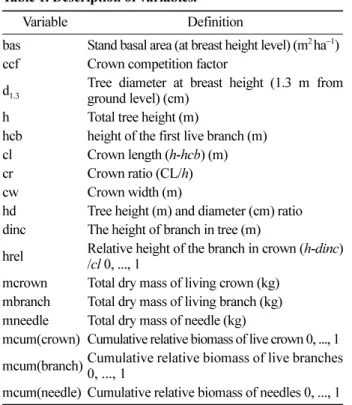
Table 1. Description of variables.

Variable Definition

bas Stand basal area (at breast height level) (m

2

ha

−1

) ccf Crown competition factor

d

1.3

Tree diameter at breast height (1.3 m from ground level) (cm)

h Total tree height (m)

hcb height of the first live branch (m) cl Crown length ( h - hcb ) (m) cr Crown ratio (CL/ h )

cw Crown width (m)

hd Tree height (m) and diameter (cm) ratio dinc The height of branch in tree (m)

hrel Relative height of the branch in crown ( h - dinc ) / cl 0, ..., 1

mcrown Total dry mass of living crown (kg) mbranch Total dry mass of living branch (kg) mneedle Total dry mass of needle (kg)

mcum(crown) Cumulative relative biomass of live crown 0, ..., 1

mcum(branch) Cumulative relative biomass of live branches 0, ..., 1

mcum(needle) Cumulative relative biomass of needles 0, ..., 1

(3)

within the live crown is called “Layer”. Every branch in each crown layer was numbered and surveyed. Crown biomass mainly included branch biomass and needle biomass. A standard branch selected for each layer was a branch that was growing very well within each layer.

The standard branch was used to determine the crown biomass. The weight of standard branches were mea- sured and the needles were removed from the standard branches, and then branches and leaves were taken sam- ples. To estimate the biomass of crown, the samples were dried, and moisture content was measured in the laboratory. The variables used in this study were described in Table 1. The stand and tree data were sum- marized in Table 2.

2. Crown ratio model

The crown size was determined by crown length and width. Thus, the crown length and width models were needed to be constructed to estimate crown dimension.

The crown ratio instead of crown length was used in this paper.

The crown ratio will reflect tree competition and size in stand. Generally, the tree had higher crown ratio in low density stand, but with increasing density, crown recession increases. As the live crown diminished, the relation of crown ratio and competition showed random variation. Although the relationships were distinct between species, the similar tendency of these relationships could be described by a saturation curve. Hasenauer and Mon- serud (1996) applied Logistic function to predict the crown ratio.

(1)

where cr is the crown ratio and is a linear combina- tion of independent variables and unknown coefficients.

The basic tree size variables (tree height and d

1.3

) were applied. The tree height and diameter ratio( hd ) are an important variable of the taper of a tree and are related to crown ratio. The competition of trees are reflected by the basal area ( bas ) and crown competition factor( ccf ).

The advantage of ccf is that it is independent of stand age and site, and the advantage of bas is that it can be used to measure the competition under diversified thin- ning treatments(Hasenauer and Monserud, 1996; Timo and Eero, 2008). From above, the function used in this study is expressed as:

(2) where a

0

, a

1

, a

2

, a

3

and a

4

are unknown coefficients and

h , ccf , bas and hd are showed as in Table 1.

3. Crown width model

Since the crown width ( cw ) of each tree was obtained by measuring crown radius of two directions such as north to south and east to west, the mean radius of twice measurements was used in this study. We considered lin- ear regression model predicting the mean crown radius as a function of d

1.3

, h and hd .

The form of the model is as follows (Pretzsch et al ., 2002):

(3) where a

0

, a

1

, a

2

and a

3

are unknown coefficients, d

1.3

, h and hd are showed as in Table 1 and ε is the random error term.

cr 1

1 e + ---

=

cr 1

1 e + a

0

+ a

1

× h + a

2

× ccf + a

3

× log bas ( ) + a

4

× hd ---

=

ln cw ( ) a = 0 + a 1 × ln d ( 1.3 ) a + 2 × ( ) a h + 3 × ln nd ( ) ε + Table 2. Mean, standard deviation and range of stand and tree variables.

Variables Units Modeling data Validation data

N Mean (S.D.) Min-max N Mean (S.D.) Min-max

Plot(n=22) N=17 N=5

bas m

2

ha

−1

17 30.73(7.07) 17.7-47.9 5 32.91(6.21) 26.0-44.0

ccf 17 74.66(32.11) 18.5-142.6 5 70.96(25.72) 35.3-104.6

Tree(n=1595) N=1248 N=347

d

1.3

cm 1248 22.2(3.5) 5.7-34.9 347 23.88(4.7) 14.6-40.2

h m 1248 21.2(2.1) 6.7-29.4 347 22.7(2.32) 16.5-29.8

hd % 1248 00.97(0.1) 0.61-1.75 347 00.97(0.15) 0.52-1.39

hcb m 1248 10.6(3.2) 2.0-19.9 347 09.61(3.65) 2.5-18.3

cr % 1248 00.5(0.2) 0.14-0.91 347 00.58(0.15) 0.21-0.88

cl m 1248 10.6(3.4) 2.0-21.7 347 13.09(3.73) 4.4-24.4

cw m 1248 03.8 (0.9) 1.6-7.8 347 03.701.12) 1.7-8.85

Branch(n=5325) N=3897 N=1428

mneedle kg 3897 00.2(0.2) 0.002-5.47 1428 00.13(0.3) 0.001-4.61

mbanch kg 3897 00.1(0.1) 0.002-3.80 1428 00.25(0.46) 0.001-5.41

mcrown kg 3897 00.3(0.3) 0.004-6.19 1428 00.39(0.6) 0.003-6.39

(4)

4. Crown biomass models

The cumulative distribution of total living crown mass and needle mass was found to follow a sigmoid shape from the crown base to the top of the tree. To describe the mass distributions, the flexible three-parameter Chap- man–Richards function was used in this study. This model has been commonly used for the description of stand development (Timo and Eero, 2008). The transformed form of the model was applied in the study and was developed for live crown mass, branch mass and needle mass. We assumed that the relative distribution of the crown mass components was the same for different stands as well as for trees with different sizes. The form of the mode using in this study is showed as follow:

(4) where f ( x ) is cumulative relative biomass of live crown, branch and needle, a

0

, a

1

, a

2

and a

3

are unknown coef- ficients and h

rel

is showed as in Table 1.

The model (2) and (4) were fitted by applying the STATISTICA procedure “NLIN” using the Gauss–New- ton method. Root mean square error (RMSE) and coef- ficient of determination (R

2

) were used to evaluate model fittings.

5. Validation

The validation date set includes 25 sample trees of 5 sample plots (Table 2). The independent validation procedures for each model in the validation data were performed using the following statistical measures: Mean Error (ME), Mean Absolute Error (MAE), Relative Mean Error (RME), Relative Mean Absolute Error (RMAE), and Precision Estimation (Li et al. , 2001).

Results 1. Crown ratio model

The fitted results of crown ratio model (Eq. (2)) were showed in Table 3. The estimated parameters all passed t-test if we set significant level at 0.05, R

2

is 0.45 and RMSE is 0.093 (Table 3). Based on the sign of esti- mated coefficients, the higher the stand basal area or more suppressed the status of the tree (negative height competition index) may correspond to the lower crown ratio. The plot of residuals showed no obvious trend (Figure 1).

2. Crown width model

The diameter at breast height ( d

1.3

) was used in crown width model because previous studies have showed that

d

1.3

was the most important variable to predict width of crown radius. The regression equations (3) were fitted

f x ( ) a 0 a 1

1 + e ( h

rel

a

2

) a

3

( )

--- +

=

Table 3. Parameter estimates and fit statistics of equation (2).

Parameters Estimate Standard Error t-value p-value Fit statistics

n RMSE R

2

a

0

-0.4275 0.154129 -0.94141 0.046638

1248 0.093 0.45

a

1

0.0348 0.007605 4.58252 0.000005

a

2

-0.0029 0.001244 -2.40682 0.016205

a

3

-0.0712 0.005210 -0.40626 0.024606

a

4

0.1898 0.014071 1.66426 0.026257

Table 4. Parameter estimates and fit statistics of equation (3).

Parameters Estimate Standard Error t-value p-value Fit statistics

n RMSE R

2

a

0

1.114574 0.528376 1.773736 0.046298

1248 0.074 0.69

a

1

-0.266649 0.108075 -0.865533 0.046877

a

2

0.044589 0.014884 2.995808 0.002779

a

3

1.442424 0.308863 4.670108 0.000003

Figure 1. Residuals for model estimating crown ratio.

(5)

and R

2

and root mean square error (RMSE) were cal- culated. In Table 4, R

2

is 0.69 and RMSE is 0.074. The fitted model was logical and significant at the 0.05 level.

The relation between crown width and d

1.3

is negative and this result of study was consistent with former research (Pretzsch et al ., 2002). The plot of residuals showed no obvious trend (Figure 2).

3. Biomass distribution models in crown

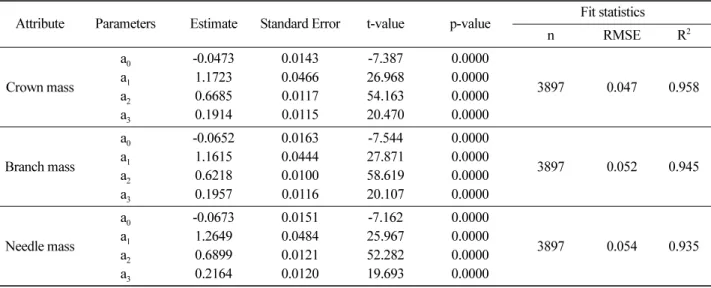
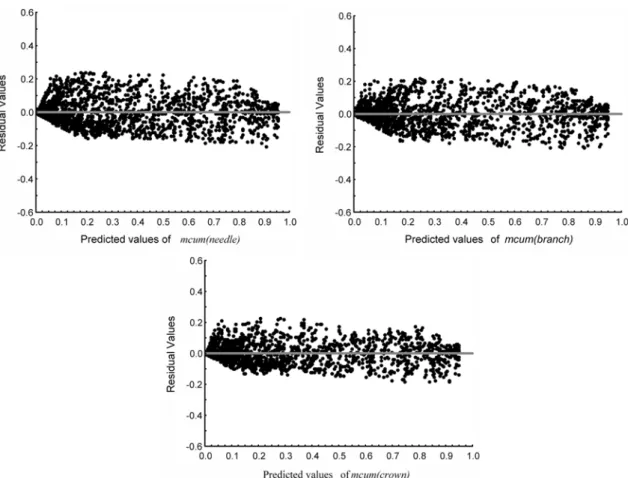
The function (4) fitted the sigmoid shape of the cumu- lative relative biomasses of living crown, branch and needle quite well (Table 5). For the cumulative relative biomass of living crown ( mcum(crown) ), R

2

is 0.96 and RSME is 0.047, For the cumulative relative biomass of living branch ( mcum(branch) ), R

2

is 0.95 and RSME is 0.052, For the cumulative relative biomass of living nee- dle ( mcum(needle) ), R

2

is 0.94 and RSME is 0.054. The plots of residuals showed no obvious trend (Figure 3), but in the upper quarter of the canopy, the model was slightly rigid (Figure 4).

The study showed that the percentage of needle bio- mass was scanty within the height of 0.2 cl and the value of cumulative needle biomass was less than 10% of the total needle biomass. When the relative distance from crown base achieved 0.4 cl , the value of cumulative nee- dle biomass was about 20% of the total needle biomass.

When relative distance from crown base achieved 0.5 cl (the location was the half distance of crown), the per- centage of needle biomass gradually increased and the value of cumulative needle biomass was about 30% of the total needle biomass. With the relative height increasing, the percentage of needle biomass achieved the largest value in 0.6-0.7 cl , but the increasing rate of percentage of needle biomass was slow in 0.9 cl . So the photosynthesis was stronger in middle location of the crown, and the distribution of total dry mass of branch, needle and crown were uniform (Figure 4). These char- acters were consistent with biology character of the Larix olgensis .

4. Model validation

For the validation purpose, the fitted models of crown ratio, crown width, and cumulative relative biomass of crown, branch and needle were applied to the validation data set and then several evaluation statistics including ME, MAE, M%E/%, MA%E/% and Precision/% were computed, The result of validation statistics was sum- marized in Table 6.

The validation results indicated that deviance measures were all fairly low. The fitted crown width model was slightly underestimated the validation data, but the mean absolute errors (MAE) and the mean percent errors (M%E) are 0.18 and -23.91% respectively. Thus the pre- dictions for crown width are reasonably precise, but slightly biased.

Figure 2. Residuals for model estimating crown width.

Table 5. Parameter estimates and fit statistics of equation (4).

Attribute Parameters Estimate Standard Error t-value p-value Fit statistics

n RMSE R

2

Crown mass

a

0

-0.0473 0.0143 -7.387 0.0000

3897 0.047 0.958

a

1

1.1723 0.0466 26.968 0.0000

a

2

0.6685 0.0117 54.163 0.0000

a

3

0.1914 0.0115 20.470 0.0000

Branch mass

a

0

-0.0652 0.0163 -7.544 0.0000

3897 0.052 0.945

a

1

1.1615 0.0444 27.871 0.0000

a

2

0.6218 0.0100 58.619 0.0000

a

3

0.1957 0.0116 20.107 0.0000

Needle mass

a

0

-0.0673 0.0151 -7.162 0.0000

3897 0.054 0.935

a

1

1.2649 0.0484 25.967 0.0000

a

2

0.6899 0.0121 52.282 0.0000

a

3

0.2164 0.0120 19.693 0.0000

(6)

Figure 3. Residuals for Eq. (4) estimating the cumulative relative biomass of live crown, branch and needle.

Figure 4. The predicted and observed cumulative relative biomass of live crown, branch and needle.

(7)

Discussion

1. Crown models

The stand’s and tree’s growth history, like earlier thin- nings, Competition effects were estimated by crown competition factor ( ccf ) and stand basal area ( bas ) in Eq.

(2). The ccf and logarithmic bas were significant for the crown ratio model, resulting in decreasing crown ratio as competition increases. Hasenauer and Monserud (1996) developed a crown ratio model for all major tree species in Austria. Timo and Eero (2008) found that a negative sign of hd ratio in crown ratio model indicated that the living crown may decrease as hd ratio increases. A negative competition factor, ccf and bas, which reacted the effect of suppression on a tree, reduced the crown length estimates.

Tree crown width is an important measure for several key factors in stand management (Pretzsch et al ., 2002).

On an individual tree basis, it helps to describe compe- tition between trees and by being related to branch thick- ness, it also indirectly affects timber quality (Van Laar, 1973), and thus the economic value of a tree. On a stand basis, it is a general competition measure and an impor- tant measure of habitat quality, and also can evaluate crown closure. The crown width model provides ade- quate crown diameter predictions for China Larix olgen- sis plantations. The selected model, like the rest of the functions tested, uses diameter at breast height as pre- dictor variable because it is by far the most common variable used in crown diameter prediction models (Bechtold, 2003). Diameter at breast height is the stron- gest predictor of crown diameter. Many researchers used diameter at breast height as predictor variable. For example, Paulo et al . (2002) reported an improvement in a model to relate crown diameter to diameter at breast height in open cork oak woodlands by including a crown shape parameter and distance to the nearest tree.

2. The distribution of biomass in crown

In closed-canopy plantation of larch pine, crown, branch and needle biomass were largely correlated with relative distance from crown base. The relationship of crown, branch and needle biomass to relative distance from crown base was known to vary by species. The

maximum values of branch, needle and crown biomass occurred near sixty percent of the relative distance from crown base for larch. The branch, needle and crown bio- mass were distinct with tree size, and the crown biomass of dominant tree was greater than the suppressed tree.

The results were similar to the past researches (Figure 4). The maximum values of crown, branch and needle biomass occurred near the midpoint of the crown for western hemlock, two-thirds up the crown for Douglas- fir, and gradually increases up the crown for grand fir (Kershaw and Maguire, 1995). The crown, branch and needle biomass does not differ significantly among upper crown levels, but it is lower at the crown bottom (Horntvedt, 1993). At the crown base, although branches diameter are larger, less foliages on them are sustained probably because of the limitation of light availability (Valentine et al ., 1994).

The models of the cumulative relative biomass of live crown, branch and needle were fitted quite well in this study. The relative height at which the needle biomass reached its maximum point was 60% for larch pine. The needle biomass reached its maximum point was 47% for pine and 52% for spruce (Timo and Eero, 2008). In pine stands of various ages, the vertical foliage density peaked at about 50% relative height (Makela and Van- ninen, 2001). These results showed that the height of efficiency crown was in location of 60% crown.

Conclusion

The crown ratio and width models built in this study can be utilized for the thinning system to analyze the transfor- mation of crown. The distribution model of crown biomass may be applied to analyze the physiological processes, such as photosynthesis, respiration, transpiration, to esti- mate the light interception within the canopy in crown on different treatments, and to explain the transformation of crown (crown length and width) and tree growth situation.

These models can be applied to improve the current forest management modeling system.

Acknowledgements

This study was financed by Planning Programs for Sci-

Table 6. Validation results of equation (2), (3), and (4).

Model ME MAE M%E /% MA%E /% Precision /%

Crown ratio 0.1351 0.1715 16.6177 27.7988 96.1718

Crown width 0.1572 0.1889 -23.9105 52.9105 90.6969

Cumulative relative biomass of crown 0.07300 0.1211 -2.1451 53.8168 97.2234

Cumulative relative biomass of branch 0.0425 0.0933 -7.2846 42.7102 97.5084

Cumulative relative biomass of needle 0.0658 0.1073 4.2400 43.0966 97.2571

(8)

ence and Technology Support of China, No.2006BAD24B06,

“Study and demonstration of cultivation key techniques in Larix olgensis fast-growing and high-yield plantation”.

Literature Cited

1. Baldwin, V.C. and Peterson, K.D. 1997. Predicting the crown shape of loblolly pine trees. Can. J. For. Res. 27:

102-107.

2. Bechtold, W.A. 2003. Crown-diameter prediction mod- els for 87 species of stand grown trees in the eastern United States. Southern Journal of Applied Forestry.

27: 269-278.

3. Benitez, J.Y. Rivero, M. Vidal A. et al ., 2003. Estimación del diámetro de copaa partir del diámetro normal (d

1.3

) en plantaciones de Casuarina equisetifolia Forst. Invest Agrar: Sist RecurFor. 12(2): 37-41.

4. Biging, G.S. and Dobbertin, M., 1992. A comparison of distance-dependent competition measures for height and basal area growth of individual conifer trees. For Sci. 38: 695-720.

5. Bragg, D.C. 2001. A local basal area adjustment for crown width prediction. North J Appl For. 18: 22-28.

6. Cole, W. and Lorimer, C.G. 1994. Predicting tree growth from crown variables in managed Northern hardwood stands, For Ecol Manage. 67: 159-175.

7. Daniels, R.F. and Burkhart, H.E. 1975. Simulation of individual tree growth and stand development in man- aged loblolly pine plantations. Pub1. FWS-5-75, Col- lege of Forestry and Wildlife Resources, Virginia Technical Institute, Blacksburg, 69pp.

8. Daniels, R.F. Burkhart, H.E. Spittle, G.D. and Somers, G.L. 1979. Methods for modeling individual tree growth and stand development in seeded loblolly pine stands.

Publ. FWS-1-79, College of Forestry and Wildlife Resources, Virginia Technical Institute, Blacksburg, 50pp.

9. Gill, S.J. Biging, G.S. and Murphy, E.C. 2000. Model- ing conifer tree crown radius and estimating canopy cover. For Ecol Manage. 126: 405-416.

10. Gillespie, A.R. Allen, H.L. and Vose, J.M. 1994. Amount and vertical distribution of foliage of young loblolly pine trees as affected by canopy position and silviculture treatment. Can. J. For. Res. 24: 1337-1344.

11. Habus, M.L. and Hann, D.W. 1998. Forest visualization user’s manual edition 1.0. Oregon State University, Department of Forest Resources, Corvallis, Ore.

12. Hakkila, P. 1991. Hakkuupoistuman latvusmassa. Sum- mary: crown mass of trees at the harvesting phase.

Folia For. 773, 24.

13. Hale, S. 2004. Managing light to enable natural regen- eration in British conifer forests. Forestry Commission Information Note 63, Forestry Commission, Edin burgh.

14. Hann, D.W. 1997. Equations for predicting the largest crown width of stand-grown trees in Western Oregon.

For ResLab, Oregon State Univ, Corvallis. Res Contrib 17. 14pp.

15. Hann, D.W. 1999. An adjustable predictor of crown profile for stand-grown Douglas-fir trees. For Sci.

45(2): 217-225.

16. Hasenauer, H. and Monserud, R.A. 1996. A crown ratio model for Austrian forests. For Ecol Manage. 84:

49-60.

18. Horntvedt, R. 1993. Crown density of spruce trees related to needle biomass. For Ecol Manage. 59: 225-235.

19. Jahnke, L.S. and Lawrence, D.B. 1965. Influence of photosynthetic crown structure on potential productiv- ity of vegetation based primarily on mathematical mod- els. Ecology. 46: 319-326.

20. Kershaw, J.A. and Maguire, D.A. 1995. Crown struc- ture in western hemlock, Douglas-fir and Grand-fir in western Washington trends in branch-level mass and leaf area. Can. J. For. Res. 25: 1897-1912.

21. Korhonen, K.T. and Maltamo, M. 1990. Mannyn Maanpaa llisten Osien Kuivamassat Etela Suomessa, Vol. 371.

Metsantutkimuslaitoksen tiedonantoja, Joensuu, p.29.

22. Larson, B.C. 1963. Stem form development of forest trees. Forest Science Monograph. 5: 1-42.

23. Li, F. R. Choi, J.K. and Kim, J.H. 2001. The develop- ment of growth and yield models for the natural broa- dleaved-Korean pine forests in northeast China. Journal of Korean Forestry Society. 90(5): 650-662.

24. Maguire, D.A. Kershaw, J.A. Hann, D.W. 1991. Pre- dicting the effects of silviculture regime on branch size and crown wood core in Douglas-fir. Forest Science.

37: 1409-1428.

25. Makela, A. and Vanninen, P. 2001. Vertical structure of Scots pine crowns in different age and size classes.

Trees. 15: 385-392.

26. Marklund, L.G. 1988. Biomass afunktioner for tall, gran och bjo rk I Sverige. Biomass functions for pine, spruce and birch in Sweden. Report 45. Swedish Uni- versity of Agricultural Sciences, Department of Forest Survey. Umea. p.73.

27. Marshale, D.D. Gregory, P.J. Hann, D.W. 2003. Crown profile equations for stand-grown western hemlock trees in northwestern Oregon. Can. J. For. Res. 33:

2059-2066.

28. Mohren, G.M.J. 1987. Simulation of forest growth, applied to Douglas-fir stands in the Netherlands. Ph.D.

Dissertation, Agricultural University of Wagenin. The Netherlands.

29. Monserud, R.A. 1975. Methodology for simulating Wisconsin Northern hardwood stand dynamics. Ph.D.

Thesis, University of Wisconsin, Madison, 156pp.

30. Monserud, R.A. and Sterba, H. 1996. A basal area

increment model for individual trees growing in even

and uneven aged forest stands in Austria. For Ecol

Manage. 80: 57-80.

(9)

31. Moore, J. 2002. Mechanical behavior of coniferous trees subjected to wind loading. Ph.D. Dissertation, Oregon State University, Corvallis, Oregon.

32. Paulo, M.J. Stein, A. and Tome M. 2002. A spatial sta- tistical analysis of cork oak competition in two Portu- guese silvopastoral systems. Can. J. For. Res. 32: 1893- 1903.

33. Pretzsch, H. Biber, P. and Dursky, J. 2002. The single tree-based stand simulator SILVA: Construction, appli- cation and evaluation. For Ecol Manage. 162(1): 3-21.

34. Timo, T. and Eero, F. 2008. Individual tree models for the crown biomass distribution of Scots pine, Norway spruce and birch in Finland. For Ecol Manage. 255:

455-467.

35. Tomen. Coelho M.B., Almeida A., Lopes, F., 2001. model SUBER. Estrutura equações utilizadas, Relatórios téc- nico-científicos do GIMREF nº 2/2001, Centro de Estudos

Florestais, Instituto Superior de Agronomia, Lisboa.

36. Valentine, H.T. Ludlow, A.R. and Furnival, G.M. 1994.

Modeling crown rise in even-aged stands of Stika spruce or loblolly pine. For Ecol Manage. 69: 189-197.

36. Vanclay, J.K. 1994. Modeling forest growth and yield, Applications to mixed tropical forests, CAB Interna- tional, Wallingford. 312pp.

37. Van Laar, A. 1973. Needle Biomass, Growth and Growth Distribution of Pinus radiata in South Africa in Rela- tion to Pruning and Thinning. Forschungsberichte der Forstl. Forschungsanstalt Munchen, Vol. 9. 168pp.

38. Zarnoch, S.J. Bechold, W.A. and Stolte, K.W. 2004. Using crown condition variables as an indicator of forest health. Can. J. For. Res. 34: 1057-1070.

(Received January 4, 2010; Accepted March 4, 2010)

수치

Table 1. Description of variables.
Table 4. Parameter estimates and fit statistics of equation (3).
Table 5. Parameter estimates and fit statistics of equation (4).
Figure 3. Residuals for Eq. (4) estimating the cumulative relative biomass of live crown, branch and needle.
+2

참조

관련 문서