762
FOREST SOCIETY
The Habitat Influences the Composition of Minerals and Amino Acids in Allium victorialis var. platyphyllum (Wild Garlic)
Jae Kyung Yang
1, Ji Su Kim
1, Ji Young Jung
1, Mi Jin Jeong
2, Hyun Jin Song
2, Chung Weon Yun
3, Eun Su Do
4, Jun Pok Chang
4, Chandrakant S. Karigar
5and Myung Suk Choi
2*1Division of Environmental Forest Products, Gyeongsang National University, Jinju, 660-701, Korea
2Division of Environmental Forest Science, Gyeongsang National University, Jinju, 660-701, Korea
3Department of Forest Resources, Kongju National University, Yesan, 340-802, Korea
4Division of Herbal Pharmaceutical Science, Joongbu University, Geumsan, 312-702, Korea
5Department of Biochemistry, Bangalore University, Bangalore, 560001, India
Abstract :The composition of minerals and amino acids in Allium victorialis var. platyphyllum tissues collected from different habitats in Ulleung Island and Mt. Hambeak of the Korean Peninsula is investigated. The mineral composition of A. victorialis stem was high compared to that of bulb in all population samples. The most abundant mineral found in all the samples was potassium (K). The mineral composition was variable in garlic population of Ulleung Island in a habitat dependent manner. The A.
victorialis stems and bulbs showed significant differences in their amino acid compositions according to varying habitats of Ulleung Island and Mt. Hambeak. Among the amino acids the most abundant amino acid in A. victorialis bulb tissue was arginine, followed by leucine and valine. The amino acids leucine, valine, and phenylalanine were abundant in stem tissues. The total amino acids of the A. victorialis stem tissue from Teawha pass peak sample (837 mg/100 g dry wt) were higher than the mean of other population samples (355-824 mg/100 g dry wt). However, content of amino acids in the bulb was high in A. victorialis from Nari basin (1,919 mg/100 g dry wt).
Key words :Minerals, amino acids, wild garlic, variation, Ulleung Island, habitat
Introduction
The genus Allium comprises of more than 600 differ- ent species found distributed throughout North America, North Africa, Europe and Asia. Most Allium species are edible and possess characteristic aromas (Lancaster et al., 1999). Their leaves and bulbs have been used not only as wild-edible herbs but also as functional foods for the control of gastritis and heart failures (Moon, 1984).
Health-beneficial properties of Allium species have been attributed to several sulfur-containing compounds derived from amino acid secondary metabolites (Amagase et al., 2001).
Populations of A. victorialis (wild garlic) in South Korea are found restricted to locations on mountain slopes with 10-35° at 1,200-1,400 m above sea level. These plants also prefer relatively cool (8.2-20.1°C) and humid (71-74%) climatic conditions. Ulleung Island, research
site is about 120 km east of the Korean Peninsula. This island is volcanic in origin with steep rocks and placed on the top of a large strato-volcano which rises from the seafloor, reaching a maximum elevation of 984 meters (3,228 ft) at Seongin Peak (Park et al., 2009). Although Ulleung island is tiny it has a large diversity with respect to plant growth conditions such as soil type, rainfall, alti- tude and others. Thus Ulleung Island is a plant biodi- versity hot spot harboring approximately 700 species of vascular plants including a high number of endemic taxa (Oh et al., 2010).
Wild garlic is a perennial herb widely distributed in the Ulleung Island, Mt. Odae, Mt. Hambeak of the Korean peninsula. Several studies on the free amino acid com- position of Allium related plants have been reported (Sagisaka, 1974; Cuiafiez et al., 1981; Kato, 1981; Sau- ter, 1981). However, there is no systematic study on the minerals and amino acid profiles of wild garlic of Korea.
Therefore, as basic research to develop various product with efficient cultivation, in this communication we report the variations in the mineral and amino acids composi-
*Corresponding author E-mail: [email protected]
tion of the A. victorialis growing in different habitats of Ulleung Island and Mt. Hambeak.
Materials and Methods
1. Sampling sites and plant material
A. victorialis var. platyphyllum (wild garlic) plants were collected during August of 2009 from four growing habitats of Ulleung Island (Jungmaewha vally, Teawha pass, Nari basin, and Sungin peak), Kyungbuk Province of Korea (Figure 1), and Mt. Hambeak, Gangwon prov- ince of Korea. Details of sampling sites for each sam- pled plant are presented in Table 1. The taxonomic identifications of wild garlic were verified by Prof. C.W.
Yun, Gongju National University, Korea, and voucher spec- imens are deposited in the Herbarium.
The plant was segregated into two parts, the stem
including leaf and the bulb. Each part was dried avoid- ing direct sunlight and pulverized. The fresh leaves were preserved in refrigerator at -10oC for extraction of amino acids and used within two days.
2. Minerals analysis
Two portions (50.0 mg) of each of the three samples of dried wild garlic were weighed, then wet-ashed by refluxing overnight with 15 mL of HNO3 (6.0 N) and 2.0 mL of HClO4 (70%) at 150oC. The refluxed samples were dried at 120C and the resulting residue was dissolved in 10 mL of HNO3 (4.0 N)-HClO4 (1%) solution. The min- eral content of the samples was determined by Induc- tively Coupled Argon Plasma (ICAP) Atomic Absorption Spectroscopy (AAS Jarrel-Ash). The samples were quanti- fied against standard solutions of known concentration analyzed concurrently. The data reported in Table 4 rep- resent the average of at least three determinations.
3. Determination of amino acids
Soluble amino acids were extracted by grinding frozen wild garlic tissue with sand in a mortar containing 2-4 mL of methanol:chloroform:water (12:5:l v/v) (MCW). The extract was centrifuged at 255 g for 5 min and the supernatant decanted. The sediment was reground with an additional 2-3 mL of MCW and centrifuged. The pooled supernatants were adjusted to a final 40:60:100 ratio of water:methanol:chloro- form with water and chloroform. After mixing, the emulsion was broken by centrifuging at 255 g.
The aqueous methanol phase containing the amino acids passed through 2.5×8 cm Pasteur pipette column filled with Dowex 50W, 100-200 mesh, H form, pre- pared in 60% methanol. The sample was applied from the top, washed with four volumes of 60% methanol, and then eluted with methanolic (60%)-NH4OH (6N).
The second l-mL fraction containing the amino acids Figure 1. Study area and site location map for Allium
victorialis var. platyphyllum populations at Ulleung Island. 1. Jungmaewha valley (10 sites), 2. Nari basin (8 sites), 3. Taewha pass (9 sites), 4. Sungin peak (17 sites), and 5. Mt. Hambeak (10 sites).
Table 1. Ecological characteristics of habitat of Alliunm victorialis.
Taewha Pass Nari Basin Seongin-Peak Jeongmaehwa
Valley Mt. Hambaek Geumdae-Peak Elevation (m) 449 (387-474) 404 (309-521) 866 (768-972) 279 (238-310) 1347 (1334-1356)
Slope ( °) 26 (5-40) 16 (3-40) 30 (15-47) 34 (20-52) 13 (5-20)
Topography (No.) U6, R2, L1 M4, L2, T1, U1 U17 M5, U3, L1, V1 U3, R1
Exposed Soil area (%) 7 (0-10) 14 (0-70) 14 (0-70 16 (5-40) 1 (0-5)
Litter layer (cm) 12 (2-16) 3 (1-5) 5 (1-15 6 (2-10) 11 (10-12)
Tree coverage area (%) 85 (75-95) 76 (70-80) 84 (70-90) 87 (80-90) 83 (80-85) Herb coverage area (%) 64 (50-75) 85 (50-95) 86 (70-95) 75 (55-90) 86 (75-90)
Tree layer height (m) 14 (13-17) 16 (12-21) 14 (9-18) 15 (3-15) 10 (7-13)
DBH tree layer (cm) 42 (14-66) 32 (22-56) 30 (18-42) 25 (20-30) 21 (16-28)
No. of species 26 (18-33) 22 (16-35) 24 (16-35) 23 (15-37) 47 (40-52)
No. of samples 9 8 17 10 4
In topography, U: upper slope area; R: ridge area; L: lower slope area; M: middle slope area; V: valley area. DBH: diameter at breast height.
was collected, treated with ethanol:water:triethylamine (EWT 1:1:1 v/v) and dried under vacuum repeatedly.
The amino acids were derivatized for 20 min by treat- ing with ethanol:water: triethylamine:phenylisothiocyanate (7:1:1:l v/v) (Bidlingmeyer et al., 1984) dried under vac- uum, and stored at -20oC.
The derivatized amino acids were separated and directly quantified by high pressure liquid chromatography (HPLC) using an ISCO ChemResearch System. Amino acids were detected with the ISCO model V4 detector at 254 nm. Samples were chromatographed on a Waters 4 pm Nova-Pak Reverse Phase ODS 150×3.9 mm column.
Solvent A was aqueous sodium acetate (0.14 M), pH 6.35, containing 0.5 mL/L triethylamine. Solvent B was ace- tonitrile (60%) in water. Samples for analysis were sus- pended in B:A (1:9 v/v) and filtered through 0.45 um nylon-66 filters in centrifugal filter tubes (Rainin Instru- ments). The samples were loaded at 10% B in A at a flow rate of 0.7 mL min/L, and a series of linear gra- dients were run sequentially increasing B to 20% in 1 min, 51% of B in 10 min, and finally 100% for 0.1 min.
After maintaining for 2 min, the flow was increased to 1 mL min/L for 2 min, and finally returned to 10% B in
1 min. During the chromatography the column temper- ature was maintained at 37oC. The chemicals used for analysis were of HPLC grade and water was purified through a Milli-RQ purifier (Millipore) to greater than 2.5 megohms resistivity.
Each sample was chromatographed in duplicate and five samples of each population were analyzed. The chromato- graph obtained with standard amino acid mixture was employed to ascertain co-chromatography peaks. Identifi- cation and quantity of the amino acids was determined by co-chromatography and by comparison of the standard chromatograph for individual amino acid respectively.
4. Statistical analysis
All the above experiments were conducted in three replications. The data generated was subjected to statis- tical analysis by using SAS for Window Version 6.12 (SAS, 2001).
Results
1. Mineral composition in
Allium victorialistissue
The mineral composition of A. victorialis plant studied Table 2. Mineral composition of Allium victorialis from different habitats.Sample Minerals content, mg/g1)
Jungmaehwa Mean
valley Nari basin Taehwa pass Sungin Peak Mt. Hambeak
Stem
Fe 00.15±0.03b2) 0.29±0.03b 00.35± 0.09a 0.26±0.08c 00.06±0.01g2) 0.22±0.05 K 22.90±3.85b0 37.83±3.92a0 22.57±6.74b0 2.97±0.67d 14.43±0.49a0 20.14±3.130 Ca 6.66±0.72b 37.83±3.92a0 8.07±0.74b 0.29±0.06d 1.94±0.15c 10.96±1.120
Mg 3.26±0.23c 4.01±0.19a 3.88±0.35b 0.26±0.04d 0.57±0.03d 2.40±0.17
Na 0.46±0.06b 0.67±0.10a 0.46±0.13b 0.39±0.12c 0.28±0.05e 0.45±0.09
Zn 0.01±0.00d 0.06±0.00a 0.02±0.00c 0.03±0.01b 0.03±0.01i 0.03±0.00
Mn 0.13±0.02b 0.81±0.20b 0.06±0.02c 0.13±0.04b 0.05±0.01h 0.24±0.06
Al 0.13±0.02b 0.81±0.20b 2.67±0.69a 1.41±0.34c 0.07±0.01f 1.02±0.25
P 1.63±0.18a 1.34±0.05c 1.15±0.13d 1.51±0.28b 2.15±0.22b 1.56±0.17
Cu -3) - - - 0.03±0.01i 0.006±0.0.002
Total 32.33 83.65 39.23 7.25 19.61 36.41±0.00
Bulb
Fe 0.01±0.00c 0.04±0.00b 0.04±0.01a 0.01±0.00d 0.14±0.01f. 0.05±0.00
K 5.12±0.83a 4.38±0.43c 4.79±1.02b 2.97±0.67d 10.75±0.36a.0 5.60±0.66
Ca 0.58±0.06c 0.69±0.09a 0.64±0.05b 0.29±0.06d 1.44±0.09c 0.73±0.07
Mg 0.30±0.01c 0.49±0.04d 0.56±0.03a 0.26±0.04d 0.68±0.12d 0.46±0.05
Na 0.23±0.02c 0.47±0.02a 0.31±0.03b 0.18±0.04d 0.22±0.01e 0.28±0.02
Zn 0.01±0.00c 0.01±0.00b 0.01±0.00a 0.01±0.00d 0.04±0.01h 0.02±0.00
Mn 0.01±0.00a - - - 0.03±0.01i. 0.01±0.00
Al 0.28±0.02c 2.33 0.11d 4.58±0.30a 0.14±0.03d 0.07±0.01g 1.48±0.09
P 1.22±0.15a 1.16±0.11d 0.79±0.05c 0.49±0.02d 3.62±0.28b 1.46±0.12
Cu - - - - 0.03±0.01i. 0.01±0.00
Total 7.76 9.57 11.72 4.35 17.02 10.08±0.290
1)Oven dry weight, 1 g
2)Means with different superscripts in the same row are significantly different at p<0.05
3)Not detected
in this work is given in Table 1. The major minerals found in the wild garlic stem tissue were; potassium (K) (14.4-37.7 mg/g dry wt), calcium (Ca) (0.29-37.8 mg/g dry wt) and phosphorous (P) (1.3-2.1 mg/g dry wt). In the wild garlic bulb tissue the major mineral found were;
K (3.0-10.8 mg/g dry wt), Ca (0.3-10.8 mg/g dry wt) and P (0.5-3.6 mg/g dry wt). The most abundant mineral in all samples detected was K. The mineral composition was variable depending upon plant habitat, especially within Ulleung Island population. Among the plant parts stems were richer than that of bulb in all population. A. victorialis
stems from Nari basin contained higher minerals than bulbs of Mt. Hambeak of other minerals compared to other hab- itats. Total mineral contents appeared lower in both stems and bulbs of A. victorialis of Sungin peak.
2. Amino acid composition of
Allium victorialistissue
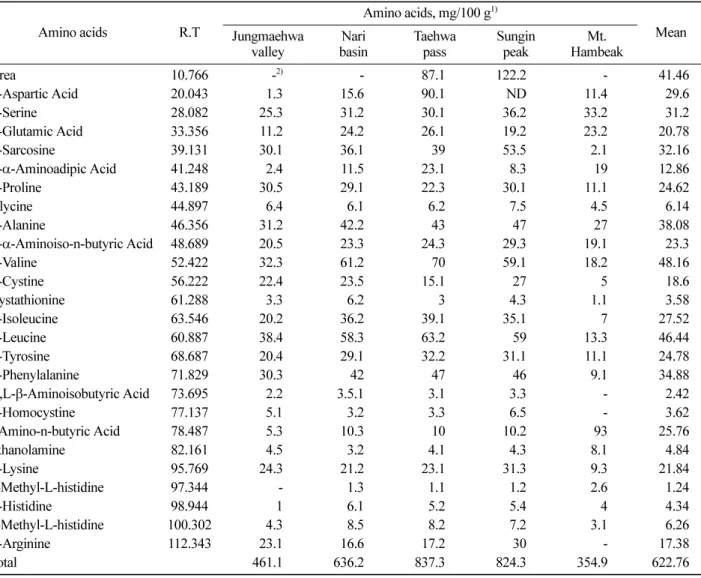
The amino acid content of A. victorialis from Ulleng Island and Mt. Hambaek is indicated in Table 3 and 4.Amino acids quantified from stem were; L-aspartic acid, L-serine, L-glutamic acid, L-sarcosine, L-α-aminoadipic acid, L-proline, glycine, L-alanine, L-α-amino-iso-n-butyric acid, L-valine, L-cystine, cystathionine, L-isoleucine, L-leu- cine, L-tyrosine, L-phenylalanine, D,L-β-aminoisobutyric acid, L-homocystine, r-amino-n-butyric acid, ethanola- mine, L-lysine, 1-methyl-L-histidine, L-histidine, 3-methyl- L-histidine, and L-arginine.
The 5 population samples had a total free amino acid content ranging from 1121.7 to 3106.1 mg/100 g dry wt of fresh weight (mean; 2130.7 mg/100 g dry wt). The most abundant free amino acid in all but one sample was
Figure 2. (A) Free amino acid profiles of authentic amino acids and (B) stem amino acids of Allium victorials from Nari basin. Phser: O-Phospho-L-serine, Taur: Taurine, Pea: O-Phosphoethanolamine, Urea: urea, Asp: L-Aspartic Acid, Hypro: Hydroxy-L-poline, Thr: L-Threonine, Ser: L-Serine, Asn: L-Asparagines, Glu: L-Glutamine, Sarc: L-Sarcosine, AAAA: L-α-Aminoadipic acid, Pro: L-Proline, Gly: Glycine, Ala: L-Alanin, Citr: L-Citrulline, aaba: L-α-Aminoiso-n- butyric Acid, Val: L-Valine, cys: L-Systine, Met: L-Methionine, cysth-1,2: Cystathionine, ILe: L-Isoleucine, Leu: L- Leucine, Tyr: L-Tyrosine, β-ala: β-Alanine, Phe: L-Phenylalanine, aaiba: D,L-β-Aminoisobutyric Acid, Homocys: L- Homocystine, Gaba: γ-Amino-n-butyric Acid, Ethamin: Ethanolamine, Amm: Ammonium Chloride, Hylys: δ-Hydroxylysine, Orn: L-Ornithine, Lys: L-Lysine, l-Mhis: l-methy-L-histidine, his: L-Histidine, l-Mhus: 3-Methyl-L-histidine, Ans: L- Anserine, Car: L-Carnosine, Arg: L-Arginine.
arginine. The amino acid composition of A. victorialis
was variable according to habitat, especially within Ulle- ung Island. Figure 2 shows typical free amino acid chro- matograms of 5 population sample (Table 3).
Numbers of amino acids in bulb extract were compa- rable with those in stem tissue extract. Numbers of amino acids in bulb and stem extracts were 28 and 26, respectively. Number of compounds in different groups did not vary much among habitats.
3. Amino acid composition of
Allium victorialisparts
The amino acid profiles of A. victorialis stems and bulbs showed variations. Significant differences in amino acid contents of wild garlic stems and bulbs were observed (Table 3 and 4). In the bulb tissues of wild garlic, the most abundant amino acids are; argi- nine, followed by leucine and valine. Similarly the major amino acids in stem tissues were L-leucine, fol- lowed by valine and phenylalanine.4. Influence of habitat on amino acid composition of wild garlic
The amino acid composition in A. victorialis bulb tis- sues varied based on the collection habitats of Ulleung Island and Mt. Hambeak (Table 3 and 4). The bulbs of wild garlic from Nari basin and Sungin peak were richer than compared to other habitats. However, stem amino acids were high in A. victorialis from Taehwa pass (837 mg/100 g dry wt) and Sungin peak (824 mg/
100 g dry wt). Among the plants from locations of Nari basin and Sungin peak a wide difference in amino acids between stem and bulbs was noted. Amino acids were generally less in wild garlic from Jungmaewha valley of Ulleung Island compared to other habitats.
The wild garlic amino acid composition of A. victori- alis from Mt. Hambeak, of Korean peninsula was lower than that of Ulleung Island. Total amino acid composition was highest among wild garlic of the Seongin peak.
Table 3. Amino acids composition of Allium victorials stems from different habitats.
Amino acids R.T Amino acids, mg/100 g1)
Jungmaehwa Mean
valley Nari
basin Taehwa
pass Sungin
peak Mt.
Hambeak
Urea 10.766 -2) - 87.1 122.2 - 41.46
L-Aspartic Acid 20.043 1.3 15.6 90.1 ND 11.4 29.6
L-Serine 28.082 25.3 31.2 30.1 36.2 33.2 31.2
L-Glutamic Acid 33.356 11.2 24.2 26.1 19.2 23.2 20.78
L-Sarcosine 39.131 30.1 36.1 39 53.5 2.1 32.16
L-α-Aminoadipic Acid 41.248 2.4 11.5 23.1 8.3 19 12.86
L-Proline 43.189 30.5 29.1 22.3 30.1 11.1 24.62
Glycine 44.897 6.4 6.1 6.2 7.5 4.5 6.14
L-Alanine 46.356 31.2 42.2 43 47 27 38.08
L-α-Aminoiso-n-butyric Acid 48.689 20.5 23.3 24.3 29.3 19.1 23.3
L-Valine 52.422 32.3 61.2 70 59.1 18.2 48.16
L-Cystine 56.222 22.4 23.5 15.1 27 5 18.6
Cystathionine 61.288 3.3 6.2 3 4.3 1.1 3.58
L-Isoleucine 63.546 20.2 36.2 39.1 35.1 7 27.52
L-Leucine 60.887 38.4 58.3 63.2 59 13.3 46.44
L-Tyrosine 68.687 20.4 29.1 32.2 31.1 11.1 24.78
L-Phenylalanine 71.829 30.3 42 47 46 9.1 34.88
D,L-β-Aminoisobutyric Acid 73.695 2.2 3.5.1 3.1 3.3 - 2.42
L-Homocystine 77.137 5.1 3.2 3.3 6.5 - 3.62
r-Amino-n-butyric Acid 78.487 5.3 10.3 10 10.2 93 25.76
Ethanolamine 82.161 4.5 3.2 4.1 4.3 8.1 4.84
L-Lysine 95.769 24.3 21.2 23.1 31.3 9.3 21.84
1-Methyl-L-histidine 97.344 - 1.3 1.1 1.2 2.6 1.24
L-Histidine 98.944 1 6.1 5.2 5.4 4 4.34
3-Methyl-L-histidine 100.302 4.3 8.5 8.2 7.2 3.1 6.26
L-Arginine 112.343 23.1 16.6 17.2 30 - 17.38
Total 461.1 636.2 837.3 824.3 354.9 622.76
1)Ovendry weight, 100 g
2)Not detected
Discussion
Ulleung Island is the major producer of A. victorialis (wild garlic) in Korea. This study was to evaluate the mineral contents of five wild garlic populations. In addi- tion, mineral composition between Ulleung Island and Mt. Hambeak was determined by amino acid profiling.
Minerals in wild garlic vary widely compared among other garlic species. The results of our study, when con- trasted with those of Cho and Lee (1974), document a wide variation in the mineral and amino acid composi- tion of A. victorialis obtained at 5 populations. In this study, contents of mineral in wild garlic tissues were lower than that of cultivated garlic. These results indi- cated that wild garlic grown in mountain area depend on soil quality. However, potassium is a key component in garlic cultivation in natural habitats. Shin et al. (2004) reported that
the total mineral content of garlic samples from Korean mainland range between 7112.6-9067.3 mg/g dry wt with potassium being the highest (4117.3±7.19-5175.3±9.61 mg/
g dry wt). Profiling of mineral content will constitute characterizing of wild garlic cultivars according to their mineral content as well as in relating the wild garlic cul- tivars mineral content with their geographic origin.
A. victorialis has a high content of free amino acids dominated by the arginine. L-arginine can augment the protective effect of garlic against ulcerative colitis; an effect that might be mainly attributed to its NO donating property resulting in enhancement of garlic antioxidant effect (Harisa et al., 2009).
Amino acid profiles of wild garlic were different com- pared to other Allium sp. The types of amino acids in wild garlic were different from other Allium species. In Korean wild garlic, cysteine, and other odor related non- Table 4. Amino acid profile of Allium victorials bulbs from different habitats.
Amino acids R.T Amino acids, mg/100g1)
Jungmaehwa Mean
valley Nari
basin Taehwa
pass Sungin
peak Mt.
Hambeak
L-Aspartic Acid 20.121 2.1 -2) 2 3.4 - 1.1
Hydroxy-L-proline 23.565 - 1282 - 1111.2 - 478.64
L-Serine 27.976 15.3 20.2 17.1 22.1 15 17.94
L-Glutamic Acid 33.29 10 15 12.3 21.2 62.1 24.12
L-Sarcosine 39.322 5.1 14.3 11 16.3 - 9.34
L--Aminoadipic Acid 41.248 3.2 8.1 6.4 9.2 19.3 9.24
L-Proline 43.172 15.1 21.2 15.1 25.1 26 20.5
Glycine 44.93 2.3 3.2 3.1 4.3 3.2 3.22
L-Alanine 46.364 16.1 22.2 22 24 19 20.66
L--Aminoiso-n-butyric Acid 48.747 25 42.3 32.2 37.2 3.3 28
L-Valine 52.422 27.2 41.2 33.3 43.3 40 37
L-Cystine 56.921 9.1 10.1 8.1 14 2.4 8.74
L-Methionine 59.088 2.1 2.4 1.3 3 2.2 2.2
Cystathionine 61.421 3.2 1 2.2 4.4 - 2.16
L-Isoleucine 63.596 19.3 27 22 30 30.2 25.7
L-Leucine 60.937 33.2 46.3 38 50 46.3 42.76
L-Tyrosine 63.737 22.2 31 28.2 34.1 34 29.9
L-Phenylalanine 71.904 26.3 38.1 31.4 40.3 25.1 32.24
D,L--Aminoisobutyric Acid 73.729 2.1 4.1 3.2 4.4 - 2.76
L-Homocystine 76.637 1 1.3 1 1.1 - 0.88
r-Amino-n-butyric Acid 78.545 5.1 13 12 9 27 13.22
Ethanolamine 82.187 3.3 4.2 3.2 4 5.1 3.96
L-Ornithine 92.953 1.1 1.4 1.1 1.2 - 0.96
L-Lysine 95.844 17.4 19.3 15.2 26 18 19.18
1-Methyl-L-histidine 97.444 1.3 1.2 1.1 1.2 5 1.96
L-Histidine 99.011 7.2 10.2 7.2 11.2 22.2 11.6
3-Methyl-L-histidine 100.369 8.3 90.4 8.1 9.4 18.4 26.92
L-Arginine 112.359 71.4 89.1 62 103.1 1.5 65.42
Total 408.2 1919.8 454.1 1743.7 449.3 995.02
1)Ovendry weight, 100 g
2)Not detected
volatile precursors such as methiin, alliin, and isoalliin were not detected. Instead, cystine a sulfur containing amino acid was found in the bulb and stem of wild gar- lic. Cystine is a dimeric amino acid formed by the oxi- dation of two cysteine residues that can be converted to cysteine by the reduction (Keusgen, 2008). Cho et al. (1974) reported that garlic bulb contained 18 amino acids including cysteine, hydroxyproline and arginine. Also, major amino acid of garlic, tryptophan and glutamic acid were not determined in tissues of wild garlic.
The amino acid profiles of A. victorialis were variable on the basis of sample habitat. The high chemical vari- ability among habitats could be mainly explained by genetic rather than by ecological factors (Chograni et al., 2010). Variation of amino acids between the four habi- tats could be the result of selective factors such as rain- fall, temperature, population size and soil quality. These parameters affect the amino acids composition of Allium species. In response to various stresses such as salt, nutrient deficiency, cold, anoxia, and SO2 the tissue nitrogen and amino acid contents increase (Stewart and Lahrer, 1980;
Karolewski, 1985). For example, in plants subjected to drought, there is an increase in amino acids, especially proline (Stewart and Larher, 1980; Morgan, 1984). In this study a high amount of proline was noted in bulb and stem tissues. Especially, proline was found to be sig- nificantly higher in A. victorialis bulbs of Nari basin and Sungin peak. This is indicative of the fact that the wild garlic in these habitats may be stressed by low water contents.
The fresh wild garlic is a rich source of numerous amino acids and minerals compared to cultivated garlic.
These studies allow us to make predictions, so that data about these elements makes it feasible to determine from which population each individuals of wild garlics. Until recently a high mineral and amino acid content in plants were not a specific selection criterion for plant breeding, although genetic variation for this trait is present in the available germplasm collections. The study further hints at developing breeding and propagation of wild garlic genotypes of interesting and superior varieties. The stud- ies with A. victorialis thus contribute to the importance of garlic cultivation in the forest and nursery.
Acknowledgements
This work was granted from the Korea Forest Service.
Literature Cited
1. Amagase, H., Petesch, B.L., Matsuura, H., Kasuga, S.
and Itakura, Y. 2001. Intake of garlic and its bioactive components. Journal of Nutrition 131: 955S-962S.
2. Cho, S.Y. and Lee, S.W. 1974. Studies on the compo- sitional changes of garlic during growth I. Changes in alliin and amino acid contents in various parts. Journal of The Korean Society for Horticultural Science 15: 1- 3. Cho, S.Y. and Lee, S.W. 1974. Studies on the compo-6.
sitional changes of garlic during growth III. Alliin and amino in bulblet. Journal of The Korean Society for Horticultural Science 15: 11-13.
4. Chograni, H., Zaouali, Y., Rajeb, C. and Mohamed, B.M. 2010. Essential Oil Variation among Natural Pop- ulations of Lavandula multifida L. (Lamiaceae). Chem- istry & Biodiversity 7: 933-942.
5. Culiatiez, F., Martin, B., Gueni, J., Tadeo, J.L. and Millo, E.P. 1981. Proteins and amino acids changes in citrus organs during the fruiting period. Processing Interna- tional Society of Citriculture 2566-5761.
6. Harisa, G.E., Abo-Salem, O.M., El-Sayed el-S.M., Taha, E.I. and El-Halawany, N. 2009. L-arginine augments the antioxidant effect of garlic against acetic acid induced ulcerative colitis in rats.Pakistan Journal of Pharmaceu- tical Sciences 22: 373-80.
7. Karolewski, I. 1985. The role of free proline in the sen- sitivity of poplar (Populus robustu) plants to the action of SO2. European Journal of Plant Pathology 15: 199- 8. Kato, T. 1981. Major nitrogen compounds transported206.
in xylem vessels from roots to top in citrus trees.plant physiology 52: 275-279.
9. Keusgen, M.2008. Unusual cystine lyase activity of the enzyme alliinase: direct formation of polysulphides.
planta medica 74: 73-9.
10. Lancaster, J.E. and Boland, M.J. 1999. Onions and allied crops. In Flavor Biochemistry; Brewster, J.L., Rabintowich, H.E., Eds.; CRC Press: Boca Raton, FL, pp 33-72.
11. Moon, K.S. 1984. Usage and Components of Herbal Medicine, Scientific Encyclopedia Co., Pyongyang. pp 671-672.
12. Morgan, J.M. 1984. Osmoregulation and water stress in higher plants. Annual Review of Plant Physiology 35:
299-319.
13. Oh, S.H., Chen, L, Kim, S.H., Kim, Y.D. and Shin, H.C. 2010. Phylogenetic relationship of Physocarpus insularis (Rosaceae) endemic on Ulleung Island: Impli- cations for conservation biology. Journal of plant biol- ogy 53: 94-105.
14. Park, J.W., Lee, J.S., So, S.K. and Kim, M.Y. 2009. Genetic variation and conservation of the endangered species cotoneaster wilsonii (Rosaceae) from Ulleung Island.
Korean Journal of Plant Taxonomy 39: 125-129.
15. Sagisaka, S. 1974. Effect of low temperature on amino acid metabolism in wintering poplar. Plant Physiology 53: 319-322.
16. SAS Institute Inc., 2001. ADO/OLE Cookbook for the SAS Data Providers, Cary, NC: SAS Institute, Inc.
17. Sauter, J.J. 1981. Seasonal variation of amino acids and amides in the xylem sap of Salix. Z. Pflanzenphysiol 101: 399-411.
18. Shin, J.H., Ju, J.C., Kwen, O.C., Yang, S.M., Lee, S.J.
and Sung, N.J. 2004. Physicochemical and physiolog- ical activities of garlic from different area. The Korean
Journal of Food And Nutrition 17: 237-245.
19. Stewart, C.R. and Larher, F. 1980. Accumulation of amino acids and related compounds in relation to envi- ronmental stress. In The Biochemistry of Plants. Ed.
B.J. Miflin. Academic Press, New York, 5: 609-635.
(Received September 29, 2010; Accepted October 11, 2010)