@ % . * , F w ~ " ; F ~ x ~
4 1 1 5 3 ~ 1 2 a ( 2 m 5 4 8 9 ) J Korran Soc Occup Environ Hyg 2005; 15(2); 1 141 23Characteristics of Work-related Musculoskeletal Disorders Compensated by the Industrial Accident Compensation Insurance in Shipbuilding Industry
Sang
WooKim . Yong
ChulShin' ' - Dongmug Kang2
Chat~gwon Areu Office. Korea Occuputionul Safety atld Health Agency . 'Department of Occuputionul Health utld Safety Engineering, Itljr University . 'Department of Preventi~~e und Ocr.upationrr1 Medicine,
Pusurz Natiotlul University
We analyzed the demographic and job features of 197 shipyard workers with work-related musculoskeletal disorders(ll/MSDs) compensated by the Industrial Accident Compensation Insurance Act, and the features of the disorders, the causes of operation and the induced behaviors. The three shipbuilding companies surveyed w e r e l o c a t e d i n Busan M e t r o p o l i t a n c i t y arid Cyungsangnam-do. The results were as follows.
1.
The ages of lVMSDs patients in shipyard were 43.6*
8.6 and the job tenure was 14.3t
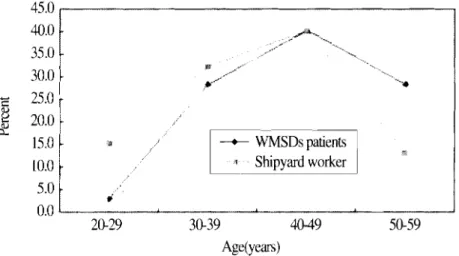
5.6. The 40's of them was 40.1%. and the 30's was 29.4%. Patients less than 5 year-work duration were 85.3%, and ones more than 16 year-work duration 6.6%. In occupations, welders were 32.5%, pre-welders 17.3%, and settirig engineers 6.6%.2. T h e causes o f WhlSDs i n shipyard w e r e works(95.4%) and outer crash or accident shock (3.6%).
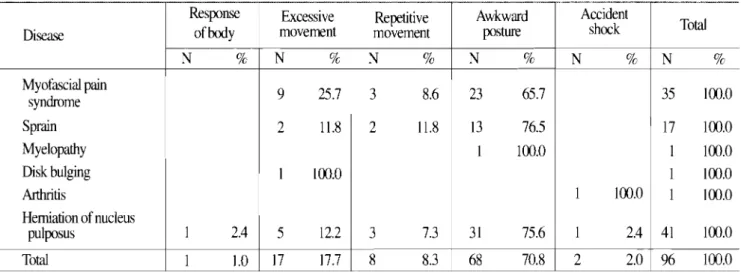
Based on the standard of the NlOSH induced behaviors, the causes were awkward posture (62.9%). excessive
movenient(l9.3%) and repetitive rnovenient(l3.7%).
3. The compensated WhISDs by body part was the highest.
36%,
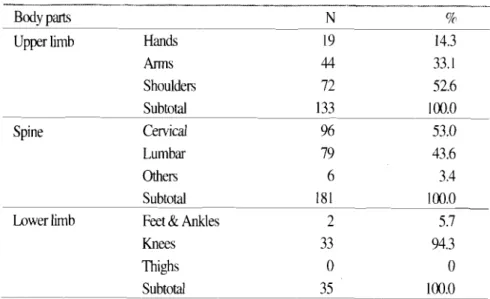
in the spines, 32.0% in both the upper limbs and the spines, and 14% in the upper limbs. The number of cases of WhlSDs in body were96
in the cervical, 79 in the lumbar and 72 in the shoulders.4.
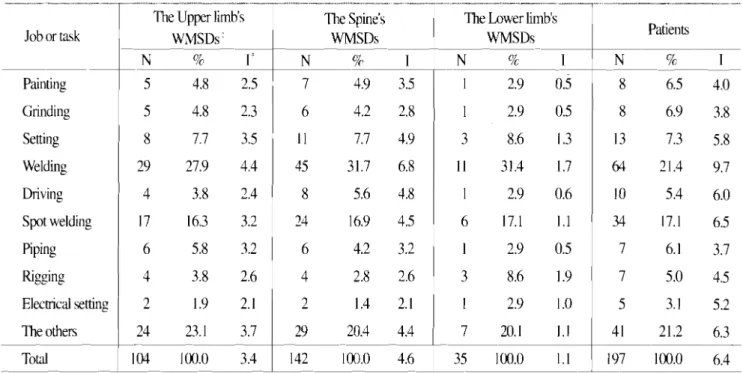
As a result of chi-square test(f) between diagnosis and operation in body, welding and spot welding had the most diagnoses in all parts of the body among other occupations. Chi-square testw) between diagnosis and induced behavior in body showed that awkward postures recorded the highest rate and repetitive movements was the second.5. T h e m o s t hazardous o c c u p a t i o n was the welding(incidence rate=9.7) and the most hazardous behavior was the awkward posture.
--
Key Words
:Work-related musculoskeletal disorders(WibiSDs), Industrial accident cornpensation insurance act.Shipbuilding, Cause of WMSDs.
499 : 2mng 2% 219, ;nl";1 : :2mg 7%
3%f
Z ~ X ~ Z ) :q-$-g (4% 431~1 +J+ m g ~ ] 94qq1 931g?qi!+
Trl : 055-320-3676, Fax : 055-320-3676, E-mall : [email protected])
*%a?! Ad t S q A 1 4 @ ( w o r k - relatd musculoskeletal disorders)~] 3 % 3 Fk 7 1 3 s ~j]$ qqgq $9
g 7 1 ~ 1 3 9 2 , 9 %$$ g34yq 4 +qq"d J&g5]~ yz)ghq
% ",F@)/.11, gq k 5 7 J 5 , qqhl
A]-$Sq?
429 g , .gg-gqi $4,
2 0
;"F@$g3, $4 2 7qq1 %F-$
TT 7 w
512 459 4%
3 6 1% g o ] qq
x = , g $ B H O
xAlogl+q7$
TJr TTZ T u - -
g , 43 541 u1~j3-J $+J6] ~87.1
ZJq 534 gzp]^,Fg jiis12 + g q A ] q 9 3 4 m 7 J % o f l 6 ] q NOSH, 1989; Hagberg et al., 1995).
t-gqA13gg $g
+*Q)$FA+gcumulative trdunla disorders, CTD)o] 3 -$qq z-$51dcl A1-$%1J 2cq,
repetitive strain injures(RSI), occupational overuse syndronies(00S) 3 4 -$ qZ!!E
~)-$q
3$lf+@dgberg et al., 1995).
q t 3 q P 4 4 4 4 A j 2 2S-q A1 4 g 6 ] %7]-E;FJ $2 +4]61q.
qyAJgg $ tS-qA]gg l3]$6]
1 9 9 6 g 26.3%(5069
)611 Aj 2 0 0 2 9 33.7%(1,827$)s 3 7 ] % \ 3 J , g x j
Table 1. Definition of ind~~ced behavior
Induced behavior Definition
Response of body Instant movement, action, sudden noise. surprise, tension, or stress
Excessive movement Instant movement or action like pushing, drawing, lifting, spinning and catching which need much muscle power
Repetitive movement Repetitive movement or action which may bother our body in related with treating objects and need little niuscle power
Awkward posture A long time work in certain posture which can burden on our body because of defect of work process
Vibration and cold Vibration and cold which may cause body problem
Outer crash Getting worse from previous accidents before having diseases Sharp side contact Sharp side contact which may cause body problen~
Accident shock Diseases resulted from accidents
Table 2. General characteristics of study populations and subjects
q.
3) lgqqgg gq
tgzj A] 4% 3q gg(g$+"d ",F
839, 2003)Og 37, 7]$4gs_F q, qq+44 qAJgFog LF+l g
A 4 0 1 2 StfiL *1,
9 4 % 6 1
%A141qtl 7\45 ",F%+lgqqz 543 aq ggqq giqgfi15 y3 q"-F\g q.
4) 5414 9 4
g 97 x\i?Lk
$7412.";'Ez3g 9 SPSS for W~ndows Release 10.0 K(SPSS Inc.)S
61-$Z\q 541 EY
Z\%q.t
Total worker (three shipbuilding)
N
%WMSDS~ Incidence
--
rate7
N %
Sex Male 26,387 85.1 197 100 7.5
Female 4,62 1 14.9 0 0 0.0
Work hourlday 1 8 12,403 40.1 66 33.5 5.3
9 - 10 15,504 50.2 126 64.0 8.2
11
-12 3,101 9.7 5 2.5 1.6
Job tenure 1 5 9,6 12 30.1 168 85.3 17.8
6 - 10 10,852 35.1 4 2.0 0.4
11- 15 6,5 1 1 20.1 12 6.1 1.8
16
-20 4,033 14.7 13 6.6 3.2
- -
Employnient Regular 18,604 60.8 197 100 10.7
tYPe Irregular 12.404 39.2
-0 0
--0.0
Occupation Painting 2,016 6.5 8 4.1 4.0
Grinding Setting Welding Dnving Spot weldmg Piping Rigging
Electorical setting The others
Total 3 1,008 100.0 197 100.0 6.4
'WMSDs
:work-related
nuscllos skeletal disorders
'Inciderice rate
=patients/vopulation exposed
x1,000 persoris
=zA]%gq
Ef Ig*qg
5 A j i ! l .Qg
BI
=
E M 0,
O~ r13~7i H A -4811 7 1 ~ 4 1 % 4 g ~ g * , _FgY, g); 7 ) 6 ] ~ F ~ ~
htl~2 4~l+;tsdq;)-.
I) gTq%q 994
;'Ad3 4 " d A j 9 7 1 $93 S-gqA]
2 8 ~ ) q 6?@4
% A d sTable2qAj LL2 .tq 2q. 6)ss 97 ,'$-$q
'&ZtZ
461 2 43.6k8.6~1161 2 27
713s
14.3k5.69
61gq. +?Sq71]
% % x F ~ g$i! 4 2 4q7) 4.1%,30
47) 28.4%S %\;cl%);tsd2 ZY713S
51g~+!&q
7 1 2 0 15 9 6124-7) 85.370, 1 6 9 ol%"] 6.6% f
012q. $41 ZsqA12qz)q qilq y2-g q g$i!g q9q "%$ 4 qqz 9 x 1 9 Z97j7,Fk 5 9
bl%\7)
g @ gg q5-g qE+qz gq
(Fig. 1 9 Fig. 2).
q$% .]%& -$do] 32.5%, #.1$
71 17.3%
$0122q Z!ggAja$
9 % ) ~ +$$ q 4612 50q7F 14.1, 27713s 5 9
06]5)7)17.8s
7)5Fg22, g;Zjgs2 -$qp] 9.7, 47 71 6.5, 71q7) 6.3 22s %$.764 8 9%61
7F3Z2q.
o]O]BI E A - I
2 ) z L Z
1 0z + ! q q ] A j 3 x 1 e g g +?i27$7ij
3gz)bll q 3 %?j%gg 9T7)
95.4%(188 8)s gq;T?Os gaiL, -$-9qgq q q A j 2 F;T?g$ Z\Aj]
62.9%(124 8 ) , i!l.q$ grx,F 19.3%(38 8 ) , @+%* 13.7%(27 8 ) f
013q.
-+
WMSDs patients Shipyard worker
Fig. 1. Comparison of MIMSDs patients and shipyard worker by age.
Job tenure
Fig. 1. Cornparison of MIMSDs patients and shipyard worker by job tenure.
Table 3. Distribution of work-related musculoskeletal disorders in the body
Body parts N
%Spiie
Upper lunb & spine Upper limb Lower lunb
2. d~il??lS Upper limb & lower lunb 9 4.6
S ~ i n e
' -& -lower lunb I) g%l]?q$ g35
Upper lunb & spine & lower limb
~ + ! % b l ] A j 331 e g g SsqA1
- ----SP1-4 g;il] g2+ Table 4 4 Qq.
--Total
Table 4. Deta~led distribution of work-related m~isculoskeletal disorders irl the three body parts
Body parts
Upper limb Hands
Arms Shoulders Subtotal
Spine Cervical 96 53.0
Lumbar 79 43.6
Othen 6 3.4
Subtotal 181 100.0
Lower limb Feet & Ankles 2 5.7
Knees Thighs Subtotal
- -
Table 5. Work-related rnusc~~loskeletal disorders in the cervical spine diseases
Diseases N 9%
Herniation of nucleus pulpsus Myofascial pain syndrome Sprain
M yelopathy Disk bulgmg Althritis
Total 96 100.0
Table 6. Work-related rnusculoskeletal in the lumbar spine diseases
Herniation of nucleus pulpsus Sprain
Myofascial pain syndrome Tendinitis
Spndylolithesis
Total 79 100.0
Table 7. Relationship between work-related rn~~sculoskeletal disorders and occupations
1 TheUppsr limb's The Spine's The Lower lunb's
Jobortask , WMSDs
'1 WMSDs Patients
Painting Grinding Setting Welding Dnving Spot welding Piping hgging Elecmcal setting The others
Total ( 104 100.0 3.4 142 100.0 4.6 35 100.0 1.1 1 197 100.0 6.4
'1IIMSDs : work-related musculoskelelal disorders
'I
= I~icidetice rateTable 8. Relationship between work-related m~~sc~.~loskeletal disorders and occupations in the shot~lders Myofaxial pun sprain hTlphgement Tendinitis
syndrome
Job or task syndrome Total
Painting Grinding Setting Welding Dnving Spot welding Piping h 2 v g Elechicd setting The others
Total 63 87.5 3 4.2 4 5.6 1 1.4 1 1 1.4 72 100.0
Table 9. Relationship between work-related musculoskeletal disorders and causes of disorders Upper limb's
Causes of disorders WMSDst
Table 10. Relationship between work-related musc~~loskeletal disorders and causes of disorders in the cervical spine Sprain WMSDs 1 Lower limb's
WMSDs 1 Total
Response of body Excessive movement Repetitive movement Awkward posture Mbration and cold Accident shock Total
Response Excessive Repetitive Awkward Accident
movement movement shock
19 18.3
22 21.2
59 56.7
3 2.9
1 1 .O
1 100.0
Disease
'WMSDs : work-related musculoskeletal disorders
Myofascial pain syndrome Sprain M yelopath y Disk bulging h t i s
Herniation of nucleus pulposus
Total
Iv. il g
8(84%)03 qq9q. 9;7dqq 5 9
ol%)7)
%\x]%)? $%]I tgq
741 s@x)q qizflg q +q%)it7.ll %
2?~j](@.OS), 42 E4qq zqq- qg qqgr 34-4 q t q ]
t g x \ q &$ g-+jo]
1$J
9 0 s 7;61gq.
%%j%$(3$^,Ff",Fa%g, 2003)
522 q77) 95.4%(188 8)s $4
5)
NIOSH
71341qS fi -3
88 q (NOSH, 1989)k 7 4 33 z)A~]
62.9%(124 a), 4q3 gq 19.37438 a), gq%q 13.7%'0(27 8) $ 5 3 Lf
~ + q ~49611~j 71% qg$ fi-i--i;Hg x ) 3 7 4 4 $ 4 4 l 9 303 qq-9 q. 4 3 4 +!A]qg 49 aq 7)o]x\
+gy 44, ^Jx], q+, %);T]q\ rgF
g$-p] $461 7)% o F 2 3 l 1
613s 99qq q5LLq +-q%)7-11 $?%?
orl(p<O.OS) 3$$61] 7 l & % P q S
9 . 7 s
7\22$?Qq. fi-@J$]qF 441
?q 4 9 3 4 H 4 4 , +!x]qlAj Bxqx-13 x)~]], 3 q % z F $gg,
L- T I 2
q + q % ) x ] q ~ j ? 74$$
Z\A{],qre %q $ 2 ~ fi-q8\7-11 (Prn.05).
G g744, E 3 % tS4741$!3 q qg01 $?g q2gg $"dlil fi-
@JqZ?
+LZj$$x\A~], q r q
%",F, 3q*q $ 0 ~ 71% ',F$ 3
03 qq9q. S3 441+Lq% 3
!
4 '3AJgg-s qE 30s qqsjt 2 q , qqq
9s7)$?$ -I?@4 4
% 4 4 3 q \ q3;H";lt ylxj qqg
i--i;Ho\ 9 301q. "I' $ q A j b $
4, -ffg%Jqz y+3g z ) A ] ] ~
d]5 6 1
![Table 2. General characteristics of study populations and subjects q. 3) lgqqgg gq tgzj A] 4% 3q gg(g$+"d ",F 839, 2003)Og 37, 7]$4gs_F q, qq+44 qAJgFog LF+l g A 4 0 1 2 StfiL *1, 9 4 % 6 1 %A141 qtl 7\45 ",F%+lgqqz 543 aq ggqq giq](https://thumb-ap.123doks.com/thumbv2/123dokinfo/4968294.544411/3.918.90.836.483.1104/table-general-characteristics-populations-subjects-lgqqgg-qajgfog-stfil.webp)