• 검색 결과가 없습니다.

Application of Bioabsorbable Plates in Orthognathic Surgery

N/A
N/A
Protected

Academic year: 2021

Share "Application of Bioabsorbable Plates in Orthognathic Surgery"

Copied!
5
0
0

로드 중.... (전체 텍스트 보기)

전체 글

(1)

INTRODUCTION

For stabilizing craniofacial skeleton, various internal fixation devices have been developed and titanium plates and screws are regarded as the standard treatment in oral and maxillofacial surgery until now. Also, for the fixation of osteotomized segments in orthognathic surgery, titanium plates and screws have been generally used.

Though they are considered as reliable devices, titani- um plates and screws have limitations in application due to some potential problems. In the literature, many clini- cal studies showed that titanium devices had to be removed in considerable portion of cases due to several reasons

1,2)

. These included infection, unacceptable palpa- bability, thermal conductivity, allergenicity, carcino- genicity and so forth. The removal of titanium plates and screws should be considered in the case of infection and plate exposure. Some patients, in the follow-up period, complained unacceptable palpability resulted from phys- iologic bony remodeling or response against toxic mate- rials

3)

. Thermal conductivity is one of the common post- operative complaints of the patients especially in the aspect of cold hypersensitivity. Also, it is hard to get

* Corresponding quthor

Pil-Young Yun, D.D.S., M.S.D., Ph.D.

Dept. of Oral & Maxillofacial Surgery, Section of Dentistry, Seoul National Univ. Bundang Hospital

300, Gumi-dong, Bundang-gu, Seongnam-si, Gyeonggi-do, 463-707, Korea Tel: 82-31-787-2780, 7545 FAX: 82-31-787-4055 E-mail: [email protected]

Application of Bioabsorbable Plates in Orthognathic Surgery

Young-Kyun Kim D.D.S., M.S.D., Ph.D.

1

, Cheong-Hwan Shim D.D.S., M.S.D.

2

, Ji-Hyun Bae D.D.S., M.S.D., Ph.D.

3

, Pil-Young Yun D.D.S., M.S.D., Ph.D.

4

1

Associate Professor, Department of Oral and Maxillofacial Surgery, Section of Dentistry, Seoul National University Bundang Hospital, Seongnam, Korea

2

Fellow, Department of Oral and Maxillofacial Surgery, Section of Dentistry, Seoul National University Bundang Hospital, Seongnam, Korea

3

Full-time Lecturer, Department of Conservative Dentistry, Section of Dentistry, Seoul National University Bundang Hospital, Seongnam, Korea

4
Assistant Professor, Department of Oral and Maxillofacial Surgery, Section of Dentistry, Seoul National University Bundang Hospital, Seongnam, Korea

Backgrounds: Though they are considered as reliable devices, titanium plates and screws have limitations due to some potential problems. To overcome these problems, researches on bioabsorbable materials for internal fixation have been con- tinuing. Recently, there are many clinical trials to apply biodegradable internal fixation devices in oral and maxillofacial surgery. The purpose of this study was to evaluate the clinical results of application of bioabsorbable plates and screws in orthognathic surgery.

Methods: Fifty-four patients with dentofacial deformity (17 male patients and 37 female patients) were selected in this study. The patients were treated by internal fixation using bioabsorbable plates and 2.4-mm, 2.0-mm pretapped screws (Biosorb FX, Bionix Implants, Inc., Finland). The patients were evaluated for complications during the follow-up period.

Results: Five patients (9.3%) experienced complications. All complications in these cases were infection. No other complica- tions related with physical or mechanical properties of bioabsorbable plates were found such as malunion or nonunion, frac- tures of plates and loosening of screws. All complications were minor and adequately managed with drainage and support- ive care with antibiotics coverage.

Conclusions: From the results, the use of these fixation systems in orthognathic surgery will provide a promising alterna- tive titanium fixation in appropriate cases.

Key words

Bioabsorbable, Internal fixation, Biodegradable, Orthognathic surgery

Abstract

(2)

accurate image from computed tomography (CT) scan- ning or magnetic resonance imaging (MRI) due to arti- fact, though it may be negligible in comparison with oth- er metallic devices, caused by titanium internal fixation devices

4,5)

. Furthermore, passive translocation of titanium devices according to the growth, it is problematic, espe- cially, in infant or child patients. A second operation may be planned to remove the internal fixation devices, whether it was clinically important or not, on the bases of some animal and human studies that showed the pres- ence of titanium particles in the scar tissue, in the lungs and in locomotional lymph nodes

6,7)

.

To overcome these problems, research into the devel- opment of bioabsorbable materials for internal fixation has been continuing as an alternative. Biodegradable properties of these bioabsorbable devices can solve the aforementioned problems. In contrast to metallic devices, bioabsorbable devices have no scattering or ferromagnet- ic effect. Bioabsorbable fixation has already been used successfully in children patients without showing any adverse effect on normal bony growth

8,9)

.

Especially in the elective procedures for esthetics such as orthognathic surgery, more safe and predictable treat- ment is required. The necessities of additional surgery to remove foreign materials from their bodies may be bur- den to the patients. In this aspect, the application of bioabsorbable plates is very advantageous.

Recently, with the technical development, there are many clinical trials to apply biodegradable internal fixa- tion devices in oral and maxillofacial surgery. The pur- pose of this study was to evaluate the clinical results of application of bioabsorbable plates and screws in orthog- nathic surgery. For this, we reviewed our early experi- ence using Biosorb FX plates and screws (Bionix Implants, Inc., Finland) for internal fixation in 54 patients undergoing orthognathic surgery.

MATERIALS AND METHODS

The research protocol was approved by the Insti- tutional Review Board on Human Subjects of the Seoul National University Bundang Hospital. From the patients with problems of dentofacial deformity requir- ing orthognathic surgery, the patients who had been operated at Seoul National University Bundang Hospital from May 2003 to Dec 2004 were included in this study.

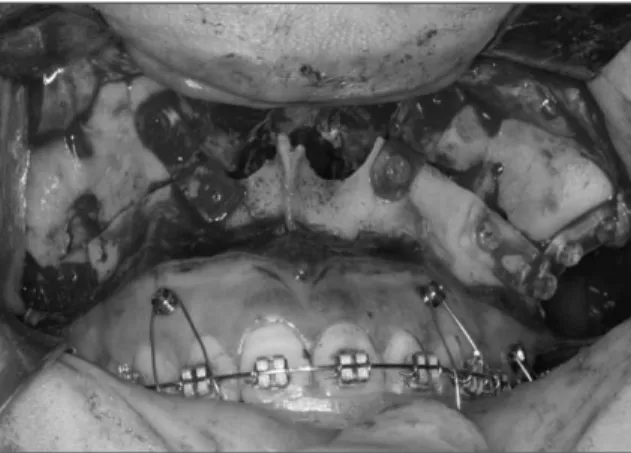
All the operations in this study were performed by the same surgeon with the same surgical protocol. The patients were treated by internal fixation using bioab- sorbable plates and 2.4-mm, 2.0-mm pretapped screws (Biosorb FX, Bionix Implants, Inc., Finland). A single 2.4- mm plate was used for the fixation of split segments of mandible during bilateral sagittal split ramus osteotomy (BSSRO) procedure (Fig. 1). Four 2.0-mm plates were applied for stabilizing the maxillary segment in Le Fort I osteotomy (Fig. 2). Two 2.0-mm plates were bended and adapted to the chin segment in genioplasty (Fig. 3). All the patients had full fixed orthodontic treatment before and after operation. The patients were evaluated for complications during the follow-up period.

RESULTS

Fifty-four patients with dentofacial deformity (17 male patients and 37 female patients) were selected in this study. The patients ranged from 15 to 52 years in age (mean 22.6) and follow-up period was between 8 to 24 months (mean of 15). Thirteen patients had bimaxillary osteomtomies and 41 patients had mandibular reposi- tioning only. Genioplasties were performed for 20 patients in combination with other procedures except 2 cases.

The duration of intermaxillary fixation ranged from 7 to 14 days, with a mean of 8.3 days. Five patients (9.3%) experienced complications. All complications in these cases were infection. No other complications related with physical or mechanical properties of bioabsorbable plates were found such as malunion or nonunion, frac- tures of plates and loosening of screws. All complica- tions were minor and adequately managed with drainage and supportive care with antibiotics coverage.

(Table 1, 2) DISCUSSION

Clinical tests have already proved the excellent bio-

compatibility and corrosion resistance of titanium mater-

ial. And there is little evidence regarding the long term

local and systemic effect when in the maxillofacial skele-

ton. However, it is foreign substance that remains per-

manently in the body. Additional operation may be nec-

essary to remove fixation devices. More over, in the cases

(3)

Table 2. Clinical data of application of bioabsorbable plates in orthognathic surgery

Type of Surgery Number of Patients Number of Plates Complication

Maxillary osteotomy 13 52 0

LeFort I osteotomy 13 52 0

Advancement 5 20 0

Impaction 8 32 0

Mandibular osteotomy 72 144 0

Bilateral Sagittal Split Ramus Osteotomy 52 104 5

Advancement 1 2 1

Set-back 51 102 4

Genioplasty 20 40 0

Advancement 4 8 0

Set-back 6 12 0

Reduction 10 20 0

Total 85 196 5

Table 1. Patients’characteristics

Diagnosis Number of patients

(male/female)

Facial asymmetry 13 ( 7/6 )

Mandibular prognathism 39 (10/29)

Mandibular retrognathism 2 ( 0/2 )

Total 54 (17/37)

Fig. 1. Application of bioabsorbable plate and screws in BSSRO. A single 2.4-mm plate was used for the fixation of split segments of mandible during BSSRO procedure.

Fig. 2. Application of bioabsorbable plates and screws in Le Fort I osteotomy. Four 2.0-mm plates were applied for stabilizing the maxillary segment in Le Fort I osteotomy procedure.

Fig. 3. Application of bioabsorbable plates and screws in

genioplasty. Two 2.0-mm plates were bended and adapted

to the chin segment in genioplasty procedure.

(4)

removal of metallic plate is not mandatory procedure, there were some cases to remove plates and screws for various reasons. Furthermore, some patients just want to remove the metallic plates from their body without any complications.

There have been controversial opinions on the removal of fixation devices. Removal of titanium plates and screws after completion of bony healing process is advo- cated in some surgeons without any evidence of compli- cations. Other clinicians reported successful clinical results of titanium devices and claimed that routine removal of titanium fixation devices was not recom- mendeded

10)

. Kim et al suggested that the titanium plates should be removed routinely after completion of bone healing on the base of destructive findings of hard and soft tissue surrounding titanium plates in microscopic examination

11)

.

The use of bioabsorbable materials to stabilize the facial skeleton was firstly reported by Cutright et al.

12)

The development of self-reinforcing manufacturing tech- nique marked a new era in bioabsorbable materials.

Reinfo- rcement by parallel polylactide fibers and poly- mer blending increases the mechanical strength of this material considerably, and therefore suggested the possi- bility of its use for internal fixation. With this sintering technique, it could be possible to avoid the use of bulky plates which have been associated with some shortcom- ings. Self-reinforcing technique also produce strong and malleable devices which are bent at room temperature by a set of mini-bending pliers. A variety of synthetic high-molecular weight polymers have been investigated including polylactides (PLA) and polyglycolides (PGA)

13,14)

. In the past, poly-L-lactide (PLLA), a derivate of polyhydroxy acids, was used for internal fixation in oral and maxillofacial surgery. Initial results of PLLA plates and screws were promising. However, some of the disadvantages of PLLA have become clear, including for- eign body reactions, osteolysis around the screws and a long degradation period. To overcome these problems, various polymer combinations have been tried to improve the mechanical properties and degradation kinetics of the bioaborbable fixation devices. By adding D-lactide it was possible to reduce crystallinity and so increase biodegradability.

In this study, the Biosorb FX bioabsorbable fixation sys- tem (Bionix Implants Inc., Tampere, Finland) was used.

designs, which are made of self-reinforced poly-L/D lac- tide (PLDLA) copolymer in a ratio of 70% L-lactide and 30% D-lactide. The hydrolytic degradation of these copolymers yields lactic acid monomers, which are fur- ther metabolized by the citric acid cycle, yielding energy, carbon dioxide and water. Carbon dioxide is excreted by the lungs.

In recent years, there have been a number of studies reporting successful clinical application of bioabsorbable internal fixation devices in orthognathic surgery

15,16)

. Many researchers were able to demonstrate promising results in terms of clinical morbidities and skeletal stabil- ity

17,18)

.

In this study, successful results were obtained. Only minor complications were detected in 5 cases. The infec- tion subsided rapidly with drainage and supportive care with antibiotics coverage and there was no clinical evi- dence of chronic inflammation in the infected site. It was interesting that there were no infection in maxillary pro- cedures. It was known that the fixation devices applied in maxillary procedure can be the source of maxillary sinusitis and there were several reports on the removal of fixation devices due to maxillary sinus infection

19)

. The bioabsorbable fixation device was ruled out from the direct source of infection or foreign body.

The successful application of bioabsorbable plates and screws may be associated with technique during the drilling procedure. Careful attention to the preparation of the holes is requested to get the adequate angulation and to avoid oversized holes that preclude effective tap- ping. Also, there is accidental grinding of the plates dur- ing drilling procedure. For the correct angulation of drilling procedure, vertical osteotomy was performed more anterior in BSSRO. It is suspected that the dena- tured polymer particles heated and grinded during the drilling procedure is the source of infection.

Close adaptation of plates to the bony segment is

important for the stability of fixation. Easy manipulation

of plates at room temperature in the same way of titani-

um plates is possible in Biosorb FX system. Biodegra-

dable property is associated with several subsequent

advantages. Most of all, it is consequently more econom-

ic because there is no need to consider the cost of addi-

tional operation for device removal. Radiolucency is ben-

eficial to patients unwilling to disclose the history of

their surgical interventions. Many patients are psycho-

(5)

However, in contrast to the titanium internal fixation devices, biodegradable devices have not been used on a large scale in orthognathic surgery. Hesitation to choose bioabsorbable devices is partly due to the deficiency of confidence on the strength of materials and additional time-consuming procedure including tapping or heating.

Also bioabsorbable devices have several technical prob- lem to be improved such as weakness of screw head.

Nevertheless, it is still attractive to use bioabsorbable materials as fixation devices. Making up for these weak points in the current systems, the use of these fixation systems in orthognathic surgery will provide a promis- ing alternative of titanium internal fixation devices in appropriate cases.

REFERENCES

1. Tuovinen V, Norholt SE, Sindet-Pedersen S, Jensen J: A ret- rospective analysis of 279 patients with isolated mandibu- lar fractures treated with titanium miniplates. J Oral Maxillofac Surg 1994;52:931-935.

2. Matthew IR, Frame JW: Policy of consultant oral and max- illofacial surgeons towards removal of miniplate compo- nents after jaw fracture fixation: pilot study. Br J Oral Maxillofac Surg 1999;37:110-112.

3. Iizuka T, Lindqvist C: Rigid internal fixation of mandibular fractures. An analysis of 270 fractures treated using the AO/ASIF method. Int J Oral Maxillofac Surg 1992;21:65-69.

4. Fiala TG, Novelline RA, Yaremchuk MJ: Comparison of CT imaging artifacts from craniomaxillofacial internal fixation devices. Plast Reconstr Surg 1993;92:1227-1232.

5. Fiala TG, Paige KT, Davis TL, Campbell TA, Rosen BR, Yaremchuk MJ: Comparison of artifact from craniomaxillo- facial internal fixation devices: magnetic resonance imag- ing. Plast Reconstr Surg 1994;93:725-731.

6. Schliephake H, Reiss G, Urban R, Neukam FW, Guckel S:

Metal release from titanium fixtures during placement in the mandible: an experimental study. Int J Oral Maxillofac Implants 1993;8:502-511.

7. Jorgenson DS, Mayer MH, Ellenbogen RG, Centeno JA,

Johnson FB, Mullick FG, Manson PN: Detection of titanium in human tissues after craniofacial surgery. Plast Reconstr Surg 1997;99:976-979.

8. Eppley BL, Sadove AM, Havlik RJ: Resorbable plate fixa- tion in pediatric craniofacial surgery. Plast Reconstr Surg 1997;100:1-7.

9. Tharanon W, Sinn DP, Hobar PC, Sklar FH, Salomon J:

Surgical outcomes using bioabsorbable plating systems in pediatric craniofacial surgery. J Craniofac Surg 1998;9:441- 444.

10. Ferretti C, Reyneke JP: Mandibular, sagittal split os- teotomies fixed with biodegradable or titanium screws: a prospective, comparative study of postoperative stability.

Oral Surg Oral Med Oral Pathol Oral Radiol Endod 2002;

93:534-537.

11. Kim YK, Yeo HH, Lim SC: Tissue response to titanium plates: a transmitted electron microscopic study. J Oral Maxillofac Surg 1997;55:322-326.

12. Cutright DE, Hunsuck EE, Beasley JD: Fracture reduction using a biodegradable material, polylactic acid. J Oral Surg 1971;29:393-397.

13. Suuronen R: Biodegradable fracture-fixation devices in maxillofacial surgery. Int J Oral Maxillofac Surg 1993;22:50- 57.

14. Suuronen R, Pohjonen T, Vasenius J, Vainionpaa S:

Comparison of absorbable self-reinforced multilayer poly- l-lactide and metallic plates for the fixation of mandibular body osteotomies: an experimental study in sheep. J Oral Maxillofac Surg 1992;50:255-262.

15. Kallela I, Laine P, Suuronen R, Iizuka T, Pirinen S, Lindqvist C: Skeletal stability following mandibular ad- vancement and rigid fixation with polylactide biodegrad- able screws. Int J Oral Maxillofac Surg 1998;27:3-8.

16. Shand JM, Heggie AA: Use of a resorbable fixation system in orthognathic surgery. Br J Oral Maxillofac Surg 2000;

38:335-337.

17. Turvey TA, Bell RB, Tejera TJ, Proffit WR: The use of self- reinforced biodegradable bone plates and screws in orthog- nathic surgery. J Oral Maxillofac Surg 2002;60:59-65.

18. Haers PE, Sailer HF: Biodegradable self-reinforced poly- L/DL-lactide plates and screws in bimaxillary orthognathic surgery: short term skeletal stability and material related failures. J Craniomaxillofac Surg 1998;26:363-372.

19. Schmidt BL, Perrott DH, Mahan D, Kearns G: The removal

of plates and screws after Le Fort I osteotomy. J Oral

Maxillofac Surg 1998;56:184-188.

수치

Table 2. Clinical data of application of bioabsorbable plates in orthognathic surgery

참조

관련 문서

Anxiety, depression, and sleep disturbances are closely correlated with the relationship between patients and caregivers, and have been identified as factors

(Background) The standard triple therapy used as the first-line treatment for Helicobacter pylori infection are a combination of proton pump inhibitor(PPI),

Micro- and nano-sized pores were formed on the surface of the alloy using PEO and anodization methods, and the pore shape change according to the Zr

Arbab-Chirani, PhD,c,d and Sylvain Calloch, PhD,cBrest and Plouzané, Oral Surgery, Oral Medicine, Oral Pathology, Oral Radiology, and Endodontology (2011)

Various studies have been performed to improve properties of material, electrical and mechanical properties of railway train according to the increase of the speed in the

quality of life and improved standard of living, and as reflected in this popular desire, kiosks provide various forms of food-related information and have

To this end, among the art fields presented in the 2015 Revised Middle School Art Textbook, the weight, content, and reference plates of each area occupied by

3,4 Therefore, to date, studies have been conducted to examine the absorbable fixation plate manufactured using polymer and a fixation screw that can