Manuscript received April 24, 2016, revised May 26, 2016, accepted June 2, 2016
A Feasibility Study on Adopting Sliding Pressure Operation for Drum Type Boiler
SeHyun Baek†, HyunHee Kim, SangBin Park, YoungJoo Kim, Hoyoung Park
KEPCO Research Insitute, Korea Electric Power Corporation, 105 Munji-Ro Yusung-Gu, Daejeon 305-380, Republic of Korea
Abstract
In general, drum-type boilers are designed for base load duty and applied under constant pressure operation mode. Recently, however conditions often occur that even drum-type boilers have to operate at partial load conditions. A feasibility study on adopting the sliding pressure operation for drum-type boiler was conducted, and corresponding performance changes and effects on the equipment were analyzed by utilizing a process simulation model. As a result, the conclusion was reached that drum type boilers are able to adopt the sliding pressure operation and can improve of net efficiency at part load operation in spite of the Rankine cycle efficiency reduction due to the decreases in main steam pressure. Because of thank to improvement of high pressure turbine stage-1 internal efficiency and power savings of boiler feed water pump. The sliding pressure operation is advantageous in terms of stress level relief for boiler tube as well as maintaining the rating steam temperature at part load condition. However, cautions are required because the drum boilers have poor dynamic response characteristics which may get worse during the sliding pressure operation.
Keywords: Drum Boiler, sliding pressure operation, performance
I. INTRODUCTION
The sliding pressure operation refers to the method of reducing the main steam pressure at part load operation condition by full opening the main steam control valve, in order to improve the net efficiency by improvement of high-pressure turbine stage- 1 internal efficiency and saving of boiler feed water pump. This operation method is generally being applied in once-through type power plant boilers [1].
Application of sliding pressure operation method to drum- type boiler is extremely rare because they are usually designed for base load duty and applied under constant pressure operation mode. Due to power grid system operating condition, however even the drum type boilers often have to operate at partial load condition.
In this study, we conducted a feasibility study to adopt the sliding pressure operation in a drum-type boiler and analyzed the performance and effects on the equipment by using a process simulation model.
II. CONCEPT OF SLIDING PRESSURE OPERATION A. Overview of Boiler Pressure Control System
1) Constant Pressure Operation
Constant pressure operation is the method that controls the power plant output by using the control valve of the turbine, while the boiler maintains the constant pressure of the main steam.
In other words, its throttle loss is high at the partial load because the amount of steam which is required from the turbine is controlled by the throttle of turbine control valves. Therefore, this method is advantageous for base-load type power plant, compared to cycling-load type. This is the reason why the drum
type boilers apply constant-pressure operation mode, most of which are designed as base-load duty.
2) Sliding Pressure Operation
Sliding pressure operation is the method which controls the power plant output by varying the steam pressure using boiler load control, while maintaining the turbine control valve in a fully open state.
a) Pure Sliding Pressure Operation Method
Pure sliding pressure operation method is very advantageous in terms of thermal efficiency, because this method delivers the required power output by control the steam pressure using boiler load control, while maintaining all turbine control valves in a fully open state without throttle loss.
However, this method has a disadvantage in dynamic response to the power load variation, because the main steam pressure is controlled by adjusting the fuel throughput of the boiler
b) Modified Sliding Pressure Operation Method
This method is used to improve the dynamic response characteristic by using the accumulated heat capacity of boiler promptly, whenever the load suddenly increases or decreases, while controlling the turbine control valves close to normal condition.
This method can not only obtain the advantages of sliding pressure operation method but also partly solve the poor dynamic response characteristic of pure sliding pressure operation, although throttling losses inevitably occurs.
B. Performance Characteristics of Sliding Pressure Operation 1) Improvement of High Pressure Turbine Stage-1 Internal
Efficiency
The internal efficiency of HP turbine is improved because there is no throttle loss between the main steam and the first nozzle of HP turbine when sliding pressure operation method is applied.
Generally, the design of turbine nozzle exit velocity (spouting velocity) V0 is optimized for the VWO (Valve Wide Open) load condition. So maximum efficiency is achieved only at that load.
= 1 − = × 1 −
(1) If it is possible to eliminate valve throttling loss of the control valves and could match the ratio of rotation velocity (W) to absolute velocity (V0) with that of optimized VWO condition, then the efficiency of the first section of HP turbine will be able to achieve the best efficiency regardless of the output.
= = .
√ (2)
HP = HP (3)
Meanwhile, the IP and LP turbine has little efficiency change according to the load variations due to the nature of the turbine design characteristic. Therefore, the efficiency change according to the operation mode is generated almost only in HP turbine [3].
2) Decrease in Rankine Cycle Efficiency
Rankine cycle efficiency refers to the thermodynamic efficiency of the turbine cycle, regardless of the mechanical
efficiency in the turbine. Therefore, the efficiency is determined by the temperature and pressure of the working fluid (steam). If the sliding pressure operation is adopted, Rankine cycle efficiency is reduced as shown in Fig. 2. That is to say it can influence the increasing heat rate of the cycle.
3) Power Savings of Boiler Feed Water Pump
The power consumption of the feed pump in the constant- pressure operation mode is not largely changed regardless of the power plant output, because the main steam pressure is constant at all load range. However, when the sliding pressure operation the boiler feed water pump power is varied in accordance with required main steam pressure changes.
In that case, it is possible to reduce cycle heat rate at the partial load power condition if the pump can change the rotation speed with such as hydraulic coupling.
III. SIMULATION RESULTS & DISCUSSION A. Modeling and Simulation Methods
The target plant which is considered to evaluate the sliding pressure operation method is domestic N-power plants. The main specification is listed in Table 1.
The plant was originally designed at the rated output of 100 MW, but now it is operated below about 80 MW of average weekly output, and about 60 MW for night time depending on the power grid system operating condition.
In order to predict the effect of applying sliding pressure operation on the performance and impact on equipment, we conducted process modeling for the power plant boiler and turbine system by utilizing a commercial code like following Fig.
3 and 4. And we also performed off-design simulation for each operation method.
The evaluation for reliability of the simulation model is conducted by comparing the design specification values and calculated values for major operation points.
In the simulation, main steam pressure for each operation method and each power load is set as listed in Table 2 in order to analyze effect of sliding pressure operation method. The other operating parameters were maintained identical for each operation method.
W: tangential velocity of rotation at Pitch point for each blade
V0 : absolute velocity that can be obtained from the effective energy of the each stage
x : reaction degree of each stage
Fig. 1. The velocity ratio and stage efficiency [2].
Fig. 2. Rankine cycle change during to sliding pressure operation.
Table 1. Specification of N-power plant [4]
system Description unit specification
Boiler
Type - Constant Pressure
Drum Type, Balanced Draft Evaporation rate T/h 312.1 at BMCR
Main steam pressure kg/cm2 132.00
Main steam temperature °C 541.00
Reheat steam pressure kg/cm2 24.20
Reheat steam temperature °C 541.00
Turbine
Type - Single Reheat, Condensing, 20 Stages(7/7/6, 25" LSB) Rating power kW 103,600 at MGR
Main steam pressure kg/cm2 128.00
Main steam temperature °C 538.00
Reheat steam pressure kg/cm2 22.99
Reheat steam temperature °C 538.00
Extraction stage ea 6
Condenser vacuum mmHg 721.90
B. Results and Discussion 1) Performance
Net plant efficiency can be achieved at part load condition by adopting the sliding pressure operation as shown in Fig. 5, in spite of the decrease in Rankine cycle efficiency.
The effect of sliding pressure operation was remarkable at lower partial load conditions and when the control valve is fully open.
The main difference between the constant pressure operation and sliding pressure operation method for turbine is the throttling
loss of the control valves and nozzle exit spouting velocity.
When the constant pressure operation is applied, internal efficiency of HP turbine section-1 is significantly reduced at the partial load condition.
On the other hand, if the sliding pressure operation is adopted, it is possible to maintain the internal efficiency almost equal to the rated load condition even at the part-load conditions, as like shown in Fig. 6.
Fig. 7. compares the power consumption of the boiler feed water pump for each operational method at each partial load.
The result shows that it is possible to reduce the internal power consumption of the boiler feed water pump by adopting sliding pressure operation method.
In case of constant pressure operation mode, the power consumption of boiler feed water pump is not largely changed regardless of the power plant output.
When the sliding pressure operation is applied, however, the boiler feed water pump power is varied in accordance with required main steam pressure changes.
In actual application, its effect will be somewhat different, depending on pressure control ability of boiler feed water pump and control system type.
2) Impact on Equipment and Operation
Fig. 8 represents the result of comparing the hoop stress of final heat boiler tube for each operational method at each partial load.
The life-time of boiler tubes can be extended and the risk of rupture accident can be alleviated by effect of reduced boiler tube hoop stress when sliding pressure operation is adopted. The fatigue life consumption is accumulated during the load change in the boiler due to stress. However, the fatigue life consumption could be minimized when operating pressure is reduced
Fig. 5. Net plant efficiency.
Fig. 6. HP turbine section1 internal efficiency.
Table 2. Applied operation method for simulation Operation method Main steam pressure (kg/cm2) note
100% load 75%load 50%load
Constant pressure 128 128 128 control valve throttling Partial sliding
pressure 128 112 96
Full sliding pressure 128 96 64 control valve fully open
Fig. 3. Boiler system process analysis model for N-power plant.
Fig. 4. Turbine system process analysis model for N-power plant.
significantly because the maximum stress level is also lowered.
The risk of tube overheating at the partial power load point will be reduced by ensuring the minimization action of the flow distribution imbalances of steam. Since the specific volume of steam is increased as the steam pressure reduced.
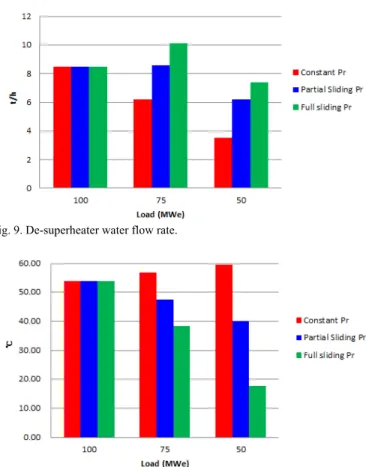
A larger amount of de-superheater water flow rate is required,
when sliding pressure operation is applied, as shown in Fig. 9.
The specific heat of final superheater outlet condition (128 kg/cm2, 540 °C) for constant pressure operation at 50% load is 2,638 J/kgK, while the specific heat of final superheater outlet condition (64 kg/cm2, 540 °C) for sliding pressure operation at 50% load is 2,376 J/kgK.
Therefore, de-superheater water flow rate is increased because the steam temperature tents to rise as the specific heat of the steam is reduced during the sliding pressure operation.
The more the part-load operation, the more tendency is appeared that radiation heat transfer is getting reduced while convection heat transfer getting increased.
Therefore, increased excess air ratio and re-circulation gas flow setting is applied in this simulation at the partial load to maintain the rating steam temperature.
But in the case of power plant with no measure for steam temperature control (such as gas recirculation system or burner tilt), it is hard to maintain the rating temperature of the superheater and reheater steam temperature.
However, if the sliding pressure operation is applied, it can be helpful to relieve the phenomena mentioned above.
The risk of boiling phenomena occurs at the boiler economizer section will be increased due to the reduction of steam saturated pressure when the sliding pressure operation method is applied.
Fig. 10 shows the temperature margin which is the deviation between the economizer outlet temperature and its saturation temperature. In case of sliding pressure operation method, only 18 °C temperature margin is secured at 50% partial load point.
The available maximum pressure selection for adopting sliding pressure operation is main steam pressure conditions (high-pressure turbine inlet).
While Minimum pressure is determined with a sufficient margin, between the minimum pressure for preventing boiling phenomena occured at the boiler economizer section (Saturation pressure corresponding to the economizer outlet water temperature), and the pressure which is corresponding to the high-pressure turbine Rolling Condition at startup.
When the load change occurs under the control valve is fixed position, steam pressure changing is accompanied at the same time. And the amount of change in the pressure is greater in case of sliding pressure operation than during constant pressure operation.
Substantially, the dynamic response characteristic of drum type boiler is poor, because the steam generation control only relies on flame intensity change.
While Once-through boiler using two parallel processes control which are feed water and flame intensity control.
What is more, this poor dynamic response characteristic of drum type boiler is getting worse when adopting sliding pressure operation Since the turbine control valve is fully opened.
IV. FIELD OPERATION DATA ANALYSIS
The recorded application of sliding pressure operation method is very rare in drum-type boilers, because the boilers are designed as base load duty and typically adopt constant pressure operation mode.
In case of domestic power plants, there was experience of temporarily adopting partially reduced pressure operation method in a the drum-type fluidized bed boiler which was to solve a poor
Fig. 7. Boiler feed water pump power consumption.
Fig. 8. Final superheater tube hoop stress & pressure.
Fig. 9. De-superheater water flow rate.
Fig. 10. Economizer outlet approach temperature.
reheat steam temperature problem [5]. And report stated that method was effective to maintain the normal temperature of the steam. But it was not possible to obtain detailed operating data.
Meanwhile it is possible to obtain the operation data [6]
regarding the reduced pressure operation test at the part load condition for Y power plant which has a drum type boiler. So, the operation data analysis was performed based on that data as follows.
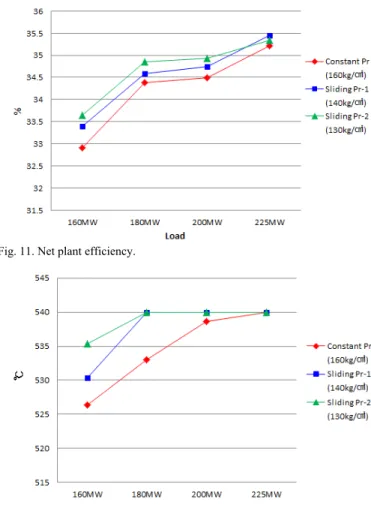
Fig. 11 compares the results for effect of each operation method on net plant efficiency. The reduced pressure operation method could achieve higher efficiency than constant pressure method for each load point. At the lower load, the more benefit of the reduced pressure operation is achieved.
Fig. 12 illustrates the effect of each operation method on the boiler reheater outlet steam temperature.
There is a tendency that reheater outlet steam temperature
could not satisfy the rating condition at the low load condition due to the changed in ratio between radiation and convection heat transfer characteristics.
However, the sliding pressure operation method exhibited relatively good results.
V. CONCLUSIONS
The drum type boiler is able to adopt the sliding pressure operation to improve the plant net efficiency during partial load operation, although the Rankine cycle efficiency is reduced by the decrease in main steam pressure. The improvement in the efficiency is larger at lower loads.
When applying the sliding pressure operation, the net plant efficiency at the part load condition can be improved by the following reasons;
▪ Improvement of high pressure turbine stage-1 internal efficiency by throttling losses removing and spouting velocity optimization.
▪ Power savings of boiler feed water pump due to reduced pressure.
▪ Maintaining the rating steam temperature.
The impact of the sliding pressure operation on the equipment and operation of the drum boiler is as follows;
▪ Increasing risk of boiling at the boiler economizer section due to the reduction of saturated pressure.
▪ Improved reliability in terms of stress level relief for boiler tube and risk reduction of local overheating.
REFERENCES
[1] Sehyun Baek, "Variable pressure operation of drum boiler", KCA News Vol 77, 2010.
[2] K.C. Cotton, "Improving and evaluating steam turbine performance,"
2nd Edition, 1998.
[3] Joongho Lee, "Thermo dynamical design theory and application for variable pressure operation", International power technology, TM- 8.
[4] KOSPO, "Technical data steam generator and auxiliaries for Namjeju # 3,4", 2007.
[5] T. H. Kim, Y. S. kyun, B. C. Park, " Performance Change Characteristics of Turbine Cycle by Decreasing Main Steam Pressure of Fossil Power Plant", Kosee symposium, pp140, 2015.
[6] KEPCO, " Annual power plant O&M report of Yeusu", 1980. 2009.
Fig. 11. Net plant efficiency.
Fig. 12. Reheater outlet steam temperature.
![Fig. 1. The velocity ratio and stage efficiency [2].](https://thumb-ap.123doks.com/thumbv2/123dokinfo/4900896.291535/2.936.482.872.88.341/fig-velocity-ratio-stage-efficiency.webp)