약학회지 제 56 권 제 4 호 236~239 (2012) Yakhak Hoeji Vol. 56, No. 4
236
육계 유래 Cinnamaldehyde의 투여와 항염증 및 진통효과의 평가
제 현 동#
대구가톨릭대학교 약학대학 약물학교실 (Received May 23, 2012; Accepted July 27, 2012)
Antinociceptive and Anti-inflammatory Properties of Cinnamomum cassia Derived-cinnamaldehyde in Rodents
Hyun Dong Je#
Department of Pharmacology, College of Pharmacy, Catholic University of Daegu, Gyeongbuk 712-702, Korea
Abstract — The aim of present study was to investigate the possible influence and the related mechanism of Cinnamomum cassia derived-cinnamaldehyde on the inflammation or nociception. Cinnamomum cassia was referred to be treated for com- mon cold or dyspepsia in the traditional medicine. However, there are no reports on the antinociceptive or anti-inflammatory properties of cinnamaldehyde, the primary ingredient of Cinnamomum cassia. We hypothesized that cinnamaldehyde would play a role in the modulation of inflammation or nociception evoked by carrageenan, acetic acid or heat. Male Institute of Cancer Research mice were used and the size of edema, frequency of writhing and latency of abnormal behaviors such as licking, flicking, shaking or jumping were measured and recorded. The present study was carried out to evaluate the anti- inflammatory and antinociceptive effects of cinnamaldehyde. The administration of cinnamaldehyde (30 and 100 mg/kg) inhibited carrageenan-induced paw edema only at the final phase, suggesting the blockade of synthesis or release of pros- taglandins. It also reduced the frequency of the acetic acid-induced writhing reflex in mice. In addition, the administration of cinnamaldehyde prolonged the latency for extraordinary reaction at the hot plate in mice. In conclusion, cinnamaldehyde has anti-inflammatory and analgesic properties and is a potential therapeutic for inflammation and nociception.
Keywords □ anti-inflammatory, cinnamaldehyde, hot plate, writhing
통증은 조직을 손상시킬 수 있는 위협을 감지하여 방지하거나 그 정도를 최소화 할 수 있는 인체의 방어 작용이며 발생 원인 으로 외상 및 기타 물리적 요인에 의한 신경세포 손상, 면역반응 및 기관이나 조직에 도달하는 혈류의 이상 등이 있다. 염증은 인 체의 손상 및 감염 등에 대한 일차적인 보호 작용으로 물리화학 적 요인, 면역학적 요인 등에 의해 발생하며 발적, 발열, 부종, 통 증을 동반한다. 염증과 통증은 침입 인자에 대한 생체의 방어 작 용으로 특히 염증은 공격인자에 대해 혈관이 확장되고 체액과 세 포가 목표조직으로 접근하는 식으로 대응하는 신체의 반응이며1) 염증의 중요한 신호로 통각수용기의 직접적 자극이나 염증성 매 개물의 작용에 의해 촉발되는 통증이다.2)이들 매개물질에 히스 타민, 세로토닌, 류코트리엔, 프로스타글란딘 등이 포함되며 이 들은 혈관 투과성을 증가시키며 염증 부위로 백혈구의 이동을 증
가시킨다. 그리고 심혈관계 질환, 대사성 질환, 소화성 궤양, 암 등 다른 병리적 과정들도 염증과 관련이 많다.3)게다가 직접적 인 화학자극 또는 자가면역반응에 의한 2차 반응에 의해 초래되 는 염증과 조직 손상, 감염, 종양의 성장 등으로 초래되는 염증 은 지속적이고 장기적인 통증을 유발하기도 하여 삶의 질을 저 하시키고 만성적인 통증은 불안, 우울 등의 정신질환을 초래하 기도 한다.4-6)염증성 통증에 대해 일반적으로 비스테로이드성 소염진통제가 사용되고 있으나 소화불량, 위 점막의 자극, 위장 출혈, 궤양, 수분 저류, 신독성 및 심혈관계 이상반응 등의 부작 용으로 그 사용이 최근에 제한되었다.7-9)따라서 현재까지도 더 나은 물질을 찾으려고 노력하고 있으며 이러한 노력은 통증 전 달과 염증 발생과 관련된 기전을 이해하는데 도움이 된다.10)
본 연구 대상인 계지는 녹나무과에 속한 상록교목인 육계 또는 동속 근연식물의 어린 가지를 기원으로 하는 본초로 월경부조, 수 종, 소변불리, 심계 등에 응용한다. 주요 성분은 cinnamaldehyde 이고 그 밖에 cinnamic acid, o-ethoxycinnamic acid, coumarin, benzylenzoate, β-cadinene, calamenene, taxifolin, protocatechuic
#본 논문에 관한 문의는 저자에게로
(전화) 053-850-3615 (팩스) 053-850-3602 (E-mail) [email protected]
종설
Cinnamaldehyde의 통증 조절 효과 237
Vol. 56, No. 4, 2012
acid, protocatechuic aldehyde, daucosterol 등이 보고되었는데11) 그 중 cinnamaldehyde(Fig. 1)와 cinnamic acid가 Cinnamomum 속 식물을 기원으로 하는 육계와 계지의 정량 및 정성 시험에서 가장 많이 활용되는 지표성분이다.
따라서 이번 실험의 목적은 다양한 실험동물모델을 사용하여 육계에서 유래된 cinnamaldehyde의 염증과 통증 조절을 관찰 및 평가하고 그 역할을 설명하는 것이다. 이번 실험에서 carrageenan 으로 염증을 유도하고 초산 acetic acid이나 열로 통증을 유도하 여 cinnamaldehyde의 억제 활성을 측정하였고 이를 기존의 indomethacin과 비교하여 효력이 좋으면서 부작용이 적은 새로 운 기전의 소염진통제을 개발하고자 노력하였다.
실험방법
재료, 시약 및 기기
다음과 같은 약품이 사용되었다. Indomethacin(Sigma, St.
Louis, MO, USA), carrageenan(Sigma), cinnamaldehyde (Sigma), pentobarbital sodium(Dongwon, Korea), sodium chloride(Sigma), ICR(Institute of Cancer Research) 마우스 (Hyochang Science, Korea). 그 외 다른 시약은 특급 또는 일급 으로 사용하였다. 약품은 3차 증류수에 용해되어 필요에 따라 Krebs 용액이나 생리식염수에 첨가되었다.
실험과정
본 실험은 US National Institute of Health(NIH, 1996)에 의 해 출판된 실험동물의 care와 use에 대한 guide에 따라서 수행 되었다. 무게 25~30 g의 성숙한 웅성 ICR 마우스가 실험에 사 용되었다. 실험동물은 분리된 상자에 개별적으로 수용되었고 1 주일 이상 사료와 물이 충분히 공급되었다. 그 다음 무작위로 대 조군, 대조약 및 시험약 처치군으로 분류되었고 점진적인 적응 기를 거쳐 carrageenan, acetic acid 또는 heat 등에 노출되었다.
염증 유도
마우스에 1% carrageenan 0.02 ml을 피하 주사하여 염증을 유 도하였다. 마우스는 carrageenan 피하투여 1시간 전에 생리식염 수(대조군), cinnamaldehyde(30, 100 mg/kg) 또는 indomethacin
(10 mg/kg, 양성 대조군)을 각각 전처치하였다.
초산 유도 writhing test
초산용액(1%, v/v)을 마우스에 복강투여하고 마우스는 각각 관 찰자가 보이지 않도록 하여 사육용 투명 케이지 가운데에 넣고 60분간 writhing 횟수를 측정하였다. 마우스는 초산 복강투여 1 시간 전에 생리식염수(대조군), cinnamaldehyde(30, 100 mg/kg) 또는 indomethacin(10 mg/kg, 양성 대조군)을 각각 전처치하였다.
Hot plate test
Hot plate test는 55±1oC로 온도를 고정한 hot plate(IITC Inc., model 39, CA)에서 실시하였다. 생쥐를 열판 hot plate 위 에 놓고 뒷발을 핥거나 흔들거나 점프하는데 걸리는 시간을 측 정하였다. 생쥐는 열자극 실험 1시간 전에 생리식염수(대조군), cinnamaldehyde(30, 100 mg/kg) 또는 indomethacin(10 mg/kg, 양성 대조군)을 각각 전처치하였다.
통계 분석
모든 실험결과들은 평균±표준오차로 나타내었고 통계 처리는 Student's t-test를 실시하여 p<0.05를 기준으로 유의성 여부를 판정하였다.
실험결과
고용량 cinnamaldehyde에 의해 유도된 급성 독성
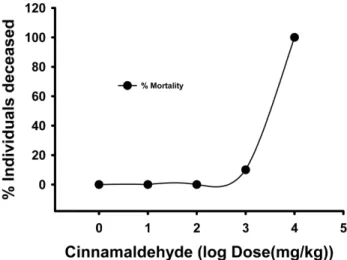
경구 투여된 cinnamaldehyde는 마우스에서 2,000 mg/kg 이상 에서 치사율이 증가하였다(Fig. 2). 즉 50% 치사량이 2,500 mg/
kg인 독성을 나타내었지만 평가기간동안 기타 입모, 비틂, 하수 증, 진전, 경련, 운동실조, 설사 등을 나타내지는 않았다.
Fig. 1− Chemical structure of cinnamaldehyde.
Fig. 2− The effect of cinnamaldehyde on the median lethal dose in the mice.
238 제 현 동
J. Pharm. Soc. Korea Carrageenan에 의해 유도된 염증에 대한 cinnamaldehyde의
효과
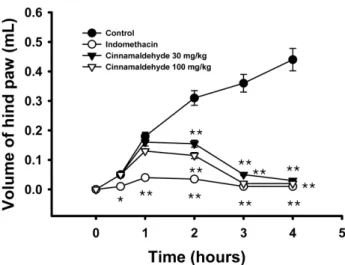
전처치된 cinnamaldehyde는 마우스에서 1% carrageenan에 의 해 유도된 뒷다리 염증에 대해 1시간 이내에서는 억제 효과가 없 었다가 2시간 이후에서는 농도의존적으로 억제 효과가 있었다 (Fig. 3). 즉 염증의 initial phase에서는 효과가 없었지만 final phase에서는 indomethacin 10 mg/kg와 유사한 정도의 항염증 효 과를 나타내었다. 따라서 cinnamaldehyde는 초기 단계의 히스타 민, 세로토닌 및 브라디키닌의 유리에는 효과가 없고 마지막 단 계의 프로스타글란딘의 합성 및 유리에만 효과가 있는 것으로 생 각된다.
Acetic acid에 의해 유도된 통증에 대한 cinnamaldehyde의 효과
전처치된 cinnamaldehyde는 마우스에서 0.75% acetic acid에 의해 유도된 복부근 수축에 대해 30분 이내에서는 억제 효과가 없었다가 50분 이후에서는 억제 효과가 있었다(Fig. 4). 즉 일정 시간 경과 후에는 indomethacin 10 mg/kg와 유사한 정도의 진 통 효과를 나타내었다.
열에 의해 유도된 통증에 대한 cinnamaldehyde의 효과 전처치된 cinnamaldehyde는 마우스가 뒷발을 핥거나 흔들거 나 점프하는 등 열(55±1oC)에 의해 유도된 이상행동에 대해 저 농도에서는 억제 효과가 약했다가 고농도에서는 억제 효과가 증 가되었다(Fig. 5). 이는 indomethacin 10 mg/kg와 유사한 정도의 진통 효과를 나타내었다. 실내온도에서의 이상행동에 대해서는
효과는 없었다(data not shown). 따라서 휴지기의 구심성 경로 에는 영향이 없었고 통증수용기의 활성화가 관련된 구심성 경로 에는 억제 효과가 있는 것으로 생각된다.
고 찰
일상에서 흔히 접하는 육계의 경우 한방에서 월경부조, 수종, 소변불리, 심계 등에 사용되는 것으로 알려져 있으나 최근 연구 결과에 따르면 항미생물 및 항암효과까지 나타내는 것으로 밝혀 Fig. 4− The effect of cinnamaldehyde on the acetic acid-induced nociception in the mice. Developed contraction is expressed as a percentage of the resting condition. Data are expressed as means of 3-5 experiments with vertical bars showing SEM. *P<0.05, presence versus absence of cinnamaldehyde or indomethacin.
Fig. 3− The effect of cinnamaldehyde on the carrageenan-induced inflammation in the mice. Developed capacity is expressed as a percentage of the resting condition. Data are expressed as means of 3-5 experiments with vertical bars showing SEM. *P<0.05, **P<0.01, presence versus absence of cinnamaldehyde or indomethacin.
Fig. 5− The effect of cinnamaldehyde on the thermally-induced nociception in the mice. Developed licking or flicking is expressed as a percentage of the resting condition. Data are expressed as means of 3-5 experiments with vertical bars showing SEM. *P<0.05, **P<0.01, presence versus absence of cinnamaldehyde or indomethacin.
Cinnamaldehyde의 통증 조절 효과 239
Vol. 56, No. 4, 2012
졌다.12)따라서 이번 실험에서 ICR 마우스를 이용하여 항염증, 진통 등 육계 유래 cinnamaldehyde의 추가 작용을 조사하게 되 었다.
Carrageenan에 의해 유도된 뒷다리 부종은 항염증 약물의 개 발과 연구를 위해 널리 사용되는 급성 염증 모델로 간주된다. 특 히 이런 모델은 cyclooxygenase 억제제에 민감한 것으로 알려져 있고 프로스타글란딘의 합성을 억제하여 작용하는 비스테로이드 성항염증제 NSAIDs의 효과를 평가하기 위해 사용되어 왔다.13) 뒷다리 부종은 연속적으로 유리되는 몇 가지 염증성 매개인자에 의해 진행된다. 즉 초기 단계는 히스타민, 세로토닌 및 브라디키 닌의 유리에 의해 초래되고 그 다음 프로스타글란딘 유리가 carrageenan 투여 후 3시간에서 6시간까지 지속된다. 그런데 마 지막 단계에서 백혈구가 염증 부위로 이주하고 최대 혈관 반응 이 발생하여 중요하다.14)이번 실험에서 cinnamaldehyde의 투여 는 뒷다리 부종을 초기 단계에서 억제하지 못하였고 마지막 단 계에서 억제하였다. 이렇게 carrageenan 투여 후 3시간에서 유 의성 있는 억제효과를 나타내었기에 히스타민, 세로토닌 및 브 라디키닌의 유리에는 효과가 없었고 프로스타글란딘 합성과 유 리를 차단하여 작용하는 것으로 생각된다.
그리고 초산 용액의 복강투여는 복강 내에 염증을 유도하여 마우스에서 writhing reflex를 초래한다. 본 연구자는 이번 실험 에서 cinnamaldehyde가 writhing reflex의 횟수를 감소시키는 지 를 확인하고자 하였다. 실험 결과 양성 대조군으로 사용한 indomethacin은 대조군과 비교하여 writhing의 횟수를 유의적으 로 감소시켰고 cinnamaldehyde도 유사한 결과를 나타내었다(Fig.
4). 또한 본 연구자는 열에 의해 유도되는 통증에 대한 cinnamaldehyde의 진통 활성을 알아보기 위해 hot plate test를 실시하였다. 양성 대조군으로 사용한 indomethacin은 대조군과 비교하여 hot plate 위에서 견디는 시간을 유의적으로 증가시켰 으며 cinnamaldehyde도 모든 용량에서 hot plate 위에서 견디는 시간을 유의적으로 증가시켰다(Fig. 5).
현재 임상에서 다양한 진통제 및 항염증제가 사용되고 있으나 이러한 치료제는 위장관 궤양, 심장발작, 뇌졸중 등의 다양한 부 작용을 초래할 수 있으므로 새로운 진통제 및 항염증제의 개발 이 요구되고 있고 천연물은 이러한 진통제의 소재의 중요한 원 천으로 여겨지고 있다.
결 론
본 실험에서는 염증, 통증 등에 대해 예방과 치료를 목적으로 사용될 수 있는 cinnamaldehyde에서의 염증 조절 기전과 통증 조절 기전에 대해 조사하여 천연물 유래 cinnamaldehyde의 투 여에서의 주의 및 새로운 가능성을 확인하고자 하였다.
Cinnamaldehyde는 다양한 실험동물모델에서 유의성 있는 항염
증과 진통 효과를 나타내었고 이는 indomethacin과 유사하였다.
향후 cinnamaldehyde의 효과와 관련하여 nuclear facter κB, cyclooxygenase 및 matrix metalloproteinases 등을 포함하는 염 증 및 통증 조절 경로 등을 생화학적 방법으로 확인하고자 한다.
참고문헌
1) Schmid-Schonbein, G. W. : Analysis of inflammation. Annu.
Rev. Biomed. Eng. 8, 93 (2006).
2) Brenner, P. S. and Krakauer, T. : Regulation of inflammation: A review of recent advances in anti-inflammatory strategies.
Curr. Med. Chem. Anti-Inflamm. Anti-Allergy Agents 2, 274 (2003).
3) Hansson, G. K. : Inflammation, atherosclerosis, and coronary artery disease. N. Engl. J. Med. 352, 1685 (2005).
4) Merskey, H. : The definition of pain. Eur. Psychiat.
6, 153
(1991).5) Argoff, C. E. : The coexistence of neuropathic pain, sleep, and psychiatric disorders: novel treatment approach. Clin. J. Pain 23, 15 (2007).
6) Fishbain, D. A. : Approaches to treatment decisions for psychiatric comorbidity in the management of the chronic pain patient. Med. Clin. N. Am. 83, 737 (1999).
7) Derle, D. V., Gujar, K. N. and Sagar, B. S. H. : Adverse effects associated with the use of nonsteroidal antiinflammatory drugs: An overview. Indian J. Pharm. Sci. 64, 409 (2006).
8) MacPherson, R. D. : The pharmacological basis of contemporary pain management. Pharmacol. Ther. 88, 163 (2000).
9) Sanchez-Borges, M. : NSAID Hypersensitivity (Respiratory, Cutaneous, and Generalized Anaphylactic Symptoms). Medical Clinics of North America 94, 853 (2010).
10) Darland, T., Heinricher, M. M. and Grandy, D. K. : Orphanin FQ/nociceptin: a role in pain and analgesia, but so much more.
Trends Neurosci. 21, 215 (1998).
11) Yang, L., Zhao, Q., Tan, J., Shang, Z. and Du, Z. : Studies on chemical constituents of Ramulus Cinnamomi. Practical Pharmacy and Clinical Remedies 13, 183 (2010).
12) Cabello, C. M., Bair, W. B., Lamore, S. D., Ley, S., Bause, A. S., Azimian, S. and Wondrak, G. T. : The cinnamon-derived Michael acceptor cinnamic aldehyde impairs melanoma cell proliferation, invasiveness, and tumor growth. Free Radic. Biol.
Med. 46, 220 (2009).
13) Di Rosa, M. and Willoughby, D. A. : Screens for anti- inflammatory drugs. J. Pharmacy Pharmacol. 23, 297 (1971).
14) Vinegar, R., Schreiber, W. and Hugo, R. : Biphasic development of carrageenin edema in rats. J. Pharmacol. Exp. Ther. 166, 96 (1969).