• 검색 결과가 없습니다.

Factors Affecting Customer Satisfaction When Buying on Facebook in Vietnam

N/A
N/A
Protected

Academic year: 2021

Share "Factors Affecting Customer Satisfaction When Buying on Facebook in Vietnam"

Copied!
7
0
0

로드 중.... (전체 텍스트 보기)

전체 글

(1)

Print ISSN: 2288-4637 / Online ISSN 2288-4645 doi:10.13106/jafeb.2020.vol7.n10.267

1

First Author. Le Quy Don Technical University, Hanoi, Vietnam [Postal Address: 236 Hoang Quoc Viet Street, Co Nhue, Bac Tu Liem, Hanoi, 100000, Vietnam] Email: [email protected]

2

Thai Nguyen University of Economics and Business Administration.

Email: [email protected]

3

National Economics University, Hanoi, Vietnam.

Email: [email protected]

4

Corresponding Author. Foreign Trade University, Hanoi, Vietnam [Postal Address: 91 Chua Lang Street, Lang Thuong, Dong Da, Hanoi, 100000, Vietnam] E-mail: [email protected]

© Copyright: The Author(s)

This is an Open Access article distributed under the terms of the Creative Commons Attribution Non-Commercial License (https://creativecommons.org/licenses/by-nc/4.0/) which permits unrestricted non-commercial use, distribution, and reproduction in any medium, provided the original work is properly cited.

Factors Affecting Customer Satisfaction When Buying on Facebook in Vietnam

Tha Hien TO

1

, Du Kim DO

2

, Lan Thi Hoang BUI

3

, Huong Thi Lan PHAM

4

Received: July 30, 2020 Revised: August 23, 2020 Accepted: September 03, 2020

Abstract

With the strong growth of social networking sites such as Facebook in recent years, the potential of exploiting customers on Facebook is increasing. Presently, trading activities on Facebook is rapidly developing. Therefore, businesses have become increasingly competitive when selling products on Facebook, so as to retain customers as well as to satisfy customer, which is of paramount importance. This study was conducted to assess the factors affecting the satisfaction of individual customers in Vietnam when buying goods on Facebook. This study uses multivariate analysis techniques (Confirmatory Factor Analysis, Structural Equation Modeling) to determine the factors affecting customer satisfaction when buying goods on Facebook. Research results from 268 individual customers in Vietnam indicated trust and convenience are the two important factors related to customer satisfaction when buying goods on Facebook. Customer satisfaction is the result of consumer experience throughout the different stages of purchase. The more the shopping experience, the more the customers are satisfied when buying products. The price and products do not affect customer satisfaction (prices are easy to compare and products are easily understood on the Internet; hence, these two factors are not considered as determinants of customer satisfaction). Furthermore, this study provides recommendations to improve customer satisfaction.

Keywords: Customer’s Satisfaction, Buying Behavior, Facebook JEL Classification Code: C38, D70, M21

these sites for buying and selling products. Therefore, online stores have been rapidly developing in the past few years.

According to the statistics of the General Department of Taxation, in June 2017, Hanoi had 13,422 online stores on various social networking sites (General Department of Taxation, 2017). At the same time, Hanoi is second to Ho Chi Minh in terms of the number of Facebook users (14 million users) (Statistic Portal, 2017). With the presence of a large number of Facebook users in Hanoi and Ho Chi Minh, there will also be a large market for developing sales services on Facebook. In addition, there are numerous online stores in other provinces of Vietnam, doing business on various social networking sites.

Several researchers have been studying customer satisfaction related to online purchases. Some of these studies have shown that the expectation of a good quality product must be considered as a consumer standard; this indicator directly affects consumer satisfaction (Moriuchi

& Takahashi, 2016). Besides, some studies have also shown customers’ trust in online stores and price factor affect customer satisfaction; (Shiau & Luo, 2012; Horppu et al., 2008; Piercy et al., 2010; Dodds et al, 1991); while some

1. Introduction

With 64 million Facebook accounts in Vietnam (out of a

total of 97 million) accounting for 3% of the total number of

global Facebook users, Vietnam has become one of the seven

countries with the largest number of Facebook users in the

world (Statistic Portal, 2017). Facebook users not only use

social networking sites for sharing information but also use

(2)

studies have shown that factors such as buying experience and the convenience of online shopping affect customer satisfaction (Ribbink, 2004; Flavian & Associates, 2006;

Szymanski & Hise, 2000).

With the growing popularity of selling goods on Facebook, competition amongst online stores has increased.

Meanwhile, customer satisfaction will become a factor that can retain customers within a store. Therefore, this study was conducted to assess the impact of factors affecting the satisfaction of individual customers in Hanoi when buying goods on Facebook.

2. Literature Review 2.1. Literature Review

Satisfaction in general and customer satisfaction when buying goods on Facebook in particular are assessed by customers through the related aspects that customers are interested in when buying a product. When purchasing/

buying products on Facebook or other online channels, customers are interested in knowing whether or not the products they buy meet their requirements (Moriuchi &

Takahashi, 2016). At the same time, where customers believe in buying products on Facebook, the convenience of trading and reasonable pricing of products being sold on Facebook will also make customers feel satisfied or dissatisfied (especially when compared with traditional purchases).

The product concept in this study refers to the differences between products. Product differentiation, which is a marketing strategy that strives to distinguish a product from its competition, here refers to the strong brand and diverse and quality product lines. This is an ability for online stores to develop competitively and build barriers with traditional suppliers (Moriuchi & Takahashi, 2016). Therefore, products can be identified as one of the strengths of online stores on Facebook. Trust is a customer’s trust in making a purchase after considering the trading environment characteristics (Pavlou, 2003). Trust also comes from the brand of the store selling on Facebook (Moriuchi & Takahashi, 2016). The supplier here refers to the online store on Facebook who complies with what they agree to offer customers in terms of product quality, thereby making customers more confident (Moriuchi & Takahashi, 2016)

Purchasing experience on Facebook is where customers have many options on Facebook; at the same time, through every purchase, customers draw their buying experience for the next time. Online shopping provides consumers with more information and opportunities to compare products and prices, with greater product selection, with convenience and ease of finding desired products online. Purchasing experience increases as more purchases are made on Facebook (Moriuchi & Takahashi, 2016).

Price is the factor that appears in all purchases. In this study, prices are defined as ‘price competition’ when buying goods on Facebook when compared to buying products from traditional stores. Many customers expect online stores to offer their products at the lower price in comparison to traditional stores. In addition, prices are also shown by negotiating product prices when buying goods on Facebook (Moriuchi & Takahashi, 2016).

The convenience of buying products on Facebook is product diversity on Facebook. Convenience helps customers orient their goals, related to their needs (Forsythe et al., 2006; Szymanski & Hise, 2000). The convenience of purchasing on Facebook also brings with it the advantages of product diversity and product availability that online stores offer customers, without psychological barriers while choosing a product.

2.2. Research Model

Figure 1 shows the theoretical research framework model of Moriuchi and Takahashi (2016). The research model includes the following factors: five independent variables which are ‘product’, ‘trust’, ‘price’, ‘convenience’, and

‘experience’, and one dependent which is ‘satisfaction’. The author’s research model is as follows:

Highly rated and branded products can give an advantage to online shopping even when the online store does not really compete with other online stores in terms of price and features (Moriuchi & Takahashi, 2016). In addition, product quality is a standard for customers to consider and be satisfied with suppliers. Therefore, the author hypothesizes the following:

H1: Better products make customers more satisfied Holmes (1991) points out that consumers who believe in a unit will lead to customers will have satisfied expectations for the service that the organization provides. If an online item on Facebook is considered to be reliable, customers will tend to appreciate and be more satisfied when buying.

Therefore, the author hypothesizes the following:

H2: Trust has a positive impact on customer satisfaction

There are many studies that have done an assessment

of the impact of prices on customer satisfaction. Burke et

al. (1992) noted that the main difference between online

shopping and traditional shopping is that customers can

collect price information in many places to compare when

shopping online. As online stores offer consumers a variety

of products, customers can compare product prices from

different websites and find the products at lower prices than

the prices in the stores. Wang (2003); and Evanschitzky et

al. (2004) have shown that consumer satisfaction depends

(3)

not only on service quality but also on price. The author hypothesis is as follows:

H3: Price has a positive impact on customer satisfaction Convenience is one of the advantages of online shopping in general and shopping on Facebook in particular. The fact that customers can buy products on Facebook conveniently and quickly will make them more satisfied with purchasing decisions than buying in traditional stores. Therefore, the author hypothesizes the following:

H4: Convenience has a positive impact on customer satisfaction

Customers always expect to be positive on every purchase on Facebook, so in case that expectations are not met, it will reduce the intention to purchase on Facebook. Conversely, if customers’ expectations are achieved through each purchase, they will be satisfied with their purchases on Facebook. With more and more customers having shopping experience, they have many ways to know to achieve satisfaction. Therefore, the research hypothesis is given by the author as follows:

H5: Experience has a positive impact on customer’s satisfaction

3. Method

3.1. Research Design

The study was carried out through a survey (using a questionnaire) of individual customers in Vietnam who buy

products on Facebook. Time of conducting the survey was December 2019. The author uses the scale (e.g., Szymanski

& Hise, 2000; Moriuchi & Takahashi, 2016) to build a survey with the set of scales used is Likert 5 points, where 1 point is ‘strongly disagree’ and 5 points is ‘strongly agree’.

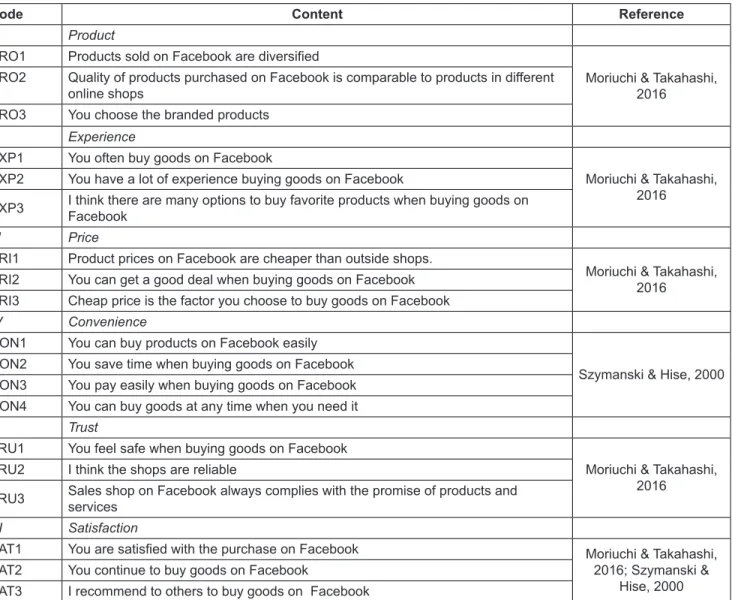
The survey is summarized in Table 1.

3.2. Sample

Subjects of the survey are individual customers in Vietnam who buy products on Facebook. The method of online data collection is used by the author in the research paper. Online survey forms are distributed through email and Facebook channels. The number of survey samples collected by the author are 268 valid samples. With the number of 268 samples, the study was assessed as suitable for the number of samples according to the sampling rules of Tabachnick and Fidell (2007) with the number of samples calculated by 50 + 8 * p = 90, in which p=5 (5 independent variables) 3.3. Data Analysis

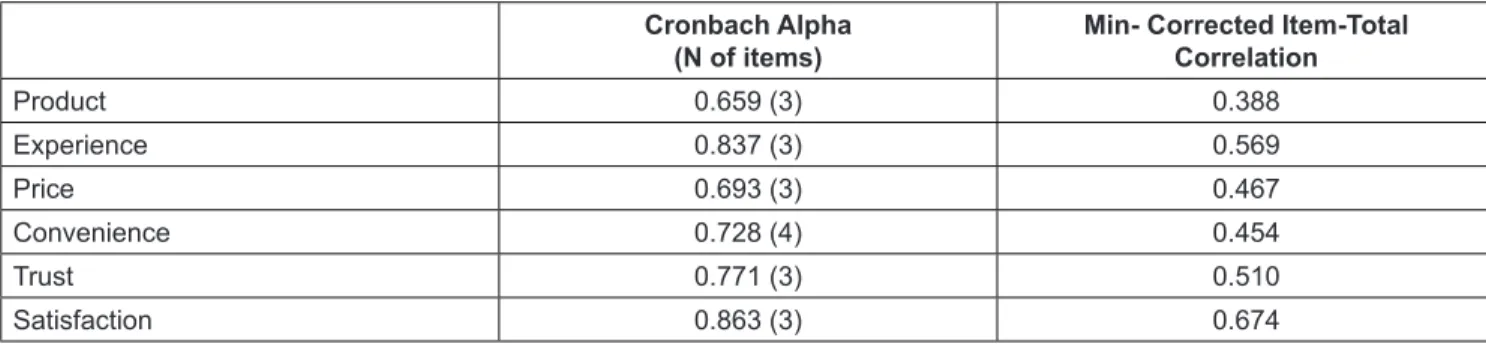
The 268 samples is included in the reliability scale analysis by Cronbach Alpha coefficients, corrected item-total correlation with criteria: Cronbach’s Alpha greater than 0.6, the Corrected Item-Total Correlation is greater than 0.3 (Hair et al., 2006; Nguyen et al., 2020; Nguyen, 2020; Than et al., 2020). Assessing the appropriateness of the research scales:

Confirmatory Factor Analysis (CFA) is used for convergence validity and discriminant validity. The factor is convergence validity when Total Variance Explained (TVE) is greater than 50% and factor loading is greater than 0.5, and the square root of the TVE is greater than the correlation. The research concepts are concepts with discriminant validity (Hair et al.,

H5 H4 H3

H1 H2 Price

Trust

Satisfaction Product

Convenience

Experience
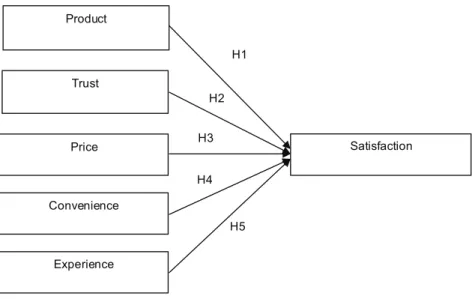
Figure 1: Research Model

(4)

2014). Subsequent studies using structural modeling (SEM) to find out the impact of factors on customer’s satisfaction.

The CFA, critical and SEM models are reliable when the Chi - square / df conditions are less than 3; The value of CFI, TLI, IFI is greater than 0.9; RMSEA coefficient is less than 0.08 (Hair et al., 2004; Kline, 2015).

4. Results

4.1. Results of Reliability Scale

The reliability scale results show that all factors are reliable with Cronbach’s Alpha and is greater than 0.6, and the corrected item-total correlation is greater than 0.3 (see Table 2).

4.2. CFA

After checking the reliability of the scale, the author analyzed the convergence and reliability of the factors using CFA analysis. CFA analysis results show the factor loadings are greater than 0.5 and the Average Variance extracted is also greater than 50%, indicating that factors achieve convergence validity. At the same time, the Composite Reliability (CR) is greater than 0.7, indicating the reliability of factors. Furthermore, the indicators of the appropriateness of the CFA analysis: CFI = .944; TLI = .902; and IFI = .945 are all greater than .9; RMSEA = .704 is less than .08, and Chi2-square / df = 2.450 value is less than 3. This result shows that CFA analysis is appropriate, and the research data is consistent with the market data (see Table 3).

Table 1: The Survey

Code Content Reference

I Product

PRO1 Products sold on Facebook are diversified

Moriuchi & Takahashi, PRO2 Quality of products purchased on Facebook is comparable to products in different 2016

online shops

PRO3 You choose the branded products

II Experience

EXP1 You often buy goods on Facebook

Moriuchi & Takahashi, EXP2 You have a lot of experience buying goods on Facebook 2016

EXP3 I think there are many options to buy favorite products when buying goods on Facebook

III Price

PRI1 Product prices on Facebook are cheaper than outside shops.

Moriuchi & Takahashi, PRI2 You can get a good deal when buying goods on Facebook 2016

PRI3 Cheap price is the factor you choose to buy goods on Facebook

IV Convenience

CON1 You can buy products on Facebook easily

Szymanski & Hise, 2000 CON2 You save time when buying goods on Facebook

CON3 You pay easily when buying goods on Facebook CON4 You can buy goods at any time when you need it

V Trust

TRU1 You feel safe when buying goods on Facebook

Moriuchi & Takahashi, TRU2 I think the shops are reliable 2016

TRU3 Sales shop on Facebook always complies with the promise of products and services

VI Satisfaction

SAT1 You are satisfied with the purchase on Facebook Moriuchi & Takahashi,

2016; Szymanski &

Hise, 2000 SAT2 You continue to buy goods on Facebook

SAT3 I recommend to others to buy goods on Facebook

(5)

Table 2: The Reliability Test

Cronbach Alpha

(N of items) Min- Corrected Item-Total Correlation

Product 0.659 (3) 0.388

Experience 0.837 (3) 0.569

Price 0.693 (3) 0.467

Convenience 0.728 (4) 0.454

Trust 0.771 (3) 0.510

Satisfaction 0.863 (3) 0.674

Table 3: The Reliability Test

Factors Composite Reliability TVE (%)

PRO3 <--- PRO

0.751758 0.709854

PRO2 <--- PRO

PRO1 <--- PRO

EXP3 <--- EXP

0.833136 0.794748

EXP2 <--- EXP

EXP1 <--- EXP

PRI3 <--- PRI

0.731392 0.690262

PRI2 <--- PRI

PRI1 <--- PRI

TRU3 <--- TRU

0.989651 0.985952

TRU2 <--- TRU

TRU1 <--- TRU

CON4 <--- CON

0.742605 0.64882

CON3 <--- CON

CON2 <--- CON

CON1 <--- CON

SAT3 <--- SAT

0.863666 0.871903

SAT2 <--- SAT

Table 4: The Discriminant Validity

PRO EXP PRI CON TRU SAT

PRO 0.843

EXP 0.331 0.891

PRI 0.385 0.467 0.831

CON 0.174 0.556 0.722 0.805

TRU 0.003 0.367 0.319 0.304 0.993

SAT -0.001 0.621 0.493 0.613 0.422 0.934

(6)

Finally, the test of the Discriminant validity between the factors. The results show that the correlation coefficients between the variables are smaller than the square root of the TVE, so the factors reach Discriminant validity (see Table 4).

4.2. SEM Analysis

After CFA analysis, with the factors obtained, the author proceeds to include it in the SEM analysis and obtained the following results (see Table 5):

With VIF less than 10, it is reasonable to include the independent variables in the analysis (no multi-line phenomenon occurs in the model). Trust variables (TRU);

Convenience (CON) and purchase experience (EXP) all have a positive impact on customer satisfaction (p-value is less than 0.05 and positive beta). Product factor (PRO) and price (PRI) do not affect satisfaction (p-value greater than 0.05)

5. Discussion and Recommendation

The trust factor that has a positive impact on customer’s satisfaction shows that customers believe in buying on Facebook based on the image elements as well as sales content that will make shopping more comfortable.

Customers will be more satisfied with increasing the belief factor. The higher level of customer confidence represents a positive feeling for highly satisfying shopping experiences when purchased through Facebook. This result is similar to that of Shiau and Luo (2012). From this result, the author recommends improving customer confidence with online stores on Facebook. In order to do this, shops need to: (1) provide complete and truthful information about products, information of selling goods, and synchronously trust to keep fan page, website to increase reliability; and (2) commitment regimes are transparent and comfortable for both sellers and buyers.

Convenience has a positive impact on individual customer’s satisfaction when buying goods on Facebook.

Not having to travel and still buy the desired item at all times will increase customer satisfaction. The more convenient online shopping is, the more satisfied customers will be.

It can be seen that in studies related to factors affecting consumer behavior towards online channels, convenience is an important factor for customers using this utility service.

The study of SzymanskI and Hise (2000) also showed similar results as the author’s study. To improve customer satisfaction when buying goods on Facebook, the author recommends the following: (1) Online stores create utilities on fan page of ordering, texting and calling to store owners, easily; (2) Given the service and Facebook time frame, hotline phones regularly help timely serve customers;

(3) The mode of transportation is correct according to customers’ commitment to receive the most convenient and fastest goods.

Purchasing experience is also a factor that has a positive impact on individual customer satisfaction when buying goods on Facebook. This result of the author is similar to the research of Moriuchi and Takahashi (2016). Customer satisfaction is the result of consumer experience throughout the different stages of purchase. Since the experience of online consumers, due to the inability of physical contact with the product, is based on information provided by online stores, it is clear that the information provided can affect consumer satisfaction, both in the information search phase and during the purchase decision phase. In addition to increase in purchases, customers’ experience will increase thereby making them withdraw the limitations when buying products on Facebook. Therefore, the later purchase risks are less likely and consumers will be more satisfied.

For purchasing experience, the author recommends the following: (1) establishing customer information file and feedback for better customer service; (2) receive customer feedback through purchases to better improve their services.

The price factor does not affect customer satisfaction when buying goods on Facebook. The price of the product is not a factor that makes customers more satisfied when customers decide to buy any product on Facebook.

Customers will often learn through some other channels to compare prices. Because of the convenience of using the Internet to shop, price comparison is done quickly. Due to better purchase conditions, consumers use the Internet to buy the same product at a lower price than in the store. This result is similar to that of Moriuchi and Takahashi (2016).

Table 5: The Result of SEM

Dependent variable: Satisfaction (SAT) Estimate S.E. P-value

SAT <--- PRO - 0.09 .068 0.876 Rejected

SAT <--- EXP 0.620 0.128 0.000 Accepted

SAT <--- PRI 0.214 0.182 0.239 Rejected

SAT <--- CON 0.372 0.178 0.037 Accepted

SAT <--- TRU 0.091 0.034 0.007 Accepted

(7)

Because the price is not the deciding factor for satisfaction, online stores should price or change according to the market without having to adjust prices to compete with other online stores.

Finally, the product is not a factor affecting customer satisfaction when buying goods on Facebook. Products sold on Facebook are very diverse and customers can easily buy the products they are looking for. Since online customers do not have the opportunity to directly see, touch, and feel the products, customers expect online stores to provide all relevant and accurate information about the product before making a decision on a purchase. Consumers appreciate information that will meet their demands; therefore, the online stores have provided sufficient product information so that customers can grasp it. Thus, product quality seems to be known to customers before ordering. With price information and origin of the product easy to search for on the website, it will make customers more proactive in choosing quality products as desired. From this result, the author also recommends that online stores continue to keep advertising and give detailed information as relevant.

References

Burke, D., Gracies, J. M., Meunier, S., & Pierrot-Deseilligny, E. (1992). Changes in presynaptic inhibition of afferents to propriospinal-like neurones in man during voluntary contractions. Journal of Physiology, 449(1), 673–687.

Dodds, W. B., Monroe, K. B., & Grewal, D. (1991). Effects of price, brand, and store information on buyers’ product evaluations.

Journal of Marketing Research, 28(3), 307–319.

Evanschitzky, H., Iyer G. R., Hesse, J., & Ahlert, D. (2004).

E-satisfaction: a re-examination. Journal of Retailing, 80(3), 239–247. http://dx.doi.org/10.1016/j.jretai.2004.08.002 Forsythe, S., Liu, C., Shannon, D., & Gardner, L. C. (2006).

Development of a scale to measure the perceived benefits and risks of online shopping. Journal of Interactive Marketing, 20(2), 55-75.

Flavián, C., Guinaliu, M., & Gurrea, R. (2006). The role played by perceived usability, satisfaction and consumer trust on website loyalty. Information Management, 43(1), 1–14. http://dx.doi.

org/10.1016/j.im.2005.01.002

Hair Jr, J. F., Black, W. C., Babin, B. J., Anderson, R. E., & Tatham, R. L. (2006). Multivariate data analysis (6th ed.). Upper Saddle River, NJ: Prentice-Hall.

Holmes, J. G. (1991). Trust and the appraisal process in close relationships. In: W. H. Jones & D. Perlman (Eds.), Advances in personal relationships. Advances in personal relationships:

A research annual, 2, (pp. 57–104). London, UK: Jessica Kingsley Publishers.

Horppu, M., Kuivalainen, O., Tarkiainen, A., & Ellonen, H. K.

(2008). Online satisfaction, trust and loyalty, and the impact of the offline parent brand. Journal of Product and Brand Management, 17(6), 403–413.

Moriuchi, E., & Takahashi, I. (2016). Satisfaction trust and loyalty of repeat online consumer within the Japanese online supermarket trade. Australasian Marketing Journal, 24(2), 146-156.

Nguyen, O. T. (2020). Factors affecting the intention to use digital banking in Vietnam. The Journal of Asian Finance, Economics, and Business, 7(3), 303-310. https://doi.org/10.13106/

jafeb.2020.vol7.no3.303

Nguyen, T. K. C., Nguyen, D. M., Trinh, V. T., Tran, T. P. D., &

Cao, T. P. (2020). Factors affecting intention to purchase green products in Vietnam. Journal of Asian Finance, Economics, and Business, 7(4), 205-211. https://doi.org/10.13106/

jafeb.2020.vol7.no4.205

Pavlou, P. A. (2003). Consumer acceptance of electronic commerce:

Integrating trust and risk with the technology acceptance model.

International Journal Electronic Commerce, 7(3), 101–134.

https://doi.org/10.1080/10864415.2003.11044275

Piercy, N. F., Cravens, D. W., & Lane, N. (2010). Thinking strategically about pricing decisions. Journal of Business Strategy, 31(5), 38–48. http://dx.doi.org/10.1108/02756661011076309

Shiau, W. L., & Luo, M. M. (2012). Factors affecting online group buying intention and satisfaction: A social exchange theory perspective. Computers in Human Behavior, 28(6), 2431-2444.

Statistic Portal. (2017). Leading countries based on number of Facebook users as of January 2018 (in millions). Retrieved from:

https://www.statista.com/statistics/268136/top-15-countries- based-on-number-of-facebook-users/, assess at 5/2/2018 Szymanski, D. M., & Hise, R. T. (2000). E-satisfaction: an initial

examination. Journal of Retailing, 76(3), 309-322.

Tabachnick, B. G., & Fidell, L. S. (2007). Using multivariate statistics (5th ed.). London, UK: Allyn & Bacon/Pearson Education.

Than, T. T., Kieu, T. P. H., Pham, T. A. D., Van Hoang, T. C., Tran, T. H., Nguyen, H. D., & Dao, T. K. (2020). Impact of community attachment and resident’s support on destination sustainability: Evidence from spiritual and community destination in Vietnam. Journal of Asian Finance, Economics and Business, 7(8), 361-369. https://doi.org/10.13106/

jafeb.2020.vol7.no8.361

Ribbink, D., Van Riel, A. C., Liljander, V., & Streukens, S. (2004).

Comfort your online customer: Quality, trust and loyalty on the Internet. Managing Service Quality: An International Journal, 14(6), 446–456.

Wang, M. (2003). Assessment of e-service quality via e-satisfaction in e-commerce globalization, The Electronic Journal of Information Systems in Developing Countries, 11(10), 1-4.

https://doi.org/10.1002/j.1681-4835.2003.tb00073.x

수치

Figure 1: Research Model
Table 1: The Survey
Table 2: The Reliability Test
Table 5: The Result of SEM

참조

관련 문서

The purpose of this study is to identify how the Customer Satisfaction (CS) policy affects the employees'level of stress and satisfaction, and to minimize the

Overall, international logistics service factors have a significant effect on satisfaction with international logistics services provided to trading companies,

The purpose of this study is to analyze the effects of service quality on customer satisfaction and revisit intention perceived by Chinese golf range

3) When investigating effects of sports club activity on university life satisfaction and self-efficacy, social satisfaction of club activity affected influences positively

As shown in the results of this study through research methods and data processing described above, since customer service is increasingly important, dance

For the sub-factors of selection attributes and customer value according to screen golf course handicap, convenience, professionality, facilities, price,

The purpose of this study is to determine customer satisfaction and repurchase intentions based on various characteristics when Korean Chinese consumers actually

Therefore, in this study, based on the media facade expression characteristics and expression techniques, evaluation factors through satisfaction analysis on