Print ISSN: 2288-4637 / Online ISSN 2288-4645 doi:10.13106/jafeb.2021.vol8.no7.0255
The Effects of Customer Value and Customer Trust on Customer Retention: An Empirical Study in Indonesia
Wiji DEWOBROTO 1 , Umar NIMRAN 2 , Zainul ARIFIN 3 , Edy YULIANTO 4
Received: July 31, 2020 Revised: May 22, 2021 Accepted: June 01, 2021
Abstract
The purpose of this study is to analyze the role of customer value and customer trust as a mediator of flexibility influence on customer retention. The study applies SEM tools with WarpPLS analysis and translates customer value and customer trust as mediation. This study was organized into three parts: exploratory research, descriptive research, and explanatory research. The quantitative approach in this study uses a survey method by taking samples from the population. This is a latent variable that is measured using a research instrument in the form of a questionnaire. The survey was conducted by distributing questionnaires to respondents. This research was conducted at PT.
Nusa Prima Logistics Terminal Teluk Lamong by taking primary data, in the form of assessments or perceptions from respondents, so a survey was conducted by submitting a questionnaire directly to 194 respondents. Quantitative data analysis was performed using Structural Equation Modeling (SEM) to answer the research hypothesis. Flexibility is very influential in increasing customer retention so to develop customer retention, it is necessary to increase flexibility, customer value, and customer trust. The novelty in this research lies in identifying the role and position of customer value and customer trust as mediation that affect customer retention.
Keywords: Flexibility, Customer Value, Customer Trust, Customer Retention JEL Classification Code: A11, A13, A14, C12
Those three companies agreed to run PT. Nusa Prima Logistik as a terminal manager and transit warehouse commodity grains and meals. Considering that animal feed is related to the availability and stability of food, especially the availability of livestock meat, so diversity is seen as very strategic and essential.
PT. Nusa Prima Logistik in collaboration with PT. Teluk Lamong Terminal as a subsidiary of PT. Pelindo III is an alternative solution to the problems in the logistics world, especially the port. This becomes a particular concern because the existing port, especially Tanjung Perak, will lack capacity and result in cessation of sea traffic because all activities will pile up and become very ineffective and inefficient.
In 2018, Nusa Prima Logistics and the Teluk Lamong Terminal recorded 2.5 million metric tons (MT) of the commodity out of a total of 3.5 million MT or 75% of the existing market share, while the other 25% was spread across three other ports such as Sinar Maspion Terminal, Manyar (JIIPE), and Tanjung Perak. This number is a significant achievement from the 2018 projected target of 1.9 million MT or equivalent to 130% of the actual achievement of the target set. This is an outstanding achievement and needs
1
First Author and Corresponding Author. Department of Business Administration, Faculty of Administrative Sciences, Brawijaya University, Indonesia [Postal Address: St. Veteran, Lowokwaru, Malang, East Java, 65145, Indonesia]
Email: [email protected]
2
Lecturer, Department of Business Administration, Faculty of Administrative Sciences, Brawijaya University, Indonesia.
Email: [email protected]
3
Lecturer, Department of Business Administration, Faculty of Administrative Sciences, Brawijaya University, Indonesia.
Email: [email protected]
4
Lecturer, Department of Business Administration, Faculty of Administrative Sciences, Brawijaya University, Indonesia.
Email: [email protected]
© Copyright: The Author(s)
This is an Open Access article distributed under the terms of the Creative Commons Attribution Non-Commercial License (https://creativecommons.org/licenses/by-nc/4.0/) which permits unrestricted non-commercial use, distribution, and reproduction in any medium, provided the original work is properly cited.
1. Introduction
PT. Nusa Prima Logistik is a combination of three
large commodity importers and animal feed producers,
namely, PT.FKS Multi Agro, Tbk, PT. Charoen Pokhpan
Indonesia, Tbk., and PT. Japfa Comfeed Indonesia, Tbk.
to be maintained. A well-managed company can engender customer satisfaction and customer value. Only company that are consumer-oriented and can provide superior value to their customers alone will survive in the business arena where competition is fierce like today (Ilyas, Rahmi, Tamsah, Munir, & Putra, 2020). Customer loyalty plays a key role in the development of company for expanding their market share (Phuong, Luan, Dong, & Khanh, 2020). Therefore, attention to customer retention is critical.
Customer retention is a long-term relationship with customers and the company’s strategic goal. The level of customer retention depends on the company’s efforts.
From the customer’s side, the intention to survive or leave the company depends on various factors: service quality, satisfaction level, customer value, customer experience, commitment, trustworthiness, company image, company reputation, and others (Boohene, Agyapong, & Gonu, 2013;
Danesh, Tabari, Hosseinpourpia, Nazarnezhad, & Shams, 2012; Edward & Sahadev, 2011; Cohen & Grifo, 2007;
Nguyen & Leblance, 2001). Relationship marketing is also an essential factor in increasing and maintaining customer retention.
Customer retention in marketing is critical, including marketing terminal logistics services. This study focuses on the middle range for consumer behavior. According to Solomon (2002), consumer behavior is the study of the processes carried out by a person or group of people in choosing, buying, using or determining an item, service, idea or experience to satisfy their desires or fulfill their needs.
Consumer behavior is the process a person goes through to find, buy, use, evaluate, and act after consuming products, services, and ideas expected to meet their needs.
Flexibility is believed to relate to customer retention.
Flexibility is the ability to adapt and work effectively in different situations and with various individuals or groups.
Flexibility requires the ability to understand and appreciate different and conflicting views on an issue and adjusts its approach to change the situation, and readily accept changes in the organization.
Customer retention, as described earlier, relates to relationship marketing. Lupiyoadi (2013) stated that relationship marketing is an implementation of the customer orientation that enables companies to retain customers through loyalty and commitment from consumer. The holistic marketing concept model also shows a shift in the marketing approach from transactional to relationship marketing, but it does not negate the transactional approach, especially the use of 4P as the primary marketing tool. As explained by Gummesson (1994), combined marketing is still needed, but it is no longer effective in creating long-term relationships with customers.
Based on the things that have been described, this in-depth research is focusing on PT. Nusa Prima Logistics’ marketing conditions. The development of concepts and/or customer
retention theories is through setting the conditions. This research builds on various studies about flexibility, customer value, and customer trust because there is a research gap.
Many studies have documented a significant positive effect of flexibility on customer retention. However, the role and position of the customer value and customer trust have yet to be investigated.
The theoretical benefit of this research is the development of consumer behavior theory, precisely the customer retention concept or model. While the practical benefits of this research are information on seaport companies to formulate and implement marketing strategies and policies, especially strategies on how to retain customers.
2. Literature Review 2.1. Flexibility
Flexibility is the ability to adapt and work effectively in different situations and with various individuals or groups. Flexibility requires the ability to understand and appreciate different and conflicting views on an issue, adjust its approach due to a change in the situation, and can easily accept changes in the organization.
Manufacturing flexibility is the company’s ability to respond effectively to the changes in the current condition, both in the company’s internal (operations) and in the company’s external environment (Gerwin, 1993). Four areas of the company environment affect manufacturing flexibility: strategy, environmental factors, technology, and organizational attributes (Gerwin et al., 1987). Strategic flexibility is generally considered to be a construct with multiple dimensions (Evans 1991) and has been defined as the ability to adapt to environmental changes (Aaker &
Macarenhas 1984), to change game plans (Harrigan, 1985), to precipitate intentional changes, to continuously respond to unanticipated changes, and to adjust to the unexpected consequences of predictable changes (Young-Ybarra &
Wiersema, 1999). In production and operation, flexibility is very difficult to implement. Usually, the word flexibility is used in many ways, especially in things that describe the quality and capabilities of a system.
A flexible manufacturing system is one or more production machines that are integrated with automatic material transfer where the settings are controlled by a computer. Another definition states that the flexible manufacturing system (FMS) is an integrated production system where there is a number of systems that support the system to react to any changes both predicted and unexpected. Flexibility in a manufacturing system is often described as:
1) Ability to adapt to engineering changes;
2) An increase in the number of equal parts produced in
a system;
3) Ability to accommodate route changes that allow a portion of the product to be produced by different machines;
4) Ability to change system setups quickly from one production type to another.
Various kinds of flexibility in FMS are Machine Flexibility, Routine Flexibility, Process Flexibility.
2.2. Customer Value
Nowadays, customer value occupies more attention, both among academics and researchers and business practitioners. One of the triggers is the smarter the customer, the easier the access to verify company’s claims and look for superior alternatives. In making purchasing choices, customers are more value-oriented in consuming services because they have various choices (Slater, 1997;
Woodruff, 1997). In defining customer value, Kotler and Keller (2009) compare the total benefits received and the total costs incurred by customers. Therefore, both define the value perceived by customers as the difference between the prospective customer’s assessment of all benefits and costs of an alternative offer. What is meant by total customer benefit is monetary value, a collection of economic, functional, and psychological benefits that customers expect from a market offering caused by the products, services, personnel, and image involved.
2.3. Customer Trust
Trust is the specific belief in integrity, benevolence, and ability of a buyer with a seller. Ability is a belief in the skills and capabilities of company to provide the right quality products and services (Nguyen & Khoa, 2019). Consumer trust is consumer knowledge about an object, its attributes, and its benefits. Based on this concept, consumer knowledge is closely related to the discussion of attitudes because consumer knowledge is consumer trust. Consumer trust or consumer knowledge concerns the belief that a product has various attributes and the benefits of these various attributes.
Trust, in general, can be interpreted as trusting others because they can be trusted. Kim (2017) states that consumer trust affects whether the consumer will use the products or services offered by the company for the long term. A person or company can be trusted because they have high integrity associated with qualities such as being consistent, competent, honest, fair, responsible, very helpful, and kind (benevolent).
According to Mowen and Minor (2002), consumer trust is
“All knowledge held by consumers and all conclusions consumers make about objects, its attributes, and its benefits. Objects can be products, people, companies, and everything where a person has trust and attitude.” Attributes are characteristics or features that may be or not owned by
the object. While the benefits are positive results provided to consumers.
2.4. Customer Retention
Limitation on customer retention can be seen from two points of view, namely, the company’s point of view and the customer’s point of view. From a company’s perspective, Buttle (2004) defines customer retention as the number of customers doing business with a company at the end of the financial year expressed by the percentage of active customers at the beginning of the book year.
Exact intervals for retention periods should be measured in one year. However, it also depends on the repurchase cycle found in the industry. While Kaplan and Norton (1996) define customer retention as activities aimed at being able to maintain ongoing interaction with customers through ongoing relationships, marketing loyalty, database marketing, permission marketing and others.
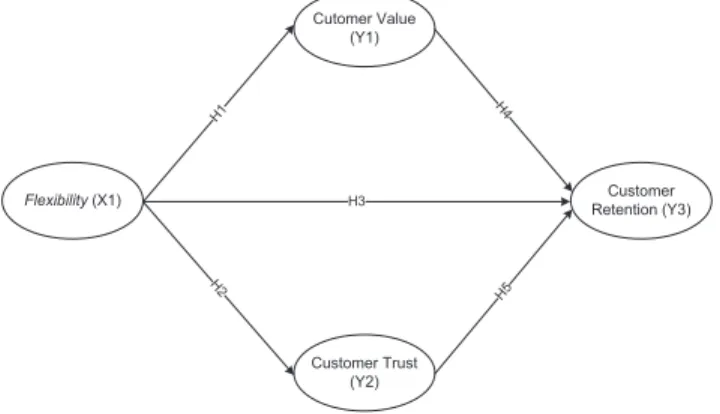
The conceptual framework of this study connects the relationship between variables, where flexibility has an influence on customer retention with customer value and customer trust as a mediator (Figure 1).
Referring to the conceptual framework and the hypothesized model of research that has been stated above, the theoretical influence between variables in research can be explained as follows.
2.5. The Effect of Flexibility on Customer Value Yang and Ahn (2020) conducted a study entitled “The Effects of Attitude, Subjective Norm, and Behavioral Intention on Perceived Values in Traditional Marketplaces”.
Traditional markets have served as important locations for social-cultural and economic activities. It is a hub of economic transactions where people gather and exchange information and goods, while also serving as the center of social activities, including commercial exchanges.
Customer Retention (Y3)
Customer Trust (Y2) Flexibility (X1)
Cutomer Value (Y1)
H3
H5 H4
H2 H1