1
1. Introduction
Currently, most shipyards adopt the line heating method for hull forming, using a gas torch as the heat source. However, due to the difficulties in controlling and estimating the amount of heat input, gas heating equipment has been found unsuitable for automatic hull forming system. Moreover, it aggravates the working environment with heavy noise and air pollution. To solve these issues, a series of studies on line heating using an induction heating system were conducted in Japan (Ueda and Murakawa, 1994) and a study on the prediction of plate bending by induction heating using circular type coil was performed in Korea (Jang et al., 2002). An induction heating method is being focused upon due to its availability of control, precise estimation of heat input, and a favorable working environment, such as one free of noise and air pollution. The phenomenon of induction heating is a 3-D transient problem coupled with electro-magnetic, heat transfer and elasto-plastic deformation analysis (Krawczyk and Turowski, 1987). Kang et al. (2000) performed deformation analysis of a stationary heat source using high frequency induction heating, and compared the results with the deformation characteristics observed in gas heating. Lee and Jang (2008) proposed a multi-step analysis method for induction heating analysis and performed a hull forming analysis using the long type coil. According to these research results, the induction
[email protected], 055-213-3682
heating simulation has to consist of electro-magnetic, heat transfer and elasto-plastic deformation analysis. Also, the analysis steps for electro-magnetic and heat transfer analysis are divided into different time intervals considering the convergence of the induced heat rate to increase the accuracy of the induction heating simulation. In this study, the induction heating simulation which consists of electro-magnetic analysis, heat transfer analysis and thermal elasto-plastic analysis was newly developed and the simulation was modified through induction heating experiments.
Finally, an effective heating coil was designed for an automatic hull forming system based on the induction heating simulation.
2. Induction heating simulation
2.1 Electro-magnetic analysis
When alternating current flows through a heating coil, a magnetic field is formed around the coil. This magnetic field induces the current inside the plate and a loss of resistance is caused by this current as the heat source. Fig. 1 shows the process of calculating the induced heat and governing equations.
To increase analysis time efficiency, an electro-magnetic analysis was designed in the form of a 2-D symmetric problem as shown in Fig. 2. The finite element model for electro magnetic analysis consists of the coil, core, air, and steel plate part using 2D plane elements, and the model was constructed using the commercial software package ‘ANSYS’.
allows for the estimation of precise heat input. Also, workers can carry out the induction heating in a comfortable working environment. In this research, the induction heating simulation, which consists of electro-magnetic, heat transfer and thermal elasto-plastic analysis, was developed and modified through induction heating experiments. Finally, the effective heating coil was designed for the automatic hull forming system based on the results of induction heating simulation. For the purposes of a future study, if an algorithm to obtain optimal working conditions is developed, automatic systems for hull forming can then be constructed.
Key Words : Induction heating, Coil design, Hull forming, Automation, Coupled analysis
Fig. 1. Heat generation process and governing equations.
Fig. 2. Finite element model for electro-magnetic analysis.
Table 1 shows material properties and input values for electro-magnetic analysis. Frequency, current density and efficiency are determined by characteristics of power supply and heating coil.
Frequency Relative permeability
Specific resistance
Current
density Efficiency
4.5 [kHz]
Temperature dependent
values Fig. 3
Temperature dependent
values Fig. 4
3.0×10⁷
[A/m2] 0.75 Table 1. Material properties and input values for electro-magnetic
analysis (Lee and Jang, 2008)
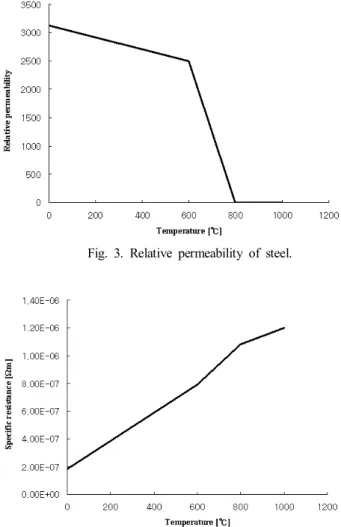
The variation of relative permeability and specific resistance due to temperature variation was taken into account, as shown in Fig. 3 and Fig. 4.
Fig. 3. Relative permeability of steel.
Fig. 4. Specific resistance of steel.
2.2 Heat transfer analysis
During the heat transfer analysis, the distribution of induced Joule’s heat which is calculated by electro-magnetic analysis is used as the input condition as shown in Fig. 5.
Fig. 5. Induced Joule’s heat distribution.
Fig. 6. Temperature distribution.
The purpose of the heat transfer analysis is for calculation of the heat load for the deformation analysis of the steel plate by calculating the temperature distribution during the heating and cooling process through induction heating. The time spent on analysis of each step of heat transfer analysis is determined by the convergence of the induced Joule’s heat value according to each step. All of the material properties used in the heat transfer analysis were implemented in an attempt to improve the accuracy of the solution by using the temperature dependent property values (Patel, 1985).
2.3 Thermal elasto-plastic analysis
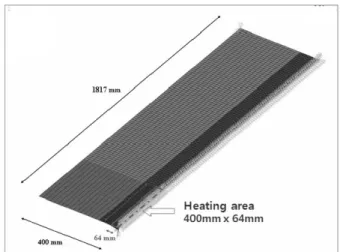
In this study, both the non-linearity of materials and geometric non-linearity are considered through the use of the temperature dependent properties and the Newton-Raphson approach in thermal elasto-plastic analysis. A layered shell element was used to consider variation of the induced Joule’s heat within the thickness of the steel plate. Fig. 7 shows the thermal elasto plastic analysis model of the steel plate using 4-node finite strain shell elements. In order to improve the accuracy of the analysis, the heating area is densely divided into elements, and only half of the steel plate is modeled symmetrically. The temperature dependent properties were determined by the model defined by Tekriwal (1989).
Fig. 7. Thermal elasto-plastic analysis model and boundary conditions.
The thermal elasto-plastic analysis is performed in the course of three-dimensional heat transfer analysis and elasto-plastic analysis by setting the temperature distribution, which is the result of electro-magnetic and heat transfer analysis, as thermal loads. The induced joule's heat which is the result of the coupled analysis is applied to the thermal elasto-plastic analysis as a heat load as shown in Fig. 8.
Fig. 8. Induced Joule’s heat input.
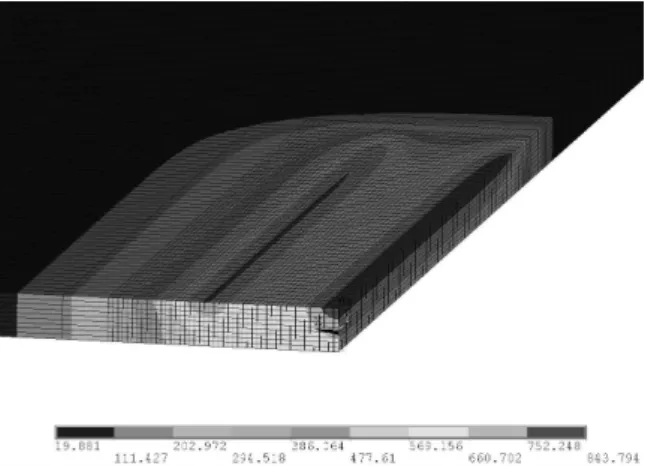
Fig. 9 shows the result of the temperature distribution at the end of the heat transfer analysis by the thermal load as shown in Fig. 8. Fig. 10 displays an example of the final deformation result of the thermal elasto-plastic analysis for all stages of the heating and cooling process. In these results, angular deformations, longitudinal deformations, and shrinkage of the steel plate are found quantitatively.
Fig. 9. Temperature distribution results.
Fig. 10. Thermal elasto-plastic analysis results.
2.4 Induction heating simulation procedure
Fig. 11 shows a flow chart of the induction heating simulation.
The induction heating simulation consists of electro magnetic analysis, heat transfer analysis, and thermal elasto plastic analysis.
Initially, temperature dependent material properties for each analysis are defined as input data in the simulation and electro-magnetic analysis and heat transfer analysis are coupled at the analysis check stage as shown in Fig. 11. This coupled analysis is performed repeatedly during total induction heating time. In the coupled analysis, analysis steps are divided into each of the different time intervals considering the convergence of induced Joule's heat. Finally, induced Joule's heat calculated at each coupled analysis step is applied to the thermal elasto-plastic analysis as a heat source, and deformation of the plate is calculated through an elasto-plastic analysis.
Fig. 11. Flow chart of induction heating simulation.
3. Design of the induction heating coil
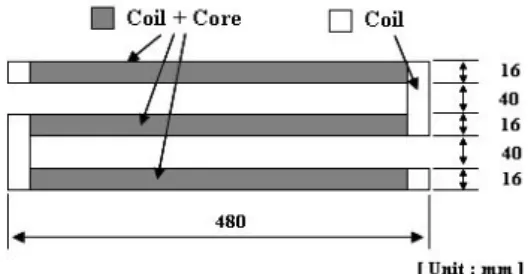
The role of the induction heating machine in the automatic hull forming system is to cause shrinkage and bending deformations in the steel plate. These deformations can be induced via a triangular heating process using a gas torch. In the triangular heating process, a relatively wide and deep heat affected zone is formed as shown in Fig. 12. The heat affected zone (HAZ) is the area of base metal which is not melted and has had its microstructure and properties altered by the application of heat. Therefore, in this study three coils are arranged at uniform distance as shown in Fig. 13 to increase the width and depth of the heat affected zone.
Fig. 12. Heat affected zone in triangular heating.
Fig. 13. Arrangement of three coils with a space ‘b’.
In order to determine the effective uniform space ‘b’, temperature distributions are calculated for each of the following values; b=8 mm, 16 mm, 24 mm, 40 mm, 80 mm, 160 mm as
Fig. 14. Temperature distributions where b=8 mm, 16 mm, 24 mm, 40 mm, 80 mm, 160 mm.
In order to arrange the three coils as show in Fig. 13, the shape of the induction heating coil has been proposed as show in Fig. 15. The proposed induction heating coil needs only one power line and one water cooling cable. Therefore, the structure of the induction heating machine becomes much simpler and manufacturing costs for the induction heating machine can be reduced. Fig. 16 shows the induction heating machine and design details based on the results of this study. The induction heating experiment for improvement in the accuracy of the induction heating simulation was carried out using this induction heating machine.
(a) Induction heating machine
(b) Drawing details of induction heating machine Fig. 16. Induction heating machine and drawing details.
4. Induction heating experiment
The induction heating experiment is performed using an induction heating machine which is manufactured with the proposed induction heating coil as shown in Fig. 16. Fig. 17 shows the induction heating machine and a specimen of steel plate.
Fig. 17. Induction heating machine and specimen.
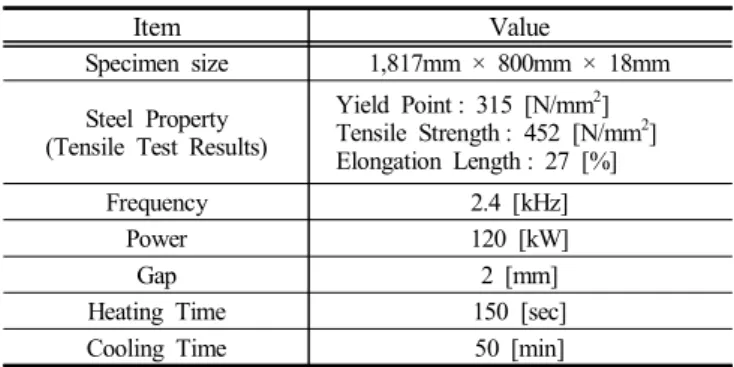
Table 2 shows the specimen size, material properties, and induction heating conditions for the experiment. The ‘Gap’ indicates the distance between the steel plate and the induction heating coil.
Item Value
Specimen size 1,817mm × 800mm × 18mm Steel Property
(Tensile Test Results)
Yield Point : 315 [N/mm2] Tensile Strength : 452 [N/mm2] Elongation Length : 27 [%]
Frequency 2.4 [kHz]
Power 120 [kW]
Gap 2 [mm]
Heating Time 150 [sec]
Cooling Time 50 [min]
Table 2. Specimen size, material properties and conditions for experiment
Fig. 18 shows positions of the heating area and measuring points. A dial gauge is used for the measurement and deflections are obtained at each measuring point. Fig. 19 shows the results of the induction heating experiment. As shown in Fig. 19, the maximum deflection occurs at the center of the free edge line (line1) and relatively large deflections occur locally around the heating area.
Fig. 18. Heating area and measuring points.
Fig. 19. Results of the induction heating experiment.
In order to compare the results, deformation simulation by induction heating was performed under the same conditions as existed in the experiment. In this process, the experimental results are compared with the simulation results while the input efficiency is changed. When the input efficiency of the induction heating is 0.85, simulation results which are very close to the experimental results are obtained as shown in Fig. 20.
Fig. 20. Experimental and simulation results with efficiency 0.85 for induction heating.
5. Conclusions
In this study, an induction heating simulation system was developed and an effective induction heating coil was designed for the automatic hull forming system. The main conclusions were drawn as follows;
(1) In order to predict deformations of the steel plates caused by induction heating, an induction heating simulation consisting of electro-magnetic analysis, heat transfer analysis, and elasto-plastic analysis was proposed.
(2) Using the induction heating simulation, an effective induction heating coil was designed and adopted into an induction heating machine.
(3) The results of the simulation were compared with those of the experiment and the results showed that the input efficiency of the induction heating was 0.85, which was very close to the experimental results. Through these comparisons, the validity of the simulation method proposed in this study was verified.
(4) Based on the results of this study, a new induction heating coil can be designed efficiently.
(5) Effective working conditions for the induction heating process can be obtained from the database constructed by
References
[1] Jang, C. D., H. K. Kim and Y. S. Ha(2002), Prediction of Plate Bending by High Frequency Induction Heating, Journal of Ship Production, Vol. 18, No. 4, pp. 226-236.
[2] Kang, J. G., J. H. Lee and J. G. Shin(2000), Numerical analysis of induction heating for the application of line heating, Journal of the Society of Naval Architects of Korea, Vol. 37, No. 3, pp. 110-121.
[3] Krawczyk, A. and J. Turowski(1987), Recent Development in Eddy Current Analysis, IEEE Transactions on Magnetics, Vol. 23, No. 5, pp. 3032-3037.
[4] Lee, Y. H. and C. D. Jang(2008), A Study of Bending Using Long Type Coil by Discrete Method, Journal of the Society of Naval Architects of Korea, Vol. 45, No. 3, pp.
303-308.
[5] Patel, B.(1985), Thermo-Elasto-Plastic Finite Element Formulation for Deformation and Residual Stresses Due to Welds, Ph.D. Thesis, Carleton Univ., Ottawa, Ontario, Canada.
[6] Tekriwal, Prabhat Kumar(1989), Three-dimensional transient thermo-elasto-plastic modeling of gas metal arc welding using the finite element method, Ph.D. Thesis, Univ. of Illinois, Urbana, Illinois, USA.
[7] Ueda, Y. and H. Murakawa(1994), Development of Computer Aided Process Planning System for Plate Bending by Line Heating(3rd Report), Journal of Ship Production, Vol. 10, No. 4, pp. 248-257.
Received : 2018. 04. 10.
Revised : 2018. 05. 23.
Accepted : 2018. 05. 29.