The Philippine Merchant Marine in Consonance with STCW 2010 Manila Amendments
Orlando S. Dimailig
*․Jae-Yong Jeong
**†*, ** Mokpo National Maritime University, 571 Chukkyo-dong, Mokpo, 530-729, Korea
STCW 2010 마닐라 개정에 따른 필리핀 해운의 적용
올랜도 디마이리그
*․정재용
**†*, ** 목포해양대학교
Abstract :This paper reviews the implementation of the STCW 78/95 in the Philippine MET including the effects of the revised 2010 Manila Amendments. It discusses the country’s maritime environment and the structures, quality of maritime education in the country and the effects on the maritime human resource. Among the various resolutions adopted at the conference, the standards of training and certifications, and promoting skills and competency will be more emphasized in this report. These will be compared with the existing curriculum mandated by CHED and upgrade STCW trainings advised by MTC for maritime institutions. A brief comparison and analysis with other Asian countries’ maritime training shall be offered. The recommendation pinpoints to the weaknesses of the present maritime regimes in certification and evaluation of maritime institutions. It concludes with the need to have mutually acceptable evaluation standards in view of developing a competent human resource for the future.
Key Words : CHED, Curriculum, Human Resource, Maritime Education and Training, Maritime Training Council, Maritime Transportation, STCW ’95
요 약 :이 연구는 2010 마닐라 개정을 적용한 필리핀 해기 교육 및 훈련의 STCW 78/95의 이행여부를 검토한다. 또한 각국의 해사환경, 해 기교육의 구조와 질, 해기인적 자원의 효과에 대해 논한다. 2010 마닐라 회의에서 채택한 다양한 결의안 중에서, 이 논문에서는 훈련과 증명의 기준 및 기술과 역량 증진에 대해 강조한다. 이는 필리핀고등교육위원회(CHED)에 의해 위임된 기존의 교과과정과 해사훈련위원회(MTC)에 의 해 향상된 STCW 훈련을 비교할 것이며, 다른 아시아 국가에서의 해기 훈련에 대해서도 비교·분석할 것이다. 해기교육기관의 자격과 평가에 대 한 현재 해사 제도의 약점을 지적한다. 이 연구에서는 미래에 유능한 인적자원 개발 측면에서 상호 채택 가능한 평가기준이 필요하다고 결론짓 고 있다.
핵심용어 :CHED, 교육과정, 인적 자원, 해사 교육과 훈련, 해사훈련위원회, 해사수송, STCW ’95
*
1. Introduction
IMO adopted major revisions to the International Convention and Code on Standards of Training, Certification and Watchkeeping(STCW) at a diplomatic conference in Manila in June 2010 and what is known as the “Manila amendments”. They are set to enter into force on 1 January 2012 under the IMO tacit acceptance procedure.
The resolutions adopted by the conference relate to: update standards of competence required, particularly in light of
* First author : [email protected], 061-240-7175
†Corresponding author : [email protected], 061-240-7175
emerging technologies; introduce new training and certification requirements and methodologies; improve mechanisms for enforcement of the Convention’s provisions; and detail requirements on hours of work and rest, prevention of drug and alcohol abuse, and medical fitness standards for seafarers(Maritime Safety Committee, 2011).
The first part deals with the maritime situation in the country that describes the social impact of the Philippine MET. Section 2 deals with statistics of the human resource, the deployment of seafarers in the international fleet and the monetary remittances. Section 3 introduces the MET system in the country, the enrollees and the volume of graduates from the numerous maritime
institutions and the maritime training centers that caters to the upgrading courses. The tables 1-4 in this section show the upgraded curriculum for marine transportation and marine engineering courses mandated and non-mandated by STCW 2010. The later part of this section deals with a brief comparison with other countries’ MET methodologies and lastly, it shows the different agencies of government and the international organizations that assess and audit the MET compliance with international standards.
This paper introduces the Philippines as a maritime nation and its MET. It aims to upgrade the maritime human resource through its offerings of the basic maritime education and upgrading courses in consonance with recently adopted 2010 STCW Amendments.
2. The Philippine Merchant Marine
2.1 The Philippine Maritime Environment
The Philippine is an archipelagic country comprising of more than 7,000 islands. Marine transportation is the main means of movement of peoples, goods and products between the different islands. Commerce thrive through this mode of transportation and the national government adopted a “Nautical Highway” program, a fast and more efficient mode of water transportation. However, albeit these developments most of the domestic fleet still consists of old, second-hand, refurbished and converted ships, and passenger ferries.
Maritime policies are made by the different agencies concerned with maritime commerce and traffic and these are mostly set by different regions(Dimailig et al., 2010).
2.2 Human Resource
Under the government policy, all domestic fleets are manned by Filipino seafarers. There is an abundant supply of human resource both for domestic and for overseas ships. This is described in Section 2. 2 and Fig. 1. Most of the domestic fleet are old but has been a good training ground for young graduates to learn the practical side of theories learned in the classrooms and where necessary skills are acquired and honed. These were mostly the gateway for a lucrative overseas placement during the relaxed periods of the 60’s and 70’s where STCW and the present ubiquitous regulated regimes in competency selection of seafarers were less strictly enforced.
Nowadays, a freshly minted graduate, full of required training, with no sea experience has a sure-fire overseas
assignment as a cadet under the “cadet pooling programs”
initiated by foreign principals. These young cadets, in selected maritime academies, are doing all sorts of deck and engine duties under the guise of training, financially compensated with basic pay and overtime remuneration.
Some view these schemes as exploitation and has closely been look at by international labor unions. But this system works advantageously in the part of the trainees because they gain the practical training on deck and engine where other training modules has set these aside and doing all sorts of “bridge and engine training” but has mostly been concentrated in managerial paperwork onboard during their sea-time apprenticeship training. These also train the future generation of Filipino seafarers with traditional skills of seamanship where they actually smell and
“tasted” grease and paints and felt the strains of chipping hammers and gone through the maze of cordage handling and splicing now buried in the labyrinth of priorities courtesy of automation and technology.
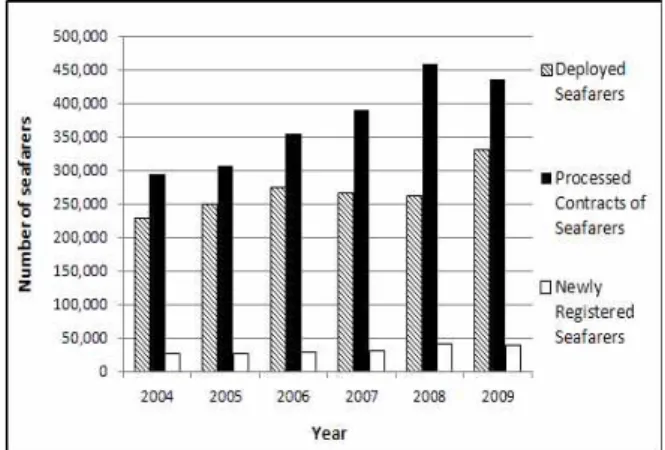
2.3 Overseas Filipino Workers(OFW) Sea-based Statistics Fig. 1 shows there are about 330,424 deployed overseas seafarers in 2009, an increase of 26.3 % from 261,614 as of December 2008 according to the records of the Philippine Overseas Employment Agency(POEA) 2009 statistics. At that same year, the Agency processed 435,515 contracts and 38,067 newly registered seafarers and it has continually increased since 2004.
Fig. 1. Selected Sea-based Statistics: 2004-2009.
The Agency(POEA) also has accredited 1,253 sea-based principals and a total of 15 newly licensed manning agencies plus the 68 manning agencies which renewed their licenses to hire seafarers. Although the manning agencies have dropped from 170 in 2004 due to crackdown
on illegal recruiters and the stricter STCW requirements, still, the country has recorded a robust numbers for foreign deployment.
Topping the list of these deployments were the bulk carriers with 62,229 seafarers, closely followed by passenger ships. These figures on passenger vessels, however, were mostly non-maritime graduates. They were mostly cabin crews, entertainers and in the restaurants but had also undergone the required STCW requirements for positions held. Ranked at the bottom were the PCC with 7,918 personnel and anchored by the gas carriers with 6,187 personnel(Fig. 2).
Fig. 2. Deployed seafarers by top-ten vessel type (2007-2009).
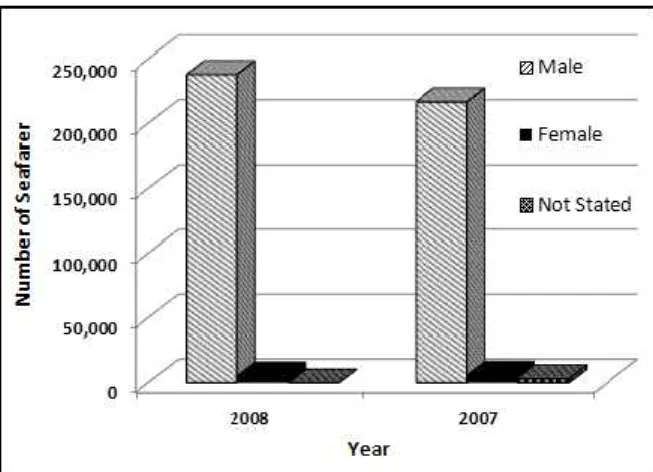
Since the empowerment of women sometime in 1994 and giving them equal opportunity in the maritime sector, a total 6,000 female seafarers were deployed according to the POEA statistics of 2008, a miniscule 2 % share of the total number of OFW deployed shown in Fig. 3. However, it has grown to 1.5 % from the last year’s total.
Fig. 3. Deployed seafarers by sex: 2007 & 2008.
Despite the oft-repeated reports of the shortage of competent ship’s officers worldwide, the country still ranks first in hiring and deployment of non-officer seafarers. In the same 2009 POEA statistics, the ratings positions ranked in the top figures of seafarers deployed. The AB rank was first, followed with almost 50 % difference by the Oiler and OS ratings. Although there are many Filipino seafarers in the management positions nowadays, only the 2nd Engineer made it to the top-tep list at the bottom with 9,557 engineers deployed(Fig. 4). It has been declared that the Philippines has secured its position as the world’s preferred supplier of able ship staff.
Fig. 4. Deployed seafarers by top-ten occupation (2007-2009).
In terms of financial gains, Fig. 5, remittances sent home by OFW seafarers was recorded at 3.8 billion in US dollars, up $ 406 million or 12 percent from the $ 3.4 billion they remitted via the banking system in 2009. From January to July this year, remittances from Filipino seamen already hit $ 2.433 billion, up by 14.13 percent or
$ 301 million, from the $ 2.132 billion in the same period last year(Philippine Overseas Employment Agency, 2010).
Fig. 5. Seabased overseas Filipino remittances.
3. The Philippine MET Structure
3.1 Survey of Government Agencies for Maritime Education The Commission on Higher Education(CHED) manages both public and private higher education institutions in the Philippines. The Commission operates the Maritime Education Programs(MEPs) namely, the Bachelor of Science in Marine Transportation(BSMT) and the Bachelor of Science in Marine Engineering(BSMarE). For maritime education, CHED created a consultative and recommendatory body,
‘The Technical Panel for Maritime Education(TPME)’. It also consults with qualified technical experts from the academe, industry, professional organizations, government concerned agencies and other stakeholders that conducts reviews and conduct public hearings in maritime matters for the Commission.
Another agency that has concerns with the maritime education is The Maritime Training Council(MTC). It is attached to the Department of Labor and Employment (DoLE) which sits as its lead agency. As a council, It is composed of 8 other government agencies (including CHED) and one for the private sector representing the employers and another for seafarers. Among the various functions of MTC is to regulate and supervise the establishment and operation of training centers, and evaluates the quality standards involved in the certification system, training programs, examination and these are conducted in accordance with STCW standards, among others.
Aside from the above, additional government agencies involve in the implementation of the STCW are: National Telecommunication Commission(NTC), Technical Education and Skills Development Authority(TESDA) and the Department of Health(DOH)(Commission of Higher Education, 2000).
Fig. 6. Matrix of government maritime agencies implementing STCW in the Philippines.
3.2 Analysis of the Maritime Higher Education Institutions(HEIs) Statistics
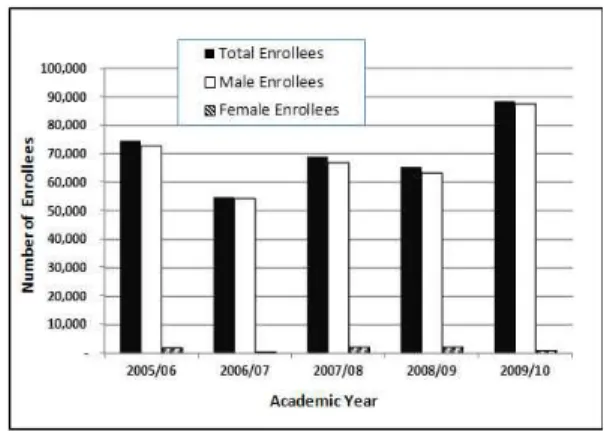
There are more than 90 maritime institutions offering maritime baccalaureate degrees in BSMT and/or BSMarE in the country as of July 2011 according to the records of CHED. Fig. 7 graphs the summary of the tertiary enrolment in the maritime discipline from 2005/06 until the AY 2009/10. The graph shows the slump in ’06 figure and this was supposedly due to CHED’s drive of weeding out under-performing schools and the stricter requirements for modern maritime teaching aids and equipments.
Fig. 7. Tertiary enrolment in maritime discipline.
From AY 2005/06 until 2008/09, the percentage of enrollee/graduate varied from 11 %-20 %, Fig 8, the highest percentage(20.2 %) at AY 2006/07 when CHED and MTC were supposedly active in upgrading the maritime education sector. There was no data yet for AY 2009/10 of graduates but shows the highest number of enrollees in the 5-year period. However, the result of EMSA audit of 2010 shows that whatever they did, did not suffice to realize the competency standards taking effect in the maritime education acceptable to the Europeans(see Section 3.5).
Fig. 8. Enrolment and graduates(AY 2005/06-2009/10).
RefNo. Course Title Prescribed Standards Training Assessment 1
1a
Basic Safety Training Personal Survival Techniques (13.25 hours)
Regulation VI/I
Revised IMO Model Course 1.19
Assessment of competence in accordance with the guidelines in Annex IV 1b Fire Prevention and
Fire Fighting (12 hours) Regulation VI/I
Revised IMO Model Course 1.20 1c Elementary First Aid
(12 hours) Regulation VI/I
Revised IMO Model Course 1.13
Table 1. Mandatory Courses(as appropriate to the required certificate)
1d
Personal Safety and Social Responsibility (14 hours) Regulation VI/I
Revised IMO Model Course 1.21
2
Proficiency in Survival Craft and Rescue Boats (other than Fast Rescue Boats) (31.5 hours)
Regulation VI/2 (1)
Revised IMO Model Course 1.23
3
Proficiency in Fast Rescue Boats (24.5 hours)
Regulation VI/2 (2)
Revised IMO Model Course 1.24 4 Advanced Training in
Fire Fighting (35 hours) Regulation VI/3
Revised IMO Model Course 2.03 5 Medical Emergency
First Aid (21 hours) Regulation VI/4 (1)
Revised IMO Model Course 1.14 6 Medical Care (40 hours)Regulation VI/4 (2)
Revised IMO Model Course 1.15
7
General Tanker Familiarization (60 hours) Regulation V/1 (1.2)
IMO Model Course 1.01
Exam or Assessment in subjects listed in set out in course program and the syllabus set out in Para 2-7 Sec. A-V/1 of the Code
8 Shore-Based Fire Fighting (16 hours) Regulation V/1
MTC Training Course Program 97-004
Assessment in subjects set out in course program 9
Specialized Training for Oil Tankers (54.5 hours) Regulation V/1 (2.2)
Revised IMO Model Course 1.02
Exam or Assessment in theoretical & practical knowledge set out in Para 9-14 of Sec A-V/1 of the Code 10
Specialized Training for Chemical Tankers (60.5 hours) Regulation V/1 (2.2)
Revised IMO Model Course 1.04
Exam or Assessment in theoretical & practical knowledge set out in Para 16-21 of Sec A-V/1 of the Code 11
Specialized Training for Liquefied Gasl Tankers (54.5 hours) Regulation V/1 (2.2)
Revised IMO Model Course 1.06
Exam or Assessment in theoretical & practical knowledge set out in Para 23-34 of Sec A-V/1 of the Code
12
Crowd Management, Passenger Safety and Safety Training for Personnel Providing Direct Services to Passengers in assenger Spaces (7.75 hours) Regulation V/2 Para 4,5 & 6 (4.0 hours) Reg. V/3 Para 4, 5 & 6
IMO Model Course 1.28
Examination or Assessment in subjects set out in the course program
13
Proficiency in Crisis Management & Human Behavior Training in Passenger Safety, Cargo Safety and Hull Integrity (14 hours) Regulation V/2 Para 7-8 (7.75 hours) Reg.
V/3 Para 7-8
IMO Model Course 1.29
Assessment in subject listed in column 2 of Table A-V-2 for Crises Management and Human Behavior.
Exam or assessment in subjects set out in course program for the Passenger Safety, Cargo Safety and Hull Integrity Training.
14 GOC for GMDSS
MTC/NTC Course Program No.98-0020 (IMO Model Course 1.25)
Assessment in subjects listed in column 2 of Table A-V/2 and demonstration of competence in accordance with columns 3 and 4 of the said table
Enrolment and graduate by sex ratio, Figs. 7 and 9, show that the male dominates the population of enrollees from AY 2005/06 to 2009/10 (in red are the female figures). There were 87,467 male against only 974 female enrollees (2009/10). Fig. 9 also shows that a dismal 4 % of females graduated while 18.6 % males completed the course in 2008/09 data.
Fig. 9. Enrolment and graduates [by sex]
(AY 2005/06-2009/10).
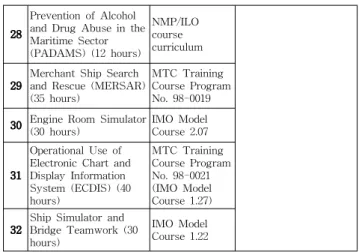
Maritime Training Centers. There are 84 training providers as of 08 July 2011(Maritime Training Council, 2011) scattered all over the country where 55 centers are located in the Metro Manila area. These training centers offer the refresher, upgrading and pre-requisite courses required by the IMO(SOLAS, STCW, Marpol, ISM, ISPS, etc.) and those required under ILO, WHO. They are monitored and supervised by MTC. Recently, MTC issued several maritime advisories conforming with the STCW 2010 Manila amendments. Tables 1 and 2, dated 05 January 2011, were issued in compliance with IMO Model mandatory and non-mandatory courses in lieu of STCW 2010 Manila amendments.
15 Radar Simulator (30hours) IMO Model course 1.09
Exam or assessment in subjects set out in the course program 16 Radar, ARPA, Bridge
Teamwork and Search and Rescue (38 hours)
IMO Model Course 1.08 17 Ship Security Officer’sCourse (16 hours)
MTC Course Program No.
2003-21 18 MARPOL 73/78
Consolidated Annexes 1-6 (36.5 hours)
MTC Course Program No.
2010-01
19
Management Level Course for Marine Deck Officers Function 1- Advanced Navigation (81 hours) Function 2- Advanced Cargo Handling and Stowage (80 hours) Function 3- Advanced Shipboard Operation &
Management (82 hours)
MTC Course Program Approved under Resolution No.
03, Series of 2005
Assessment of Competence in accordance with the guidelines specified in Annex V
20
Management Level Course for Marine Engineering Officers Function 1- Marine Engineering at the Management Level (120 hours)
Function 2- Electrical, Electronic and Control Engineering at the Management Level (80 hours)
Function 3- Maintenance and Repair at the Management Level (40 hours)
Function 4- Controlling the Operation of the Ship and Care of Persons onboard at the management Level (66 hours)
MTC Course Program Approved under Resolution No.
03, Series of 2005
RefNo. Course Title Prescribed Standards Training Assessment 21 Radar Navigation,
Radar Plotting and Use of ARPA (66.5 hours)
IMO Model Course 1.07
Exam or assessment in subjects set out in the course program 22 Ratings Forming Part
of Engineering Watch (28 hours)
MTC Training Course Program No. 97-0013
Assessment in subjects listed in column 2 of Table A-III/4 and demonstration of competence in accordance with columns 3-4 of the said table 23 Ratings Forming Part
of Navigational Watch (30 hours)
MTC Training Course Program No. 97-0014 24 Cargo Handling and
Care of Cargo (39 hours)
IMO Model Course 1.18
Exam or assessment in subjects set out in the course program 25 Basic Stability (19.5hours) IMO Model
Course 1.17 26 Dangerous, Hazardous
and Harmful Cargoes (31.5 hours)
IMO Model Course 1.10 27 Cargo and Ballast
Handling Simulator (30 hours)
IMO Model Course 2.06
Table 2. Refresher/Upgrading Courses which may be required by Ship Owners/Shipping Principals
28
Prevention of Alcohol and Drug Abuse in the Maritime Sector (PADAMS) (12 hours)
NMP/ILO course curriculum 29 Merchant Ship Search
and Rescue (MERSAR) (35 hours)
MTC Training Course Program No. 98-0019 30 Engine Room Simulator(30 hours) IMO Model
Course 2.07 31
Operational Use of Electronic Chart and Display Information System (ECDIS) (40 hours)
MTC Training Course Program No. 98-0021 (IMO Model Course 1.27) 32 Ship Simulator and
Bridge Teamwork (30 hours)
IMO Model Course 1.22
3.3 The Maritime Curriculum
According to its Latin origin, a curriculum is a
“runway”, a course which one runs to reach a goal. It defines the ground where students and teachers cover to reach the goal or aims of education(Brubacher, 1978). It has no internationally agreed definition, only a common understanding that it provides learning opportunities and experience to students. In maritime education, STCW already provides, in its Code, the objectives for students and teachers to abide by - competence, knowledge, understanding and proficiency. In Philippine MET, the STCW Code is strictly applied to all maritime programs and the sole basis for program evaluation and assessment.
l Ships, Ship Routines & Construction l Terrestrial Navigation 1
l Basic Safety 1
l Deck Watchkeeping, Chapter VIII l Terrestrial Navigation 2
l Cargo handling & Stowage 1 - Carriage of Non-Dangerous Goods
l Celestial Navigation 1 l Collision Regulations
l Radio Communication, Inmarsat/GMDSS l Celestial Navigation 2
l Merchant Ship Search and Rescue l Electronic Navigation, Radar
l Cargo handling & Stowage 2 - Carriage of Dangerous Goods l Electronic Navigation, ARPA
l Basic Marine Engineering l Stability and Trim l Maritime Law
l Shipboard Personnel Management l Meteorology and Oceanography l Maritime Pollution and Prevention
Table 3. BS Marine Transportation(BSMT) Course Specifications
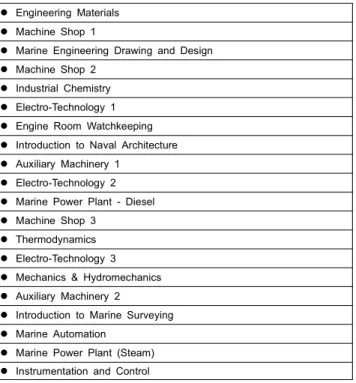
l Engineering Materials l Machine Shop 1
l Marine Engineering Drawing and Design l Machine Shop 2
l Industrial Chemistry l Electro-Technology 1 l Engine Room Watchkeeping l Introduction to Naval Architecture l Auxiliary Machinery 1
l Electro-Technology 2 l Marine Power Plant - Diesel l Machine Shop 3
l Thermodynamics l Electro-Technology 3 l Mechanics & Hydromechanics l Auxiliary Machinery 2
l Introduction to Marine Surveying l Marine Automation
l Marine Power Plant (Steam) l Instrumentation and Control
Table 4. BS Marine Engineering(BSMarE) Course Specifications CHED being the lead agency on higher education, issued memorandum orders, CMO No. 13, series of 2000 creating the “Syllabi for the BS Marine Transportation(BSMT) and BS Marine Engineering(BSMarE) Programs” and CMO No. 13, series of 2005 which revised the “Policies, Standards and Guidelines(PSG) for Maritime Education (2005 Revision)”, stating the program specifications, the competency standards and curriculum for the two maritime programs and were the governing guidelines in the conduct of maritime education for all maritime institutions in the country. These are shown below in Tables 3 and 4 and list only the courses for professional subjects. They do not include the “Arts and Science courses” mandated by the Commission for baccalaureate degrees. It also issued List of Required Equipment for Deck and Engine, Standards for Simulator, Rules for QSS which include assessment for education programs and assessment of instrument.
CHED also issued CMO No. 38, series of 2005 which covers the rules in implementing the Bridging Programs for BS Mechanical and BS Electrical Engineering to BS Marine Engineering Program(Commission of Higher Education Annual Report, 2010). This has been adopted by several schools in the country.
3.4 MET Comparative Analysis
In the Philippine MET, two systems are adopted. These are the 3-1 and the 2-1-1 systems. In the 3-1 curriculum,
all the required learning activities are lumped in those three years and the last remaining year would be for the 12-month minimum required shipboard training. In this method, mostly the student is left alone to look for his company of shipboard training. Most of the privately operated schools adopt the 3-1 structure.
In the 2-1-1 system, the first two years are for academic theories, then one-year of practical shipboard training and the trainee returns to school to complete the academic requirement for baccalaureate degree. The latter system is only adopted by two leading schools in the country and they assign their cadets to each shipping company.
The 3-1 system is the leading cause why there is high difference in enrolment and graduates ratio(see Section 3.2, and Figs. 8 and 9).
There are maritime schools associations who coordinate with each other in different forms of activities and in social and academic maritime fora.
Likewise, the Philippine MET strictly follow the STCW standards where curriculum is structured for shipboard career and practical and leadership skills. In the neighboring maritime countries, there are more elective courses in their curriculums and are 2-pronged in their approaches in maritime education where the students can choose their majors and, thus, open for more career paths either ashore or onboard(Dimailig et. al., 2010).
Curriculum structures of leading maritime universities in the region: Kobe University of Japan, Shanghai and Dalian Maritime Universities of China, Korea Maritime University and Mokpo National Maritime University of Korea have structured their course offerings with multiple maritime disciplines where majors for maritime studies and foundation for maritime business are both offered and emphasized(Inoue, 2007)
Although maritime has its global face and reach, each country’s local social and economic environment still dictates the best offering for its students. The Philippines has adopted these settings according to its socio-economic standing and its MET has proved and withstood the test of time and, hence, its focus on STCW assessment standards has been the hallmark of its local maritime education.
In this increasingly computer oriented age, there are plenty of anecdotal evidence of rapid degradation of traditional skills through over-reliance on technology. With advanced equipment and continuous discoveries of new technology, the basic skill of seamanship is still needed for
the future navigators. Training at both facets of knowing – the future and the basic - is still paramount and state of the art equipment requires competent operators. The Philippine MET mentality anchors on these priorities.
3.5 Program Assessment
Like all HEIs in the country, the maritime institutions undergo strict evaluation by CHED which empowers the TPME to conduct the assessment. They use the STCW standards in evaluating the quality of maritime programs offered by the schools. They also include and give weight in the performance of each school’s graduates to the Board licensure examination results given by the Professional Regulation Commission(PRC), the government agency in charge of licensure examinations for professionals. Poor performing schools and those whose programs do not comply with CHED audits are being phased out.
There is also the European Maritime Safety Agency (EMSA) inspections that normally take place based on a five year cycle. Last 2010, EMSA visited the country under this program. Its inspection plan involves visits to different parts of the national administrations responsible for maritime education and training. Coupled with the visits to administrations are visits to the individual maritime education and training institutions.
EMSA inspectors verify such things as: the quality of the systems and procedures they have set in place; their operating methods and; the human resources and equipment they have assigned to the different activities.
In countries with a large number of MET institutions like the Philippines, a representative sample is often chosen using predefined criteria. At the end of each inspection visit, EMSA prepares a report for the European Commission, which recommends what decision should be made to the country concerned(European Maritime Safety Agency, 2010).
Last 2010 EMSA inspection found “deficiencies” in the local maritime education, training and certification system.
Among the deficiencies identified by EMSA were the lack of a single government agency which monitors maritime training schools and the insufficient training of its teachers and the lack of equipments and facilities. It threatened to ban the deployment of Filipino seafarers in European countries. In lieu of this, the government had submitted a report to the EMSA findings and they are confident they were able to address these issues by intensifying the assessment of maritime certifications and closing down substandard maritime schools.
4. Recommendations
STCW 2010 Manila amendments calls for improved standards of competency based on skills, the human element concerns and the necessities for new guidance on the training and experience of new technologies. There is also a requirement for training in leadership and teamwork, and marine environment awareness. Basic Security training is also required for all seafarers and competence assessment of which are required for those with security duty designation. There are also new competency standards on seafarers who work as electro-technical officers or ratings.
All of these must be addressed by the local maritime agencies with more vigorous attention to its MET. Like the result of EMSA audit of 2010, less bureaucracy and red tape should be maintained without sacrificing quality and seafarers’ competitiveness.
This report recommends further, thus:
1. Open more post-graduate offerings other than usual Master's degree on Maritime Education, Business Management and Port Administration, among others and elevate to higher learning based on research and new discoveries.
2. More government and private sector engagements in maritime education. The EMSA report on the lack of competent teaching staff despite the abundant knowledge lying dormant from those retired and new generation of sailors can be tapped to augment this long standing problem on teaching.
3. Improvement of assessment methods. This can only be measured with actual performance required without compromise to quality and as near as practicable to the real world environment as possible. There should be a program to upgrade the competencies of teachers, the same as what is required by the STCW from the students. Important competency for a practicing mariner requires practical skills and right mental approach.
4. Streamlined government agencies in maritime affairs especially those involve in certification and validation of competencies. The present system, although structured to plug the loopholes and enforce stricter STCW requirements is mostly the breeding ground of corruption and red-tape.
5. Tap more experts in maritime field and not solely rely on politicians and lawyerly management style in
maritime affairs.
6. Eliminate redundant maritime policies and adopt a more futuristic ideas in equipment and maritime management.
5. Conclusion
This research on the Philippine MET deals with effects of the recently ammended STCW known as the 2010 Manila Amendments which tackles on the local onto the global context. It begins with illustrations of the local maritime situation bourne by the country’s archipelagic set-up. It, then, discusses its seafarers’ standing in the global seafaring business where the bulk of its maritime graduates mostly are deployed. It, also, presents the social gains through their dollar remittances to their allottees.
The relationship and effect of 2010 Manila amendments with the country’s MET is depicted with the presentations of its curriculum. Only the basic subjects as seen in the BSMT and BSMarE course specifications given by CHED are offered by the maritime institutions. There are no pro-active courses, like the ones required by the amended STCW that are offered in the institution levels. These are offered outside the baccalaureate learning where the private maritime centers catch the new graduates on a rebound because these requirements must be taken by each seafarer before deployment whether on domestic or foreign fleet.
This research, likewise, illustrates the bureaucratic maze of attaining the required level of competency due to the different government agencies that handle the maritime affairs. The conundrum is clearly and openly depicted by the result of the recent EMSA report.
In order to further improve the safety of shipping, it is essential that seafarers receive effective education and training regardless of the school they attended. And ensuring the effectiveness and consistency of education has to be maintained even within an environment where the trend is to reduce costs in order to keep shipping competitive. These result in a continual quest to employ seafarers at the most globally competitive quality possible.
It should be noted that there are significant differences between education and training systems around the world.
Standards vary between countries. Consequently, there is a significant need for mutual recognition of certificates of competency based on similarly mutual quality standards which is the broader aim of the STCW 2010 Manila Amendments.
Abbreviations
AY – Academic Year
BSMarE – Bachelor of Science in Marine Engineering BSMT – Bachelor of Science in Marine Transportation BSP – Bangko Sentral ng Pilipinas (Central Bank of
the Philippines)
CHED – Commission on Higher Education CMO – CHED Memorandum Orders DOH – Department of Health
DoLE – Department of Labor and Employment EMSA – European Maritime Safety Agency HEIs – Higher Education Institutions MARINA – Maritime Industry Authority MEPs – Maritime Education Programs MET – Maritime Education and Training MTC – Maritime Training Council OFW – Overseas Filipino Workers
POEA – Philippine Overseas Employment Agency PRC – Professional Regulation Commission PSG – Policies, Standards and Guidelines
STCW – Standards of Training, Certification and Watchkeeping
TESDA – Technical Education and Skills Development Authority
TPME – Technical Panel for Maritime Education
References
[1] Brubacher, J.(1978), Modern Philosophies of Education, pp. 155-159.
[2] Commission of Higher Education(2000), CHED Memorandum Order, No. 13. pp. 1-2.
[3] Commission of Higher Education Annual Report(2010).
p. 5.
[4] Dimailig, O. S., J. Y. Jeong and C. S. Kim(2010), Comparative Review of Marine Transportation Education between Korea and the Philippines, pp.
73-78.
[5] European Maritime Safety Agency(2010), August 2010 Newsletter, pp. 12-13.
[6] Inoue, K.(2007), Strategic Design of Future Maritime Education, pp. 49-61.
[7] Maritime Safety Committee(2011), IMO, Training and Watchkeeping, Implementation of the 2010 Manila Amendments to the STCW Convention and Code and Future Terms of Reference of the STW Sub-Committee
Report of the Working Group, pp. 1-5.
[8] Maritime Safety Committee(2011), IMO, Training and Watchkeeping, Implementation of the 2010 Manila Amendments to the STCW Convention and Code and Future Terms of Reference of the STW Sub-Committee Report of the Working Group, Annex 1, pp. 1-2, Annex 2, pp. 1-3 and Annex 3, pp. 1-2.
[9] Maritime Training Council(2011), Memorandum Orders, pp. 1-5.
10] Philippine Overseas Employment Agency(2010), Annual Report, p. 11.
Received : 2011. 12. 15.
Revised : 2012. 03. 09. (1st) 2012. 04. 13. (2nd) Accepted : 2012. 06. 25.
![Fig. 9. Enrolment and graduates [by sex]](https://thumb-ap.123doks.com/thumbv2/123dokinfo/5078480.318635/5.892.102.403.294.505/fig-enrolment-and-graduates-by-sex.webp)