Comparative Study on Biological Technology in Artificial Floating Island: Application of Media
and Daphnia to Algal Biomass Control
Mei-Yan Jin*·Kwang-Hyeon Chang*·Tae-Hoon Kim*·Jong-Min Oh*
Department of Environmental Science and Engineering, Kyung Hee University*
인공부도의 생물학적 처리 기술 비교 연구:
인공부도의 조류의 저감 효과 개선을 위한 여재와 물벼룩 적용
Mei-Yan Jin*·장광현*·김태훈*·오종민*
경희대학교 환경학 및 환경공학과*
요 약 : 호소의 경관성을 향상 시킬 수 있은 자연정화법인 인공식물섬을 설계하고 수질개선 효율을 향상 시키기 위하여 여재, 식생과 물벼룩을 혼용하는 방법을 개발하였다. 따라서 조류 제거 효율을 알아보기 위 한 각 혼합시스템은 G-BD-여재와 물벼룩, G-OB-식물과 여재, G-BOD-여재 식물과 물벼룩, G-C- 대조군으로 실험 및 평가하였다. 각 혼합시스템 현장적용성을 평가하기 위하여 chl-a, TN과 TP의 제거효 율을 조사 하였고, 그 결과 G-BD의 평균제거 효율은 69.24%, 16.61%, -0.61%; G-OB는 평균 68.39%, 14.11%, 10.52%; G-BOD는 평균 78.30%, 6.69%, 25.09%; G-C는 평균 35.42%, -3.47%, -25.18%로 조사되었다. 결과에 따라 제안하면 여재, 식생과 동물플랑크톤을 혼용한 시스템이 조류제어방면에서 효 율적으로 나타났다. 하지만 영양염류 제어관리에서는 식생과 여재를 혼합한 시스템이 가장 효율적이다.
주요어 : 생물조작, 여재, 미나리, 물벼룩, 부영양화
Abstract : Media (bio-stone), aquatic macrophytes (Oenanthe javanica) and herbivorous cladoceran (Daphnia similoides) have been used in artificial floating island (AFI) systems for water pollution control.
Efficiency in chl-a concentration controlling of AFI was tested using different combinations of each device: G-BD-mixture bio-stone and Daphnia similoides, G-OB-mixture Oenanthe javanica and bio-stone, https://doi.org/10.14249/eia.2018.27.1.83
Research Paper
First Author: Mei-Yan Jin, Department of Environmental Science and Engineering, Kyung Hee University, Yongin 1732, Korea, Tel:+82- 31-201-3392, E-mail: [email protected]
Corresponding Author: Jong-Min Oh, Department of Environmental Science and Engineering, Kyung Hee University, Yongin 1732, Korea, Tel:+82-31-201-2461, E-mail: [email protected]
Co-Author: Kwang-Hyeon Chang, Department of Environmental Science and Engineering, Kyung Hee University, Yongin 1732, Korea, Tel:+82-31-201-3392, E-mail: [email protected]
Tae-Hoon Kim, Department of Environmental Science and Engineering, Kyung Hee University, Yongin 1732, Korea, Tel:+82-31- 201-2461, E-mail: [email protected]
Received: 11 October, 2017. Revised: 24 November, 2017. Accepted: 6 February, 2018.
Ⅰ. Introduction
From the latter half of the last century, there has been increasing concern regarding the elevat- ed nutrient status and the eutrophication of rivers and lakes (Sierp et al. 2009). One of the most widespread examples of pollution is eutrophica- tion due to inputs of large quantities of organic nutrients, particularly nitrogen and phosphorus to freshwater rivers, lakes, streams and reservoirs (Yang et al. 2008; Zhu et al. 2011). It is well known the main causes of water eutrophication are nitrogen in the form of nitrite or ammonia and phosphorus in the form of orthophosphate (Horne et al. 1994; Lijklema 1995; Cai et al. 1992).
Nitrogen and phosphorus contained in waste- water accumulate incessantly in water body, and increase algal biomass excessively. Therefore, it is quite necessary to develop efficient treatments to mitigate and prevent eutrophication.
Ecological engineering for the removal of pol- lutants at low cost is an emerging field dedicated to the design and construction of sustainable ecosystems that provide a balance of natural and human values (Mitsch et al. 2002). Artificial Floating Island (AFI) technology (Watling 1975;
Mallison et al. 2001; Sun et al. 2009; Hu et al.
2010; Hu et al. 2010; Li et al. 2010) is a surface soilless planting technology of modern agronomic
and ecological engineering, and it has been proved to be cost-effective and feasible for water quality improvement in eutrophicated water bod- ies. Recently, AFI has been recognized as eco- technology all over the world and installed at various water bodies such as weirs, rivers, ponds and lakes (Ahn et al. 2004). To increase the effi- ciency of AFI, new designs and their application include not only various kinds of plant species but also trial of a huge variety of media.
In addition, biological control (Biomanipulation) of algal biomass is the method based on classical top-down control of algal biomass using herbivo- rous zooplankton. The key species in biological control is cladoceran genus, Daphnia, since it is major grazer on high variety of phytoplankton species. Thus, its intensive grazing can suppress algal growth efficiently in water body.
To control the algal biomass in the water body more efficiently, we combined these two tech- niques, AFI and biomanipulation, and tested its efficiency in nutrients removal and algal biomass suppression from the waste water. We tested the availability of bio-stone, new media material. We combined bio-stone, aquatic macrophytes (Oenanthe javanica) and herbivorous cladoceran (Daphnia similoides) in the AFI. We compared the algal bio- mass control efficiencies of the equipment among different combinations of media, macrophytes G-BOD-mixture bio-stone, Oenanthe javanica and Daphnia similoides, and the out-put water quality improvement was compared with G-C-control (no device was applied). We analyzed removal efficiency of chl-a concentration and nutrient concentrations in the artificially eutrophic water in the laboratory experimental facility. The results showed average removal rates of Chlorophyll a, TN and TP for different four groups: 69.24%, 16.61%, -0.61%; 68.39%, 14.11%, 10.52%; 78.30%, 6.69%, 25.09%;
35.42%, -3.47%, -25.18%, respectively. The results have suggested that the mixture of media, plants and zooplankton is the most efficient combination for Chlorophyll a control, while the mixture of macrophytes and bio-stone have better efficiency nutrient control.
Keywords : Biomanipulation, Bio-stone, Oenanthe javanica , Daphnia similoides, eutrophication
and herbivore applied to AFI. We estimated their efficiency and suitability in application to eutrophic water bodies throughout the laboratory experiments.
Ⅱ. Materials and methods
The experiments were carried out in laboratory.
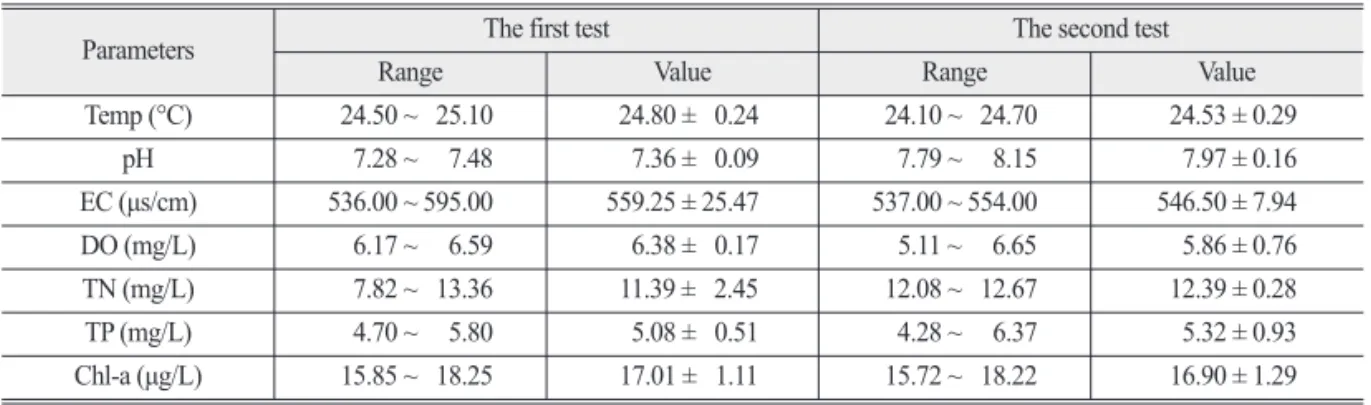
Before construction of AFI, the artificial eutrophic water was prepared with addition of algae (Senedesmus), which was cultured in the laborato- ry. The primeval water quality of artificial eutrophic water was showed in the Table 1. The bio-stone was used in the experiments, which was one kind of media with porosity (adsorptivity, filterability) (Kim et al. 2010). The water quantity used for the test was 800 L (the size of tank:
Ф108 cm × 115 cm) (Figure 1).
An integrated artificial floating bed system con- sisted of three subsystems, aquatic macrophytes (Oenanthe javanica) on the first floor (subsystemⅠ), floating island with media (bio-stone) on the sec- ond floor (subsystem Ⅱ) and net with herbivo- rous cladoceran (Daphnia similoides) on the third floor (subsystem Ⅲ) was constructed (Figure 1).
The bed dimension of System Ⅰ was 40 cm (L) × 40 cm (W) × 15 cm (H) with a perforated bottom plate which had Ф2 cm aperture for supporting plants. The bed dimension of System Ⅱ was 40 cm (L) × 40 cm (W) × 10 cm (H) with perforated acrylic plate which had Ф2 cm aperture. The bed dimensions of System Ⅲ was covered with plas- tic net (40 cm × 40 cm × 40 cm, Ф1 mm). Four groups were devised with combination of bio- stone, Oenanthe javanica and Daphnia similoides.
The groups consisted of G-BD-mixture Bio-stone Table 1. The primeval water quality of artificial eutrophic water in the two tests.
Parameters The first test The second test
Range Value Range Value
Temp (°C) 24.50 ~ 25.10 24.80 ± 0.24 24.10 ~ 24.70 24.53 ± 0.29
pH 7.28 ~ 7.48 7.36 ± 0.09 7.79 ~ 8.15 7.97 ± 0.16
EC (μs/cm) 536.00 ~ 595.00 559.25 ± 25.47 537.00 ~ 554.00 546.50 ± 7.94
DO (mg/L) 6.17 ~ 6.59 6.38 ± 0.17 5.11 ~ 6.65 5.86 ± 0.76
TN (mg/L) 7.82 ~ 13.36 11.39 ± 2.45 12.08 ~ 12.67 12.39 ± 0.28
TP (mg/L) 4.70 ~ 5.80 5.08 ± 0.51 4.28 ~ 6.37 5.32 ± 0.93
Chl-a (μg/L) 15.85 ~ 18.25 17.01 ± 1.11 15.72 ~ 18.22 16.90 ± 1.29
Figure 1. Schematic diagram of the integrated artificial floating island system.
and Daphnia similoides, G-OB-mixture Oenanthe javanica and Bio-stone, G-BOD-mixture Bio-stone, Oenanthe javanica and Daphnia similoides, and G-C- Control (no device was applied).
The experiment was repeated twice for each treatment, and each test was carried out for 8- day. The water samples were collected from 20 cm below the water surface at 4 O’clock on daily basis. The water column of experimental tank was gently mixed before the sampling. The col- lected water samples were kept at 4 ℃ until the analyzed. A portion of each sample was filtered (Whatman GF/C glass microfiber filters 47 mm Ø circles) and analyzed for ammonium nitrogen (NH4+
-N), nitrate nitrogen (NO3–
-N), nitrite nitro- gen (NO2–
-N) and orthophosphate phosphorous (PO43–
-P) by ion chromatograph (Metrohm 792 Basic IC). Unfiltered samples were used for the measurements of total nitrogen (TN) by alkaline potassium persulfate digestion-UV spectropho- tometry and total phosphorous (TP) by ammoni- um molybdate spectrophotometric method.
Through the experiments, the Chlorophyll-a con- centration was measured with Aquaflour (Tunner design).
Ⅲ. Results and Discussion
As shown in Table 2, the experimental temper- ature was maintained about 25℃ by using elec- tronic thermostat (DH-1000AC1). The analysis of pH, there was not obvious changes in the four groups during the laboratory experiment, and they showed the similar changing ranges. The pH ranged from 7.3 to 8.3, the water was showed slightly alkaline. The electrical conductivity (EC) also showed relatively small changing range in the different four groups, but the changing ranges in G-C (control) and G-BOD (bio-stone, Oenanthe javanica and Daphnia similoides) were lower than G-OB (Oenanthe javanica and bio- stone) and G-BD (bio-stone and Daphnia sim- iloides). The dissolved oxygen (DO) concentration was not obviously change in G-C and G-BD, another two groups were obviously decreased with the experimental time. At the second test, the DO concentration was decreased with the experimental time in all groups.
Assimilation and removal of nutrients from water by floating island system are adsorptivity and filterability of media, bioremediation and Table 2. The range and mean value (±standard deviation) of temperature, pH, DO, EC in the two tests.
Parameters G-C
(Control) G-OB
(Oenanthe javanica & Bio-stone)
G-BOD (Bio-stone & Oenanthe javanica & Daphnia similoides)
G-BD (Bio-stone &
Daphnia similoides )
Range Value Range Value Range Value Range Value
The first test
Temp (°C) 24.60 ~ 25.10 24.80 ± 0.22 24.30 ~ 25.40 25.00 ± 0.39 24.70 ~ 25.40 24.90 ± 0.24 24.80 ~ 25.30 25.00 ± 0.18 pH 7.33 ~ 8.33 7.92 ± 0.28 7.48 ~ 8.14 7.90 ± 0.22 7.28 ~ 8.21 7.87 ± 0.27 7.34 ~ 8.29 7.91 ± 0.28 EC (μs/cm) 529.00 ~ 548.00 536.10 ± 7.10 522.00~ 558.00 534.30 ± 12.34 536.00 ~ 549.00 540.40 ± 5.53 539.00 ~ 595.00 550.10 ± 18.41 DO (mg/L) 6.05 ~ 6.65 6.46 ± 0.18 5.04 ~ 6.50 5.85 ± 0.44 5.04 ~ 6.60 5.66 ± 0.60 6.34 ~ 6.55 6.45 ± 0.08
The second test
Temp (°C) 24.60 ~ 25.10 24.90 ± 0.21 24.70 ~ 25.10 24.90 ± 0.15 24.10 ~ 25.30 24.90 ± 0.24 24.60 ~ 25.40 25.00 ± 0.28 PH 7.81 ~ 8.15 7.97 ± 0.11 7.70 ~ 7.99 7.82 ± 0.12 7.68 ~ 7.88 7.81 ± 0.06 7.78 ~ 8.15 7.96 ± 0.12 EC (μs/cm) 537.00 ~ 552.00 546.00 ± 2.05 543.00 ~ 566.00 556.10 ± 7.95 552.00 ~ 575.00 564.90 ± 8.27 553.00 ~ 569.00 560.90 ± 5.51 DO (mg/L) 5.80 ~ 6.65 6.16 ± 0.27 4.42 ~ 5.33 4.71 ± 0.28 3.89 ~ 5.11 4.37 ± 0.41 5.52 ~ 6.36 6.10 ± 0.25
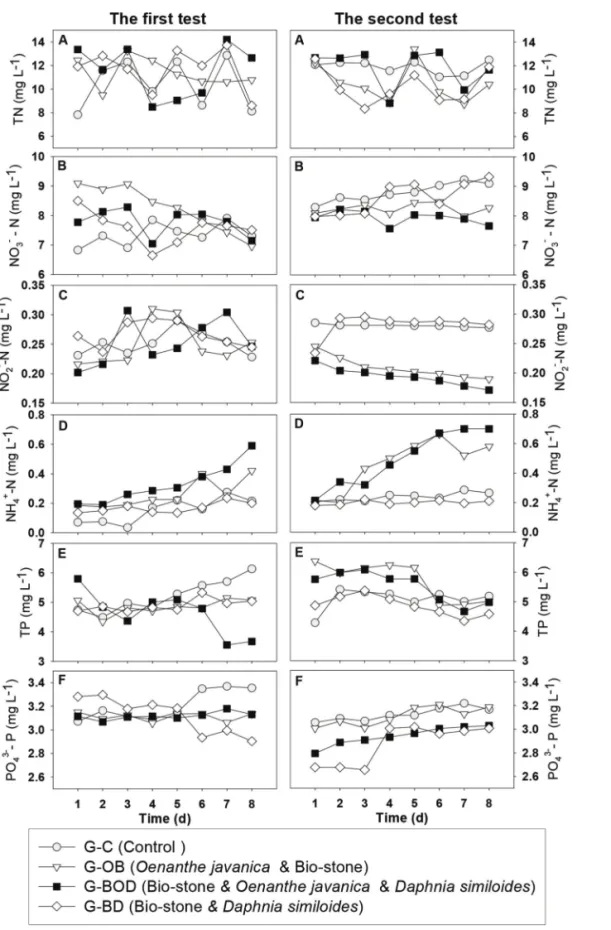
phytoremediation approach. As shown in Figure 2A, the initial concentrations of TN in the two tests showed respectively: 11.92 mgL–1, 12.58 mgL–1in G-BD (bio-stone and Daphnia similoides);
12.44 mgL–1, 12.23 mgL–1in G-OB (Oenanthe javan- ica and bio-stone); 13.36 mgL–1, 12.67 mgL–1in G- BOD (bio-stone, Oenanthe javanica and Daphnia similoides); 7.82 mgL–1, 12.08 mgL–1 in G-C (con- trol). Average removal rates for TN were showed ranges of 16.61% in G-BD, 14.11% in G-OB, 6.67%
in G-BOD, -3.47% in G-C (Table 3). The processes of nitrogen removal from eutrophic water may include nitrification/denitrification, plant uptake, microbial uptake, and volatilization (Tanner et al.
1999). As shown Figure 2D, NH4+
-N concentra- tions of the two tests in the four groups ranged:
0.24 ~ 0.14 mgL–1in G-BD, 0.67 ~ 0.18 mgL–1in G-OB, 0.7 ~ 0.19 mgL–1in G-BOD and 0.29 ~ 0.07 mgL–1in G-C. NH4+
-N concentrations in the two tests had similar trend between G-OB and G- BOD, and the same trend between G-BD and G- C. NO2
–-N concentrations of the two tests in the four groups ranged: 0.3 ~ 0.23 mgL–1in G-OB, 0.3
~ 0.19 mgL–1 in G-BD, 0.31 ~ 0.17 mgL–1in G- BOD, 0.29 ~ 0.23 mgL–1 in G-C, as shown in Figure 2C. At the first test, all groups of NO2–
-N concentrations had the similar changing trend.
Two groups were similar, one was between G-BD and G-C, another was among G-OBand G-BOD at the second test. As shown Figure 2B, NO3
–-N concentrations of the two tests in the four groups ranged: 9.3 ~ 6.6 mgL–1in G-BD, 9.1 ~ 7.0 mgL–1
in G-OB, 8.3 ~ 7.0 mgL–1 in G-BOD, 9.2 ~ 6.8 mgL–1 in G-C. At the first test, three groups of NO3
–-N concentrations decreased except G-C, and both three groups of NO3
–-N concentrations increased except group G-BOD at the second test.
The initial concentrations of TP concentrations in the two tests showed respectively: 4.70 mgL–1, 4.87 mgL–1 in G-BD (bio-stone and Daphnia sim- iloides); 5.06 mgL–1, 6.37 mgL–1in G-OB (Oenanthe javanica and bio-stone); 5.80 mgL–1, 5.76 mgL–1 in G-BOD (bio-stone, Oenanthe javanica and Daphnia similodes); 4.74 mgL–1, 4.28 mgL–1in G-C (con- trol), as shown in Figure 2E. Average removal rate for TP in the two tests was shown for -0.61%
in G-BD, 10.52% in G-OB, 25.09% in G-BOD, - 25.18% in G-C (Table 3). From the Figure 2E, the TP concentrations were decreased obviously in two tests, and the reduced trend of three groups were similar except G-C at the second test. G- BOD revealed most clearly on the reduced trend of TP concentration in the two tests, but in the first test was mostly. As shown Figure 2F, PO4
3–-P concentrations of the two tests in the four groups ranged: 3.3 ~ 2.7 mgL–1in G-BD, 3.2 ~ 3.0 mgL–1 in G-OB, 3.2 ~ 2.8 mgL–1 in G-BOD, 3.4 ~ 3.1 mgL–1in G-C.
The performance of TN concentration fluctuat- ed up and down throughout the experiments due to the impacts of Daphnia similoides, bio-stone and Oenanthe javanica (Figure 2A). And the trend of TP concentrations was similar to TN (Figure 2E).
The changes stemmed from integrated floating Table 3. Average removal rate of chlorophyll a, TP and TN in the artificial floating bed system.
Chlorophyll a
(%) TP
(%) TN
(%)
G-C (Control) 35.42 -25.18 -3.47
G-BD (Bio-stone & Daphnia similoides) 69.24 -0.61 16.61
G-OB (Oenanthe javanica & Bio-stone) 68.39 10.52 14.11
G-BOD (Bio-stone & Oenanthe javanica & Daphnia similoides) 78.30 25.09 6.69
Figure 2. Time courses of total nitrogen (TN), ammonia nitrogen (NH4+-N), nitrate nitrogen (NO3–-N), nitrite nitrogen (NO2–-N), total phosphorous (TP) and orthophosphate phosphorous (PO43–-P) concentration of different floating-bed systems in the two tests.
island system with Daphnia, aquatic macrophytes and bio-stone. There was a marked drop in chl-a concentration due to the direct grazing of D. sim- iloides on algae. Therewith, nutrient concentration was decreased. But nutrient regenerated by Daphnia and they returned N to the environment at a much higher rate than P, nutrients recycling theory predicts that the phytoplankton communi- ty should become more uniform and strong P limited system in the presence of low N : P ratio (Sterner 1990). It has been suggested that grazers such as Daphnia, result in the elevated phyto- plankton C : P and N : P ratios. Consistent with this prediction, the removal rate of TN was lower than TP but rates did not change in the control.
Nutrient was consumed by the growth process of plants, and microorganisms on aquatic macro- phytes’ roots can absorb and assimilate a part of nutrient (Schmidt et al. 2002). However, particles attached on the roots, and stems and leaves made Suspended Solid (SS) and nutrient concentrations increase when they are released to the water.
Besides, there was a marked removal efficiency in nutrient by using bio-stone. Bio-stone decreased nutrient concentrations with its porosity (adsorp- tivity, filterability) (Kim et al. 2010).
Daphnia had a significant grazing impact on phytoplankton biomass, and induced lower chl-a in the treated systems. At the same time, bio- stone have good efficiency for decreasing chl-a concentrations with its porosity (adsorptivity).
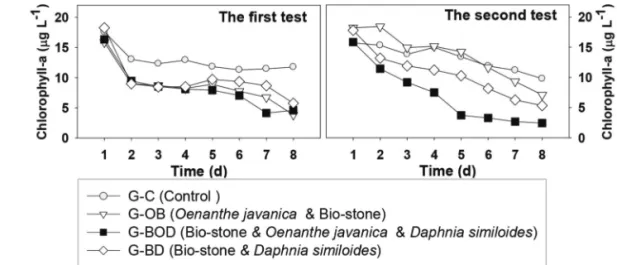
Moreover, aquatic macrophytes over the water surface provides a barrier against light penetration into the water column, and deficiency in nutrients due to the competition with hydrophytes, thereby inhibiting algae growth. Chl-a concentrations of the two tests in the four groups ranged: 18.2 ~ 5.3 ugL–1 in G-BD (bio-stone and Daphnia sim- iloides), 18.4 ~ 3.8 ugL–1in G-OB (Oenanthe javanica and bio-stone), 16.3 ~ 2.4 ugL–1in G-BOD (bio- stone, Oenanthe javanica and Daphnia similoides), 17.6 ~ 9.7 ugL–1 in G-C (control), as shown in Figure 3. Average removal rate for chl-a in the two tests was shown for 69.24% in G-BD, 68.39% in G- OB, 78.30% in G-BOD, 35.42% in G-C (Table 3).
All of the groups except group control showed an obviously reducing pattern of chl-a in two tests.
Ⅳ. Conclusions
The main purpose of the present study was
Figure 3. Time courses of Chlorophyll-a concentration of different floating-bed systems in the two tests.
application of different floating-bed systems with bio-stone, Oenanthe javanic and Daphnia similoides, estimate their efficiencies in nutrients and chl-a removal from the water body. The results showed good efficiency on algae control in different artifi- cial floating beds system, but the removal rates of nutrient were not efficient as we expected. This low efficiency seems to be due to the nutrient recycling through the Daphnia grazing and excre- tion, which is often happening in the artificial floating bed with application of biomanipulation.
The removal efficiency of chl-a concentration was different according to different combination of bio-stone, herbivore and macrophyte. The most efficient removal of chl-a occurs at the different artificial floating beds system treatment followed by G-BOD (bio-stone, Oenanthe javanica and Daphnia similoides) > G-OB (Oenanthe javanica and bio-stone) > G-BD (bio-stone and Daphnia similoides)
> G-C (control). In spite of this, with the experi- mental duration of floating island system, the removal rates of algae were more than 65% in all groups except group C, but the group including all devices (with D. similoides) was better in algal biomass control. From the results, mixture of Oenanthe javanica and bio-stone had better effi- ciency than other combination in nutrient control.
Therefore, the present study had suggested that the combination of various devices should be considered depending on the eutrophication char- acteristics of target water body for the efficient application.
Acknowledgment
This subject was supported by “Development of algae management using stream structures in the stream” (code 17CCTI-B063263-06) funded by
MOIT (Ministry of Land, Infrastructure and Transport).
References
Ahn TS, Yoo JJ, Kim OS, Choi S, Byeon MS.
2004. New Microbial Ecosystem Created by Artificial Floating Island. Research Report. Shinshu University, 5-6.Japan Cai Q, Liu R, Li D. 1992. Comprehensive
Evaluation of Trophic States of Water Systems in Fengqiu Experimental Area of Huang-Huai-Hai Plain, J Lake Sci. 4 (2):
46-50.
Hu GJ, Zhou M, Hou HB, Zhu X, Zhang WH.
2010. An Ecological Floating-bed made from Dredged Lake Sludge for Purification of Eutrophic Water. J Ecol. Eng. 36 (10):
1448-1458.
Hu MH, Yuan JH, Yang XE, He ZL. 2010.
Effects of Temperature on Purification of Eutrophic Water by Floating Eco-island System. J Acta Ecol. Sin. 30 (6): 310-318.
Horne AJ, Goldman CR. 1994. Limnology (2nd Ed). McGraw-Hill. New York.
Kim TH, Ahn TW, Jung JH, Choi IS, Oh JM.
2010. Research on Improvement of Lake Water Quality Using Artificial Floating Island. Korean J Limnol. 43 (2): 263-270.
[Korean Literature]
Li XN, Song HL, Li W, Lu, XW, Nishimura O.
2010. An Integrated Ecological Floating-bed Employing Plant, Freshwater Clam and Biofilm Carrier for Purification of Eutrophic Water. J Ecol. Eng. 36 (4): 382-390.
Lijklema L. 1995. Development and Eutrophication:
Experiences and Perspectives. J Water Sci.
Technol. 31 (9): 11-15.
Mallison CT, Stocker RK, Cichra CE. 2001.
Physical and Vegetative Characteristics of Floating Islands. J Aquat. Plant Manag.
39: 107-111.
Mitsch WJ, Lefeuvre JC, Bouchard V. 2002.
Ecological Engineering Applied to River and Wetland Restoration. J Ecol. Eng. 18 (5): 529-541.
Sun LP, Liu Y, Jin H. 2009. Nitrogen Removal from Polluted River by Enhanced Floating Bed Grown Canna. J Ecol. Eng. 35 (1):
135-140.
Sierp MT, Qin JG, Recknagel F. 2009.
Biomanipulation: a Review of Biological Control Measures in Eutrophic Waters and the Potential for Murray cod Maccul-lochella peelii peelii to Promote Water Quality in Temperate Australia. Rev. Fish Biol. Fisher.
19 (2): 143-165.
Sterner RW. 1990. The Ratio of Nitrogen to Phosphorus Resupplied by Herbivores:
Zooplankton and the Algal Competitive Arena. J Am. Nat. 136 (2): 209-229.
Schmidt I, Sliekers O, Schmid M, Cirpus I, Strous M, Bock E, Kuenen JG, Jetten MSM. 2002. Aerobic and Anaerobic Ammonia Oxidizing Bacteria-competitors or Natural Partners. J FEMS Microbiol.
Ecol. 39 (3): 175-181.
Watling L. 1975. Artificial Islands: Information Needs and Impact Criteria. J Mar Pollut.
Bull. 6 (9): 139-142.
Yang XE, Wu X, Hao HL, He ZL. 2008.
Mechanisms and Assessment of Water Eutrophication. J Zhejiang Univ.-Sci. B 9 (3): 197-209.
Zhu LD, Li ZH, Ketola T. 2011. Biomass Accumulations and Nutrient Uptake of Plants Cultivated on Artificial Floating Beds in China’s Rural Area. J Ecol. Eng.
37 (10): 1460-1466.