• 검색 결과가 없습니다.

Improving Performance of Machine Learning-based Haze Removal Algorithms with Enhanced Training Database

N/A
N/A
Protected

Academic year: 2021

Share "Improving Performance of Machine Learning-based Haze Removal Algorithms with Enhanced Training Database"

Copied!
5
0
0

로드 중.... (전체 텍스트 보기)

전체 글

(1)

Improving Performance of Machine Learning-based Haze Removal Algorithms with Enhanced Training

Database

Dat Ngo

*

, Bongsoon Kang

*

Abstract

Haze removal is an object of scientific desire due to its various practical applications. Existing algorithms are founded upon histogram equalization, contrast maximization, or the growing trend of applying machine learning in image processing. Since machine learning-based algorithms solve problems based on the data, they usually perform better than those based on traditional image processing/computer vision techniques. However, to achieve such a high performance, one of the requisites is a large and reliable training database, which seems to be unattainable owing to the complexity of real hazy and haze-free images acquisition. As a result, researchers are currently using the synthetic database, obtained by introducing the synthetic haze drawn from the standard uniform distribution into the clear images. In this paper, we propose the enhanced equidistribution, improving upon our previous study on equidistribution, and use it to make a new database for training machine learning-based haze removal algorithms. A large number of experiments verify the effectiveness of our proposed methodology.

Key words:uniform distribution; equidistribution; enhanced equidistribution; haze removal; machine learning;

training database

* Dept. of Electronics Engineering, Dong-A University

★ Corresponding author

E-mail:[email protected], Tel:+82-51-200-7703

※ Acknowledgment

This research was supported by research funds from Dong-A University.

Manuscript received Nov. 23, 2018; revised, Dec. 16, 2018; accepted Dec. 21, 2018

This is an Open-Access article distributed under the terms of the Creative Commons Attribution Non-Commercial License (http://creativecommons.org/licenses/by-nc/3.0) which permits unrestricted non-commercial use, distribution, and reproduction in any medium, provided the original work is properly cited.

Ⅰ. Introduction

Haze is used as a general term to indicate the natural and human activity-originated aerosols, which is the main cause of decline in image quality. Thus, haze removal plays a crucial role in many practical applications. For example, it can be employed as a preprocessing step to restore the image/video visibility, later easing the difficulties in object recognition or object tracking. Although there are numerous haze removal algorithms developed up to the present

time, the main focus of this paper is machine learning-based methods, which hold a great potential in years to come [1-3].

The basic idea in machine learning is that an

algorithm has to learn how to handle a particular

task from a set of examples before being

assigned this task. Hence, the training database

is of vital importance. However, since collecting

pairs of hazy and haze-free images is extremely

demanding, it turns researchers’ interest into the

synthetic one. Zhu et al. has suggested adding

haze derived from the standard uniform distribution

63

(2)

(SUD) to clear images in order to produce the hazy ones [3]. Nevertheless, existing pseudo random number generators do not always guarantee the uniform distribution. In previous work, we proposed the equidistribution ensuring the uniformity of generated sequences to solve this problem [4]. However, equidistribution does not guarantee that the image pixels used to offset the histogram always come from adjacent bins. In this paper, we resolve this problem by introducing the enhanced equidistribution.

The rest of this paper is organized as follows.

Section II introduces the conventional method proposed by Zhu et al. and the equidistribution.

Section III presents the newly-developed enhanced equidistribution. Section IV provides the simulation results to verify the effectiveness of our proposed methodology. Conclusions are drawn in section V.

Ⅱ. Related Works

The atmospheric scattering model, described by equations (1) and (2), is widely used to model the effect of haze on photography [3]. I(x, y) and J(x, y) are pixel values at (x, y) location in the hazy and haze-free images, respectively. A is the atmospheric light and t is the transmission map, which varies exponentially along with the product of scene depth d and scattering coefficient b..

I(x,y) = J(x,y)t(x,y) + A[1 – t(x,y)] (1)

t(x,y) = e

-bd(x,y

(2)

Owning the ill-posed characteristic of haze removal, it is required to estimate A and t to restore the image visibility. Zhu et al. proposed a linear model shown in equation (3) to estimate the scene depth d from the image’s brightness v and saturation s. The random error of the model is denoted by e and q

0

, q

1

, q

2

are unknown coefficients, estimated by utilizing supervised learning scheme on the synthetic training database [3].

d(x,y) = q

0

+q

1

v(x,y) + q

2

s(x,y) + e(x,y) (3)

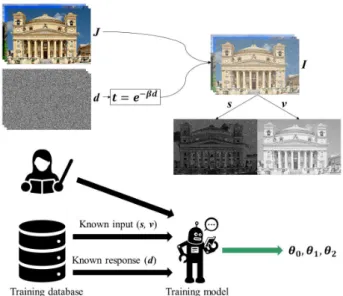
In Zhu et al.’s method, clear images are collected from the Internet, synthetic depths are drawn from SUD on the open interval (0, 1) and A is assumed to be a random number between 0.85 and 1. Then, hazy images can be synthesized by substituting J, A, and d to equations (1) and (2). The training procedure is depicted in Fig. 1.

Fig. 1. Training procedure proposed by Zhu et al. consists of training data preparation (upper part) and supervised learning process (lower part)

The histogram of 1,000 random numbers drawn from SUD on the open interval (0, 1) shows that SUD does not guarantee the uniformity, as shown in Fig. 2. Our previous study on equidistribution solves this problem by rearranging the histogram of the generated sequence to resemble the shape of theoretical uniform distribution as much as possible.

Details about equidistribution can be found in [4].

Fig. 2. Histogram of 1,000 random numbers drawn from

SUD on the open interval (0, 1)

(3)

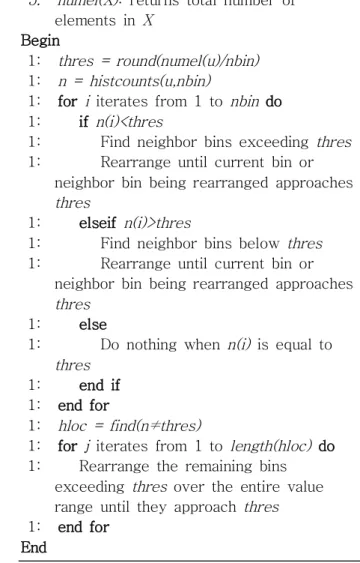
Algorithm

Input: the random sequence u and the number of histogram bins nbin

Output: the sequence e following the enhanced equidistribution

Auxiliary functions:

1. round(): rounds to nearest integer 2. hiscounts(X,N): partitions X into N bins

and returns the count in each bin

3. length(X): returns the length of X vector 4. find(X): finds indices of nonzero elements

in X

5. numel(X): returns total number of elements in X

Begin

1: thres = round(numel(u)/nbin) 1: n = histcounts(u,nbin)

1: for i iterates from 1 to nbin do 1: if n(i)<thres

1: Find neighbor bins exceeding thres 1: Rearrange until current bin or

neighbor bin being rearranged approaches thres

1: elseif n(i)>thres

1: Find neighbor bins below thres 1: Rearrange until current bin or

neighbor bin being rearranged approaches thres

1: else

1: Do nothing when n(i) is equal to thres

1: end if 1: end for

1: hloc = find(n≠thres)

1: for j iterates from 1 to length(hloc) do 1: Rearrange the remaining bins

exceeding thres over the entire value range until they approach thres 1: end for

End

Ⅲ. Enhanced Equidistribution

The problem lies in equidistribution is that it does not guarantee to use pixels from adjacent bins when rearranging the histogram. By working on this problem, we propose the enhanced equidistribution, which always guarantees that offset pixels come from adjacent bins. The algorithm is described in detail in Algorithm. It first calculates the threshold and then examines all bins in the histogram one by one. If a particular bin is above (below) the threshold, neighbor bins falling below (exceeding) threshold would be used to offset this bin. Fig. 3 illustrates the situation when our idea is applied to a small random sequence.

Using the enhanced equidistribution, we collect 500 haze-free images via Flickr and follow the procedure depicted in Fig. 1 to make our own training database for evaluation.

Fig. 3. An example of applying the enhanced equidistribution to a small random sequence

Ⅳ. Evaluation

To assess the effectiveness of the proposed methodology, the linear model proposed by Zhu et al. is retrained with our own database and obtained coefficients are substituted into Zhu et al.’s haze removal algorithm. Then, its performance is compared to the original one’s as well as our

previous work’s. Regarding algorithms’ performance

assessment, 25 real hazy images from IVC and

264 synthetic hazy images representing four

types of haze from FRIDA2 image databases are

used as test sets [5-6]. Assessment metrics are

the rate of new visible edges (e) and quality of

contrast restoration (r) for the former owning to

(4)

its lack of ground-truth haze-free images [7]. In contrast, the mean squared error (MSE) and tone mapped image quality index (TMQI) are used for the latter to make good use of its ground truths [8]. Equations of e, r, MSE, and TMQI are as follows.

e = (n

r

- n

o

)/n

o

(4)

r = VL

r

/VL

o

(5)

MSE = [å(J

r

- J

o

)

2

]/(H*W) (6) TMQI = aS

b

+ (1 – a)N

c

(7)

In equations (4) and (5), n

r

, n

o

and VL

r

, VL

o

are the number of visible edges and visibility levels in the restored and original hazy images, respectively [7]. In equations (6) and (7), J

r

, J

o

are the restored and ground-truth haze-free images of size HxW, S, N denote the structural fidelity and statistical naturalness of a pair {J

r

, J

o

}, a is constant to adjust the relative importance of two components, and b, c are used to determine their sensitivities [8].

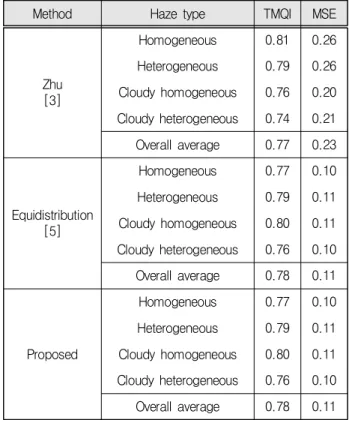
All experiments are conducted in MATLAB R2018a on a Core i7-6700 CPU (3.4Hz) with 8GB RAM. Simulation results tabulated in Table 1 and Table 2 show that all metrics are improved.

When comparing to Zhu et al.’s original method, e, r, TMQI, and MSE are improved by 8.97%, 2.54%, 1.3%, and 52.17%, respectively. This means that low-level features (edges, etc.) faded by haze are better restored and then leads to a significant improvement in four metrics. When comparing to our previous work, e is improved by 6.25%, while other metrics remain similar.

Accordingly, the improvement in the number of restored edges is not large enough to bring about the improvement in the image structural information.

Table 1. Average e, r values on IVC

Method e r

Zhu [3] 0.78 1.18

Equidistribution [5] 0.80 1.21

Proposed 0.85 1.21

Table 2. Average TMQI, MSE values on FRIDA2

Method Haze type TMQI MSE

Zhu [3]

Homogeneous 0.81 0.26 Heterogeneous 0.79 0.26 Cloudy homogeneous 0.76 0.20 Cloudy heterogeneous 0.74 0.21 Overall average 0.77 0.23

Equidistribution [5]

Homogeneous 0.77 0.10 Heterogeneous 0.79 0.11 Cloudy homogeneous 0.80 0.11 Cloudy heterogeneous 0.76 0.10 Overall average 0.78 0.11

Proposed

Homogeneous 0.77 0.10 Heterogeneous 0.79 0.11 Cloudy homogeneous 0.80 0.11 Cloudy heterogeneous 0.76 0.10 Overall average 0.78 0.11

Ⅴ. Conclusion

We have presented the enhanced equidistribution, always ensuring the uniformity of the generated random sequence, and employed it to prepare the synthetic database for retraining the Zhu et al.’s haze removal algorithm. The improved performance showed that the enhanced equidistribution is highly likely to benefit other machine learning- based haze removal algorithms as well.

References

[1] Z. Xu, X. Liu, and N. Ji, “Fog Removal from Color Images using Contrast Limited Adaptive Histogram Equalization,” 2009 2nd International Congress on Image and Signal Processing, pp.

1-5, 2009. DOI:10.1109/CISP.2009.5301485

[2] R. Tan, “Visibility in bad weather from a single image,” 2008 IEEE Conference on Computer Vision and Pattern Recognition, pp.

1-8, 2008. DOI:10.1109/CVPR.2008.4587643

[3] Q. Zhu, J. Mai, and L. Shao, “A Fast Single

(5)

Image Haze Removal Algorithm Using Color Attenuation Prior,” IEEE Transactions on Image Processing, vol.24, no.11, pp.3522-3533, 2015.

DOI:10.1109/TIP.2015.2446191

[4] D. Ngo and B. Kang, “A New Data Preparation Methodology in Machine Learning-based Haze Removal Algorithms,” submitted to International Conference on Electronics, Information, and Communication (ICEIC) 2019.

DOI:10.1109/ICIP.2015.7351475

[5] K. Ma, W. Liu, and Z. Wang, “Perceptual evaluation of single image dehazing algorithm,”

2015 IEEE International Conference on Image Processing (ICIP), pp.3600-3604, 2015.

DOI:10.1109/ICIP.2015.7351475

[6] J. P. Tarel, N. Hautiere, L. Caraffa, A. Cord, H. Halmaoui, and D. Gruyer, “Vision Enhancement in Homogeneous and Heterogeneous Fog,” IEEE Intelligent Transportation Systems Magazine, vol.4, no.2, pp.6-20, 2012. DOI:10.1109/MITS.2012.2189969 [7] N. Hautiere, J. P. Tarel, D. Aubert, and E.

Dumont, “BLIND CONTRAST ENHANCEMENT ASSESSMENT BY GRADIENT RATIOING AT VISIBLE EDGES,” Image Analysis & Stereology, vol.27, no.2, pp.87-95, 2011.

DOI:10.5566/ias.v27.p87-95

[8] H. Yeganeh and Z. Wang, “Objective Quality Assessment of Tone-Mapped Images,” IEEE Transactions on Image Processing, vol.22, no.2, pp.657-667, 2013. DOI:10.1109/TIP.2012.2221725

BIOGRAPHY

Dat Ngo (Student Member)

2016:BS degree in Electronic and Telecommunication Engineering, Danang University.

2018:MS degree in Electronic Engineering, Dong-A University.

2018~present::Pursuing PhD degree in Electronic Engineering, Dong-A University

Bongsoon Kang (Member)

1985:BS degree in Electronic Engineering, Yonsei University.

1987:MS degree in Electrical Engineering, Pennsylvania University.

1990:PhD degree in Electrical and Computer Engineering, Drexel University.

1989~1999:Senior staff researcher, Samsung Electronics.

1999~present:Professor, Dong-A University.

수치

Fig. 1. Training  procedure  proposed  by  Zhu  et  al.  consists  of  training  data  preparation  (upper  part)  and  supervised  learning  process (lower  part)
Fig. 3. An example of applying the enhanced equidistribution  to a small random sequence
Table  1.  Average  e,  r  values  on  IVC

참조

관련 문서