서론 I.
.
.
, ,
. ,
,
.
. ,
[13]
.
* (Corresponding Author)
: 2011. 4. 18., : 2011. 7. 6., : 2011. 7. 20.
, :
([email protected]/[email protected]) 2011 26 ICROS
, (M.K.E) .
, ,
[1].
.
. ,
,
. ,
,
. ,
.
( , , )
, [2,12]
.
, ,
.
,
Design and Implementation of Web-based Software Engineering Tool for Robot
, *
(Chang-Ho Hong1 and Hong Seong Park1)
1
Kangwon National University
Abstract: As the requirement of user for robot functionality, the function and interface for controlling the robot system is more sophisticated and complicated. Accordingly development process of robot is more complicated and it takes much longer time to develop a robot system. Software development using project management tool is more important in software engineering because of the complexity of software, especially robot system. This paper proposes SEED (Software Engineering Equipment for Development), which is a web-based and integrated software engineering tool to provide independent tools for robot software development. SEED includes the document management tool, the software configuration management tool, the software testing tool on developing robot software and provide a functionality of collaborated and remote development due to WEB-based operations.
Keywords: robot software, software engineering tool, document management, software testing
Copyright© ICROS 2011
,
.
[3-6].
,
, ,
.
SEED (Software Engineering Equipment for Development) .
SEED ,
, , ,
.
, ,
,
n
. [14] .
. II
III SEED
. IV SEED
V SEED
, VI .
관련 연구 II.
,
.
, ,
.
.
.
, , ,
[7]. ,
[2].
.
, , , , ,
[8].
,
.
. ,
.
구조 III. SEED SEED
, ,
.
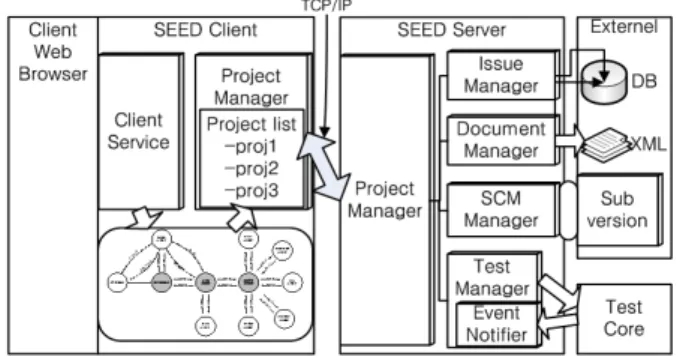
SEED
1 . SEED
SEED
,
(test core)
. SEED (project manager),
(document manager), (software configuration
manager), (test manager), (issue
manager) .
, (subversion) [9] .
1. SEED .
Fig 1. System architecture of SEED.
SEED SEED
.
.
2 . 2 ‘Start/End’, ‘Base
Fame’ ‘Login Module’ ,
‘Main
Module’ ‘User Module’
.
.
.
.
SEED TCP/IP
.
. , (query)
, , .
SEED (RFP:
Request for Proposal), (SRS: Software Require-
ments Specification), (DSRS: Detailed
SRS), (SDS: Software Design Specification), (interface), (source code) 6
.
.
IEEE .
.
(subversion) [9] ,
(commit), (checkout), (update)
.
( ,
)
.
, .
, .
서버 모듈의 관계 및 동작 IV. SEED
SEED , SEED
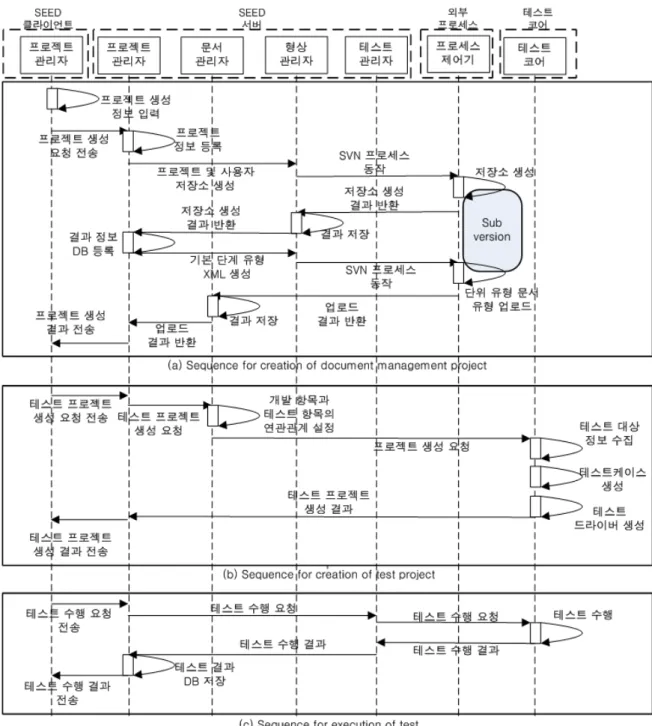
. 3
, 4 (a)
, (b) , (c)
. 연관 관계 설정과 해제
1.
.
,
.
. ,
2. SEED .
Fig 2. Structure of SEED client module.
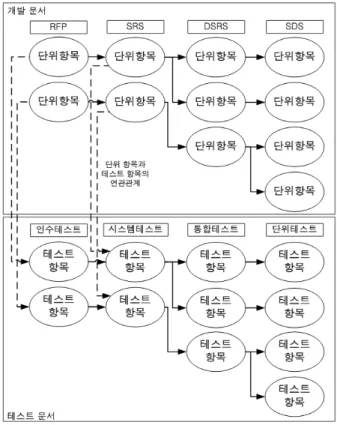
3. .
Fig 3. Association between development process and test process.
. (acceptance test),
(system test), (integration test), (unit
test) ,
.
.
. 3
. ,
. , RFP
, SDS ,
.
문서 관리 프로젝트 생성 2.
(
) .
,
4. .
Fig 4. Sequence for creation of document management project and sequence for creation and execution of test project.
,
,
XML
,
.
4(a) ,
.
테스트 프로젝트의 생성 및 수행 3.
.
.
(
1:N . ,
)
.
.
, .
.
.
4(b) 4(c) .
테스트 코어의 동작 4.
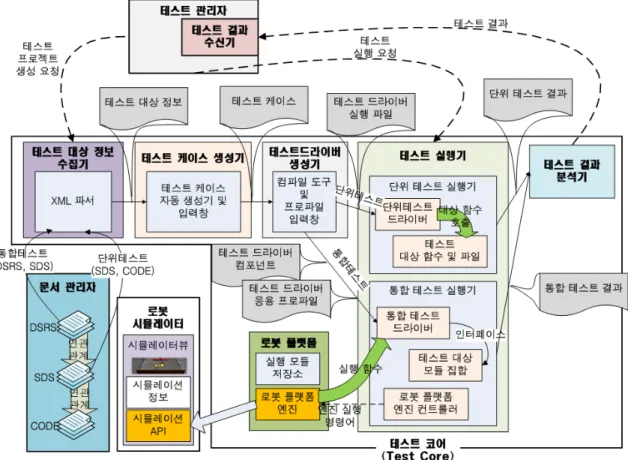
. 5
.
,
.
,
. ,
5. .
Fig 5. Architecture and activity flow of Test Core.
API
.
구현 및 결과 V.
SEED Flex3
XML ,
J2EE BlazeDS [10]
.
1 .
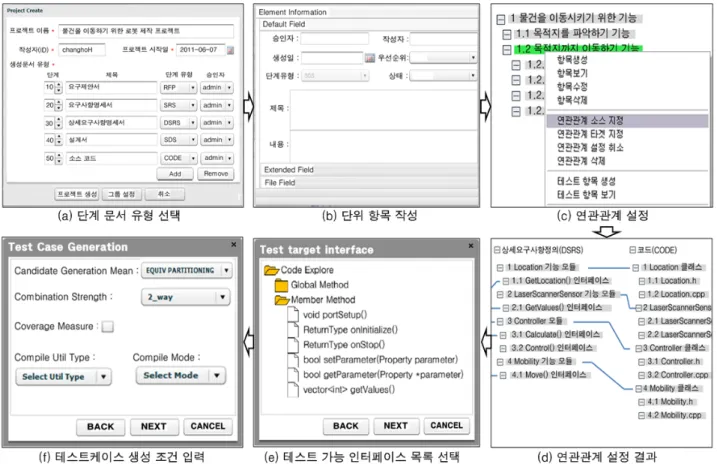
6 SEED
,
. 6(a) .
. 6(b)
.
, , ,
, ,
,
. 6(c)
.
. 6(d)
(view) . (view)
,
. 6 (e), (f)
. 6(e) (view)
.
. 6(f)
. (equivalence partitioning)
(boundary value analysis) [11],
. ,
(view) .
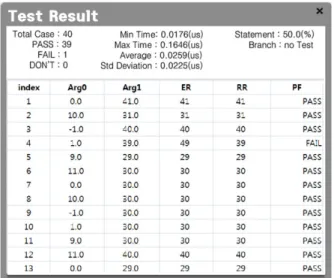
7
. 7 Arg0, Arg1
, ER
(expected result), RR (real
result), PF / (PASS/FAIL)
6. .
Fig 6. Experiment procedure.
1. .
Table 1. Environment for system implementation.
OS Windows Server 2008
MySQL 5.1
WAS Tomcat 5.5
Subversion 1.5.x
. 7 Arg0,
Arg1 0.0, 41.0 41
41
, PF PASS .
Arg0 = -1.0,
Arg1 = 40.0 40
40 PF PASS
.
49 39 PF
FAIL .
PASS .
,
.
결론 VI.
SEED . SEED
. ,
,
. ,
,
.
참고문헌
[1] S. I. Lee, C. S. Jang, S. W. Jung, and J. B. Kim,
“Research trends and status of robot software archi- tecture,” Electronics and Telecommunications Trends (in Korean), vol. 20, no. 2, pp. 1-13, Apr. 2005.
[2] J. S. Kang, H. S. Choi, S. W. Maeng, S. W. Kim, and H. S. Park, “SITAT: Simulation-based Interface Testing Automation Tool for robot software component,” Journal of Institute of Control, Robotics and System (in Korean), vol. 16, no. 6, pp. 608-616, Jun. 2010.
[3] ActiveCollab, Project Management and Collaboration Tool, www.activecollab.com, 2010.
[4] A. Sarama and A. van der Hoek, “Towards awareness in the large,” Proc. of International Conference on Global Software Engineering (ICGSE 06), IEEE CS Press, pp.
127-131, 2006.
[5] M. Cataldo, C. Shelton, Y. J. Choi, Y. Y. Huang, V.
Ramesh, D. Saini, and L. Y. Wang, “CAMEL: A tool for colaborative distributed software design,” Proc. of International Conference on Global Software Engineering (ICGSE 09), Costão do Santinho, Brazil, pp. 83-92, 2009.
[6] S. H. Edwards, “A framework for practical, automated black-box testing of component-based software,”
International Journal of Software Testing, Verification and Reliability, vol. 11, no. 2, pp. 97-111, Jun. 2001.
[7] B. S. Ko, S. E. Lee, and H. J. Lee, “Domestic software industry status by the research on the level of the soft- ware engineering,” Communications of the Korean Institute of Information Scientists and Engineers (in Korean), vol. 27, no. 2, pp. 43-51, Feb. 2009.
[8] S. S. Kim, H. Yin, B. J. Lee, and S. Y. Park,
“Software engineering technology for the next gen- eration,” Communications of the Korean Institute of Information Scientists and Engineers (in Korean), vol.
24, no. 12, pp. 6-16, Dec. 2006.
[9] B. C-Sussman, B. W. Fitzpatrick, and C. M. Pilato, Version Control with Subversion for Subversion 1.6v (Compiled from r3305), svnbook.red-bean.com, 2011.
[10] S. Tiwari, Professional Blazeds : Creating Rich Internet Application With Flex and Java, 1st Ed., WROX Press, 2009.
[11] R. Black, Advanced Software Testing, 1st Ed., Rocky Nook, 1996.
[12] S. W. Maeng and H. S. Park, “Generation algorithm of test suite for state transition sequence with abnormal transitions in robot software component,” Journal of Institute of Control, Robotics and System (in Korean), vol. 16, no. 8, pp. 786-793, Aug. 2010.
[13] H. Yoon and T. Park, “Motion Planning of Autonomous
7. .
Fig 7. Test result through proposed tool.
Mobile Robot using Dynamic Programming,” Journal of Institute of Control, Robotics and System (in Korean), vol. 16, no. 1, pp. 53-60, Jan. 2010.
[14] C. H. Hong and H. S. Park, “Design and im-
plementation of web-based software engineering tool for robot,” Proc. of ICROS Annual Conference 2010 (in Korean), Gwangju, Korea, pp. 29-34, May 2011.
홍 창 호
2009 IT
. 2011.8
. ( )
.. ,
, ,
.
박 홍 성 1983
. 1986 . 1992
. 1992 ~ .
S/W , SW ,
, .