보온단열재의 설치방법에 따른 보온성 효과 분석
김영복1*·이시영2·정병룡3
1경상대학교농업생명과학대학생물산업기계공학과
,
농업생명과학연구원,
2농촌진흥청원예연구소시설원예시험장
,
3경상대학교농업생명과학대학농생명학부원예학전공
,
농업생명과학연구원Analysis of the Insulation Effectiveness of the Thermal Insulator by the Installation Methods
Young-Bok Kim
1*, Si-Young Lee
2, and Byoung Ryong Jeong
31Department of Bio-machinery Engineering, CALS, IALS,
2Protected Horticultural Experimental Station, NHRI, RDA
3Department of Horticulture, CALS, IALS
Abstract.
In this study, the thermal insulation effectiveness of the greenhouse insulators by the installa- tion methods was investigated to find the right installation way of the insulation materials. Physical proper- ties of the insulators such as thickness, air transmissivity, apparent density, ultraviolet rays cutoff ratio, reflectance, thermal conductivity, moisture absorptivity were evaluated and the insulation ability of the insu- lators were measured by the module experiments. For the same insulator, the insulation ability of the case with the outward direction of the black colored face, i.e., with the inward direction of the white colored face, was better than that of vice versa. The case of the black colored both surfaces was better than the case of the white colored both surfaces. For aluminium reflection material, the case with the outward direction of the lustre face, i.e., with the inward direction of the non-lustre face, was better than that of vice versa. For the same material with the inner thin polyethylene foam (or polyester) and the chemical wool, the case with the outward direction of the inner thin polyethylene foam (or polyester), i.e., with the inward chemical wool, was better than that of vice versa. Addition of the inner thin polyethylene foam increased the insulation effect very much.
Key words :
effectiveness, greenhouse, installation method, insulator, thermal curtain
서 론
우리나라농업에너지중약
45%
이상이시설원예의난방을 위해사용되고 있다
(RDA, 2005).
시설원예를비롯한시설농업의필요성은농업생산의 계절성을극 복하고
,
소비자의안전하면서도고품질의농산물요구에부응하여계속적으로 요청될것이므로시설농업에 투입되는에너지의절감방안이지속적이고적극적으로 연구되어야할것으로판단된다
.
시설농업에서의에너지절감방안 중가장우선적이며적극적으로 논의되어
야할분야가난방에너지를많이소모하는겨울철온 실의보온성향상이라할수있다
.
이와관련하여Kim
등
(2007), Ko(2009)
는알루미늄반사재의설치방향연구에서무광표면을 안쪽으로유광표면을바깥쪽으로향 하게 하는 것이 보온성이 좋다고 하였다
.
그리고Chang
등(1996)
은시설하우스에이용되고있는보온커튼의종류별
,
두께별로물리적,
광학적특성을시험분 석하였다.
그결과보온커튼재의인장응력시험결과를 보면 인장하중은3.4~13.4kg
범위이고 인장응력은0.32~l.82kg/mm
2 범위에서 커튼이 두꺼워짐에 따라인장하중은증가하나인장응력은 큰차이가나타나지 않았으며
,
폴리프로필렌계가신장율이크고,
폴리에스 터계는인장 하중과 응력이큰 경향을보였다.
또한,
*Corresponding author: [email protected]
*Received October 23, 2009; Revised November 2, 2009;
*Accepted November 17, 2009
광투과성은
390~1100nm
파장대범위에서평균50.3~
81.7%
범위로보온커튼재가두꺼울수록광투과율이낮고상대적으로차광율이높아지며
,
비슷한두께에서폴 리프로필렌계가폴리에스터계보다광투과율이20~30%
더높은것으로나타났다
.
보온율은18.2~41.1%
범위에서보온재가두꺼워질수록증가하였으며
,
폴리프로필렌계가폴리에스터계보다보온율이다소 높은경향을 보였다
.
그리고,
보온커튼재는폴리프로필렌계가신장 율,
보온성,
광투성측면에서우수하고폴리에스테계가인장응력이나 차광성 측면에서 우수하다고 하였다
. Kim
등(2000)
과Chandra
와Albright(1989)
는 온실의 보온을위한보온커튼의겹수와반사율등물리적특 성이보온성에미치는영향에대하여이론적으로분석한 바있다
.
그리고Lee(2003)
는온실커튼자재별 보온효과및설치방법구명연구에서온실용보온커튼자 재별보온력은알루미늄스크린이부직포보다열관류량 이적어보온성이높은것으로나타났으며
,
알루미늄+
화학솜
+
알루미늄3
겹보온자재가알루미늄스크린에비 해열관류량이34%
적었고,
조합형다겹보온자재(
부직 포+
폴리폼+
화학솜+
폴리폼+
부직포+
폴리프로필 렌)
가3
겹보온자재에비해열관류량이30%
적어조합형다겹보온자재의보온효과가가장좋은것으로나타
났다고 하였다
. Kwon
등(2004)
은 보온피복 재료 및방법이플라스틱하우스의보온력과토마토의생육과수 량에미치는영향을구명하고자수행한연구에서다겹 보온덮개
(
카시미론8
온스1
겹+
폴리폼(1mm) 4
겹+
부 직포2
겹+
폴리프로필렌1
겹+
흑색네트차광망1
겹)
를 이중하우스구조의외면에피복한것이이중하우스구 조의내부에피복한것에비해하우스내야간의기온 과지온은낮았으나광투과율이높아서토마토상품수 량이약2%
증가한다고하였다.
그리고다겹보온덮개 를피복하지않고이중하우스구조의내부에EVA
커튼 을 설치한 것에 비해서는 하우스내 야간기온이3
oC
높게유지되어수확기가약
1
일빨라지고토마토과실도
19%
증수된다고하였다.
한편,
이중하우스 외면에다겹보온덮개를피복하고내부에보온커튼
(
알미늄+
직물
)
을설치한것은다겹보온 덮개를피복하고보온커 튼을설치하지않은 것과이중하우스에다겹보온덮개 를피복하지않고EVA
커튼만설치한것에비해하우 스내기온이각각2.2
oC
와4.5
oC
높게유지된다고하였다
.
또한,
이러한보온효과에 의해토마토과실수량 도 각각18%
와37%
가 되었다고 하였다.
따라서남 부지역에서저온기에다겹보온덮개를이중플라스틱하 우스 구조의 외면에 피복하고내부에 보온성이 높은 커튼자재를사용하면가온을하지않거나최소한의난 방비로토마토를재배할수있음을시사해준다고하 였다.
본연구에서는농업현장에서사용하는보온재를개 발하고사용하는과정에서그사용방법상의차이에따 라보온성이어떻게변하는가를분석하여올바른사용 방법을제시하고자하였다
.
즉,
보온재를구성하는재료가 비록 같은 재료라하더라도 보온재간의 색깔이 다른경우
,
그리고동일한보온재의앞뒤의색깔이다 른경우,
알루미늄반사재와같이앞뒤가그특성이다 른 경우 각각의 경우에 대하여 재료가 어느 방향을 보도록설치하는가에따라 보온성이어떻게달라지는 가를비교분석하였다.
재료 및 방법
여러가지보온재의상대적인보온성비교분석을위 하여실험장치를제작하고실험분석하였다
.
보온단열 재의색깔,
방향,
구성재료등의영향을분석하기위하여
Table 1
에 나타낸바와 같이 모듈을 구성하고실험과분석을실시하였다
.
즉,
재료가동일하다고하더 라도설치방법에 따라보온성이어떻게달라지는가를 분석하기 위하여 흑색과백색의 방향에따른 효과를 분석하였고,
구성물질이동일하면서색깔이다른경우 Table 1. Comparison items for the effect analysis.Effect analysis item Module
Surface color Black or white
Direction of the color Inward/outward, Black/white
Number of the inside material layer Two or three layers of polyethylene foam (1mm)
Direction of the inside materials Inward/outward, Black fabric polyester (40g)/Chemical wool (4 ounces) Direction of the lustre face of the Alluminium foil Inward/outward, lustre face/non-lustre face
도 분석하였다
.
아울러 알루미늄의 반사면의방향에 따른영향을분석하였으며,
동일재료이라하더라도내부재료의 구성물질 방향에 따른 영향도 분석하였다
.
그리고 내부구성물질의 겹수에따른영향등을 분석 하였다
.
실험은실제의사용농업시설을고려하여목재로모 듈을만들어바깥박스에는비닐을씌우고안쪽박스 에는 여러 종류의보온재의 설치방법을 달리하여 각 모듈별로보온성을분석하였다
.
1. 실험 모듈
실험에사용된모듈은정육각형의모듈
15
개를만들 어이용하였다.
각실험모듈은사각형박스2
개로구성되며
, 2
개의 사각형박스의 크기는가로×
세로×
높이 가 각각1,000 × 1,000 × 1,000mm(Box1000), 700 ×
Table 2. Components of insulators used for the experimental modules.
Module number Components of insulation material
1 White polyester (Apparent density 479.9kg/m2, Thickness 0.2mm, called as minimat 300*300 in market) 2 White polyester (Apparent density 890.1kg/m2, Thickness 0.4mm, called as Oxford 300*600 in market) 3 White polyester (Apparent density 884.7kg/m2, Thickness 0.44mm, called as Oxford 600*600 in market) 4 4A Alluminum foil-outward direction of the lustre face with the inward direction of the non-lustre face
4B Alluminum foil-Inward direction of the lustre face with the outward direction of the non-lustre face 5 5A Black fabric polyester (80g/m2) + Chemical wool (4 ounces) + White fabric polyester (80g/m2)
5B White fabric polyester (80g/m2) + Chemical wool (4 ounces) + Black fabric polyester (80 g/m2)
6 6A Black fabric polyester (80g/m2) + Black fabric polyester (40g)) + Chemical wool (4 ounces) + Black fab- ric polyester (80g/m2)
6B Black fabric polyester (80g/m2) + Chemical wool (4 ounces) + Black fabric polyester (40g)) + Black fab- ric polyester (80g/m2)
7 7A White polyester (module 1 material) + White polyethylene foam (1mm*1layer) + Chemical wool (4 ounces) + White polyester (module 1 material)
7B White polyester (module 1 material) + Chemical wool (4 ounces) + White polyethylene foam (1mm*1layer) + White polyester (module 1 material)
8 White polyester (module 1 material) + Polyethylene foam (1mm*3 layers)) + White polyester (module 1 material)
9 White polyester (module 1 material) + Polyethylene foam (1mm*2 layers)) + White polyester (module 1 material)
10 White fabric polyester (80g/m2) + Polyethylene foam (1T*3 layers)) + White fabric polyester (80g/m2) 11 11A Black polyester (module 1 material) + White threads + White polyester (module 1 material)
11B White polyester (module 1 material) + White threads + Black polyester (module 1 material) 12 White polyester (module 1 material) + White threads + White polyester (module 1 material) 13 Black polyester (module 1 material) + Black threads + Black polyester (module 1 material)
Fig. 1. Experimental module inside view showing the elec- trical heating rod, black globe, sensors of the air tempera- ture and relative humidity.
700 × 700mm(Box700)
로하였다.
그리고Box1000
안에는
Box700
이들어가고,
박스간6
면 사이의거리는모두
150mm
가되도록하였다.
각박스는 가로와세로가각각
25mm
인각목을이용하여후레임을제작한후
, Box1000
의 주위에는 농업용필름(
두께0.1mm)
을씌우고
, Box700
주위에는 분석하고자 하는 보온재를모듈별로각각둘러싸서조립하였다
.
조립과정에서측정을위한계측부가설치되었으며
,
조립된Box1000
은실험실바닥으로부터
400mm
높이의 사각박스위에설 치하여바닥으로부터분리하였다.
모듈내열량의공급은전기히터를이용하였으며
,
전기히터는모듈내부온도와안전을고려하여
40W
로하였다
.
그크기는직경20mm,
길이350mm
이며,
핀을 달아열전달이촉진되도록하였다.
설치위치는내부의 대류 등에의한공기온도분포를고려하여전기히터를 하단에설치하였다.
모듈내부의모양을나타내면Fig.
1
과같다.
2. 실험재료
실험재료는
Table 2
에 나타낸바와 같이13
가지로서앞뒤색깔이다른재료로구성된모듈
,
보온재내부 의재료가같은 재료일지라도그배치순서가다른재 료로구성된모듈등으로구성되어있다.
보온재의앞뒤면이다른경우는그사용방법에따라 보온성이달 라지는가를분석하기위하여각각따로배치된모듈을 배치하여비교실험하였다
.
3. 실험재료의 물성치
실험재료는시료를채취하여
KATRI(
한국의류시험연 구원)
산업환경연구센터에보내어열물리적특성을측 정하였다.
측정항목은KATRI
와위탁시험기관인한국건자재시험연구원에서측정가능한 항목중보온과관
련되는항목을중심으로하여 두께
(KS K0506:2006),
Table 3. Physical properties of the insulators.
Module
no. Thickness (mm)
transmittanceAir (cm3/min/cm2)
Apparent density
(kg/m2) Light shade
rate (%) UV-A cut
rate (%) UV-B cut rate (%)
Thermal conductivity
(W/mK)
Moisture absorption rate
(%)
1 0.20 2136.0 479.9 75.93 76.9 91.1 0.0041 136.7
2 0.40 781.2 890.1 80.50 86.3 95.7 0.0123 193.8
3 0.44 1028.4 884.7 81.83 87.2 96.2 0.0101 198.9
4A/4B 1.05 2653.2 680.3 97.73 96.7 97.4 0.0381 044.6
5A/5B 6.40 4471.2 1754.7 99.77 99.9 99.9 0.0206 317.4
6 5.02 2660.4 2236.0 99.83 99.9 99.9 0.0226 289.6
7A/7B 3.96 1388.4 2198.2 89.13 97.7 99.4 0.0212 331.7
8 3.78 112.2 2434.0 93.30 95.5 98.9 0.0338 144.9
9 2.59 8.2 1648.8 86.30 94.9 98.6 0.0248 183.9
10 4.49 101.5 1130.8 83.43 85.4 88.7 0.0388 318.9
11A/11B 1.10 2279.8 1442.1 99.47 99.8 99.8 0.0237 294.6
12 1.53 2786.4 1274.5 83.60 91.8 97.8 0.0210 381.4
13 1.21 2803.2 1462.5 99.87 99.9 99.9 0.0231 320.2
Table 4. Physical properties of the insulators (outward surface).
Module
no. Far infra red
emissivity Far infra-red emissivity
energy (W/m2) Reflectance Moduleno. Far infra red
emissivity Far infra-red emissivity
energy (W/m2) Reflectance
1 0.886 3.57*102 54.5 7A 0.883 3.56*102 77.2
2 0.884 3.56*102 64.6 7B 77.3
3 0.886 3.57*102 66.6 8 0.865 3.49*102 76.4
4A 0.351 1.42*102 80.7 9 0.868 3.50*102 76.5
4B 0.444 1.79*102 75.7 10 0.884 3.40*102 68.3
5A 0.874 3.53*102 3.5 11A 0.886 3.57*102 5.6
5B 0.850 3.43*102 59.8 11B 0.881 3.55*102 66.7
6 0.872 3.52*102 3.2 12 0.883 3.56*102 74.2
13 0.887 3.58*102 2.7
공기투과도
(KS K 0570:2006),
겉보기밀도(KS M ISO 845:2002),
차광율(KS K 0819:2004),
자외선차단율
(KS K 9850:2004),
반사율(Lambda900 UV/VIS/
NIR Spectrometer with Integrated Sphere),
열전도율(KS K 0466:2002),
수분흡수율(KS K 0434:2006),
원적외선 방출량
(
방사율 및 방사에너지, KICM-FIR- 1005)
으로 하였다.
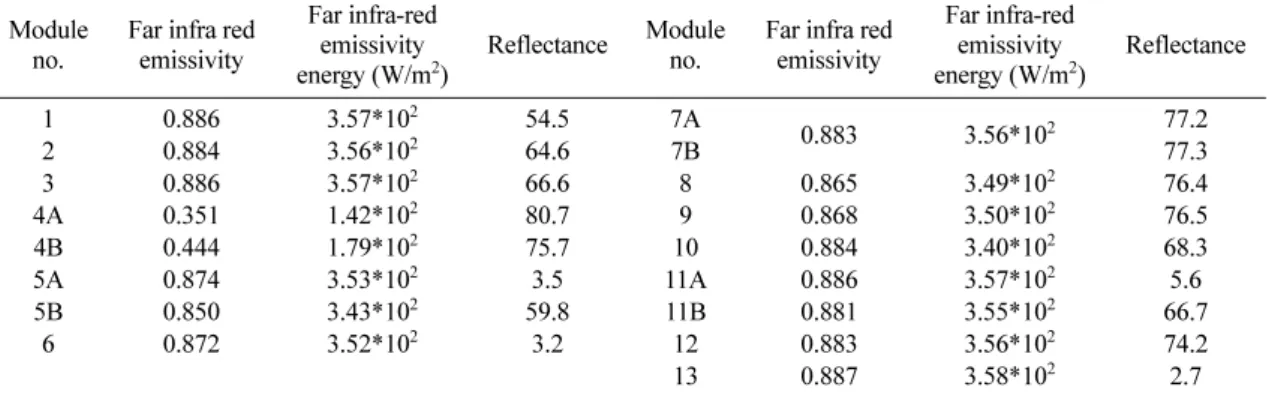
측정결과는 아래Table 3, 4
와 같다
.
표에 나타낸 반사율은380~780nm
파장대에서의평균을나타내고있다
.
4. 계측부 및 실험수행
실험분석을위해계측한항목은건구온도
,
상대습도 이었다.
모듈내부의광성분을측정하였으나가시광선은나타나지않았고
,
적외선범위의열복사도일부모듈에 서는감지되었으나전체적으로는안정된측정값으로나 타나지않았다.
이는실험을모듈내온도차조성의필요 때문에야간실험을하였고모듈내가온전열봉에의한 열복사적외선이크지않았기때문으로보인다.
외기 온도와습도는바닥으로부터
1400mm
위치에 서측정하였다.
열전대는K
타입의열전대를사용하였다
.
내부온도및습도는Box700
하단으로부터500mm
위치에서측정하였다
.
온도와습도의측정을위한온습 도및 온도로거는Testo 177-H1, Sato SK-L200TH-
α,
Testo 177-T4
를사용하였다.
실험은외부의바람과같은기상조건영향을받지않도록실내에서수행하였다
.
실험은
2008
년10
월7
일부터2009
년2
월11
일까지여러차례에걸쳐실시하여명확한결과가나오도 록하였다
.
실험은전열봉을켜기전부터데이터를기 록하기시작하여전열봉을켠지2
시간이후까지데이 터를측정하였으며,
측정간격은2
분간격으로측정저장하였다
.
온습도의 변화는실험기간중 초기에변화한후거의일정한상태를유지하였으며
,
결과에대한분 석은내부온도가일정하게유지되는기간의자료를이 용하였다.
결과 및 고찰
1. 보온재별 모듈내부건구온도
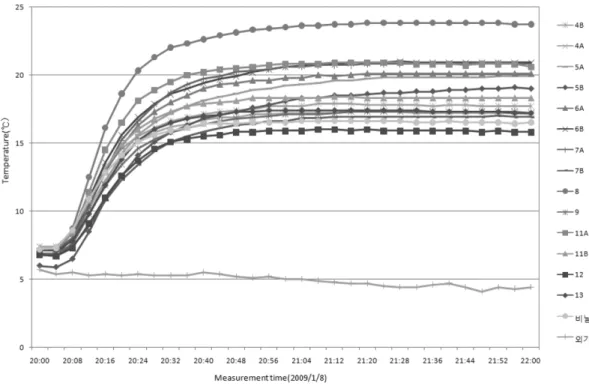
모듈내의경시별온도변화는
Fig. 2
와같다.
모듈내 의온도는전열봉을켜기시작한실험초기에외기온도 에서부터상승하기시작하여약30
분이지나면서부터 는비교적정상상태에도달하여유지되고있었으며모Fig. 2. Variation of the air temperatures inside of the modules depending on time duration.
듈별로 온도차를 유지하고 있었다
.
외기온이 약4
oC
정도일 때 모듈내부는
15.8
oC
에서23.7
oC
사이의 범위에있었으며
,
외기와의온도차는모듈별로12
oC
에서19
oC
의차이를나타내었다.
2. 보온재별 모듈내 상대습도의 변화
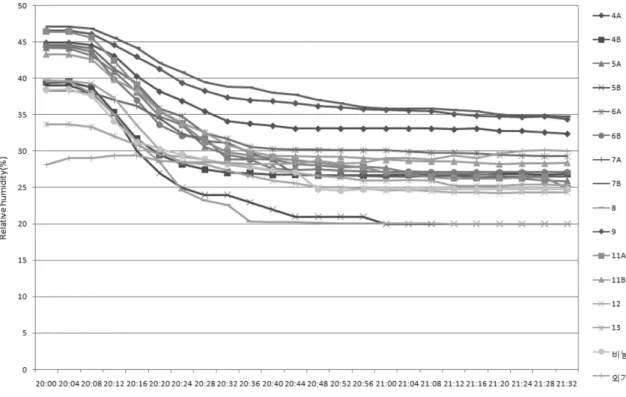
모듈내상대습도의 변화는
Fig. 3
과 같다.
본실험 에서는겨울실험으로서전체적으로상대습도가상당히 낮은값을나타내고있었다.
실험시작단계에서도모듈 별내부건구온도차이에의해 모듈별다른값을나타 내었으며이런경향은4
번의반복실험과정에서비슷한 현상을나타내었다.
3. 보온재설치방법에 따른 보온성 비교
보온재를구성하는재료가같다하더라도색깔이다 른 경우
,
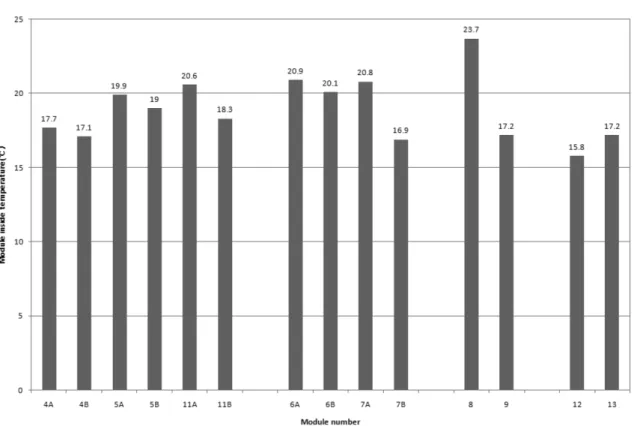
앞뒤의색깔이다른 경우설치방법등에 따 라서 보온성의 차이를알아보기 위하여 비교 실험한 결과는Fig. 4
와같다.
가장 뛰어난보온력을 보인 것은
8
번모듈이며 각실험변수에서알루미늄반사재의경우반짝이는유광면 이 바깥쪽을 향하도록 설치하는 것이 보온성이 좋은 것으로나타났다
.
이결과는Kim
등(2007)
에의한연구
, Ko(2009)
에의한연구결과와같으며,
유광면은비유광면과비교할때반사율이높은반면 원적외선방 사율과에너지강도가낮은것으로분석되었다
(Table 4
참조
).
동일한재료라하더라도색깔의내외방향에 따라서 보온효과가어떻게달라지는가를알아보기위한실험 에서 모듈
5A
와모듈5B
는 같은 재료로서모듈5A
는흑색이외향이며백색이외향인경우의
5B
보다상 당히보온효과가좋은것으로나타났다.
뿐만아니라모 듈11A
와모듈11B
도 같은 재료이지만 모듈11A
는흑색이 외향인 경우로서 역시 백색이 외향인 모듈
11B
보다 매우 좋은 보온성을 나타내었다.
그 물리적 특성을살펴보면원적외선방사율이나원적외선방사 에너지는큰차이가없으나반사율의경우두재료의 경우모두흑색이백색표면에비해매우 반사율이낮 으며 반사율이낮은 표면을외향으로,
반사율이높은Fig. 3. Variation of relative humidity inside of the module depending on time duration.
표면을내향으로설치하는것이보온성이좋은것으로 나타났다
.
그리고같은재료라하더라도내부재료의배치위치에 따른보온성을알아보면모듈
6
의경우바깥쪽에부직 포를 두고 안쪽에화학솜과얇은흑색부직포(40g)
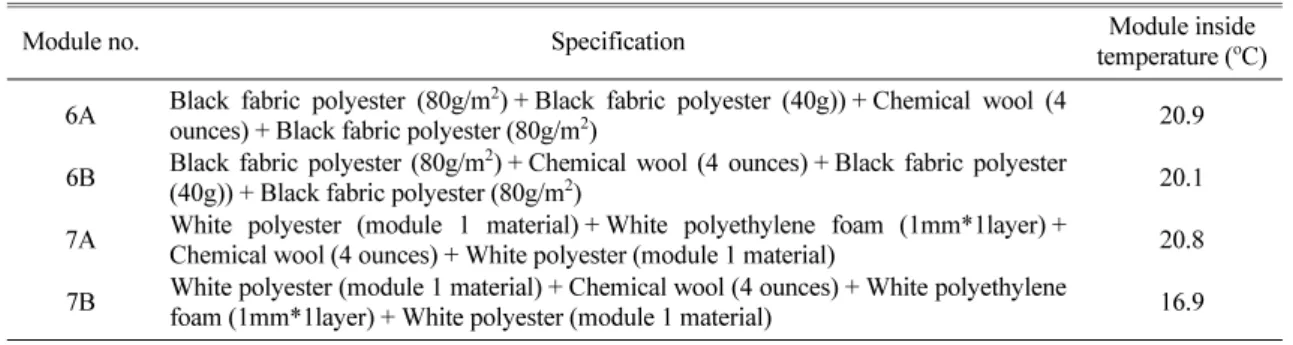
한 겹을넣어만든재료인데이경우안쪽의얇은부직포가바깥쪽에놓이도록설치하는것이안쪽에놓이도록 설치하는것보다보온성이좋은것으로나타났다
.
특히,
모듈
7
의경우는양쪽에미니마트를두고안쪽에화학솜과백색피폰
(
폴리에틸렌포옴두께1mm)
한겹을넣 어만든재료인데이재료의경우도백색피폰이바깥 쪽에놓이도록설치하는것이그반대의경우보다매 Fig. 4. The insulation effectiveness comparison depending on the installation methods and materials.Table 5. Effect of the direction of the lustre surface on the inside air temperature for the same material compositions.
Module
no. Module inside
temperature (oC) Material properties of module (From Table 4)
Far infra red emissivity Far infra-red emissivity energy (W/m2) Reflectance (%)
4A 17.7 0.351 1.42*102 80.7
4B 17.1 0.444 1.79*102 75.7
Table 6. Effect of the direction of the surface material color on the inside air temperature for the same material compositions.
Module
no. Module inside
temperature (oC) Material properties of module (From Table 4)
Far infra red emissivity Far infra-red emissivity energy (W/m2) Reflectance (%)
5A 19.9 0.874 3.53*102 3.5
5B 19.0 0.850 3.43*102 59.8
11A 20.6 0.886 3.57*102 5.6
11B 18.3 0.881 3.55*102 66.7
우큰차이로보온성이높음을알수있었다
.
그리고 모듈
8
번과 모듈9
번은 각각 같은 재료를사용하면서안쪽에피폰
(
폴리에틸렌포옴1mm)
을두겹 넣은경우와세겹넣은 경우로서한겹을더넣은모 듈8
번이모듈9
번에 비해매우 보온성이 좋은것을알수있었다
.
동일한재료이면서표면이색깔이다른경우를비교 하기 위한 실험에서 모듈
12
번은 전체가 백색,
모듈13
번은전체가흑색으로서흑색인경우가백색인경우 에 비해 보온성이 매우 좋은 것으로 나타났다.
이는역시 원적외선방사율이나원적외선방사에너지의크기 는 거의 같지만 반사율이 적은 쪽이 훨씬 보온성이 좋은것으로나타났다
.
적 요
보온단열재의열물리적특성에따라보온성이어떻
게달라지는가를분석하여그개발방향과올바른사용 방법을알아보고자실험장치를제작하고실험 분석하 였다
.
그내용을요약정리하면다음과같다.
실험은실제의사용농업시설을고려하여목재로모 듈을만들어바깥박스에는비닐을씌우고안쪽박스 에는보온재를씌운다음모듈내부에서가열되는과정 에서의각모듈의보온성을 측정 분석하고
,
보온재의 열물리적특성을측정하고비교함으로서보온재의종 류와물리적특성에따른보온효과를분석하였다.
실험재료의열물리적특성은
KATRI(
한국의류시험연구원
)
와한국건자재시험연구원에서측정가능한항목중 보온과관련되는항목을중심으로하여두께,
공기투과 도,
겉보기밀도,
차광율,
자외선차단율,
반사율(380~
1200nm),
열전도율,
수분흡수율,
원적외선방사율및원적외선방사에너지를측정하였다
.
모듈내의건구온도는 전열봉을켜기시작한실험초기에외기온도에서부터상 승하기시작하여약30
분이지나면서부터는비교적정Table 7. Effect of the surface color on the inside air temperature for the same material compositions.
Module no. Specification Module inside
temperature (oC) 6A Black fabric polyester (80g/m2) + Black fabric polyester (40g)) + Chemical wool (4
ounces) + Black fabric polyester (80g/m2) 20.9
6B Black fabric polyester (80g/m2) + Chemical wool (4 ounces) + Black fabric polyester
(40g)) + Black fabric polyester (80g/m2) 20.1
7A White polyester (module 1 material) + White polyethylene foam (1mm*1layer) +
Chemical wool (4 ounces) + White polyester (module 1 material) 20.8 7B White polyester (module 1 material) + Chemical wool (4 ounces) + White polyethylene
foam (1mm*1layer) + White polyester (module 1 material) 16.9
Table 8. Effect of layer number of the polyethylene foam (1mm) inside the insulator on the inside air temperature.
Module no. Specification (From Table 4) Module inside
temperature (oC) Temperature difference (oC) 8 White polyester (module 1 material) + Polyethylene foam (1mm*3
layers)) + White polyester (module 1 material) 23.7 +6.5
9 White polyester (module 1 material) + Polyethylene foam (1mm*2
layers)) + White polyester (module 1 material) 17.2
Table 9. Effect of the insulator material color on the inside air temperature.
Module
no. Module inside
temperature (oC) Temperature difference (oC)
Material properties of module(From Table 4) Far infra red
emissivity Far infra-red emissivity
energy (W/m2) Reflectance (%)
12 15.8 0.883 3.56*102 74.2
13 17.2 +1.4 0.887 3.58*102 02.7
상상태에도달하여유지되고있었으며모듈별로다른 온도차를유지하고있었다
.
보온재별모듈내외의온도차는 모듈별로최저
8.4
oC
에서 최대17.5
oC
까지의온 도차이를나타내고있었다.
가장보온성이좋은모듈는 모듈8
번으로서다른모듈들보다현격하게좋은보온성을나타내었으며
,
모듈8
번은양쪽표면을미니마트로 하고내부에백색폴리에칠렌포옴
1mm
두께세겹 을넣은것이었다.
보온재의표면색깔이앞뒤가다를 때에는흑색이바깥방향을향하도록하고백색이안쪽 을향하도록하면그반대의경우보다보온성이상당 히 커지는것을 알수있었고,
양쪽면이 흑색인경우 가양쪽면이백색인경우보다더보온성이좋은것으 로 나타났다.
실험모듈 전체에서흑색의경우 백색에비해반사율이훨씬적은값을나타내었다
.
알루미늄반 자재의경우반짝이는유광면이바깥쪽을향하도록설 치하는것이보온성이좋은것으로나타났다.
같은재 료라하더라도내부의재료가어느방향을보도록하 는가에따라서도보온성이달라지는것으로나타났다.
바깥쪽에부직포를두고안쪽에화학솜과얇은흑색부
직포
(40g)
한겹을넣어만든재료의경우안쪽의얇은부직포가바깥쪽에놓이도록설치하는것이안쪽에놓 이도록설치하는것보다보온성이좋은것으로나타났 다
.
그리고,
양쪽에미니마트를두고안쪽에화학솜과 백색피폰(
폴리에틸렌포옴두께1mm)
한겹을넣어만 든재료의경우백색피폰이바깥쪽에놓이도록설치 하는 것이 그 반대의경우보다 매우 큰차이로보온 성이나아지는것을알수있었다.
보온재를구성하는 겹수의 효과를 알아보기 위한 실험에서 재료는같은 재료를사용하면서안쪽에피폰(
폴리에틸렌포옴1mm)
을두겹넣은경우와세겹넣은경우에서한겹을더 넣은모듈이매우보온성이좋은것을알수있었다
.
주제어 : 단열재
,
보온커튼,
설치방법,
온실,
효율사 사
본연구는농촌진흥청 현안기술연구사업단과제
(
과 제번호: 20070301-036-001-001-02-00)
의 지원에의해 이루어진것임.
인 용 문 헌
1. Chang, Y.S., K.Y. Oh, S.H. Kim, J.G. Jeun, K.C. Kang, and D.H. Chyong. 1996. Study on the physical proper- ties of the greenhouse thermal curtains. Journal of Bio- Environment Control 5(1):34-42 (in Korean).
2. Kim, Y.B. 2000. Bio-systems simulation. Gyeongsang national University Press (in Korean).
3. Kim, Y.B., J.C. Park, M.R. Huh., S.Y. Lee, and S.W.
Jeong. 2007. Effectiveness of the aluminum thermal screens depending on the allocation type. Journal of Bio-Environment Control. 16(4):284-290 (in Korean).
4. Ko, K.D. 2009. Insulation effectiveness depending on the greenhouse insulation methods. RDA. http://blog.
naver.com/hyjjung?Redirect=Log&logNo=140066786847 (in Korean).
5. Kwon, J.K., J.H. Lee, N.J. Kang, K.H. Kang, and Y.H.
Choi. 2004. Effectiveness study on the insulation effect and yields of tomato depending on the thermal insulator materials and methods of the plastic house.
Journal of Bio-Environment Control 13(4):251-257 (in Korean).
6. Lee, S.Y. 2003. Study on the thermal insulation effec- tiveness and installation method depending on the thermal curtains. RDA (in Korean).
7. Pitam Chandra and L.D. Albright. 1989. Analytical determination of the effect on greenhouse heating requirements of using night curtains. TRANSAC- TIONS of the ASAE 23(4):994-1000
8. RDA. 2005. The principle and application of the Agri- cultural energy technology (in Korean).