아스타잔틴을 포함하는 나노에멀젼의 안정성 향상을 위한 신규 Glyceryl Ester 이용 캡슐화
김 동 명†⋅홍 원 기⋅공 수 성⋅이 언 엽
한국콜마 색조화장품 연구소
(2013년 4월 23일 접수, 2013년 5월 1일 수정, 2013년 7월 8일 채택)
Novel Encapsulation with New Glyceryl Ester Vesicle Enhances Stability of Nanoemulsion Containing Astaxanthin
Dong Myung Kim
†,Weon Ki Hong, Soo Sung Kong, and Un Yep Lee
Kolmar Korea, 183-5 Dodang-dong, Wonmi-gu, Bucheon-si, Gyeonggi-do, Korea (Received April 23, 2013; Revised May 1, 2013; Accepted July 8, 2013)
요 약: 아스타잔틴을 포함하는 수중유형 형태의 나노에멀젼을 고압균질기를 이용하여 제조하였다. 이에 유화조
건, 유화제 종류, 유화제 농도 그리고 아스타잔틴 농도에 따라 최적화를 되었다. 나노에멀젼의 안정성은 제타포 텐셜, FF-SEM, 입도분석기, 색차계를 이용하여 측정하였다. 제조된 아스타잔틴 나노에멀젼의 입도는 160 ~ 190 nm로 균일하였으며 레시친에 의한 나노에멀젼 보다 glyceryl citrate/lactate/linoleate/oleate에 의한 나 노에멀젼이 더욱 안정하고 균일한 입도분포를 가졌다. 아스타잔틴의 봉입도는 HPLC, FF-SEM을 이용하여 확 인 하였으며, 제형 구성 후 보관조건에서의 안정도 및 제타 포텐셜 값도 -41의 우수한 결과를 나타내었다.
Abstract: Oil in water nanoemulsion of astaxanthin was prepared by high pressure homogenization. The emulsifying con- ditions including emulsifier type, concentration and astaxanthin concentration were optimized. Stability of nanoemulsion was measured using zetasizer, freeze-fracture scanning electron microscope (FF-SEM), particle analyzer and colorimeter.
The mean diameter of the dispersed particles containing astaxanthin ranged from 160 to 190 nm. Size distribution was unimodal and extended from 40 to 200 nm. The nanoemulsion prepared by glyceryl citrate/lactate/linoleate/oleate had smaller particle size and narrow size distribution. Stable incorporation of astaxanthin in nanoemulsion was performed and checked using high performance liquid chromatography (HPLC), freeze-fracture scanning electron microscope (FF-SEM). Physical stability of nanoemulsion was not significantly changed during storage at both light and thermal condition for a month with zeta potential value of -41 mV meaning stable colloid.
Keywords: nanoemulsion, astaxanthin, high pressure homogenation, zeta potential
1. Introduction
1)
In recent years, researchers have further shown that carotenoids posses certain health benefiting functions which might be helpful in the prevention in health dis- orders[1]. Especially in cosmetic industry, butylated hy-
† 주 저자 (e-mail: [email protected])
droxyl toluene (BHT), acerora and tocopherol are the
conventionally used antioxidant for improving formula-
tion stability and durability. Astaxanthin (3, 3’-dihyd-
roxy- β-β’-carotene-4-4’-dione) is a ketocarotenoid, used
as a preferred pigment in aqua-culture feeds. Due to high
antioxidant activity[2,3], it can be used as a potential
prophylactic agent against skin cancer and a possible
chemopreventive agent. Despite the availability of syn-
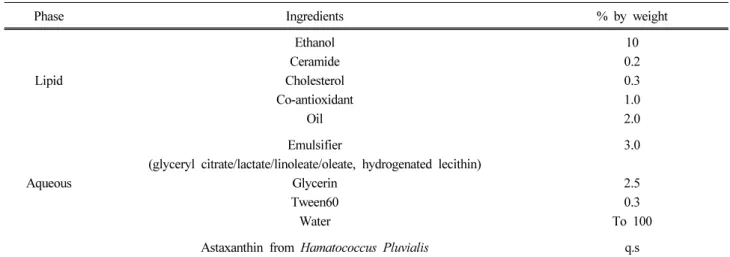
Phase Ingredients % by weight
Lipid
Ethanol Ceramide Cholesterol Co-antioxidant
Oil
10 0.2 0.3 1.0 2.0
Aqueous
Emulsifier
(glyceryl citrate/lactate/linoleate/oleate, hydrogenated lecithin) Glycerin
Tween60 Water
3.0
2.5 0.3 To 100
Astaxanthin from Hamatococcus Pluvialis q.s
Table 1. Prescription of Formulation for Astaxanthin Nanoemulsion
thetic astaxanthin, astaxanthin from natural sources still received more interest due to its greater antioxidant activ- ity and stability[4].
However, like most carotenoids, astaxanthin is a high- ly unsaturated molecule and thus it is highly sensitive to high temperature, light, and oxidative conditions which may promote the isomerization of astaxanthin into cis form which possesses less activity than their correspond- ing trans configuration[5]. In additions, genericity of use in the food and cosmetic field are not much enough be- cause of following reasons. Low solubility, color change and Photostability are of that[6]. One of the approaches that can be used to improve the solubility and bioavail- ability of carotenoids such as β-carotene is to incor- porate them in the fine particles of oil-in water (O/W) emulsions. But systemic study with active incorporation into a nanoemulsion using carotenoids especially, astax- anthin, has not been proposed. Besides, physicochemical influence of emulsifier concentration, homogenation con- dition, temperature as well as variety of co-antioxidants on astaxanthin incorporated nanoemulsion was not examined.
Furthermore, the effect of astaxanthin nano emulsion during storage which is very important parameter of emulsions has not been studied thoroughly.
Therefore, we report the stability evaluation of astax- anthin nanoemulsion prepared by high pressure homoge- nization under various conditions using new vesicle,
glyceryl citrate/lactate/linoleate/oleate and it is thought be very useful for cosmetic industry.
2. Materials & Experiments
2.1. Extraction of astaxanthin
Astaxanthin were collected from Hamatococcus pul- vialis (Honghao Chemical Co., Ltd, China). The astax- anthin was specially extracted with a continuous-flow su- per critical-carbon dioxide extraction apparatus (Lab SFE, Supercritical labs, Korea).
2.2. Preparation of astaxanthin nanoemulsion
Oil-in-water (O/W) nanoemulsion prepared using liq-
uid paraffin (seojin chemical, Korea), Ceramide (Doosan
biotech, Korea), cholesterol as dispersed phase and glyc-
eryl citrate/lactate/linoleate/oleate (Imwitor 375, Sasol,
Germany), ester of mono- and diglycerides of unsaturated
edible fatty acids with citric acid and lactic acid, hydro-
genated lecithin (Lipoid 100 - 3, Lipoid GMBH, Ger-
many), polysorbate 60 (Croda Korea, Korea), ethanol
(Korea alcohol, Korea), propylene glycol (SKC Chem,
Korea), deionized water as continuous phase. Prescription
of formulation for astaxanthin nanoemulsion was men-
tioned on table 1. The continuous and dispersed phases
were each heated to 70 ~ 75 ℃ and then mixed to form
pre-mix. The pre-mix was then homogenized using ho-
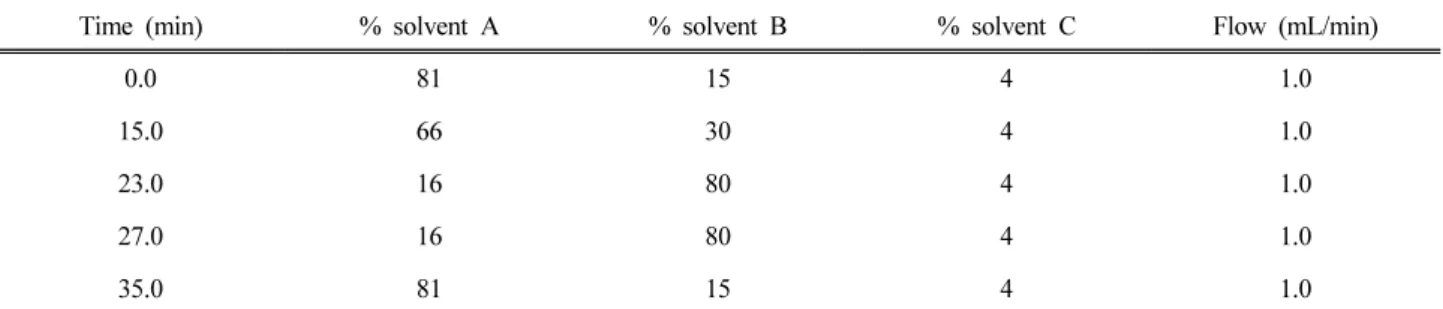
Time (min) % solvent A % solvent B % solvent C Flow (mL/min)
0.0 81 15 4 1.0
15.0 66 30 4 1.0
23.0 16 80 4 1.0
27.0 16 80 4 1.0
35.0 81 15 4 1.0
Calculation of Astaxanthin contents as follow.
Contents of Astaxanthin (mg/g) = [(S × a × b × 1,000)/[sample weight (mg) × 1,000]
S : Solution concentration (mg/mL) a : Total amount of test solution (mL) b : Dilution factor
Table 2. Condition of Elution
momixer (T.K Homo mixer, Osaka, Japan) for 5 min to pre-emulsify, and then, high-pressure homogenization (Microfluidics, Panda, Italy) was performed at 1,000 bar.
2.3. Analysis of astaxanthin concentration
Standard astaxanthin and astaxanthin in the extract were analyzed by a high-performance liquid chromatog- raphy (HPLC, Agilent 1,200, and Japan) series, equipped with a diode array detector. The standard and extract sol- utions were diluted with dichloromethane/methanol (1 : 3, v/v) and injected through the auto sample and separated with a reversed-phase C18-YMCA Carotenoid column (5 µm, 4.6 ⋅250 mm) at 25 ℃. Gradient elution was per- formed. The detection wavelength was kept at 474 nm.
The gradient elution condition was shown in table 2.
2.4. Identification and analytical study of particle size and distribution
The average particle size and size distribution of nano- emulsion were determined by dynamic light scattering using Mastersizer (Mastersizer 2,000 Hydro, Malvern Instrument, and Worcestershire, UK). The particle size of the emulsions was described by mean diameter and size distribution was described by volume per diameter and size distribution graph .
2.5. Evaluation of emulsion stability
The emulsion stability of the nano emulsion was eval-
uated using particle size analyzer, zeta potential (Zetasi- zer 3000HS, Malvern, UK), change of C, E value were carried out by colorimeter (Croma Meter CR200, Minolta, Japan), the nanoemulsions were sampled immediately af- ter the preparation and divided into three groups which store at 5 ℃, Cycle (-5 ℃ ~ 45 ℃), for four weeks, Light irradiated by suntester (Suntest CPS
+, Atlas, USA)
Stability of nanoemulsion was evaluated according to the potential difference by zetasizer as well as change of size and color for certain period of time.
The zeta potential was calculated from the following equation:
ζ = µU
e/ ε
d(1)
( ζ = zeta potential, µ = viscosity of solution, U
e= electronflowrate, ε
d= permittivity).
Zeta potential is a scientific term for electro kinetic potential in colloidal systems. Zeta potential is electric potential in the interfacial double layer at the location of the slipping plane versus a point in the bulk fluid away from the interface. The significance of zeta potential is that its value can be related to the stability of colloidal dispersions. When the potential is low, attraction exceeds repulsion and the dispersion will break and flocculate.
So, colloids with high zeta potential (approximately over
± 40) are electrically stabilized whereas colloids with low
zeta potentials tend to coagulate or flocculate.
Particle size (um)
0.01 0.02 0.05 0.1 0.2 0.5 1 2 5 10
Volume (%)
0 10 20 30 40 50 60
Glyceryl ester(glyceryl citrate/lactate/cinolea Glyceryl stearate citrate
Hydrogenated lecithin(PC 40%) Hydrogenated lecithin(PC 55%) Hydrogenated lecithin(PC 60%) Hydrogenated lecithin(PC 70%)
Figure 1. Particle size distribution on vesicle.
Particle size (um)
0.010.02 0.05 0.1 0.2 0.5 1 2 5 10 20 30 50 70 90
Volume (%)
0 20 40 60 80 100
Glyceryl ester (astaxanthin 1%) Glyceryl ester (astaxanthin 2%) Glyceryl ester (astaxanthin 3%) Glyceryl ester (astaxanthin 5.5%) Hydrogenated lecithin (astaxanthin 1%, FITC-dex Hydrogenated lecithin (astaxanthin 1%) Hydrogenated lecithin (astaxanthin 2%) Hydrogenated lecithin (astaxanthin 4%)
Figure 2. Particle size distribution on astaxanthin concentration.
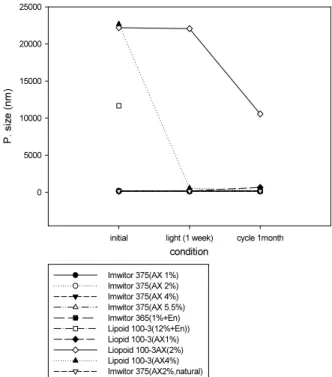
condition
initial light (1 week) cycle 1month
P. size (nm)
0 5000 10000 15000 20000 25000
Imwitor 375(AX 1%) Imwitor 375(AX 2%) Imwitor 375(AX 4%) Imwitor 375(AX 5.5%) Imwitor 365(1%+En) Lipoid 100-3(12%+En)) Liopid 100-3(AX1%) Liopoid 100-3AX(2%) Lipoid 100-3(AX4%) Imwitor 375(AX2%,natural)
Figure 3. Particle size distribution on astaxanthin concentra- tion under storage condition.
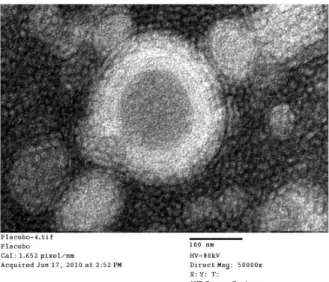
2.6. Encapsulation morphology by electron micro- scopy
The measurement of astaxanthin incorporation status was carried out by freeze-fracture scanning electron mi- croscope (FF-SEM, JEM1400, and Jeol, Japan) and trans- mission electron microscope (TEM, H-7600, and Hitachi, Japan). A small amount of sample was immersed into liquid ethane which was immediately frozen in liquid ni- trogen, and morphology checked using FF-SEM with propane gas.
3. Results & Discussion
3.1. Effect of the emulsifier type and homogenization pass times on the particle size parameter of nanoemulsion
Unimodal nanoemulsion sized about 170 nm was ob- served when used glyceryl citrate/lactate/linoleate/oleate as an emulsifier. but broad and larger size distribution of nanoemulsion was observed in the use of lecithin which may has much contents of phosphatidyl cholin.
3.2. Effect of the astaxanthin extract concentration on the particle size parameter in the astaxanthin nano emulsion
Astaxanthin incorporated nanoemulsion was inves- tigated according to the amount of astaxanthin concentra-
tion. Particle distribution on different vesicles between
new vesicle, glyceryl citrate/lactate/linoleate/oleate and
normal hydrogenated lecithin was studied. Tendency for
unimodal particle size distribution was observed in the
use of new vesicle, glyceryl citrate/lactate/linoleate/ole-
ate compared to that of hydrogenated lecithin. Size dis-
tribution rate dependant on concentration from 1 to 5.5%
Solution concentration (ug/mL)
Sampleweight (mg)
Total amount of test solution
Contents of
astaxanthin (mg/g) % Nanoemulsion
(initial) 1,710 884.1 50 0.1934 100
Nanoemulsion
(Sun light irradiated, 1 week) 1.637 975.4 50 0.1678 86.7
Nanoemulsion
(Cycle test, 1 month) 1.510 799.1 50 0.1890 97.8
Table 3. Analytical Data of Astaxanthin
(a) (b) (c) (d) (e) Figure 4. Comparison of the clarity of astaxanthin emul- sions made with glyceryl ester, with increasing astaxanthin concentration. (a) 1%, (b) 2%, (c) 4%, (d) 5.5%, (e)
Astaxanthin 1% + FITC Dextran.
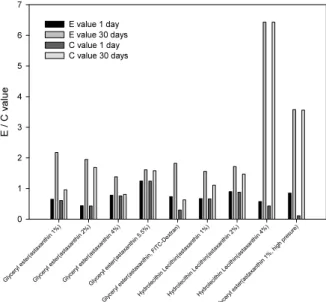
Glyceryl es ter(astaxant hin 1%
)
Glyceryl es ter(asta
xant hin 2%
)
Glyceryl es ter(as
taxant hin 4%
)
Glyceryl este r(astaxant
hin 5.5%)
Glyceryl es ter(astaxanthin, FITC-De
xtran)
Hydro lecithin Le
cithin(asta xanthin 1%
)
Hydro lecithin Le
cithin(astaxa nthin 2%
)
Hydro lecithin Le
cithin(astaxa nthin 4%
)
Glyceryl es ter(astaxant
hin 1%
, high pres ure)
E / C value
0 1 2 3 4 5 6 7
E value 1 day E value 30 days C value 1 day C value 30 days