DOI http://dx.doi.org/10.12791/KSBEC.2014.23.1.043 eISSN 2288-100X
Effect of Red LEDs during Healing and Acclimatization Process on the Survival Rate and Quality of Grafted Tomato Seedlings
Ngoc-Thang Vu1, Young-Shik Kim2, Ho-min Kang1, and Il-Seop Kim1*
1Department of Horticulture, Kangwon National University, Chuncheon 200-701, Korea
2Department of Plant and Food Science, Sangmyung University, Cheonan 330-720, Korea
Abstract. This study was designed to determine the effect of red LEDs during healing and acclimatization process on the survival rate and quality of grafted tomato seedlings. Red LEDs and no light (darkness) were used for treating three rootstock cultivars, which are ‘B-Blocking’, ‘Kanbarune’, ‘High-power’ in healing room. Results showed that survival rates of grafted seedlings in red LEDs were higher than those in no light treatment. Significant variation on survival rates of rootstock cultivars was observed in no light treatment but there was not significant variation in red LEDs treatment. Light treatment also reduced the percentage of infected plants, except for the ‘Kanbarune’ cultivar.
Seedling quality in red LEDs was better than that in no light treatment by improving growth parameters such as plant height, leaf length, leaf width, leaf area, fresh and dry weight of shoot and root. Light treatments and rootstock culti- vars did not affect number of leaves, leaf chlorophyll value and T/R ratio of seedlings, but seedlings in red LEDs were significantly more compact than those in no light treatment. Moreover, the root morphology of seedlings such as total root surface area, total root length, and number of toot tips in red LEDs was also greater than that in no light treatment.
Additional key words : growth parameters, infected plant, plug seedlings, rootstock, scion
Introduction
Interest in the use of grafted vegetable seedlings has increased in many countries during recent years in order to improve resistance to biotic and abiotic stresses (Lee and Oda, 2003; Rivero et al., 2003). The successful production of grafted plants requires highly technical grafting skills and environmental control during healing and acclimatiza- tion process. Proper acclimatization is critical for grafted plants to survive (Lee et al., 2010). After grafting, it is important to control the environment around grafted seed- lings for the robust joining of a scion and rootstock. In con- ventional culture, acclimatization may be achieved simply by enclosing the rootstock and scion in a plastic film shaded by cloth to avoid heat buildup, keep the high rela- tive humidity and reduce light intensity until the union is formed (Oda, 1999; Davis et al., 2008). However, it is quite difficult to control optimal environment for healing and the acclimatization of grafted seedlings under natural condition.
Once grafting is performed, it is important to increase the
chances for vascular bundles of the scion and rootstock to come into contact (Oda et al., 1994). During formation of the graft union, callus proliferation in both the rootstock and the scion is very important for vascular connection in the rootstock-scion interface (Ogata et al., 2005). A low or incorrect callus formation between the rootstock and scion could lead to defoliation, reduction of scion growth and low survival of grafted plants (Johkan et al., 2008; Johkan et al., 2009; Oda et al., 2005). In addition, some research- ers report that callus induction and growth required light condition (Afshari et al., 2011; Moon et al., 1997). There- fore, light is one of important factors that are necessary for grafted plants to survive (Nobuoka et al., 2005).
Light quality regulates a variety of plant development pathways from germination to flowering induction and fruit development (Jiao et al., 2007). Light-emitting diodes (LEDs) are the new fourth-generation light source with good spec- tral characteristics and spectral width, and can be assem- bled to match light quality which plants need (Goins et al., 1997). Many studies were carried out to evaluate effect of LEDs on growth and development of plants, however, most studies have focused on growth, photosynthesis, metabo- lism and gene expression (Neff et al., 2000; Yu and Ong, 2003; Wang et al., 2009; Zhang et al., 2003), while less is
*Corresponding author: [email protected]
*Received January 23, 2014; Revised February 24, 2014;
*Accepted March 11, 2014
known about how LEDs affects the survival rate and qual- ity of grafted seedlings during the healing and acclimatiza- tion process. Regarding irradiation by different LEDs during healing and acclimatization period, Vu et al. (2014) reported that there were no significant differences between red LEDs and white fluorescent lamps treatments with survival rate and growth parameters, but they decreased in far-red LEDs, blue LEDs, or darkness treatments. Therefore, the objec- tive of this study was conducted to confirm the effects of red LEDs during healing and acclimatization process on the survival rate and seedling quality of different tomato cultivars.
Materials and Methods
1. Plant materials and grafting method
Both scion and rootstocks of tomato seeds were sown in the 128-cell plug trays (Bumnong. Co., Ltd., Jeongeup, Korea) that was filled with commercial growing substrate (BM2, Berger Group Ltd., Quebec, Canada). ‘Choice’ cul- tivar was used as scion while ‘B-Blocking’, ‘Kanbarune’,
‘High-power’ cultivars were used as rootstocks. During the plastic house, seedlings were watered daily or as required.
One week after sowing, seedlings started to receive a fertil- ization based on Wonder Grow fertilizers (Wonder Grow Fertilizers, Chobi Co., Ltd., Seoul, Korea) twice a week through an overhead irrigation. Twenty-two days after sow- ing, the seedlings were used for grafting.
Grafting was done by splice grafting method. Plants were grafted by first making approximately 45o cuts on both the rootstock and scion seedlings using a sharp razor blade.
After placing the scion on the rootstock, ordinary grafting clips were used to fix the grafted position tightly together (Lee and Oda, 2003). Rootstock and scion plants with simi- lar stem diameters (2.3~2.4 mm) were chosen to increase the grafting success rate.
2. Light quality treatments
Red LEDs (the light intensity was approximately 15µmol · m−2· s−1 PPFD) and no light (darkness) were used for treat- ing three rootstock cultivars in healing room for 10 days.
The healing room was equipped with an auto-controlled air conditioning system for healing the grafting. Relative humid- ity was maintained 85~90%, temperature were set up 23oC.
After 10 days in the healing room, grafted seedlings were transferred to plastic house in natural condition for 5 days.
3. Data collection and analysis
All grafted seedlings were evaluated for signs of graft failure on the 10th day after grafting. Infected seedlings were evaluated on the 15th day after grafting. Grafted seed- lings on the 15th day after grafting were harvested for anal- ysis of growth characteristics. Plant height and number of leaves of grafted seedlings were measured, leaf area esti- mated by leaf area meter (Delta-T Device Ltd., Burwell, Cambridge, UK), leaf chlorophyll content was measured by using a chlorophyll meter (SPAD-502 Plus, Konica Minolta Sensing Inc., Osaka, Japan). The fresh and dry weights of shoot and root were measured. Dry weights of shoot and root were taken through oven-dry method at 80oC for 72 h until constant weight was achieved. T/R ratio and compact- ness were calculated according to Kim et al. (2008). For the root system morphology, the WinRHIZO Pro 2009c (Regent Instruments, Inc, Quebec, Canada) images analysis system was used, coupled with professional scanner Epson 10000XL (Seiko Epson Corporation, Nagano, Japan) accord- ing to Arsenault et al. (1995). The roots were detached from their shoots and then placed in a tray (15 × 30 × 2 cm) with water and placed on the scanner. Scanned images were analyzed by the WinRHIZO program for total root surface area, total root length, average root diameter, and number of root tips.
The experimental design was a split-plot. Light was the main plot and rootstock cultivars were the sub plot in this experiment. Six treatments were designed by combination of two levels of light (red LEDs and no light) and three cultivars. For the statistical analysis of survival rate, one 128-cell plug tray with 64 plants in each replication was measured. For the statistical analysis of growth parame- ters, ten seedlings per treatment from each replication were randomly selected. Data were analyzed using SAS v.9.3 software (SAS Institute Inc., Cary, NC, USA). Mean separations were calculated using Duncan’s multiple range tests.
Results
1. Effect of red LEDs on survival rate of grafted tomato seedlings
On the 10th day after grafting, the survival rates of grafted seedlings in red LEDs were higher than the sur- vival rate of grafted seedlings in no light treatment. Signifi- cant variation on survival rates of rootstock cultivars was
observed in no light treatment but there was not significant variation in red LEDs treatment. Light treatment also reduced percentage of infected plants, except for the ‘Kan- barune’ cultivar. Final survival rates (87.9~95.4%) were considerably high in all rootstock cultivars when red LEDs irradiation was applied during the healing and acclimatiza- tion process whereas final survival rates (34.9~67.7%) were low in no light treatment. Red LEDs had greatly influenced the survival rate of ‘Kanbarune’ cultivar which
‘High-Power’, ‘B-Blocking’ cultivars followed in order (Table 1).
2. Effect of red LEDs on growth characteristics of grafted tomato seedlings
Analysis of the variance of growth characteristics in red LEDs and no light of three rootstock cultivars are pre- sented in Table 2 and 3. Significant differences on plant
height, leaf length, leaf width, leaf area, fresh and dry weight of shoot and root of grafted seedlings were observed between red LEDs and no light treatments. Plant height of seedlings in red LEDs was higher than that in no light treatment. Stem diameter was not significant differ- ence on light treatments but significant different on root- stock cultivars. Leaf number and leaf chlorophyll value did not exhibit any significant difference between no light and red LEDs treatment in all rootstock cultivars. However, leaf length, leaf width, and leaf area of seedling in red LEDs were higher than those in no light treatment. Fresh and dry weights of shoot and root of seedlings in red LEDs were greater than those in no light treatment. Different light treatments and different rootstock cultivars did not affect on T/R ratio of grafted seedlings but seedlings in red LEDs were significantly more compact than those in no light treatment.
Table 1. Effect of red LEDs and darkness during healing and acclimatization process on the survival rate and infected plants of grafted tomato seedlings.
Treatments Cultivars Survival rate after 10 days (%) Infected plants (%) Final survival rate (%) No light
(Darkness)
‘B-Blocking’ 72.6 bz 4.8 a 67.7 b
‘Kanbarune’ 35.7 dz 1.8 c 34.9 c
‘High-Power’ 50.8 cz 4.9 a 48.5 c
Red LEDs
‘B-Blocking’ 90.2 az 3.3 b 87.9 a
‘Kanbarune’ 98.2 az 1.8 c 95.4 a
‘High-Power’ 93.4 az 3.3 b 90.5 a
Significance
Light (L) **y * **
Cultivar (C) * * *
L × C * * *
zMean separation within columns by Duncan’s multiple range test at P = 0.05.
y*, ** indicates significant at P≤0.05 and P ≤ 0.01, respectively.
Table 2. Effect of red LEDs and darkness during healing and acclimatization process on growth characteristics of grafted tomato seed- lings.
Treatments Cultivars Plant height (cm)
Stem diameter (mm)
No. of leaves
Leaf chlorophyll value (SPAD)
Leaf length (cm)
Leaf width (cm)
Leaf area (cm2) No light
(Darkness)
‘B-Blocking’ 6.88 cz 2.57 ab 4.20 c0 45.05 a0 6.56 c 4.50 b 15.10 b
‘Kanbarune’ 6.58 cz 2.32 c0 4.40 bc 44.11 a0 6.09 c 4.28 b 13.50 b
‘High-Power’ 6.67 cz 2.45 bc 4.50 bc 43.74 ab 6.48 c 4.28 b 13.20 b
Red LEDs
‘B-Blocking’ 8.93 az 2.73 a0 5.00 a0 40.95 b0 9.03 a 5.18 a 19.20 a
‘Kanbarune’ 7.64 bz 2.49 bc 4.30 bc 44.84 a0 7.59 b 5.25 a 17.70 a
‘High-Power’ 7.39 bz 2.54 b0 4.70 ab 42.93 ab 8.19 a 5.33 a 19.30 a
Significance
Light (L) **y NS NS NS ** ** **
Cultivar (C) NS * NS NS NS NS NS
L × C * * NS NS * NS *
zMean separation within columns by Duncan’s multiple range test at P = 0.05.
yNS, *, ** indicates Non-significant; significant at P≤ 0.05 and P ≤ 0.01, respectively.
Table 3. Effect of red LEDs and darkness during healing and acclimatization process on fresh weight, dry weight, T/R ratio and compact- ness of grafted tomato seedlings.
Treatments Cultivars Fresh weight (g) Dry weight (g) T/Rz
ratio
Compactnessy (mg · cm−1)
Top Root Top Root
No light (Darkness)
‘B-Blocking’ 0.987 cx 0.228 ab 0.094 b 0.016 b 4.21 ab 11.78 bc
‘Kanbarune’ 0.820 dx 0.148 b0 0.081 c 0.011 c 4.96 ab 10.75 c0
‘High-Power’ 0.802 dx 0.177 b0 0.081 c 0.012 c 4.75 ab 11.87 bc
Red LEDs
‘B-Blocking’ 1.383 ax 0.274 a0 0.119 a 0.021 a 5.05 a0 13.69 a0
‘Kanbarune’ 1.089 bc 0.286 a0 0.123 a 0.021 a 4.13 b0 14.23 a0
‘High-Power’ 1.181 bx 0.244 a0 0.118 a 0.020 a 4.81 ab 13.30 ab
Significance
Light (L) *w * ** * NS *
Cultivar (C) * NS NS NS NS NS
L × C * * * NS NS *
zT/R ratio is shoot dry weight/root dry weight.
yCompactness is the values of the dry weight divided by the plant height.
xMean separation within columns by Duncan’s multiple range test at P = 0.05.
wNS, *, ** indicates Non-significant; significant at P≤ 0.05 and P ≤ 0.01, respectively.
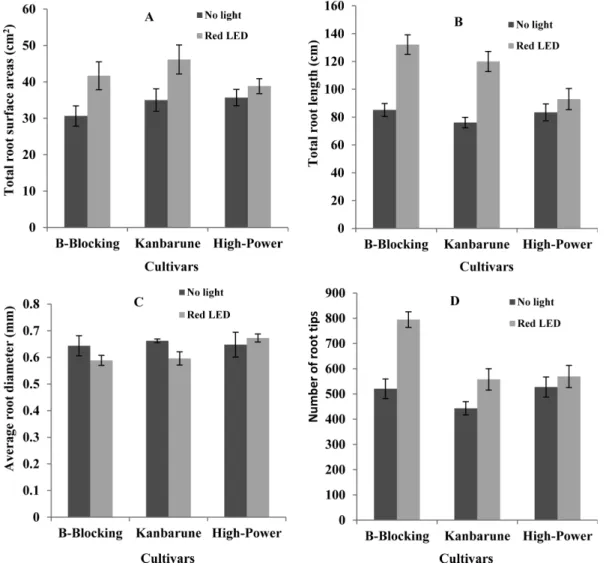
Fig. 1. Effect of red LEDs and darkness during healing and acclimatization process on root morphology of grafted tomato seedlings. Total root surface area (A), total root length (B), average root diameter (C), and number of root tips (D). Vertical bars represent ± SD, n = 10.
3. Effect of red LEDs on root morphology of grafted tomato seedlings
Root morphology of grafted seedlings responses to red LEDs and no light treatments are given in Fig. 1. Total root surface area, total root length, average root diameter, and number of root tips were significantly different in both light treatments and rootstock cultivars. Total root surface area, total root length, and number of toot tips of seedlings in red LEDs were higher than those of seedlings in no light treatment, except of ‘High-Power’ cultivar. However, aver- age root diameter of ‘B-Blocking’ and ‘Kanbarune’ culti- vars in red LEDs was lower than those in no light treatment.
Discussions
Light is one of the important factors that influence the survival rate of grafted seedling during healing and accli- matization process (Nobuoka et al., 2005). Therefore, in this study survival rates of grafted seedlings in red LEDs were higher than survival rates of grafted seedlings in no light treatment. This result agreed with results of Nobuoka et al. (2005) who suggested that the survival rate and growth of grafted tomatoes were enhanced by light during healing and acclimatization process. In addition, no signifi- cant difference was observed on survival rate in red LEDs treatment. Our result agreed with results of Oda et al.
(1993) who did not find difference in survival rate between cucumber grafted onto C. maxima and C. moschata. Salehi et al. (2009) suggested that survival rate was not affected by the number of vascular bundles in hypocotyls of root- stocks. Vu et al. (2013) also reported that survival rate was not affected by different rootstock cultivars. On the other hand, light treatment also reduced percentage of infected plants, except ‘Kanbarune’ cultivar. This result agreed with the result of Buck et al. (2010) who reported that germina- tion and germ tube elongation of fungi decreased with increasing light intensity. However, the survival rates of grafted seedlings in no light treatment were very low.
Moreover, there was significant different among rootstock cultivars with survival rate in no light treatment. There- fore, darkness during healing and acclimatization process was not a suitable environment for grafted seedlings after grafting.
Some papers reported that the plant height of seedlings decreased with increasing light intensity during healing and
acclimatization process (Jang et al., 2011; Nobuoka et al., 2005). However, in our study seedlings in red LEDs were higher than seedlings in no light treatment. A suitable envi- ronmental condition for grafted seedlings in red LEDs treatment was the cause that increased the chances for vas- cular bundles of the scion and rootstock to come into con- tact. Therefore, the growth recovery of grafted seedlings in red LEDs was faster than those in no light treatment. So, plant growth parameters in red LEDs were higher than those in no light treatment. Moreover, the grafted seedlings in red LEDs were significantly more compact than grafted seedlings in no light treatment. This result agreed with result of Jang et al. (2011) who reported an increase of photosynthetic photon flux during healing and acclimatiza- tion led to the improvement of growth and quality of grafted plants. In addition, the root morphology were also enhanced in seedlings treated with red LEDs through improving total root surface, total root length, and number of root tips. In relation to this, Li et al. (2010) and Moon et al. (2006) indicated that the root activity of seedlings was greatest under red LEDs light compared with no light con- ditions in tissue culture. However, the rapid development of root by increasing total root length and number of root tips in red LEDs of ‘B-Blocking’ and ‘Kanbarune’ culti- vars could be the cause of reduced average root diameter in these cultivars.
In conclusion, short-term red LEDs irradiation is a suit- able environmental condition during healing and acclimati- zation process for grafted seedlings. Red LEDs promoted the survival rate and quality of grafted tomato seedlings.
Acknowledgements
This study was supported by Export Promotion Technol- ogy Development Program, Ministry of Agriculture, Food and Rural Affairs, Republic of Korea.
Literature Cited
Arsenault, J.L., S. Pouleur, C. Messier, and R. Guay. 1995.
WinRHIZO, a root-measuring system with a unique over- lap correction method. HortScience 30:906 (Abtract).
Afshari, R.T., R. Fngoshtari, and S. Kalantari. 2011. Effect of light and different plant growth regulators on induction of callus growth in rapeseed (Brassica napus L.) genotypes.
Plant Omics Journal 4:60-67.
Buck, J.W., W.B. Dong, and D.S. Mueller. 2010. Effect of
light exposure on in vitro germination and germ tube growth of eight species of rust fungi. Mycologia. 102:1134-1140.
Davis, A.R., P. Perkins-Veazie, Y. Sakata, S. L'opez-Galarza, J.V. Maroto, S.G. Lee, Y.C. Huh, Z.Y. Sun, A. Miguel, R.K.
Stephen, R. Cohen, and J.M. Lee. 2008. Cucurbit Grafting.
Critical Reviews in Plant Sciences 27:50-74.
Goins, G.D., N.C. Yorio, M.M. Sanwo, and C.S. Brown. 1997.
Photomorphogenesis, photosynthesis, and seed yield of wheat plants grown under red light-emitting diodes (LEDs) with without supplemental blue lighting. J. Exp. Bot. 48:
1407-1413.
Jang, Y.A., E. Goto, Y. Ishigami, B. Mun, and C.H. Chun.
2011. Effect of light intensity and relative humidity on pho- tosynthesis, growth and graft-take of grafted cucumber seedlings during healing and acclimatization. Hort. Enviro.
Biotechnol. 52:331-338.
Jiao, Y., O.S. Lau, and X.W. Deng. 2007. Light-regulated tran- scriptional networks in higher plants. Nat. Rev. Genet.
8:217-230.
Johkan, M., M. Oda, and G. Mori. 2008. Ascobic acid pro- motes graft-take in sweet pepper plants (Capsicum annuum L.). Scientia Horticulturae 116:343-347.
Johkan, M., K. Mitukuri, S. Yamasaki, G. Mori, and M. Oda.
2009. Causes of defoliation and low survival rate of grafted sweet pepper plants. Scientia Horticulturae 119:103-107.
Kim, I.S., C.H. Zhang, H.M. Kang, and B. Mackay. 2008.
Control of stretching of cucumber and tomato plug seed- lings using supplemental light. Hort. Environ. Biotechnol.
49:287-292.
Lee, J and M. Oda. 2003. Grafting of herbaceous vegetable and ornamental crops. Horticultural Reviews 28:61-124.
Lee, J.M., C. Kubota, S.J. Tsao, Z. Bie, P. HoyosEchevarria, L. Morra, and M. Oda. 2010. Current status of vegetable grafting: Diffusion, grafting techniques, automation. Scien- tia Horticulturae 127:93-105.
Li, H., Z. Xu, and C. Tang. 2010. Effect of light-emitting diodes on growth and morphogenesis of upland cotton (Gossypiumhirsutum L.) plantles in vitro. Plant Cell Tissue Organ Cult. 103:155-163.
Moon, H.K. and A.M. Stomp. 1997. Effects of medium com- ponents and light on callus induction, growth, and frond regeneration in Lemna gibba (Duckweed). In Vitro Cell.
Dev. Biol-Plant 33:20-25.
Moon, H.K., S.K. Park, Y.W. Kim, and C.S. Kim. 2006.
Growth of Tsuru-rindo (Tripterospermum japonicum) cul- tured in vitro under various sources of light-emitting diode (LED) irradiation. J. Plant. Biol. 49:174-179.
Neff, M.M., C. Fankhauser, and J. Chory. 2000. Light: an indi- cator of time and place. Genes & Develoment 14:257-271.
Nobuoka, T., T. Nishimoto, and K. Toi. 2005. Wind and light
promote graft-take and growth of grafted tomato seedlings.
J. Japan. Soc. Hort. Sci. 74:170-175.
Oda, M., K. Tsuji, and H. Sasaki. 1993. Effect of hypocotyls morphology on survival rate and growth of cucumber seed- lings grafted on Cucurbita spp. J. Japan. Soc. Hort. Sci.
26:259-263.
Oda, M., K. Tsuji, K. Ichmura, and H. Sasaki. 1994. Factors affecting the survival of cucumber plants grafted on pump- kin plants by horizontal grafting at the hypocotyl level. Bul.
Natl. Res. Inst. Veg. Ornamental Plants, Tea 9:51-60.
Oda, M. 1999. Grafting of vegetables to improve greenhouse production. Food and Fertilizer Technology Centre Exten- sion Bulletin. 480:1-11.
Oda, M., M. Maruyama, and G. Mori. 2005. Water transfer at graft union of tomato plants grafted onto Solanum root- stocks. J. Japan. Soc. Hort. Sci. 74:458-463.
Ogata, T., Y. Kabashima, S. Shiozaki, and S. Horiuchi. 2005.
Regeneration of the vascular bundle at the graft interface in auto-and hetero grafts with juvenile nucellar seedlings of satsuma mandarin, yuzu and trifoliate orange. J. Japan. Soc.
Hort. Sci. 74:214-220.
Rivero. R.M., J.M. Ruiz, and L. Romero. 2003. Role of graft- ing in horticultural plants under stress conditions. Food, Agriculture & Environment. 1:70-74.
Salehi, R., A. Kashi, S.G. Lee, Y.C. Huh, J.M. Lee, M.
Babalar, and M. Delshad. 2009. Assessing the survival and growth performance of Iranian melons to grafting onto Cucurbita rootstocks. Kor. J. Hort. Sci. Technol. 27:1-6.
Vu, N.T., C.H. Zhang, Z.H. Xu, Y.S. Kim, H.M. Kang, and I.S. Kim. 2013. Enhanced graft-take ratio and quality of grafted tomato seedlings by controlling temperature and humidity conditions. Protected Horticulture and Plant Fac- tory 22:146-153.
Vu, N.T., Y.S. Kim, H.M. Kang, and I.S. Kim. 2014. Influ- ence of short-term irradiation during pre- and post-grafting period on the graft-take ratio and quality of tomato seed- lings. Hort. Environ. Biotechnol. 55:27-35.
Wang, H., M. Gu, J. Cui, K. Shi, Y. Zhou, and J. Yu. 2009.
Effects of light quality on CO2 assimilation, chlorophyll-flu- orescence quenching, expression of Calvin cycle genes and carbohydrate accumulation in Cucumis sativus. J. Photo- chem. Photobiol. B: Biol. 96:30-37.
Yu, H. and B.L. Ong. 2003. Effect of radiation quality on growth and photosynthesis of Acacia mangium seedlings.
Photosynthetica. 41:349-355.
Zhang, C., I.J. Chun, Y.C. Park, and I.S. Kim. 2003. Effects of timings and light intensities of supplemental red light on the growth characteristics of cucumber and tomato plug seed- lings. J. Bio-Env. Con. 12:173-179.
토마토 접목묘의 순화과정에서 적색LED광조사가 접목 활착율과 묘소질에 미치는 영향
넉탕부1· 김영식2· 강호민1· 김일섭1*
1강원대학교 원예학과, 2상명대학교 식물식품공학과
적 요. 본 연구는 토마토 플러그묘의 접목후, 순화과정에서 단기간 광조사 여부가 접목 활착율과 묘소질에 미치는 영향을 구명하기 위하여 실시 되었다. 공시 품종으로 ‘B-Blocking’, ‘Kanbarune’, ‘High-Power’의 3종 류 대목 품종에 방울토마토 ‘Choice’ 품종을 각각 접목한 뒤, 활착실에서 10일간 적색LED 광조사구와 무처리 (대조구)로 나누어 접목 활착율과 묘소질을 조사하였다. 적색 LED 광조사구의 접목 활착율은 대목품종에 관계 없이 무처리구에 비해 높았다. 광조사구 접목 활착율은 세 품종 모두 90% 이상으로 품종간의 유의성이 없었 으나, 무처리구의 접목 활착율은 35~72% 정도로 품종에 따른 차이가 매우 컸다. 활착기간 중 곰팡이병 이병 율도 ‘Kanbarune’를 제외하고 광조사구가 무처리구에 비해 저하하는 경향을 보였으나, 품종간 유의차는 나타나 지 않았다. 묘소질은 경경, 엽수, 엽록소 함량을 제외한 모든 생육지표에서 LED광 조사구가 우수한 결과를 나타내었으나, 처리에 따른 대목 품종간 유의차는 전반적으로 나타나지 않았다. 지하부 생육에서 평균 근경을 제외한 뿌리 표면적, 전 근장, root tip수는 광조사구가 무처리구에 비해 모든 품종에서 우세하였다.
추가 주제어 : 생육지표, 이병율, 플러그묘, 접수, 대목