Long-Term Follow-Up Results of a Second-Generation Cementless Femoral Prosthesis with a Collar and
Straight Distal Fixation Channels
Chang Wook Han,
1Ick Hwan Yang,
1Hye Yeon Lee,
2and Chang Dong Han
1Departments of 1Orthopaedic Surgery and 2Anatomy, Yonsei University College of Medicine, Seoul, Korea.
Received: February 22, 2011 Revised: April 6, 2011 Accepted: April 6, 2011
Corresponding author: Dr. Chang Dong Han, Department of Orthopaedic Surgery, Yonsei University College of Medicine, 50 Yonsei-ro, Seodaemun-gu, Seoul 120-752, Korea.
Tel: 82-2-2228-2180, Fax: 82-2-363-1139 E-mail: [email protected]
∙ The authors have no financial conflicts of interest.
© Copyright:
Yonsei University College of Medicine 2012 This is an Open Access article distributed under the terms of the Creative Commons Attribution Non- Commercial License (http://creativecommons.org/
licenses/by-nc/3.0) which permits unrestricted non- commercial use, distribution, and reproduction in any medium, provided the original work is properly cited.
Purpose: We evaluated the results of more than 10 years of follow-up of total hip ar- throplasty using a second-generation cementless femoral prosthesis with a collar and straight distal fixation channels. Materials and Methods: One hundred five patients (129 hips) who underwent surgery between 1991 and 1996 for primary total hip ar- throplasty using cementless straight distal fluted femoral stems were followed for more than 10 years. Ninety-four hips in 80 patients were available for clinical and ra- diologic analysis. The mean age at the time of surgery was 47 years, and the mean duration of follow-up was 14.3 years. Results: The mean Harris hip scores had im- proved from 58 points to 88 points at the time of the 10-year follow-up. Activity-re- lated thigh pain was reported in nine hips (10%). At the last follow-up, 93 stems (99%) were biologically stable and one stem (1%) was revised because of loosening.
No hip had distal diaphyseal osteolysis. Proximal femoral stress-shielding was report- ed in 86 hips (91%). We found no significant relationship between collar-calcar con- tact and thigh pain, stem fixation status, or stress-shielding. The cumulative survival of the femoral stem was 99% (95% confidence interval, 98-100%) after 10 years.
Conclusion: The long-term results of total hip arthroplasty using a second-generation cementless femoral prosthesis with a collar and straight distal fixation channels were satisfactory; however, the high rate of proximal stress-shielding and the minimal ef- fect of the collar indicate the need for some changes in the stem design.
Key Words: Total hip arthroplasty, second-generation, cementless, collar, straight distal fixation channel
INTRODUCTION
Cementless total hip arthroplasty was developed as an alternative method to ce- mented arthroplasty, in which aseptic loosening and subsequent mechanical failure were common problems.1-3 Bone ingrowth by direct contact between the host bone and the porous-coated surface of the prosthesis was expected to achieve stable bio- logic fixation and prevent component loosening.
Although “first-generation” cementless femoral components showed acceptable prosthetic stability due to bone ingrowth,4-6 problems were reported, including distal
up (six years post-operation); all the other hips were followed for a minimum of 10 years after the operation. Patient de- mographic data are shown in Table 1.
The HG Multilock femoral stem is a straight-collared femoral component made of Ti-6Al-4V alloy (Fig. 1). The implant’s features include a proximal circumferential fiber- metal porous coating consisting of a titanium wire mesh that is diffusion-bonded to the substrate. The porous surface area is trapezoidal and extends into the metaphyseal-diaph- yseal junction of the stem. The distal portion of the implant is polished and has fixation channels (flutes) that engage the diaphyseal cortex to enhance initial rotational stability.
A posterolateral approach without trochanteric osteotomy was used in all cases. A 28-mm cobalt-chromium alloy fem- femoral osteolysis, stress-shielding, and activity-related thigh
pain.7-13 Changes in prosthetic material and design produced second-generation cementless femoral components, using materials with a lower modulus of elasticity (such as titanium alloy) to minimize postoperative thigh pain and femoral stress-shielding. The porous-coated surface was limited to the proximal region of the stem to reproduce a load-transfer pat- tern similar to that of a normal femur. In addition, proximal porous-coating was applied in a circumferential pattern with no smooth channel that could act as a passage for polyethyl- ene wear particles and cause distal diaphyseal osteolysis.14
The Harris-Galante (HG) Multilock (Zimmer, Warsaw, IN, USA) femoral stem is a second-generation femoral compo- nent that is newly characterized by use of titanium alloy with circumferential proximal porous coating. Although the stem produces relatively good short- to mid-term results,15-17 the collared and distal fluted design of the stem (retained from its predecessor) left room for improvement; hence its successor is a femoral prosthesis that is collarless and has a distal tapered design.
The purpose of the present study was to evaluate long- term clinical outcomes, radiographic results, and implant survival rates for patients followed up for a minimum of 10 years after a primary cementless total hip arthroplasty per- formed using a collared and distal fluted second-generation femoral prosthesis. The effectiveness of the collared and straight distal fluted geometry in the femoral prosthesis was also assessed.
MATERIALS AND METHODS
Between August 1991 and February 1996, a single surgeon performed 129 cementless total hip arthroplasties in 105 patients using the HG Multilock femoral stems and cement- less acetabular components (Harris-Galante II; Zimmer).
Eleven of these patients (15 hips) died within the 10-year postoperative period from conditions not related to the ar- throplasty, and none underwent revision surgery before death. Fourteen patients (20 hips) were lost to follow-up within the 10-year period. All 14 patients were last contact- ed by telephone and had no complaints related to the hip re- placement at their last follow up. The remaining 80 patients (94 hips) were available for clinical and radiologic analysis.
The mean duration of follow-up was 14.3 years (range, 10 to 18.7 years). Only one patient (one hip) received revision surgery for a femoral component before the 10-year follow-
Table 1. Demographic Data
No. of hips 94
No. of patients 80
Diagnosis (No. of hips)
Avascular necrosis 63
Osteoarthritis 17
Femur neck fracture 10
Sequelae of pyogenic arthritis 4 Gender (No. of patients)
Male 61
Female 19
Age at operation* (yrs) 47 (25 to 73)
Height* (cm) 166 (150 to 183)
Weight* (kg) 62.4 (44 to 84)
Body mass index* (kg/m2) 22.6 (16.8 to 32.5)
*Data are given as a mean with the range in parenthesis.
A B
Fig. 1. (A) Anteroposterior and (B) lateral postoperative radiographs of the Harris-Galante Multilock femoral prosthesis.
Intramedullary bone formation at the distal tip (bony pedes- tal) was considered ‘stable’ if the new bone formation was in direct contact with the distal stem tip and if no new radio- lucencies or reactive lines formed around the stem tip.22 In contrast, a radiolucency and a line surrounding the distal stem was considered to indicate that the pedestal beneath the stem was unstable.22 Distal cortical hypertrophy was re- corded. Change in the position of the stem to varus or valgus was determined by drawing a line through the longitudinal axis of the stem and another line through the longitudinal axis of the proximal femoral canal. Instability of the femo- ral stem was defined as subsidence of >2 mm or change of the stem position angle of >2°, or a continuous radiolucent line wider than 2 mm.7,23 Linear polyethylene wear was mea- sured with the Picture Archiving Communication System (PACS, General Electrics, Milwaukee, WI, USA) accord- ing to the method by Livermore, et al.24
The statistical association between the collar-calcar con- tact and activity-related thigh pain, the status of stem fixation or the severity of stress-shielding was evaluated using the chi-square test and Fisher’s exact test. The level of signifi- cance was p<0.05. Kaplan-Meier analysis of the survival of the femoral component was performed for all 129 hips.
The Institutional Review Board of Yonsei University Col- lege of Medicine approved this retrospective study.
RESULTS
Clinical results
The average Harris hip score improved from a preoperative 58 points (range, 4 to 93 points) to an 88-point average (range, 29 to 100 points) at the last follow up. Fifty-four hips (57%) had excellent outcomes; 21 hips (22%), good out- comes; 10 hips (11%), fair outcomes; and nine hips (10%), poor outcomes. Of the nine poor outcomes, the low Harris scores of 4 were not related to the total hip replacement; two were related to spinal stenosis, one was complicated with an ipsilateral knee problem, and one was associated with stroke. The other five poor outcomes were related to the ac- etabular cup or polyethylene liner. Activity-related thigh pain was reported in nine patients (9 hips; 10%). The pain was spontaneously relieved in six hips within the 2-year postop- erative period and minor complaints in three hips did not compromise daily activities.
Postoperative dislocations occurred in six patients (six hips); five of these were treated with closed reduction, and oral head and a ram extruded GUR 4150 (Westlake Plastics,
Lenni, PA, USA) ultra-high-molecular-weight polyethylene, machined and sterilized with γ-irradiation in air, was inserted in all patients. Prophylactic antibiotics (third-generation ceph- alosporin) were given to all patients intraoperatively unless contraindicated, and continued until 2 days after surgery. An- ti-thromboembolic stockings were applied to all patients as prophylaxis for deep-vein thrombosis, but anti-coagulation agents were not routinely used except for those who had any risk factors for cardiovascular disease. Partial weight-bearing with two crutches was allowed for 6 weeks post-operation and full weight-bearing was allowed thereafter.
Preoperative clinical and radiographic evaluations were performed as well as postoperative exams at 6 weeks, 3 months, 1 year, and annually after that. The Harris Hip score18 was used for clinical evaluation of function and pain. The results were considered excellent for a Harris Hip score of 90-100, good for a score of 80-89, fair for a score of 70-79, and poor for a score below 70. Activity-related thigh pain was recorded separately. All intraoperative and postopera- tive complications were recorded.
Standard radiographs included an anteroposterior view of the pelvis and anteroposterior and lateral views of the prox- imal femur. Two independent observers (C.W.H. and I.H.Y.) who were not involved in the implantation evaluated all ra- diographs. The immediate postoperative radiograph was evaluated for the contact of the collar and the medial femo- ral cortical bone (calcar) using the method of Meding, et al.19 The locations of radiographic findings in the femur were recorded using the zones described by Gruen, et al.20 and Johnston, et al.21 Considering the structure of the HG Multilock stem, zones 1 and 2 were divided by the junction of the porous and smooth areas of the implant laterally, zone 4 included the distal smooth tip, zones 3 and 5 divided the remaining smooth portion of the stem laterally and me- dially, and zones 6 and 7 were divided by the junction of the porous and smooth surfaces of the stem medially.15 Femoral component fixation was graded as bone ingrowth, stable fi- brous ingrowth, or unstable implant, using the criteria of Engh, et al.7 Endosteal bone bridging (spot weld) formation, presence of radiolucent lines at the bone-prosthesis inter- face, and osteolysis were evaluated. Proximal femoral re- modeling (stress-shielding) was graded as first degree; cal- car rounding only, second degree; calcar rounding and loss of medial cortical density at zone 7, third degree; more ex- tensive resorption of cortical bone at zone 6 and 7, as fourth degree; and cortical resorption extended into the diaphysis.7
bility of the femoral stems was checked intraoperatively, and both stems were well-fixed to the femoral bones. There- fore, stem revisions were not performed, and only allogenous bone grafts for the femoral defect area were performed.
Proximal femoral stress-shielding was noted in 86 hips (91%), and eight hips (9%) showed no evidence of femoral stress-shielding upon the latest radiographic follow-up. For- ty-six hips (49%) had first-degree stress-shielding and 39 hips (41%) had second-degree stress-shielding. Extensive cortical resorption was noted in one hip at the six-year post- operative point. In spite of stable bony ingrowth with end- osteal spot weld in zone 7, the stem was revised because the patient was relatively young, male and highly active. At the latest clinical follow-up (15 years after index surgery, nine years after revision surgery), the patient had a 95-point Harris hip score and no complaints about his hip function.
Contact of the collar and femoral calcar was observed in 44 hips (47%), and collar-calcar contact showed no statisti- cal correlation with thigh pain, the status of stem fixation or stress-shielding (p>0.05).
The linear wear rate was 0.20 mm/year (0.05 to 0.66 mm/
year).
Revisions
Forty-four hips (47%) received revision surgery for any rea- son during the follow-up period (average 10.5 years, range 2.5-18.3 years after surgery). One hip received revision only of the femoral stem because of extensive stress-shielding.
In 18 (19%) hips, only the polyethylene liner and femoral head were changed and 13 of these 18 liner-exchange sur- geries were performed because of the locking mechanism failure in the Harris-Galante II acetabular prosthesis. The remaining 25 (27%) hips received acetabular component revisions to treat severe pelvic osteolysis with or without acetabular loosening. The stability of every femoral compo- nent was tested during the acetabular revision procedure and only one stem was confirmed to have been loosened, although there was no radiographic evidence of femoral loosening during the 15-year postoperative period (stable fibrous ingrowth status). Overall, only two femoral compo- nent revisions (one for severe stress-shielding and one for stem loosening) were performed.
When femoral component revision for any reason was used as the end point, the cumulative survival rate of femo- ral prosthesis was 99% (95% confidence interval, 98% to 100%) at 10 years and 97% (95% confidence interval, 95%
to 99%) at 15 years (Fig. 2).
re-dislocation was not reported. Only one patient had recur- rent dislocation and required revision surgery to exchange the polyethylene liner and femoral head, and tighten the capsule two years after the index operation. The femoral component was stabilized during surgery in this patient.
Nondisplaced metaphyseal fractures (calcar cracks) dur- ing insertion of the femoral components occurred in nine patients (nine hips). All of these fractures were treated with two cerclage wirings, and all femoral components subse- quently had stable ingrowth.
Radiographic assessment of the femoral components Stable bone ingrowth occurred in all femoral stems except one (93 of 94 hips, 99%), and stable fibrous ingrowth oc- curred in the remaining one hip (1%). No loose stems were found upon radiographic assessment. Endosteal spot weld formation was seen in 93 hips (99%). Lateral porous surface (zone 1) was the most common site of endosteal spot weld formation (90 hips, 96%). Distal medial porous surface (dis- tal zone 7) was the second most common site (75 hips, 80%).
Radiolucent lines in one or more zones were observed in 49 hips (52%) upon the last radiographic evaluation. The lines observed at the non-porous smooth surface were ≤1 mm in width, and were not progressive except as observed in one hip. An extensive radiolucent line was seen through- out the entire bone-prosthesis interface on both the antero- posterior and lateral radiographs in one hip, but the width was less than 1 mm, and subsidence or angle change of the stem was not detected. The prosthesis was therefore consid- ered to have stable fibrous ingrowth. No femoral compo- nent had subsided or changed its varus-valgus alignment.
Bone pedestals were present in 17 hips (18%), but none were accompanied by other findings of stem instability. Distal cor- tical hypertrophy was seen in three hips (3%).
Proximal femoral osteolysis was seen in 81 hips (86%).
The mean time for first radiographic appearance of osteoly- sis was three years (range, 1 to 6 years) postoperatively. In 79 of the 81 hips, osteolytic lesions were restricted to the proximally located zones (zone 1 and 7) in the form of linear endosteal erosion. In the remaining two hips, however, rela- tively large osteolytic lesions (4×2 cm and 3×1 cm) were defined at the level of the greater trochanter (zone 1) in the 14- and 15-year postoperative follow-up radiographs, re- spectively. Although both stems appeared to be stable upon serial radiographic follow-up, the patients received revision surgery of the acetabular components for progression of ac- etabular osteolysis with severe polyethylene wear. The sta-
ried, et al.13 described the concept of ‘effective joint space’, in which polyethylene wear particles can migrate to the dis- tal bone-prosthesis interface via the passage with the lowest intra-articular pressure. Bobyn, et al.29 reported that in ani- mal models, wear particles could migrate to the diaphyseal area more easily through the non-porous surface than through the porous surface. An important feature of second-genera- tion cementless femoral prostheses is circumferential po- rous coating, which was expected to prevent distal migra- tion of wear particles. For this reason, all osteolytic lesions in the present study were selected to be proximal to the po- rous-coated surface of the stem. Among these, however, two large osteolytic lesions were observed in the region of the greater trochanter in follow-up radiographs obtained more than 10 years post-operation. Although the osteolytic lesions were not accompanied by any diaphyseal extension or consequent stem loosening, prophylactic bone graft was performed to prevent periprosthetic fracture. In both cases, no radiographic abnormalities appeared before the 10-year postoperative follow-up. Meding, et al.30 also reported ob- serving a large area of osteolysis in the region of the greater trochanter, without stem loosening, at the 10-year follow- up of another circumferential proximal porous-coated ce- mentless femoral prosthesis. Long-term radiographic fol- low-up is therefore essential, even though notable osteolysis is not commonly associated with second-generation ce- mentless femoral prostheses.
The known causes of activity-related thigh pain include micro-motion of the unstable stem tip and a difference in elastic modulus between the bone and the implant. A high
DISCUSSION
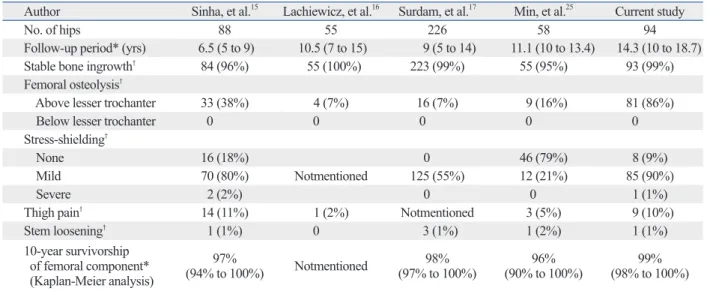
In the present study, stable bone ingrowth with endosteal spot weld formation was noted in 93 of 94 hips (99%) and the 10-year survival rate of the femoral component was 99%.
These results compare favorably with those of other studies using the HG Multilock prosthesis (Table 2).15-17,25
Although first-generation cementless femoral prostheses produced stable bone ingrowth, studies also reported rates of diaphyseal osteolysis greater than 10%.11,26-28 Schmalz-
Table 2. Comparison of Studies of the Multilock Prosthesis
Author Sinha, et al.15 Lachiewicz, et al.16 Surdam, et al.17 Min, et al.25 Current study
No. of hips 88 55 226 58 94
Follow-up period* (yrs) 6.5 (5 to 9) 10.5 (7 to 15) 9 (5 to 14) 11.1 (10 to 13.4) 14.3 (10 to 18.7)
Stable bone ingrowth† 84 (96%) 55 (100%) 223 (99%) 55 (95%) 93 (99%)
Femoral osteolysis†
Above lesser trochanter 33 (38%) 4 (7%) 16 (7%) 9 (16%) 81 (86%)
Below lesser trochanter 0 0 0 0 0
Stress-shielding†
None 16 (18%) 0 46 (79%) 8 (9%)
Mild 70 (80%) Notmentioned 125 (55%) 12 (21%) 85 (90%)
Severe 2 (2%) 0 0 1 (1%)
Thigh pain† 14 (11%) 1 (2%) Notmentioned 3 (5%) 9 (10%)
Stem loosening† 1 (1%) 0 3 (1%) 1 (2%) 1 (1%)
10-year survivorship of femoral component*
(Kaplan-Meier analysis)
(94% to 100%)97% Notmentioned 98%
(97% to 100%) 96%
(90% to 100%) 99%
(98% to 100%)
*Data are given as a mean with the range in parenthesis.
†Data are given as a number with a percentage in parenthesis.
Fig. 2. Kaplan-Meier survivorship curve, with 95% confidence intervals, showing a 99% rate of implant survival at 10 years and 97% at 15 years with revision of femoral component as the end point.
0.0 0.1 0.2 0.3 0.4 0.5 0.6 0.7 0.8 0.9 1.0
Survival rate
0 1 2 3 4 5 6 7 8 9 10 11 12 13 14 15 Follow-up (year)
Kaplan-Meier survivorship analysis (stem)
of the HG Multilock prosthesis and which has a distal ta- pered geometry, gave a better result in terms of stress-shield- ing (21%).35
Meding, et al.19 showed that the collar has no effect in ce- mentless femoral prostheses, and that in a stem with distal tapered geometry, the collar can block subsidence of the stem and interfere with tight fixation. Therefore, the collar of cementless prostheses should be improved, especially in those with tapered geometry. In the present study, collar-cal- car contact showed no relationship to thigh pain, stem fixa- tion, or stress-shielding.
During follow-up of this study, 44 revisions (47%) were performed, most of which (43 out of 44 cases) was due to problems in the locking mechanism of the Harris-Galante II acetabular cup, or pelvic osteolysis caused by polyethylene wear. Both of these problems can be resolved by modifica- tion of the cup design or development of an alternative bear- ing surface.
The retrospective design of our study and the relatively small number of cases (94 hips) available for analysis limit the general application of our results. Also, a direct compar- ison of the biomechanical performance of straight and ta- pered stems would have allowed us to address the problem of the straight stem design more specifically. However, be- cause the present femoral prosthesis is no longer available, this long-term follow-up report may prove more valuable as a reference for studies of the newly developed, collarless and distal tapered femoral prosthesis.
In conclusion, this long-term follow-up of total hip ar- throplasty using a second-generation cementless femoral prosthesis with collared and straight distal fluted geometry showed satisfactory results for a relatively young patient sample. However, the high rate of proximal stress-shielding and the minimal effect of the collar both indicate the need for some changes to the stem design, especially the collar and straight distal fixation channels.
REFERENCES
1. Salvati EA, Wilson PD Jr, Jolley MN, Vakili F, Aglietti P, Brown GC. A ten-year follow-up study of our first one hundred consecu- tive Charnley total hip replacements. J Bone Joint Surg Am 1981;63:753-67.
2. Sutherland CJ, Wilde AH, Borden LS, Marks KE. A ten-year fol- low-up of one hundred consecutive Muller curved-stem total hip- replacement arthroplasties. J Bone Joint Surg Am 1982;64:970-82.
3. Stauffer RN. Ten-year follow-up study of total hip replacement. J Bone Joint Surg Am 1982;64:983-90.
rate (20-33%) of thigh pain was reported in previous stud- ies of first-generation cementless femoral prostheses.31,32 In the present study, the rate of activity-related thigh pain was 10%, and pain persisted in only three hips (3%). These re- sults are favorable compared to those of other studies (Ta- ble 2). The specific material and design features of the pros- thesis may explain the low rate of thigh pain. The stem is composed of titanium alloy, which has increased biocom- patibility and a lower modulus of elasticity than cobalt- chromium alloy. In addition, the close contact between the distal flutes of the stem and the femoral cortex through the line-to-line reaming process would promote early postoper- ative rotational stability, and the increased depth of the flutes with increasing stem diameter may have the effect of de- creasing the diameter of the stem tip and attenuating bend- ing and torsional stiffness similarly in the distal tapered femoral component.
Stress-shielding is a spontaneous reaction of the femur to the altered load-transfer pattern through the stably fixed prosthesis-bone interface. Engh, et al.7 reported a 12% rate of moderate to severe stress-shielding (third or fourth de- gree) after cementless total hip arthroplasty using an exten- sively porous-coated, cobalt-chromium alloy femoral stem.
In the present study, we observed extensive stress-shielding in only one hip, perhaps because of the proximally limited porous coating and greater flexibility of the prosthetic ma- terial. Although the rate of severe stress-shielding was very low, the overall incidence of proximal femoral osteopenia, including minor involvement (first or second degree) was still high (91%). This may be due to the design feature of a straight (non-tapered) distal portion of the prosthesis. When early postoperative stability is obtained by tight distal fixa- tion in a straight femoral stem, the viscoelasticity of the fem- oral metaphysis can relax the contact pressures at the proxi- mal femoral area, resulting in diminished proximal load- transfer and consequent proximal femoral stress-shielding.33 In contrast, tapered geometry can lead to gradual subsid- ence of the stem into a tighter relationship with the bone, so that proximal load-transfer can be maintained.33 In support of this theory, Sano, et al.34 compared postoperative chang- es in femoral bone mineral density (BMD) between the dis- tal tapered and straight fluted types of cementless stems, and found an early decrease of BMD that was recovered af- ter 12 months in the tapered stem group, but a continued decrease in BMD without recovery in the fluted stem group.
Moreover, a five-year follow-up study of the Versys Fiber Metal Taper (FMG; Zimmer), which is an advanced model
mented stem-type femoral components: a radiographic analysis of loosening. Clin Orthop Relat Res 1979:17-27.
21. Johnston RC, Fitzgerald RH Jr, Harris WH, Poss R, Muller ME, Sledge CB. Clinical and radiographic evaluation of total hip re- placement. A standard system of terminology for reporting results.
J Bone Joint Surg Am 1990;72:161-8.
22. Engh CA, Massin P, Suthers KE. Roentgenographic assessment of the biologic fixation of porous-surfaced femoral components. Clin Orthop Relat Res 1990:107-28.
23. Campbell AC, Rorabeck CH, Bourne RB, Chess D, Nott L. Thigh pain after cementless hip arthroplasty. Annoyance or ill omen. J Bone Joint Surg Br 1992;74:63-6.
24. Livermore J, Ilstrup D, Morrey B. Effect of femoral head size on wear of the polyethylene acetabular component. J Bone Joint Surg Am 1990;72:518-28.
25. Min BW, Song KS, Bae KC, Cho CH, Lee KJ, Kim HJ. Second- generation cementless total hip arthroplasty in patients with osteo- necrosis of the femoral head. J Arthroplasty 2008;23:902-10.
26. Dorr LD, Lewonowski K, Lucero M, Harris M, Wan Z. Failure mechanisms of anatomic porous replacement I cementless total hip replacement. Clin Orthop Relat Res 1997:157-67.
27. Goetz DD, Smith EJ, Harris WH. The prevalence of femoral oste- olysis associated with components inserted with or without ce- ment in total hip replacements. A retrospective matched-pair se- ries. J Bone Joint Surg Am 1994;76:1121-9.
28. Martell JM, Pierson RH 3rd, Jacobs JJ, Rosenberg AG, Maley M, Galante JO. Primary total hip reconstruction with a titanium fiber- coated prosthesis inserted without cement. J Bone Joint Surg Am 1993;75:554-71.
29. Bobyn JD, Pilliar RM, Cameron HU, Weatherly GC. The opti- mum pore size for the fixation of porous-surfaced metal implants by the ingrowth of bone. Clin Orthop Relat Res 1980:263-70.
30. Meding JB, Keating EM, Ritter MA, Faris PM, Berend ME. Min- imum ten-year follow-up of a straight-stemmed, plasma-sprayed, titanium-alloy, uncemented femoral component in primary total hip arthroplasty. J Bone Joint Surg Am 2004;86-A:92-7.
31. Kim YH, Kim VE. Results of the Harris-Galante cementless hip prosthesis. J Bone Joint Surg Br 1992;74:83-7.
32. Maloney WJ, Jasty M, Harris WH, Galante JO, Callaghan JJ.
Endosteal erosion in association with stable uncemented femoral components. J Bone Joint Surg Am 1990;72:1025-34.
33. Mallory TH, Lombardi AV Jr, Leith JR, Fujita H, Hartman JF, Capps SG, et al. Why a taper? J Bone Joint Surg Am 2002;84-A Suppl 2:81-9.
34. Sano K, Ito K, Yamamoto K. Changes of bone mineral density af- ter cementless total hip arthroplasty with two different stems. Int Orthop 2008;32:167-72.
35. Klein GR, Levine HB, Nafash SC, Lamothe HC, Hartzband MA.
Total hip arthroplasty with a collarless, tapered, fiber metal proxi- mally coated femoral stem: minimum 5-year follow-up. J Arthro- plasty 2009;24:579-85.
4. Galante JO. New developments in hip arthroplasty. Overview of current attempts to eliminate methylmethacrylate. Hip 1983:181-9.
5. Pilliar RM, Lee JM, Maniatopoulos C. Observations on the effect of movement on bone ingrowth into porous-surfaced implants.
Clin Orthop Relat Res 1986:108-13.
6. Engh CA, Massin P. Cementless total hip arthroplasty using the anatomic medullary locking stem. Results using a survivorship analysis. Clin Orthop Relat Res 1989:141-58.
7. Engh CA, Bobyn JD, Glassman AH. Porous-coated hip replace- ment. The factors governing bone ingrowth, stress shielding, and clinical results. J Bone Joint Surg Br 1987;69:45-55.
8. Engh CA, Bobyn JD. The influence of stem size and extent of po- rous coating on femoral bone resorption after primary cementless hip arthroplasty. Clin Orthop Relat Res 1988:7-28.
9. Pellegrini VD Jr, Hughes SS, Evarts CM. A collarless cobalt- chrome femoral component in uncemented total hip arthroplasty.
Five- to eight-year follow-up. J Bone Joint Surg Br 1992;74:814-21.
10. Xenos JS, Callaghan JJ, Heekin RD, Hopkinson WJ, Savory CG, Moore MS. The porous-coated anatomic total hip prosthesis, in- serted without cement. A prospective study with a minimum of ten years of follow-up. J Bone Joint Surg Am 1999;81:74-82.
11. Clohisy JC, Harris WH. The Harris-Galante uncemented femoral component in primary total hip replacement at 10 years. J Arthro- plasty 1999;14:915-7.
12. Kawamura H, Dunbar MJ, Murray P, Bourne RB, Rorabeck CH.
The porous coated anatomic total hip replacement. A ten to four- teen-year follow-up study of a cementless total hip arthroplasty. J Bone Joint Surg Am 2001;83-A:1333-8.
13. Schmalzried TP, Jasty M, Harris WH. Periprosthetic bone loss in total hip arthroplasty. Polyethylene wear debris and the concept of the effective joint space. J Bone Joint Surg Am 1992;74:849-63.
14. Kim YH, Kim VE. Uncemented porous-coated anatomic total hip replacement. Results at six years in a consecutive series. J Bone Joint Surg Br 1993;75:6-13.
15. Sinha RK, Dungy DS, Yeon HB. Primary total hip arthroplasty with a proximally porous-coated femoral stem. J Bone Joint Surg Am 2004;86-A:1254-61.
16. Lachiewicz PF, Soileau ES, Bryant P. Second-generation proxi- mally coated titanium femoral component: minimum 7-year re- sults. Clin Orthop Relat Res 2007;465:117-21.
17. Surdam JW, Archibeck MJ, Schultz SC Jr, Junick DW, White RE Jr. A second-generation cementless total hip arthroplasty mean 9-year results. J Arthroplasty 2007;22:204-9.
18. Harris WH. Traumatic arthritis of the hip after dislocation and ac- etabular fractures: treatment by mold arthroplasty. An end-result study using a new method of result evaluation. J Bone Joint Surg Am 1969;51:737-55.
19. Meding JB, Ritter MA, Keating EM, Faris PM. Comparison of collared and collarless femoral components in primary uncement- ed total hip arthroplasty. J Arthroplasty 1997;12:273-80.
20. Gruen TA, McNeice GM, Amstutz HC. “Modes of failure” of ce-