• 검색 결과가 없습니다.

Conjunctival Inclusion Cysts in Long-standing Chronic Vernal Keratoconjunctivitis

N/A
N/A
Protected

Academic year: 2022

Share "Conjunctival Inclusion Cysts in Long-standing Chronic Vernal Keratoconjunctivitis"

Copied!
4
0
0

로드 중.... (전체 텍스트 보기)

전체 글

(1)

Korean Journal of Ophthalmology 21(4):251-254, 2007 DOI : 10.3341/kjo.2007.21.4.251

251

Conjunctival Inclusion Cysts in Long-standing Chronic Vernal Keratoconjunctivitis

Seung-Won Lee, MD,

1

Seung-Chan Lee, MD,

2

Kyung-Hyun Jin, MD

1

Department of Ophthalmology, Kyung Hee University College of Medicine

1

, Seoul, Korea Department of Ophthalmology, Kang Won University College of Medicine

2

, Kangwon, Korea

Purpose: To report a case of conjunctival inclusion cysts on the corneal limbus of a patient with chronic vernal keratoconjunctivitis during 16 months' follow up

Methods: The patient was a 26 year old male without any specific history of surgery or trauma. Giant papillae, shield ulcers, and Horner-Trantas dots were detected. During the 16 month follow-up, Sodium cromoglycate eye drops and Prednisolone acetate 1% eye drops were given 3 times a day. During this period, conjunctival cysts were detected on the corneal limbus in both eyes. In spite of improvement of the corneal and conjunctival conditions, the conjunctival cysts did not seem to show any specific changes. For relief of foreign body sensation, excision of the conjunctival cysts and giant papillae of the left eye and histopathologic examination of the specimen was performed.

Results: On histopathological examination, the conjunctival cysts consisted of nonkeratinizing stratified epithelial cells filled with PAS-positive mucous substance. Inflammatory cells were not found in the vicinity.

Conclusions: Conjunctival inclusion cysts can be seen as an atypical finding of long-standing vernal keratoconjunctivitis. Mechanical friction between the giant papillae and conjunctiva may be a factor in inducing the formation of the conjunctival cysts.

Korean Journal of Ophthalmology 21(4):251-254, 2007

Key Words: Conjunctival inclusion cysts, Chronic vernal keratoconjunctivitis, Giant papillae, Mechanical friction

Received: May 17, 2007 Accepted: July 31, 2007

Reprint requests to Kyung Hyun Jin, MD. Department of Ophthal- mology, Kyung Hee University Hospital, 1 Hoegi-dong, Dongdae mun-gu, Seoul, 130-702, Korea. Tel: 82-2-958-8451, Fax: 82-2- 966-7340, E-mail: [email protected]

* This study was presented as a poster at the 95th annual meeting of the Korean Ophthalmological Society in April, 2006.

Vernal keratoconjunctivitis is a type of chronic conjunctivitis which develops, in most cases, before the age of 10, and usually persists for 2 to 10 years. It may be associated with allergic diseases such as atopy, asthma and eczema.

Symptoms include severe itching sensation, foreign body sensation, mucoid discharge, glare, and conjunctival injection.

1

The most typical findings of vernal keratoconjunctivitis are giant papillae with flat tops on the upper tarsal conjunctiva, Horner-Trantas dots and neovascularization distributed along the corneal limbus, and superficial punctate keratitis, corneal erosions and shield ulcers.

2

During a long-term follow up of a 26 year-old patient with chronic vernal keratoconjunctivitis without a special history of trauma or surgery, conjunctival cysts were discovered on the corneal limbus in both eyes. The cysts were not noticed

until 16 months after treatment. The size of the cysts appeared to be in proportion with the size of the corresponding giant papillae. After excision and histopathologic examination of the conjunctival cysts, the cysts were diagnosed as conjunctival inclusion cysts.

Therefore, we report this case as an atypical finding of chronic vernal keratoconjunctivitis.

Case Report

In January of 2003, a healthy 26 year old male without

any history of surgery or trauma visited our hospital for

deterioration of vision and persisting pain in both eyes, which

started one week before the visit. The corrected vision of

both eyes at the time of visit was 20/40 in each eye. The

patient did not have any prior allergic symptoms prior to this

visit to the ophthalmologic clinic. On slit lamp examination,

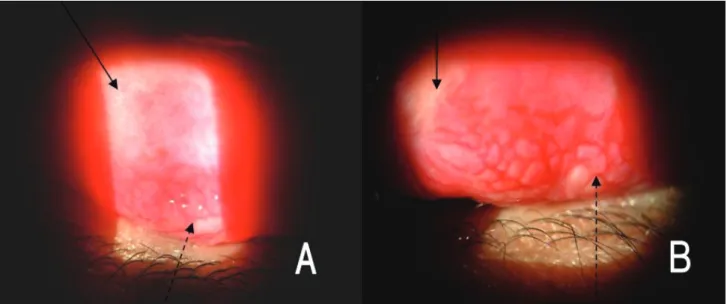
giant papillae in the upper tarsal conjunctiva (Fig. 1),

persistent epithelial defects and shield ulcers, Horner-Trantas

dots and neovascularization in the corneal limbus were

detected in both eyes. A diagnosis of vernal

keratoconjunctivitis was made, and the corneal shield ulcer

was treated with Sodium cromoglycate eye drops (Opticrom

,

(2)

Kor J Ophthalmol Vol.21, No.4, 2007

252

Fig. 1. Giant papillae with flat tops on the upper tarsal conjunctiva (dot-arrow), typically described as a 'cobblestone' appearance were the hallmark of vernal keratoconjunctivitis and were different in shape compared with hypertrophic conjunctival cicatrization (lined-arrow). The size of the giant papillae in the left eye was larger than that of the right eye (A: Right eye, B: Left eye).

Fig. 2. At 16 months after the diagnosis of vernal keratoconjunctivitis, the conjunctival cyst on the limbus, which was not identified before, was detected (lined-arrow), It appears as a raised, circumscribed, pale, transparent cystic lesion and was located on the superior limbus. The size of the cysts in the left eye was larger than that of the right eye (A: Right eye, B: Left eye).

Sanofi-aventis, France) and Prednisolone acetate 1% eye drops (Pred forte

, Allergan, USA) 3 times a day. Even though there was improvement of the overall conditions of the cornea and conjunctiva and improvement of corrected vision to 20/25 in the right eye and 20/30 in the left eye, the giant papillae did not show any specific changes. In May 2004, at the 16 month period of follow up, conjunctival cysts that had not been detected previously were observed in the corneal limbus of both eyes (Fig. 2). Even with Sodium cromoglycate eye drops and Prednisolone acetate 1% eye drops 3 times a day, conjunctival cysts did not disappear. The size of the cysts was larger in the left eye compared with the right, corresponding with the size of giant papillae, which

was also larger in the left eye.

The size of conjunctival cysts was not changed and the

patient complained of foreign body sensation and photopsia

continuously especially in the left eye. We decided to remove

the conjunctival cysts with the patient's consent, to relieve the

symptoms and to know the nature of cyst. In March 2006,

under local anesthesia, the conjunctival cysts and contacting

giant papillae of the left eye were excised and

histopathologic examinations were performed. The light

microscopic findings showed that the conjunctival cysts

were inclusion cysts. The walls were formed with

non-keratinizing stratified epithelium and were filled with

PAS-positive mucoid materials. Inflammatory cells were not

(3)

SW Lee, et al. CONJUNCTIVAL INCLUSION CYSTS IN VKC

253 Fig. 3. The gross histopathologic finding disclosed the portion

of conjunctiva showing a cystic wall lined by a single layer of low cuboidal epithelium with edema and congestion measuring 0.1-0.2 ml in volume. (H & E stain, ×100)

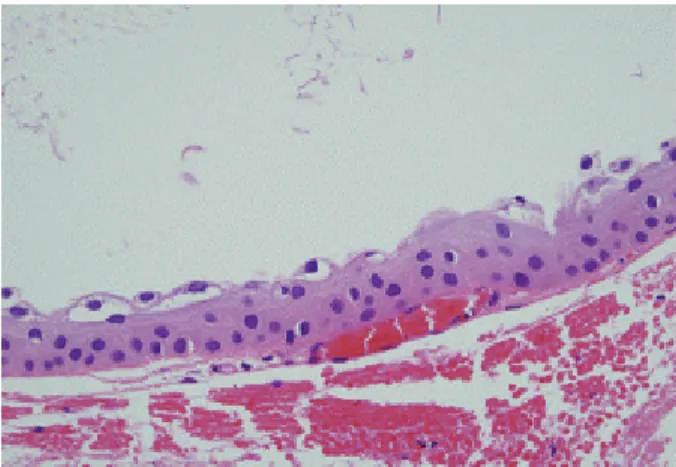
Fig. 4. The histopathologic section of conjunctival cyst wall.

The cyst wall is lined by nonkeratinizing stratified epithelium and connective tissue with no inflammatory cell infiltration.

(H & E stain, ×200)

Fig. 5. The PAS-stained histopathologic finding. The cyst was filled with PAS-positive amorphous proteinous materials. (PAS stain, ×400)

found in the vicinity (Fig. 3, 4, 5). The contacting giant papillae showed chronic inflammatory changes.

D iscussion

Inclusion cysts are benign cysts filled with clear serous fluid containing shed cells or gelatinous mucous materials.

The fluid is located within cyst walls, which consist of several layers of non-keratinizing epithelium and connective tissue. Twenty-five percents of acquired epithelial lesions of the conjunctiva, and 80% of the entire cystic lesions of the conjunctiva are inclusion cysts. The ratio of development is equal between male and female, and the mean age of onset is 47 years.

3

Inclusion cysts are classified as primary or secondary, depending on their causes.

4

The primary inclusion cyst is generally restricted to the superio-medial side of the orbit and is congenitally developed during the embryonal period by separation of a portion of conjunctival epithelial cells. The secondary type of inclusion cyst is more prevalent than the primary cyst. It is an acquired type of cyst and is located primarily in the supero-lateral side of the orbit. It occurs naturally or under inflammatory conditions of the conjunctiva, and it may be developed by amalgamation of mucosal folds. In most cases, it is developed by detachment of a portion of the conjunctival epithelium by surgery or trauma and its following implantation onto the conjunctival epithelium.

Cases of secondary inclusion cysts developed in the conjunctiva after ophthalmic surgery have been reported.

5-7

Two cases of conjuctival cysts developed in patients without specific history of surgery, trauma or inflammation were reported by Srinivasan et al.

8

Kiratli et al. have reported cases in association with pterygium as examples of inclusion cysts developed in the conjunctiva in association with chronic inflammation.

9

Suzuki et al. have reported 2 cases of inclusion cysts in patients of age 8 and 9 with vernal keratoconjunctivitis without any clinical or morphologic findings.

10

The infiltration of inflammatory cells were claimed to contribute to the development of inclusion cysts.

This case is an example of development of conjunctival inclusion cysts in a healthy 26 year old male after a 16 month follow-up of vernal keratoconjunctivitis.

Histopathologic section showed the conjunctival cyst lined

with nonkeratinizing stratified epithelium filled with PAS

positive ingredients with no inflammatory cells in the

vicinity. The size of the conjunctival cysts was larger in the

left eye than in the right, corresponding with the size of the

giant papillae of the upper tarsus. It is possible that

mechanical friction by the giant papillae of the upper tarsus

had mediated an effect on the development of the inclusion

cysts.

11

A portion of the conjunctival epithelium could have

been detached and had proliferated after being buried directly

into the subepithelial connective tissue by mechanical

stimulation. As a matter of fact, shield ulcers, which are

characteristic findings of vernal keratoconjunctivitis, are

developed by mechanical stimulation.

12

In addition, histamine,

eosinophil major basic protein, prostaglandin F, eosinophil

(4)

Kor J Ophthalmol Vol.21, No.4, 2007

254

chemotactic factor, tryptase and other characteristic inflammatory mediators of vernal keratoconjunctivitis may cause the development of inclusion cysts by inducing a certain toxic reaction.

13,14

However, this is difficult to confirm, as immunological examinations of the excisional biopsy of the inclusion cysts were not performed in this case.

When the change of size of the inclusion cysts is minimal, no specific treatment is needed.

15

In cases where the size is large, or there is foreign body sensation, corneal astigmatism, or impediment of sight, excision of the cyst, cryotherapy, electric cauterization, or YAG laser may be considered.

16,17

In this case, excision of the conjunctival cysts and giant papillae of the left eye was performed because the cysts and papillae of the left eye were significantly larger than those of the right.

The conjunctival inclusion cysts might be an atypical finding of chronic vernal keratoconjunctivitis. The key factor of development of the cysts may be chronic irritative mechanical friction caused by giant papillae. Long standing giant papillae would be the inducing factor in the formation of conjunctival inclusion cysts in vernal keratoconjunctivitis.

References

1. Trocme SD, Sra KK. Spectrum of ocular allergy. Curr Opin Allergy Clin Immunol 2002;2:423-7.

2. BenEzra D, Pe'er J, Brodsky M, Cohen E. Cyclosporin eyedrops for the treatment of severe vernal keratoconjunctivitis. Am J Ophthalmol 1986;101:278-82.

3. Grossniklaus HE, Green WR, Luckenbach M, Chan CC.

Conjunctival lesions in adults. A clinical and histopathologic review. Cornea 1987;6:78-116.

4. Jakobiec FA, Bonanno PA, Sigelman J. Conjunctival adnexal cysts and dermoids. Arch Ophthalmol 1978;96:1404-9.

5. Ho VT, Rao VM, Flanders AE. Postsurgical conjunctival epithelial cysts. AJNR Am J Neruoradiol 1994;15:1181-3.

6. Bourcier T, Monin C, Baudrimont M, et al. Conjunctival inclusion cyst following pars plana vitrectomy. Arch Ophthalmol 2003;121:1067.

7. Finqer PT, McCormick SA, Lombardo J, et al. Epithelial inclusion cyst of the iris. Arch Ophthalmol 1995:113:

777-80.

8. Srinivasan BD, Jakobiec FA, Iwamoto T, Devoe AG.

Epibulbar mucogenic subconjunctival cysts. Arch Ophthalmol 1978;96:857-9.

9. Kiratli H, Bilgic S, Gokoz O, Sokmensuer C. Conjunctival epithelial inclusion cyst arising from a pterygium. Br J Ophthalmol 1996;80:769-70.

10. Suzuki K, Okisaka S, Nakagami T. The contribution of inflammatory cell infiltration to conjunctival inclusion cyst formation. Nippon Ganka Gakkai Zasshi 2000;104:170-3.

11. Jones BR. Trachoma and allied infections. Trans Ophthalmol Soc U K 1961;81:2115-28.

12. Kim YH, Oh SY, Ha JK, Shin MC. Amniotic membrene transplantation in the management of shield ulcers of vernal keratoconjunctivitis. J Korean Ophthalmol Soc 2004;45:

315-8.

13. Udell IJ, Gleich GJ, Allansmith MR, et al. Eosinophil granule major basic protein and Charcot-Leyden crystal protein in human tears. Am J Ophthalmol 1981;92:824-8.

14. Trocme SD, Kephart GM, Bourne WM, et al. Eosinophil granule major basic protein deposition in corneal ulcers associated with vernal keratoconjunctivitis. Am J Ophthalmol 1993;115:640-3.

15. Johnson DW, Bartley GB, Garrity JA, Robertson DM.

Massive epithelium lined inclusion cysts after scleral buckling. Am J Ophthalmol 1992;113:439-42.

16. Soong HK, Okayawa RT, Iliff NT. Corneal astigmatism from conjunctival cyst. Am J Ophthalmol 1982;93:118-9.

17. de Bustros S, Michels RG. Treatment of acquired epithelial

inclusion cyst of the conjunctiva using the YAG laser. Am

J Ophthalmol 1984;98:807-8.

수치

Fig. 1. Giant papillae with flat tops on the upper tarsal conjunctiva (dot-arrow), typically described as a 'cobblestone' appearance  were the hallmark of vernal keratoconjunctivitis and were different in shape compared with hypertrophic conjunctival cicat
Fig. 5. The PAS-stained histopathologic finding. The cyst was  filled with PAS-positive amorphous proteinous materials

참조

관련 문서