• 검색 결과가 없습니다.

A Case of Ocular Benign Lymphoid Hyperplasia Treated with Bevacizumab Injection

N/A
N/A
Protected

Academic year: 2022

Share "A Case of Ocular Benign Lymphoid Hyperplasia Treated with Bevacizumab Injection"

Copied!
3
0
0

로드 중.... (전체 텍스트 보기)

전체 글

(1)

57

Korean J Ophthalmol 2011;25(1):57-59 DOI: 10.3341/kjo.2011.25.1.57 pISSN: 1011-8942 eISSN: 2092-9382

Case Report

A Case of Ocular Benign Lymphoid Hyperplasia Treated with Bevacizumab Injection

Doo Hwan Oh, Yeoun Sook Chun, Jae Chan Kim

Department of Ophthalmology, Chung-Ang University College of Medicine, Seoul, Korea

We report the first case of ocular benign lymphoid hyperplasia (BLH) treated with subconjunctival injection of bev- acizumab (Avastin). A 27-year-old man presented to our clinic with conjunctival masses and limbal neovascularization.

An incisional biopsy yielded the diagnosis of BLH. The patient was subsequently given a subconjunctival injection of bevacizumab (1.25 mg / 0.1 mL). The patient did not experience recurrence or malignant metaplasia during the one-year follow-up period. In patients with conjunctival BLH, subconjunctival injection of bevacizumab can be a use- ful treatment option in patients unable to undergo a surgical procedure due to limbal neovascularization.

Key Words: Bevacizumab, Conjunctival benign lymphoid hyperplasia, Subconjunctival injection

ⓒ2011 The Korean Ophthalmological Society

This is an Open Access article distributed under the terms of the Creative Commons Attribution Non-Commercial License (http://creativecommons.org/licenses /by-nc/3.0/) which permits unrestricted non-commercial use, distribution, and reproduction in any medium, provided the original work is properly cited.

Received: January 12, 2010 Accepted: May 11, 2010

Corresponding Author: Jae Chan Kim, MD, PhD. Department of Ophthalmology, Chung-Ang University Yongsan Hospital, Chung-Ang University College of Medicine, #65-207 Hangangno 3-ga, Yongsan-gu, Seoul 140-757, Korea. Tel: 82-2-748-9838, Fax: 82-2-6381-9838, E-mail:

[email protected]

Ocular adnexal lymphoproliferative lesions are lympho- histologic masses that can appear in various locations, in- cluding the conjunctiva, orbit, eyelid, lacrimal duct, and lacrimal gland. They can be both primary or secondary and encompass a wide disease spectrum ranging from benign lymphoid hyperplasia (BLH) to malignant lymphoma.

Conjunctival lymphoproliferative lesions have the best prog- nosis among ocular lymphoproliferative lesions; the ma- jority are diagnosed as BLH. It has been reported that more than 90% of such lesions do not go on to develop into sys- temic lymphoma [1]. There is no definitive recommended treatment for conjunctival BLH, but reported treatments in- clude cryotherapy and the combination of surgical excision and oral steroid administration [2,3]. There have also been reports of using local radiotherapy to prevent malignant proliferation and systemic invasion [4]. However, cryotherapy or surgical excision carry the risk of cosmetic problems due to scar formation. Furthermore, localized radiotherapy, cry- otherapy, or surgical excision would be difficult to perform in lesions with limbal neovascularization. As such, we re- port the first case of conjunctival BLH treated with bev- acizumab injection.

Case Report

A 27-year-old man with a two year history of bilateral me- dial conjunctival masses was referred to our hospital. His chief complaint was injection of both eyes. His best corrected visual acuity was 20/20 and the intraocular pressures in both eyes were within normal limits. Color vision testing, auto- mated visual fields, fundus examination, and extraocular muscle function were normal bilaterally. There were no palpable masses or edema in the eyelids and there was no exophthalmos.

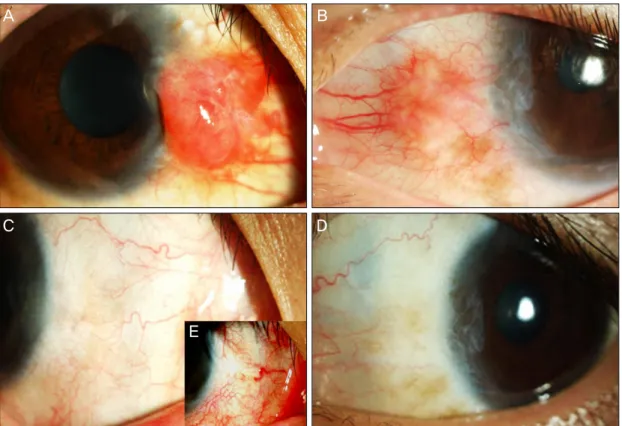
Slit lamp examination revealed a protruding hypervascular mass with combined medial limbal neovascularization on each medial conjunctival surface. Specifically, examination revealed a salmon colored, elevated (2 mm), moderately firm patch (6 mm × 5 mm) on the nasal conjunctiva of the right eye with neovascularization. A faint, salmon colored, ele- vated (1 mm) mass (5 mm × 4 mm) on the nasal conjunctiva of the left eye, with thinner new vessels than in the right eye, was also observed (Fig. 1A and 1B).

Incisional biopsy was performed on the mass in the right eye for definitive diagnosis. Pathological examination revealed benign lymphohistiocytic infiltrates (Fig. 2). The lymphoid reaction showed T cells (CD3+) and B cells (CD20+) with no evidence of atypical malignant cells. The patient sub- sequently underwent a complete physical exam, including serology (thyroid function tests) and radiology (chest radiog- raphy and abdominal unltrasonography), to rule out systemic disease. There were no significant findings.

Given the combination of BLH with hypervascular masses

and medial limbal neovascularization, bevacizumab (2.5 mg

(2)

Korean J Ophthalmol Vol.25, No.1, 2011

58

A B

C D

E

Fig. 1. (A) Slit lamp photograph of the patient’s right eye on initial presentation. Note the size, salmon color, and ele- vated appearance of the hypervascular lesion. (B) Slit lamp photograph of the patient’s left eye on initial presentation.

Note the size, faint salmon color, and mildly protruding mass. (C,D) Slit lamp photograph of both eyes 2 months follow- ing subconjunctival injection of bevacizumab. The lesions appear to be almost completely resolved with no obvious rem- nants seen on the sclera or conjunctiva. (E) Slit lamp photograph of the patient’s right eye after biopsy.

A B

Fig. 2. Haematoxylin and eosin staining. (A) ×40 magnification of the lesion biopsied in Fig. 1A. (B) ×200 magnifica- tion of the same lesion. Note the abundance of lymphocytes and the predominance of T cells (CD3+) and B cells (CD20+), a pattern typical of benign lymphoid hyperplasia.

/ 0.1 mL) (Avastin; Genentech, South San Francisco, CA, USA) was injected into both medial subconjunctival spaces. Two months after injection, both masses had almost completely disappeared and the accompanying neovascularization was

reduced (Fig. 1D and 1E). The patient did not experience re-

currence or any other complications during the one-year

follow-up period.

(3)

DH Oh, et al. Ocular Benign Lymphoma Treated with Bevacizumab
59

Discussion

Appropriate treatment for ocular BLH remains controversial.

Many physicians simply recommend observation. The re- ported treatments for orbital BLH include surgical excision, radiation therapy, systemic corticosteroid treatment, chemo- therapy, and cryotherapy. Chemotherapy can be used for lymphoma in the conjunctiva if it coexists with systemic lymphoma. One report found the final remission rate to be 98% for cryotherapy used to treat lymphoma localized in the conjunctiva [5]. Additionally, local excision or oral or topical corticosteroids can also be considered as treatment options.

However, in the present case, localized radiotherapy, cry- otherapy, or surgical excision would have been inappropriate treatment options because the lesion was accompanied by limbal neovascularization and surgical excision carries the risk of postoperative cosmetic defects. As such, bevacizumab injection was administered under the assumption that the conjunctival BLH, which is often difficult to treat using ex- isting treatment methods, could be treated by altering the oc- ular surface blood vessels and lymphatic vessel formation.

Bevacizumab is an anti-vascular endothelial growth factor (VEGF)-A antibody approved to treat metastatic colorectal cancer [6]. Recently, it has been reported that anti-VEGF antibody may be effective in treating age-related macular degeneration and diabetic retinopathy [7,8]. Bevacizumab has recently been studied as a treatment option for neo- vascularization in ocular surface diseases [9-11]. However, it is unclear if bevacizumab inhibits lymphangiogenesis.

Only a handful of experimental approaches deal with the in- hibition of lymphangiogenesis (e.g., the use of VEGF

R1R2

-Trap [12] or a blocking anti-VEGFR3-antibody [13]). Recently, several studies have reported that VEGF-A not only mediates hemangiogenesis, but also lymphangiogenesis [14-16].

Given this, bevacizumab has been reported to be an inhibitor of angiogenesis and lymphangiogenesis on the ocular surface [17]. According to this report, bevacizumab also inhibits the proliferation of lymphatic endothelial cells. However, there has not yet been a report of conjunctival BLH treated with bevacizumab.

In this case, we hypothesized that with the inhibition of new blood and lymphatic vessel formation due to bev- acizumab injection, the influx of polyclonal lymphocytes would be blocked and the polyclonal lymphocytes that had already accumulated would be drained by the existing lym- phatic vessels. We subsequently observed a dramatic re- sponse to the local subconjunctival injection of bevacizumab.

The bevacizumab near the reactive follicle must have been sufficient to suppress the inflow of lymphocytes. In the treat- ment of BLH, a common lymphoma in the conjunctiva, sub- conjunctival injection of bevacizumab can be a useful treat- ment option for patients who cannot tolerate a surgical proce- dure because of limbal neovascularization.

Conflict of Interest

No potential conflict of interest relevant to this article was reported.

References

1. Jo YJ, Yim JH, Park KS. MALT (mucosa associated lymphoid tissue) type lymphoma of the ocular adnexa. J Korean Ophthalmol Soc 2002;43:357-62.

2. Yu SB, Lew HL, Yun YS. A case of conjunctival benign lym- phoid hyperplasia associated with ptosis of the eyelid in a child. J Korean Ophthalmol Soc 2005;46:560-4.

3. Chang WS, Park JB, Kim KH, Kim SY. Two cases of con- junctival mucosa-associated lymphoid tissue (MALT) lym- phomas treated by cryotherapy. J Korean Ophthalmol Soc 2008;49:1165-72.

4. Bolek TW, Moyses HM, Marcus RB Jr, et al. Radiotherapy in the management of orbital lymphoma. Int J Radiat Oncol Biol Phys 1999;44:31-6.

5. Eichler MD, Fraunfelder FT. Cryotherapy for conjunctival lymphoid tumors. Am J Ophthalmol 1994;118:463-7.

6. Ferrara N, Hillan KJ, Novotny W. Bevacizumab (Avastin), a humanized anti-VEGF monoclonal antibody for cancer therapy. Biochem Biophys Res Commun 2005;333:328-35.

7. Lazic R, Gabric N. Intravitreally administered bevacizumab (Avastin) in minimally classic and occult choroidal neo- vascularization secondary to age-related macular degeneration.

Graefes Arch Clin Exp Ophthalmol 2007;245:68-73.

8. Jorge R, Costa RA, Calucci D, et al. Intravitreal bevacizumab (Avastin) for persistent new vessels in diabetic retinopathy (IBEPE study). Retina 2006;26:1006-13.

9. Manzano RP, Peyman GA, Khan P, et al. Inhibition of ex- perimental corneal neovascularisation by bevacizumab (Avastin). Br J Ophthalmol 2007;91:804-7.

10. DeStafeno JJ, Kim T. Topical bevacizumab therapy for corneal neovascularization. Arch Ophthalmol 2007;125:834-6.

11. Hosseini H, Nejabat M. A potential therapeutic strategy for in- hibition of corneal neovascularization with new anti-VEGF agents. Med Hypotheses 2007;68:799-801.

12. Cursiefen C, Cao J, Chen L, et al. Inhibition of hemangio- genesis and lymphangiogenesis after normal-risk corneal transplantation by neutralizing VEGF promotes graft survival.

Invest Ophthalmol Vis Sci 2004;45:2666-73.

13. Cursiefen C, Ikeda S, Nishina PM, et al. Spontaneous corneal hem- and lymphangiogenesis in mice with destrin-mutation depend on VEGFR3 signaling. Am J Pathol 2005;166:1367-77.

14. Björndahl MA, Cao R, Burton JB, et al. Vascular endothelial growth factor-a promotes peritumoral lymphangiogenesis and lymphatic metastasis. Cancer Res 2005;65:9261-8.

15. Hong YK, Lange-Asschenfeldt B, Velasco P, et al. VEGF-A promotes tissue repair-associated lymphatic vessel formation via VEGFR-2 and the alpha1beta1 and alpha2beta1 integrins.

FASEB J 2004;18:1111-3.

16. Nagy JA, Vasile E, Feng D, et al. Vascular permeability fac- tor/vascular endothelial growth factor induces lymphangio- genesis as well as angiogenesis. J Exp Med 2002;196:1497-506.

17. Bock F, Onderka J, Dietrich T, et al. Bevacizumab as a potent

inhibitor of inflammatory corneal angiogenesis and lymp-

hangiogenesis. Invest Ophthalmol Vis Sci 2007;48:2545-52.

수치

Fig. 1. (A) Slit lamp photograph of the patient’s right eye on initial presentation. Note the size, salmon color, and ele- ele-vated appearance of the hypervascular lesion

참조

관련 문서