• 검색 결과가 없습니다.

Nicotine in High Concentration Causes Contraction of Isolated Strips of Rabbit Corpus Cavernosum

N/A
N/A
Protected

Academic year: 2022

Share "Nicotine in High Concentration Causes Contraction of Isolated Strips of Rabbit Corpus Cavernosum"

Copied!
6
0
0

로드 중.... (전체 텍스트 보기)

전체 글

(1)

257

http://dx.doi.org/10.4196/kjpp.2015.19.3.257 eISSN 2093-3827

ABBREVIATIONS: HEPES, 4-(2-hydroxyethyl)-1-piperazineethane- sulfonic acid; PSS, physiological salt solution; TP receptor, throm- boxane receptor; S.E.M., standard error of means; ANOVA, analysis of variance; W/O, washout; NO, nitric oxide; Rho-kinase, Rho-asso- ciated protein kinase; COX, cyclooxygenase; PG, prostaglandin;

TXA

2

, thromboxane A

2

; PGF

, prostaglandin F

; PGI

2

, prosta- cyclin; PGE

2

, prostaglandin E

2

; FP receptors, F-prostanoid recep- tors.

Received January 5, 2015, Revised March 13, 2015, Accepted April 8, 2015

Corresponding to: Soon Chul Myung, Department of Urology, College of Medicine, Chung-Ang University, 221 Heukseok-dong, Dongjak-gu, Seoul 156-756, Korea. (Tel) 82-2-6299-1785, (Fax) 82-2-6294-1406, (E-mail) [email protected], Moo Yeol Lee, Department of Physio- logy, College of Medicine, Chung-Ang University, 84 Heukseok-ro, Dongjak-gu, Seoul 156-756, Korea. (Tel) 82-2-820-5687, (Fax) 82-2-817-7115, (E-mail) heeyun@ cau.ac.kr

*These authors contributed equally to this work (co-corresponding author).

This is an Open Access article distributed under the terms of the Creative Commons Attribution Non-Commercial License (http://

creativecommons.org/licenses/by-nc/3.0) which permits unrestricted non-commercial use, distribution, and reproduction in any medium, provided the original work is properly cited.

Copyright ⓒ Korean J Physiol Pharmacol & MEDrang Inc.

Nicotine in High Concentration Causes Contraction of Isolated Strips of Rabbit Corpus Cavernosum

Hoai Bac Nguyen

1

, Shin Young Lee

2

, Soo Hyun Park

3

, Jun Hyun Han

4

, Moo Yeol Lee

3,

*, and Soon Chul Myung

1,

*

1

Advanced Urogenital Disease Research Center; Research Institute for Translational System Biomics; Department of Urology, Chung-Ang University Hospital, Seoul 156-755,

2

Department of Urology, Seoul Medical Center, Seoul 131-795,

3

Department of Physiology, College of Medicine, Chung-Ang University, Seoul 156-756,

4

Department of Urology, Hallym University Dongtan Sacred Heart Hospital, Hwaseong 445-170, Korea

It is well known that cigarette smoke can cause erectile dysfunction by affecting the penile vascular system. However, the exact effects of nicotine on the corpus cavernosum remains poorly understood.

Nicotine has been reported to cause relaxation of the corpus cavernosum; it has also been reported to cause both contraction and relaxation. Therefore, high concentrations of nicotine were studied in strips from the rabbit corpus cavernosum to better understand its effects. The proximal penile corpus cavernosal strips from male rabbits weighing approximately 4 kg were used in organ bath studies. Nicotine in high concentrations (10

-5

∼10

-4

M) produced dose-dependent contractions of the corpus cavernosal strips. The incubation with 10

-5

M hexamethonium (nicotinic receptor antagonist) significantly inhibited the magnitude of the nicotine associated contractions. The nicotine-induced contractions were not only significantly inhibited by pretreatment with 10

-5

M indomethacin (nonspecific cyclooxygenase inhibitor) and with 10

-6

M NS-398 (selective cyclooxygenase inhibitor), but also with 10

-6

M Y-27632 (Rho kinase inhibitor).

Ozagrel (thromboxane A2 synthase inhibitor) and SQ-29548 (highly selective TP receptor antagonist) pretreatments significantly reduced the nicotine-induced contractile amplitude of the strips. High con- centrations of nicotine caused contraction of isolated rabbit corpus cavernosal strips. This contraction appeared to be mediated by activation of nicotinic receptors. Rho-kinase and cyclooxygenase pathways, especially cyclooxygenase-2 and thromboxane A

2

, might play a pivotal role in the mechanism associated with nicotine-induced contraction of the rabbit corpus cavernosum.

Key Words: Contraction, Cyclooxygenase, Nicotine, Rabbit corpus cavernosum, Rho-kinase

INTRODUCTION

Clinical and basic science research studies provide strong indirect evidence that smoking may affect penile erections by impairing endothelium dependent smooth muscle relax- ation [1,2]. In addition, cigarette smoking appears to ampli- fy the association between erectile dysfunction and car-

diovascular risk factors such as coronary artery disease [1].

Nicotine, an alkaloid derived from the plant Nicotiana to- baccum, acts as an agonist of nicotinic receptors [3,4]. Cur- rently, the exposure to nicotine is increasing worldwide not only due to the global use of tobacco but also the wide use of medications such as nicotine replacement therapy to as- sist smoking cessation [3,5].

Many studies have reported the effects of nicotine on the

cardiovascular system. In chronic nicotine-administered rat,

the chronic nicotine administration impaired aortic reactivity,

probably via redox imbalance and vascular remodelling mech-

anism [6]. In humans, cigarette smoking also increases blood

pressure by 5∼10 mmHg for 15∼30 min [7]. However, hy-

pertension is not more common among cigarette smokers com-

pared to non-smokers [8]. This discrepancy may be caused

by a transient blood pressure increase for a short duration,

(2)

during and after smoking. In contrast to the effects on the cardiovascular system, currently there is no evidence show- ing that nicotine has direct effects on erectile function.

While the nicotine effect on the penile vascular smooth muscles has been extensively reported, its direct effects in high concentrations on the cavernosal smooth musculature remain poorly understood [4]. The goal of this study was to determine the effects of nicotine on erectile function. Thus, an organ bath study was conducted to investigate the ef- fects of nicotine in high concentrations on isolated rabbit corpus cavernosal strips and the associated mechanisms.

METHODS

Preparation of rabbit corpus cavernosal strips and tension recording

Experiments were carried out according to the guidelines of the Committee for the Protection of Persons and Animals at the Institute of Medical Science, Chung-Ang University, Seoul, Korea. A total of 34 New Zealand white rabbits (ap- proximately 4 kg) were used. The rabbits were anaesthetized with an overdose of pentobarbital (60 mg/kg, intraperitoneal injection) and then sacrificed by incision of the carotid artery.

The whole penis was detached from the animal and placed in a Petri dish containing cold (4

o

C) HEPES (4-(2-hydrox- yethyl)-1-piperazineethanesulfonic acid) buffered physio- logical salt solution (PSS) with 100% O

2

saturation.

A ventral corporotomy was made on each side of the penis and the penile erectile tissue was carefully dissected from the surrounding tunica albuginea. Two strips of the prox- imal corpus cavernosum were obtained from each animal.

The strips of corpus cavernosum were trimmed to a stand- ard size of 1×1×8 mm. Each strip was suspended in a 30 ml organ bath containing PSS with the following composi- tion: 114 mM NaCl, 26 mM NaHCO

3

, 4.7 mM KCl, 2.5 mM CaCl

2

, 1.2 mM NaH

2

PO

4

, and 11 mM D-glucose. During the experiments, the baths were maintained at 37

o

C and con- tinuously bubbled with gas containing 95% O

2

and 5% CO

2

, maintaining a pH of 7.3∼7.4. For the experiments, each corpus cavernosal strip was connected to a force transducer (52-9545, Harvard Apparatus, UK). Analog signals were converted to digital signals that were recorded on a MacLab 4e recording system (AD Instruments, Australia). The pas- sive tension was adjusted to 1 g over an equilibration period of 120 minutes, with several changes of PSS.

Measuring strip responses to nicotine

To determine nicotine-induced contraction, the strips were contracted by adding cumulative concentrations of nicotine from 10

-8

M to 10

-4

M to the organ bath, and the responses were recorded.

Investigating the involvement of nicotinic receptors on nicotine-induced contraction

First, nicotinic receptor involvement with the nicotine-in- duced contraction was examined by incubating the tissue with 10

-5

M hexamethonium (nicotinic receptor antagonist;

N,N,N,N',N',N'-hexamethylhexane-1,6-diaminium) in the or- gan bath for 10 minutes in separate experiments; then the nicotine-induced contraction was recorded as described in the above protocol.

Determining involvement of the Rho-kinase pathway in the nicotine-induced contraction

To investigate whether the Rho-kinase pathway was in- volved in the mechanism associated with nicotine-induced contraction, the experimental strips were pretreated with a Rho-kinase inhibitor by adding 10

-6

M Y-27632 ((1R, 4r)- 4-((R)-1-aminoethyl)-N-(pyridin-4-yl)cyclohexanecar- boxamide) to the organ bath for 10 minutes, then adding cumulative concentrations of nicotine from 10

-8

M to 10

-4

M to the organ bath. Changes in the nicotine contractile am- plitude of the studied strips were measured.

Determining involvement of the cyclooxygenase pathway on nicotine-induced contractile effects

To identify cyclooxygenase pathway involvement with the nicotine-induced contraction, the experimental strips were exposed to nonselective cyclooxygenase inhibitor and selective cyclooxygenase-2 inhibitor by seperately incubating with 10

-5

M indomethacin (2-{1-[(4-chlorophenyl)carbonyl]-5-me- thoxy-2-methyl-1H-indol-3-yl}acetic acid) and 10

-6

M NS-398 (N-[2-(Cyclohexyloxy)-4-nitrophenyl]methanesulfonamide) in the organ bath for 10 minutes in each experiment. Conse- quently, nicotine was added in a concentration dependent manner to the bath. The nicotine induced contractile ampli- tude was recorded.

Determining involvement of the thromboxane A

2

in nicotine-induced contractile effects

To investigate whether the thromboxane A

2

was involved in nicotine-induced contraction, the experimental strips were pretreated with thromboxane A

2

synthase inhibitor and highly selective TP (thromboxane) receptor antagonist;

ozagrel 10

-7

M ((2E)-3-[4-(1H-imidazol-1-ylmethyl)phenyl]

acrylic acid) and SQ-29548 10

-7

M ([1S-[1 alpha,2 beta (5Z),3 beta,4 alpha]]-7-[3-[[2-[(phenylamino) carbonyl]hydr- azino]methyl]-7-oxabicyclo[2.2.1] hept-2-yl]-5-heptenoic ac- id) were separately added to the organ bath in each experi- ment for 10 minutes, then two different concentrations of nicotine, 10

-5

M and 10

-4

M, were added. Changes in the nicotine associated contractile amplitude of the experi- mental strips were measured.

Drugs

Nicotine, hexamethonium and Y-27632 were purchased from Sigma-Aldrich Corporation (St. Louis, MO, USA). In- domethacin, NS-398, ozagrel, and SQ-29548 were ordered from Cayman Chemical Company (Ann Arbor, MI, USA).

We used nicotine, indomethacin soluble in ethanol and Y-2- 7632 soluble in water.

Data analysis

The experiments were repeated more than five times.

Results are presented as the means±standard error of means

(S.E.M.). Each contraction measurement of a corpus cav-

ernosal strip is expressed as microN per mg of wet strip

weight. The maximum tension value was calculated and ob-

tained from regression plots, and each regression plot was

constructed with four to five points using the logistic sig-

moidal fitting model (MicroCal Origin, version 7.5). For all

(3)

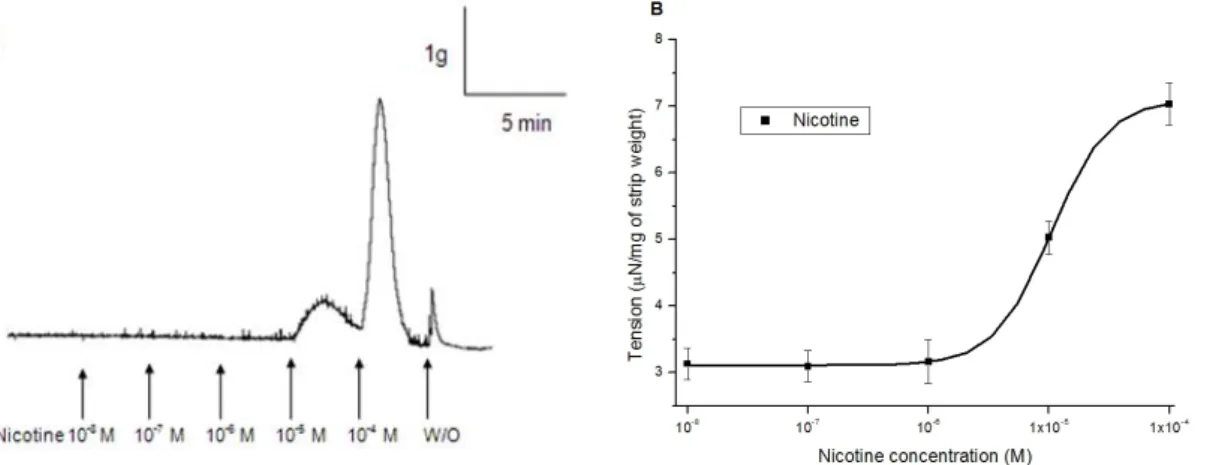
Fig. 1. Effect of nicotine on corpus cavernous strips. High-nicotine concentrations were associated with contraction of the rabbit corpus cavernosal strips (n=12). The typical recording of these results is representative of five independent experiments (A), and the contraction was expressed in grams (g). W/O=washout (B). Each point indicates the mean±standard error of means (S.E.M.).

Fig. 2. Effect of hexamethonium (10

-5

M) on nicotine-induced con- tractions. Hexamethonium almost completely inhibited the nico- tine-induced contractions. Data are shown as the mean±standard error of means (S.E.M.) (n=12, *p<0.05). For the statistical analysis, repeated measures analysis of variance (repeated measures ANOVA) was used to evaluate differences and a *p<0.05 was considered significant.

experiments, “n” refers to the number of strips. For the statistical analysis, the Student t-test and repeated meas- ures analysis of variance (repeated measures ANOVA) were used to evaluate differences and a p<0.05 was considered significant.

RESULTS Nicotine-induced contractile effects

The strip responses to nicotine were inconsistent. A ma- jority of the experimented strips contracted in a dose de- pendent manner in response to nicotine; however, the re- maining strips showed contraction followed by relaxation, or only relaxation or no response. The contractile responses of the corpus cavernosal strips to cumulative exposures to nicotine (10

-8

M∼10

-4

M) were dose-dependent (Fig. 1). The maximum tension value was 6.82±0.11 microN per mg of wet strip weight. The initial contraction was observed at the concentration of 10

-5

M. However, the higher concentration of nicotine, the more unstable strips became, due to the nic- otine toxicity.

Involvement of nicotinic receptors in nicotine-induced contractions

Hexamethonium pretreatment itself evoked no response at resting strips. However, nicotine-induced contraction was inhibited almost completely in the strips pretreated with hex- amethonium with the maximum tension values of 3.89±0.06 microN per mg of wet strip weight (Fig. 2). The responses of the hexamethonium-pretreated strips were significantly different from the control group (p<0.05, n=12).

The Rho-kinase pathway in association with nicotine- induced contractions

10

-6

M Y-27632 pretreatment itself evoked no response at resting strips. However, compared with the control, the pretreatment with 10

-6

M Y-27632 significantly inhibited the nicotine-induced contraction with the maximum tension values of 3.83±0.25 microN per mg of wet strip weight (p<0.05, n=12) (Fig. 3).

Involvement of cyclooxygenase pathway in nicotine- induced contractions

NS-398 or indomethacin pretreatment itself evoked no re- sponse at resting strips. However, the nicotine-induced con- traction was inhibited in the strips pretreated with NS-398 or indomethacin with maximum tension values of 3.93±0.06 microN per mg of wet strip weight for the former and of 4.72±0.36 microN per mg of wet strip weight for the latter.

Compared with the control group, the changes in response of these strips were significant (p<0.05, n=12) (Fig. 4).

The association of thromboxane A

2

in nicotine-induced contraction

Ozagrel and SQ-29548 pretreatment itself evoked no re-

(4)

Fig. 3. Influence of Y-27632 on the corpus cavernosal strips response to nicotine. Y-27632 (10

-6

M) pretreatment markedly reduced the nicotine effects on the study strips. Data are shown as the mean±

standard error of means (S.E.M.) (n=12, *p<0.05). For the statistical analysis, repeated measures analysis of variance (repeated measures ANOVA) was used to evaluate differences and a *p<0.05 was considered significant.

Fig. 5. Effects of SQ-29548 (10

-7

M) on nicotine-induced contractions.

SQ-29548 pretreatment almost completely reduced nicotine-induced contractions. Data are shown as the mean±standard error of means (S.E.M.) (n=12, *p<0.05). For the statistical analysis, repeated measures analysis of variance (repeated measures ANOVA) was used to evaluate differences and a *p<0.05 was considered significant.

Fig. 4. Comparison of the effects of indomethacin (10

-5

M) and NS-398 (10

-6

M), nonselective COX and COX-2 inhibitors, on nicotine-induced contraction. Compared with the control, indomethacin (10

-5

M) and NS-398 (10

-6

M) significantly caused inhibition of the nicotine effects;

however, NS-398 (10

-6

M) effect might be more potent than indo- methacin. Data are reported as the mean±standard error of means (S.E.M.) (n=12, *p<0.05). For the statistical analysis, repeated measures analysis of variance (repeated measures ANOVA) was used to evaluate differences and a *p<0.05 was considered significant.

Fig. 6. The influence of ozagrel on the nicotine effects at a concentration of 10

-5

M. Ozagrel pretreatment significantly reduced nicotine-induced contractions. Data are reported as the mean±standard error of means (S.E.M.) (n=12, *p<0.05). For the statistical analysis, the Student t-test was used to evaluate differences and a *p<0.05 was considered significant.

sponse at resting strips. However, ozagrel and SQ-29548 significantly reduced the nicotine-induced contractile am- plitude. The responses in ozagrel and SQ-29548-pretreated strips were significantly different from the control group (p<0.05, n=12) (Figs. 5 and 6).

DISCUSSION

It is well known that anatomical and functional integrity

of the cavernosal smooth musculature and the penile vas-

cular smooth muscles plays a key role in the penile erectile

process. Clinical and basic science studies on the penile vas-

cular system provide strong indirect evidence that cigarette

may affect penile erection by the impairment of endothe-

lium dependent vascular smooth muscle relaxation [1]. Data

on human subjects have suggested that cigarette smoking

may not only cause acute vasospasm of the penile arteries

(5)

leading to reduction in arterial flow, but also increase re- striction of the venous system [9]. Smoking decreased the penile brachial pressure index and the response to papaver- ine injections in smokers compared to nonsmokers. Fur- thermore, smoking cigarettes with a high nicotine concen- tration increased penile arterial vasoconstriction [1]. In vivo, nicotine administration is expected to produce penile arterial constriction by the predominant stimulation of adre- nergic nerves, leading to impaired penile erection, even though cavernosal smooth muscle is relaxed [10].

There are various results about the effects of nicotine on corpus cavernosal strips. In the studies using isolated strips of bovine retractor penis muscle and rabbit corpus cavernosum, nicotine had been reported to induce relaxation [11,12]. The mechanisms underlying these effects were thought to occur as a result of nicotine activating inhibitory nerves located in the muscles of the penis or potentiating the release of nitric oxide (NO) from nitrergic nerve terminals in the cor- pus cavernosum [12,13]. In a study on canine corpus cav- ernosal strips, nicotine produced both contraction and re- laxation responses [14]. Four out of 10 examined strips showed contraction followed by relaxation in response to nicotine.

The six remaining strips responded by relaxation. The un- derlying mechanism associated with the nicotine-induced contraction is the release of norepinephrine in response to nicotine from adrenergic nerves in the penile corpus cav- ernosum that stimulates α1-adrenoceptors and then elicits contraction [14].

Similarly, in the present study, rabbit corpus cavernosal strips responded inconsistently to nicotine. A majority of the examined strips contracted in a dose dependent manner.

The remaining strips showed contraction followed by relax- ation or only a relaxation response. The contraction response produced a sufficient magnitude for analysis without any precontraction by other agents and was initially observed at the high concentration of 10

-5

M.

Nicotinic receptors are part of a superfamily of neuro- transmitter-gated ion channels that mediate rapid intra- cellular communication. In the corpus cavernosum, nicotinic receptors have been shown to be located in the nerve end- ings (adrenergic and nitrergic endings) and the smooth muscle cells [15,16]. They are involved in many nicotine associated relaxation and contraction activities. Although many experiments reported the relaxation or both relaxa- tion and contraction after phenylephrine precontraction [11,13], we carried out experiments without precontraction.

As a result, nicotine in high concentration evoked contractions at resting state. Hayashida et al. reported that the con- traction of isolated canine corpus cavernosal strips by nic- otine was blocked by hexamethonium, suggesting the in- volvement of nicotinic receptors [14]. In the present study, nicotine-induced contraction was completely inhibited by 10

-5

M hexamethonium. These findings imply that nicotine exerts its contractile effect on corpus cavernosal smooth muscle by activation of nicotinic receptors. Nicotine may act directly as a transmitter through activation of nicotinic receptors on smooth muscle cells.

Rho-associated protein kinase (Rho-kinase) is a target mol- ecule of RhoA, a small G protein that plays an important role in the signal transduction pathway of the cell membrane.

The Rho-kinase pathway has been suggested to play a piv- otal role in the regulation of myosin light chain phospha- tase activity and in the regulation of Ca

2+

sensitivity in smooth muscle contraction [17]. To investigate the involve- ment of Rho-kinase associated with the nicotine-induced

contraction in the present study, the corpus cavernosal strips were incubated with Y-27632, an inhibitor of Rho-kinase.

Y-27632 treatment significantly inhibited the nicotine-in- duced contraction. These findings suggest the possibility that Rho-kinase participates in the nicotine associated me- chanisms. This result is in accordance with the findings re- ported by Rees that Y-27632 inhibited the contraction of human and rabbit corpus cavernosal strips elicited by nora- drenergic nerve stimulation; that is, Rho-kinase is involved in the noradrenergic contractile pathway in the cavernosal smooth muscle of a penis [18]. In the rat, the Rho-kinase pathway was also shown to be associated with endothelin-1 and phenylephrine combined induction of contraction of cor- poral cavernosal tissues [19].

Cyclooxygenase (COX) is a membrane-bound functional enzyme that transforms arachidonic acid to the intermediate prostaglandin (PG) H

2

, which is then converted to prostanoids by specific synthases [20]. At least two distinct COX iso- forms have been identified, namely COX-1 and COX-2. It is well known that COX-1 is found in most tissues and is thought to be involved in physiological processes in the stom- ach, kidneys, platelets, and smooth muscle; while COX-2 is preferentially expressed in cells and in the central nerv- ous system [21]. Recently, the expression of COX-2 was also observed in smooth muscle and endothelium cells [22]. In the study reported by Ji X, COX-1 inhibitors (flurbiprofen and ketoprofen) did not cause any changes in the nicotine-in- duced endothelium-dependent contraction of the rat basi- lar arterial strips; however, COX-2 inhibitors (nimesulide, L-745,337 and celecoxib) attenuated, in a concentration-de- pendent manner, the contractions. Therefore, this study sug- gested that COX-2, but not COX-1, is involved in nicotine-in- duced endothelium-dependent contraction in the rat basilar artery [23]. In the present study, indomethacin 10

-5

M and NS-398 10

-6

M were used to examine whether cyclooxygenase was involved in the corpus cavernosal smooth muscle con- traction caused by nicotine. Although both indomethacin and NS-398 significantly inhibited contraction, the inhibit- ing ability of NS-398 appear to be more potent than indo- methacin suggesting the participation of COX-2 in nicotine-in- duced contraction. The involvement of COX-2 implies the importance of certain endogenous prostanoids.

The prostanoids are local mediators involved in many reg- ulatory processes such as inflammation, platelet aggregation, and a control of vascular tone. In rabbit and human corpus cavernosal tissues, some prostanoids such as thromboxane A

2

(TXA

2

), prostaglandin F

(PGF

), prostacyclin (PGI

2

), and prostaglandin E

2

(PGE

2

) have been reported [24-26].

TXA

2

and PGF

act through the activation of their specific receptors, thromboxane receptors (TP receptor) and F-prosta- noid receptors (FP receptors), respectively, to regulate con- tractile processes in human corpus cavernosal tissues [27,28].

Angulo et al. reported that prostanoid-induced contraction

was regulated mainly by thromboxane prostanoids (TP) in

human corpus cavernosal tissues [27]. In the present study,

ozagrel, a selective inhibitor of thromboxane A

2

synthase

that specifically converts PGH

2

to TXA

2

, significantly in-

hibited nicotine-induced contraction. This observation was

also supported by the effect of the selective TP receptor an-

tagonist (SQ-29548). These findings suggest the possibility

that TXA

2

, to some extent, is involved in the observed effects.

(6)

CONCLUSIONS

The results of this study showed that high nicotine con- centrations caused contraction of isolated rabbit corpus cav- ernosal strips and that this contraction may be mediated by activation of nicotinic receptors. Rho-kinase and cyclo- oxygenase pathways, especially cyclooxygenase-2 and throm- boxane A

2

, might play a pivotal role in this process.

ACKNOWLEDGEMENT

This research was supported by Agriculture, Food and Rural Affairs Research Center Support Program, Ministry of Agriculture, Food and Rural Affairs.

REFERENCES

1. McVary KT, Carrier S, Wessells H; Subcommittee on Smoking and Erectile Dysfunction Socioeconomic Committee, Sexual Medicine Society of North America. Smoking and erectile dysfunction: evidence based analysis. J Urol. 2001;166:1624-1632.

2. Saenz de Tejada I, Goldstein I, Azadzoi K, Krane RJ, Cohen RA. Impaired neurogenic and endothelium-mediated relaxation of penile smooth muscle from diabetic men with impotence. N Engl J Med 1989;320:1025-1030.

3. Henningfield JE, Fant RV, Buchhalter AR, Stitzer ML. Phar- macotherapy for nicotine dependence. CA Cancer J Clin. 2005;

55:281-299; quiz 322-323, 325.

4. Hukkanen J, Jacob P 3rd, Benowitz NL. Metabolism and dis- position kinetics of nicotine. Pharmacol Rev. 2005;57:79-115.

5. Benowitz NL. Pharmacology of nicotine: addiction and thera- peutics. Annu Rev Pharmacol Toxicol. 1996;36:597-613.

6. Zainalabidin S, Budin SB, Ramalingam A, Lim YC. Aortic re- modelling in chronic nicotine-administered rat. Korean J Physiol Pharmacol. 2014;18:411-418.

7. Pickering TG, Schwartz JE, James GD. Ambulatory blood pressure monitoring for evaluating the relationships between lifestyle, hypertension and cardiovascular risk. Clin Exp Pharmacol Physiol.

1995;22:226-231.

8. Gunby P. Surgeon General emphasizes nicotine addiction in annual report on tobacco use, consequences. JAMA. 1988;259:2811.

9. Hanna ST. Nicotine effect on cardiovascular system and ion channels. J Cardiovasc Pharmacol. 2006;47:348-358.

10. Hayashida H, Okamura T, Tomoyoshi T, Toda N. Neurogenic nitric oxide mediates relaxation of canine corpus cavernosum.

J Urol. 1996;155:1122-1127.

11. Bagcivan I, Gokce G, Yildirim S, Sarioglu Y. Investigation of the mechanism of nicotine induced relaxation in rabbit corpus cavernosum in vitro. Urol Res. 2004;32:209-212.

12. Klinge E, Alaranta S, Sjöstrand NO. Pharmacological analysis of nicotinic relaxation of bovine retractor penis muscle. J Phar- macol Exp Ther. 1988;245:280-286.

13. Bozkurt NB, Vural IM, Sarioglu Y, Pekiner C. Nicotine po-

tentiates the nitrergic relaxation responses of rabbit corpus cavernosum tissue via nicotinic acetylcholine receptors. Eur J Pharmacol. 2007;558:172-178.

14. Hayashida H, Fujimoto H, Yoshida K, Tomoyoshi T, Okamura T, Toda N. Comparison of neurogenic contraction and relaxation in canine corpus cavernosum and penile artery and vein. Jpn J Pharmacol. 1996;72:231-240.

15. Ozturk Fincan GS, Vural IM, Ercan ZS, Sarioglu Y. Enhancement effects of nicotine on neurogenic relaxation responses in the corpus cavernosum in rabbits: the role of nicotinic acetylcholine receptor subtypes. Eur J Pharmacol. 2010;627:281-284.

16. Albuquerque EX, Pereira EF, Alkondon M, Rogers SW. Mam- malian nicotinic acetylcholine receptors: from structure to function. Physiol Rev. 2009;89:73-120.

17. Webb RC. Smooth muscle contraction and relaxation. Adv Physiol Educ. 2003;27:201-206.

18. Rees RW, Ralph DJ, Royle M, Moncada S, Cellek S. Y-27632, an inhibitor of Rho-kinase, antagonizes noradrenergic contractions in the rabbit and human penile corpus cavernosum. Br J Phar- macol. 2001;133:455-458.

19. Wingard CJ, Husain S, Williams J, James S. RhoA-Rho kinase mediates synergistic ET-1 and phenylephrine contraction of rat corpus cavernosum. Am J Physiol Regul Integr Comp Physiol.

2003;285:R1145-1152.

20. Needleman P, Moncada S, Bunting S, Vane JR, Hamberg M, Samuelsson B. Identification of an enzyme in platelet microsomes which generates thromboxane A2 from prostaglandin endope- roxides. Nature. 1976;261:558-560.

21. Clària J. Cyclooxygenase-2 biology. Curr Pharm Des. 2003;9:

2177-2190.

22. Crofford LJ, Lipsky PE, Brooks P, Abramson SB, Simon LS, van de Putte LB. Basic biology and clinical application of specific cyclooxygenase-2 inhibitors. Arthritis Rheum. 2000;43:

4-13.

23. Ji X, Nishihashi T, Trandafir CC, Wang A, Shimizu Y, Kurahashi K. Pharmacological nature of nicotine-induced contraction in the rat basilar artery: involvement of arachidonic acid metabolites.

Eur J Pharmacol. 2007;577:109-114.

24. Daley JT, Brown ML, Watkins T, Traish AM, Huang YH, Moreland RB, De Tejada IS. Prostanoid production in rabbit corpus cavernosum: I. regulation by oxygen tension. J Urol.

1996;155:1482-1487.

25. Daley JT, Watkins MT, Brown ML, Martinez V, Cuevas P, Saenz de Tejada I. Prostanoid production in rabbit corpus ca- vernosum. II. Inhibition by oxidative stress. J Urol. 1996;156:

1169-1173.

26. Moreland RB, Albadawi H, Bratton C, Patton G, Goldstein I, Traish A, Watkins MT. O2-dependent prostanoid synthesis activates functional PGE receptors on corpus cavernosum smooth muscle. Am J Physiol Heart Circ Physiol. 2001;281:H552-558.

27. Angulo J, Cuevas P, La Fuente JM, Pomerol JM, Ruiz-Castañé E, Puigvert A, Gabancho S, Fernández A, Ney P, Sáenz De Tejada I. Regulation of human penile smooth muscle tone by prostanoid receptors. Br J Pharmacol. 2002;136:23-30.

28. Hedlund H, Andersson KE. Contraction and relaxation induced

by some prostanoids in isolated human penile erectile tissue

and cavernous artery. J Urol. 1985;134:1245-1250.

수치

Fig. 2. Effect of hexamethonium (10 -5  M) on nicotine-induced con- con-tractions. Hexamethonium almost completely inhibited the  nico-tine-induced contractions
Fig. 4. Comparison of the effects of indomethacin (10 -5  M) and NS-398  (10 -6  M), nonselective COX and COX-2 inhibitors, on nicotine-induced  contraction

참조

관련 문서