pISSN 1976-1457 eISSN 2005-6168
Effect of coenzyme Q10 and Ardisia japonica Blume on plasma and liver lipids, platelet aggregation, and erythrocyte Na efflux channels in simvastatin-treated guinea pigs
Min Sook Kang, Hun Mo Yang, Ja Young Kang, Sung Hee Ryou and Jung Sook Kang
§Department of Foods and Nutrition, Jeju National University, 1 Ara-dong, Jeju-si, Jeju 690-756, Korea
Abstract
Forty guinea pigs were divided into four groups and fed 0.04% cholesterol based control diet, plus 0.05% simvastatin, and statin plus 0.1%
CoQ10 or 10% Ardisia Japonica Blume (AJB) leave powder for 4 weeks. Plasma total cholesterol levels decreased significantly in all groups fed the statin-containing diet compared with that in guinea pigs fed the control diet (P < 0.01). Plasma and liver triglycerides decreased significantly in the statin plus CoQ10 group compared with those in the control (both P < 0.05). Maximum platelet aggregation was significantly higher in the statin plus CoQ10 group than that in the other groups (P < 0.05). Na-K ATPase activity increased in the statin group and decreased in the statin plus CoQ10 group (P < 0.01). Na-K co-transport and Na passive transport decreased significantly in the control group compared with those in the other groups (both P < 0.05). Intracellular Na was highest in the statin group and lowest in the statin plus CoQ10 group and was correlated with Na-K ATPase activity. Thiobarbituric acid reactive substance production in platelet-rich plasma and liver tended to decrease in the statin plus CoQ10 group compared with those in the other groups. Plasma glutamic-pyruvic transaminase and glutamic-oxaloacetic transaminase increased significantly in the statin group compared with those in the control (P < 0.05). These result suggest that antioxidant rich AJB did not have positive effects on cardiovascular disease parameters. The statin plus CoQ10 seemed to decrease cholesterol more efficiently than that of statin alone.
Key Words: Simvastatin, Ardisia japonica Blume, CoQ10, cholesterol, guinea pig
Introduction
5)Statins are HMG coA reductase inhibitors and are one of the most popular cholesterol-lowering drugs in humans. Among US adults aged ≥ 40 years with hypertension, 14.5% are taking statin medications based on the NHANES (1999-2002) [1], and an increasing number of the Korean population is using statin therapy. Besides their cholesterol lowering effect, statins are effective for preventing cardiovascular diseases such as stroke, myocardial infarction, and hypertension [2,3].
The beneficial effects of statins include preservation of bone minerals [4] and prevention of beta amyloid accumulation [5]
and cell apoptosis [6]. However, muscle dysfunction such as myalgia and cardiomyopathy have been reported as statin- associated adverse effects [7,8]. Statins deplete ubiquinone, which is involved in the cholesterol biosynthetic pathway.
Endogenous ubiquinones such as coenzyme Q10 (CoQ10) are essential electron carriers in the mitochondrial electron transport system (ETS) of active muscle. Statin users with myopathic symptoms have lower CoQ10 muscular concentrations [9], and CoQ10 supplementation reverses the decreased plasma CoQ10 and alleviates myalgic symptoms following statin therapy [8].
Dhanasekaran and Ren [10] reviewed the beneficial effects of
CoQ10 on preventing neurodegenerative disorders, cancer, cardi- ovascular diseases, diabetes mellitus, aging, and Alzheimer's disease.
CoQ10 in mammals has a hydrophilic benzoquinone ring with a lipophilic side chain of 10 isoprene units embedded in a hydrophobic membrane core. The benzoquinone head exists in three different redox states: the fully oxidized form ubiquinone, the partially reduced free radical form ubisemiquinone, and the fully reduced form ubiquinol [11]. Maroz et al. [12] suggested that ubiquinone scavenges superoxide in the ETS, whereas ubiquinol scavenges other oxygen radicals and carbon-centered radicals, indicating that ubiquinol may play a role preventing membrane lipid peroxidation. López-Lluch et al. [13] proposed that CoQ10 in the plasma membrane participates in regenerating alpha-tocopherol and ascorbate from their radical forms and prevents loss of antioxidant capacity and membrane damage.
Platelet activation and the platelet release reaction may be affected by conditions such as oxidative stress and platelet lipids.
Plant polyphenols decrease the platelet response and release reaction, thereby suppressing platelet aggregation and superoxide production [14,15]. Reduced CoQ10 improves platelet mitochon- drial function by protecting platelets from oxidative stress [16].
Statins affect platelet aggregation by modulating platelet choles-
This work was supported by the Korea Research Foundation (KRF-2008-521-F00064).
§Corresponding Author: Jung Sook Kang, Tel. 82-64-754-3555, Fax. 82-64-725-2539, Email. [email protected] Received: April 19, 2012, Revised: August 16, 2012, Accepted: August 30, 2012
ⓒ2012 The Korean Nutrition Society and the Korean Society of Community Nutrition
This is an Open Access article distributed under the terms of the Creative Commons Attribution Non-Commercial License (http://creativecommons.org/licenses/by-nc/3.0/) which permits unrestricted non-commercial use, distribution, and reproduction in any medium, provided the original work is properly cited.
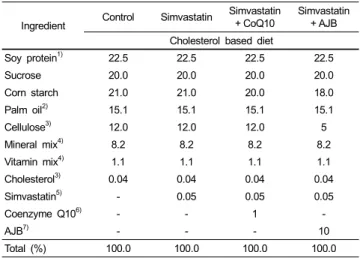
Ingredient Control Simvastatin Simvastatin
+ CoQ10 Simvastatin + AJB Cholesterol based diet
Soy protein1) 22.5 22.5 22.5 22.5
Sucrose 20.0 20.0 20.0 20.0
Corn starch 21.0 21.0 20.0 18.0
Palm oil2) 15.1 15.1 15.1 15.1
Cellulose3) 12.0 12.0 12.0 5
Mineral mix4) 8.2 8.2 8.2 8.2
Vitamin mix4) 1.1 1.1 1.1 1.1
Cholesterol3) 0.04 0.04 0.04 0.04
Simvastatin5) - 0.05 0.05 0.05
Coenzyme Q106) - - 1 -
AJB7) - - - 10
Total (%) 100.0 100.0 100.0 100.0
1)Soy protein: Aitken, Vanson & Co., Ltd. (Hong Kong, China).
2)Palm oi: MM Vitaoils Sdn. Bhd. (Selangor, Malaysia).
3)Cellulose and cholesterol from Sigma Chemical Co (St. Louis, MO, USA).
4)Harlan, Teklad (mineral and vitamin mixture adjusted to meet NRC requirements for guinea pigs. The detailed composition of the vitamin and mineral mix has been reported previously [41].
5)Simvastatin, Choongwage Pharma Co. Korea; 0.05% statin equivalents to 30 mg/kg BW/day.
6)Coenzyme Q 10, Yunjin Pharma Co. Korea; 1% CoQ10 equivalent to 600 mg/kg BW/day, calculated from daily food consumption.
7)AJB (Ardisia japonica Blume) 10% leaf powder, harvested from Halla mountain, Jeju Korea; freeze dried after cleaning and then powdered.
Table 1. Experimental diet composition (%)
terol [17]. Atorvastatin decreases cholesterol content in erythrocyte membranes by decreasing the cholesterol/phospholipid ratio, which provides membrane stability and increased Na-K ATPase activity in guinea pigs [18]. Changes in membrane lipid com- position and peroxidation may cause alterations in membrane cation channels that are associated with clinical complications such as hypertension, pregnancy, and diabetes. Increased erythro- cyte Na-Li counter-transport activity is correlated with increased membrane cholesterol/phospholipid ratio in patients with essential hypertension [19]. Elevated erythrocyte Na-pump activity, Na-K co-transport and Na-Li counter-transport, and decreased erythro- cyte membrane phospholipid content were are observed in patients with insulin dependent diabetes [20]. Abnormally low erythrocyte Na-K co-transport activity is associated with red blood cell (RBC) deformities and membrane permeability in patients with pregnancy-induced hypertension [21].
The evergreen shrub Ardisia japonica Blume (AJB) is native to eastern China, Japan, and Korea. It is considered one of the 50 fundamental herbs in traditional Chinese medicine, called zijinniu, and is used to treat cough, cancer, poisons, and tuber- culosis and improves diuresis and blood circulation [22].
Kobayashi and de Mejia [23] reported that ardisin, ardisianone, berginin and embelin in A. japonica have anti-allergenic, anti- human immunodeficiency virus, anti-cancer, and hypoglycemic effects as well as strong antioxidant activity. Ardisianone and benzoquinone from A. japonica have an inhibitory effect on 5-lipoxygenase [23], and triterpenoid saponins from A. crenata stimulate cAMP phosphodiesterase activity [24]. Besides rich in triterpenoids of isoprene units, genus Ardisia contains 2-hydroxy- 5-methoxy-3-pentadecenyl-benzoquinone, which is structurally similar to the benzoquinone nucleus of coenzyme Q (2,3 dimethoxy- 5-methyl-6-dedecaprenyl-benzoquinone) [23,25].
Interests in complementary and alternative medicine have increased to prevent and therapeutically treat certain diseases using a “natural” and “safe” method despite a lack of scientific evidence for their efficacy. In this study, we investigated the possible use of AJB as a CoQ10 substitute following depletion as a result of statin therapy. We tested the effects of a statin and the resulting depletion of CoQ10 on plasma and liver lipids, erythrocyte Na efflux channels, and platelet aggregation to investigate the repletion effects of dietary CoQ10 or AJB on these parameters and antioxidation status in guinea pigs.
Materials and Methods
Animals and diets
This study was approved by the Laboratory Animal Care Committee of Jeju National University, and the animals were maintained in accordance with the Guidelines for the Care and use of Laboratory Animals of the University.
Forty 6-week-old guinea pigs (Orient Bio Co Ltd, Gapyung,
Korea) were divided into four groups and fed the following diets:
0.04% cholesterol-based control diet; control diet plus 0.05%
simvastatin (30 mg/kg body weight [BW]); simvastatin plus 1%
CoQ10 (600 mg/kg BW); and simvastatin plus 10% AJB leave powder. The doses of AJB (Halla mountain), CoQ10 (Yunjin Pharm Co, Seoul, South Korea), and simvastatin (Choongwae Phama Co, Seoul, South Korea) are shown in Table 1. The diet was pelletized with assistance from the Korea Food Research Institute. Guinea pigs had free access to water and were housed individually cages in a room maintained at 20-25℃ with a 12-hour dark-light cycle. Blood samples were obtained by cardiac puncture into heparinized vacuum tubes after 4 weeks of ad libitum feeding, and whole blood platelet aggregation and RBC Na efflux were assessed with fresh blood. Platelet rich plasma (PRP), plasma, and liver samples were stored at -70℃ for later assays.
Whole blood platelet aggregation
Platelet aggregation was measured using a Chronolog Whole Blood Aggregometor (model 500-Ca; Havertown, PA, USA).
Fresh whole blood was diluted with isotonic saline (1:4) to
produce a platelet concentration of approximately 200,000 plate-
lets/µl. Adenosine diphosphate (ADP; 2 μM; Chronolog) was
added to initiate aggregation, and three impedance change readings
were averaged for each guinea pig to determine the maximum
aggregation and initial slope. The principle is based on the
increase in impedance (Ω) across two platinum electrodes as
platelet aggregation proceeds.
Plasma and liver lipid assays
Plasma total cholesterol, high-density lipoprotein (HDL)-cho- lesterol, triglycerides, and glucose were assayed using enzymatic kits (Asan Pharmaceuticals, Seoul, South Korea). Ten µl of plasma was used for the total cholesterol, triglyceride, and glucose assays. A 200 µl aliquot of plasma was incubated with dextran sulfate to precipitate apo B containing lipoprotein, and 50 µl of the supernatant was used for the HDL-cholesterol assay.
Liver extraction solvents were supplied by Merck (Darmstadt, Germany). Liver lipids were extracted using a modified Folch method [26]. One g of liver tissue was homogenized for 5 min in 6 ml of Folch solution [chloroform (2): methanol (1)] and 2 ml H
2O. After centrifugation for 10 min, the lower phase containing the liver lipids was separated. The lower phase of the lipid fractions was assayed using enzymatic kits (Asan Pharmaceuticals) after treatment with Triton X-100:chloroform (25 µl: 475 µl) for total cholesterol or with methanol for triglycerides.
Na efflux channels
RBC preparation: Chemicals for media that included ouabain, furosemide, and morpholinopropane sulfonic acid (MOPS) were purchased from Sigma Chemical Co. (St. Louis, MO, USA).
Blood was centrifuged at 1,000 × g for 10 minutes, and the plasma and buffy coat were removed. RBCs were washed five times with a cold isotonic washing solution (150 mM choline chloride, 10 mM Tris-4 MOPS, pH 7.4 at 4℃), and centrifuged at 1,000 × g for 5 minutes after each wash. The RBC pellet was resuspended in a choline chloride wash to produce a hematocrit (Hct) of 40-50%. A 50 µl aliquot of the RBC suspension was added to 5 ml of 0.02% acationox (a metal free detergent, Scientific Products, McGraw Park, IL, USA) to determine intracellular Na concentrations.
Na efflux: Four ml of the RBC suspension was added to 40 ml of MgCl
2medium with and without 1 mM ouabain (70 mM MgCl
2, 10 mM KCl, 85 mM sucrose, 10 mM glucose, 10 mM Tris MOPS pH 7.4 at 37℃) to determine Na efflux via Na-K ATPase activity. Two ml of the RBC suspension was added to 40 ml choline chloride medium with and without 1 mM furosemide (150 mM choline chloride, 10 mM glucose, 1 mM ouabain, 10m Tris- MOPS pH 7.4 at 37℃) to determine Na efflux via Na-K co- transport. The RBCs in each medium were mixed and aliquoted into 12 tubes. Duplicate tubes were transferred to an ice bath after a 37℃ incubation in a shaking water bath for 0, 2, 4, 6, 8, and 10 minutes to measure Na-K ATPase and 0, 10, 20, 30, 40, and 50 minutes to measure Na-K co-transport.
The tubes were centrifuged at 1,000 × g for 5 minutes, and the supernatant was removed to measure Na concentrations using an atomic absorption spectrophotometer (Shimadzu model AA6701F, Tokyo, Japan) [27].
Calculations:
Na efflux:
Na μg/(ml × min) × 60 min × μmole/23 μg × [44 ml - (4 ml × Hct)/(4 ml × Hct)] = mmole/l RBC/hr
Intracellular Na:
Na μg/(ml × min) × 60 min × μmol/23 μg × 101/Hct = mmole/l RBC
Liver and PRP thiobarbituric acid reactive substance (TBARS) production
PRP was obtained after centrifuging whole blood at 300 × g for 10 minutes. PRP and liver TBARS production were measured with a method modified from Buege and Aust (1978). TBARS was measured with a spectrophotometer at 532 nm. Liver TBARS was measured using a nonTBA treated as a blank.
Glutamic-pyruvic transaminase (GPT) and glutamic-oxaloacetic transaminase (GOT)
Plasma GPT and GOT were measured with a spectro- photometric diagnostic kit purchased from Asan Pharmaceutical.
The absorbance was read at 505 nM using a spectrophotometer, and results are expressed as IU/l.
Statistical analysis
Values were analyzed using the SAS software package (SAS, 1994). Analyses of variance were conducted in a completely randomized block design. Duncan’s multiple-range test was applied to compare individual means when the F-value was significant. A P < 0.05 was considered significant.
Results
Body weights and plasma and liver lipids
Final body and liver weights were not different among the groups (Table 2). Plasma total cholesterol decreased in the statin groups compared with that in the control (P < 0.01) but no difference in HDL-cholesterol was observed among the groups.
Plasma triglycerides tended to decrease in all statin groups compared with that in the control, but the difference was not significant. Liver total cholesterol was not different among the groups. Liver triglycerides decreased in all statin groups and a significant difference was observed between the control and statin plus CoQ10 group (P < 0.05).
Whole blood platelet aggregation
Maximum platelet aggregation tended to increase in the statin
groups, and the initial slope tended to increase in the statin plus
Control Simvastatin Simvastatin
+ CoQ10 Simvastatin + AJB Cholesterol based diet
Final weight (g) 450.8 ± 54.0 425.2 ± 37.9 400.8 ± 36.3 460.7 ± 68.5 Liver weight (g) 15.3 ± 2.0 13.4 ± 1.8 14.5 ± 3.9 14.9 ± 2.7 Plasma (mg/dl)
Total-cholesterol** 180.4 ± 40.3a 101.3 ± 17.9b 86.6 ± 14.4b 109.4 ± 25.7b HDL- cholesterol 17.0 ± 0.8 16.9 ± 0.3 16.2 ± 0.6 16.9 ± 1.1 Triglycerides 120.2 ± 29.6 113.4 ± 34.2 104.5 ± 34.3 115.1 ± 21.5 Glucose 136.2 ± 21.8 130.5 ± 13.5 126.4 ± 25.9 135.1 ± 16.0 Liver (mg/g)
Total-cholesterol 7.2 ± 1.3 6.4 ± 1.7 6.5 ± 2.2 7.1 ± 2.6 Triglycerides* 57.2 ± 8.2a 50.3 ± 8.1ab 41.3 ± 11.6b 53.5 ± 18.6a Values are mean ± SD of 10 guinea pigs.
* Values in the same row not sharing the same superscript differ significantly (P
< 0.05).
** Values in the same row not sharing the same superscript differ significantly (P
< 0.01).
Table 2. Supplementation effects of simvastatin, coenzyme Q10 (CoQ10), and Ardisia japonica Blume (AJB) on plasma and liver lipids
Fig. 1. Supplementation effects of simvastatin, coenzyme Q10 (CoQ10), and Ardisia japonica Blume (AJB) to cholesterol based diet on platelet aggregation and hematocrit. Values are mean ± SD of 10 guinea pigs.
Fig. 2. Supplementation effects of simvastatin, coenzyme Q10 (CoQ10), and Ardisia japonica Blume (AJB) to cholesterol based diet on erythrocyte sodium efflux channels. Values are mean ± SD of 10 guinea pigs.
Fig. 3. Supplementation effects of simvastatin, coenzyme Q10 (CoQ10), and Ardisia japonica Blume (AJB) to cholesterol based diet on platelet rich plasma (PRP) and liver thiobarbituric acid reactive substance (TBARS) production.
Values are mean ± SD of 10 guinea pigs.
CoQ10 group, but no differences were observed between any two groups (Fig. 1).
Na efflux channels
The assessment of Na efflux channels is shown in Fig. 2. No difference in intracellular Na was observed among the groups.
RBC Na efflux through Na-K ATPase increased significantly in the statin only group but decreased in the statin plus CoQ10 group (P < 0.05). Na efflux through Na-K co-transport increased in all statin groups compared with that in the control, (P < 0.05).
Total Na efflux increased significantly in statin only group and decreased in the statin plus CoQ10 group (P < 0.05). Total Na efflux tended to match that in the major Na-K ATPase efflux channels.
Liver and PRP TBARS production
TBARS production in PRP decreased in the statin plus CoQ10
group compared with that in the control (Fig. 3). Liver TBARS
Fig. 4. Supplementation effects of simvastatin, coenzyme Q10 (CoQ10), and Ardisia japonica Blume (AJB) to cholesterol based diet on plasma glutamic-pyruvic transaminase (GPT) and glutamic-oxaloacetic transaminase (GOT) levels. Values are mean ± SD of 10 guinea pigs.
production tended to decrease in the statin plus CoQ10 group, but the difference was not significant.
Plasma GOT and GPT
Plasma GOT and GPT levels are shown in Fig. 4. Plasma GOT increased in the statin and statin plus AJB groups but decreased in the statin plus CoQ10 group (P < 0.05). Plasma GPT also increased significantly in the statin only group compared with that in the control and statin plus CoQ 10 groups (P < 0.05).
Discussion
The hypochoelsterolmic effects of statins have been reported in human and animal studies. Fluvastatin (80 mg daily for 8 weeks) decreases LDL cholesterol by 35% in patients with type II hypercholesterolemia [28]. Saito et al. [29] reported that 1-40 mg rosuvastatin daily shows a linear response for reducing total cholesterol and apolipoprotein B in patients with hypercholes- terolemia. Fluvastatin (3.5 mg/kg BW) decreases plasma total cholesterol and triglycerides in mice [30], and lovastatin (5 mg/kg BW) or pravastatin (2.5 mg/kg BW) reduces plasma cholesterol by 36% and 30%, respectively, along with decreases in HMG CoA reductase by 50% and 41% in chow-fed dogs [31]. In contrast, Sawada et al. [32] reported that pravastatin (1-100 mg/kg BW) increases serum cholesterol levels and dose depen- dently decreases serum triglyceride levels in hamsters. In rat studies, simvastatin (2 mg/kg BW) significantly increases plasma total cholesterol [33] but a high dose of simvastatin (30 mg/kg BW) in rats does not decrease plasma total cholesterol [34] In the present study, 30 mg/kg BW simvastatin decreased plasma cholesterol levels without affecting liver total cholesterol in
guinea pigs, suggesting a species difference in the cholesterol and lipoprotein metabolic pathway. Approximately 65% of total cholesterol in humans is endogenously synthesized in extrahe- patic tissues [35]. Fernandez [36] observed that guinea pigs synthesize moderate amounts of hepatic cholesterol, as in humans, whereas the major site of cholesterol synthesis in rats is the liver. Guinea pigs, unlike rats, carry most cholesterol in low-density lipoprotein (LDL), and upregulating the LDL receptor with statins is another way to lower cholesterol in humans and guinea pigs [36]. In the present study, the statin tended to decrease plasma and liver triglycerides, and the statin plus CoQ10 (600 mg/kg BW) treatment further decreased plasma total cholesterol and plasma and liver triglycerides, suggesting that CoQ10 potentiated the hypocholesterolemic and hypolipi- demic effects of the statin. CoQ10 (15 mg/kg BW) at the same dose as a statin does not affect plasma and liver cholesterol or triglycerides in rats [34]. Simvastatin plus green tea in Kim’s study [34] lowered total liver cholesterol and triglycerides, but a statin plus AJB in the present study did not affect plasma or liver lipid levels.
Statins may have a platelet aggregation function through their action on cholesterol metabolism and membrane lipids, as platelet hypersensitivity is associated with hypercholesterolemia. Atorvastatin decreases platelet cholesterol content and potentiates the action of aspirin to deactivate platelets in patients with hypercholes- terolemia [17]. Fluvastatin dose-dependently inhibits platelet aggregation and decreases platelet-derived nitric oxide release in vitro [37]. Simvastatin reduces platelet adhesion to endocardium in human heart tissue and arterial segment fibrillation in vitro [38]. Despite these reports, simvastatin tended to increase maximum platelet aggregation in guinea pigs in vivo in the present study. In our previous studies with rats, low and high dose simvastatin did not affect platelet aggregation in vivo [33,34]. Depletion of antioxidants may be another factor associated with platelet activation. Antioxidants inhibit cyclooxygenases and decrease platelet thromboxane levels, which affect platelet activa- tion and platelet responses to stimulation factors such as ADP, thrombin, and collagen [15]. Reduced CoQ10 improves platelet mitochondrial function and protects platelets from oxidative stress which, in turn, results in platelet aggregation and adhesion [16]. In the present study, CoQ10 and AJB tended to attenuate maximum platelet aggregation in the statin-treated guinea pigs, but CoQ10 may cause increased platelet sensitivity considering the steep initial slope.
Atorvastatin decreases RBC-membrane cholesterol content by
decreasing the cholesterol/phospholipid ratio resulting in increases
membrane fluidity with increased Na-K ATPase in guinea pigs
[18]. Cholesterol content of membranes is one of determining
factors of membrane fluidity. Higher concentrations of membrane
cholesterol and lower Na-K ATPase activity are observed in
RBCs of patients with hyperlipidemia, and pravastatin reverses
or lessens this condition independent of its cholesterol-lowering
effect [39]. In the present study, the statin decreased plasma total
cholesterol and increased Na-K ATPase activity, which agreed with these results. However, the statin plus CoQ10 group showed further deceased plasma total cholesterol and suppressed Na-K ATPase channel activity. CoQ10 in antibiotic-treated rats recovers the reduced brush border Na-K ATPase activity and alleviates the nephrotoxicity of the antibiotic [40]. In our study, the statin also increased Na-K co-transport and Na passive transport by increasing total Na efflux. The observation that total Na efflux increased through Na channels with a higher intra- cellular Na in statin-treated animals is difficult to explain. AJB has strong antioxidant potency due to total polyphenol content of 21-72 mg equivalents gallic acid/g [25]. But, AJB did not favorably effect TBARS production or plasma GPT and GOT.
In conclusion, simvastatin decreased plasma cholesterol in guinea pigs, which is not observed in rats. CoQ10 seemed to potentiate the hypocholesterolemic effect of the statin and further decreased plasma cholesterol levels. Statins are analogues of HMG coA reductase and inhibit CoQ10 and cholesterol synthesis.
Therefore, CoQ10 supplementation is recommended for patients undergoing statin therapy for proper electron transport system function. Exogenous CoQ10 may play roles in negative feedback of the cholesterol biosynthetic pathway. CoQ10 also effectively decreased plasma and liver triglycerides in guinea pigs, potentiating the hypolipidemic effect of the statin. Despite reports that lower plasma cholesterol levels are related with higher Na-K ATPase activity, the present study showed lower plasma cholesterol with lower RBC Na-K ATPase activity in CoQ10- treated guinea pigs, which may be explained by differences in methodology. Na-K ATPase activity in the present study was determined by Na efflux through this channel. Despite its triterpenoid content and structural similarity to CoQ10, AJB did not show cholesterol lowering, liver protecting, or antioxidant effects.
References
1. King DE, Mainous AG 3rd, Egan BM, Player M, Geesey ME.
Use of statins and blood pressure. Am J Hypertens 2007;20:
937-41.
2. Matsuno H, Takei M, Hayashi H, Nakajima K, Ishisaki A, Kozawa O. Simvastatin enhances the regeneration of endothelial cells via VEGF secretion in injured arteries. J Cardiovasc Pharmacol 2004;43:333-40.
3. Susic D, Varagic J, Ahn J, Slama M, Frohlich ED. Beneficial pleiotropic vascular effects of rosuvastatin in two hypertensive models. J Am Coll Cardiol 2003;42:1091-7.
4. Staal A, Frith JC, French MH, Swartz J, Güngör T, Harrity TW, Tamasi J, Rogers MJ, Feyen JH. The ability of statins to inhibit bone resorption is directly related to their inhibitory effect on HMG-CoA reductase activity. J Bone Miner Res 2003;18:88-96.
5. Petanceska SS, DeRosa S, Olm V, Diaz N, Sharma A, Thomas- Bryant T, Duff K, Pappolla M, Refolo LM. Statin therapy for Alzheimer's disease: will it work? J Mol Neurosci 2002;19:
155-61.
6. Kaneta S, Satoh K, Kano S, Kanda M, Ichihara K. All hydro- phobic HMG-CoA reductase inhibitors induce apoptotic death in rat pulmonary vein endothelial cells. Atherosclerosis 2003;170:
237-43.
7. Littarru GP, Langsjoen P. Coenzyme Q10 and statins: biochemical and clinical implications. Mitochondrion 2007;7 Suppl:S168-74.
8. Nawarskas JJ. HMG-CoA reductase inhibitors and coenzyme Q10. Cardiol Rev 2005;13:76-9.
9. Lamperti C, Naini AB, Lucchini V, Prelle A, Bresolin N, Moggio M, Sciacco M, Kaufmann P, DiMauro S. Muscle coenzyme Q10 level in statin-related myopathy. Arch Neurol 2005;62:1709-12.
10. Dhanasekaran M, Ren J. The emerging role of coenzyme Q-10 in aging, neurodegeneration, cardiovascular disease, cancer and diabetes mellitus. Curr Neurovasc Res 2005;2:447-59.
11. Kamzalov S, Sumien N, Forster MJ, Sohal RS. Coenzyme Q intake elevates the mitochondrial and tissue levels of coenzyme Q and alpha-tocopherol in young mice. J Nutr 2003;133:3175-80.
12. Maroz A, Anderson RF, Smith RA, Murphy MP. Reactivity of ubiquinone and ubiquinol with superoxide and the hydroperoxyl radical: implications for in vivo antioxidant activity. Free Radic Biol Med 2009;46:105-9.
13. López-Lluch G, Barroso MP, Martín SF, Fernández-Ayala DJ, Gómez-Díaz C, Villalba JM, Navas P. Role of plasma membrane coenzyme Q on the regulation of apoptosis. Biofactors 1999;9:
171-7.
14. Ryszawa N, Kawczyńska-Drózdz A, Pryjma J, Czesnikiewicz- Guzik M, Adamek-Guzik T, Naruszewicz M, Korbut R, Guzik TJ. Effects of novel plant antioxidants on platelet superoxide production and aggregation in atherosclerosis. J Physiol Pharmacol 2006;57:611-26.
15. Sobotková A, Másová-Chrastinová L, Suttnar J, Stikarová J, Májek P, Reicheltová Z, Kotlín R, Weisel JW, Malý M, Dyr JE.
Antioxidants change platelet responses to various stimulating events. Free Radic Biol Med 2009;47:1707-14.
16. Merlo Pich M, Castagnoli A, Biondi A, Bernacchia A, Tazzari PL, D'Aurelio M, Parenti Castelli G, Formiggini G, Conte R, Bovina C, Lenaz G. Ubiquinol and a coenzyme Q reducing system protect platelet mitochondrial function of transfusional buffy coats from oxidative stress. Free Radic Res 2002;36:429-36.
17. Luzak B, Boncler M, Rywaniak J, Wilk R, Stanczyk L, Czyz M, Rysz J, Watala C. The effect of a platelet cholesterol modu- lation on the acetylsalicylic acid-mediated blood platelet inhibi- tion in hypercholesterolemic patients. Eur J Pharmacol 2011;658:
91-7.
18. Uyuklu M, Meiselman HJ, Baskurt OK. Effect of decreased plasma cholesterol by atorvastatin treatment on erythrocyte mechanical properties. Clin Hemorheol Microcirc 2007;36:25-33.
19. Villar J, Montilla C, Muñiz-Grijalvo O, Muriana FG, Stiefel P, Ruiz-Gutiérrez V, Carneado J. Erythrocyte Na(+)-Li+ counter- transport in essential hypertension: correlation with membrane lipids levels. J Hypertens 1996;14:969-73.
20. Lijnen P, Fenyvesi A, Bex M, Bouillon R, Amery A. Erythrocyte cation transport systems and membrane lipids in insulin-dependent diabetes. Am J Hypertens 1993;6:763-70.
21. Heilmann L, von Tempelhoff GF, Ulrich S. The Na+/K+ co-trans- port system in erythrocytes from pregnant patients. Arch Gynecol Obstet 1993;253:167-74.
22. Duke JA, Ayensu ES. Medicinal Plants of China, Vol 2. Algonac:
Reference Publications; 1985. p.705S.
23. Kobayashi H, de Mejia E. The genus Ardisia: a novel source of
health-promoting compounds and phytopharmaceuticals. J Ethno- pharmacol 2005;96:347-54.
24. Jia Z, Koike K, Nikaido T, Ohmoto T, Ni M. Triterpenoid saponins from Ardisia crenata and their inhibitory activity on cAMP phosphodiesterase. Chem Pharm Bull (Tokyo) 1994;42:
2309-14.
25. Newell AM, Yousef GG, Lila MA, Ramírez-Mares MV, de Mejia EG. Comparative in vitro bioactivities of tea extracts from six species of Ardisia and their effect on growth inhibition of HepG2 cells. J Ethnopharmacol 2010;130:536-44.
26. Folch J, Lees M, Sloane Stanley GH. A simple method for the isolation and purification of total lipides from animal tissues. J Biol Chem 1957;226:497-509.
27. Kang JS, Cregor MD, Smith JB. Effect of calcium on blood pressure, platelet aggregation and erythrocyte sodium transport in Dahl salt-sensitive rats. J Hypertens 1990;8:245-50.
28. Scharnagl H, Vogel M, Abletshauser C, Freisinger F, Stojakovic T, März W. Efficacy and safety of fluvastatin-extended release in hypercholesterolemic patients: morning administration is equivalent to evening administration. Cardiology 2006;106:241-8.
29. Saito Y, Goto Y, Dane A, Strutt K, Raza A. Randomized dose- response study of rosuvastatin in Japanese patients with hyper- cholesterolemia. J Atheroscler Thromb 2003;10:329-36.
30. Galus R, Włodarski P, Włodarski K. Influence of fluvastatin on bone formation induced by demineralized bone matrix in mice.
Pharmacol Rep 2006;58:443-7.
31. Davis HR Jr, Pula KK, Alton KB, Burrier RE, Watkins RW. The synergistic hypocholesterolemic activity of the potent cholesterol absorption inhibitor, ezetimibe, in combination with 3-hydroxy- 3-methylglutaryl coenzyme a reductase inhibitors in dogs.
Metabolism 2001;50:1234-41.
32. Sawada M, Matsuo M, Seki J. Inhibition of cholesterol synthesis causes both hypercholesterolemia and hypocholesterolemia in hamsters. Biol Pharm Bull 2002;25:1577-82.
33. Kim JL, Chae IS, Kang YH, Kang JS. Effect of onion and beet
on plasma and liver lipids, platelet aggregation, and erythrocyte Na efflux in simvastatin treated hypercholesterolmic rats. Nutr Res Pract 2008;2:211-7.
34. Kim YH, Moon YI, Kang YH, Kang JS. Effect of coenzyme Q10 and green tea on plasma and liver lipids, platelet aggregation, TBARS production and erythrocyte Na leak in simvastatin treated hypercholesterolmic rats. Nutr Res Pract 2007;1:298-304.
35. Dietschy JM, Turley SD, Spady DK. Role of liver in the main- tenance of cholesterol and low density lipoprotein homeostasis in different animal species, including humans. J Lipid Res 1993;
34:1637-59.
36. Fernandez ML. Guinea pigs as models for cholesterol and lipoprotein metabolism. J Nutr 2001;131:10-20.
37. Haramaki N, Ikeda H, Takenaka K, Katoh A, Sugano R, Yamagishi S, Matsuoka H, Imaizumi T. Fluvastatin alters platelet aggrega- bility in patients with hypercholesterolemia: possible improvement of intraplatelet redox imbalance via HMG-CoA reductase. Arter- ioscler Thromb Vasc Biol 2007;27:1471-7.
38. Chello M, Spadaccio C, Patti G, Lusini M, Barbato R, Goffredo C, Di Sciascio G, Covino E. Simvastatin reduces platelet-endo- cardium adhesion in atrial fibrillation. Atherosclerosis 2008;197:
588-95.
39. Broncel M, Balcerak M, Cieślak D, Duchnowicz P, Koter- Michalak M, Sikora J, Chojnowska-Jezierska J. Effect of fluvastatin extended release on the protein-lipid structure of erythrocyte membrane and C-reactive protein in patients with hyperlipidemia.
Pol Merkur Lekarski 2007;22:107-11.
40. Upaganlawar A, Farswan M, Rathod S, Balaraman R. Modifica- tion of biochemical parameters of gentamicin nephrotoxicity by coenzyme Q10 and green tea in rats. Indian J Exp Biol 2006;
44:416-8.
41. Fernandez ML, Lin EC, Trejo A, McNamara DJ. Prickly pear (Opuntica sp.) pectin reverses low density lipoprotein receptor suppression induced by a hypercholesterolemic diet in guinea pigs. J Nutr 1992;122:2330-40