• 검색 결과가 없습니다.

Penidioxolanes A and B, 1,3-Dioxolane Containing Azaphilone Derivatives from Marine-derived Penicillium sp. KCB12C078

N/A
N/A
Protected

Academic year: 2022

Share "Penidioxolanes A and B, 1,3-Dioxolane Containing Azaphilone Derivatives from Marine-derived Penicillium sp. KCB12C078"

Copied!
6
0
0

로드 중.... (전체 텍스트 보기)

전체 글

(1)

http://dx.doi.org/10.20307/nps.2015.21.4.231

231

Penidioxolanes A and B, 1,3-Dioxolane Containing Azaphilone Derivatives from Marine-derived Penicillium sp. KCB12C078

Seung Min Kim 1 , Sangkeun Son 1,2 , Jong Won Kim 1 , Eun Soo Jeon 1 , Sung-Kyun Ko 1 , In-Ja Ryoo 1 , Kee-Sun Shin 5 , Hiroshi Hirota 3 , Shunji Takahashi 3,4 , Hiroyuki Osada 4 , Jae-Hyuk Jang 1,2, *, and Jong Seog Ahn 1,2, *

1

Chemical Biology Research Center, Korea Research Institute of Bioscience and Biotechnology, Chungbuk 363-883, Korea

2

Department of Biomolecular Science, University of Science and Technology, Daejeon 305-333, Korea

3

RIKEN-KRIBB Joint Research Unit, Global Research Cluster, RIKEN, Saitama 351-0198, Japan

4

Chemical Biology Research Group, RIKEN CSRS, Saitama 351-0198, Japan

5
Microbial Resources Center, KRIBB, Daejeon 306-809, Korea

Abstract – Two new azaphilone derivatives containing 1,3-dioxolane moiety, penidioxolanes A (1) and B (2), were isolated from marine-derived fungus Penicillium sp. KCB12C078, together with four known compounds (3- 6) by chemical investigation. Compounds 1 - 6 were isolated by combination of silica gel, ODS column chromatography and preparative HPLC. Their structures were determined by analysis of spectroscopic data including 1D-, 2D-NMR, and MS techniques. The isolates were evaluated against cancer cell growth inhibition effects and antimicrobial activity.

Keywords – azaphilone derivatives, 1,3-Dioxolane, Marine-derived fungus, Penicillium

Introduction

To date more than one million natural products have been discovered from various living organisms including plants, animals and microbes. 1 Among them, emerging source of new bioactive substance has been developed from the many recent studies of microbial diversity in the marine environment. 2 Marine microorganisms have recently proven to be an important sources of chemically interesting and biologically active secondary metabolites for the development of novel pharmaceutical agents. 3 Therefore, these rich marine habitat provides a magnificent opportunity to discover newer compounds such as antibiotics, enzymes, vitamins, drugs and other valuable compounds of com- mercial importance. 4 Among these various bioactive com- pounds, azaphilone family has been isolated from fungi belonging to 23 genera from 13 families, such as, Asper- gillus, Penicillium, Chaetomium, Talaromyces, Pestalotiopsis,

Phomopsis, Emericella, and Epicoccum, as well as Monascus and Hypoxylon sp.. Several azaphilones are unique to one species and constitute taxonomically important marker metabolites. 5,6 Azaphilone family are structurally diverse pigments, mostly secondary metabolites of fungal origin, and are highly oxygenated bicyclic rings showing various biological activities, including antimi- crobial, antifungal, antiviral, antioxidant, cytotoxic, nema- ticidal and anti-inflammatory activities. 7-13

As part of our efforts to search for novel bioactive secondary metabolites from marine-derived fungi, Penicillium sp. KCB12C078 was isolated from marine sediment in the Korea western sea region, Anmyeon Island, and chemical investigation of fungus led to the isolation of two new azaphilone derivatives, penidioxolanes A (1) and B (2), and four known azaphilones (3-6). In this study, we describe the fermentation, isolation, and structural deter- mination of these compounds, and their biological activity.

Experimental

General experimental procedures and materials − UV/vis spectra were obtained on an ultropec 3100 pro spectrophotometer (Amersham, USA). Optical rotation data were recorded using a P-1020 polarimetet (Jasco, Japan). NMR experiments were operated on a Bruker

*Author for correspondence

Jong Seog Ahn, Chemical Biology Research Center, Korea Research Institute of Bioscience and Biotechnology, Chungbuk 363- 883, Korea

Tel: +82-43-240-6160; E-mail: [email protected]

Jae-Hyuk Jang, Chemical Biology Research Center, Korea Research Institute of Bioscience and Biotechnology, Chungbuk 363-883, Korea

Tel: +82-43-240-6164; E-mail: [email protected]

(2)

Biospin Avance II 900 MHz NMR spectrometer (Bruker, Germany) in DMSO-d 6 as an internal standard ( δ H/C 2.49/

39.5). Chemical shifts are reported in ppm and coupling constants (J) are reported in Hz. High resolution mass spectra were recorded on a Waters Synapt G2 mass spectrometer (Waters, USA). Column chromatography was performed on silica gel (0.063 to 0.2 mm; Merck KGaA, USA) and reversed phase silica gel (0.075 mm; Cosmosil, Japan). Preparative HPLC was performed using a pre- parative Grom TM Sil 120 ODS 5 column (20 × 250 mm;

Grom, Germany), Cosmosil cholester column (10 × 250 mm; Cosmosil, Japan) and Cosmosil 5PYE column (4.6 × 150 mm; Cosmosil, Japan) equipped with a Waters 515 pump and Waters 2996 photodiode detector (Waters, USA).

Strain isolation and identification − The samples were collected from sediment in the Anmyeon Island of South Korea in November 2011. Collected sample was diluted with distilled artificial sea water, and spread over the surface of PDA medium (containing 50% artificial sea water) adjusted to pH 7.4. Serial transfers of one of the resulting colonies provided a pure strain (KCM12C078).

The fungal strain was identified based on the sequences of the LSU rRNA gene D1/D2 domains and ITS (internal transcribed spacer) region as Penicillium sp. KCB12C078.

This strain has been deposited as KCTC18283P at the Korean Collection for Type Culture (KCTC), located within the Biological Resources Center (BRC) in the Korea Research Institute of Bioscience and Biotechnology (KRIBB), Korea.

Fermentation − Spores of fungus were inoculated into 150 mL seed culture medium (PDB containing 50%

artificial sea water) in a 500 mL Erlenmeyer flask. After incubation at 28 o C on a rotary shaker (130 rpm) for 3 days, the seed cultures were transferred to 1000 mL Erlenmeyer flask with one baffle containing each 300 mL of same medium (20 L) and were incubated at 28 o C on a rotary shaker (130 rpm) for 7 days.

Extraction and isolation − The culture was separated into broth and mycelia after centrifugation at 5000 rpm for 25 min. The broth was partitioned with EtOAc three times and evaporated to remove EtOAc. The mycelium was extracted five times with equal volume of acetone for 2 h. The aqueous acetone layer was concentrated under reduced pressure. To the extracts was added H 2 O and then partitioned with equal volume of EtOAc three times. The aqueous EtOAc layer was concentrated under reduced pressure and added by 80% MeOH. The aqueous mixture was washed with equal volume of hexane. The 80%

MeOH layer was evaporated to dryness under reduced pressure. Combined extracts (3.5 g) was separated by silica

gel C.C. and eluted with a gradient of CHCl 3 /MeOH (50:1 to 0:100, 1 L), resulting in 9 fractions. CHCl 3 / MeOH (40:1) fraction was separated by vacuum liquid column chromatography (RP-18 C.C.) and eluted with a gradient of MeOH/H 2 O (20:80 to 100:0, 500 mL) to yielded 11 fractions. MeOH/H 2 O (80:20) fraction was purified by HPLC with an ODS column (10 × 250 mm, flow rate: 2 mL/min) eluted with MeCN/H 2 O (80:20) and cholester column (10 × 250 mm, flow rate: 2 mL/min) eluted with MeCN/H 2 O (70:30) to yield penidioxolane A (1, 1.3 mg). Moreover 5PYE column (4.6 × 150 mm, flow rate: 0.7 mL/min) eluted with MeCN/H 2 O (53:47) to yield penidioxolane B (2, 0.9 mg), together with compounds 3 (406.0 mg), 4 (0.6 mg), 5 (508.2 mg), and 6 (0.8 mg).

Penidioxolane A (1) − Yellow powder; +15 (c 0.025, MeOH); UV (MeOH) λ max (log ε) 351 (4.04);

HRESIMS: m/z 439.1889 [M −H] (calcd. for C 23 H 32 35 Cl O 6 : m/z 439.1887)

Penidioxolane B (2) − Yellow powder; −31 (c 0.05, MeOH); UV (MeOH) λ max (log ε) 342 (3.91); HRESIMS:

m/z 505.1965 [M+Na] + (calcd. for C 25 H 35 35 ClO 7 Na: m/z 505.1969)

Isochromophilone IX (3) − Red powder; +430 (c 0.10, MeOH); UV (MeOH) λ max 235, 367; ESI-MS: m/

z 446 [M+H] + , C 25 H 32 ClNO 6 ; 1 H NMR (DMSO-d 6, 400 MHz) 8.17 (1H, s, H-1), 7.16 (1H, d, H-10), 6.97 (1H, s, H-4), 6.57 (1H, d, H-9), 5.85 (1H, d, H-12), 4.13 (2H, m, H-2´), 2.51 (2H, t, H-4´), 2.25 (2H, m, H-3´), 2.06 (3H, s, 1´-Me), 1.89 (3H, s, 11-Me), 1.43 (3H, s, 7-Me), 1.38 (2H, m, H-14), 1.37 (1H, m, H-13), 0.98 (3H, d, 13-Me), 0.85 (3H, t, 14-Me); 13 C NMR (DMSO-d 6 , 100 MHz) 192.9 (C-8), 182.1 (C-6), 174.1 (C-5´), 169.1 (C-1´), 148.6 (C-3), 146.7 (C-12), 144.6 (C-10), 144.0 (C-4a), 142.7 (C-1), 132.5 (C-11), 115.9 (C-8a), 113.9 (C-9), 109.4 (C-4), 99.0 (C-5), 84.8 (C-7), 53.0 (C-2´), 34.2 (C- 13), 29.5 (C-14, C-4´), 25.1 (C-3´), 23.0 (7-Me), 20.1 (1´- Me), 20.0 (13-Me), 12.3 (11-Me), 11.8 (14-Me)

Isochromophilone VI (4) − Red powder; +217 (c 0.10, MeOH); UV (MeOH) λ max 235, 345, 370; ESI- MS: m/z 434 [M+H] + , C 23 H 28 ClNO 5 ; 1 H NMR (DMSO- d 6, 400 MHz) 8.09 (1H, s, H-1), 7.10 (1H, d, H-10), 6.95 (1H, s, H-4), 6.52 (1H, d, H-9), 5.83 (1H, d, H-12), 4.21 (2H, t, H-2´), 3.36 (2H, t, H-3´), 2.51 (2H, t, H-4´), 2.33 (1H, m, H-13), 2.06 (3H, s, 1´-Me), 1.85 (3H, s, 11-Me), 1.40 (3H, s, 7-Me), 1.31 (2H, m, H-14), 0.98 (3H, d, 13- Me), 0.84 (3H, t, 14-Me); 13 C NMR (DMSO-d 6 , 100 MHz) 193.9 (C-8), 184.2 (C-6), 170.4 (C-1´), 149.0 (C- 4a), 148.3 (C-12), 145.5 (C-3, C-10), 142.3 (C-1), 131.7 (C-11), 114.9 (C-9), 114.7 (C-8a), 111.9 (C-5), 101.6 (C- 4), 84.8 (C-7), ), 60.7 (C-3´), 55.7 (C-2´), 35.0 (C-13),

α [ ] D 23

α [ ] D 23

α [ ] D 23

α

[ ] D 23

(3)

30.0 (C-14), 23.3 (7-Me), 20.3 (1´-Me), 20.2 (13-Me), 12.3 (11-Me), 12.0 (14-Me)

Sclerotiorin (5) − Yellow powder; +133 (c 0.10, MeOH); UV (MeOH) λ max 284, 361; ESI-MS: m/z 413 [M+Na] + , C 21 H 25 ClO 5 ; 1 H NMR (DMSO-d 6, 400 MHz) 8.34 (1H, s, H-1), 7.07 (1H, d, H-10), 6.95 (1H, s, H-4), 6.56 (1H, d, H-9), 5.78 (1H, d, H-12), 2.51 (1H, m, H- 13), 2.11 (3H, s, 1´-Me), 1.83 (3H, s, 11-Me), 1.49 (3H, s, 7-Me), 1.39 (2H, m, H-14), 0.97 (3H, d, 13-Me), 0.82 (3H, t, 14-Me); 13 C NMR (DMSO-d 6 , 100 MHz) 191.1 (C-8), 184.9 (C-6), 169.5 (C-1´), 158.3 (C-3), 154.4 (C- 1), 147.7 (C-12), 141.7 (C-10), 139.3 (C-4a), 132.2 (C- 11), 116.8 (C-9), 113.8 (C-5), 108.5 (C-8a), 106.4 (C-4), 84.7 (C-7), 34.4 (C-13), 29.4 (C-14), 22.1 (7-Me), 20.0 (13-Me), 19.8 (1´-Me), 12.1 (11-Me), 11.8 (14-Me)

Chloroisotiorin (6) − Yellow powder; +15 (c 0.46, MeOH); UV (MeOH) λ max 209, 303, 357; ESI-MS:

m/z 415 [M+H] + , C 23 H 23 ClO 5 ; 1 H NMR (DMSO-d 6, 900 MHz) 8.74 (1H, s, H-1), 7.18 (1H, d, H-10), 6.91 (1H, s, H-4), 6.57 (1H, d, H-9), 5.84 (1H, d, H-12), 2.59 (1H, m, H-13), 2.49(3H, s, 3´-Me), 2.11 (3H, s, 1´-Me), 1.84 (3H, s, 11-Me), 1.84 (3H, s, 7-Me), 1.39 (2H, m, H-14), 0.99 (3H, d, 13-Me), 0.84 (3H, t, 14-Me); 13 C NMR (DMSO- d 6 , 225 MHz) 194.3 (C-3´), 183.3 (C-6), 168.6 (C-1´), 162.9 (C-8), 158.4 (C-3), 152.3 (C-1), 148.3 (C-12), 142.7 (C-10), 140.5 (C-4a), 132.8 (C-11), 124.0 (C-2´), 117.4 (C-9), 110.2 (C-8a), 107.6 (C-5), 106.3 (C-4), 87.6

(C-7), 34.9 (C-13), 30.1 (3´-Me), 30.0 (C-14), 26.0 (7- Me), 20.5 (13-Me), 12.7 (11-Me), 12.3 (14-Me)

Cytotoxicity assay − The cytotoxicity was determined using EZ-CyTox cell viability assay kit (Daeil Lab.

Service, Seoul, Korea) against B16F10 (melanoma), HeLa (cervical cancer), Hep-3B (hepatoma) and MDA-MB-231 (breast cancer). All cell lines were cultured in media supplemented with 10% fetal bovine serum, 100 U/mL penicillin and 100 µg/mL streptomycin at 37 o C in a 5%

CO 2 incubator. The tested four cancer cell lines were seeded in 96-well plates at a density of 5 × 10 4 /mL for 24 h, and compounds were added at various concentrations.

After 24 h, cells were treated with 10 µL of WST solution and the plates were incubated at 37 o C for 2 h. The absorbance at 450 nm was recorded with a microplate reader (Versa Max TM , Molecular Devices, USA).

Antimicrobial assay − The antimicrobial activity against seven species of microorganisms was measured by the paper disk method. Nutrient broth agar (Difco) was used as the medium for growing Escherichia coli, Bacillus subtilis, Staphylococcus aureus, Candida albicans, and Aspergillus fumigates. Each sample was applied to a paper disk (6 mm) at a dose of 50 μg/disk, and the paper disk was then air-dried. The impregnated paper disk was placed on the surface of an agar plate seeded with one of the microbial strains. The growth inhibition zone was measured after 48 h of incubation at 30 o C.

α [ ] D 23

α [ ] D 23

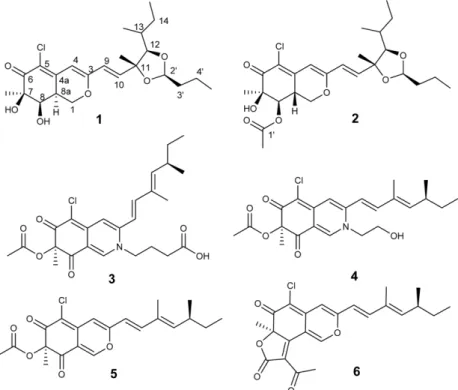
Fig. 1. Structures of isolated compounds 1 - 6.

(4)

Results and Discussion

Strain KCB12C078, producing compounds 1 - 6, was isolated from a marine sediment sample collected at Anmyeon Island in Korea. Morphological, physiological, and phylogenetic properties classified the strain as the genus, Penicillium. The Penicillium sp. KCB12C078 was cultured in potato dextrose media (50% artificial sea water, 20 L) for 7 days at 28 o C on a rotary shaker (130 rpm). The EtOAc-soluble portion of the fungal extract was purified using silica gel chromatography and ODS flash column chromatography followed by reverse-phase HPLC to afford two novel fungal metabolites named penidioxolanes A (1, 1.3 mg) and B (2, 0.9 mg), together with compounds 3 (406.0 mg), 4 (0.6 mg), 5 (508.2 mg), and 6 (0.8 mg). Compounds 3-6 were identified to iso- chromophilone IX (3), 14 isochromophilone VI (4), 15 sclero-

tiorin (5), 16,17 and chloroisotiorin (6), 18 respectively, by comparing the spectroscopic data in the literature (Fig. 1).

Penidioxolane A (1) was obtained as a yellow amorphous solid with +15 (c 0.025, MeOH). Compound 1 exhibited a cluster of molecular ion peaks at m/z 439 and 441 in a ratio of 3:1 in the ESIMS, indicating the presence of a chlorine atom in the molecule. The molecular formula of C 23 H 33 ClO 6 was determined on the basis of HRESIMS data (m/z 439.1889 [M −H] ; calculated for C 23 H 32 35 ClO 6 , 439.1887) in combination with 1 H and 13 C NMR data (Table 1). The 1 H, 13 C, and DEPT NMR data suggested the presence of 23 carbons, comprising five methyl carbons ( δ C 23.6, 21.0, 16.7, 14.4, and 11.2), four methylene carbons ( δ C 68.7, 36.6, 25.0, and 17.3), eight methine carbons ( δ C 140.6, 123.9, 103.2, 102.2, 88.0, 74.6, 37.4, and 34.4) and six quaternary carbons ( δ C

194.0, 160.3, 144.0, 117.3, 80.7, and 78.3). Interpretation α

[ ] D 23 Table 1.

1

H (900 MHz) and

13

C (225 MHz) NMR data of 1 and 2 in DMSO-d

6

No. 1 2

δ

H

(mult., J in Hz) δ

C

δ

H

(mult., J in Hz) δ

C

1 4.01 (dd, 14.0, 10.8)

68.7 3.80 (dd, 14.0, 11.0)

4.53 (dd, 10.8, 5.5) 4.49 (dd, 11.0, 5.0) 67.8

3 160.3 161.2

4 6.14 (s) 103.2 6.19 (s) 102.3

4a 144.0 144.9

5 117.3 119.5

6 194.0 188.0

7 78.3 74.5

7-CH

3

1.22 (s) 23.6 1.19 (s) 20.0

8 3.91 (d, 3.0) 74.6 4.93 (d, 10.0) 73.3

8a 3.16 (ddd, 14.0, 5.5, 3.0) 37.4 3.26 (ddd, 14.0, 10.0, 5.0) 35.9

9 6.43 (d, 16.0) 123.9 6.49 (d, 15) 123.6

10 6.43 (d, 16.0) 140.6 6.43 (d, 15) 141.1

11 80.7 80.8

11-CH

3

1.23 (s) 21.0 1.22 (s) 21.4

12 3.40 (d, 10.0) 88.0 3.37 (d, 9.0) 88.3

13 1.55 (m) 34.4 1.61 (m) 34.2

13-CH

3

0.99 (d, 6.5) 16.7 0.99 (d, 6.0) 16.6

14 0.92 (m)

25.0 0.96 (m)

1.35 (m) 1.36 (m) 25.0

14-CH

3

0.84 (t, 7.0) 11.2 0.85 (t, 7.0) 11.1

1’ 170.7

1’-CH

3

2.16 (s) 21.0

2’ 4.94 (t, 5.5) 102.2 4.94 (t, 5.0) 102.3

3’ 1.55 (m) 36.6 1.56 (m) 36.6

4’ 1.39 (m) 17.3 1.39 (m) 17.3

4’- CH

3

0.91 (t, 7.0) 14.4 0.91 (t, 7.0) 14.4

(5)

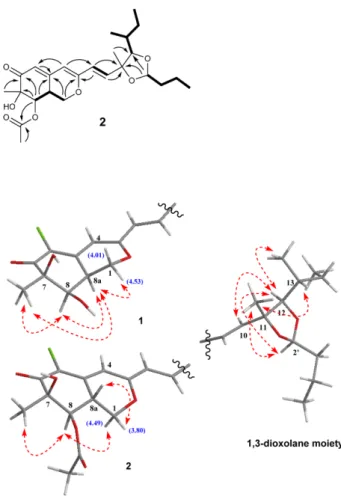
of the 2D-NMR data including COSY, HMQC, and HMBC spectra led to the construction of planar structure of 1. 1 H- 1 H spin systems of H-1/H-8a/H-8, H-12/13-CH 3 / H-13/H-14/14-CH 3 , and H-2’/H-3’/H-4’/4’-CH 3 was deduced from COSY data. From these spin system, key HMBC correlation enabled the construction of three partial structures of compound 1. The location of isolated methyl group (7-CH 3 ) was confirmed by HMBC correlations of C-6 ( δ 194.0), C-7 (δ 78.3), and C-8 (δ 74.6) with methyl protons at δ 1.22 (3H, s). Taking the COSY correlation mentioned above into consideration, there exists a bond connection of C-6/C-7/C-8/C-8a/C-1, and C-1 methylene is attached with an oxygen from its chemical shifts (ä C/H 68.7/4.01 and 4.53). HMBC correlations of H-1/C-3/C-4a, H-8a/C-4a/C-5, H-4/C-3/C-5/C-8a, and weak correlation of 7-CH 3 /C-5 revealed the presence of a tetrahydro- benzopyrane unit. The side chain part of 1 included three separated spin systems. The first one consisted of two olefinic methines (C-9 and C-10) and the coupling constant (J 9,10 = 16.0 Hz) indicated the E-olefin. The second one consisted of two methyl groups (13-CH 3 and 14-CH 3 ), methylene group (C-14) and two methine groups (C-10 and C-11). The third one consisted of one methyl group (4’-CH 3 ), two methylene groups (C-3’ and C-4’) and one methine group (C-2’). An isolated methyl group (11-CH 3 ) showed the HMBC correlations with not only a quaternary carbon (C-11) but also C-10 and C-12.

Other 1 H- 13 C HMBC correlations of H-10/C-9, C-11, and C-12, 13-CH 3 /C-12 and C-14, 15-CH 3 /C-13 and C-14 established a 3,5-dimethylhept-1-ene-3,4-diol unit. 1 H- 13 C HMBC correlation of H-9 and H-10/C-3 showed that the side chain was attached at the C-3 position. Through long range HMBC correlation of H-12/C-2’ and H-2’/C-12, butane unit was connected with azaphilone unit (Fig. 2).

The relative stereochemistry of the tetrahydrobenzopy- ranone part was determined by analysis of coupling constants and NOESY spectrum. The coupling constants of H-8a were J 8a,8 = 3.0 Hz, J 8a,1α (4.53) = 5.5 Hz, and J 8a,1β

(4.01) = 14.0 Hz, indicating that H-8 is in the equatorial disposition; NOE correlation of H-8a with 7-CH 3 suggested

that these protons are in the same face of the bicyclic ring.

Therefore, the relative configuration of tetrahydroben- zopyranone part was proposed as 7R*, 8R*, and 8aS*.

The relative configuration of the 1,3-dioxolane part of 1 was separately determined by the NOESY spectrum (Fig.

3). 19,20 In the NOESY spectrum, H-12 showed a corre- lation with H-2’ and 11-CH 3 correlation with H-2’, whereas no correlation between 11-CH 3 and H-12. This implied that H-12 and 11-CH 3 were located on the opposite face each other. However, the configuration at C- 13 of the side chain remains unclear. Therefore, relative stereochemistry of the 1,3-dioxolane part of 1 was proposed as 11R* and 12R* configuration.

Penidioxolane B (2) was obtained as a yellow amorphous solid with −31 (c 0.05, MeOH). The molecular formula was determined to be C 25 H 35 ClO 7 on the basis of [M+Na] + ion signal at m/z 505.1965 (calcd. 505.1969) of HRESIMS spectrum. A 3:1 isotopic peak ratio for [M+Na] + : [M+Na+2] + was observed, which also indicates the presence of a chlorine atom in the molecule. The number of carbons was in accordance with 25 individual signals obtained in the 13 C-NMR and DEPT NMR

α [ ] D 23 Fig. 2. Key COSY and HMBC correlations for 1 and 2.

Fig. 3. NOESY correlations for 1 and 2.

(6)

spectra. The 1 H and 13 C NMR spectrum of 2 showed almost identical signals as 1 except for an acetyl group connected to C-8 instead of a hydroxyl group. HMBC correlations of H-8/C-1’ (carbonyl carbon) and 1’-CH 3 /C- 1’ afforded an acetoxyl group should be attached at C-8.

The quaternary carbons C-5 and C-7 should be also attach by a chloride and hydroxyl group, respectively, due to their 13 C chemical shifts. The relative stereochemistry of the tetrahydrobenzopyranone part was determined from the J-values and the NOESY spectrum. The coupling constants of H-8a were J 8a, 8 = 10.0 Hz, J 8a, 1α (4.49) = 5.0 Hz, and J 8a, 1β (3.80) = 14.0 Hz, indicating that H-8 is in the axial disposition. Observed NOE signals between H-8 and each 7-CH 3 , and H-1 α, between H-1β and H-8a indicated that 2 had 7R*, 8R*, and 8aR* configuration.

The relative configuration of the 1,3-dioxolane part of 2 was proposed to be identical to that of 1 as they possessed similar NMR signals.

Azaphilones are one of the largest groups a fungal secondary metabolites and more than 300 azaphilone derivatives have been discovered from a variety of fungi. 6 To our knowledge, 1,3-dioxolane moiety containing aza- philone type compound have been only reported as penicilazaphilone A isolated from Penicillium sclerotiorum. 21 Biological Activities − Compounds 1 - 6 were tested for their cell growth inhibitory activity against four tumor cell lines, B16F10 (melanoma), HeLa (cervical cancer), Hep-3B (hepatoma), and MDA-MB-231 (breast cancer).

From this assay revealed that compounds were inactive against those cells at 100 μM level. Furthermore, new compounds 1 and 2 did not show any antimicrobial activity against Escherichia coli, Bacillus subtilis, Staphy- lococcus aureus, Vibrio costicola, Candida albicans, and Aspergillus fumigates at 50 μg/disk. Further studies regarding biological activities are currently under way.

Acknowledgments

We acknowledge financial support by grants from the Global R&D Center (GRDC, NRF-2010-0079) programs of the National Research Foundation of Korea (NRF) funded by the Ministry of Science, ICT and Future

Planning of Korea (MSIFP). We also thank financial support by grants from the Chungcheongbuk-do and KRIBB Research Initiative Program. We thank the Korea Basic Science Institute, Ochang, Korea, for providing NMR (900 MHz) and HRESIMS data.

References

(1) Bérdy, J. J. Antibiot. 2005, 58, 1-26.

(2) Fenical, W.; Jensen, P. R. Nat. Chem. Biol. 2006, 2, 666-673.

(3) Faulkner, D. J. Nat. Prod. Rep. 1998, 15, 113-158.

(4) Satpute, S. K.; Banat, I. M.; Dhakephalkar, P. K.; Banpurkar, A. G.;

Chopade, B. A. Biotechnol. Adv. 2010, 28, 436-450.

(5) Osmanova, N.; Schultze, W.; Ayoub, N. Phytochem. Rev. 2010, 9, 315-342.

(6) Gao, J. M.; Yang, S. X.; Qin, J. C. Chem. Rev. 2013, 113, 4755- 4811.

(7) Quang, D. N.; Hashimoto, T.; Fournier, J.; Stadler, M.; Radulovi , N.; Asakawa, Y. Tetrahedron 2005, 61, 1743-1748.

(8) Kanokmedhakul, S.; Kanokmedhakul, K.; Nasomjai, P.; Louangsy- souphanh, S.; Soytong, K.; Isobe, M.; Kongsaeree, P.; Prabpai, S.;

Suksamrarn, A. J. Nat. Prod. 2006, 69, 891-895.

(9) Yu, B. Z.; Zhang, G. H.; Du, Z. Z.; Zheng, Y. T.; Xu, J. C.; Luo, X.

D. Phytochemistry 2008, 69, 2523-2526.

(10) Quang, D. N.; Hashimoto, T.; Tanaka, M.; Stadler, M.; Asakawa, Y.

Phytochemistry 2004, 65, 469-473.

(11) Li, J. J.; Shang, X. Y.; Li, L. L.; Liu, M. T.; Zheng, J. Q.; Jin, Z. L.

Molecules 2010, 15, 1958-1966.

(12) Dong, J.; Zhou, Y.; Li, R.; Zhou, W.; Li, L.; Zhu, Y.; Huang, R.;

Zhang, K. FEMS. Microbiol. Lett. 2006, 264, 65-69.

(13) Yasukawa, K.; Takahashi, M.; Natori, S.; Kawai, K.; Yamazaki, M.; Takeuchi, M.; Takido, M. Oncology 1994, 51, 108-112.

(14) Michael, A. P.; Grace, E. J.; Kotiw, M.; Barrow, R. A. Aust. J.

Chem. 2003, 56, 13-15.

(15) Arai, N.; Shiomi, K.; Tomoda, H.; Tabata, N.; Yang, D. J.; Masuma R.; Kawakubo, T.; Omura, S. J. Antibiot. 1995, 48, 696-702.

(16) Curtin, T. P.; Reilly, J. Biochem. J. 1940, 34, 1419-1421.

(17) Holker, J. S. E.; Ross, W. J.; Staunton J.; Whalley, W. B. J. Chem.

Soc. 1962, 4150-4154.

(18) Gray, R. W.; Whalley, W. B. Chem. Commun. 1970, 12, 762.

(19) Yang, D. J.; Tomoda, H.; Tabata, N.; Masuma, R.; Omura, S. J.

Antibiot. 1996, 49, 223-229.

(20) Matsuzaki, K.; Tanaka, H.; Omura, S. J. Antibiot. 1995, 48, 708- 713.

(21) Arunpanichlert, J.; Rukachaisirikul, V.; Sukpondma, Y.;

Phongpaichit, S.; Tewtrakul, S.; Rungjindamai, N.; Sakayaroj, J. Chem.

Pharm. Bull. 2010, 58, 1033-1036.

Received June 5, 2015

Revised June 17, 2015

Accepted June 17, 2015

수치

Fig. 1. Structures of isolated compounds 1 - 6.
Fig. 3. NOESY correlations for 1 and 2.

참조

관련 문서