Korean Circulation Journal
Introduction
The ascending aorta in congenital heart disease (CHD) may di- late out of proportion to hemodynamic or morphogenetic expect- ations, may become aneurysmal, and may rupture.
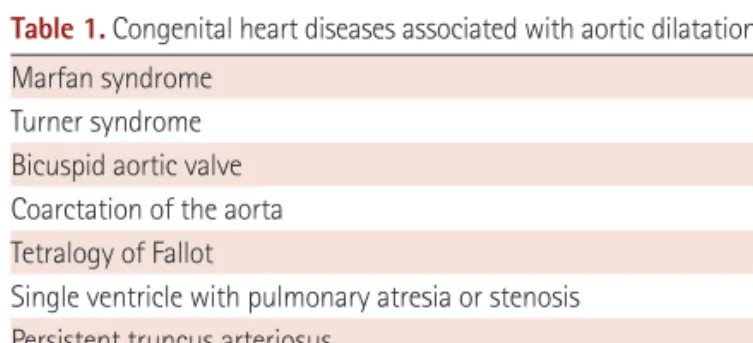
1)2) Aortic dilation in Marfan syndrome, Turner syndrome, bicuspid aortic valve (BAV), and coarctation of the aorta is well recognized; these disorders are associated consistently with ascending aortic and/or para-coarcta- tion medial abnormalities.
2)3) CHD such as single ventricle, persistent truncus arteriosus, transposition of the great arteries, hypoplastic left heart syndrome, and tetralogy of Fallot (TOF) are associated with aortic medial abnormalities, aortic dilatation, and aortic regurgita-
Print ISSN 1738-5520 • On-line ISSN 1738-5555
Aortopathy in Congenital Heart Disease in Adults: Aortic Dilatation with Decreased Aortic Elasticity that Impacts Negatively
on Left Ventricular Function
Koichiro Niwa, MD
Department of Cardiology and Adult CHD Program, Cardiovascular Center, St Luke’s International Hospital, Tokyo, Japan
Bicuspid aortic valve and/or coarctation of the aorta are consistently associated with ascending aortic and para-coarctation medial ab- normalities. Medial abnormalities in the ascending aorta are prevalent in other types of patients with a variety of forms congenital heart disease (CHD), such as single ventricle, persistent truncus arteriosus, transposition of the great arteries, hypoplastic left heart syndrome, te- tralogy of Fallot. These abnormalities encompass a wide age range, and may predispose to dilatation, aneurysm, and rupture that necessi- tates aortic valve and root surgery. This dilatation can develop in CHD patients without stenotic region. These CHDs exhibit ongoing dilatation of the aortic root and reduced aortic elasticity and increased aortic stiffness that may relate to intrinsic properties of the aortic root. The concept of aortic dilatation is shifting a paradigm of aortic dilatation, as so called post stenotic dilatation, to primary intrinsic aortopahy. These aortic dilatation and increased stiffness can induce aortic aneurysm, rupture of the aorta and aortic regurgitation, but also provoke left ventricular hypertrophy, reduced coronary artery flow and left ventricular failure. We can recognize this association of aortic pathophysiological abnor- mality, aortic dilation and aorto-left ventricular interaction as a new clinical entity: “aortopathy”. (Korean Circ J 2013;43:215-220) KEY WORDS: Aortic disease; Congenital heart defects; Cystic medial necrosis of aorta; Tetralogy of fallot.
Correspondence: Koichiro Niwa, MD, Department of Cardiology and Adult CHD Program, Cardiovascular Center, St Luke’s International Hospital, 9-1 Akashi-cho, Chuo-ku, Tokyo 104-8560, Japan
• The author has no financial conflicts of interest.
This is an Open Access article distributed under the terms of the Creative Commons Attribution Non-Commercial License (http://creativecommons.
org/licenses/by-nc/3.0) which permits unrestricted non-commercial use, distribution, and reproduction in any medium, provided the original work is properly cited.
tion (AR).
1) Aortic medial abnormalities-incorrectly called cystic medial necrosis-reach their severest form in Marfan syndrome, and are prevalent and qualitatively similar, but seldom quantitatively as marked, in a wide variety of CHDs with a wide age range.
1) These observations have led us to hypothesize that various types of CHD harbor an aortic medial abnormality that reflects a common devel- opmental fault leading to a weakened and attenuated aortic wall.
These CHDs with aortic dilatation are associated often with latent complications, which are decreased elasticity and increased stiff- ness of the aorta.
4-6) These aortic pathophysiological changes have a negative influence on the systemic ventricular systolic and diastolic functions, due to increased afterload and ventricular hypertrophy.
5)
In this review, we will discuss the aortic complications of CHD, em- phasizing their history, pathophysiology, and importance of the new clinical entity “aortopathy”.
Historical Perspective
In 1928, Maude Abbott, Montreal,
7) mentioned in her textbook on
CHD that the presence of a BAV appears to indicate, at least in a por-
tion of the cases in which it occurs, a tendency for spontaneous ru-
pture”. In 1972, McKusick
3) reported that the association of BAV and