• 검색 결과가 없습니다.

Utility of B-Type Natriuretic Peptide for Predicting Perioperative Cardiovascular Events in Patients Without History of Cardiovascular Disease Undergoing Major Non-Cardiac Surgery

N/A
N/A
Protected

Academic year: 2022

Share "Utility of B-Type Natriuretic Peptide for Predicting Perioperative Cardiovascular Events in Patients Without History of Cardiovascular Disease Undergoing Major Non-Cardiac Surgery"

Copied!
5
0
0

로드 중.... (전체 텍스트 보기)

전체 글

(1)

11

Open Access

Utility of B-Type Natriuretic Peptide for Predicting Perioperative Cardiovascular Events in Patients Without History

of Cardiovascular Disease Undergoing Major Non-Cardiac Surgery

Sung Eun Kim, MD, Dae-Gyun Park, MD, Jun Hee Lee, MD, Kyoo Rok Han, MD and Dong Jin Oh, MD Division of Cardiology, Department of Internal Medicine, Kangdong Sacred Heart Hospital,

Hallym University College of Medicine, Seoul, Korea ABSTRACT

Background and Objectives: Patients without previous history of cardiac disease can be regarded as low-risk when under- going major non-cardiac surgery. The aim of this study was to examine whether preoperative B-type natriuretic peptide (BNP) level predicted postoperative cardiac events in these patients. Subjects and Methods: Preoperative BNP level was measured in 163 patients whose risk was considered low according to the Revised Cardiac Risk Index. Postoperative cardiac events, including death during hospitalization, myocardial injury, arrhythmia, cerebrovascular accidents and congestive heart failure were assessed. Results: Postoperative cardiac events occurred in 8 patients (4.9%). Preoperative BNP levels were signifi- cantly higher among patients who experienced postoperative cardiac events, compared to those who did not (130.6±148.8 vs.

57.9±70.8 pg/mL, p=0.009). Conclusion: Preoperative BNP level may provide prognostic information in low-risk patients undergoing major non-cardiac surgery. (Korean Circ J 2011;41:11-15)

KEY WORDS: B-type natriuretic peptide; Perioperative care; Cardiovascular disease.

Received: February 19, 2010 Revision Received: May 3, 2010 Accepted: May 31, 2010

Correspondence: Dae-Gyun Park, MD, Division of Cardiology, Depart- ment of Internal Medicine, Kangdong Sacred Heart Hospital, Hallym Uni- versity College of Medicine, 445 Gil 1-dong, Gangdong-gu, Seoul 134- 701, Korea

Tel: 82-2-2224-2924, Fax: 82-2-2224-2402 E-mail: [email protected]

• The authors have no financial conflicts of interest.

cc
This is an Open Access article distributed under the terms of the Cre- ative Commons Attribution Non-Commercial License (http://creativecom- mons.org/licenses/by-nc/3.0) which permits unrestricted non-commer- cial use, distribution, and reproduction in any medium, provided the origi- nal work is properly cited.

Introduction

Perioperative mortality and morbidity associated with ma- jor non-cardiac surgery are strongly related to cardiac complic- ations, such as myocardial infarction, stroke, unstable angina, pulmonary edema and serious arrhythmia. Many studies have identified clinical predictors of adverse cardiac events, includ- ing age, type of surgery, diabetes, congestive heart failure and previous history of angina or myocardial infarction.

1-3)

Poor left ventricular (LV) systolic dysfunction is also a known pre- dictor of perioperative cardiac events.

4)

If a cardiology consultation is requested for patients with kn- own cardiac disease, intensive cardiac assessment may be per- formed according to the guidelines on perioperative cardio- vascular evaluation.

5)

However, the evaluation steps or tools for risk stratification in patients with other risk factors, such as old age, diabetes and scheduled major non-cardiac surgery, which carries a 1-5% risk of cardiac events, have not been comprehensively studied. Moreover, symptoms of heart dis- ease may be absent or blunted, especially in elderly or diabetic patients, and clinical evaluation alone may not be sufficient to stratify risks. Biomarkers readily available for testing, may assist with risk stratification and guide surgeons and patients in their evaluation surgical risks.

B-type natriuretic peptide (BNP) levels correlate with prog- nosis in patients with cardiac disease

6-9)

and may be useful in risk stratification of patients undergoing non-cardiac sur- gery.

10-14)

Left ventricular systolic dysfunction is correlated with elevated BNP levels, and is a known predictor of periopera- tive cardiac events.

The purpose of this study was to assess whether BNP levels

predicted perioperative cardiac events in patients who had no

previous history of cardiac diseases, such as congestive heart

failure, angina, or myocardial infarction.

(2)

Subjects and Methods

The study was a prospective, single-center, observational co- hort study of consecutive patients undergoing major sched- uled non-cardiac surgery. Major non-cardiac surgery was de- fined as major gastrointestinal surgery (laparotomy, thoraco- laparotomy), major orthopedic surgery and other major open surgery (gynecologic and urologic surgery). The risk of cardi- ac events was calculated using the Lee’s Cardiac Risk Index, which is a standardized, validated clinical scoring system bas- ed on the presence of 6 clinical variables: high-risk surgery, history of ischemic heart disease, congestive heart failure, ce- rebrovascular disease, insulin therapy for diabetes mellitus and preoperative serum creatinine >2mg/dL.

15)

Patients with a risk index score of 0 or 1 have complication rates of 0.4-0.9%.

Such patients were regarded as low-risk. Exclusion criteria in- cluded previous history of congestive heart failure, angina, or myocardial infarction, LV ejection fraction less than 50% and creatinine level ≥2.0 mg/dL.

Data collection

Preoperative data collection included a 12-lead electrocar- diography (ECG) recording, echocardiography, clinical char- acteristics, medical and surgical history, preoperative medica- tions and renal and hepatic functions. Preoperative blood samples were also obtained for plasma BNP levels. The mean time of venous sampling before surgery was 3±8 days. All pa- tients underwent standard 2-dimensional and doppler echo- cardiographic examination with assessment of ventricular sys- tolic and diastolic function.

The left atrial (LA) volume was calculated using the formula for an ellipsoid:

LA volume (mL)=Π/6 (D1×D2×D3)

where D1, D2, and D3 are the parasternal long axis, supero- inferior, and medio-lateral measurements, respectively, of the LA at end-systole. The LA volume index was calculated as LA volume/body surface area. LV mass was calculated using guidelines recommended by the American Society of Echo- cardiography, and left ventricular mass index (LVMI) was calculated as LV msss/body surface area.

Postoperative data collection included a 12-lead ECG re- cording, chest radiograph, symptoms suggestive of myocar- dial ischemia or congestive heart failure after surgery and dea- th during hospitalization.

Study end-points

The composite end-point was death, postoperative myo- cardial injury {cardiac troponin I (cTnI) >0.32 ng/mL

-1

, with- out preoperative cTnI elevation}, ECG evidence of acute myo- cardial ischemia or arrhythmia, cerebrovascular accident and congestive heart failure. ECG evidence of ischemia was de- fined as the development of new, postoperative T-wave in-

version 2 mm and ST segment deviation 2 mm in at least two contiguous chest leads, or 1 mm in at least two contiguous limb leads. Arrhythmia was defined as a new, sustained, abnor- mal cardiac rhythm. Congestive heart failure was diagnosed by physical examination and chest radiograph.

Assays

Plasma BNP was measured using the Bayer ADVIA Cen- taur

TM

immunoassay (Bayer Healthcare LLC, Diagnostic Di- vision, Leverkusen, Germany) before an operation.

Statistical analyses

Continuous data with a normal distribution are expressed as mean±standard deviation, and were compared using the Student’s t-test. Categorical data are presented as percentage frequencies, and differences between proportions were com- pared using the chi-square test with Yates’ correction. Receiv- er-operating characteristic (ROC) curve analysis was perform- ed to calculate sensitivity, specificity and the area under the cur- ve to select a cut-off value to predict perioperative cardiovas- cular events. Multivariate analysis was conducted to determine factors related to perioperative cardiovascular complications.

The variables were selected according to significant univari- ate analysis, and odds ratios were given with 95% confidence intervals (CI). For continuous variables, the median value was used as a cut-off point to determine perioperative adverse events.

For all tests, a p less than 0.05 (2-tailed) was considered sta- tistically significant. All analyses were performed using Sta- tistical Package for the Social Sciences (SPSS) version 13.0 statistical software (SPSS, Inc., Chicago, IL, USA).

Results

Patient characteristics

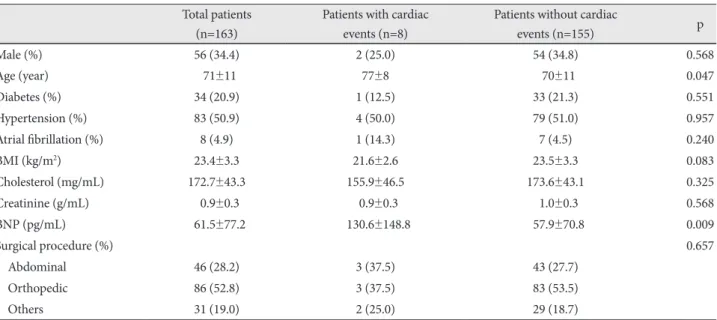
One hundred sixty-three patients met the inclusion crite- ria for the study. Table 1 describes the clinical characteristics of the study population. The mean patient age was 71 years old. The age of patients with cardiac events was significantly higher than that of patients without cardiac events (77±8 vs.

70±11, p=0.047).

Postoperative events

Postoperative cardiac events occurred in 8 patients (4.9%):

5 congestive heart failures, 1 myocardial injury, 2 unstable an- ginas and 2 strokes. There was no cardiac death.

Plasma B-type natriuretic peptide concentrations The mean preoperative BNP level was 61.5±77.2 pg/mL.

Preoperative BNP levels were significantly higher among pa-

tients who experienced postoperative cardiac events (Table 1)

(Fig. 1). Preoperative BNP predicted perioperative cardio-

vascular events with an area under the receiver operator char-

(3)

acteristic curve of 0.76 (95% CI 0.63-0.89, p=0.014). The op- timal cut-off point derived from this curve was 64.5 pg/mL.

This had a sensitivity of 75% and a specificity of 75% (Fig. 2).

Echocardiographic data

The mean LV ejection fraction was 61.5±6.7%. LA volume index was significantly higher in patients who experienced postoperative cardiac evenst than in patients who did not (33.3±23.0 vs. 22.1±7.1, p<0.0001) (Table 2).

Univariate and multivariate analysis

From univariate analysis, the presence of atrial fibrillation and LA volume index were significant predictors of postoper- ative cardiac events. However, when preoperative BNP levels were included, the presence of atrial fibrillation and LA vol- ume index were no longer statistically significant. BNP great- er than 64.5 pg/mL did not reach statistical significance, but there was a trend for BNP to provide independent prognostic information (p=0.086).

Table 1. Baseline clinical characteristics of the study cohort Total patients

(n=163)

Patients with cardiac events (n=8)

Patients without cardiac

events (n=155) p

Male (%) 56 (34.4) 2 (25.0) 54 (34.8) 0.568

Age (year) 071±11 77±8 070±11 0.047

Diabetes (%) 34 (20.9) 1 (12.5) 33 (21.3) 0.551

Hypertension (%) 83 (50.9) 4 (50.0) 79 (51.0) 0.957

Atrial fibrillation (%) 8 (4.9) 1 (14.3) 7 (4.5) 0.240

BMI (kg/m

2

) 23.4±3.3 21.6±2.6 23.5±3.3 0.083

Cholesterol (mg/mL) 172.7±43.3 155.9±46.5 173.6±43.1 0.325

Creatinine (g/mL) 00.9±0.3 00.9±0.3 01.0±0.3 0.568

BNP (pg/mL) 061.5±77.2 0130.6±148.8 057.9±70.8 0.009

Surgical procedure (%) 0.657

Abdominal 46 (28.2) 3 (37.5) 43 (27.7)

Orthopedic 86 (52.8) 3 (37.5) 83 (53.5)

Others 31 (19.0) 2 (25.0) 29 (18.7)

BMI: body mass index, BNP: B-type natriuretic peptide

Fig. 1. A comparison of preoperative BNP levels in patients who experienced a postoperative cardiac event (Y) with those who did not (N). Central lines represent medians, boxes represent 25th and 75th percentiles and whiskers represent ranges. BNP: B-type natriuretic peptide.

500.00 400.00 300.00 200.00 100.00 0.00

Outcome

BN P (p g/ m L)

N Y

** *

* *

Fig. 2. Receiver operator characteristic curve for preoperative B- type natriuretic peptide levels predicting an early postoperative car- diac event. Area under the curve=0.76 (95% confidence interval=

0.63-0.89, p=0.014). ROC: receiver-operating characteristic.

1.0 0.8 0.6 0.4 0.2

0.0

1-specificity ROC curve

Se ns iti vi ty

0.0 0.2 0.4 0.6 0.8 1.0

Table 2. Baseline echocardiographic data of study cohort Patients with

cardiac events (n=8)

Patients without cardiac events

(n=155)

p

LVEF (%) 58.7±7.3 61.7±6.6 0.338

LA (mm) 039.0±10.8 35.6±5.8 0.409

LAVI (mL/m

2

) 042.0±31.7 22.3±7.3 <0.0001

LVM (g) 237.3±58.4 195.5±54.4 0.069

LVMI (g/m

2

) 161.8±44.6 124.1±33.5 0.094

e/e’ 14.7±6.1 12.7±4.0 0.516

LVEF: left ventricular ejection fraction, LA: left atrium, LAVI: left

ventricular volume index, LVM: left ventricular mass, LVMI: left

ventricular mass index

(4)

Discussion

Patients with no previous history of cardiac disease and nor- mal LV systolic function can be regarded as low-risk for de- veloping cardiac events during major non-cardiac surgery. In our study, however, a risk did exist (4.9%), although life-th- reatening cardiac events did not happen. Preoperative BNP levels were higher in patients who suffered postoperative car- diac events, which suggests that preoperative BNP level may provide prognostic information in patients no cardiac history.

Prior studies

Efforts to identify patients at increased cardiac risks when undergoing non-cardiac surgery have led to the development of a variety of scoring systems.

1-3)

In a multi-center study com- paring several of these risk stratification indices, the areas un- der the ROC curves ranged from 0.60 to 0.64.

16)

Lee et al.

15)

indicated that an area under the ROC curve of 0.76 for the ability of the Revised Cardiac Risk Index to identify patients who experience a postoperative cardiac event. Nevertheless, our data suggest that BNP has a useful role in risk prediction in this setting. We recognize, however, that the CI around the area under the ROC curve value of 0.63 was wide (0.59-0.83), and larger studies are required to provide more precise estimates.

B-type natriuretic peptide for the prediction of perioperative cardiac events

There are several reasons to support how BNP may predict cardiac events in this setting. BNP level is known to have pre- dictive ability for cardiac events, such as heart failure, atrial fi- brillation, stroke and coronary heart disease. Although a con- centration of 100 pg/mL is widely accepted as the threshold to diagnose heart failure, excess risk exists at BNP levels well below this threshold.

7)17)

We hypothesize that some patients scheduled for major surgery may have subclinical diastolic heart failure or ischemic heart disease. As such, preoperative BNP levels may reflect their underlying cardiovascular sta- tus. In our study, the BNP level was lower than that reported in other studies, probably because all patients had an ejection fraction greater than 50%.

10)12)

Left atrial volume index and perioperative cardiac events

LA enlargement is traditionally considered a risk factor for atrial fibrillation, stroke and death in various clinical set- tings.

18-21)

Furthermore, it may be an early sign of hyperten- sive heart disease in patients with no other discernible cause of LA enlargement.

22)23)

Approximately 50% of our patients were hypertensive, so LA volume index may reflect their un- derlying hypertensive heart disease status. However, the clini- cal significance of this finding remains to be elucidated in fu- ture studies.

Study limitations

This was a small study with limited statistical power. The lack of blinding substantially confounded the results because clinicians used the results of BNP measurements to manage patients. As such, treatment bias was unavoidable. Surgical complications or incidences related to surgical procedures can influence the occurrence of serious cardiac events. However, these were not taken into consideration. Finally, our cohort was heterogeneous. For instance, it included patients under- going major abdominal surgery and hip surgery. Neverthe- less, the predictive value of BNP concentration must demon- strate sensitivity and specificity in such diverse clinical situ- ations to prove its clinical usefulness.

Conclusion

Pre-operative BNP levels were significantly higher among patients who experienced postoperative cardiac events than those who did not. Perioperative BNP levels may provide prognostic information on the risk of cardiac events in patients undergoing major non-cardiac surgery.

REFERENCES

1) Goldman L, Caldera DL, Nussbaum SR, et al. Multifactorial index of cardiac risk in noncardiac surgical procedures. N Engl J Med 1977;

297:845-50.

2) Detsky AS, Abrams HB, Forbath N, Scott JG, Hilliard JR. Cardiac assessment for patients undergoing noncardiac surgery: a multifacto- rial clinical risk index. Arch Intern Med 1986;146:2131-4.

3) Goldman L. Multifactorial index of cardiac risk in noncardiac surgery:

ten-year status report. J Cardiothorac Anesth 1987;1:237-44.

4) Halm EA, Browner WS, Tubau JF, Tateo IM, Mangano DT. Echocar- diography for assessing cardiac risk in patients having noncardiac sur- gery: study of perioperative ischemia research group. Ann Intern Med 1996;125:433-41.

5) Eagle KA, Berger PB, Calkins H, et al. ACC/AHA guideline update for perioperative cardiovascular evaluation for noncardiac surgery: exec- utive summary a report of the American College of Cardiology/Ameri- can Heart Association Task Force on Practice Guidelines (committee to update the 1996 guidelines on perioperative cardiovascular evalu- ation for noncardiac surgery). Circulation 2002;105:1257-67.

6) de Lemos JA, Morrow DA, Bentley JH, et al. The prognostic value of B-type natriuretic peptide in patients with acute coronary syndromes.

N Engl J Med 2001;345:1014-21.

7) Wang TJ, Larson MG, Levy D, et al. Plasma natriuretic peptide lev- els and the risk of cardiovascular events and death. N Engl J Med 2004;

350:655-63.

8) Choe HM, Yoo BS, Ryu HY, et al. The early changing pattern of the B-type natriuretic peptide concentration and its significance as a prog- nostic marker after acute myocardial infarction. Korean Circ J 2006;

36:526-34.

9) Chung IH, Yoo BS, Ryu HY, et al. The relationship between the early follow-up BNP level and congestive status or prognosis in acute heart failure. Korean Circ J 2006;36:200-7.

10) Dernellis J, Panaretou M. Assessment of cardiac risk before non-cardi- ac surgery: brain natriuretic peptide in 1590 patients. Heart 2006;92:

1645-50.

11) Feringa HH, Bax JJ, Elhendy A, et al. Association of plasma N-termi-

nal pro-B-type natriuretic peptide with postoperative cardiac events in

patients undergoing surgery for abdominal aortic aneurysm or leg by-

pass. Am J Cardiol 2006;98:111-5.

(5)

12) Cuthbertson BH, Amiri AR, Croal BL, et al. Utility of B-type natriure- tic peptide in predicting perioperative cardiac events in patients under- going major non-cardiac surgery. Br J Anaesth 2007;99:170-6.

13) Cuthbertson BH, Card G, Croal BL, McNeilly J, Hillis GS. The utility of B-type natriuretic peptide in predicting postoperative cardiac events and mortality in patients undergoing major emergency non-cardiac sur- gery. Anaesthesia 2007;62:875-81.

14) Gibson SC, Payne CJ, Byrne DS, Berry C, Dargie HJ, Kingsmore DB.

B-type natriuretic peptide predicts cardiac morbidity and mortality af- ter major surgery. Br J Surg 2007;94:903-9.

15) Lee TH, Marcantonio ER, Mangione CM, et al. Derivation and pro- spective validation of a simple index for prediction of cardiac risk of major noncardiac surgery. Circulation 1999;100:1043-9.

16) Gilbert K, Larocque BJ, Patrick LT. Prospective evaluation of cardi- ac risk indices for patients undergoing noncardiac surgery. Ann Intern Med 2000;133:356-9.

17) Daniels LB, Maisel AS. Natriuretic peptides. J Am Coll Cardiol 2007;

50:2357-68.

18) Vaziri SM, Larson MG, Benjamin EJ, Levy D. Echocardiographic pre- dictors of nonrheumatic atrial fibrillation: the Framingham Heart St- udy. Circulation 1994;89:724-30.

19) Benjamin EJ, D’Agostino RB, Belanger AJ, Wolf PA, Levy D. Left atrial size and the risk of stroke and death: the Framingham Heart Study. Circulation 1995;92:835-41.

20) Laukkanen JA, Kurl S, Eranen J, Huttunen M, Salonen JT. Left atrium size and the risk of cardiovascular death in middle-aged men. Arch In- tern Med 2005;165:1788-93.

21) Bayes-Genis A, Vazquez R, Puig T, et al. Left atrial enlargement and NT-proBNP as predictors of sudden cardiac death in patients with he- art failure. Eur J Heart Fail 2007;9:802-7.

22) Miller JT, O’Rourke RA, Crawford MH. Left atrial enlargement: an early sign of hypertensive heart disease. Am Heart J 1988;116:1048-51.

23) Tsioufis C, Stougiannos P, Taxiarchou E, et al. The interplay between

haemodynamic load, brain natriuretic peptide and left atrial size in the

early stages of essential hypertension. J Hypertens 2006;24:965-72.

수치

Table 1. Baseline clinical characteristics of the study cohort Total patients

참조

관련 문서