• 검색 결과가 없습니다.

The Effect of Doubling the Statin Dose on Pro-Inflammatory Cytokine in Patients With Triple-Vessel Coronary Artery Disease

N/A
N/A
Protected

Academic year: 2022

Share "The Effect of Doubling the Statin Dose on Pro-Inflammatory Cytokine in Patients With Triple-Vessel Coronary Artery Disease"

Copied!
5
0
0

로드 중.... (전체 텍스트 보기)

전체 글

(1)

Korean Circulation Journal

Introduction

Growing evidence supports the role of statins in local and syste- mic inflammation with respect to common pathophysiology in the

Print ISSN 1738-5520 • On-line ISSN 1738-5555

The Effect of Doubling the Statin Dose on Pro-Inflammatory Cytokine in Patients With Triple-Vessel Coronary Artery Disease

Yoo Ri Kim, MD 1 , Jae Hong Park, MD 2 , Hye-Jin Lee, MD 3 , Wouk Bum Pyun, MD 4 , and Si-Hoon Park, MD 4

1

Department of Cardiology, University of Ulsan College of Medicine, Asan Medical Center, Seoul,

2

Department of Cardiology, Han-Il General Hospital, Seoul,

3
Departments of Endocrinology and

4

Cardiology, Ewah Womans University School of Medicine, Ewha University Medical Center, Seoul, Korea

Background and Objectives: Statin prevents atherosclerotic progression and helps to stabilize the plaque. According to a recent study, statin reduces inflammation in blood vessels. However, it has not been demonstrated to have any anti-inflammation reaction in patients who have been diagnosed as having a triple-vessel coronary artery disease (CAD).

Subjects and Methods: This study included a total of thirty (30) patients who had been diagnosed by coronary angiogram as having a triple-vessel CAD. Patients who already had been taking statin were given doubled dosage. An interview, physical examination and blood test were performed at the beginning of this study and three months later.

Results: After doubling the dose of statin, there was no statistically significant decrease in total cholesterol, low density lipoprotein-cho- lesterol, (increase in) high density lipoprotein-cholesterol and triglyceride in the blood test. C-reactive protein (CRP), an acute phase reac- tant, significantly decreased from 0.34 mg/dL at the beginning of the study to 0.12 mg/dL at the end of study (p<0.01). The interleukin-6 concentration also significantly decreased from 8.55 pg/dL to 4.81 pg/dL (p<0.001). No major cardiovascular events occurred and the dosage regimen was not modified during the close observation period. There was no difference in the symptoms of angina pectoris, estab- lished by World Health Organization Angina Questionnaires, before and after the dose increase. Liver enzymes remained within normal range with no significant increase before and after conducting this study.

Conclusion: Doubling the dose of statin alone significantly lowers pro-inflammatory cytokine concentration, which is closely related to the potential acute coronary syndrome, and CRP, a marker of vascular inflammation. (Korean Circ J 2012;42:595-599)

KEY WORDS: Statin; C-reactive protein; Interleukin-6.

Received: November 3, 2011 Revision Received: February 1, 2012 Accepted: March 15, 2012

Correspondence: Si-Hoon Park, MD, Department of Cardiology, Ewha Womans University School of Medicine, 1071 Anyangcheon-ro, Yangcheon- gu, Seoul 158-710, Korea

Tel: 82-2-2650-5019, Fax: 82-2-2655-2076 E-mail: [email protected]

• The authors have no financial conflicts of interest.

This is an Open Access article distributed under the terms of the Creative Commons Attribution Non-Commercial License (http://creativecommons.

org/licenses/by-nc/3.0) which permits unrestricted non-commercial use, distribution, and reproduction in any medium, provided the original work is properly cited.

atherosclerotic progression of the plaque.

1)

Circulating inflammatory biomarkers such as C-reactive protein

(CRP) and interleukin-6 (IL-6) are moderately associated with a risk

of coronary heart disease events.

2)

These inflammatory biomarkers

independently predict further vascular events in healthy people wi-

thout hyperlipidemia. A recently published study an association

between CRP and stable coronary disease regardless of low density

lipoprotein-cholesterol (LDL-C) levels.

3)

However, the therapeutic

dose and duration of statin as an anti-inflammatory have been lit-

tle studied. Previous evidence regarding the effect of statins across

differing regimens on future cardiac events in high risk patients with

advanced coronary disease are inadequate. The objective of this

study was to document changes of the inflammatory biomarkers af-

ter doubling the dose of statin in high risk patients who had been di-

agnosed by coronary angiography as having a triple-vessel coronary

artery disease (CAD).

(2)

Subjects and Methods

Study design

This study included thirty (30) patients who were recruited from Ewha Womans University Mokdong Hospital from May 2008 to January 2009 and had been diagnosed by coronary angiography as having a triple-vessel CAD at least a year prior to the enrollment.

Patients with these coronary arterial lesions were either not treat- able by current angioplasty techniques or refused to undergo coro- nary artery interventions. All patients were already taking a statin.

The exclusion criteria included myocardial infarction, unstable angina, stroke and any other vascular episodes within six months, and lack of previous statin use. Thirty patients were followed up for three months after doubling the dose of statin. Nineteen patients had been taking atorvastatin 10 mg and the dose was increased to 20 mg. One patient had been taking atorvastatin 20 mg and the dose was increased to 40 mg. Five patients had been taking pravas- tatin 40 mg and the dose was increased to 80 mg. The others have been taking pitavastatin 2 mg and the dose was increased to 4 mg.

At each visit, blood pressure, heart rate, weight and height were measured while their concurrent medications in addition to statin were verified. The primary end point was the concentration change of CRP or IL-6. The secondary end points were major cardiac adverse events such as death, myocardial infarction, stroke, any revascul- arization and typical anginal symptoms, as assessed by the WHO Angina Questionnaire.

4)5)

Laboratory aspects

Lipid serum levels, CRP, IL-6, creatinine and liver enzymes were measured. The creatinine clearance was calculated from serum creatinine values by using the Modification of Diet in Renal Dis- ease equation.

6)

IL-6 was assayed on the saved ultra-low tempera- ture freezer in 2009, using a high sensitivity Enzyme-linked immu- nosorbent assay (R&D systems, Minneapolis, MN, USA). Sampling was performed with a sensitivity of less than 0.16 pg/mL before and after doubling the dose of statin.

C-reactive protein levels were measured immediately after sam- pling by using an automated particle-enhanced turbid metric im- munoassay (Hitachi, Tokyo, Japan) with a sensitivity of <0.03 mg/dL.

All samples were processed by technicians who were not informed of the clinical data.

Statistical analysis

The Statistical Package for the Social Sciences (SPSS) 16.0 soft- ware (SPSS, Chicago, IL, USA) was used for data analysis.

Continuous variables were expressed as the mean±standard de- viations while categorical variables were stated as numbers and pro-

portions (%). This single group investigation involved tests taken be- fore and after change in dosage regimen. In order to demonstrate the effect of statin therapy on inflammatory biomarkers, paired sam- ple t-tests were applied to continuous variables of the lipid profiles, inflammatory markers, body mass index and the levels of liver enzym- es. A p of less than 0.05 was considered statistically significant.

Results

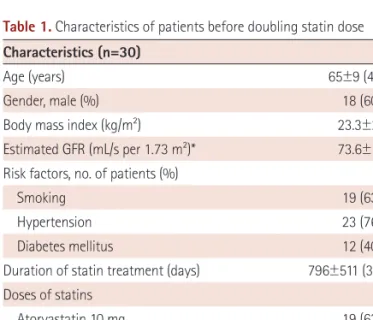
Demographic and other information of patients in this study are summarized in Table 1. The mean age was sixty-five years old and 60% of these patients were males. Cardiovascular disease risk fac- tors in these patients are smoking (63%), hypertension (23%) and diabetes mellitus (40%). The changes of serum lipid levels are shown in Table 2. The mean total cholesterol, LDL-C, high density lipopro- tein-cholesterol and triglyceride did not change significantly after doubling the dose of statin.

The safety and clinical profiles are shown in Table 3. There were no major adverse cardiac events and only two patients had chest discomfort during this study. The patients who had replied posi- tively to the WHO Angina Questionnaires before the study, did not change their answers when they were asked again at the end of the study. The mean alanine aminotransferase level was in the normal range before and after doubling the dose of statin.

Mean body mass index was changed from 23.3 kg/m

2

to 23.2 kg/m

2

, and was not statistically significant. The average CRP concentra- tion decreased from 0.34 mg/dL at the beginning to 0.12 mg/dL at the end of the study after three months (p<0.01). The mean IL-6

Table 1. Characteristics of patients before doubling statin dose Characteristics (n=30)

Age (years) 65±9 (45-86)

Gender, male (%) 18 (60.0)

Body mass index (kg/m

2

) 23.3±2.6

Estimated GFR (mL/s per 1.73 m

2

)* 73.6±18.0 Risk factors, no. of patients (%)

Smoking 19 (63.3)

Hypertension 23 (76.7)

Diabetes mellitus 12 (40.0)

Duration of statin treatment (days) 796±511 (367-2240) Doses of statins

Atorvastatin 10 mg 19 (63.3)

Atorvastatin 20 mg 1 (3.3)

Pravastain 40 mg 5 (16.7)

Pitavastain 2 mg 5 (16.7)

*Calculated from the serum creatinine value by using the Modification of

Diet in Renal Disease equation.

6)

GFR: glomerular filtration rate

(3)

level decreased from 8.55 pg/dL at the beginning of the study to 4.81 pg/dL at the end of the study (p<0.001).

Doubling the dose of statin was associated with a 63% reduction in CRP and 43% reduction in IL-6 in three (3) months (p<0.01) (Fig. 1).

Concurrent medications prescribed, along with statins, were anti platelet agents, nitrates, beta-blockers, angiotensin converting en- zyme inhibitors or angiotensin-receptor II blockers, calcium chan- nel blockers and diuretics in a decreasing order. Regular medications were continued with statin administration for the duration of this study.

The proportion of patients receiving anti-angina medications such as nitrates and beta blockers was similar in both groups at the beginning and at the end of this study. However, in most cases, the nitrate prescribed was only nitroglycerin to be taken as needed.

Discussion

The role of inflammation in the pathogenesis of atherosclerotic co- ronary disease has been extensively investigated over the last twenty years.

7)

The balance of pro-inflammatory and anti-inflammatory agents may determine the vascular health or illness.

The most extensively studied and controversial topic has been the high-sensitivity CRP, an acute phase reactant.

8)9)

Multiple studies, including several meta-analyses, have demonstrated CRP to be an independent predictor of cardiovascular risks.

10)

Among numerous circulating inflammatory biomarkers, IL-6 has been found to be a moderate indicator for 1) acute coronary syndrome and 2) aug- mented risk for cardiovascular diseases like Type-2 diabetes melli- tus.

8)

IL-6 has a pleiotropic effect and affects systemic inflamma- tions through its actions on hematopoiesis and many cell types of the immune system. IL-6 is perhaps one of the major factors that induce acute phase reactants such as CRP from the liver. IL-6 is im- plicated in the activation of the endothelium and promotes the development of functional and structural vascular changes. It con- tributes to atherogenesis and plaque vulnerability.

11)

A significant decrease in CRP or IL-6 in patients treated with an increased statin dosage regimen was evident in this study. Patients with a triple-vessel CAD are at high risk of future adverse vascular Table 2. Changes of lipid and biomarker level before and after doubling dose

of statin

Lipid (mg/dL)

Doubling dose of statin Before After

Mean Mean ΔChange p 95% CI

Total cholesterol 156±39 149 ±32 -7 0.270 -6.01-21.08

LDL-C 83±20 77±20 -6 0.110 -1.64-14.71

HDL-C 42±10 45±14 +2 0.070 -6.15-0.22

Triglycerides 134±60 124±68 -10 0.280 -9.24-30.98 CRP (mg/dL) 0.34±0.41 0.12±0.14 -0.2 0.004 0.07-0.35 IL-6 (pg/dL) 8.55±3.98 4.81±2.58 -3.7 <0.001 1.97–5.51 HDL-C: high density lipoprotein-cholesterol, LDL-C: low density lipoprotein- cholesterol, CI: confidence interval, CRP: C-reactive protein, IL-6: interleu- kin-6

Table 3. Safety and clinical profiles before and after doubling dose of statin Properties

Before doubling dose of statin

(n=30)

After doubling dose of statin

(n=30)

p

Mean, ALT (IU/L) 19±4 20±7 0.91

MACE

Death 0

MI 0

Stroke 0

Any revascularization 0

Positive angina

questionnaire (%)

2 (3.3) 2 (3.3)* 1.00

Body mass index (kg/m

2

) 23.3±2.6 23.2±2.6 0.26

*Same patients before doubling dose of statin,

Quantification of the WHO Angina Questionnaire.

4)5)

ALT: alanine aminotrasferase, MACE: major ad- verse cardiac event, MI: myocardial infarction

Fig. 1. Changes of C-reactive protein (A) and Interleukin-6 (B) concentrations before and after doubling the statin dose. *p<0.001,

p<0.01 denotes that the reduction was significantly different before and after doubling the dose of statin therapy.

9.00 8.00 7.00 6.00 5.00 4.00 3.00 2.00 1.00 0.00

0.40 0.35 0.30 0.25 0.20 0.15 0.10 0.05 0.00

Interleukin-6 (pg/dL) C-reactive protein (mg/dL)

Before doubling dose of statin Before doubling dose of statin

8.55

0.34

4.81*

0.12

After doubling dose of statin After doubling dose of statin

A   B  

(4)

events. To the best of our knowledge, no other study to date has ex- amined pro-inflammatory cytokine IL-6 and acute phase reactant CRP, evaluating systemic inflammation in this setting. We found that doubling the doses of statin significantly decreased the concentra- tions of CRP and IL-6, but without significant lipid level change.

Statins have been recognized for having anti-inflammatory and antioxidant properties. Other studies suggested that these so-called

‘pleiotropic’ effects might account for some of the benefits of st- atins beyond the aspect of lowering the LDL-C level.

12)13)

The Measurement of CRP for the targeting of statin therapy in the primary prevention of acute coronary events trial demonstrated a re- duction in CRP {74%; 95% confidence interval (CI) 71-75, p<0.001}, independent of initial LDL-C level in a high-dose atorvastatin group.

14)

In the pre-specified analysis of the A to Z trial of a recent report, the lower levels of achieved CRP in 30 days and in 4 months were found to be independently associated with improved long-term survival.

Indeed, patients with CRP levels greater than 0.3 mg/dL had more than a three-fold higher risk of death {hazard ratio (HR) 3.7; 95%

CI 1.9-7.2}. However, patients with CRP levels of 0.1-0.3 mg/dL had a greater than a two-fold higher risk of death (HR 2.3; 95% CI 1.2- 4.6) when compared with patients with CRP <0.1 mg/dL.

15)

The sub-analysis of the Pravastatin or Atorvastatin Evaluation and Infection Therapy-Thrombolysis in Myocardial Infarction 22 tri- al demonstrated that patients who achieved lower CRP levels re- gardless of achieved LDL-C levels had better clinical outcomes than those with elevated CRP.

16)

Consequently, our data showed that simply doubling the dose of statin not only significantly reduced the CRP concentrations, but also dramatically decreased the concentrations of IL-6, a pro-in- flammatory cytokine. Recent investigations have indicated that vari- ous biomarkers, such as inflammatory cytokines, cellular adhesion molecules and acute phase reactants are closely related to plaque destabilization and rupture.

17)

These biomarkers might provide an earlier indication of overall patient risks and aid in identifying pa- tients with a higher risk of having adverse events.

9)

Statins promote the potent systemic anti-oxidant effect through suppression of the distinct oxidation pathways.

13)

This study could help clarify the role of statin in systemic vascular inflammation and atherosclerosis, but several limitations should be noted. First, patients subjected to this study were composed large- ly of older patients over 60 years old and the results might not be pertinent to other age groups.

Second, this study had a relatively small number of patients who satisfied tight inclusion and exclusion criteria and did not have a control group that maintained the baseline initial dose of statin. Thus, taking measurements of CRP and IL-6 in a group with a single dos- age regimen would most likely be biased. As well, it explains that the

change of LDL-C was 6% which is consistent with the well known ef- fect of statin dose doubling but statistically insignificant in this study.

Third, this study had short-term follow-ups of only three months.

Major adverse cardiovascular events did not occur in these patients.

It might be due to insufficient time to observe adverse events . With respect to safety, the risk of statin-associated increased liver enzymes and in turn liver damage or rhabdomyolysis may not be related to the extent of LDL-C lowering. However, the risk of cancer might be significantly associated with lower achieved LDL-C levels.

18)

In our study, neither rhabdomyolysis nor elevated liver enzymes were noted. Owing to short study duration, the long-term effects of the treatment could not be proven relative to cancer risks. A large clinical study showed that additional clinical benefits could be achieved by more aggressively treating older patients with a coro- nary heart disease in an effort to reduce LDL-C levels at less than 100 mg/dL. Furthermore, their findings supported the use of inten- sive LDL-C lowering therapy in high-risk older patients with an es- tablished cardiovascular disease.

19)

Until the results of additional long-term trials in a larger number of patients become available, aggressive lipid lowering with a high- dose statin regimen appears to be as safe and effective as the st- andard care in triple-vessel CAD which could not be treated by an- gioplasty.

In conclusion, doubling of the statin dose alone significantly low- ers the pro-inflammatory cytokine concentration, which is closely related to the potential acute coronary syndrome, and CRP, a marker of vascular inflammation in patients with established coronary heart disease without adverse events. Previous data show that in- flammatory processes are involved in all stages of atherosclerosis in various medical settings while increased pro-inflammatory fac- tors result in rupture of atherosclerotic plaques.

The concentrations of CRP and IL-6 decreased regardless of lipid levels. These findings should carefully be applied to patients with a triple-vessel CAD, in whom percutaneous coronary intervention could not be performed.

References

1. Libby P, Sasiela W. Plaque stabilization: can we turn theory into evi- dence? Am J Cardiol 2006;98(11A):26P-33P.

2. Danesh J, Wheeler JG, Hirschfield GM, et al. C-reactive protein and other circulating markers of inflammation in the prediction of coronary heart disease. N Engl J Med 2004;350:1387-97.

3. Ridker PM, Danielson E, Fonseca FA, et al. Rosuvastatin to prevent vascular events in men and women with elevated C-reactive protein.

N Engl J Med 2008;359:2195-207.

4. Biloglav Z, Ivankovic´ D, Campbell H, Rudan I. Performance of WHO An-

gina Questionnaire in measuring burden of coronary heart disease in

human isolate populations. Coll Antropol 2004;28:205-13.

(5)

5. Murphy NF, Stewart S, Hart CL, MacIntyre K, Hole D, McMurray JJ. A population study of the long-term consequences of Rose angina: 20- year follow-up of the Renfrew-Paisley Study. Heart 2006;92:1739- 46.

6. Levey AS, Bosch JP, Lewis JB, Greene T, Rogers N, Roth D. A more accu- rate method to estimate glomerular filtration rate from serum creati- nine: a new prediction equation: modification of Diet in Renal Dis- ease Study Group. Ann Intern Med 1999;130:461-70.

7. Mills R, Bhatt DL. The Yin and Yang of arterial inflammation. J Am Coll Cardiol 2004;44:50-2.

8. Pradhan AD, Manson JE, Rifai N, Buring JE, Ridker PM. C-reactive pro- tein, interleukin 6, and risk of developing type 2 diabetes mellitus.

JAMA 2001;286:327-34.

9. Apple FS, Wu AH, Mair J, et al. Future biomarkers for detection of isch- emia and risk stratification in acute coronary syndrome. Clin Chem 2005;51:810-24.

10. Shishehbor MH, Bhatt DL, Topol EJ. Using C-reactive protein to assess cardiovascular disease risk. Cleve Clin J Med 2003;70:634-40.

11. Kofler S, Nickel T, Weis M. Role of cytokines in cardiovascular diseases:

a focus on endothelial responses to inflammation. Clin Sci (Lond) 2005;

108:205-13.

12. LaRosa JC. Pleiotropic effects of statins and their clinical significance.

Am J Cardiol 2001;88:291-3.

13. Shishehbor MH, Brennan ML, Aviles RJ, et al. Statins promote potent

systemic antioxidant effects through specific inflammatory pathways.

Circulation 2003;108:426-31.

14. Ridker PM, Rifai N, Clearfield M, et al. Measurement of C-reactive pro- tein for the targeting of statin therapy in the primary prevention of acute coronary events. N Engl J Med 2001;344:1959-65.

15. Morrow DA, de Lemos JA, Sabatine MS, et al. Clinical relevance of C- reactive protein during follow-up of patients with acute coronary syn- dromes in the Aggrastat-to-Zocor Trial. Circulation 2006;114:281-8.

16. Ridker PM, Morrow DA, Rose LM, Rifai N, Cannon CP, Braunwald E.

Relative efficacy of atorvastatin 80 mg and pravastatin 40 mg in ach- ieving the dual goals of low-density lipoprotein cholesterol <70 mg/dl and C-reactive protein <2 mg/l: an analysis of the PROVE-IT TIMI-22 Trial. J Am Coll Cardiol 2005;45:1644-8.

17. Ambrose JA, Martinez EE. A new paradigm for plaque stabilization. Cir- culation 2002;105:2000-4.

18. Alsheikh-Ali AA, Maddukuri PV, Han H, Karas RH. Effect of the magni- tude of lipid lowering on risk of elevated liver enzymes, rhabdomyoly- sis, and cancer: insights from large randomized statin trials. J Am Coll Cardiol 2007;50:409-18.

19. Wenger NK, Lewis SJ, Herrington DM, Bittner V, Welty FK; the Treating

to New Targets Study Steering Committee and Investigators. Outcomes

of using high- or low- dose atorvastatin in patients 65 years age or

older with stable coronary heart disease. Ann Intern Med 2007;147:1-9.

수치

Table 1. Characteristics of patients before doubling statin dose Characteristics (n=30)
Table 3. Safety and clinical profiles before and after doubling dose of statin Properties Before doubling dose of statin (n=30) After doubling dose of statin(n=30) p

참조

관련 문서