219
서 론
소화성궤양 천공의 치료는 증상발현 후 12시간이 경과하 지 않은 경우 내과적인 방법을 일부에서 일차적으로 적용 하기도 하지만,(1,2) 증상 발생 24시간 후에는 즉시 수술적 치료방법이 필요하며(2,3) 수술적 방법으로는 위산분비억 제를 위한 궤양의 근치적 수술 또는 일차봉합술이 있으나, H2 길항제나 proton pump inhibitor 등의 약물요법으로 위산 분비를 억제시키고 Helicobacter pylori를 제거함으로서 일차 봉합술 시에도 궤양의 재발을 극적으로 감소시켜,(4-6) 이 제 일차봉합술로도 소화성 궤양 천공 환자의 90% 이상을 충분히 치료할 수 있게 되었다.(7) 복강경 일차봉합술은 1990년 Nathanson, Moret이 처음 보고한 이래로(8,9) 여러 의 료 기관에서 시행되어 왔다. 일차봉합술의 장점은 수술의 범위와 침습도가 작기 때문에 복막염에 의한 패혈증 상태 시 환자의 회복에 유리한 것이다. 나아가 이러한 환자에서 최소 침습적인 방법인 복강경 수술을 적용하는 경우 더욱 좋은 결과가 기대된다. 지금까지의 연구는 대부분 후향적 연구로서 복강경하 일차봉합술이 개복술만큼 유용하며 안 전하다는 것에 대해 이견이 있다.(10,11) 이에 저자들은 소 화성궤양천공 시 복강경하 일차봉합술의 유용성을 밝히기 위하여, 개복술과 복강경하 일차봉합술을 전향적으로 비교 분석하였다.
방 법
1) 대상
1999년 1월부터 2001년 8월까지 이대목동병원 외과에서 수술 전 궤양성 천공으로 진단 받은 환자 가운데 수술 전 복강경 시술에 동의한 15예(L군)를 전향적으로 조사하였고
Open Versus Laparoscopic Primary Closure of Perforated Peptic Ulcer
Gyu-Young Jewing, M.D., Young-Woo Kim, M.D. and Ho-Seong Han, M.D.
Purpose: To compare short-term clinical outcome of laparo- scopic primary closure and open primary closure for the treatment of perforated peptic ulcers.
Methods: A prospective non-randomized study was perfor- med for patients with perforated peptic ulcer at the Ewha Womans University Mokdong Hospital between Janunary 1999 and August 2001. Fifteen patients (Group L) underwent a laparoscopic primary closure by a modified Graham's method. The control group (Group O) was comprised of twenty patients who underwent a conventional open primary closure by a modified Graham's method. Statistical com- parisons were made by a two-tailed Student's t-test.
Results: The group L and O were comparable for age, weight, preoperative leucocyte count, Blood urea nitrogen creatinine, and associated medical illness. Significant dif- ferences (P<0.05) were present between the groups with regard to the mean operative time (118.7 vs 80.8 minutes) and time to nonfebrile conversion following the operations (postoperative 2.2 days vs. postoperative 3.1 days). There were no differences in blood loss, frequencies of pain control, recovery of bowel movement, and postoperative hospital stay. Complications were seen in 1 of the cases in group L (pleural effusion), and 2 in group O (upper gastrointestinal bleeding, wound dehiscence). There was one case of mortality, due to septic shock, in group O.
Conclusion: Laparoscopic primary repair could be a safe and feasible technique for the treatment of peptic ulcer perforations with a cosmetic advantage and faster recovery.
(J Korean Surg Soc 2003;64:219-223)
소화성 궤양 천공에서 복강경하 일차 봉합술과 개복술의 비교 연구
이화여자대학교 의과대학 외과학교실 정 규 영 김 영 우 한 호 성
책임저자:김영우, 경기도 고양시 일산구 마두1동 809번지 ꂕ 411-764, 국립암센터 부속병원 위암센터 Tel: 031-920-1635 Fax: 031-920-0069 E-mail: [email protected]
접수일:2002년 7월 30일, 게재승인일:2002년 12월 1일 이 논문의 요지는 2001년 외과학회 추계학술대회에서 구연되었음.
Key Words: Laparoscopic primary repair, Perforated peptic ulcer
중심 단어: 복강경 일차봉합술, 소화성 궤양 천공 ꠏꠏꠏꠏꠏꠏꠏꠏꠏꠏꠏꠏꠏꠏꠏꠏꠏꠏꠏꠏꠏꠏꠏꠏꠏꠏꠏꠏꠏꠏꠏꠏꠏꠏꠏꠏꠏꠏꠏꠏꠏꠏꠏꠏꠏꠏꠏꠏꠏꠏꠏꠏꠏ Department of Surgery, College of Medicine, Ewha Womans University, Seoul, Korea
ꠏꠏꠏꠏꠏꠏꠏꠏꠏꠏꠏꠏꠏꠏꠏꠏꠏꠏꠏꠏꠏꠏꠏꠏꠏꠏꠏꠏꠏꠏꠏꠏꠏꠏꠏꠏꠏꠏꠏꠏꠏꠏꠏꠏꠏꠏꠏꠏꠏꠏꠏꠏꠏꠏꠏꠏꠏꠏꠏꠏꠏꠏꠏꠏꠏꠏꠏꠏꠏꠏꠏꠏꠏꠏꠏꠏꠏꠏꠏꠏꠏꠏꠏꠏꠏꠏꠏꠏꠏꠏꠏꠏꠏꠏꠏꠏꠏꠏꠏꠏꠏꠏꠏꠏꠏꠏꠏꠏꠏꠏꠏꠏꠏꠏꠏ 같은 기간에 개복술을 시행한 20예(O군)를 대조군으로 하
여 비교하였다. 수술 전 진단 방법은 병력청취, 이학적 검사 및 복부단순촬영상 자유공기 소견으로 대개 가능하였으나, 불확실한 경우에는 기체위조영술(pneumogastrogram)을 시 행하였고, 이 경우에도 확인이 되지 않으면 컴퓨터 단층 촬 영을 시행하였다(17%). 두 군 모두 천공의 위치는 십이지장 보다 위가 많았고 대부분의 위궤양 천공은 유문 및 유문전 병변이었다. 수술 후에는 항생제와 진통제가 투여되었으며 금식을 시행하였다. 비위관 및 요도관을 유지하였으며 장 운동성의 회복여부에 따라 식사여부를 결정하였다.
2) 수술 방법
(1) 복강경하 일차봉합술(L군): 전신 마취하에 환자의 자 세는 앙와위로 하였고, 수술자가 환자의 좌측에 서고 제 1 조수는 수술자의 좌측에서 카메라를 조작하였다. 모든 환 자에서 2개의 10 mm 투관침과 1개의 5 mm 투관침을 이용 한 삼공법을 시행하였다(Fig. 1). 기복하에서 좌측 늑골하에 10 mm 투관침을 삽입하여 바늘겸자용으로 사용하고, 우측 늑골하에 5 mm 투관침을 삽입하여 보조겸자용으로 사용하 였다. 천공부위를 봉합하기 전에 먼저 간하부, 골반강 및 양 측의 대장주위골에 고인 오염물질을 식염수로 세척하면서 흡입하였다. 천공주위 조직을 일부 절제하여 조직검사를 보내고, 3∼0 polyglycolic acid로 천공 부위를 봉합한 후 대 망을 그 실로 다시 결찰하였다. 식염수로 세척액이 맑아질 때까지 세척과 흡입을 반복한 후 수술을 종료하였다 (2) 개복술(O군): 환자의 자세는 앙와위를 취하고 약 20 cm 정도의 정중 절개선을 가한 후 식염수로 세척하면서 흡 입하였다. 천공주위 조직을 일부 절제하여 조직검사를 보 내고, 3∼0 black silk로 천공 부위를 봉합한 후 근처의 대장 일부를 끌어올려 놓고 대망을 그 실로 다시 결찰하였다. 식 염수로 세척액이 맑아질 때까지 세척과 흡입을 반복한 후 수술을 종료하였다.
3) 비교 방법
각 군에서 수술 난이도(수술 시간, 실혈량), 수술 후 회복 정도(수술 후 발열 기간, 진통제 투여 횟수, 장운동 회복일 및 첫 번째 식사일, 수술 후 재원기간, 창상 크기, 합병증) 등의 지표를 비교하였다.
4) 통계
결과는 Student's t-test 및 Kruskal-Wallis test로 비교 분석 하였고, P값이 0.05 미만일 때 유의하다고 판정하였다.
결 과
1) 임상상의 비교
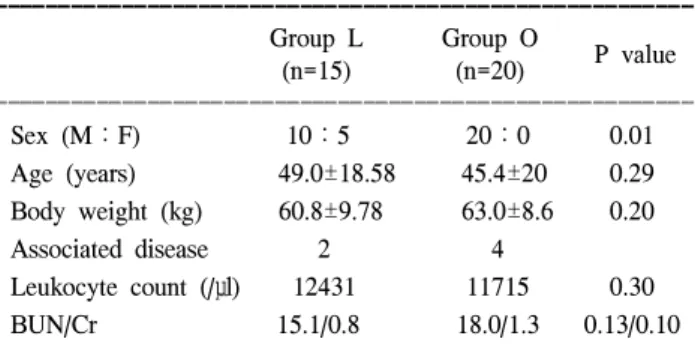
L군이 남자 10명, 여자 5명으로 평균 49 (21∼86)세였고 O군은 남자 20명으로 평균 45 (18∼76)세이었다. 각 군에서 몸무게, 검사실 소견은 유의한 차이가 없었으며, 증상 발현 후부터 수술까지의 시간도 L군이 15.4시간 O군이 19.3시간 으로 유의한 차이가 없어 비교 가능하였다(Table 1).
2) 수술 난이도
수술 시간은 L군이 118.7±49.5분, O군이 80.8±28.5분으 로 L군에서 통계적으로 유의하게 길었고(P<0.05), 실혈량 (L군 167 ml, O군 166 ml)은 유의한 차이가 없었다(Table 2).
두 군 모두 천공의 위치는 십이지장 보다 위가 많았고 대부 분의 위궤양 천공은 유문 및 유문전 병변이었다. 위궤양 천 공의 비율은 L군에서 73.3%, O군에서는 80.0%였으며 유의 한 차이가 없었다. 천공의 크기 또한 L군에서 0.71 cm, O군 에서 0.83 cm으로 유의한 차이가 없어 비교 가능하였다. 환 자의 체중은 L군에서 60.8 kg, O군에서 63.1 kg로 유의한 차이가 없었다. 동반질환은 L군에서 17명 중 2명에서 각각 고혈압, 무기폐가 있었고 O군에서는 20명 중 4명에서 각각 천식, 고혈압, 당뇨 및 다발성골수종이 있었으며, 천식, 고
Fig. 1. 3-port-technique for laparoscopic primary closure.
Table 1. Patients profile
ꠚꠚꠚꠚꠚꠚꠚꠚꠚꠚꠚꠚꠚꠚꠚꠚꠚꠚꠚꠚꠚꠚꠚꠚꠚꠚꠚꠚꠚꠚꠚꠚꠚꠚꠚꠚꠚꠚꠚꠚꠚꠚꠚꠚꠚꠚꠚꠚꠚꠚꠚꠚꠚꠚꠚ Group L Group O
P value
(n=15) (n=20)
ꠏꠏꠏꠏꠏꠏꠏꠏꠏꠏꠏꠏꠏꠏꠏꠏꠏꠏꠏꠏꠏꠏꠏꠏꠏꠏꠏꠏꠏꠏꠏꠏꠏꠏꠏꠏꠏꠏꠏꠏꠏꠏꠏꠏꠏꠏꠏꠏꠏꠏꠏꠏꠏꠏꠏ
Sex (M:F) 10:5 20:0 0.01
Age (years) 49.0±18.58 45.4±20 0.29 Body weight (kg) 60.8±9.78 63.0±8.6 0.20
Associated disease 2 4
Leukocyte count (/μl) 12431 11715 0.30
BUN/Cr 15.1/0.8 18.0/1.3 0.13/0.10
ꠏꠏꠏꠏꠏꠏꠏꠏꠏꠏꠏꠏꠏꠏꠏꠏꠏꠏꠏꠏꠏꠏꠏꠏꠏꠏꠏꠏꠏꠏꠏꠏꠏꠏꠏꠏꠏꠏꠏꠏꠏꠏꠏꠏꠏꠏꠏꠏꠏꠏꠏꠏꠏꠏꠏ Group L = fifteen patients who underwent laparoscopic primary closure with omental patch; Group O = the control group of 20 patients with conventional open primary closure and omental patch.
ꠏꠏꠏꠏꠏꠏꠏꠏꠏꠏꠏꠏꠏꠏꠏꠏꠏꠏꠏꠏꠏꠏꠏꠏꠏꠏꠏꠏꠏꠏꠏꠏꠏꠏꠏꠏꠏꠏꠏꠏꠏꠏꠏꠏꠏꠏꠏꠏꠏꠏꠏꠏꠏꠏꠏꠏꠏꠏꠏꠏꠏꠏꠏꠏꠏꠏꠏꠏꠏꠏꠏꠏꠏꠏꠏꠏꠏꠏꠏꠏꠏꠏꠏꠏꠏꠏꠏꠏꠏꠏꠏꠏꠏꠏꠏꠏꠏꠏꠏꠏꠏꠏꠏꠏꠏꠏꠏꠏꠏꠏꠏꠏꠏꠏꠏ
혈압, 당뇨는 조절이 가능하였고, 동반질환 유무에 따른 두 군간 유의한 차이는 없었다. 과거에 궤양 치료 경험이 있는 환자는 L군에서 6명이었고 O군에서 1명이었으며 이는 유 의한 차이가 있었다(P<0.01). 궤양 치료 경험이 있는 것이 궤양의 정도를 절대적으로 반영하는 것은 아니지만, L군에 서 난치성의 궤양이 많았을 가능성이 있다. 복강경하 일차 봉합술은 대개 응급수술 상황이기 때문에 주로 복강경 숙 련도가 적은 외과의에 의해 시행되었으며 시간이 경과함에 따라 수술시간, 마취시간, 입원기간, 식사시작일, 통증조절 횟수의 단축이 있었으나 통계적으로 유의한 차이를 보이지 는 않았다(Table 3).
3) 수술 후 회복 정도
수술 후 체온이 37.3oC 이상으로 상승되어 있던 기간을 발열기간으로 정의하였으며 L군에서 제 2.2 병일, O군에서 제 3.1 병일로 L군에서 유의하게 짧았다(P<0.05). 수술 후 진통제 투여 횟수(L군 4.1회, O군 4.4회), 장운동 회복일(L 군 3.2일, O군 2.9일), 첫 번째 식사일(L군 4.2일, O군 4.3일) 은 유의한 차이가 없었으며, 수술 후 재원 기간(L군 9.6병 일, O군 10.0 병일) 역시 유의한 차이가 없었다(Table 4). 장 운동 회복일은 장가스 배출일을 기준으로 당시 병일로 정 하였다. 수술 후 제 1, 3 병일 백혈구 수치는 L군은 (12125.0
±3837.8)/μl, (8695.0±3639.1)/μl, O군은 (13764.3±5930.7)/
μl, (9514.3±3739.0)μl으로 L군에서 낮았지만 유의한 차이 는 보이지 않았다. 수술 후 합병증은 수술과 연관되어 나타 난 질병으로 정하였으며 L군의 86세 여환 1명은 우측 흉막 삼출액 증가로 인한 폐기능 저하로 흉관 삽입술을 시행하 였으나 호전되었다. O군에서는 71세 남환에서 스트레스성 위점막 출혈이 1예가 있었으나 보존적 치료로 회복되었고, 폐렴을 동반한 80세 남환에서 스트레스성 위점막 출혈 및 다발성 장기 부전으로 제 15 병일에 사망한 1예가 있었다 (Table 2).
고 찰
소화성 궤양 천공의 치료에서 복강경 일차봉합술과 고식 적 개복술간의 비교연구는 현재까지 Lau 등(10)을 제외하 고 모두 후향적 연구였다. 또한 두 술식 간에 어느 방법이 더 유용한지에 대한 뚜렷한 방향성을 제시하지 못하여 복 강경하 일차봉합술이 개복술만큼 유용하며 안전하다는 것 에 대해 이견이 있다.(10,11) 본 전향적 연구 결과에 의하면 Table 2. Operative outcomes in terms of difficulties of techniques
ꠚꠚꠚꠚꠚꠚꠚꠚꠚꠚꠚꠚꠚꠚꠚꠚꠚꠚꠚꠚꠚꠚꠚꠚꠚꠚꠚꠚꠚꠚꠚꠚꠚꠚꠚꠚꠚꠚꠚꠚꠚꠚꠚꠚꠚꠚꠚꠚꠚꠚꠚꠚꠚꠚꠚ Group L Group O
P-value
(n=20) (n=14)
ꠏꠏꠏꠏꠏꠏꠏꠏꠏꠏꠏꠏꠏꠏꠏꠏꠏꠏꠏꠏꠏꠏꠏꠏꠏꠏꠏꠏꠏꠏꠏꠏꠏꠏꠏꠏꠏꠏꠏꠏꠏꠏꠏꠏꠏꠏꠏꠏꠏꠏꠏꠏꠏꠏꠏ Hospital stay
9.7 10.5 0.323 (days)
Operative time
118.7±49.5 80.8±28.5 0.007 (minutes)*
Estimated blood
167±165.8 166±298.7 0.496 loss (ml)
Pleural (1) UGI bleeding (2) Morbidity
effusion Wound dehiscence (1)
Mortality - Sepsis (1)
ꠏꠏꠏꠏꠏꠏꠏꠏꠏꠏꠏꠏꠏꠏꠏꠏꠏꠏꠏꠏꠏꠏꠏꠏꠏꠏꠏꠏꠏꠏꠏꠏꠏꠏꠏꠏꠏꠏꠏꠏꠏꠏꠏꠏꠏꠏꠏꠏꠏꠏꠏꠏꠏꠏꠏ Group L = fifteen patients who underwent laparoscopic primary closure with omental patch; Group O = twenty patients who underwent conventional open primary closure and omental patch.
*P value<0.05.
Table 3. Outcomes of laparoscopic primary closure for perforated peptic ulcer according to periods of operations ꠚꠚꠚꠚꠚꠚꠚꠚꠚꠚꠚꠚꠚꠚꠚꠚꠚꠚꠚꠚꠚꠚꠚꠚꠚꠚꠚꠚꠚꠚꠚꠚꠚꠚꠚꠚꠚꠚꠚꠚꠚꠚꠚꠚꠚꠚꠚꠚꠚꠚꠚꠚꠚꠚꠚ
1999 2000 2001
P-value*
(n=8) (n=5) (n=3)
ꠏꠏꠏꠏꠏꠏꠏꠏꠏꠏꠏꠏꠏꠏꠏꠏꠏꠏꠏꠏꠏꠏꠏꠏꠏꠏꠏꠏꠏꠏꠏꠏꠏꠏꠏꠏꠏꠏꠏꠏꠏꠏꠏꠏꠏꠏꠏꠏꠏꠏꠏꠏꠏꠏꠏ Hospital stay
12.9 7.4 6.5 0.198
(days) Anesthesia
147 145 126 0.647
time (minutes) Operative
131 119 90 0.332
time (minutes) Time to a normal
4.9 3.8 3.7 0.885
diet (days)
Pain control (times) 4.7 4.2 3.0 0.814
ꠏꠏꠏꠏꠏꠏꠏꠏꠏꠏꠏꠏꠏꠏꠏꠏꠏꠏꠏꠏꠏꠏꠏꠏꠏꠏꠏꠏꠏꠏꠏꠏꠏꠏꠏꠏꠏꠏꠏꠏꠏꠏꠏꠏꠏꠏꠏꠏꠏꠏꠏꠏꠏꠏꠏ
*Kruskal-wallis test
Table 4. Postoperative recovery
ꠚꠚꠚꠚꠚꠚꠚꠚꠚꠚꠚꠚꠚꠚꠚꠚꠚꠚꠚꠚꠚꠚꠚꠚꠚꠚꠚꠚꠚꠚꠚꠚꠚꠚꠚꠚꠚꠚꠚꠚꠚꠚꠚꠚꠚꠚꠚꠚꠚꠚꠚꠚꠚꠚꠚ Group L Group O
P-value (n=15) (n=20)
ꠏꠏꠏꠏꠏꠏꠏꠏꠏꠏꠏꠏꠏꠏꠏꠏꠏꠏꠏꠏꠏꠏꠏꠏꠏꠏꠏꠏꠏꠏꠏꠏꠏꠏꠏꠏꠏꠏꠏꠏꠏꠏꠏꠏꠏꠏꠏꠏꠏꠏꠏꠏꠏꠏꠏ Nonfebrile conversion
2.2 3.1 0.04
(postoperative day)*
Pain control (times)
4.1 4.4 0.42
Recovery of bowel Movement
3.2 2.9 0.27
(postoperative day) Hospital stay
9.6 10.0 0.42
(postoperative days)
ꠏꠏꠏꠏꠏꠏꠏꠏꠏꠏꠏꠏꠏꠏꠏꠏꠏꠏꠏꠏꠏꠏꠏꠏꠏꠏꠏꠏꠏꠏꠏꠏꠏꠏꠏꠏꠏꠏꠏꠏꠏꠏꠏꠏꠏꠏꠏꠏꠏꠏꠏꠏꠏꠏꠏ Group L = fifteen patients who underwent laparoscopic primary closure with omental patch; Group O = the control group comprising 20 patients with conventional open primary closure and omental patch. *P value<0.05.
ꠏꠏꠏꠏꠏꠏꠏꠏꠏꠏꠏꠏꠏꠏꠏꠏꠏꠏꠏꠏꠏꠏꠏꠏꠏꠏꠏꠏꠏꠏꠏꠏꠏꠏꠏꠏꠏꠏꠏꠏꠏꠏꠏꠏꠏꠏꠏꠏꠏꠏꠏꠏꠏꠏꠏꠏꠏꠏꠏꠏꠏꠏꠏꠏꠏꠏꠏꠏꠏꠏꠏꠏꠏꠏꠏꠏꠏꠏꠏꠏꠏꠏꠏꠏꠏꠏꠏꠏꠏꠏꠏꠏꠏꠏꠏꠏꠏꠏꠏꠏꠏꠏꠏꠏꠏꠏꠏꠏꠏꠏꠏꠏꠏꠏꠏ 복강경하 일차봉합술은 개복술과 비교하여 비록 수술시간
이 길지만, 수술 후 창상의 크기가 매우 작고 발열기간이 짧았다. 두 군 간에 진통제 투여 횟수, 장운동 회복일, 수술 시 추정 실혈량, 입원기간 등은 유의한 차이를 보이지 않았 지만 복강경 일차봉합술 시 술자의 숙련도가 향상됨에 따 라 점차적으로 수술시간, 진통제 투여횟수, 식사시작일, 입 원기간 등이 단축되었다(Table 3).
이제까지의 연구에서는 발열기간에 대하여 보고한 예가 없었다. 복강경 일차 봉합술에서 발열기간의 유의한 감소 가 곧 회복기간의 단축이라고 말할 순 없으나 환자의 염증 성 반응이 감소된 것으로 생각한다.
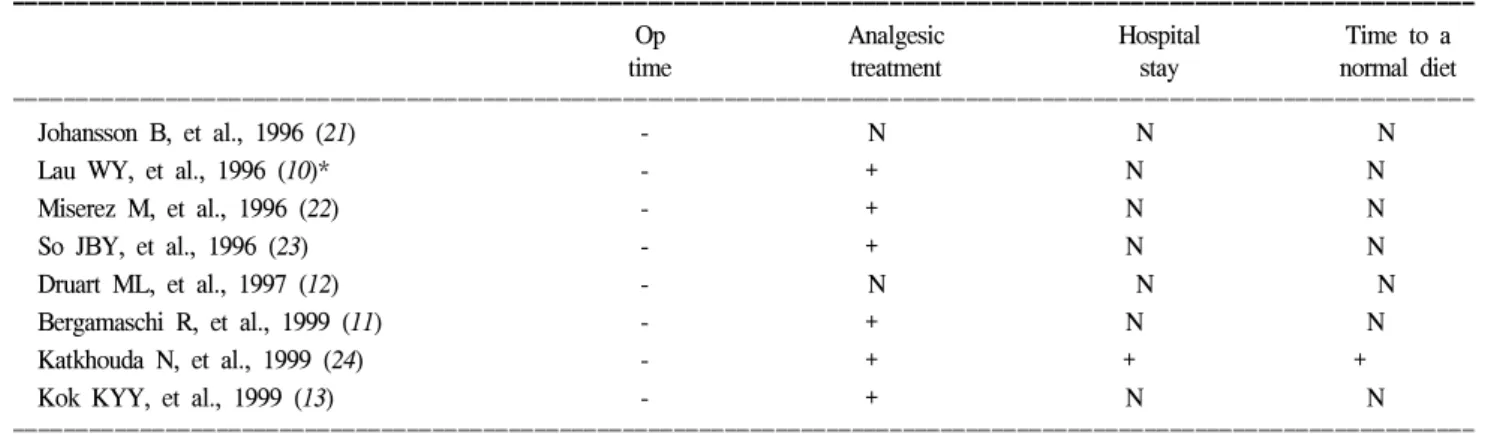
대부분의 이전 연구에서는 진통제 투여횟수의 단축이 가 능하였으며, 특히 Katkhouda N 등(1999)의 연구에서는 입원 기간 및 식사시작일도 단축이 가능하였다(Table 5). 본 연구 에서는 두 군간에 진통제 투여횟수, 입원기간 및 식사시작 일의 유의한 차이를 보이지 않았으나, 복강경 일차 봉합술 에서는 술자의 숙련도에 따라 진통제 투여횟수, 입원기간 및 식사시작일이 점차 향상되는 경향을 보였다. 그러나 기 간별로 유의한 차이 없었으며 이는 증례가 적었기 때문인 것으로 생각한다(Table 3).
복강경 일차봉합술의 단점은 수술시간이 길고, 그에 따라 마취시간이 연장되며, 복강경 기구 사용에 따른 추가비용 이 든다는 것이다. 수술시간은 술자의 숙련도에 따라 차이 가 있으며, 점차 향상될 것이다. 본 연구에서는 매년 수술시 간, 마취시간의 단축이 있었으나 기간별로 유의한 차이를 보이지는 않았다(Table 3). 이전의 연구에서도 모두 수술시 간의 연장이 있었으나(Table 4), 그것이 환자의 이환율이나 사망률에 영향을 끼친 보고는 없었다. 오히려 복강경 궤양 일차봉합술에서 기존 개복술보다 이환율이나 사망률이 감 소되어 있다는 몇몇 보고들이 있다.(12,13) 그러나 대부분의 경우 이환율이나 사망률에서 유의한 차이를 발견할 수 없 었다. 본 연구에서도 수술시간 및 마취시간의 유의한 차
이가 있었으나 역시 이환율과 사망률의 유의한 차이가 없 었다.
복강경하 천공부위의 봉합 방법은 크게 체내 봉합과 체 외 봉합으로 나뉘어진다.(14) 체내 봉합에는 천공부위를 일 차봉합한 후 대망을 고정시키는 방법이 있으며 이밖에도 위내시경을 이용하여 겸상 인대를 천공부위에 봉합하는 방 법,(15) 자동봉합기를 이용하여 대망을 함께 고정하는 방 법,(16) 그리고 천공부위에 젤라틴 스폰지와 피브린 글루를 투여하여 유착시키는 방법(10) 등이 보고되고 있다. 본 연 구에서는 개복술에서와 마찬가지로 단순 봉합 후 대망 고 정을 시행하였다.
크기가 매우 큰 궤양천공, 궤양천공이 후벽에 위치한 경 우, 전반적 건강상태가 불량한 경우 등이 복강경 일차봉합 술의 금기로 보고되고 있다.(10,12,13,17) 위궤양 천공의 치 료는 궤양 부위의 절제를 시행하는 경우가 많다. 위궤양의 병태생리가 위산의 과다 분비라기보다 위점막의 방어인자 의 결핍에 의하는 경우 산 분비 억제 치료에 반응하지 않을 가능성이 높고, 위의 악성 종양과 감별하기 힘든 경우가 있 기 때문이다. 그러나 위 절제를 시행한 경우와 일차 봉합술 을 시행한 경우를 비교한 보고들을 보면, 치료 성적에 있어 서 큰 차이를 보이지 않았다.(11,12) 본 연구에서는 위궤양 천공에 있어서, 병리 조직학적 진단을 위하여, 천공주위 병 변의 조직을 채취한 후 일차봉합술을 시행하였다. 후벽 천 공에 의한 경우가 이번 연구에서는 없었으나 이와 같은 경 우에도 복강경적 시술 방법이 시도될 수 있을 것이다. 이전 의 연구들에서 개복술로의 전환 비율은 단지 0∼25%였으 며,(10,12,17) 본 연구에서는 개복술로의 전환이 없었다.
결 론
소화성 궤양 천공 시 복강경하 일차 봉합술은 개복술과 비교하여 수술 시간이 길었지만 창상의 크기가 현격하게
Table 5. Previous studies of laparoscopic repair vs. open repair for perforated peptic ulcer
ꠚꠚꠚꠚꠚꠚꠚꠚꠚꠚꠚꠚꠚꠚꠚꠚꠚꠚꠚꠚꠚꠚꠚꠚꠚꠚꠚꠚꠚꠚꠚꠚꠚꠚꠚꠚꠚꠚꠚꠚꠚꠚꠚꠚꠚꠚꠚꠚꠚꠚꠚꠚꠚꠚꠚꠚꠚꠚꠚꠚꠚꠚꠚꠚꠚꠚꠚꠚꠚꠚꠚꠚꠚꠚꠚꠚꠚꠚꠚꠚꠚꠚꠚꠚꠚꠚꠚꠚꠚꠚꠚꠚꠚꠚꠚꠚꠚꠚꠚꠚꠚꠚꠚꠚꠚꠚꠚꠚꠚꠚꠚꠚꠚꠚꠚ
Op Analgesic Hospital Time to a
time treatment stay normal diet
ꠏꠏꠏꠏꠏꠏꠏꠏꠏꠏꠏꠏꠏꠏꠏꠏꠏꠏꠏꠏꠏꠏꠏꠏꠏꠏꠏꠏꠏꠏꠏꠏꠏꠏꠏꠏꠏꠏꠏꠏꠏꠏꠏꠏꠏꠏꠏꠏꠏꠏꠏꠏꠏꠏꠏꠏꠏꠏꠏꠏꠏꠏꠏꠏꠏꠏꠏꠏꠏꠏꠏꠏꠏꠏꠏꠏꠏꠏꠏꠏꠏꠏꠏꠏꠏꠏꠏꠏꠏꠏꠏꠏꠏꠏꠏꠏꠏꠏꠏꠏꠏꠏꠏꠏꠏꠏꠏꠏꠏꠏꠏꠏꠏꠏꠏ
Johansson B, et al., 1996 (21) - N N N
Lau WY, et al., 1996 (10)* - + N N
Miserez M, et al., 1996 (22) - + N N
So JBY, et al., 1996 (23) - + N N
Druart ML, et al., 1997 (12) - N N N
Bergamaschi R, et al., 1999 (11) - + N N
Katkhouda N, et al., 1999 (24) - + + +
Kok KYY, et al., 1999 (13) - + N N
ꠏꠏꠏꠏꠏꠏꠏꠏꠏꠏꠏꠏꠏꠏꠏꠏꠏꠏꠏꠏꠏꠏꠏꠏꠏꠏꠏꠏꠏꠏꠏꠏꠏꠏꠏꠏꠏꠏꠏꠏꠏꠏꠏꠏꠏꠏꠏꠏꠏꠏꠏꠏꠏꠏꠏꠏꠏꠏꠏꠏꠏꠏꠏꠏꠏꠏꠏꠏꠏꠏꠏꠏꠏꠏꠏꠏꠏꠏꠏꠏꠏꠏꠏꠏꠏꠏꠏꠏꠏꠏꠏꠏꠏꠏꠏꠏꠏꠏꠏꠏꠏꠏꠏꠏꠏꠏꠏꠏꠏꠏꠏꠏꠏꠏꠏ In laparoscopic primary closure, + = better result; - = worse result; N = no significant difference; *prospective randomized study.
ꠏꠏꠏꠏꠏꠏꠏꠏꠏꠏꠏꠏꠏꠏꠏꠏꠏꠏꠏꠏꠏꠏꠏꠏꠏꠏꠏꠏꠏꠏꠏꠏꠏꠏꠏꠏꠏꠏꠏꠏꠏꠏꠏꠏꠏꠏꠏꠏꠏꠏꠏꠏꠏꠏꠏꠏꠏꠏꠏꠏꠏꠏꠏꠏꠏꠏꠏꠏꠏꠏꠏꠏꠏꠏꠏꠏꠏꠏꠏꠏꠏꠏꠏꠏꠏꠏꠏꠏꠏꠏꠏꠏꠏꠏꠏꠏꠏꠏꠏꠏꠏꠏꠏꠏꠏꠏꠏꠏꠏꠏꠏꠏꠏꠏꠏ 작았으며, 그 최소 침습성으로 인해 발열기간의 유의한 차
이가 있었다. 복강경 일차봉합술에서 발열 기간의 유의한 감소가 곧 회복기간의 단축이라고 말할 순 없으나 환자의 염증성 반응이 감소된 것으로 생각되며 이는 복강경 수술 의 최소 침습성에 의한 것으로 생각한다. 복강경하 일차 봉 합술 시 비록 증례가 적어 통계적 유의성은 없었으나 진통 제 투여횟수, 입원기간, 식사시작일 등의 지표가 술자의 숙 련도에 따라 매년 향상되는 경향을 보였으며 향후 기구의 발달과 기술적 향상으로 보다 좋은 성적을 기대할 수 있을 것이다.
REFERENCES
1) Crofts TJ, Kenneth GM, Park MB, Stelle RIC, Chung SSC, Li AKC. A randomized trial ofnonoperative treatment for perforated duodenal ulcer. N Engl I Med 1989;320:970-3.
2) Marshall C, Ramaswamy P, Bergin FG, Rosenberg IL, Leaper Dl. Evaluation of a protocol for the non-operative management of perforated peptic ulcer. Br I Surg 1999;86:131-4.
3) Donovan AI, Berne TV, Donovan IA. Perforated duodenal ulcer. An alternative therapeutic plan. Arch Surg 1998;133:
1166-71.
4) Blomgren LGM. Perforated peptic ulcer: long-term results of simple closure in the elderly. World I Surg 1997;21:412-5.
5) Hulst RWM van der, Rauws EAI, Koycii B, Keller II, Bruno MI, Tijssen IGP, Tytgat GNI. Prevention of ulcer recurrence after eradication of Helicobacter pylori: a prospective long- term follow-up study. Gastroenterology 1997;113[suppll]:
SI082-6.
6) Lau WY, Leow CK. History of perforated duodenal and gastric ulcers. World I Surg 1997;21:890-6.
7) Hermansson M, Holstein CS von, Zilling T. Peptic ulcer perforation before and after the introduction ofH2-receptor blockers and proton pump inhibitors. Scand I Gastroenterol 1997;32:523-529.
8) Mouret P, Francois Y, Vignal I, Barth X, Lombard-Platet R.
Laparoscopic treatment of perforated peptic ulcer. Br I Surg 1990;77:1006.
9) Nathanson LK, Easter DW, Cuschieri A. Laparoscopic repair/peritoneal toilet of perforated duodenal ulcer. Surg Endosc 1990;4:232.
10) Lau WY, Leung KL, Kwong KH, Davey IC, Robertson C, Dawson IJW, Chung SCS, Li AKC. A randomized study com- paring laparoscopic versus open repair of perforated peptic ulcer using suture or sutureless technique. Ann Surg 1996;
224:131-8.
11) Bergamaschi R, Marvik R, Iohnsen G, Thoresen JEK, Ystgaard B, Myrvold HE. Open vs laparoscopic repair of perforated peptic ulcer. Surg Endosc 1999;13:679-82.
12) Druart ML, van Hee R, Etienne I, Cadiere GB, Gigot JF, Legrand M, Limbosch IM, Navez B, Tugilimana M, van Vyve E, Vereecken L, Wibin E, Yvergneaux JP. Lapsaroscopic repair of perforated duodenal ulcer. A prospective multicenter clinical trial. Surg Endosc 1997;11:1017-20.
13) Kok KYY, Mathew W, Yapp SKS. Laparoscopic omental patch repair for perforated duodenal ulcer. Am Surg 1999;65:
27-30.
14) Darzi A, Carey PD, Menzies-Gois N, Monson JR. Preliminary result of laparoscopic repair of perforated duodenal ulcer. Surg Laparosc Endosc 1993;#:161-3.
15) Costalat G, Darvet F, Noel P, Alquier Y, Vernhet J.
Coelioscopic treatment of perforated gastroduodenal ulcer using the ligamentum teres hepatis. Surg Endosc 1991;5:
154-5.
16) Darzi A, Cheshire NJ, Somers Ss, Super PA Guillou PJ, Monson JRT. Laparoscopic omental patch repair of perforated duodenal ulcer with automated stapler. Br J Surg 1993;80:
1552-3.
17) Pescatore P, Halkic N, Calmes JM, Blum A, Gillet M.
Combined laparoscopic-endoscopic method using an omental plug for therapy of gastroduodenal ulcer perforation. Gastro- intest Endosc 1998;48:411-4.
18) Tokunaga Y, Hara K, Ryo I, Kitaoka A, Tokuka A, Ohsumi K. Density of Helicobacter pylori infection in patients with peptic ulcer perforation. I Am CoIl Surg 1998;186:659-663.
19) Chu KM, Kwok KF, Law SYK, Tuen HH, Thung PHM, Branicki FI, Wong I. Helicobacter pylori status and endoscopy follow-up of patients having a history of perforated duodenal ulcer. Gastrointest Endosc 1999;50:58-62.
20) Inadomi JM, Sonnenberg A. The impact ofpeptic ulcer disease and infection with Helicobacter pylori on life expenctancy. Am I Gastroenterol 1998;93:1286-90.
21) Johansson B, Hallerbiick B, Glise H, Iohnsson E. Laparoscopic suture closure of perforated peptic ulcer. A nonrandomized comparison with open surgery. Surg Endosc 1996;10:656-8.
22) Miserez M, Eypasch E, Spangenberger W, Lefering R, Troidl H. Laparoscopic and conventional closure of perforated peptic ulcer. A comparison. Surg Endosc 1996;10:831-6.
23) So JBY, Kum CK, Fernandes ML, Goh P. Comparison between laparoscopic and conventional omental patch repair for perforated duodenal ulcer. Surg Endosc 1996;10:1060-3.
24) Katkhouda N, Mavor E, Mason RJ, Campos GMR, Sorou- shyari A, Berne TV. Laparoscopic repair of perforated duo- denal ulcers. Outcome and efficacy in 30 consecutive patients.
Arch Surg 1999;134:845-50.