© 2014 The Korean Ophthalmological Society
This is an Open Access article distributed under the terms of the Creative Commons Attribution Non-Commercial License (http://creativecommons.org/licenses /by-nc/3.0/) which permits unrestricted non-commercial use, distribution, and reproduction in any medium, provided the original work is properly cited.
Original Article
Symptom Based Diagnosis of Infant under One Year in Outpatient Clinic
Sangyoun Han1,Ungsoo Samuel Kim1,2
1Department of Ophthalmology, Kim’s Eye Hospital, Seoul, Korea
2Department of Ophthalmology, Konyang University College of Medicine, Daejeon, Korea
Purpose: We investigated chief complaints and ocular disorders in infants under one year of age and analyzed the association between complaints and disorders.
Methods: The medical records of 815 infants were reviewed. Chief complaints were grouped into the following 11 categories: eyelid drooping, epiphora (tearing), ocular discharge, lid swelling, eyelashes touching the eye- ball, abnormalities of the anterior segment, abnormal eyeball movement (e.g., squint or nystagmus), red eye, trauma, poor eye contact, and miscellaneous. We performed ophthalmologic examinations at the doctors’ dis- cretion and analyzed the relationship between chief complaint and final diagnosis.
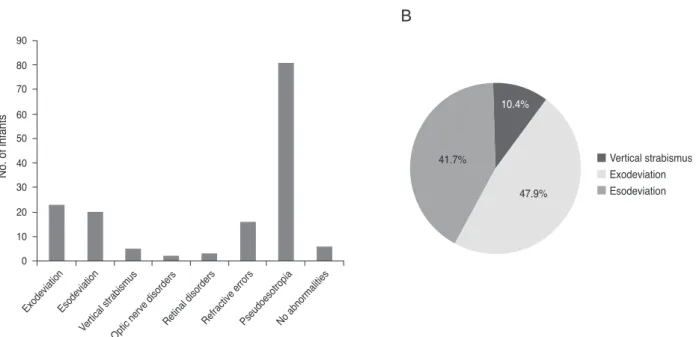
Results: Mean age of visiting the outpatient clinic was 6.09 ± 3.07 months. The most common complaint was ocular discharge, followed by abnormal eyeball movement, epiphora, and eye redness. Among infants with oc- ular discharge, most were attributed to congenital nasolacrimal duct obstruction (155 infants) and conjunctivitis (75 infants). A total of 160 guardians complained of abnormal eyeball movement and 86 of 160 infants (51.9%) suffered from pseudoesotropia. Additionally, exodeviation and esodeviation was found in 17.9% and 16.4%
of infants, respectively. Eight guardian complained of poor eye contact in their infants and these infants were diagnosed with retinal disorders (3), congenital optic nerve disorders (2), cataract (1), glaucoma (1), and high hyperopia (1).
Conclusions: The most common ocular symptoms in infants under one year of age included ocular discharge, epiphora, and eye redness. However, infants with poor eye contact or suspected abnormal eye movement should undergo a full ophthalmologic examination.
Key Words: Diagnosis, Infant
Infants under one year of age have various ocular disor- ders ranging from refractive errors to retinal abnormali- ties. Among these diseases, some such as conjunctivitis, keratitis, and corneal abrasions are treatable with medica- tion; however, other diseases, such as infantile esotropia,
congenital cataract, congenital glaucoma, and retinal prob- lems require early surgical treatment to prevent further deterioration [1]. Many of the causes of blindness are also avoidable, as they are either preventable or treatable in childhood [2].
Despite the importance of early diagnosis of childhood diseases, cooperation between the guardian and physician is one of the key factors affecting the ability to formulate a correct diagnosis. As a result, pediatricians or primary ophthalmologists can make incorrect diagnoses owing to the lack of guardian cooperation. Therefore, to present the
Received: August 14, 2013 Accepted: November 4, 2013
Corresponding Author: Ungsoo Samuel Kim, MD. Department of Oph- thalmology, Kim’s Eye Hospital, Konyang University College of Med- icine, #136 Yeongsin-ro, Yeongdeungpo-gu, Seoul 150-034, Korea. Tel:
82-2-1577-2639, Fax: 82-2-2677-9214, E-mail: [email protected]
basic outline of diagnoses based on symptoms, we investi- gated the chief complaints and ocular disorders in infants under one year of age and analyzed the association be- tween the complaint and disorder.
Materials and Methods
A total of 815 infants (400 boys and 415 girls) visited the outpatient clinic of Kim’s Eye Hospital between July 2011 and May 2012 and were under one year of age. We retro- spectively reviewed the charts of these 815 infants. Chief complaints were obtained from guardians, including the patients’ father, mother, or grandparents and they were cat- egorized into the following 11 categories: eyelid drooping, epiphora (tearing), ocular discharge, lid swelling, eyelashes touching the eyeball, abnormalities of the anterior seg- ment, abnormal eyeball movement (e.g., squint or nystag- mus), red eye, trauma, poor eye contact, and miscella- neous. Abnormalities in the anterior segments included leukocoria, spot or foreign body in the cornea, conjunctiva and sclera, and iris problems, such as color difference be- tween the two eyes. Lastly, miscellaneous complaints in- cluded the following: blinking, eye rubbing, photophobia, and a foreign object in the eye. Congenital nasolacrimal duct obstruction (CNLDO) was defined as a patient with high tear meniscus height and mucopurulent reflux from the punctum when gentle pressure was applied over the lacrimal sac. Conjunctivitis was classified into three types
(epidemic keratoconjunctivitis, allergic conjunctivitis and unspecified conjunctivitis).
We performed ophthalmologic examinations, such as manifest refraction, the Brückner test, a fundus examina- tion, and an alternate cover test at the clinicians’ discretion.
We tried to group all complaints into the 11 categories and we made a diagnosis using objective methods. This research study was reviewed and approved by the institutional review board of Kim’s Eye Hospital.
Results
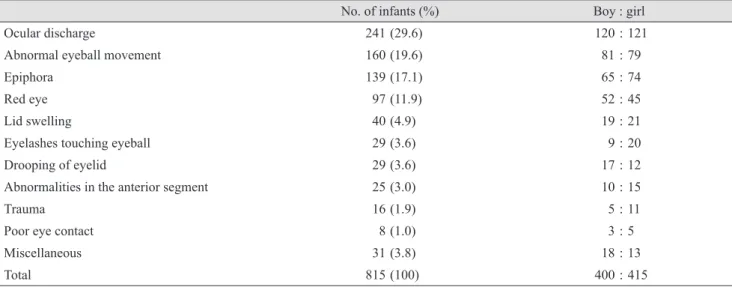
The mean age of the infants seen at the outpatient clinic was 6.09 ± 3.07 months. The most common chief com- plaint was ocular discharge followed by abnormal eyeball movement, epiphora, and eye redness (Table 1).
Among infants with ocular discharge, most were afflict- ed with CNLDO (155 infants) and conjunctivitis (75 in- fants). A total of 160 guardian complained of abnormal eyeball movement and 86 of these 160 infants (51.9%) were diagnosed with pseudoesotropia. Of all infants, exodevia- tion was found in 17.9% and esodeviation was found in 16.4% (Fig. 1). The majority of infants with epiphora had confirmed cases of CNLDO (84.3%, 119 of 141), eight had epiblepharon, seven had conjunctivitis, and seven were due to other causes. Two-thirds of the infants with red eye was due to various types of conjunctivitis, including viral or allergic causes. Among conjunctivitis, allergic conjunctivi-
Table 1. Chief guardian complaints of infants under one year of age
No. of infants (%) Boy : girl
Ocular discharge 241 (29.6) 120 : 121
Abnormal eyeball movement 160 (19.6) 81 : 79
Epiphora 139 (17.1) 65 : 74
Red eye 97 (11.9) 52 : 45
Lid swelling 40 (4.9) 19 : 21
Eyelashes touching eyeball 29 (3.6) 9 : 20
Drooping of eyelid 29 (3.6) 17 : 12
Abnormalities in the anterior segment 25 (3.0) 10 : 15
Trauma 16 (1.9) 5 : 11
Poor eye contact 8 (1.0) 3 : 5
Miscellaneous 31 (3.8) 18 : 13
Total 815 (100) 400 : 415
tis occurred in 11 infants and epidemic keratoconjunctivitis was diagnosed in 27 infants. The majority of eyelid mass lesions (27 of 40) were hordeolum or chalazion. All infants who presented with guardian complaints of drooping eye- lids were afflicted with true blepharoptosis. In the 16 in- fants with a history of trauma, corneal erosions caused the trauma in six of them, subconjunctival hemorrhages in three, and orbital contusion in two. Five infants had nor- mal findings. Epiphora and ocular discharge were common symptoms in infants, which were accurate reflections of the diagnosis (Fig. 2). The two infants with nystagumus (0.24%) had congenital nystagmus (Table 2).
There were eight complaints of poor eye contact in in- fants and the diagnoses in these cases consisted of three
retinal disorders, two congenital optic nerve disorders, one cataract, one glaucoma, and one high hyperopia. Table 3 shows the characteristics of vision-threatening disorders including glaucoma, cataract, corneal ulcer, retinal disor- ders, and optic nerve disorders.
Discussion
In the current study, we found that the most common symptom in infants under one year of age was ocular dis- charge followed by abnormal eyeball movement, epiphora, and eye redness.
The main cause of ocular discharge in our patients was CNLDO. Our results showed that the guardians of about 56% of CNLDO infants complained of ocular discharge and 44% complained of epiphora. Global incidence of CN- LDO is widely distributed from 1.2% to 20% [3,4]. Sponta- neous remission occurs throughout the year and in 96% of these infants, the condition resolves before the age of 1 [4].
CNLDO may include various symptoms such as epiphora, increased tear lake, and discharge [5]. Holmes et al. [6] de- veloped a questionnaire for CNLDO assessing symptoms including tearing, redness of the eyeball, and eye rubbing and their results attest to the questionnaire’s usefulness for evaluating CNLDO. Ocular discharge and epiphora are
Vertical strabismus Exodeviation Esodeviation 47.9%
41.7%
10.4%
90 80 70 60 50 40 30 20
No. of infants
10 0
ExodeviationEsodeviation
Vertical strabismusOptic nerve disordersRetinal disordersRefractive errorsPseudoesotropiaNo abnormalities
A B
Fig. 1. (A) The final diagnosis of infants who presented with guardian complaints of abnormal eyeball movement. (B) The type of strabis- mus in the 48 infants with true eyeball deviation.
Allergic conjunctivitis
Ocular discharge (n = 241) Epiphora(n = 139)Conjunctivitis
CNLDO Epiblepharon 4
71 155
8 3
1 7 121
8 Corneal 2
disease
Fig. 2. Characteristics of the two most common symptoms (ocular discharge and epiphora). CNLDO = congenital nasolacrimal duct obstruction.
frequently identical and some guardian confuse the two symptoms. Infants with epiphora are a common problem and several diseases, including epiblepharon, conjunctivi- tis, and CNLDO can result in epiphora [4]. Guez and Du- reau [7] reported that the main causes of tearing are CNL-
DO and congenital glaucoma, the latter accounting for the seriousness of this condition. Corneal abrasions are also extremely common among 1- to 12-week-old infants and have unclear clinical significance [8]. We found that 2 of 139 cases of infant epiphora were due to corneal abrasions.
Redness of the eye is a common symptom and Ubah et al. [9] reported that the most frequent cause of red eye was trauma in 48 (41.0%) patients, followed by allergic con- junctivitis in 29 (24.8%). However, the most common cause of red eye in the present study was conjunctivitis. This dif- ference may be attributable to age difference because Ub- ha’s study evaluated people of all ages.
Although a study in Singapore reported that the preva- lence of exotropia exceeded esotropia by a ratio of 7 : 1 [10], the current study documented that exodeviation and esode- viation occurred in similar proportions (exodeviation, 47.9%; esodeviation, 41.7%). In the exotropia cases, the ma- jority of infants suffered from intermittent exotropia [11].
Intermittent exotropia develops between the ages of 10 months and 4 years; however, it can be difficult to detect in its early stages [12]. Thus, this may be why exodeviation and esodeviation had a similar prevalence in our study. Of infants initially diagnosed with pseudoesotropia under the age of 3, 10% are later found to have strabismus, including 15 with esodeviation, three with exodeviation, one with Duane syndrome, and one with Prader-Willi syndrome and esotropia [13]. Thus, we should evaluate pseudoesotropia in infant carefully.
Rapoport et al. [14] reported that eye injuries in children up to 5 years of age were more common in boys (135 boys and 66 girls) and the frequent types of eye injuries were perforation of the cornea and/or sclera, corneal erosion, and hyphema. The present study showed that girls were more susceptible to eye injury; hyphema was noted only in one child and the most common pattern observed was cor- neal erosion (6 of 16 children). Again, this discrepancy
Table 3. Chief complaints of vision-threatening disorders
Ocular discharge Poor eye contact Others
Cataract (n = 4) - 1 Leukocoria 3
Corneal ulcer (n = 2) 2 - -
Retinal disorders (n = 4) - 3 Leukocoria 1
Optic nerve disease (n = 3) - 3 -
Glaucoma (n = 3) - - Corneal haziness 2
Proptosis 1 Table 2. Final proven diagnosis
Location No. of infants (%)
Eyelid problems 115 (14.1)
Hordeolum and chalazion 34 (4.2)
Entropion and epiblepharon 47 (5.8)
Ptosis 30 (3.7)
Others (ptosis and mass, etc.) 4 (0.5) Congenital nasolacrimal duct obstruction 277 (34.0)
Conjunctiva problems 187 (22.9)
Epidemic keratoconjunctivitis 27 (3.3)
Allergic conjunctivitis 11 (1.3)
Unspecified conjunctivitis 133 (16.3) Others (mass, hemorrhage, etc.) 16 (2.0)
Corneal problems 19 (2.3)
Scleral problems 3 (0.4)
Hyphema 1 (0.1)
Iris problems 5 (0.6)
Retinal problems 4 (0.5)
Optic nerve problems 3 (0.4)
Orbital problems 3 (0.4)
Glaucoma 3 (0.4)
Cataract 4 (0.5)
Strabismus 54 (6.6)
Pseudoesotropia 86 (10.6)
Nystagmus 2 (0.2)
Refractive errors 1 (0.1)
Non-specific findings 48 (5.9)
Total 815 (100)
may be attributable to the different ages of children en- rolled in these studies. We found retinal problems in 11 of our 815 patients (1.3%). When we suspected retinal prob- lems, we performed restrictive fundus examinations.
Therefore, the actual prevalence of retinal problems might have been higher than we observed.
Vision-threatening disorders such as congenital cata- racts, congenital glaucoma, corneal ulcer, and Leber’s con- genital amaurosis should be detected as soon as possible.
Congenital cataracts are treatable and we can prevent am- blyopia with surgical treatment. The incidence of congeni- tal cataracts varies from 1 to 3 / 10,000 live births or 10 per million of the total population in low-income countries [15]. Although the present study was designed using in- fants who visited the eye hospital, cataracts were noted in the 0.5% of infants and three of four (75%) presented with guardian complaints of leukocoria. Three infants had con- genital glaucoma and the main symptom was corneal hazi- ness. Seidman et al. [16] reported that 32% of congenital glaucoma cases had the full spectrum of classic symptom complex, including epiphora, photophobia, and blepharo- spasm and 21% of infants and children presented with guardian having noted signs of infantile glaucoma without the child ever reporting symptoms.
The study has some limitations. First, the present study noted a low incidence of refractive errors because we did not perform refraction in all patients. Thus, if we had in- vestigated refractive errors in all infants, the actual inci- dence of refractive errors may have been higher. Second, infants were evaluated by several ophthalmologists and thus, selected examinations were performed depending on the guardian’s chief complaint. As a result, other problems could have been missed.
In conclusion, the most common symptoms in infants under one year of age were usually mild symptoms such as ocular discharge, epiphora, and eye redness. However, in- fants with poor eye contact or suspected abnormal eye movement should be considered for full ophthalmologic examinations.
Conflict of Interest
No potential conflict of interest relevant to this article was reported.
References
1. Parikshit G, Clare G. Blindness in children: a worldwide perspective. Community Eye Health 2007;20:32-3.
2. Kello AB, Gilbert C. Causes of severe visual impairment and blindness in children in schools for the blind in Ethio- pia. Br J Ophthalmol 2003;87:526-30.
3. Ffooks OO. Dacryocystitis in infancy. Br J Ophthalmol 1962;46:422-34.
4. MacEwen CJ, Young JD. Epiphora during the first year of life. Eye (Lond) 1991;5(Pt 5):596-600.
5. Al-Faky YH, Al-Sobaie N, Mousa A, et al. Evaluation of treatment modalities and prognostic factors in children with congenital nasolacrimal duct obstruction. J AAPOS 2012;16:53-7.
6. Holmes JM, Leske DA, Cole SR, et al. A symptom survey and quality of life questionnaire for nasolacrimal duct ob- struction in children. Ophthalmology 2006;113:1675-80.
7. Guez A, Dureau P. Diagnosis and treatment of tearing in infancy. Arch Pediatr 2009;16:496-9.
8. Shope TR, Rieg TS, Kathiria NN. Corneal abrasions in young infants. Pediatrics 2010;125:e565-9.
9. Ubah JN, Adeoti CO, Isawumi MA. Common causes of red eye presenting at an ophthalmic clinic. Niger J Med 2006;15:144-7.
10. Chia A, Dirani M, Chan YH, et al. Prevalence of amblyo- pia and strabismus in young singaporean chinese children.
Invest Ophthalmol Vis Sci 2010;51:3411-7.
11. Chia A, Roy L, Seenyen L. Comitant horizontal strabismus:
an Asian perspective. Br J Ophthalmol 2007;91:1337-40.
12. Clarke WN. Common types of strabismus. Paediatr Child Health 1999;4:533-5.
13. Silbert AL, Matta NS, Silbert DI. Incidence of strabismus and amblyopia in preverbal children previously diagnosed with pseudoesotropia. J AAPOS 2012;16:118-9.
14. Rapoport I, Romem M, Kinek M, et al. Eye injuries in chil- dren in Israel: a nationwide collaborative study. Arch Oph- thalmol 1990;108:376-9.
15. Foster A, Gilbert C. Cataract in children. Acta Paediatr 2003;92:1376-8.
16. Seidman DJ, Nelson LB, Calhoun JH, et al. Signs and symptoms in the presentation of primary infantile glauco- ma. Pediatrics 1986;77:399-404.