J Vet Sci 2015, 16(3), 367-371ㆍhttp://dx.doi.org/10.4142/jvs.2015.16.3.367 JVS
Received 28 Aug. 2014, Revised 18 Feb. 2015, Accepted 7 Mar. 2015
*Corresponding author: Tel: +55-43-3371-5622; Fax: +55-43-3371-4063; E-mail: [email protected]
Journal of Veterinary Scienceㆍⓒ 2015 The Korean Society of Veterinary Science. All Rights Reserved.
This is an Open Access article distributed under the terms of the Creative Commons Attribution Non-Commercial License (http://creativecommons.org/licenses/
by-nc/4.0) which permits unrestricted non-commercial use, distribution, and reproduction in any medium, provided the original work is properly cited.
pISSN 1229-845X eISSN 1976-555X
Influence of category−heifers, primiparous and multiparous lactating cows−in a large-scale resynchronization
fixed-time artificial insemination program
Márcio de Oliveira Marques
1, Fábio Morotti
2, Camila Bizarro da Silva
2, Mario Ribeiro Júnior
1, Rubens César Pinto da Silva
1, Pietro Sampaio Baruselli
3, Marcelo Marcondes Seneda
2,*
1
Geraembryo, Cornélio Procópio 86300-000, Brazil
2
Laboratory of Animal Reproduction, Department of Veterinary Clinics, Agricultural Science Center, State University of Londrina, Londrina 86051-990, Brazil
3
Department of Animal Reproduction, School of Veterinary Medicine and Animal Science, University of São Paulo, São Paulo 05508270, Brazil
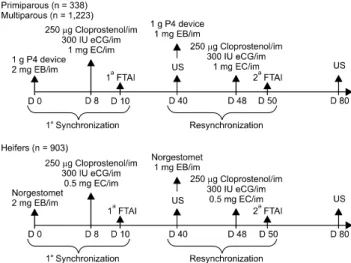
This study was conducted to evaluate the influence of category (heifers, primiparous or multiparous cows) on pregnancy rates in a large scale resynchronization ovulation program. Nelore heifers (n = 903), primiparous lactating cows (n = 338) and multiparous lactating cows (n = 1,223) were synchronized using a conventional protocol of estradiol/P4-based fixed-time artificial insemination (FTAI). Thirty days after ultrasonography, females who failed the first FTAI were resynchronized with the same hormonal protocol prior to a second FTAI. The pregnancy status of each cohort was evaluated by ultrasonography 30 days after each FTAI. The average conception rate after the first FTAI and resynchronization was 80.5%. Heifers had a higher conception rate (85%) than primiparous (76%) or multiparous cows (78%; p = 0.0001).
The conception rate after the first FTAI was similar among heifers (57%), primiparous cows (51%) and multiparous cows (56%; p = 0.193).
After the second FTAI, heifers exhibited a higher conception rate (66%) than primiparous or multiparous cows (51%; p = 0.0001). These results demonstrate the feasibility of resynchronization in large beef herds for providing consistent pregnancy rates in a short period of time. We also demonstrated that ovulation resynchronization 30 days after FTAI is particularly effective for heifers, providing a conception rate of up to 66%.
Keywords: Bos indicus, conception rate, fixed-time artificial insemination, hormonal treatment, resynchronization
Introduction
Reproductive efficiency is an important strategy for maximizing the productivity of cattle herds. Among the current strategies used to improve reproductive performance, ovulation synchronization has become the best technique for optimizing herd management and providing genetic improvements with greater efficiency.
Among beef cattle, approximately 40 to 60% of inseminated females become pregnant after the first cycle of fixed-time artificial insemination (FTAI), with slight variations in rates depending on several factors including the animals, farm management, body condition score, postpartum time and hormonal treatments [2,3,11]. Therefore, females that do not conceive after the first service need to be re-inseminated as soon as possible to increase the reproductive performance of the herd
[4,6,7,19]. If these females are not re-inseminated in a short period of time, the interval between calving and conception increases, decreasing the reproductive efficiency of the herd.
The resynchronization of females who failed the first FTAI is an effective strategy to increase the number of pregnancies achieved by AI during a short breeding season [19]. Ovulation resynchronization can increase the percentage of non-pregnant cows that are subjected to a second insemination [13] and be an advantageous strategy when the number of bulls is insufficient to mate with all of the cows that did not become pregnant after the first FTAI [8]. During resynchronization, all cows inseminated in the first round of FTAI should be evaluated by ultrasonography, and those that did not become pregnant receive the same hormonal protocol for a second round of FTAI [7,18].
One of the most common hormonal protocols for FTAI or
resynchronization in cattle involves the use of a progesterone