Introduction
Aquilegia belongs to Ranunculaceae which include about 70 perennial plant species. Natural habitats found in meadow and higher altitude area throughout the Northern Hemisphere.
Three species, A. japonica Nakai & H. Hara, A. buergariana var. oxysepala and A. buergariana var. oxysepala f. pallidiflora reportedly distribute in Korean Peninsula (Lee, 2003), and Ha et al. (2016) reported that A. buergariana var. oxysepala distribute in Gyeonggi-do province, Korea. A. japonica Nakai
& H. Hara is widely cultivated in domestic ornamental flower market. Aquilegia normally flowers from April to May. Cold temperature triggers floral differentiation and further flower development. Minimum 8 weeks of cold treatment at 4℃ at 12-leaves stage is needed to initiate flower development (Shedron and Weiler, 1982). White et al. (1990) reported that floral differentiation and further development of 13 species of Aquilegia was not observed after 7 months cultivation at 20℃
regardless of light condition. However, Zhang et al. (1991) reported that Aquilegia ‘Dove’ and ‘Purple’ flowered after 7~8 months cultivation at 20℃ day and 16℃ night temperature condition. They concluded gibberellin and light treatment accelerated flowering time by 2 weeks compared to control.
Gibberellin is a plant physiological metabolism regulator.
Lim et al. (2015) reported that gibberellin can facilitate germination of Pinus pumila. Gibberellin can facilitate floral differentiation and further flower development in some of angiosperm species which usually need long day and cold temperature condition to initiate floral differentiation and development (Ruth et al., 1992). Anton (1957) studied effect of gibberellin treatment on flowering in 17 angiosperm species and GA treatment enhanced flowering of Daucus carota L. (biennial plant) and Hyoscyamus niger L. (long-day plant), while Glycine max L. (short-day plant) did not respond by GA treatment. However, physiological mechanism con- trolling GA induced flowering in angiosperm is not clear yet.
Zeevaart (1983) reported that flowering on Samolus parviflorus was inhibited by gibberellin biosynthesis inhibitor treatment.
Effect of Gibberellin Treatment on Growth and Flowering
Characteristics in the Cultivation of Aquilegia japonica Nakai & H. Hara
Hoon Geun Oh 1 *, Joung Won Lee 1 , Gyeong Ja Lee 2 and Jae Seong Park 2
1
Researcher, Chungcheongbuk-do Agricultural Research and Extension Services, Cheongju 28130, Korea
2
Senior Researcher, Chungcheongbuk-do Agricultural Research and Extension Services, Cheongju 28130, Korea
Abstract - This study was conducted to develop gibberellin treatment technique to enhance flower initiation in Aquilegia japonica Nakai & H. Hara. Seedlings were planted in 12㎝-diameter pots on October 2016 and grown in green house.
Ambient temperature in the green house was set at minimum 15℃ during day and night to suppress flower initiation at cold temperature condition. Two different types of gibberellin, GA
3and GA
4+7, at 4 different concentration levels 100, 200, 400 and 600 ㎎/L, were tested in this study. Gibberellin was sprayed first at planting and secondly at 1-week after planting. Ten to fifteen ㎖ of gibberellin was sprayed for each pot. Plant height and petiole length were elongated by both gibberellin types, flowering was more enhanced by GA
3(91.7∼100%) compared to of GA
4+7. However, abnormal flower was less observed in GA
3treatment (0∼16.7%) than GA
4+7. Number of flower stalks per plant ranged from 1.9 to 2.5. Number of flowers per plant ranged from 6.8 to 10.3. Differences in flowering characteristics between treatments were statistically significant. Optimal gibberellin treatment to enhance flower initiation in A. japonica Nakai & H. Hara substituting cold treatment was GA
3at the concentration between 400 ㎎/L to 600 ㎎/L.
Key words – Floral differentiation, Plant growth regulator, Stem elongation
*Corresponding author. E-mail : [email protected] Tel. +82-43-220-5643
ⓒ 2018 by The Plant Resources Society of Korea
Original Research Article
This result suggested that the gibberellin biosynthetic pathway determined flowering in Samolus parviflorus.
In this study we tested different GA types at various concentrations and proposed optimal treatment enhancing flower initiation and further flower development of Aquilegia japonica Nakai & H. Hara.
Materials and Methods
Plant materials and treatment
Aquilegia japonica Nakai & H. Hara seedlings were planted in 12 ㎝-diameter pots on October 2016 and grown in green house. Ambient temperature in the green house was set at minimum 15℃ during day and night to suppress flower initiation at cold temperature condition. Two different types of gibberellin, GA
3and GA
4+7, at 4 different concentration levels 100, 200, 400 and 600 ㎎/L, were tested in this study.
Gibberellin was sprayed first at planting and secondly at 1-week after planting. Ten to fifteen ㎖ of gibberellin was sprayed for each pot. Positions of 10 plants per treatment were completely randomized and experiments were repeated 3 times.
Growth characteristics and Chlorophyll content measurement Growth characteristics including plant height, leaf length, leaf width and petiole length were measured according to agricultural examination research investigation standard (RDA, 2003) at 45-days after gibberellin treatment.
Chlorophyll content was measured by portable chlorophyll meter (JP/SPAD-502, Konica minolta). Flower characteristics including number of flower stalks, flower stalk length, number of flowers and corolla length were measured following agricultural examination research investigation standard (RDA, 2003) at 60-days after gibberellin treatment. Flowering percentage was calculated and abnormal flower morphology such as flower stalk dwarfness and fading flower color were monitored and frequency of abnormal flower was recorded.
Data analysis
Data were analyzed using CoStat (CoHort software, version 6.45, USA), and statistical significance between treatments were determined by Duncan’s multiple range test.
Results and Discussion
Growth characteristics
The growth of A. japonica Nakai & H. Hara at 45 days after gibberellin treatment is summarized in Table 1. Plant height was statistically different by gibberellin treatments compared to control. There was no noticeable difference between GA treatment and treatment at 100 ㎎/L concentration. However, plant height was started show difference at higher GA concentrations compared to control. Plant height ranged between 8.2~14.2 ㎝ when GA
3and GA
4+7were treated at 200, 400 and 600 ㎎/L compared to 8.0 ㎝ in control.
Gibberellin is one of the plant growth regulator and can cause rice bakanae disease (Galston, 1961).
One of the major effect of gibberellin on plant physiology is plant stem elongation. Phinney et al. (1986) proved that dwarfed maize caused by inhibition of endogenous gibberellin biosynthesis could be overcome by synthetic gibberellin treatment. Similarly plant height of A. japonica Nakai & H.
Hara was elongated by gibberellin treatment in this study. But A. japonica Nakai & H. Hara, differently from maize is a rosette type plant with dwarf stem. Because of this reason, plant height elongation of A. japonica Nakai & H. Hara is driven by leaf and petiole length elongation rather than stem elongation. In our study, leaf length was 5.5 ㎝ in control while leaf length ranged from 6.1 ㎝ to 7.1 ㎝ when GA
3at 200~600 ㎎/L was treated and 6.6 ㎝ to 6.8 ㎝ when GA
4+7at 200~600 ㎎/L was treated. Petiole length was even greater than leaf length. Petiole length was 5.3 ㎝ in control while it ranged from 8.2 ㎝ to 13.0 ㎝ when GA
3at 100~600 ㎎/L was treated, and 9.9 ㎝ to 13.2 ㎝ when GA
4+7at 100~600 ㎎/L was treated. Similarly, Tamotsu et al. (2005) also reported that the petiole of Arabidopsis thaliana was elongated by gibberellin treatment.
Gibberellin can elongate leaf or petiole as well as stem or stem node. We observed that leaf width was significantly elongated. Leaf width was 10.1 ㎝ in control while it was 12.2
㎝ when GA
3at 400 ㎎/L was treated, and 12.7 ㎝ when GA
3at 600 ㎎/L was treated and similar trend was observed in GA
4+7treatments. Leaf width was 12.3 ㎝ when GA
4+7at 400
㎎/L was treated and 11.8 ㎝ when GA
4+7at 600 ㎎/L was
treated. Gibberellin can facilitate plant cell division and
elongation by increasing RNA synthesis in plant cell (Johri and Varner, 1968). Because of this reason, GA is expected to trigger elongation of leaf length, petiole length and leaf width of A. japonica Nakai & H. Hara.
Average number of leaves per plant was 28.9 in control while it ranged from 18.0 to 33.2 by GA
3and 23.3 to 28.0 by GA
4+7. No remarkable difference was observed between GA types. Chlorophyll content was 57.2 in control while 51.0 by GA
3at 400 ㎎/L and 51.5 by GA
4+7at 600 ㎎/L. Chlorophyll appeared to be decreased by gibberellin treatment. Physiological disorder on plant morphology by gibberellin has not been reported in A. japonica Nakai & H. Hara. But inhibition of chloroplast development and fading leaf color were reported on some plant, similar to our study.
Flowering characteristics
A. japonica Nakai & H. Hara started flowering at 60 days after gibberellin treatment while control plants did not flower.
Flowering percentage was 91.7~100% by GA
3and 58.3~91.7%
by GA
4+7(Table 2). Flowering percentage was statistically different between GA
3and GA
4+7treatment. Anton (1957) reported that gibberellin could induce flowering on some of angiosperm species which need long-day and low temperature condition to flower. We also confirmed that A. japonica
Nakai & H. Hara could start flowering by gibberellin treatment replacing cold treatment. Gianfagna and Merritt (1998) reported that Aquilegia ‘Rose–White’ flowered after gibberellin treatment without low temperature condition, and flowering time was earlier by GA
4+7than GA
3. However in our study, days to flowering was similar between treatments regardless of GA types. Interestingly, flowering percentage was higher by GA
3than GA
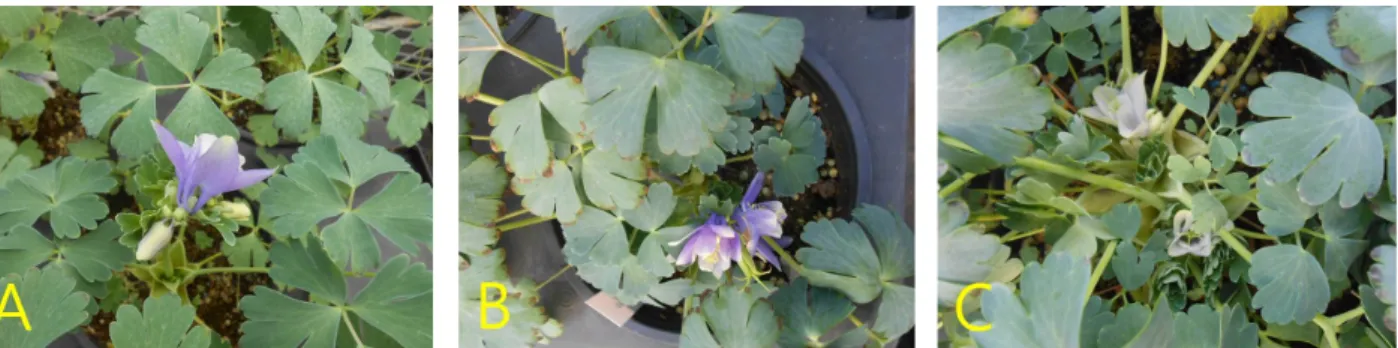
4+7(Fig. 1, Table 2). Abnormal flowers such as flower stalk dwarfness and fading flower Table 1. Effect of gibberellin treatment on growth characteristics in the cultivation of A. japonica Nakai & H. Hara
Gibberellin Plant
height ( ㎝)
Leaf length
( ㎝)
Leaf width
( ㎝)
Petiole length ( ㎝)
No. of leaves/plant
No. of tillerings/plant
Chlorophyll content (SPAD) Type Con. ( ㎎/L)
Control 8.0 c
z5.5 cd 10.1 cd 5.3 e 28.9 ab 4.0 b 57.2 a
GA
3100 10.2 c 5.2 d 8.9 d 8.2 d 33.2 a 4.6 ab 57.6 a
200 19.0 ab 6.1 a-d 10.5 b-d 10.8 bc 18.3 c 3.6 c 54.6 ab
400 21.1 a 7.0 a 12.2 ab 13.0 a 18.0 c 4.0 b 51.0 b
600 22.2 a 7.1 a 12.7 a 12.4 ab 21.2 bc 4.2 b 54.6 ab
GA
4+7100 11.5 c 5.6 b-d 9.6 d 9.9 cd 23.3 bc 3.4 c 56.3 ab
200 16.2 b 6.6 a-c 11.7 a-c 11.6 a-c 27.6 ab 6.1 a 53.7 ab
400 16.5 b 6.8 ab 12.3 ab 12.8 ab 24.6 bc 5.1 ab 54.7 ab
600 19.6 ab 6.6 a-c 1.8 a-c 13.2 a 28.0 ab 6.1 a 51.5 b
Two-way ANOVA
Type (A) * ns ns ns ns * ns
Con. (B) *** *** *** *** ** ns **
A×B ns ns ns ns *** ** ns
z
DMRT : 5%.
* p<0.05, ** p<0.01, *** p<0.001.
Table 2. Effect of gibberellin treatment on flowering and abnormal flowering percentage in the cultivation of A.
japonica Nakai & H. Hara Gibberellin
Flowering percentage (%)
Abnormal flowering percentage (%) Type Concentration
( ㎎/L)
Control - -
GA
3100 100.0 16.7
200 91.7 9.1
400 100.0 -
600 100.0 -
GA
4+7100 58.3 28.6
200 66.7 25.0
400 91.7 18.2
600 83.3 20.0
color were observed at the frequency of 0~16.7% when GA
3was treated, and this was lower than GA
4+7treatment (18.2~28.6%). Suh et al. (1992) reported that the flower color of tulip ‘Apeldoorn’ was clearer by GA
4+7than no treatment control. And Lee (1988) reported that gibberellin facilitated flowering time of Camellia japonica. However, our result was different possibly because of the difference in experimental design and condition. Respond of different plant materials by different GA types might result in difference in results as well.
Flowering characteristics of A. japonica Nakai & H. Hara were favorable by GA
3treatment than GA
4+7(Fig. 2). Number of flower stalks per plant was higher by GA
3ranging between 1.9 and 2.5 compared to 0.8 and 2.0 by GA
4+7(Table 3).
Flower stalk length ranged from 7.2 ㎝ to 10.4 ㎝ by GA
3compared to 4.5 ㎝ to 8.5 ㎝ by GA
4+7. Peduncle length
ranged from 0.9 ㎝ to 1.3 ㎝ by GA
3compared to 0.3 ㎝ to 0.8
㎝ by GA
4+7. Flower stalk and peduncle length especially appeared to elongate longer by GA
3. Interestingly, petiole length was elongated regardless of gibberellin types. Flower stalk diameter was also longer by GA
3ranging between 3.0 ㎜ to 3.6 ㎜ compared to 1.7 ㎜ to 2.6 ㎜ by GA
4+7. But statistical significance was not remarkable compared to other characteristics. Number of flowers per plant was significantly different between GA types and concentrations. Number of flowers per plant was higher by GA
3than GA
4+7. In addition, number of flowers increased with increase in GA concentration.
It was 2.0 by GA
4+7at 100 ㎎/L compared to 10.3 by GA
3at 600 ㎎/L. Flower size was also bigger by GA
3treatment.
Corolla height ranged between 2.0 ㎝ and 2.8 ㎝ when GA
3was treated compared to 1.1 ㎝ to 1.9 ㎝ by GA
4+7treatment.
Corolla height was statistically different between GA types Fig. 1. Effect of gibberellin treatment on flower growth in the cultivation of A. japonica Nakai & H. Hara (A) Normal Flower, (B) Abnormal flower (Flower stalk dwarfness), (C) Abnormal flower (Fading flower color).
GA
3GA
4+7Fig. 2. Effect of gibberellin treatment on flowering characteristic in the cultivation of A. japonica Nakai & H. Hara.
and concentrations. Corolla width ranged between 3.2 ㎝ and 4.0 ㎝ by GA
3compared to 1.9 ㎝ to 2.7 ㎝ by GA
4+7treatment. There was statistical difference between GA types.
In conclusion, GA
3was found more would be effective in regulating cell division and elongation of A. japonica Nakai
& H. Hara. Optimal gibberellin for flowering on A. japonica Nakai & H. Hara, replacing cold treatment was GA
3ranging between 400 ㎎/L and 600 ㎎/L.
Acknowledgements
This work was carried out with the support of “Cooperative Research Program for Agriculture Science and Technology Development (Project No. PJ011955)” Rural Development Administration, Republic of Korea.
References
Anton, L. 1957. Effect of gibberellin upon flower formation.
PNASU. 43(8):709-717.
Brickell, C. and H.M. Cathey. 1997. A-Z Encyclopedia of Garden Plants. DK Publishing Inc., New York, NY (USA).
pp. 127-128.
Galston, A.W. 1961. The Life of The Green Plant. Prentice- Hall, Englewood cliffs, NJ (USA). p. 116.
Gianfagna, T.J. and R.H. Merritt. 1998. GA
4/7promotes stem growth and flowering in a genetic line of Aquilegia×hybrida Sims. Plant Growth Regul. 24:1-5.
Ha, Y.H., C.Y. Yoon, S.C. Kim and J.H. Kim. 2016. Flora of Mt. Cheonma (Gyeonggi-do Prov.). Korean J. Plant Res.
29(1):90-109.
Johri, M.M. and J.E. Varner. 1968. Enhancement of RNA synthesis of isolated pea nuclei by gibberellic acid. PNASU.
59(1):269-276.
Lee, S.H. 1988. Effect of plant growth regulators on flowering in Camellia species. J. Oriental Bot. Res. 1(1):48-52 Lee, T.B. 2003. Coloured Flora of Korea. Hyangmoonsa
Publishing Co., Seoul, Korea. p. 368 (in Korean).
Lim, H.I., G.N. Kim, K.H. Jang and W.G. Park. 2015. Effect of wet cold and gibberellin treatment on germination of dwarf stone pine seeds. Korean J. Plant Res. 28(2):253-258.
Phinney, B.O., M. Freeling, D.S. Robertson, C.R. Spray and J. Silverthorne. 1986. Dwarf mutants in Maize-The gibberellin biosynthetic pathway and its molecular future: In Bopp, M.
(ed.), Plant Growth Substances 1985. Springer-Verlag, Berlin, Heidelberg. pp. 55-64.
Rural Development Administration (RDA). 2003. Agricultural examination research investigation standard. RDA, Suwon, Korea (in Korean).
Ruth, N.W., W.H. John and R.S. Chris. 1992. Gibberellin is required for flowering in Arabidopsis thaliana under short Table 3. Effect of gibberellin treatment on flowering characteristics in the cultivation of A. japonica Nakai & H. Hara
Gibberellin No. of
flower stalks/plant
Flower stalk length
( ㎝)
Flower stalk diameter
( ㎜)
Peduncle length
( ㎝)
No. of flowers/plant
Corolla height
( ㎝)
Corolla width
( ㎝) Type Con. ( ㎎/L)
GA
3100 2.3 a
z8.1 a-c 3.0 ab 1.2 a 6.8 bc 2.0 bc 3.2 ab
200 2.0 a 7.2 a-c 3.0 ab 1.3 a 8.8 ab 2.2 a-c 3.8 a
400 1.9 ab 9.7 ab 3.5 a 1.2 a 8.9 ab 2.8 a 4.3 a
600 2.5 a 10.4 a 3.6 a 0.9 a 10.3 a 2.6 ab 4.0 a
GA
4+7100 0.8 b 4.5 c 1.7 b 0.3 c 2.0 e 1.1 d 1.9 c
200 1.5 ab 5.9 a-c 2.0 b 0.4 bc 3.1 de 1.5 cd 2.2 bc
400 2.0 a 8.5 a-c 2.6 ab 0.8 a-c 6.0 bc 1.9 cd 2.7 bc
600 1.8 ab 5.7 bc 2.5 ab 0.8 ab 5.7 cd 1.9 b-d 2.4 bc
Two-way ANOVA
Type (A) * ** ** *** *** *** ***
Con. (B) ns ns ns ns ** ** ns
A×B ns ns ns * ns ns ns
z