• 검색 결과가 없습니다.

Anti-tumor effect of licochalcone-E is mediated by caspase-dependent apoptosis through extrinsic and intrinsic apoptotic signaling pathways in KB cancer cells

N/A
N/A
Protected

Academic year: 2021

Share "Anti-tumor effect of licochalcone-E is mediated by caspase-dependent apoptosis through extrinsic and intrinsic apoptotic signaling pathways in KB cancer cells"

Copied!
10
0
0

로드 중.... (전체 텍스트 보기)

전체 글

(1)

Copyright ⓒ 2017, Oral Biology Research Institute DOI: 10.21851/obr.41.04.201712.191

ORAL BIOLOGY RESEARCH

Anti-tumor effect of licochalcone-E is mediated by caspase-depen- dent apoptosis through extrinsic and intrinsic apoptotic signaling pathways in KB cancer cells

In-A Cho

1

, Kyeong-Rok Kang

1

, Su-Gwan Kim

1

, Do Kyung Kim

1

, Chun Sung Kim

1

, Sook-Young Lee

1

, Seung Sik Cho

2

, Goo Yoon

2

, Byung Soo ParK

1

, and Jae-Sung Kim

1

*

1

Oral Biology Research Institute, Chosun University, Gwangju 61452, Republic of Korea

2
Department of Pharmacy, College of Pharmacy, Mokpo National University, Muan 58554, Jeollanamdo, Republic of Korea (Received Sep 25, 2017; Revised version received Nov 22, 2017; Accepted Nov 22, 2017)

ABSTRACT ···

This study investigates the anti-cancer effects of licochalcone-E (Lico-E), a phenolic chalconoid derived from the genus Glycyrrhiza, in the human KB squamous cancer cell. Concentration-dependent cytotoxicity in KB cells increased following 24 hours of treatment with 12.5, 25, or 50 µg/ml Lico-E, with an estimated IC

50

value of approximately 25 µg/ml. Chromatin condensation, a typical apoptotic phenomenon, was observed in KB cells treated with Lico-E. Consistent with this finding, Lico-E increased caspase-3 activity in KB cells.

FasL, a death ligand associated with extrinsic apoptotic signaling pathways, was significantly up-regulated by Lico-E treatment.

Subsequently, the pro-apoptotic factor caspase-8, a part of the extrinsic apoptotic signaling pathway, was activated in a concentration- dependent manner by Lico-E treatments. Expression of anti-apoptotic factors such as Bcl-2 and Bcl-xL, components of the mitochondria- dependent apoptotic signaling pathway, significantly decreased following Lico-E treatment. Conversely, expression of pro-apoptotic factors such as Bax, Bad, Apaf-1, and caspase-9 increased with Lico-E concentrations. Finally, Lico-E activated caspase-3 and Poly (ADP-ribose) polymerase (PARP) to induce cell death. Z-VAD-fmk significantly inhibited cell death through suppression of caspase-3 expression in KB cells treated with Lico-E. Taken together, Lico-E induces KB cell death through death receptor and mitochondria- dependent apoptotic signaling pathways.

KEY WORDS: Apoptosis, Cancer, Caspases, Chemotherapeutic agent, Licochalcone-E

Introduction

Cancer is a disease with high mortality due to the inva- sion or metastasis of abnormal cells to other parts of the body [1]. Worldwide, the most commonly reported types of cancer are breast cancer, colorectal cancer, lung cancer, cervical cancer, and oral cancer [2]. The number of newly diagnosed cancer patients is increasing annually all over the world.

Recent studies associated with the development of che- motherapeutic agents have focused on producing cancer-

specific cell death to overcome numerous side-effects such as fatigue, pain, mouth and throat sores, diarrhea, nausea and vomiting, blood disorders, nervous system effects, loss of appetite and hair loss, among others [3, 4].

Thus, to overcome the side effects associated with current chemotherapies, drug developers have sought natural compounds that cause cancer-specific cell death from plants traditionally used in either folk or oriental medicine [5]. Furthermore, some medicinal plant-derived compounds that induce cancer-specific cell death have recently been approved by the United States Food and Drug Administration for chemotherapeutic use in cancer patients [6].

Licorice, the root from Glycyrrhiza species, is one of the most commonly used traditional oriental medicines [7].

Recently, licochalcone-A (Lico-A), a phenolic chalconoid purified from Glycyrrhiza species, has been reported to show anticancer effects in human lung cancer, human

*Corresponding author: Jae-Sung Kim

Pre-dentistry, School of Dentistry, Chosun University, 309 Phimundaero, Dong-gu, Gwangju 61452, Republic of Korea

Tel .: +82-62-230-7362, Fax: +82-62-230-7362 E-mail: [email protected]

Original Article

(2)

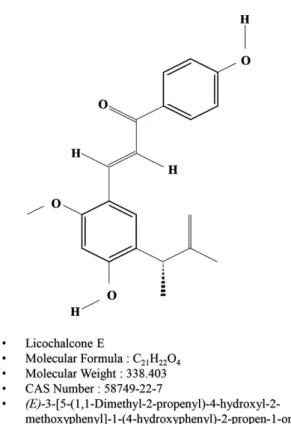
breast cancer, human cervical cancer, human gastric can- cer, and head and neck squamous carcinoma [7]. Lico- chalcone-E (Lico-E, (E)-3-[5-(1,1-Dimethyl-2-propenyl)- 4-hydroxyl-2-methoxyphenyl]-1-(4-hydroxyphenyl)-2- propen-1-one, C

21

H

22

O

4

) has also been isolated from lic- orice roots. As shown in Fig. 1, Lico-E is a flavonoid belonging to the retrochalcone family. In this study, we examined the anti-cancer effects of Lico-E and the poten- tial cellular signaling pathways associated with its mech- anism of apoptosis in the KB human squamous cancer cell.

Materials and Methods

Cell culture

The KB human squamous cancer cell was obtained from the American Type Culture Collection (ATCC), and cultured according to the instructions provided. Briefly, KB cells were maintained in minimum essential medium (Life Technologies, Grand Island, NY, USA) containing 10% fetal bovine serum (FBS). Cells were grown in a humidified incubator at 37

o

C in 5% CO

2

.

Cell viability assay

KB squamous cancer cells were cultured at a density of 5x10

5

cells/well in 96-well plates, and allowed to attach to the well overnight. After incubation, the cultured cells were treated with 12.5, 25, or 50 μg/ml Lico-E in tripli- cate, and incubated at 37

o

C in a 5% humidified CO

2

incu- bator for 24 h. MTT assay was then added to each well and incubation was continued for an additional 4 h at 37

o

C. To dissolve the resulting formazan, the cells were resuspended in 200 μL dimethyl sulfoxide, and the optical density (OD) of the solution was determined using a spec- trometer at an incident wavelength of 570 nm. The exper- iments were repeated three times, independently. The mean OD ± standard deviation (SD) for each group of rep- licates was calculated. The percentage of cell growth inhi- bition was calculated using the equation: % growth inhibition = [(1 − OD extract-treated cells) / (OD negative control cells)] × 100.

Cell survival assay

Cell survival was verified using calcein-AM to stain liv- ing cells, and ethidium bromide homodimer-1 to stain dead cells. These reagents were obtained from Molecular Probes (Eugene, OR, USA). For the cell survival assay, KB cells were cultured at a density of 5 × 10

5

cells/well in an 8-well chamber slide, and incubated with 12.5, 25, or 50 μg/ml Lico-E for 24 h, then stained with green cal- cein-AM and ethidium homodimer-1 according to the manufacturer's protocol. The cells were then observed and photographed using an inverted phase-contrast microscope (Eclipse TE2000; Nikon Instruments, Melville, NY, USA).

Nucleus staining using DAPI

Cells were treated with Lico-E and incubated for 24 h, then fixed with 4% paraformaldehyde before washing with PBS. The washed cells were stained with 1 mg/ml [4',6-diamidino-2-phenylindole dihydrochloride (DAPI);

Roche Diagnostics] for 20 min. Nuclear condensation was observed by fluorescence microscopy (Eclipse TE2000;

Nikon Instruments, NY, USA).

Caspase-3/-7 activity assay

The apoptotic activity of executioner caspase-3/-7 was determined using the cell-permeable fluorogenic substrate, PhiPhiLux-G

1

D

2

(OncoImmunin Inc., Gaithersburg, MD, USA), according to the manufacturer's instructions.

Fig. 1. Chemical structure of licochalcone-E.

(3)

Western blot analysis

KB cells plated on culture dishes at a density of 5 × 10

6

cells/ml were incubated for 24 h in a humidified incubator at 37

o

C in 5% CO

2

, then treated with Lico-E for 24 h.

Thereafter, the cells were lysed using a cell lysis buffer (Cell Signaling Technology, Danvers, MA, USA) contain- ing protease and phosphatase inhibitor cocktails, and incu- bated for 1 h at 4

o

C. Lysates were centrifuged at 14,000 × g for 10 min at 4

o

C. The supernatant contained the cyto- solic fraction. Total protein concentrations of the cell lysates were determined using bicinchoninic acid protein assays (Thermo Scientific, Rockford, IL, USA). Loading buffer (5×) was added to equal amounts of protein, and the mixture was boiled at 90

o

C for 10 min. Total proteins were separated using sodium dodecyl sulfate polyacryl- amide gel electrophoresis (SDS-PAGE) and transferred onto nitrocellulose membranes. After blocking for 2 h with 5% bovine serum albumin in Tris-buffered saline containing Tween-20 at room temperature, membranes were incubated with primary antibody at 4

o

C overnight, and then incubated with horseradish peroxidase-conju- gated secondary antibody. The antibodies used to study the apoptotic signaling pathways included antibodies against Fas ligand (FasL, 48 kDa), cleaved caspase-3 (17 and 19 kDa), cleaved caspase-8 (18 kDa), cleaved caspase-9 (37 kDa), poly (ADP ribose) polymerase (PARP, preform 116 kDa and cleaved form 85 kDa), B-cell lymphoma 2 (Bcl-2, 26 kDa), B-cell lymphoma extra-large (Bcl-xL, 26 kDa), Bcl-2-associated X protein (Bax, 21 kDa), Bcl-2- associated death promoter (Bad, 23 kDa), apoptotic pro- tease activating factor 1 (Apaf-1, 13 kDa), and β-actin (45 kDa), purchased from Cell signaling Technology (Dan- vers, MA, USA). The immunoreactive bands were visu- alized using the ECL System (Amersham Biosciences, Piscataway, NJ, USA) and were exposed on radiographic film.

Caspase dependent cell survival assay

Cells were plated at a density of 1 × 10

5

cells/ml in 96- well plates and allowed to attach overnight. After incu- bation, cultured cancer cells were treated with Lico-E in the presence or absence of 50 μM of the caspase-3 inhib- itor (Z-VAD-FMK, N-Benzyloxycarbonyl-Val-Ala-Asp(O- Me) fluoromethyl ketone) (Sigma-Aldrich, St. Louis, MO, USA) and were incubated for 24 h at 37

o

C. After incubation, cytotoxicity was measured using the MTT assay.

Statistical analysis

Data are reported as the mean ± standard deviation of three individual experiments performed in triplicate. Sta- tistical analysis was carried out using a Student's t-test, and a p-value < 0.05 was considered statistically signifi- cant.

Results

Lico-E induces KB cell death in a concentration- dependent manner

To verify whether Lico-E causes cytotoxicity, the MTT assay was performed on KB cells treated with various concentrations of Lico-E for 24 h. As shown in Fig. 2A, the percentage of cell growth inhibition was measured as

Fig. 2. Licochalcone-E treatment induces cytotoxicity in KB can-

cer cells. A. Concentration-dependent cytotoxicity was observed

in KB cells treated with Lico-E for 24 h. KB cells were cultured

and treated with 12.5, 25 and 50 µg/ml Lico-E for 24 h. Thereafter,

the MTT assay was performed to measure cytotoxicity. B. Lico-E

increased KB cell death in a dose-dependent manner. KB cells

were cultured and treated with 12.5, 25 and 50 µg/ml Lico-E for 24

h. Thereafter, living (stained as green fluorescence) and dead cells

(stained as red fluorescence) were stained using green calcein AM

and ethidium homodimer-1, respectively. Finally, the cells were

observed and photographed by inverted phase-contrast micros-

copy (Eclipse TE2000; Nikon Instruments, Melville, NY, USA).

(4)

19.7±2.4 (p<0.01), 53.4±2.8 (p<0.01), and 89.6±0.5% (p <

0.01) for KB cancer cells treated with 12.5, 25, and 50 μg/

ml Lico-E, respectively, compared with untreated controls.

Based on these results, the IC

50

value for Lico-E-induced cytotoxicity in KB cancer cells was estimated to be approximately 25 μg/ml. Furthermore, to confirm Lico-E- induced KB cell death, a living and dead cell assay was performed using permeable green calcein AM, which stains living cells with green fluorescence, and ethidium homodimer-1, which stains dead cell with red fluores- cence. As shown in Fig. 2B, after 24 h treatment the num- ber of dead KB cells stained with red fluorescence by ethidium homodimer increased with Lico-E concentration (12.5, 25, and 50 µg/ml). Taken together, these results indicate that Lico-E induces KB cell death in a concen- tration-dependent manner.

Lico-E-induced KB cell death is mediated by apoptosis To investigate whether Lico-E-induced KB cell death is mediated by apoptotic mechanisms, DAPI staining was performed to observe chromatin condensation, a represen-

tative phenomenon of programmed cell death, or apopto- sis, in KB cells treated with 12.5, 25, and 50 μg/ml Lico- E for 24 h. As shown in Fig. 3A, the number of KB cells with condensed nuclei increased with Lico-E treatment concentrations. Furthermore, to verify whether Lico-E- induced KB cell death is mediated by apoptosis, caspase- 3/-7 activity was measured using the cell-permeable flu- orogenic substrate, PhiPhiLux-G

1

D

2

. As shown in Fig. 3B, the cleavage of PhiPhiLux-G

1

D

2

by activated caspase-3 was significantly upregulated in KB cells treated with 25 μg/ml Lico-E, compared with non-treated control cells.

These results indicate that Lico-E-induced KB cell death is mediated by the activation of the pro-apoptotic factor caspase-3.

Lico-E-induced apoptosis is mediated by extrinsic death receptor-dependent and intrinsic mitochon- dria-dependent apoptotic signaling pathways

To investigate the cellular apoptotic pathways associ- ated with Lico-E-induced KB cell death, western blotting was performed, as shown in Fig. 4. FasL (48 kDa), a death receptor ligand associated with the extrinsic death receptor- mediated apoptosis pathway, was concentration-dependently up-regulated in KB cells treated with 12.5 and 25 μg/ml Lico-E, compared with non-treated control cells. Sequen- tially, up-regulated FasL induced a concentration-depen- dent increase in cleaved caspase-8 (18 kDa), a down- stream target of the pro-apoptotic factor FasL, in KB cells treated with Lico-E. These results indicate that Lico-E- induced apoptosis involves the extrinsic death receptor- mediated apoptosis pathway.

Furthermore, the expression of Bcl-2 (26 kDa) and Bcl-xL (26 kDa), anti-apoptotic factors associated with the intrin- sic mitochondria dependent apoptosis pathway, were con- centration-dependently down-regulated in KB cells treated with 12.5 and 25 μg/ml Lico-E, compared with non-treated control cells. Whereas, the expression of mitochondria depen- dent pro-apoptotic factors such as Bax (21 kDa), Bad (23 kDa) and Apaf-1 (130 kDa) were concentration-dependently increased in KB cells treated with Lico-E. Sequentially, Lico-E increased the expression of cleaved caspase-9 in KB cells. As shown in Fig. 4B, these results therefore indicate that Lico-E-induced KB cell death involves the intrinsic mitochondria-dependent apoptosis pathway. Sub- sequently, both cleaved caspase-8 and caspase-9, located both in the extrinsic death receptor mediated and intrinsic mitochondria-dependent apoptosis pathways, induced con- Fig. 3. Licochalcone-E-induced KB cancer cell death involves

apoptosis through the activation of caspase-3. In Fig. 3A, KB cells were cultured and treated with 12.5, 25 and 50 µg/ml Lico-E for 24 h. Thereafter, DAPI staining was performed to observe nuclear morphological alterations under inverted phase-contrast micros- copy (Eclipse TE2000; Nikon Instruments, Melville, NY, USA).

Condensed nuclei, which are typical of apoptotic cells, were observed in KB cells treated with Lico-E. In Fig. 3B, cultured KB cells were treated with 12.5, 25, and 50 µg/ml Lico-E for 24 h.

Thereafter, a caspase-3/-7 activity assay using its synthetic sub-

strate PhiPhiLux-G1D2 was performed to observe the activation of

caspase-3/-7 under inverted phase-contrast microscopy (Eclipse

TE2000; Nikon Instruments, Melville, NY, USA). The pro-apop-

totic factor cleaved caspase-3/-7 was observed in KB cells treated

with Lico-E.

(5)

centration-dependent up-regulation of cleaved caspase-3 (17 and 19 kDa) and PARP (89 kDa) in KB cells treated with Lico-E, as shown in Fig. 4C. Therefore, these results demonstrate that Lico-E-induced KB cell death is medi- ated by both the extrinsic death receptor-mediated and intrinsic mitochondria-dependent apoptotic signaling path- ways.

Lico-E-induced apoptosis depends on the activation of caspases in KB cells

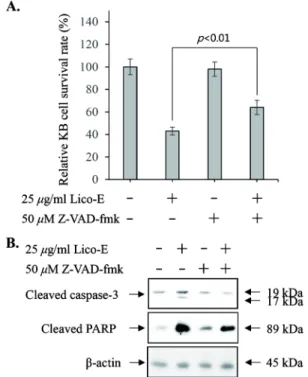
To verify whether Lico-E-induced apoptosis in KB cells requires caspase activation, Lico-E treated KB cells, with or without 50 μM pan caspase inhibitor Z-VAD-fmk, were incubated for 24 h. Thereafter, MTT staining and western blot analysis were performed, as shown in Fig. 5. Com- pared to untreated control cells, 25 μg/ml Lico-E treatment decreased the percentage of cell growth inhibition by 43±

6%. On the other hand, the relative survival rates were mea- sured as 65±8% in the KB cells co-treated with Lico-E and 50 µM pan caspase inhibitor Z-VAD-fmk for 24 h. Further- more, the cleaved form of pro-apoptotic factors such as caspase-3 and PARP were significantly down-regulated in the KB cells co-treated with Lico-E and 50 μM pan caspase inhibitor Z-VAD-fmk, compared with Lico-E treatment alone. These data indicate that Lico-E-induced apoptosis depends upon the activation of caspases in KB cells.

Fig. 4. Licochalcone-E-induced apoptosis is mediated by the extrinsic death receptor-mediated and the intrinsic mitochondria-dependent apoptotic signaling pathways in KB cells. KB cells were treated with 12.5 or 25 µg/ml Lico-E for 24 h. Thereafter, total proteins were extracted and western blots verified altered expressions of pro-apoptotic and anti-apoptotic factors associated with apoptotic signaling path- ways. In Fig. 4A, Lico-E upregulated the death receptor ligand FasL and subsequently induced the extrinsic death receptor-mediated apop- totic signaling pathway through the cleavage of caspase-8 in KB cells. In Fig. 4B, Lico-E induced the intrinsic mitochondria-dependent apoptotic signaling pathway in KB cells. In Fig. 4C, cleaved caspase-8 and caspase-9 induced the activation of caspase-3 and PARP in KB cells treated with Lico-E.

Fig. 5. Licochalcone-E-induced apoptosis is dependent on the

activation of caspases in KB cells. In Fig. 5A, pretreatment with

a pan-caspase inhibitor, Z-VAD-fmk, counteracts Lico-E-induced

KB cell death. KB cells were cultured and treated with 25 µg/ml

Lico-E in the presence or absence of 50 µM Z-VAD-fmk for 24

h. Thereafter, the MTT assay was performed to measure cyto-

toxicity. In Fig. 5B, A pan-caspase inhibitor Z-VAD-fmk inhib-

ited the activation of caspase-3 and PARP in KB cells treated with

Lico-E. Thereafter, total proteins were extracted and western blots

verified the alterations in expression of caspase-3 and PARP.

(6)

Discussion

Cancer, characterized by abnormal cell hyperplasia, is a chronic worldwide health problem [8, 9]. Recent studies report that more than 100 types of cancer have been clas- sified according to cell type and their pathological char- acteristics [10]. Although clinical interventions associated with cancer treatment, such as surgery, radiotherapy, and chemotherapy, have rapidly progressed due to huge invest- ments in the past half-century, resulting increases in the long-term survival rates of cancer patients have been mod- est [7, 11]. Recently, chemotherapy has demonstrated the greatest clinical efficacy among treatments for cancer patients [10]. However, despite the clinical efficacy of chemother- apy in treating cancer, clinical applications are often lim- ited by various side effects, such as high toxicity to healthy cells and multidrug resistance, among other side effects [12]. Therefore, to discover new clinical applica- tions of potential chemotherapeutic agents, recent drug development studies have focused on medicinal plants with known biological safety to overcome limitations imposed by negative side effects [11].

Licorice is the root from the genus Glycyrrhiza, includ- ing the species Glycyrrhiza glabra, Glycyrrhiza inflata, and Glycyrrhiza uralensis, which are commonly used in traditional oriental medicine [11]. Recent studies have reported that licorice roots contain multiple bioactive components such as saponins, flavonoids, and coumarins [13-15]. Fur- thermore, licorice has been shown to have anticancer effects in various types of cancer such as colon [16], lung [17, 18], breast [19, 20], prostate [21], and oral cancers [11] through metastatic inhibition [19], anti-proliferative properties [20], increased apoptosis [11, 22], and cell cycle arrest [23].

Recently, six retrochalcone compounds, which are struc- turally distinguished from typical chalcones by the lack of oxygen functionalities at C-2’ and C-6’, have been iso- lated and characterized from the roots of Glycyrrhiza spe- cies [24, 25]. Among these six retrochalcones, the chemical structure of Lico-E ((E)-3-[4-hydroxy-2-methoxy-5-[(2S)- 3-methylbut-3-en-2-yl]phenyl]-1-(4-hydroxyphenyl) prop- 2-en-1-one) is extremely similar to Lico-A ((E)-3-[4- hydroxy-2-methoxy-5-(2-methylbut-3-en-2-yl)phenyl]-1- (4-hydroxyphenyl)prop-2-en-1-one)). Furthermore, although studies associated with the biological effects of Lico-E have reported lower efficacy than that of Lico-A, the bio-

logical effects of both licochalcones exhibit similar prop- erties. According to recently reported studies associated with Lico-A, various biological effects such as neuropro- tective [26], chondroprotective [27, 28], antithrombotic [29], antimicrobial [30], and antiviral activities [30] have been reported. In addition, recent studies have also reported reduction in chronic allergic contact dermatitis as well as antidiabetic, anti-inflammatory, and antimicrobial effects. Anticancer effects of Lico-A have been promi- nently reported for various types of cancers, such as A549 and H460 human lung cancer cells [17], T24 bladder can- cer cells [31], human cervical cancer cells [32], human BGC-823 gastric cancer cells [33], malignant pleural mesothelioma [34], human FaDu head and neck squamous carcinoma cells [22], and human esophageal carcinoma [35] among others. On the other hand, although recent studies associated with the biological effects of Lico-E have been reported antidiabetic effect [36], the reduction of chronic allergic contact dermatitis [37], neuronal pro- tection [38], anti-inflammation [39] and antimicrobial effects [40], but the anticancer effects of Lico-E reported in the 4T1 mammary orthotopic cancer [41] and human head and neck squamous carcinoma FaDu cells [11]. As shown in various studies associated with biological effects of both licochalones, the physico-chemical properties of Lico-E are quite similar to those of Lico-A. Furthermore, we have recently reported that the anti-cancer effects of Lico-A and Lico-E in the human pharyngeal squamous carcinoma FaDu are mediated through extrinsic and intrin- sic apoptotic mechanisms [11, 22]. Therefore, we hypoth- esized that Lico-E may have anti-cancer effects similar to Lico-A in KB cells. In support of our hypothesis, the pres- ent study demonstrated that Lico-E induces apoptosis in KB cancer cells through activation of caspases in both the extrinsic death receptor-mediated and the intrinsic mito- chondria-dependent apoptotic pathways.

As shown in Fig. 2, Lico-E effectively induced cyto- toxicity in KB cells in a concentration-dependent manner.

In our previous study, Lico-E did not affect cell viability in healthy human oral keratinocytes used as controls [11].

Furthermore, the IC

50

value of Lico-E cell growth inhibi-

tion was estimated to be approximately 25 μg/ml in KB

cells. This value is a significantly lower concentration

compared to the reported 50 µg/ml IC

50

value for Lico-E

growth inhibition of FaDu human pharyngeal squamous

carcinoma cells [11]. These data indicate that Lico-E may

more effectively induce cytotoxicity in KB cells than in

(7)

FaDu human pharyngeal squamous carcinoma.

Next, to verify whether Lico-E-induced KB cell death involved apoptosis, DAPI staining was performed to observe nuclear condensation, a hallmark of apoptosis [42]. As shown in Fig. 3A, the number of KB cells with condensed nuclei was increased by Lico-E in a concen- tration-dependent manner. Although the exact role of nuclear condensation in apoptotic cells remains unknown, it may be closely related to chromosomal DNA degrada- tion by endonucleases [42]. To further verify Lico-E- induced apoptosis in KB cells, we measured the activation of caspase-3, a central component of the apoptotic cas- cade. As shown in Fig. 3B, the activity of caspase-3 was significantly increased in KB cells treated with Lico-E.

Caspase-3 pro-apoptotic factors lead to apoptosis after their activation through the cleavage of inactive precursors expressed in cells [42]. Therefore, these results are con- sistent with the hypothesis that Lico-E-induced cell death is mediated by apoptosis in KB cells.

However, apoptosis occurs through both extrinsic and intrinsic apoptotic pathways. The extrinsic apoptosis path- way is triggered by the binding of ligands such as the Fas ligand (FasL or CD95L), and/or tumor necrosis factor (TNF)-related apoptosis-inducing ligand (TRAIL) onto death domain-containing tumor necrosis factor-superfam- ily receptors, including CD95/Fas, TNF-R1, TRAIL-R1 (DR4), and TRAIL-R2 (DR5) [42]. Thereafter, intracellu- lar adaptor proteins, such as the Fas-associated death domain (FADD) and/or the TNF-R-associated death domain (TRADD), bind onto the cytosolic death domain of the death receptor to induce the cleavage of procaspase-8. Subsequently, the cleaved (active) form of caspase-8 induces the cleavage of procaspase-3 to form cleaved (active) caspase-3 [42, 43].

As shown in Fig. 4A, the expression of FasL was signifi- cantly and concentration-dependently elevated in KB cells treated with Lico-E. Sequentially, the expression of cleaved caspase-8 was concentration-dependently increased in KB cells treated with Lico-E. Although we did not investigate the interaction with intracellular adaptor proteins and up- regulated FasL in KB cells treated with Lico-E, these results indicate that Lico-E-induced apoptosis is mediated by the extrinsic death receptor-mediated apoptosis path- way through the up-regulation of FasL in KB cells.

Moreover, the mitochondrial outer membrane is pro- tected by anti-apoptotic factors including Bcl-2, Bcl-xL and Mcl-1, which neutralize the pro-apoptotic BH3-only members of the Bcl-2 family, such as Bax and Bak. There-

fore, the down-regulation of anti-apoptotic factors promote mitochondrial outer membrane permeability (MOMP) by the up-regulation of Bax and Bak [44, 45]. Apart from this, cleaved caspase-8, which is a proapoptotic factor associ- ated with the extrinsic death receptor-mediated apoptosis pathway, also increased MOMP through the cleavage of Bid to a truncated form tBid [44]. Thereafter, cytochrome c, released from mitochondrial outer membranes to the cytosol through the promoted MOMP form apoptosomes composed of a procaspase-9 and Apaf-1 [44]. Sequen- tially, procaspase-3 is activated through the cleavage of procaspase-9 induced by the interaction with Apaf-1. As shown in Fig. 4B, the expression of anti-apoptotic factors such as Bcl-2 and Bcl-xL were down-regulated in KB cells treated with Lico-E. However, the expression of proapoptotic factors such as Bax and Bad in KB cells were significantly increased by Lico-E. These results con- sistently indicate that the MOMP of KB cells treated with Lico-E is promoted by the imbalance between anti-apop- totic factors (Bcl-2 and Bcl-xL) and proapoptotic factors (Bax and Bad). Furthermore, the expression of Apaf-1 was concentration-dependently increased in KB cells treated with Lico-E. These results indicated Lico-E treated KB cells formed apoptosomes from a complex of cytochrome c released from the mitochondrial outer membrane, Apaf-1, and procaspase-9, in the presence of dATP. Subsequently, the expression of cleaved caspase-9 was gradually increased in KB cells treated with Lico-E in a concentration-dependent manner. Furthermore, these results indicate that Lico-E- induced apoptosis in KB cells involves an intrinsic mito- chondria-dependent apoptosis pathway. Finally, as shown in Fig. 4C, following Lico-E treatment in KB cells both cleaved caspase-8 and caspase-9 increased cleaved caspase-3 through the cleavage of procaspase-3. Then, cleaved caspase-3 triggered the cleavage of PARP to induce apop- tosis through the access of endonucleases to chromatin, as shown in Fig. 4C [42]. Taken together, these results con- sistently indicate that Lico-E-induced KB cell death is mediated by apoptosis through both the extrinsic death receptor mediated and intrinsic mitochondria-dependent apoptosis pathways.

However, apoptotic cell death through both the extrinsic

death receptor mediated and intrinsic mitochondria-depen-

dent apoptosis pathways is closely associated with the

cleavage of caspases such as caspase-8, caspase-9 and

caspase-3. Therefore, to verify whether Lico-E-induced

KB cell death is governed by the cleavage of procaspases,

(8)

we pretreated KB cells with Z-VAD-fmk, a cell-permeable fluoromethyl ketone (FMK)-derivatized peptide that acts as an irreversible caspase inhibitor with no cytotoxic effects, prior to Lico-E treatment. Thereafter, MTT assays were performed to measure cytotoxicity. As shown in Fig.

5A, Lico-E-induced KB cell death was significantly inhib- ited in the presence of Z-VAD-fmk compared to Lico-E only. Furthermore, the cleavage of caspase-3 and PARP were completely suppressed in KB cells co-treated with Lico-E and Z-VAD-fmk. Therefore, these results consis- tently indicate that Lico-E-induced KB cell death depends on the cleavage of procaspases in both the extrinsic death receptor mediated and the intrinsic mitochondria-depen- dent apoptosis pathways.

Our previous study showed Lico-E exhibits apoptotic effects in FaDu human pharyngeal squamous carcinoma cells through both extrinsic death receptor-mediated and intrinsic mitochondria-dependent intrinsic apoptosis path- ways triggered by upregulated expression of FasL. Simi- larly, in KB cells, Lico-E induced apoptosis through both extrinsic death receptor-mediated and intrinsic mitochon- dria- dependent intrinsic apoptosis pathways triggered by upregulated expression of FasL in KB.

In conclusion, these results suggest that the Lico-E derived from the roots of traditional medicinal plants of the genus Glycyrrhiza may be a potential chemotherapeu- tic drug lead. Our present study demonstrated Lico-E- induced apoptotic cell death in KB cells; however, further studies, including in vivo studies using xenograft animal models, are required to fully characterize the potential side effects and effective dose range of Lico-E.

Conflict of Interest

The authors declare that they have no competing interests.

ORCID

In-A Cho 0000-0003-4491-0068 Kyeong-Rok Kang 0000-0003-2981-6559 Su-Gwan Kim 0000-0002-0424-9984 Do Kyung Kim 0000-0001-6254-946X Chun Sung Kim 0000-0001-8612-3420 Sook-young Lee 0000-0002-1944-1274 Seung Sik Cho 0000-0003-1497-0529

Goo Yoon 0000-0001-7998-4708 Byung Soo Park 0000-0002-2908-3722 Jae-Sung Kim 0000-0002-3584-6351

References

1. Wojtukiewicz MZ, Hempel D, Sierko E, Tucker SC, Honn KV. Protease-activated receptors (PARs)--biology and role in cancer invasion and metastasis. Cancer Metastasis Rev 2015;34:775-796. doi: 10.1007/s10555- 015-9599-4.

2. Ferlay J, Soerjomataram I, Dikshit R, Eser S, Mathers C, Rebelo M, Parkin DM, Forman D, Bray F. Cancer inci- dence and mortality worldwide: sources, methods and major patterns in GLOBOCAN 2012. Int J Cancer 2015;136:E359-386. doi: 10.1002/ijc.29210.

3. Nersesyan H, Slavin KV. Current approach to cancer pain management: Availability and implications of dif- ferent treatment options. Ther Clin Risk Manag 2007;

3:381-400.

4. Decker-Baumann C, Buhl K, Frohmüller S, von Herbay A, Dueck M, Schlag PM. Reduction of chemotherapy- induced side-effects by parenteral glutamine supplemen- tation in patients with metastatic colorectal cancer. Eur J Cancer 1999;35:202-207. doi.org/10.1016/S0959-8049(98) 00389-X.

5. Gorman GS, Coward L, Darby A, Rasberry B. Effects of herbal supplements on the bioactivation of chemothera- peutic agents. J Pharm Pharmacol 2013;65:1014-1025.

doi: 10.1111/jphp.12055.

6. Kinghorn AD, Pan L, Fletcher JN, Chai H. The rele- vance of higher plants in lead compound discovery pro- grams. J Nat Prod 2011;74:1539-1555. doi: 10.1021/

np200391c.

7. Su X, Wu L, Hu M, Dong W, Xu M, Zhang P. Glycyr- rhizic acid: A promising carrier material for anticancer therapy. Biomed Pharmacother 2017;95:670-678. doi:

10.1016/j.biopha.2017.08.123.

8. Qi F, Zhao L, Zhou A, Zhang B, Li A, Wang Z, Han J.

The advantages of using traditional Chinese medicine as an adjunctive therapy in the whole course of cancer treat- ment instead of only terminal stage of cancer. Biosci Trends 2015;9:16-34. doi: 10.5582/bst.2015.01019.

9. Gupta P, Jani KA, Yang DH, Sadoqi M, Squillante E, Chen ZS. Revisiting the role of nanoparticles as modu- lators of drug resistance and metabolism in cancer.

Expert Opin Drug Metab Toxicol 2016;12:281-289. doi:

10.1517/17425255.2016.1145655.

10. Safarzadeh E, Sandoghchian Shotorbani S, Baradaran B.

Herbal medicine as inducers of apoptosis in cancer treat-

ment. Adv Pharm Bull 2014;4:421-427. doi: 10.5681/

(9)

apb.2014.062.

11. Yu SJ, Cho IA, Kang KR, Jung YR, Cho SS, Yoon G, Oh JS, You JS, Seo YS, Lee GJ, Lee SY, Kim DK, Kim CS, Kim SG, Jeong MA, Kim JS. Licochalcone-E induces caspase-dependent death of human pharyngeal squa- mous carcinoma cells through the extrinsic and intrinsic apoptotic signaling pathways. Oncol Lett 2017;13:3662- 3668. doi: 10.3892/ol.2017.5865.

12. Rastogi V, Yadav P, Bhattacharya SS, Mishra AK, Verma N, Verma A, Pandit JK. Carbon nanotubes: an emerging drug carrier for targeting cancer cells. J Drug Deliv 2014;2014:670815. doi: 10.1155/2014/670815.

13. Kinoshita T, Tamura Y, Mizutani K. The isolation and structure elucidation of minor isoflavonoids from lico- rice of Glycyrrhiza glabra origin. Chem Pharm Bull (Tokyo) 2005;53:847-849. doi:10.1248/cpb.53.847.

14. Isbrucker RA, Burdock GA. Risk and safety assessment on the consumption of Licorice root (Glycyrrhiza sp.), its extract and powder as a food ingredient, with emphasis on the pharmacology and toxicology of glycyrrhizin. Regul Toxicol Pharmacol 2006;46:167-192. doi: 10.1016/j.yrtph.

2006.06.002.

15. Hosseinzadeh H, Nassiri-Asl M. Pharmacological Effects of Glycyrrhiza spp. and Its Bioactive Constituents: Update and Review. Phytother Res 2015;29:1868-1886. doi:

10.1002/ptr.5487.

16. Lee CK, Park KK, Lim SS, Park JH, Chung WY. Effects of the licorice extract against tumor growth and cispla- tin-induced toxicity in a mouse xenograft model of colon cancer. Biol Pharm Bull 2007;30:2191-2195. doi:

10.1248/bpb.30.2191.

17. Qiu C, Zhang T, Zhang W, Zhou L, Yu B, Wang W, Yang Z, Liu Z, Zou P, Liang G. Licochalcone A Inhibits the Proliferation of Human Lung Cancer Cell Lines A549 and H460 by Inducing G2/M Cell Cycle Arrest and ER Stress. Int J Mol Sci 2017;18:1761. doi: 10.3390/ijms18081761.

18. Huang HC, Tsai LL, Tsai JP, Hsieh SC, Yang SF, Hsueh JT, Hsieh YH. Licochalcone A inhibits the migration and invasion of human lung cancer cells via inactivation of the Akt signaling pathway with downregulation of MMP-1/- 3 expression. Tumour Biol 2014;35:12139-12149. doi:

10.1007/s13277-014-2519-3.

19. Lee SK, Park KK, Park JH, Lim SS, Chung WY. The inhibitory effect of roasted licorice extract on human metastatic breast cancer cell-induced bone destruction.

Phytother Res 2013;27:1776-1783. doi: 10.1002/ptr.4930.

20. Tamir S, Eizenberg M, Somjen D, Stern N, Shelach R, Kaye A, Vaya J. Estrogenic and antiproliferative proper- ties of glabridin from licorice in human breast cancer cells. Cancer Res 2000;60:5704-5709.

21. Fu Y, Hsieh TC, Guo J, Kunicki J, Lee MY, Darzyn- kiewicz Z, Wu JM. Licochalcone-A, a novel flavonoid isolated from licorice root (Glycyrrhiza glabra), causes

G2 and late-G1 arrests in androgen-independent PC-3 prostate cancer cells. Biochem Biophys Res Commun 2004;322:263-270. doi: 10.1016/j.bbrc.2004.07.094.

22. Park MR, Kim SG, Cho IA, Oh D, Kang KR, Lee SY, Moon SM, Cho SS, Yoon G, Kim CS, Oh JS, You JS, Kim DK, Seo YS, Im HJ, Kim JS. Licochalcone-A induces intrinsic and extrinsic apoptosis via ERK1/2 and p38 phosphorylation-mediated TRAIL expression in head and neck squamous carcinoma FaDu cells. Food Chem Toxicol 2015;77:34-43. doi: 10.1016/j.fct.2014.12.013.

23. Jo EH, Kim SH, Ra JC, Kim SR, Cho SD, Jung JW, Yang SR, Park JS, Hwang JW, Aruoma OI, Kim TY, Lee YS, Kang KS. Chemopreventive properties of the etha- nol extract of chinese licorice (Glycyrrhiza uralensis) root: induction of apoptosis and G1 cell cycle arrest in MCF-7 human breast cancer cells. Cancer Lett 2005;230:

239-247. doi: 10.1016/j.canlet.2004.12.038.

24. Chang HJ, Yoon G, Park JS, Kim MH, Baek MK, Kim NH, Shin BA, Ahn BW, Cheon SH, Jung YD. Induction of apoptosis by the licochalcone E in endothelial cells via modulation of NF-kappaB and Bcl-2 Family. Biol Pharm Bull 2007;30:2290-2293. doi: 10.1248/bpb.30.2290.

25. Yoon G, Jung YD, Cheon SH. Cytotoxic allyl retrochal- cone from the roots of Glycyrrhiza inflata. Chem Pharm Bull (Tokyo) 2005;53:694-695. doi:10.1248/cpb.53.694.

26. Huang B, Liu J, Ju C, Yang D, Chen G, Xu S, Zeng Y, Yan X, Wang W, Liu D, Fu S. Licochalcone A Prevents the Loss of Dopaminergic Neurons by Inhibiting Microglial Activation in Lipopolysaccharide (LPS)-Induced Parkin- son's Disease Models. Int J Mol Sci. 2017;18:2043. doi:

10.3390/ijms18102043.

27. Chen WP, Hu ZN, Jin LB, Wu LD. Licochalcone A Inhibits MMPs and ADAMTSs via the NF-κB and Wnt/

β-Catenin Signaling Pathways in Rat Chondrocytes. Cell Physiol Biochem 2017;43:937-944. doi: 10.1159/

000481645.

28. Jia T, Qiao J, Guan D, Chen T. Anti-Inflammatory Effects of Licochalcone A on IL-1β-Stimulated Human Osteoar- thritis Chondrocytes. Inflammation 2017;40:1894-1902.

doi: 10.1007/s10753-017-0630-5.

29. Lien LM, Lin KH, Huang LT, Tseng MF, Chiu HC, Chen RJ, Lu WJ. Licochalcone A Prevents Platelet Activation and Thrombus Formation through the Inhibition of PLCγ2-PKC, Akt, and MAPK Pathways. Int J Mol Sci 2017;18:1500. doi: 10.3390/ijms18071500.

30. Wang L, Yang R, Yuan B, Liu Y, Liu C. The antiviral and antimicrobial activities of licorice, a widely-used Chinese herb. Acta Pharm Sin B 2015;5:310-315. doi: 10.1016/

j.apsb.2015.05.005.

31. Yang X, Jiang J, Yang X, Han J, Zheng Q. Licochalcone A induces T24 bladder cancer cell apoptosis by increas- ing intracellular calcium levels. Mol Med Rep 2016;14:

911-919. doi: 10.3892/mmr.2016.5334.

(10)

32. Tsai JP, Lee CH, Ying TH, Lin CL, Lin CL, Hsueh JT, Hsieh YH. Licochalcone A induces autophagy through PI3K/Akt/mTOR inactivation and autophagy suppres- sion enhances Licochalcone A-induced apoptosis of human cervical cancer cells. Oncotarget 2015;6:28851-28866.

doi: 10.18632/oncotarget.4767.

33. Hao W, Yuan X, Yu L, Gao C, Sun X, Wang D, Zheng Q.

Licochalcone A-induced human gastric cancer BGC-823 cells apoptosis by regulating ROS-mediated MAPKs and PI3K/AKT signaling pathways. Sci Rep 2015;5:10336.

doi: 10.1038/srep10336.

34. Kim KH, Yoon G, Cho JJ, Cho JH, Cho YS, Chae JI, Shim JH. Licochalcone A induces apoptosis in malig- nant pleural mesothelioma through downregulation of Sp1 and subsequent activation of mitochondria-related apoptotic pathway. Int J Oncol 2015;46:1385-1392. doi:

10.3892/ijo.2015.2839.

35. Yang P, Tuo L, Wu Q, Cao X. Licochalcone-A sensitizes human esophageal carcinoma cells to TRAIL-mediated apoptosis by proteasomal degradation of XIAP. Hepato- gastroenterology 2014;61:1229-1234.

36. Park HG, Bak EJ, Woo GH, Kim JM, Quan Z, Kim JM, Yoon HK, Cheon SH, Yoon G, Yoo YJ, Na Y, Cha JH.

Licochalcone E has an antidiabetic effect. J Nutr Bio- chem 2012;23:759-767. doi: 10.1016/j.jnutbio.2011.03.021.

37. Cho YC, Lee SH, Yoon G, Kim HS, Na JY, Choi HJ, Cho CW, Cheon SH, Kang BY. Licochalcone E reduces chronic allergic contact dermatitis and inhibits IL-12p40 production through down-regulation of NF-kappa B. Int Immunopharmacol 2010;10:1119-1126. doi: 10.1016/

j.intimp.2010.06.015.

38. Kim SS, Lim J, Bang Y, Gal J, Lee SU, Cho YC, Yoon G, Kang BY, Cheon SH, Choi HJ. Licochalcone E acti- vates Nrf2/antioxidant response element signaling path-

way in both neuronal and microglial cells: therapeutic relevance to neurodegenerative disease. J Nutr Biochem 2012;23:1314-1323. doi: 10.1016/j.jnutbio.2011.07.012.

39. Lee HN, Cho HJ, Lim DY, Kang YH, Lee KW, Park JH.

Mechanisms by which licochalcone e exhibits potent anti-inflammatory properties: studies with phorbol ester- treated mouse skin and lipopolysaccharide-stimulated murine macrophages. Int J Mol Sci 2013;14:10926-10943.

doi: 10.3390/ijms140610926.

40. Zhou T, Deng X, Qiu J. Antimicrobial activity of lico- chalcone E against Staphylococcus aureus and its impact on the production of staphylococcal alpha-toxin. J Microbiol Biotechnol 2012;22:800-805. doi:10.4014/jmb.1112.12020.

41. Kwon SJ, Park SY, Kwon GT, Lee KW, Kang YH, Choi MS, Yun JW, Jeon JH, Jun JG, Park JH. Licochalcone E present in licorice suppresses lung metastasis in the 4T1 mammary orthotopic cancer model. Cancer Prev Res (Phila) 2013;6:603-613. doi: 10.1158/1940-6207.CAPR- 13-0012.

42. Prokhorova EA, Zamaraev AV, Kopeina GS, Zhivotovsky B, Lavrik IN. Role of the nucleus in apoptosis: signaling and execution. Cell Mol Life Sci 2015;72:4593-4612.

doi: 10.1007/s00018-015-2031-y.

43. Zamaraev AV, Kopeina GS, Zhivotovsky B, Lavrik IN.

Cell death controlling complexes and their potential ther- apeutic role. Cell Mol Life Sci 2015;72:505-517. doi:

10.1007/s00018-014-1757-2.

44. Parrish AB, Freel CD, Kornbluth S. Cellular mecha- nisms controlling caspase activation and function. Cold Spring Harb Perspect Biol 2013;5:a008672. doi:

10.1101/cshperspect.a008672.

45. Gillies LA, Kuwana T. Apoptosis regulation at the mito- chondrial outer membrane. J Cell Biochem 2014;115:

632-640. doi: 10.1002/jcb.24709.

수치

Fig. 1. Chemical structure of licochalcone-E.
Fig. 2. Licochalcone-E treatment induces cytotoxicity in KB can- can-cer cells. A. Concentration-dependent cytotoxicity was observed in KB cells treated with Lico-E for 24 h
Fig. 5. Licochalcone-E-induced apoptosis is dependent on the activation of caspases in KB cells

참조

관련 문서