ABSTRACT
Purpose:
The rice germ fraction is a better source of protein, lipid, and fiber than the rice endosperm. Furthermore, the rice germ is rich in bioactive phytochemicals such as γ-aminobutyric acid, tocopherols, tocotrienols, phytic acid, and so on. In this study, the phytosterol content and antioxidant activity of Keunnunjami germ (KG) or normal rice germ supplement were investigated in healthy adult rats.
Methods: In vitro, quantitative assessment of phytosterols, including β-sitosterol,
campesterol, cycloartenol, and stigmasterol, was performed. Comparative antioxidant activities of 2 rice germs were measured based on DPPH radical scavenging activity, reducing power, and ABTS radical scavenging capacity. In vivo, male Spraque-Dawley rats (30-weeks- old) were randomly assigned a diet of normal control (NC, AIN-93M diet), AIN-93M diet supplemented with normal rice germ 3% (NG3), or AIN-93M diet supplemented with KG 3%
(KG3) and fed for 8 weeks.
Results:
KG contained significantly higher campesterol and stigmasterol contents and antioxidant activity than normal rice germ. The KG3 group exhibited significantly lower body weight gain as well as inguinal and total white adipose tissue weights. There were no significant differences in plasma glucose, insulin, C-peptide, or homeostasis model assessment of insulin resistance level among the 3 groups. The plasma tumor necrosis factor-α concentration was significantly lower while leptin, advanced oxidation protein products, and interleukin-6 showed downward trends in the KG3 group. In addition, the superoxide dismutase level of the KG3 group was significantly higher compared to the NC and NG3 groups.
Research Article
Received: Nov 6, 2019 Revised: Mar 6, 2020 Accepted: Mar 13, 2020 Correspondence to Mi Young Kang
Department of Food Science and Nutrition, Kyungpook National University, 80 Daehak-ro, Buk-gu, Daegu 41566, Korea.
Tel: +82-53-950-6235 E-mail: [email protected]
© 2020 The Korean Nutrition Society This is an Open Access article distributed under the terms of the Creative Commons Attribution Non-Commercial License (http://
creativecommons.org/licenses/by-nc/3.0/) which permits unrestricted non-commercial use, distribution, and reproduction in any medium, provided the original work is properly cited.
ORCID iDs Jie Liang
https://orcid.org/0000-0001-9479-0485 Jing Wen Ma
https://orcid.org/0000-0003-1752-943X Soo Im Chung
https://orcid.org/0000-0002-1452-7191 Mi Young Kang
https://orcid.org/0000-0002-9053-8650 Funding
This work was carried out with the support of
“Cooperative Research Program for Agriculture Science and Technology Development (project No. PJ013140)” Rural Development Administration, Republic of Korea.
Conflict of Interest
There are no financial or other issues that might lead to conflict of interest.
Phytosterols content of Keunnunjami germ and its antioxidative effects in adult rats
Jie Liang
1, Jing Wen Ma
1, Soo Im Chung
1,2, and Mi Young Kang
11Department of Food Science and Nutrition, Kyungpook National University, Daegu 41566, Korea
2International Agricultural Training Center, Kyungpook National University, Daegu 41566, Korea
큰눈자미 배아의 식물성 스테롤 함량 및 성숙기 흰쥐에서 항산화 효과
량지에
1, 마징원
1, 정수임
1,2, 강미영
11경북대학교 식품영양학과
2경북대학교 농업과학기술연구소
Conclusion: This study indicates that KG can be considered as a valuable source of
phytosterol components. Lastly, KG has strong antioxidant properties and may have potential to ameliorate elevation of proinflammatory cytokine production with age.
Keywords: antioxidants, functional food, cytokines, phytosterols, rice
서론
쌀은 아시아 국가의 주요 식량자원으로서 생활에 필요한 에너지 공급을 위한 영양원으로 인 식이 되었으나
,최근 쌀의 생리적 효능이 다양하게 규명되면서 쌀의 고부가가치화를 위하여 쌀의
2차
, 3차 기능성을 증진시키는 방향으로의 연구들이 활발하게 진행되고 있다
.즉 품종
개량을 통하여 기능성이 강화된 신품종 개발
[1-5]과 가공성 증진 병용
[6,7]에 의한 건강증진
용 쌀가공 식품의 다양화 그리고 생리활성 효능 검증을 통한 건강기능성 신소재로서의 개발
[8-10]
등이 진행되고 있다
.이러한 노력의 결과 품종 개량을 통하여 아밀로오스 함량이 높은
고아미
2호
[5],일반 품종 보다 배아가 큰 거대배아미
[3]및 안토시아닌 색소 함량이 증대된
자미 품종
[1,2,4]등이 육종되었고
,이들 쌀 품종을 활용하여 다양한 종류의 쌀가공 식품 개
발
[11-13]및 쌀의 건강기능성 식품 소재화 등이 이루어지고 있다
.쌀과 쌀의 부산물 생산량을 볼 때
1 kg당 배유
700 g,왕겨
200 g,미강
80 g,배아
20 g정도이 다
[14].쌀의 일반 성분을 비교해 보면 배아는 수분과 당질을 제외한
lipid, protein, fiber, ash의 함량이 배유보다 월등히 많다고 보고되었으며
[15], flavonoid, carotenoids, phenolic com- pounds, phytosterols, vitamin E isoforms, γ-oryzanol, coumaric acid, phytic acid, tricin등 대부 분 생리 활성 성분은 미강과 배아에 함유되어 있다
[16].또한 쌀의 주요
phytosterols은
β-sitos- terol, campesterol, stigmasterol및
∆5-avenasterol로 구성되어 있으며
[17], Yoshida와
Niki [18]의 연구에 따라
phytosterols은 화학적으로 항산화제
, radical scavenger,물리적으로 세포막에
서
stabilizer로 작용한다고 보고되었다
.한편
,배아를 소재로 한 연구에서 일반미 품종의 배
아오일을 보충 급여하는 경우에 당뇨 개선 및 지질대사 개선 효과를 보였다는 결과가 있었다
[19,20]. Cho
등
[21]의 연구에서 고콜레스테롤 식이 흰쥐 모델에 쌀 배아를 첨가함으로써 간
의 항산화효소의 활성을 증가시켜 지질과산화물 축적을 감소시켰음을 확인하였다
.본 연구의 소재로 사용한 큰눈자미는 기능성 유색미로서
cyanidin 3-glucoside함량이 높을 뿐
아니라 배아의 크기가 일반 벼에 비해 약
3배정도 큰 것이 특징이다
[22].과피의 색소가 흑자
색이므로 높은 플라보노이드 화합물 함량으로 인해 생리활성 효능이 더욱 긍정적일 것이라
기대된다
.따라서 본 연구자들은 고기능성 쌀 품종으로 육종한 큰눈자미벼를 분획별로 나누
어 건강 증진용 식품으로의 활용 방안을 모색하는 것이 쌀의 고부가가치화를 이끌 수 있을
것이라 생각하며
,영양가치가 높은 배아 분획의
phytosterols함량
,항산화 활성을 측정하고
,성숙기 흰쥐에게 보충 급여하였을 때의 당질 대사
,항산화능 및 일부의
cytokines개선 여부
를 각각 검증하여 중년 이후 성인의 항산화 관련 대사 개선을 위한 건강 기능성 식품 소재화
가능성을 검토하고자 한다
.연구방법
실험재료
본 실험에 사용된 큰눈자미는 한국방송통신대학교 농학과에서 현미상태로 제공을 받았다
.도정 과정을 걸쳐 미강 부분을 제외한 배아와 배유가 섞인 상태에서 수작업으로 배유를 걸 러낸 후에 배아를 거두어 실험에 사용하였다
.일반현미 배아는 국내 일반마트
(Emart, Seoul,Korea)
에서 구입하여 사용하였다
.시약
Chloroform (CHCl3), n-hexane, dimethyl sulfoxide (DMSO), 5-cholestane, 2,2-diphenyl-1-picryl- hydrazyl (DPPH), potassium hydroxide (KOH), sodium phosphate, potassium hexacyanoferrate (III) (K3Fe(CN)6), trichloroacetic acid (TCA), iron (III) chloride (FeCl3), 2,2′-azino-bis (3-ethylben- zothiazoline-6-sulfonic acid) diammonium salt (ABTS), potassium persulfate, L-ascorbic acid, β-sitosterol, campesterol, cycloartenol, stigmasterol
는
Sigma-Aldrich Chemical Co. (St. Louis, MO, USA)에서 구입하였으며
, methanol (MeOH), ethanol는
Merck KGaA (Darmstadt, Germany)에서 구입하여 사용하였다
.배아추출물제조
Phytosterols
정량 분석용 배아는 일부 수정한
Kwon등
[23]의 방법에 따라 추출하였다
. CH- Cl3-MeOH (2:1, v/v)혼합용매
100 mL에 배아 파우더
10 g을 첨가한 후
sonicator (Sinhan-Sonic,Incheon, Korea)
에 넣어 상온에서
2시간 동안 추출하였다
.추출은 총
2회 실시하였고 추출
액을 모아
Whatman GF/A glass fiber filter paper (Whatman, Maidstone, UK)로 필터링한 후에
rotary evaporator (N-1110; EYELA, Tokyo, Japan)에 넣어
30°C에서 농축시켰다
. N-hexane 10 mL를 가하고 필터링 처리하며 다시 농축시켜
oil형태를 얻었다
. Oil시료는 분석 전까지
−70°C에 보관하였다
.항산화 효과 측정용 배아 추출은
Butsat과
Siriamornpun [24]의 방법에 따라 수정하여 진행하
였다
. Eighty percent MeOH 20 mL에 배아 파우더
2 g을 가하고
, incubator (WSB-45; DAIHAN Scientific, Wonju, Korea)에 넣어 상온에서
150 rpm로
16시간 동안 교반 시키면서 총
2번 추출 하였다
.추출액을
centrifuge (Mega 17R; Hanil Scientific Inc, Gimpo, Korea)로
4°C, 2,500 rpm에서
20분간 원심분리하여 상층액을 얻은 후
Whatman No.4 filter paper (Whatman)로 필터
링하였다
.여과액을
rotary evaporator에 넣어
40°C에서 농축한 후 동결건조하여 분석전까지
−70°C
에 보관하였다
.Phytosterols
정량분석Phytosterols
함량은
Kwon등
[23], Park과
Lee [25]의 방법에 따라 수정하여 분석하였다
. 2 N KOH (dissolved in ethanol)용액
2 mL에 배아
oil샘플
0.1 g을 가하고
incubator (WB-11, DAIHAN Scientific)에 넣어
100°C에서
15분간 비누화시켰다
.샘플을 냉각시켜 증류수와
n-hexane을 각
각
2 mL를 가하고 상층액인
n-hexane층을 분리한 후 다시
n-hexane 2 mL를 넣었다
.분리된
n-hexane층을 모아
sodium sulfate anhydrous로 탈수시켜
5-cholestane (1 mg/1 mL in n-hexane) 100 µL를 넣은 후
GC-MS (Gas Chromatograph Mass Spectrometer, 7890B-5977B GC/MSD; Agi- lent, Santa Clara, CA, USA)로 분석하였다
.항산화활성측정
DPPH radical
소거 활성을 이용하는 전자공여능 측정은
Blois [26]의 방법에 따라 수정하여 진
행하였다
.동결건조된 배아 샘플을 농도별로
DMSO에 녹인 후
0.12 mM DPPH (dissolved inethanol)
용액
500 µL를 가하고 암소에서
30분간 반응시킨 후
517 nm에서 흡광도를 측정하였
다
.전자공여능은 시료첨가군과 시료무첨가군의 흡광도의 차이를 백분율
(%)로 나타냈으 며
,아래와 같이 계산하였다
.환원력
(reducing power)측정은
Oyaizu [27]의 방법에 따라 수정하여 진행하였다
.배아 샘플 과
0.2 M phosphate buffer 100 µL, 1% K3Fe(CN)6 100 µL를 혼합하고
incubator에 넣어
50°C에서
20분간 반응시킨다
.이후
10% TCA 100 µL를 가하여
4°C, 5,000 rpm에서
10분간 원심분리하 였다
.상층액
100 µL를 분리하고 증류수
100 µL와
0.1% FeCl3 20 µL를 가하여
700 nm에서 흡 광도를 측정하였다
.ABTS radical
소거능 측정은
Re등
[28]의 방법에 따라 수정하여 진행하였다
. 7.4 mM ABTS와
2.6 mM potassium persulfate
를 혼합하여 상온 암소에서 하루 동안 방치하여
ABTS이온을 형
성시킨 후
734 nm에서 흡광도 값이
1.4–1.5까지 될 때까지 증류수로 희석하였다
.배아 샘플
과
standard인
L-ascorbic acid에
ABTS용액
10 mL를 가하여
30분간 반응시키다가
734 nm에 서 흡광도를 측정하였다
.시료첨가군과 시료무첨가군의 흡광도의 차이를
µg ascorbic acid equivalents (AAE)로 나타내었다
.실험동물및실험디자인
생후
30주령 수컷
Spraque-Dawley rats 30마리를
㈜중앙실험동물
(Seoul, Korea)에서 공급받 아
1주일간 고형식이를 급여하여 주변환경에 적응시킨 후 본 실험에 사용하였다
.동물 사육 실 환경은 온도
25 ± 2°C,습도
50 ± 5%,명암주기
12시간 간격으로 유지하였다
.동물 실험은 경 북대학교 동물실험윤리위원회의 승인
(승인번호
: 2018-0036)을 받아 진행하였다
. 1주일 후 체 중을 유사하도록
randomized block design을 이용하여
10마리씩
3군으로 배분하였다
.실험식 이 디자인은
Kawabata등
[29]의
diet구성을 참고하여 수행하였다
.식이 조성은
Table 1과 같 다
.일반식이
(AIM-93M)를 급여한 정상대조군
(normal control, NC),일반식이에 일반현미배 아
3%를 첨가한 군
(AIM-93M + normal rice germ 3%, NG3),일반식이에 큰눈자미배아
3%를
첨가한 군
(AIM-93M + Keunnunjami germ 3%, KG3)으로 나누어 고형식이와 식수를 제한없이
8
주간 사육하였다
.식이 섭취량은 매일 일정한 시간에 기록하였으며
,체중 및 혈당 변화는
2주마다 측정하였다
.시료수집
8
주 후 희생 전날 실험동물을
12시간 절식시켜
CO2가스로 흡입 마취한 후 헤파린이 처리된
주사기로 복부 하대 정맥에서 채취한 혈액을
4°C, 3,000 rpm에서
15분간 원심분리하여 혈장
을 얻은 후 분석전까지
–70°C에 보관하였다
.lectron donating ability (%) = �1 − (absorbance value of sample − absorbance value of sample control)
absorbance value of control � × 100
혈액의생화학적분석
혈중
glucose수준은
kit (Asan Pharmaceutical Co., Seoul, Korea)로 측정하였고
,혈중 인슐린
,당화혈색소
, thiobarbituric acid reactive substances (TBARS), superoxide dismutase (SOD)는
en- zyme-linked immunosorbent assay (ELISA) kit (MyBioSource, San Diego, CA, USA)로 측정하였 다
.혈중
C-peptide, leptin, interleukin-6 (IL-6), tumor necrosis factor-α (TNF-α)수준은
ELISA kit (Fine Biotech Co., Wuhan, China)로 측정하였다
.혈장
advanced oxidation protein products (AOPP)는
ELISA kit (Sunlong Biotech Co., Hangzhou, China)를 구입하여 측정하였다
.통계분석
통계분석은
SPSS (ver.25; IBM Corp., Armonk, NY, USA)프로그램을 사용하여 실험결과를
mean ± SE로 구하였다
. In vitro실험에서 배아군들 간의 유의성 검정은
Independent samples t-test로 하였고
, In vivo실험에서 대조군 및 배아 섭취군들 간 유의성 차이는
p < 0.05수준에 서
Tukey's range test를 이용하여 실시하였다
.결과
Phytosterols
함량일반현미 배아
(NG)와 큰눈자미 배아
(KG)의
phytosterols함량 측정결과는
Table 2에 나타내 었다
. β-sitosterol의 함량은
NG가
0.83 mg/g, KG가
0.80 mg/g로 나타났으며
, cycloartenol의 함 량은
NG가
0.28 mg/g, KG가
0.27 mg/g로 유의적인 차이가 없었다
. Campesterol의 함량은
NG Table 1. Composition of experimental diets (%)Components Experimental diets
NC NG3 KG3
Casein 14.00 13.48 13.32
Sucrose 10.00 10.00 10.00
Dextrose 15.50 15.50 15.50
Corn starch 46.57 45.14 45.59
Cellulose 5.00 4.68 4.41
Soybean oil 4.00 3.27 3.26
NG - 3.00 -
KG - - 3.00
Mineral mix 3.50 3.50 3.50
Vitamin mix 1.00 1.00 1.00
L-cystine 0.18 0.18 0.18
Choline bitartrate 0.25 0.25 0.25
TBHQ 0.0008 0.0008 0.0008
Total 100.00 100.00 100.00
NC, normal control diet (AIN-93M); NG3, AIN-93M + normal rice germ 3%; KG3, AIN-93M + Keunnunjami germ 3%; NG, normal rice germ; KG, Keunnunjami germ; TBHQ, tertiary butylhydroquinone.
Table 2. Phytosterol contents of NG and KG powder (mg/g powder)
Phytosterols NG KG
β-sitosterol 0.83 ± 0.06 0.80 ± 0.04
Campesterol 0.15 ± 0.01 0.33 ± 0.02**
Cycloartenol 0.28 ± 0.02 0.27 ± 0.02
Stigmasterol 0.10 ± 0.01 0.14 ± 0.01*
Values are expressed as means ± SE.
NG, normal rice germ; KG, Keunnunjami germ.
*p < 0.05, **p < 0.01 by independent sample t-test.
가
0.15 mg/g에 비해
KG가
0.33 mg/g로
2배 높게 나타났다
(p < 0.01). Stigmasterol의 함량은
NG가
0.10 mg/g, KG가
0.14 mg/g로 나타났으며
KG가 유의하게 높았다
(p < 0.05).항산화활성측정
일반현미와 큰눈자미 배아 메탄올 추출물에 대한 항산화 활성 측정결과는
Fig. 1과같다
.전 자공여능은
10, 2, 1 mg/mL농도에서
NG는
33.60%, 12.81%, 10.52%, KG는
90.42%, 38.40%,23.66%
으로 나타나 큰눈자미 배아군에서 유의하게 높은 활성을 보였다
(p < 0.001).환원력
을 측정한 결과
10, 2, 1 mg/mL농도에서
NG의 흡광도 값은
0.24, 0.08, 0.07로 나타났으며
, KG는
1.11, 0.38, 0.24로 나타나
NG에 비해 유의적으로 높았다
(p < 0.001). ABTS radical소거능 도
10, 2, 1 mg/mL농도에서
NG가 각각
130.34 µg AAE, 36.95 µg AAE, 19.66 µg AAE로 측정되 었으며
, KG는 각각
167.57 µg AAE, 103.00 µg AAE, 65.49 µg AAE로 유의적 높은 값으로 나타났 다
(p < 0.001).체중변화
,
식이효율및부위별지방무게체중 변화
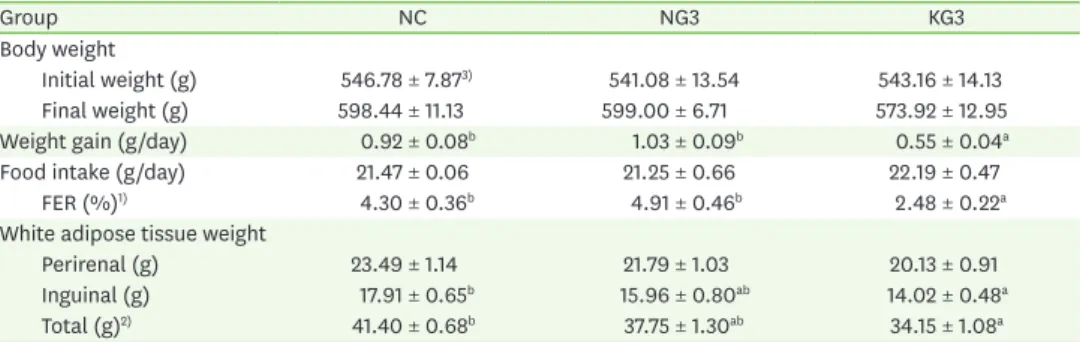
,식이 효율 및 부위별 지방 무게 측정결과는
Table 3과 같다
.실험을 시작할 때와 종료
시의 체중은 세 군 사이에 유의적인 차이가 없었으나
,체중 증가량은
NC군이
0.92 g/day, NG3군
이
1.03 g/day에 비해
KG3군이
0.55 g/day로 유의적으로 감소한 것으로 나타났다
(p < 0.05).식이 A
Electron donating ability (%) 0
Concentration (mg/mL)
1 2 10
***
60 100
20 80
40
C
ABTS radical scavenging activity (µg AAE) 0 120 200
40 160
80
***
***
B
Absorbance at 700 nm
0 0.6 1.4
0.2 1.0
0.4 1.2
0.8
Concentration (mg/mL)
1 2 10
***
***
***
Concentration (mg/mL)
1 2 10
***
***
NG ***
KG
NG KG
NG KG
Fig. 1. Antioxidant activities measurement of KG. (A) electron donating ability, (B) reducing power, (C) ABTS radical scavenging activity. Values are expressed as means ± SE. NG, normal rice germ; KG, Keunnunjami germ; µg AAE, µg ascorbic acid equivalents. ***p < 0.001 by independent sample t-test.
Table 3. Changes in body weight, food intake and white adipose tissue weight of aged rats treated with Keunnunjami germ
Group NC NG3 KG3
Body weight
Initial weight (g) 546.78 ± 7.873) 541.08 ± 13.54 543.16 ± 14.13
Final weight (g) 598.44 ± 11.13 599.00 ± 6.71 573.92 ± 12.95
Weight gain (g/day) 0.92 ± 0.08b 1.03 ± 0.09b 0.55 ± 0.04a
Food intake (g/day) 21.47 ± 0.06 21.25 ± 0.66 22.19 ± 0.47
FER (%)1) 4.30 ± 0.36b 4.91 ± 0.46b 2.48 ± 0.22a
White adipose tissue weight
Perirenal (g) 23.49 ± 1.14 21.79 ± 1.03 20.13 ± 0.91
Inguinal (g) 17.91 ± 0.65b 15.96 ± 0.80ab 14.02 ± 0.48a
Total (g)2) 41.40 ± 0.68b 37.75 ± 1.30ab 34.15 ± 1.08a
Values with different letters in the same row are significantly different by Tukey's range test (p < 0.05).
NC, normal control diet (AIN-93M); NG3, AIN-93M + normal rice germ 3%; KG3, AIN-93M + Keunnunjami germ 3%; FER, food efficiency ratio.
1)FER (%) = �weight gain per day (g)
food intake per day (g) × 100� 2)Total = perirenal + inguinal. 3)Means ± SE of 10 rats per group.
섭취량은 차이가 없었으며
,식이효율
(food efficiency ratio)은
KG3군이
2.48%로
NC군이
4.30%,NG3
군이
4.91%에 비해 유의하게 낮았다
(p < 0.05).지방조직들의 무게의 경우 신장주위의 지
방은 세 군간에 유의한 차이를 보이지 않았으나
,사타구니와 총지방은
NC군이 각각
17.91 g, 41.40 g에 비해
KG3군이
14.02 g, 34.15g로 유의하게 낮았다
(p < 0.05).혈당변화
,
인슐린및C-peptide
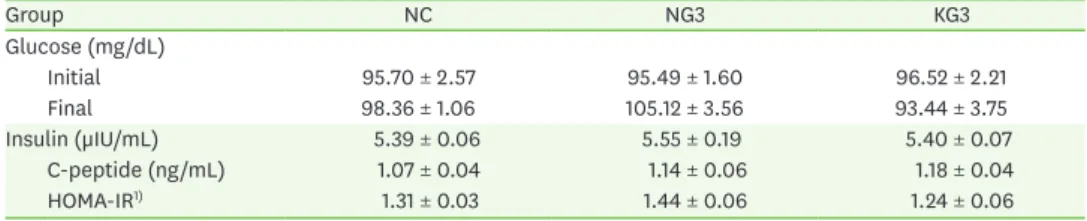
수준혈당 변화는 실험 시작한 시점이 종료한 시점과 비교했을 때 세 군 사이에 유의적 차이가 없
었으나
, NG3군에서 약간 증가하는 경향을 보였다
.인슐린
, C-peptide및 인슐린저항성
(ho-meostasis model assessment of insulin resistance, HOMA-IR)
는 모든 군에서 유의한 차이를 보 이지 않았다
(Table 4).Leptin, TNF-α
수준혈장
leptin과
TNF-α의 측정 결과는
Fig. 2에나타냈다
. Leptin수준은
NC군이
8.69 ng/mL, NG3군이
7.68 ng/mL, KG3군이
7.23 ng/mL로 나타나
NC군에 비하여
NG3군이 유의적인 차이를 보 이지 않았으나
, KG3군이 유의하게 낮은 값으로 나타났다
(p < 0.05). TNF-α수준은
NC군이
273.77 pg/mL, NG3군이
259.42 pg/mL에 비해
KG3군이
219.01 pg/mL로 나타나 유의적으로 감 소하였다
(p < 0.05).Table 4. Plasma insulin, C-peptide level and HOMA-IR of aged rats treated with Keunnunjami germ
Group NC NG3 KG3
Glucose (mg/dL)
Initial 95.70 ± 2.57 95.49 ± 1.60 96.52 ± 2.21
Final 98.36 ± 1.06 105.12 ± 3.56 93.44 ± 3.75
Insulin (µIU/mL) 5.39 ± 0.06 5.55 ± 0.19 5.40 ± 0.07
C-peptide (ng/mL) 1.07 ± 0.04 1.14 ± 0.06 1.18 ± 0.04
HOMA-IR1) 1.31 ± 0.03 1.44 ± 0.06 1.24 ± 0.06
Values are expressed as means ± SE.
NC, normal control diet (AIN-93M); NG3, AIN-93M + normal rice germ 3%; KG3, AIN-93M + Keunnunjami germ;
HOMA-IR, homeostasis model assessment of insulin resistance.
1)HOMA − IR = �fasting insulin (µIU/mL) × fasting glucose (mg/dL)
405 � .
B
TNF-α (pg/mL)
0 150 350
50 250
100 300
200
A
Leptin (ng/mL)
0 4 12
8
2 10
6
NC
b ab a
c b
a
NG3 KG3 NC NG3 KG3
Fig. 2. Plasma leptin, TNF-á concentration of aged rats treated with Keunnunjami germ. Values are expressed as means ± SE. Mean values with the different letters are significantly different by Tukey's range test (p < 0.05). NC, normal control diet (AIN-93M); NG3, AIN-93M + normal rice germ 3%; KG3, AIN-93M + Keunnunjami germ 3%;
TNF-á, tumor necrosis factor-á.
AOPP, TBARS, IL-6
및SOD
수준혈장
AOPP, TBARS, IL-6및
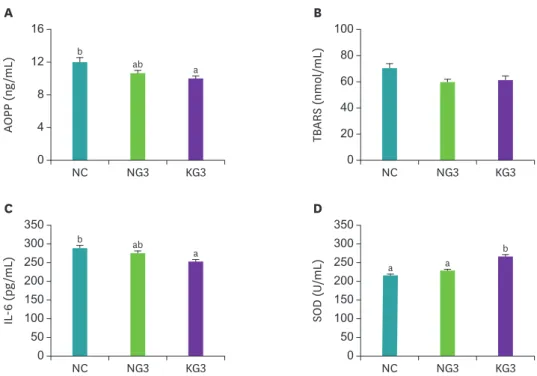
SOD의 측정 결과는
Fig. 3에나타내었다
. AOPP는
NC군이
11.97 ng/mL
에 비해
NG3군이
10.62 ng/mL로 유의적인 차이가 없었으나
, KG3군이
10.01 ng/mL로 나
타나 유의하게 낮았다
(p < 0.05). TBARS는 세 군 사이에 통계학적 유의성을 보이지 않았다
.IL-6
은
NC군이
288.20 pg/mL에 비해
NG3군이
274.51 pg/mL로 유의한 차이를 보이지 않았으 나
, KG3군이
251.91 pg/mL로 나타나 유의적으로 낮은 값을 보였다
(p < 0.05). SOD는
NC군이
214.29 U/mL, NG3군이
229.10 U/mL, KG3군이
266.33 U/mL로 나타났다
. NC군에 비해
NG3군이
유의적 차이가 없었으나
, KG3군이 유의하게 증가한 것으로 나타났다
(p < 0.05).고찰
노화가 진행되면서 항산화 방어의 감소로 생성된 체내 과산화물은 산화성 스트레스를 증 가시켜 세포막 등 조직에 손상을 줄 수 있고
,이는 대사질환의 주요 요인 중 하나이다
[30].Phytosterols
는 식물성 식품에서 발견되는 스테롤로 장내 콜레스테롤 흡수를 억제하고
,지질
과산화 저해효과가 있으며
, β-linoleoyl-γ-palmitoyl phosphatidylcholine liposomal membranes에서
α-tocopherol이 산화를 방지하여 항산화뿐만 아니라 관상동맥 질환을 예방할 수 있다
[18,31].
쌀에 함유되어 있는
phytosterols은
β-sitosterol, campesterol, stigmasterol순으로 비율
이 높은데
[17],본 실험결과 이와 유사한 경향을 보였으며 특히
,일반현미에 비해 큰눈자미에
서 유의하게 높은 것으로 확인되었다
.B
TBARS (nmol/mL)
0 20 100
60 80
40
A
AOPP (ng/mL)
0 16
8 12
4
NC
b
ab a
NG3 KG3 NC NG3 KG3
D
SOD (U/mL)
C
IL-6 (pg/mL)
0 350
150 250
50 300
100 200
0 350
150 250
50 300
100 200
NC
b ab
a
a a
b
NG3 KG3 NC NG3 KG3
Fig. 3. Plasma AOPP, TBARS, IL-6, SOD concentration of aged rats treated with Keunnunjami germ. Values are expressed as means ± SE. Mean values with the different letters are significantly different by Tukey's range test (p < 0.05). NC, normal control diet (AIN-93M); NG3, AIN-93M + normal rice germ 3%; KG3, AIN-93M + Keunnunjami germ 3%; AOPP, advanced oxidation protein products; TBARS, thiobarbituric acid reactive substance; IL-6, interleukin-6; SOD, superoxide dismutase.
현미의
phytosterol을 포함한 혼합 식이를 고혈압 쥐에게
3주간 섭취시키면서 혈압과 지질변 화를 측정한 결과
,체중 및 부고환지방
,간조직 중 총 지질
,중성지방 및 콜레스테롤 함량
,신
장
TBARS수준이 감소하였고
, HDL콜레스테롤이 증가하여 항고혈압성 효과
,지질 대사 개
선
,항산화 효과를 보고하였다
[32].이외에
campesterol은 콜레스테롤 강하
,항발암성
,항혈 관 형성
(antiangiogenic) [33]작용이 있으며
stigmasterol은 항관절염
[34],혈당 강하
[35],기
억력 개선
[36],호르몬 합성 참여
[37]등 효능이 있다는 보고가 있다
.DPPH radical
소거 활성 측정은 활성 라디칼에 전자를 공여하여 지방질의 산화를 억제하는
방법으로 사용되고
,환원력은 항산화 작용의 다양한 메커니즘에서 활성 산소종 및 유리 라디 칼에 전자를 공여하는 능력을 말하며
, ABTS radical소거능 측정은
ABTS를
peroxidase, H2O2와
반응시켜 활성 양이온인
ABTS+이 형성되는데 추출물의 항산화 물질에 의해 양이온 라디칼
이 소거되어 항산화 활성을 평가할 수 있다
[38]. Wang등
[39]은 쌀 미강에서 추출한 오일 보
다 쌀 배아에서 추출한 오일에서 더 우수한 항산화 활성을 있음을 보고 하였고
, Moongngarm등
[40]의 연구에서 쌀 배아는 겨
,미강에 비해
α-tocopherol과
γ-tocopherol이 더 많이 함유되 어있을 뿐 아니라 이는 높은 항산화능이 있다고 보여주었다
.또한 쌀 배아를 첨가한 스낵은
DPPH
및
ABTS라디칼 소거활성이 높은 결과를 보였다는 결과를 나타내었다
[41].이어 본 연
구에서
DPPH radical소거 활성
,환원력
, ABTS radical소거능을 측정한 결과
,일반 현미 배아 보다 큰눈자미 배아의 항산화 활성이 더 우수함을 확인하였다
.Cytokines
중 하나인
leptin은 지방 조직에서 합성되는 호르몬으로 뇌에 작용하여 체지방률
조절 대한 메시지를 전달하는데
,체지방량과 양의 상관성을 가지기 때문에 체지방량이 감소 에 따라 혈중
leptin의 농도도 줄어든다
[42].한편
, leptin은
macrophages를 자극하여
TNF-α,IL-6, IL-12
와 같은 염증사이토카인의 발현을 유도시킨다
[43]. TNF-α는 염증반응의 주요 초기
인자로 세포를 공격하여 조직 손상을 유발시키고
, IL-6는 염증반응과정에서 정상 상태에서 낮은 수준으로 유지하고 있으나
,감염
,천식
,스트레스 등의 원인으로 의해 발현이 유도되어
증가하게 된다
[44].본 실험결과 쿤눈자미 배아 보충급여에 의해 체중 증가가 감소되었고
,TNF-α
수준은 유의적으로 낮았으며
, leptin과
IL-6수준은 일반 현미 배아보다 유의적 차이를
보이지 않았지만 감소하는 경향을 보인 것으로 관찰되었다
.산화는 신진대사의 중요한 부분 중 하나로 면역반응
,세포사멸 및 유전자 발현 등 체내 생
화학적 과정에서 자유 라디칼
(free radicals)이 자연적으로 생성되는데
,이것은 활성산소종
(reactive oxygen species),
반응성 질소종
(reactive nitrogen species)을 포함하고
,정상 생리학
적 조건에서 활성산소
(oxygen free radicals)발생과 항산화 방어 간에 균형을 유지하고 있는
데 균형을 깨뜨리는 주요 원인은 산화스트레스
(oxidative stress)이다
.자유 라디칼은
DNA를
비롯한 단백질과 지질세포 등의 산화적 손상을 초래한다
[45].산화매개성 단백질 손상지
표인
AOPP는 아미노산 잔기 즉
, tyrosine이
dityrosine으로 산화되면서 단백질이
aggregation,cross-linking
또는
fragmentation을 형성하면서 정상적인 단백질 분해가 일어나지 않아 생성
되는데
,비만과 당뇨병 환자에게서 증가하기 때문에 산화스트레스와 염증으로 유발되는 조 직 손상의 신뢰성 있는 마커로 알려져있다
[46].본 연구에서 일반 현미와 큰눈자미 배아 보
충급여를 했을 때
AOPP수준은 유의적 차이가 없었지만 감소하는 경향을 보였다
. TBARS는
활성산소가 세포막의 구성성분인 불포화지방산을 공격하여 생성되는 반응물인
malondial-dehyde (MDA)
를 측정함으로써 세포의 산화적 스트레스 및 과산화 정도를 확인할 수 있는데
,MDA
가 축적되면 세포막의 형태가 변형되어 이온수송
,효소활성 및 세포표면 부착상태를 변 성시키고
,또한
DNA의 염기와 반응하여 돌연변이성 병변을 일으킨다고 알려져 있다
. SOD는 세포내에서 생성되는
superoxide anion radical을 과산화수소로 전환시킴으로써
catalase,glutathione peroxidase
와 함께 세포의 손상을 스스로 보호한다
[47].노화가 진행되고 있는 성
숙쥐 모델에서 항산화 대사 활성 및
biomarker분석을 통해 큰눈자미 배아 섭취군에서 항산
화 활성이 높은 것으로 확인하였고 이는 항산화 관련 기능성 식품소재로서의 가능성이 있을 것으로 판단된다
.연구 결과를 종합하면
in vitro실험에서 큰눈자미 배아의
campesterol, stigmasterol함량이 높 고
, DPPH radical소거 활성
,환원력
, ABTS radical소거능이 우수한 것으로 나타났다
.그리고 성숙기 흰쥐 모델에서 큰눈자미 배아 보충급여는 체중 증가량과 체지방량이 감소된 것을 관 찰하였으나
,혈당 변화
, insulin및
C-peptide수준으로 평가한 당질 대사에 미치는 영향은 제
한적이다
.또한
, TNF-α의 유의적 감소 및
SOD활성이 유의하게 차이가 있음을 확인하였으며
,leptin, AOPP
및
IL-6수준이 감소되는 경향을 보였다
.요약
본 연구에서는 고기능성 쌀인 큰눈자미 배아의
phytosterols함량 및
in vitro항산화 활성을 평
가하고
,성숙기 흰쥐에게 보충 급여한 당질 대사
,항산화 활성 및 일부
cytokines개선 효과 여
부를 검증하였다
. Phytosterols분석에서
NG보다
KG의
campesterol과
stigmasterol의 함량이 유의하게 높았다
. NG에 비해
KG가
DPPH radical소거 활성
,환원력 및
ABTS radical소거능 측 정에서 유의적으로 높은 값을 나타내었다
.실험동물은 각
10마리씩
3군으로 나누어 일반 식 이를 급여하는
NC군
,일반현미배아
3%를 첨가하는
NG3군
,큰눈자미배아
3%를 첨가하는
KG3군으로 나누어 사육하였다
.그 결과
KG3군에서 체중증가량
,신장주위 및 총 지방량이 유 의하게 감소하였다
.당질 대사에서 실험군들 간에
glucose,인슐린
, C-peptide및
HOMA-IR의
수준이 유의적인 차이가 나타나지 않았다
. KG3군에서 혈중
TNF-α수준이
NG3에 비해 유의
적으로 감소하고
, SOD활성이 유의하게 증가하였으며
, leptin, AOPP및
IL-6수준이 감소하는
경향을 나타내었다
.이상의 결과로부터 큰눈자미 배아는 높은 함량의
phytosterols과
,우수한
in vitro항산화활성
,그리고
in vivo실험에서 일부의
cytokine개선 및 항산화에 긍정적인 효과 가 있음을 제시하였고 향후 더 많은 생리활성물질 분석
,대사 지표 개선
,작용 기전 규명 등 세 부적인 연구가 필요할 것으로 사료된다
.REFERENCES
1. Kim HY, Kim JH, Lee SA, Ryu SN, Han SJ, Hong SG. Antioxidative and anti-diabetic activity of C3GHi, novel black rice breed. Korean J Crop Sci 2010; 55(1): 38-46.
2. Ham TH, Kwon SW, Ryu SN. A early maturing and high contents of cyanidin 3-glucoside(C3G) rice variety
‘Pareunsuperjami’. Korean J Breed Sci 2016; 48(4): 535-540.
3. Koh HJ, Park SJ, Won YJ, Heu MH. Nutritional and agronomic characteristics of super-giant embryo mutant in rice. Korean J Crop Sci 1993; 38(6): 537-544.
4. Park DS, Hwang UH, Park SK, Lee JH, Han SI, Cho JH, et al. A waxy black giant embryo early maturing rice variety ‘Nunkeunheugchal’. Korean J Breed Sci 2015; 47(1): 68-74.
CROSSREF
5. Kim KS, Kang HJ, Hwang IK, Hwang HG, Kim TY, Choi HC. Fibrillar microfilaments associated with a high-amylose rice, goami 2, a mutant of ilpumbyeo, a high-quality japonica rice. J Agric Food Chem 2005;
53(7): 2600-2608.
PUBMED | CROSSREF
6. Lee EJ, Seo HS, Lee SY, Kim SH, Hwang IK. Quality characteristics of black sesame gruel with high- dietary fiber rice ‘Goami 2’. Korean J Food Cook Sci 2006; 22(6): 940-948.
7. Han JA. Digestive, physical and sensory properties of cookies made of dry-heated OSA-high amylose rice starch. Korean J Food Sci Technol 2009; 41(6): 668-672.
8. Chung SI, Kwon YI, Kang MY. Effects of ‘Superhongmi’ rice bran extracts on biochemical markers of glycolysis and bone metabolism in ovariectomized rats. Prev Nutr Food Sci 2019; 24(2): 144-149.
PUBMED | CROSSREF
9. Nam SJ, Chung SI, Kang MY. Effects of improving plasma lipid profiles and antioxidant metabolism of Superjami extract supplementation. Korean J Food Nutr 2019; 32(3): 179-188.
10. Chung SI, Lee SC, Kang MY. Physicochemical properties of giant embryo rice Seonong 17 and Keunnunjami. Biosci Biotechnol Biochem 2017; 81(5): 972-978.
PUBMED | CROSSREF
11. Shin DS, Yoo YM, Han GJ, Oh SG. Quality of Tteokbokki tteok prepared by adding various concentration of brown rice. Korean J Food Preserv 2016; 23(2): 194-203.
CROSSREF
12. Park BH, Jeon ER, Kim SD, Cho HS. Cooking quality characteristics of cooked rice of YenipSambab with pigmented rice. Korean J Food Preserv 2012; 19(2): 185-192.
CROSSREF
13. Lee YR, Choi YH, Koh HJ, Kang MY. Quality characteristics of brown rice flakes prepared with giant embryonic rice and normal rice cultivars. Korean J Food Sci Technol 2001; 33(5): 540-544.
CROSSREF
14. Nagendra Prasad MN, Sanjay KR, Shravya Khatokar M, Vismaya MN, Nanjunda Swamy S. Health benefits of rice bran - a review. J Nutr Food Sci 2011; 1: 108.
CROSSREF
15. Choi OK, Yun SK, Hwang SY. The chemical components of Korean rice germ. Korean J Diet Cult 2000;
15(4): 253-258.
16. Verma DK, Srivastav PP. Bioactive compounds of rice (Oryza sativa L.): review on paradigm and its potential benefit in human health. Trends Food Sci Technol 2020; 97: 355-365.
CROSSREF
17. Zubair M, Anwar F, Ashraf M, Uddin MK. Characterization of high-value bioactives in some selected varieties of Pakistani rice (Oryza sativa L.). Int J Mol Sci 2012; 13(4): 4608-4622.
PUBMED | CROSSREF
18. Yoshida Y, Niki E. Antioxidant effects of phytosterol and its components. J Nutr Sci Vitaminol (Tokyo) 2003; 49(4): 277-280.
PUBMED | CROSSREF
19. Lee SH, Chun HK, Chang SO, Lee YS. Supplementary effect of the rice germ oil on lipid metabolism in diabetic KK mice. Korean J Community Living Sci 2003; 14(3): 47-57.
20. Raghuram TC, Rao UB, Rukmini C. Studies on hypolipidemic effects of dietary rice bran oil in human subjects. Nutr Rep Int 1989; 39(5): 889-895.
21. Cho MK, Kim MH, Kang MY. Effects of rice embryo and embryo jelly with black rice bran pigment on lipid metabolism and antioxidant enzyme activity in high cholesterol-fed rats. J Korean Soc Appl Biol Chem 2008; 51(3): 200-206.
22. Han SJ, Kwon SW, Chu SH, Ryu SN. A new rice variety ‘Keunnunjami’, with high concentrations of cyanidin 3-glucoside and giant embryo. Korean J Breed Sci 2012; 44(2): 185-189.
23. Kwon YJ, Lee KT, Yun TM, Choi SW. Effect of heat pretreatment on the functional constituents of rice germ. J Food Sci Nutr 2004; 9(4): 330-335.
24. Butsat S, Siriamornpun S. Antioxidant capacities and phenolic compounds of the husk, bran and endosperm of Thai rice. Food Chem 2010; 119(2): 606-613.
CROSSREF
25. Park RK, Lee KT. Optimization for the phytosterol extraction and production of structured lipids from safflower seed. Korean J Food Preserv 2003; 10(2): 219-223.
26. Blois MS. Antioxidant determinations by the use of a stable free radical. Nature 1958; 181(4617): 1199-1200.
CROSSREF
27. Oyaizu M. Studies on products of browning reaction: antioxidant activity of products of browning reaction prepared from glucosamine. Jpn J Nutr Diet 1986; 44(6): 307-315.
CROSSREF
28. Re R, Pellegrini N, Proteggente A, Pannala A, Yang M, Rice-Evans C. Antioxidant activity applying an improved ABTS radical cation decolorization assay. Free Radic Biol Med 1999; 26(9-10): 1231-1237.
PUBMED | CROSSREF
29. Kawabata K, Tanaka T, Murakami T, Okada T, Murai H, Yamamoto T, et al. Dietary prevention of azoxymethane-induced colon carcinogenesis with rice-germ in F344 rats. Carcinogenesis 1999; 20(11):
2109-2115.
PUBMED | CROSSREF
30. Ali SS, Xiong C, Lucero J, Behrens MM, Dugan LL, Quick KL. Gender differences in free radical homeostasis during aging: shorter-lived female C57BL6 mice have increased oxidative stress. Aging Cell 2006; 5(6): 565-574.
PUBMED | CROSSREF
31. Ostlund RE Jr. Phytosterols in human nutrition. Annu Rev Nutr 2002; 22(1): 533-549.
PUBMED | CROSSREF
32. Hong KH, Kim IH, Choue EK, Ahn JY, Ha TY. Brown rice phytosterol improves hypertension and lipid metabolism in spontaneously hypertensive rats. Korean J Food Cult 2012; 27(5): 535-543.
CROSSREF
33. Choi JM, Lee EO, Lee HJ, Kim KH, Ahn KS, Shim BS, et al. Identification of campesterol from Chrysanthemum coronarium L. and its antiangiogenic activities. Phytother Res 2007; 21(10): 954-959.
PUBMED | CROSSREF
34. Gabay O, Sanchez C, Salvat C, Chevy F, Breton M, Nourissat G, et al. Stigmasterol: a phytosterol with potential anti-osteoarthritic properties. Osteoarthritis Cartilage 2010; 18(1): 106-116.
PUBMED | CROSSREF
35. Panda S, Jafri M, Kar A, Meheta BK. Thyroid inhibitory, antiperoxidative and hypoglycemic effects of stigmasterol isolated from Butea monosperma. Fitoterapia 2009; 80(2): 123-126.
PUBMED | CROSSREF
36. Park SJ, Kim DH, Jung JM, Kim JM, Cai M, Liu X, et al. The ameliorating effects of stigmasterol on scopolamine-induced memory impairments in mice. Eur J Pharmacol 2012; 676(1-3): 64-70.
PUBMED | CROSSREF
37. Kaur N, Chaudhary J, Jain A, Kishore L. Stigmasterol: a comprehensive review. Int J Pharm Sci Res 2011;
2(9): 2259-2265.
38. Lee BB, Park SR, Han CS, Han DY, Park E, Park HR, et al. Antioxidant activity and inhibition activity against α-amylase and α-glucosidase of viola mandshurica extracts. J Korean Soc Food Sci Nutr 2008; 37(4): 405-409.
CROSSREF
39. Wang H, Geng H, Tang H, Wang L, Yu D, Wang J, et al. Enzyme-assisted aqueous extraction of oil from rice germ and its physicochemical properties and antioxidant activity. J Oleo Sci 2019; 68(9): 881-891.
PUBMED | CROSSREF
40. Moongngarm A, Daomukda N, Khumpika S. Chemical compositions, phytochemicals, and antioxidant capacity of rice bran, rice bran layer, and rice germ. APCBEE Procedia 2012; 2: 73-79.
CROSSREF
41. Wu X, Kim E, Choi K, Kim H. Antioxidative and physical characteristics of rice germ added sweet pumpkin rice snack for infants. J Korean Soc Food Cult 2018; 33(1): 62-69.
42. Seong SH, Ahn EM, Sohn HS, Baik SH, Park HW, et al. Genistein combined with exercise improves lipid profiles and leptin levels in C57BL/6J mice fed a high fat diet. Food Sci Biotechnol 2007; 16(5): 910-917.
43. Loffreda S, Yang SQ, Lin HZ, Karp CL, Brengman ML, Wang DJ, et al. Leptin regulates proinflammatory immune responses. FASEB J 1998; 12(1): 57-65.
PUBMED | CROSSREF
44. Choi SP, Kang MY, Nam SH. Inhibitory activity of pigmented rice bran extract to the allergic inflammation in basophilic cell line and peritoneal mast cells. J Korean Soc Appl Biol Chem 2005; 48(4): 315-321.
45. Muller GC, Gottlieb MG, Luz Correa B, Gomes Filho I, Moresco RN, Bauer ME. The inverted CD4:CD8 ratio is associated with gender-related changes in oxidative stress during aging. Cell Immunol 2015;
296(2): 149-154.
PUBMED | CROSSREF
46. So YS, Kim MI, editors. Effects of walking on AOPP and proinflammatory factors in obese adolescents.
Proceedings of Korean Entertainment Industry Association 2014 Spring Conference; 2014 May 22-23;
Pocheon, Korea. Seoul: Korean Entertainment Industry Association; 2014.
47. Lee SM, Park SY, Jang GS, Ly SY. The protective effects of ethanol extract of wild simulated ginseng on carbon tetrachloride induced acute hepatic injury in mouse. Korean J Nutr 2008; 41(8): 701-710.