The Effect of Role Models on Entrepreneurship and Social
Competence of Korean and Chinese University Students - Focused
on Mediating Effect of Social Competence
Zhanxi1, Jun-Hwan Yang2*
1Assistant Professor, Guangzhou University, China
2Assistant Professor, Dankook University
역할모델이 한․중 대학생들의 기업가정신 및 사회적 역량에 미치는
영향에 관한 연구 - 사회적 역량의 매개효과를 중심으로
첨희1, 양준환2*
1광조우대학교, 2단국대학교
Abstract Entrepreneurship has been received enormous attention all around the world in terms of economic prosperity of local society and a nation. This paper explores the critical factors which influence entrepreneurship, particularly how role models affects social competence and entrepreneurship of Korean and Chinese university students. Total 440 students participated in the study;
Korea(n=224) and China(n=216). Verifying mediating effect of social competence was another aim of this study. Four hypotheses were suggested to assess the extent to which they prove the students' perceptions with hierarchical multiple regression analysis(PASW Statistic 18). Our findings showed that role models have positive relationships with social competence as well as entrepreneurship. Social competence influences entrepreneurship significantly, too. Social competence has also a partial mediating effect in relationship between role models and entrepreneurship. We presented both theoretical contribution and practical implication for school authorities and policy makers as to the effective pedagogy for promoting entrepreneurship of university students.
요 약 기업가정신은 지역 및 국가경제 활성화 측면에서 전 세계적으로 많은 관심을 받아오고 있다. 본 연구는 아시아지 역 대학생들의 기업가정신에 영향을 미치는 핵심 요인들을 살펴보기 위해 진행되었다. 이를 위해 한국과 중국대학생들을 대상으로 역할모델이 대학생들의 사회적 역량 증진 및 기업가정신 함양에 미치는 영향을 실증분석 하였다. 또한 창업과 정에 있어 사회적 역량의 중요성에 비추어 사회적 역량의 매개효과를 함께 검증하였다. 본 연구에는 한국과 중국 각각 3곳 대학교의 대학생들이 참가, 한국 224부, 중국 216부의 표본을 최종 확보하여 4개의 가설 검증에 이용하였다. 가설 검증은 위계적 다중회귀분석방법(PASW Statistic 18)을 이용하였다. 검증결과 역할모델은 한국과 중국대학생 모두 기업 가정신과 사회적 역량에 유의한 정(+)의 영향을 미치는 것으로 나타났다. 또한 사회적 역량도 양국 대학생들의 기업가정 신에 유의한 정(+)의 영향을 미침을 알 수 있었다. 마지막으로 사회적 역량은 역할모델과 기업가정신 사이에 부분매개효 과를 갖는 것을 알 수 있었다. 마지막으로 본 연구결과의 이론적 기여 및 교육당국과 정책입안자들을 위한 실무적 시사점 과 제안사항을 제시해 두었다.
Keywords : Role Models, Social Competence, Entrepreneurship, Korean University Students, Chinese University Students
*Corresponding Author : Jun-Hwan Yang(Dankook Univ.) Tel: +82-10-9253-0836 email: [email protected]
Received February 19, 2019 Revised March 19, 2019 Accepted May 3, 2019 Published May 31, 2019
1. Introduction
Why are some people prone to be entrepreneurs while others are not? A number of studies tackling on this question have zoomed in on the effect of entrepreneurial role models for one's decision to start up a new venture[1-4]. The decision whether to commit oneself to a certain behavior or not are often affected by the behaviors of other people through the examples and demonstrations that they display[5]. Besides, role modeling has a socio-psychological effect.
For example, Fornahl argued that individuals may perceive entrepreneurs as a desirable career option by observing their local peers who are engaged in entrepreneurial activities [6]. Krumboltz and his associates noted that the influence is even strongly associated with entrepreneurial career choice[7]. Many entrepreneurs agree that their entrepreneurial decision and development of their new venture have been influenced by others. These others are referred as entrepreneurs covering wide range from successful entrepreneurs to former peers or family members. Such people are depicted as role models[8]. Thus, observing the entrepreneurs provides an opportunity to learn about entrepreneurial process and capabilities[3].
China has been unprecedently accomplishing one of the fastest growing transition economies in the world. Naturally, this transformation has attracted huge investments from oversea and so brought influx of a rapid flow of foreign capital.
Chinese people has been motivated to be an entrepreneur, because not only shut down of state-owned firms but also desirability to exploit abundant profitable business opportunities created by economic reform [9]. GEM[10] revealed that China ranked 19th place out of 54 countries in both of 'High status to entrepreneurs' and 'Entrepreneurship a good career choice', while Korea ranked 29th and 49th in the same dimensions. This result indicates that China is far
ahead of Korea in 'Societal Value about Entrepreneurship'. Korea ranked 34th place in the item of 'Entrepreneurial Spirit Index', while China showed 37th, displaying a little bit lagged behind in this item.
As close neighboring countries, Korea and China have strived for promoting entrepreneurship of young people as an important national policy.
Not many studies have investigated the importance of role models as a means of fostering entrepreneurship, and still more studies are required to figure out how role models could serve as an effective working agent for entrepreneurship education. This study explores the effectiveness of role models in terms of diffusing and enforcing entrepreneurship among young university students under following research question: Are role models associated with developing social competence as well as promoting entrepreneurship of university students in Korea and China? The main objective is how to develop and permeate entrepreneurial mind-set into young generation in this region.
2. Literature Review and Hypotheses
2.1 Role Models and Social CompetenceRole model theory stems from Social Learning Theory which explains how role models affect others to think, act, imitate and follow personal characteristics, behaviors, styles and attributes[11].
People learn by observing behaviors of others and the outcomes caused by the behaviors within their social network The studies about role models have been carried out mainly in psychology and organizational area[12]. Role model is defined as one who shows examples to be emulated by others, and instigate or inspire others to decide and attain the aim[8]. Namely, individuals learn, define oneself, motivate and select career pathway through role model[7, 13].
Thus, existence of role models is important in entrepreneurship[14], and role model is classified as a sociological factor in this regard[15].
Wyrwich and his team outlined two different effects of entrepreneurial role models [16]. The first one is that entrepreneurs provide opportunities people to learn about entrepreneurial tasks and competences. The second is observing successful entrepreneurs enables individuals to learn how to gather and organize resources and activities required for establishing and operating one's own venture, and increase self-confidence[17].
Meanwhile, social competence plays an important role when identifying and exploiting entrepreneurial opportunities, and it is regarded as a key element of entrepreneurship[18]. Social competence is defined as one's ability to develop and capitalize necessary resources through interpersonal skill[19]. Social competence affects output of interpersonal exchange, and it's cognitive aspect is related to social information processing[20]. In this respect, social competence contains two perspectives, i.e., emotional and cognitive dimensions[21]. The emotional aspect was conceptually developed to ‘emotional competence’[22], ‘emotional intelligence’ [23], and ‘effective social competence’[24]. By the same token, four aspects of social competence were suggested related to entrepreneurial success;
social perception, impression management, social adaptability, and expressiveness[19]. Impression management and expressiveness are relevant to the emotional aspect of social competencies[21].
These two concepts embrace core ingredients such as adequate management of one’s affections, vicarious communication, efficacious expression of one’s affections and emotions, and finally successful translation and response to others’ feelings and emotions[22, 24]. In contrast, social perception and social adaptability indicate the cognitive aspect of social competencies including accurate perceiving others’ thoughts and situations, communicating along with
rational thoughts, making decisions, and adjusting oneself to situational changes[24].
Based on the discussions in the literature, it is inferable that university students can surely benefit from role models for acquiring social competence. Thus, we suggest a hypothesis as;
H1. Role models have a positive effect on social competence of both Korean and Chinese university students.
2.2 Role Models and Entrepreneurship Role models have received remarkable attention from many researchers as a key factor of one's entrepreneurial process. Potential entrepreneurs may perceive entrepreneurial pathway as an attractive career option by observing someone - with whom they are socially interacting - undertakes entrepreneurial activities[25]. Notably, entrepreneurship is self-perpetuating over time[16], and so, the role models for individual in early times are generally their parents[26]. However, the role models can be someone emerging from a wider arena in later, and sometimes the role models are not known by individual personally. Rahman and Day noted that children may have a chance to get in contact with somebody unknown previously, and then the relationship could develop over time[12]. This progress decrease the influence of their parents, while increase the influence of others. In this case, the others can serve as another role models other than parents.
Especially, if the others have successful entrepreneurial career and became wealthy, they may convince individuals to choose the same career pathway, and treat them as the role models to emulate[26]. In a similar vein, Wyrwich and his colleagues argued that observing entrepreneurial peers should decrease fear of failure as an entrepreneur[16]. Therefore, the presence of entrepreneurial role models has a positive effect and relationship with engaging in
entrepreneurship [27-29].
Entrepreneurship can be defined as the creation of new enterprise[30]. Entrepreneurship has been well conceptualized in the literature as being relevant particularly to new venture creation[31- 34]. Their notions are new venture creation is the hallmark of entrepreneurship, and creation of a firm is a necessary condition for entrepreneurship [35]. Thus, it is arguable that role models have a positive impact on entrepreneurship of university students.
Therefore, it is hypothesized that;
H2. Role models have a positive effect on promoting entrepreneurship of Both Korean and Chinese university students.
2.3 Social Competence and Entrepreneurship The concept of competence was suggested to predict job performance by differentiating effective performer from less effective performers[36]. In this perspective, entrepreneur's competence to overcome demands of entrepreneurship play an important role in achieving success[37].
Competence was conceptualized a little bit different way by researchers such as 1) task or relationship related behaviors[22], 2) overarching characteristic include ability, skill, and knowledge[38], 3) strategy effectiveness[39].
Likewise, competence can be summarized in another three views[21]. The first view stresses the behaviors predicting effectiveness like success and sustainability in the workplace. The second is to view it as a mixed set of individual capabilities, skills, and static knowledge. Finally, the third one is strategies as core competence of a firm in the competition and development. In the meantime,
successful entrepreneurs are prone to display high levels of mental and social competences[40].
Social ability is also associated with the strength of ties with others of nascent entrepreneurs such
as networking, which is a critical task of entrepreneurs[41]. Another concept called SPACE was suggested as core elements of social skills, that stands for situational awareness, presence, clarity, and empathy[42]. These are critical capabilities for the entrepreneur, especially when building relations and networks with employees, customers and suppliers [43]. Entrepreneurs should build social relationships with various business partners during the early stage of entrepreneurial process[44].
Meanwhile, entrepreneurial opportunity does not exist in an objective dimension, nor does it exist before the awareness of entrepreneurs[45].
Rather, creating a new business opportunity is result of a social construction which does not exist without entrepreneur's perceptions. This perspective points that entrepreneurial opportunity is determined by endogenous way based on creative imagination and social skill of entrepreneur, not by an exogenous way in the external environment[46]. Accordingly, creation of new venture opportunity is product of institutional entrepreneurship in which entrepreneurs should mobilize resources that transform or create environmental conditions[47]. Mobilizing resources requires extraordinary social skills of entrepreneur [48]. Considering the all these arguments, it is surely inferable that social competence must have a certain impact on entrepreneurship.
Therefore, we propose a hypothesis as;
H3. Social competence has a positive effect on entrepreneurship of both Korean and Chinese university students.
Finally, prior studies presented social competence works as both mediator[49]. and moderator[37]. We replicate attesting of the mediating effect of social competence in the relationship between role models and entrepreneurship;
H4. Social competence will mediate the relationship between entrepreneurial role models and entrepreneurship of both Korean and Chinese university students.
3. Methodology
3.1 Research DesignAs presented in Fig. 1, an integrative research framework was developed following the grounded approach to exhibit relationships among the variables and the hypotheses we established.
Role Models
Social Competence
Entrepreneurship
Fig. 1. Research Model
3.2 Sample
The sample of this study is made of both Korean and Chinese university students at three universities from Korea(Dankook, Soongsil and Wonkwang) and China(Guangdong, Guangzhou, Shenzhen). By obtaining the sample from three different university students in each country, the finding of this study could allows us to capture more validated result. Self-administrative survey was used to collect the data. Particularly, to gain a big quantitative data, convenience sampling method was applied. The survey was carried out for three months from April 01 through to June 31, 2018. Total 440 qualified samples were gained from both countries(224 from Korea, 216 from China).
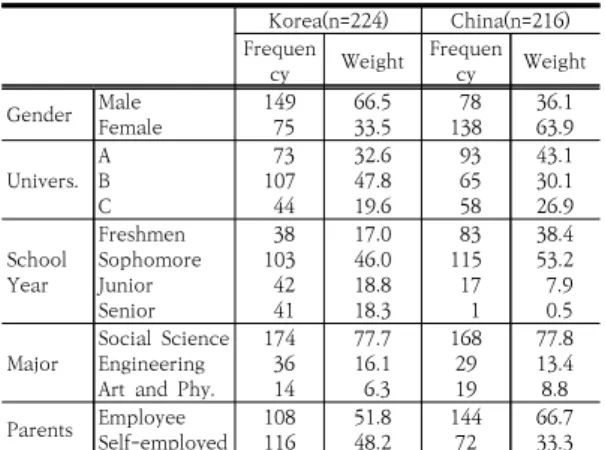
Korean sample comprised of 66.5% of male and 33.5% of female students, while 36.1% of male and 63.9% of female students consisted of Chinese sample. The sample comprised all undergraduate students. Sophomore students occupied the highest distribution in the school year in both countries; 46% in Korea(n=103), and
53.2% in China(n=115). Likewise, social science majoring students reported the highest proportion in both countries; 77.7% in Korea(n=174), and 77.8%
in China (n=168). Finally, 48.2% of Korean students responded their parents are self-employer, while 33.3% of Chinese students did so. Table 1 reports sample characteristics.
Korea(n=224) China(n=216) Frequen
cy Weight Frequency Weight Gender MaleFemale 149
75 66.5
33.5 78
138 36.1
63.9 Univers. A
BC
73107 44
32.647.8 19.6
93 65 58
43.130.1 26.9 School
Year
Freshmen Sophomore Junior Senior
38103 4241
17.046.0 18.818.3
115 83 17 1
38.453.2 7.9 0.5 Major Social Science
Engineering Art and Phy.
174 36 14
77.716.1 6.3
16829 19
77.813.4 8.8 Parents EmployeeSelf-employed 108
116 51.8
48.2 144
72 66.7
33.3 Table 1. Sample Characteristics
3.3 Instrument
The questionnaire consists of two parts; The first part asks students demographic informations that includes gender, university name, school year, age, major, parents job(employee or self-employed). The second part includes the items designed to measure the scale of each research variables; role models, social competence and entrepreneurship that were developed based on prior studies. Therefore, all the items were validated already. All the items were measured on a 5-point Likert scale by asking students to rate the extent to which the statements are true or not(1=strongly untrue, and 5=strongly true). Some statements were reverse-scored and intermixed with other statements to get rid of response-set bias and halo effect.
The Chinese version was completed based on the back-translation method suggested by[50].
Korean questionnaire was translated into Chinese first by a Chinese professor who earned
Doctorial degree in Korea. Then, the translated in Chinese questionnaire was retranslated in Korean by two Chinese students now on Doctorial course in business management in Korea. The homogeneity of Korean and Chinese version was made sure in this method. Finally, the cognitive homogeneity of instrument is regarded crucial in cross-cultural study. t-test is widely used to ascertain the cognitive homogeneity between the two different groups. The test result presented that Korean and Chinese students had homogeneous cognitions on the instrument for each research variable; t-value of role models=-1.927(p=.055), social competence=.871(p=.384), entrepreneurship=
-1.602(p=.110).
Role Models
Role models(RM) is defined as individuals who provide examples to be emulated by others, and inspire others to make a decision toward achieving the goal they set up[8]. Our definition of role models is individuals who provide entrepreneurial examples to be chased by others, and inspire to determine choosing the entrepreneurial career. The measuring items were developed referring to the previous studies[8,13,15,49]. The items particularly asked participants to evaluate the impact of role models they may perceive. Several sample items are 'Successful entrepreneurs stimulate my desire for becoming entrepreneur', 'I want to follow the entrepreneurial pathway of successful entrepreneurs', 'The success cases of entrepreneurship drives me toward start-up'.
Social Competence
Social competence(SC) is defined as one's ability to develop and exploit resources for start-up by means of interpersonal skills. This variable is made as one construct by averaging total value of the following four sub-scales that consist of social competence construct[19,21,49]; Social
Perception (SP), Impression Management(IM), Social Adaptability(SA), and Expressiveness(EP) based on prior studies. Social Perception(SP) is defined as the accurate perceiving on thoughts and situations of other people. The measuring items include 'I can perceive one's motivation and trait immediately by looking at his or her behavior', 'It's not difficult to understand why people behave in a certain way', 'I have a good sense of the timing point for asking a favor'.
Impression Management(IM) is defined as an ability to manage of one’s affections adequately including vicarious communication. Some example items are 'I have a good reputation on my facial impression from people around me', 'I'm able to build a warm atmosphere when meeting with people', 'I resolve any disputes better than others'. Social Adaptability(SA) is defined as one's ability to communicate based on rational thought process, making timely decisions, and adjusting oneself to situational changes. Some sample items are 'I can make a decision quickly and properly even in new social environment', 'I communicate with people clearly and rationally', 'I tend to adapt to new situation well'. Expressiveness(EP) is defined as the capability to express efficaciously one’s affections and emotions as well as translate and respond to others’ feelings and emotions. The measuring items include 'I can control my emotion appropriately in any situations', 'I understand and interpret other's feelings and emotions correctly', 'I can manage a vicarious communication well'.
Entrepreneurship
Entrepreneurship(ES) has been defined in various ways by different scholars, and so there exists no one certain definition which everyone agrees upon. However, most studies have focused on creation of new venture when it comes to entrepreneurship. We define this construct as
seeking opportunities, taking risks beyond security, and having tenacity to push an idea through to reality by adopting the notion of Kuratko[51].
The instrument is composed of five items that include ‘I'm a decisive, determined, and patient person', 'I have a strong driving force toward attaining the goal, once I admitted to do', 'I always seek new opportunities and goal-oriented'.
Control Variables
We used 4 control variables in the analysis that were most frequently referred to entrepreneurship studies; gender, school year, major, parents job (employer or employee). Both Gender(1=male, 2=female) and parents job(1=employee, 2=employer) were coded as binary variable. School year and Major were coded, 1=freshmen, 2=Sophomore, 3=Junior, 4=Senior; 1=social science, 2=engineering, 3=art
& physical education.
4. Empirical Analysis Results
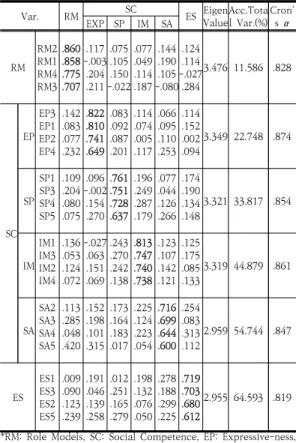
4.1 Factor AnalysisSimultaneous multi-group exploratory factor analy- sis(EFA) was applied to determine the dimensions of multi-item scales of the integrated data using principal components analysis with varimax rotation method. This method is known as instrumental in deciding the dimensions, and appraising content and construct validity of variables. The factor analysis result showed six distinctive dimensions with Eigen value greater than 1.0 each. But the factor loading of every one item in each dimension was found being less than .6(i.e., (RM) entrepreneurial efforts should be paid off=.561, (EP) delivering message correctly=.533, (SP) time to ask a favor=.560, (IM) deal with uncomfortable status=.518, (SA) make a quick decision=.587, (ES) calculated risk taker=
.481). The result of second run after deleting all
six items showed that all the rest 24 items were loaded on a six distinctive single factor(factor loading value >.6). Accordingly, each grouped items were aggregated into the six factor as they were identified uni-dimensional one another[52].
The six dimensions explained 64.6% of the total variance. Kaiser-Meyer-Olkin Measure of sampling adequacy(KMO) presented .924 that is higher than .7, minimum acceptable value[53].
Bartlet's test for Sphericity reported the adequacy of the data, too; 7098.345(p<.01). Finally, the reliability and internal consistency was verified with Cronbach’s alpha coefficient value for each variable. The alpha value of six variables are all greater than the threshold value .7[54]. Thus, the reliability and internal consistency of the data was verified to be acceptable.
Var. RM SC ES Eigen ValueAcc.Tota l Var.(%)Cron'
s α EXP SP IM SA
RM RM2RM1 RM4RM3
.860.858 .775.707
-.003.117 .204.211
.075.105 -.022.150
.077.049 .114.187
.144.190 -.080.105
.124.114 -.027 .284
3.476 11.586 .828
EP3EP1 EP2EP4
.142.083 .077.232
.822.810 .741.649
.083.092 .087.201
.114.074 .005.117
.066.095 .110.253
.114.152 .002.094
3.349 22.748 .874
SC EP
SP SP1SP3 SP4SP5
.109.204 .080.075
-.002.096 .154.270
.761.751 .728.637
.196.249 .287.179
.077.044 .126.266
.174.190 .134.148
3.321 33.817 .854
IM IM1IM3 IM2IM4
.136.053 .124.072
-.027 .063.151 .069
.243.270 .242.138
.813.747 .740.738
.123.107 .142.121
.125.175 .085.133
3.319 44.879 .861
SA SA2SA3 SA4SA5
.113.285 .048.420
.152.198 .101.315
.173.164 .183.017
.225.124 .223.054
.716.699 .644.600
.254.083 .313.112
2.959 54.744 .847
ES ES1ES3 ES2ES5
.009.090 .123.239
.191.046 .139.258
.012.251 .165.279
.198.132 .076.050
.278.188 .299.225
.719.703 .680.612
2.955 64.593 .819
*RM: Role Models, SC: Social Competence, EP: Expressive-ness, SP: Social Perception, IM: Impression Management, SA:
Social Adaptation, ES: Entrepreneurship
Table 2. Factor Analysis (Korea-China Integrated)
Consequently, all items grouped in each category were summed up and averaged to form each distinctive variables as shown on Table 2.
Particularly, the 4 sub-scales (EP, SP, IM, SA) of SC were all aggregated and averaged to form into an uni-dimensional variable SC for regression analysis.
The descriptive statistics and inter-correlation matrix are presented on Table 3. As reported, SC is most highly correlated with ES(r=.640, p<.01), followed by the correlation between RM and SC (r=.518, p<.01). RM is also correlated with ES (r=404, p<.01) positively. Thus, it is acknowledged that all variables are correlated with one another significantly.
Vari. Mean SD # of item RM SC ES
RM 3,443 .723 4 1
SC 3.368 .540 4 .518*** 1
ES 3.575 .670 4 .404*** .640*** 1
*p< .1, **p< .05, ***p< .01 Table 3. Correlation Matrix
4.2 Results
First, the conditions for the application of multiple linear regression of the model was verified through SPSS(PASW Statistic 18 version).
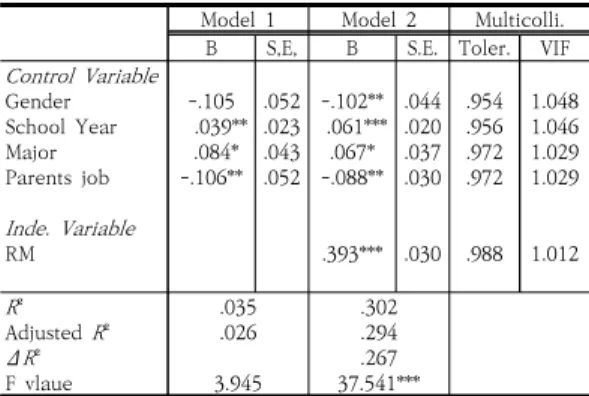
The conditions refer to linearity of the model including normality and homoscedasticity of residuals. The absence of multi-variate multicollinearity is verified, too. The tolerances(.698~.988) are all higher than criterion .10[55], and the VIF values(1.012~1.433) meet the acceptable ranges too[56]. H1 is to attest if RM influences SC positively. The empirical result presents that 30.2% of SC is explained by RM including demographic variables. F statistics show the adequacy of the model(F=37,541, p<.01).
The regression analysis reports that RM has a positive and significant effect on SC(B=.393, p<.01). This finding supports the prediction of H1. Thus, H1 is accepted. H2 and H3 are
proposed to test if both RM and SC affect ES positively. The test result reports that 42.2% of ES are explained by the two variables. The model adequacy is also verified significantly(F=63.324, p<.01). The result displays that both RM(B=.088, p<.01) and SC(B=.731, p<.01) have positive impacts on ES significantly. Thus, both H2 and H3 are all supported. Table 4 and 5 present the results of regression analyses for H1, H2, and H3.
Model 1 Model 2 Multicolli.
B S,E, B S.E. Toler. VIF
Control Variable Gender School Year Major Parents job Inde. Variable RM
-.105 .039**
.084*
-.106**
.052.023 .043.052
-.102**
.061***
.067*
-.088**
.393***
.044.020 .037.030
.030 .954.956 .972.972
.988 1.048 1.046 1.029 1.029
1.012 R²
Adjusted R² ΔR² F vlaue
.035.026 3.945
.302.294 37.541***.267
*p< .1, **p< .05, ***p< .01, Dependent variable: SC Table 4. Regression Results for H1
Model 1 Model 2 Multicolli.
B S,E, B S.E. Toler. VIF
Control Variable Gender School Year Major Parents job Inde. Variable RMSC
-.140*
.040 -.007 -.078
.065.029 .054.065
-.062 .017 -.072*
.004 .088***
.732***
.050.023 .041.050
.040.054 .943.936 .964.964
.714.698 1.061 1.069 1.037 1.038
1.400 1.433 R²
Adjusted R² ΔR² F vlaue
.018.008 3.937
.422.414
52.649***
*p< .1, **p< .05, ***p< .01, Dependent variable: ES Table 5. Regression Results for H2 and H3
Step Depend.Variable Independ.
Variable B
(non-stand) SE β
1 ES RM(c) .374 .040 .404***
2 SC RM(a) .391 .031 .518***
3 ES RM(c') .087 .040 .088**
SC(b) .735 .053 .595***
*p< .1, **p< .05, ***p< .01
Table 6. Mediating Effect of SC for H4
Finally, H4 is to examine the mediating role of SC in the relationship between RM and ES. A mediating effect of a variable refers to 'to the extent that explains the relationship between the outcome and the criterion'[55]. As shown in Table 6, SC has a partial mediating effect. The result implies that the effect size of SC on ES would be getting higher by interacting with RM only than the one from it's action solely. The mediating effect size of SC comes to .287 based on the simple equation c-c'=ab(.391x.735=.374-.087).
Thus, H4 is also accepted.
5. Conclusion and Suggestion 5.1 Conclusion and Implication
This paper has stepped into critical factors which affect entrepreneurship of university students, that takes us several steps forward in understanding how role models shapes the capability of young people for social activity to become entrepreneurs. Specifically, we have investigated how role models play a critical role in building social competence and entrepreneurship of both Korean and Chinese university students.
Given the fact that majority entrepreneurship studies have been executed in the western context, this study has it's own distinction in terms of attesting claims of previous studies in the eastern context. Verifying the role of social competence as mediator was another focal point of this study. Relying upon the relevant key theories supported by empirical studies, the paper attempted to identify and elaborate the recurring subjects of entrepreneurship research.
With the solid theoretical foundation, we have developed a research model to test causal relationships among the key variables. Four hypotheses were established to test the extent to which they prove the students' perceptions and previous findings. Our findings are as followings;
First, role models have a positive and significant relationship with social competence. Role models
also have a positive effect to entrepreneurship.
Social competence has a positive relationship with entrepreneurship. Finally, social competence has a partial mediating effect between role models and entrepreneurship. The contributions of this study are fourfold at the theoretical level.
Most of all, we extended the investigation of the effect of role models on social competence and the relationship with entrepreneurship by testing the arguments of prior studies and applicability in a non-Western cultural context. So, theoretical implications are as followings; First, This study empirically verified the positive effect between role models and com- petence as well as entrepreneurship. Third, our finding revealed social competence has a positive relationship with entrepreneurship. This result indicates that social competence can be the critical element for promoting entrepreneurship of young people.
Finally, it revealed that social competence has a mediating effect between role models and entrepreneurship. Thus, it is identified that there is no difference in the role of the key antecedents on promoting entrepreneurship between Korean and Chinese university students, and further the arguments in prior studies are also applicable to the eastern context. Further, as to the identical responsiveness of the two countries, it is inferable common cultural context shared between the two countries. Therefore, it became obvious that social competence comes into play in promoting entrepre- neurship when role models exist in entrepreneurial process.
Considering that role models are playing crucial role in promoting entrepreneurship of university students, it seems to be essential to address the need for adequate pedagogy in educational settings. From this view, this study offers several practical implications. First, role models should be included in entrepreneurship education program and relevant course at school as a formal session. By having role models in place, students can gain far better benefit and
opportunity in enforcing entrepreneurial mind-set. Second, social competence is an essential element in entrepreneurship. Thus, the educational institutions need to take into account well-designed educational programs intended to develop potential social competence of young students. Role models must take a part absolutely in executing the task.
This investigation has revealed that young people who are exposed to entrepreneurial role models are more likely to gain access to valuable information, advice, and resources, which in return, increase the likelihood to get interested in entrepreneurship, and consequently heighten their disposition to identify entrepreneurial opportunities.
5.2 Limitation
Although this paper produced some useful results, we have some limits obviously. First, our research model is too simple to catch in dept insights on the role of key factors including four sub-scales of social competence. Second, sample size is not big enough to justify generalization of our findings as a global study for the groups from two countries. Future study need to get bigger sample size as well as larger territorial base per country. Third, our study attempted to focus on both Korean and Chinese university students in Asian culture as opposed to Western culture. Accordingly, we used a dataset that two different data were integrated into one. Instead of this approach, a cross-cultural comparison study is recommended to obtain clear understanding with regards to what works similarly and differently between the two countries.
References
[1] S. Chlosta, H. Patzelt, S.B. Klein, C. Dormann,
"Parental role models and the decision to become selfemployed: The moderating effect of personality",
Small Business Economics, Vol.38, No.1, pp.121-138, 2012.
DOI: https://doi.org/10.1007/s11187-010-9270-y [2] A. Kacperczyk, "Social influence and entrepreneur-
ship: The effect of university peers on entrepreneurial entry", Organization Science, Vol.24, No.3, pp. 664- 683, 2013.
DOI: http://dx.doi.org/10.1287/orsc.1120.0773 [3] M, Minniti, "Entrepreneurship and network external-
ities", Journal of Economic Behavior and Organization, Vol.57, No.1, pp. 1-27, 2005.
DOI: https://doi.org/10.1016/j.jebo.2004.10.002 [4] R. Nanda, J. Sørenson, "Workplace peer effects and
entrepreneurship", Management Science, Vol.56, No.7, pp. 116-1126, 2010.
[5] G. A. Akerlof, R. E. Kranton, "Economics and identity", The Quarterly Journal of Economics, Vol. 115, No.3, pp. 715-753, 2000.
DOI: https://doi.org/10.1016/S0883-9026(03)00012-0 [6] D. Fornahl, Entrepreneurial activities in a regional
context, in: Dirk Fornahl and Thomas Brenner (Eds):
Cooperation, Networks, and Institutions in Regional Innovation Systems, Cheltenham: Edward Elgar, pp.
38-57, 2003.
[7] J. Krumboltz, A. Mitchell, G. A. Jones, "Social learning theory of career selection", The Counseling Psychologist, Vol.6, No.1, pp. 71-80, 1976.
[8] N. Bosma, J. Hessels, V. Schutjens, M. Van Praag, I.
Verheul, "Entrepreneurship and role models", Journal of Economic Psychology, Vol.33, No.2, pp. 410-424, 2012.
[9] J. Y. Yang, J. Li, "The development of entrepre- neurship in China", Asia Pacific Journal of Management, Vol.25, No.2, pp. 335-359, 2008.
DOI: https://doi.org/10.1007/s10490-007-9078-8 [10] GEM. Global Report 2017/18. the Global
Entrepreneurship Research Association (GERA).
[11] A. Bandura, Social Learning Theory, Englewood Cliffs, N.J: Prentice-Hall, 1977.
[12] H. Rahman, J. Day, "Who is your role model? The relationship between role models and student entrepreneurial motivation", Proceedings in ICSB World Conference, WA, USA, pp. 0-35, 2012.
[13] D. E. Gibson, "Role models in career development:
New directions for theory and research", Journal of Vocational Behavior, Vol.65, No.1, pp. 134-156. 2004.
[14]S . M. Bridge, K. O'Neill, S. Cromie, Understanding Enterprise, Entrepreneurship and Small Business (3rd ed.), Palgrave MacMillan, pp. 103-133, 2003.
[15] R. Henderson, M. Robertson, "Who wants to be an entrepreneur? Young adult attitudes to entrepreneurship as a career", Education + Training, Vol.41, No.5, pp. 236-245, 1999.
DOI: https://doi.org/10.1016/S0883-9026(03)00011-9
[16] M. Wyrwich, M. Stuetzer, R. Sternberg, "Entrepre- neurial role models, fear of failure, and institutional approval of entrepreneurship: A tale of two regions", Small Business Economics, Vol.46, No. 3, pp. 467-492, 2016.
DOI: https://doi.org/10.1007/s11187-015-9695-4 [17] O. Sorenson, P. G. Audia, "The social structure of
entrepreneurial activity: Geographic concentration of footwear production in the United States, 1940- 1989", American Journal of Sociology, Vol.106, No.2, pp. 424-462, 2000.
[18] A. Walter, M. Auer, T. Ritter, "The impact of net- work capabilities and entrepreneurial orientation on university spin-off performance", Journal of Business Venturing, Vol.21, No.4, pp. 541-567, 2006.
DOI: https://doi.org/10.1016/j.jbusvent.2005.02.005 [19] R. A. Baron, G. D. Markman, "Beyond social capital:
The role of entrepreneurs' social competence in their financial success", Journal of Business Venturing, Vol.18, No.1, pp. 41-60, 2003.
DOI: https://doi.org/10.1016/S0883-9026(00)00069-0 [20] N. R. Crick, K. A. Dodge, "A review and refor-
mulation of social information-processing mechanisms in children's social adjustment", Psychological Bulletin, Vol.115, No.1, pp. 74, 1994.
[21] H. Wei, D. Bilimoria, S. Li, "How Does Culture Matter?
The Xin (Heart-Mind)-based Social Compe- tence of Chinese Executives", Management and Organization Review, Vol.13, No.2, pp. 307-344, 2017.
DOI: https://doi.org/10.1017/mor.2016.37
[22] R. Boyatzis, A. McKee, D. Goleman, Primal leadership:
Learning to lead with emotional intelligence, McGraw-Hill, 2003.
[23] D. Mayer, M. DiPaolo, P. Salovey, "Perceiving affective content in ambiguous visual stimuli: A component of emotional intelligence", Journal of personality assessment, Vol.54, No.3-4, pp. 772-781, 1990.
DOI: https://doi.org/10.1080/00223891.1990.9674037 [24] A. G. Halberstadt, S. A. Denham, J. C. Dunsmore,
"Affective social competence", Social development, Vol.10, No.1, pp. 79-119, 2001.
DOI: https://doi.org/10.1111/1467-9507.00150 [25] D. Fornahl, Entrepreneurial activities in a regional
context. Cooperation, Networks and Institutions in Regional Innovation Systems, Cheltenham: Edward Elgar, pp. 38-57, 2003.
[26] D. E. Gibson, D. I. Cordova, Women's and men's role models: The importance of exemplars, Psychology Press, pp. 135- 154, 1999.
[27] P. Davidsson, B. Honig, "The role of social and human capital among nascent entrepreneurs", Journal of business venturing, Vol.18, No.3, pp. 301-331, 2003.
DOI: https://doi.org/10.1016/S0883-9026(02)00097-6 [28] E. Lafuente, Y. Vaillant, J. Rialp, "Regional differ-
ences in the influence of role models: Comparing the
entrepreneurial process of rural Catalonia", Regional Studies, Vol.41, No.6, pp. 779- 796, 2007.
DOI: https://doi.org/10.1080/00343400601120247 [29] J. Wagner, R. Sternberg, "Start-up activities, indivi-
dual characteristics, and the regional milieu: Lessons for entrepreneurship support policies from German micro data", The annals of regional science, Vol.38, No.2, pp. 219-240, 2004.
DOI: https://doi.org/10.1007/s00168-004-0193-x [30] M. B. Low, I. C. MacMillan, “Entrepreneurship: past
research and future challenges” Journal of Management, Vol.14 No.2, pp. 139-161, 1988.
DOI: https://doi.org/10.1177/014920638801400202 [31] K. H. Vesper, "Entrepreneurial Academics-How Can
We Tell when the Field", Journal of Small Business Management, Vol.25, No.2, pp. 1-10, 1987.
[32] W. B. Gartner, "Some suggestions for research on entrepreneurial traits and characteristics", Entrepre- neurship theory and practice, Vol.14, No.1, pp. 27- 38, 1989.
DOI: https://doi.org/10.1177/104225878901400103 [33] A. Cooper, Entrepreneurship: The past, the present,
the future. Springer, Boston, MA, pp. 21-34, 2003.
[34] P. Reynolds, N. Bosma, E. Autio, S. Hunt, N. De Bono, I. Servais, P. Lopez-Garcia, N. Chin, "Global Entrepreneurship Monitor: Data Collection Design and Implementation 1998–-2003", Small Business Economics, Vol.24, No.3, pp. 205-231, 2005.
DOI: https://doi.org/10.1007/s11187-005-1980-1 [35] N. C. Churchill, D. F. Muzyka, Entrepreneurial
Management: A converging theory for large and small enterprises. Proceedings at Babson Entrepreneu- rial Research Conference, pp. 1-17, 1994.
[36] D. C. McClelland, "Testing for competence rather than for 'intelligence'", American psychologist, Vol.28, No.1, pp. 1-14, 1973.
[37] M. M. Baluku, J. F. Kikooma, E. Bantu, K. Otto,
"Psychological capital and entrepreneurial out -comes: the moderating role of social competences of owners of micro-enterprises in East Africa", Journal of Global Entrepreneurship Research, Vol.8, No.1, pp.
1-23, 2018.
DOI: https://doi.org/10.1186/s40497-018-0113-7 [38] C. Saarni, The development of emotional competence.
Guilford Press, pp. 9-17, 1999.
[39] C. K. Prahalad, G. Hamel, "The core competence of the corporation", Harvard Business Review, Vol. 68, No.3, pp. 79–91, 1990.
[40] R. A. Baron, "Psychological perspectives on entrepre- neurship: Cognitive and social factors in entrepre- neurs’ success", Current Directions in Psycho- logical Science, Vol.9, No.1, pp. 15–18, 2000.
DOI: https://doi.org/10.1111/1467-8721.00050 [41] T. Lans, V. Blok, J. Gulikers, "Show me your network
and I’ll tell you who you are: Social competence and social capital of early-stage entrepreneurs", Entrepreneurship & Regional Development, Vol.27, No.7–8, pp. 458–473, 2015.
DOI: https://doi.org/10.1080/08985626.2015.1070537 [42] K. Albrecht, Social intelligence: The new science of
success. Willy, pp. 33-66, 2006.
[43] H. W. Williams, “Characteristics that distinguish outstanding urban principals: Emotional intelligence, social intelligence, and environmental adaptation”, Journal of Management Development, Vol.27, No.1, pp. 36-54, 2008.
DOI: https://doi.org/10.1108/02621710810840758 [44] D. M. Cable, S. A. Shane, "Prisoner's dilemma
approach to entrepreneur-venture capitalist relation- ships", Academy of Management Review, Vol.22, No.1, pp. 142-176, 1997.
DOI: https://doi.org/10.5465/amr.1997.9707180262 [45] S. A. Alvarez, J. B. Barney, "Discovery and creation:
alternative theories of entrepreneurial action", Strategic Entrepreneurship Journal, Vol.1, No.1–2, pp.
11-26, 2007.
DOI: https://doi.org/10.1002/sej.4
[46] R. Suddaby, G. D. Bruton, S. X. Si, "Entrepreneur- ship through a qualitative lens: Insights on the construction and/or discovery of entrepreneurial opportunity", Journal of Business Venturing, Vol.30, No.1, pp. 1-10, 2015.
DOI: https://doi.org/10.1016/j.jbusvent.2014.09.003 [47] P. DiMaggio, Interest and agency in institutional
theory. Chicago Press, pp. 3-21, 1988.
[48] N. Fligstein, "Social skill and the theory of fields", Sociological theory, Vol.19, No.2, pp. 105-125, 2001.
DOI: https://doi.org/10.1111/0735-2751.00132 [49] J. H. Yang, "The effect of role models on social
competence and entrepreneurial attitude: Focused on Korean and Japanese university students", Korean Journal of Business Administration, Vol.31, No.11, pp.
1991-2012, 2018.
DOI: https://doi.org/10.18032/kaaba.2018.31.11.1991 [50] R. W. Brislin, W. J. Lonner, R. M. Thorndike, Cross-
cultural research methods. Wiley, 1973.
[51] D. F. Kuratko, Introduction to entrepreneurship.
South-Western. pp. 2-30, 2009.
[52] J. G. Covin, D. P. Slevin, "The influence of organi- zation structure on the utility of an entrepreneurial top management style", Journal of management studies, Vol.25, No.3, pp. 217-234, 1988.
DOI: https://doi.org/10.1111/j.1467-6486.1988.tb00033.x [53] J. F. Hair, M. Wolfinbarger, D. J. Ortinau, R. P. Bush,
Essentials of Marketing Research. New York, McGraw-Hill Irwin, 2008.
[54] J. C. Nunnally, I. H. Bernstein, Psychometric Theory (3rd. ed.) New York: McGraw-Hill Book Co. 1994.
[55] R. M. Baron, D. A. Kenny, "The moderator–mediator variable distinction in social psychological research:
Conceptual, strategic, and statistical considerations", Journal of personality and social psychology, Vol.51, No.6, pp. 1173-1182, 1986.
[56] J. F. Hair, W. C. Black, B. J. Babin, R. E. Anderson, Multivariate data analysis (7th ed.), New Jersey:
Prentice Hall. 2010.
Zhanxi [Regular member]
• January 2014 ~ Current: Assistant Professor, Guangzhou University, The author earned Doctorial degree in Entrepreneurship area, and teaches Entrepreneurship, Finance, Venture Management, and Incubator operation <Research Interests>
- Entrepreneurship
- Entrepreneurial self-efficacy
Jun-Hwan Yang [Regular member]
• March 2014 ~ Current: Assistant Professor, Dankook University, teaches Entrepreneurship, Venture Management, and Leadership, at the college of liberal arts.
<Research Interests>
- Entrepreneurship
- Entrepreneurial motivation & intention - Entrepreneurial networking
- BPO of SME & Venture Firms