• 검색 결과가 없습니다.

The Efficacy of Early Start Denver Model Intervention in Young Children with Autism Spectrum Disorder Within Japan: A Preliminary Study

N/A
N/A
Protected

Academic year: 2021

Share "The Efficacy of Early Start Denver Model Intervention in Young Children with Autism Spectrum Disorder Within Japan: A Preliminary Study"

Copied!
6
0
0

로드 중.... (전체 텍스트 보기)

전체 글

(1)

INTRODUCTION

Autism spectrum disorder (ASD) is a neurodevelopmental disorder characterized by impairments in social interaction and communication as well as restricted, repetitive patterns of behavior, interests, or activities [1]. Over the years, the prev- alence of ASD has steadily increased. The annual report by the Centers for Disease Control and Prevention (CDC) not- ed that approximately 1 in 54 children (1.85%) was identified as having ASD in 2019 as per the estimate made by the CDC’s Autism and Developmental Disabilities Monitoring Network [2]. A large general population-based study conducted in

South Korea reported that the prevalence of ASD was esti- mated to be 2.64% [3]. Recently, a similar study in Japan dem- onstrated that the adjusted rate of ASD could be as high as 3.22% [4]. As the incidence of ASD could be much higher than earlier estimates, and since individuals with ASD re- quire continuous medical and welfare support throughout their lives depending on the severity of their ASD features [5], effective intervention strategies for subjects with ASD at an early life stage is an urgent necessity.

Although there are several intervention programs for chil- dren with ASD, many failed to establish their effectiveness in clinical trials [6]. However, the clinical efficacy of the Ear- ly Start Denver Model (ESDM) has been underscored through a compelling randomized controlled trial (RCT) [7]. Since the publication of the report outlining the successful, mea-

This is an Open Access article distributed under the terms of the Creative Commons Attribution Non-Commercial License (https://creativecommons.org/licenses/by-nc/4.0) which permits unrestricted non-commercial use, distribution, and reproduction in any medium, provided the original work is properly cited.

The Efficacy of Early Start Denver Model Intervention in Young Children with Autism Spectrum Disorder Within Japan: A Preliminary Study

Yukie Tateno 1,2,3 , Kahoru Kumagai 2 , Ryunosuke Monden 1 , Kotaro Nanba 1,3 , Ayumi Yano 1 , Eri Shiraishi 1 , Alan R. Teo 4,5,6 , and Masaru Tateno 1,3

1

Tokiwa Child Development Center (Division Child Psychiatry of Tokiwa Hospital), Sapporo, Japan

2

Tokiwa Developmental Support Center (Division Child Welfare of Tokiwa Hospital), Sapporo, Japan

3

Department of Psychiatry, Tokiwa Hospital, Sapporo, Japan

4

VA Portland Health Care System, HSR&D Center to Improve Veteran Involvement in Care, Portland, OR, USA

5

Department of Psychiatry, Oregon Health & Science University, Portland, OR, USA

6
School of Public Health, Oregon Health & Science University, and Portland State University, Portland, OR, USA

Objectives: Among the many intervention programs for children with autism spectrum disorder (ASD), the Early Start Denver Model (ESDM) is one of the few approaches that has succeeded in demonstrating clinical efficacy in randomized control trials. Here, we inves- tigate the clinical efficacy of ESDM intervention in young children with ASD in a community setting within Japan.

Methods: All subjects were children with ASD who received ESDM intervention during the study period. Each ESDM session lasted 75 min and occurred once per week for at least 12 weeks. The outcome measures consisted of the Kyoto Scale of Psychological Develop- ment (K-test), Aberrant Behavior Checklist-Japanese version (ABC-J), and the Clinical Global Impression-Severity scale (CGI-S).

Results: Twenty-seven subjects (29.4±6.4 months old) received ESDM intervention that lasted for 8.0±2.6 months on average. The score on Language and Social developmental quotient on the K-test increased significantly after the intervention. The total scores on the ABC-J and CGI-S significantly decreased after completion of the ESDM intervention.

Conclusion: Our results suggest that ESDM intervention could reduce the severity of distinct clinical features of ASD, such as impair- ments in social interaction and communication assessed by the K-test, and maladaptive behavior rated by the ABC-J and CGI-S. We be- lieve that the ESDM adapted to each institution might become one of the standard options for children with ASD in Japan.

Key Words: Autism spectrum disorder; Neurodevelopmental disorder; Early intervention; Pervasive developmental disorder;

Early Start Denver Model.

Received: September 25, 2020 / Revision: November 25, 2020 / Accepted: December 17, 2020

Address for correspondence: Masaru Tateno, Department of Psychiatry, Tokiwa Hospital, Tokiwa 3-1-6-1, Minami-ku, Sapporo 0050853, Japan Tel: +81-11-591-4711, Fax: +81-11-591-0922, E-mail: [email protected]

J Korean Acad Child Adolesc Psychiatry 2021;32(1):35-40

https://doi.org/10.5765/jkacap.200040

(2)

surable outcomes of ESDM, the technique has been recog- nized as an effective intervention strategy for ASD patients by eminent experts across the world. In their study, Dawson et al. [7] performed interventions for toddlers with autism in an RCT design and demonstrated that ESDM could reduce the severity of ASD diagnosis as assessed by the Autism Diag- nostic Observation Schedule (ADOS) [8].

ESDM is a naturalistic developmental behavior interven- tion that considers the toddlers’ normal development in re- lation to adults and is based on applied behavioral analysis.

ESDM is mainly administered to those between 12 and 36 months of age, although it might continue to positively affect until 48 to 60 months. ESDM intervention significantly pro- motes eye contact and joint attention in children with ASD and others during joint activity routine. ESDM could also improve reciprocal social interactions by using sensory, so- cial routines. The child’s communication skills might be sig- nificantly and rapidly facilitated by sharing enjoyment with an adult.

However, ESDM is usually an intensive intervention (15–

25 hours per week for 24 months or more) program. Most countries, including Japan, lack adequate public financing and a medical and welfare workforce to support such a pro- cess on a large scale.

In this study, we investigated the clinical efficacy of ESDM intervention in young children with ASD in Japan by admin- istering developmental tests and assessment tools at the be- ginning of and upon completing ESDM therapy delivered in an individualized setting.

METHODS

Participants

All children with ASD who received ESDM intervention at Tokiwa Child Development Center, Tokiwa Hospital be- tween April 2018 and April 2019 were invited to participate in this study. The clinical diagnosis was confirmed by a con- sensus among a multi-professional team (consisting of a psy- chologist, occupational therapist, speech therapist, and a child psychiatrist certified in ESDM) as per the Diagnostic and Sta- tistical Manual of Mental Disorders, Fifth Edition (DSM-5) [1]. The diagnosis was further confirmed by reference to the results of a set of developmental and psychological tests, in- cluding ADOS, Second Edition (ADOS-2) [9].

There were no exclusion criteria for this study. However, three subjects were excluded from the analysis, one each be- cause of the incidence of encephalitis, movement to another city, and withdrawal of consent.

ESDM intervention in this study

The ESDM intervention was delivered in an individualized setting; wherein there was a therapist and a young child with ASD and their mother or another family member as an ob- server in a well-prepared room. Generally, ESDM interven- tion is implemented intensively, 15 to 25 hours per week for two years or more. However, most medical or welfare insti- tutes cannot provide such intensive therapy in terms of fi- nancial aspects and limited human resources. In this study, each ESDM session lasted 75 minutes. The ESDM interven- tion was delivered by a certified therapist, the first author of this paper, or one of the other therapists under the supervi- sion of a certified therapist, once a week. In response to the increasing need to provide ESDM therapy in community settings, the UC Davis MIND Institute published a policy statement in 2019 on its website. It encouraged more practi- tioners to implement ESDM intervention within their set- tings. These might be different from the conditions in which the original ESDM was developed. To maintain the quality of ESDM therapy, we strictly followed the curriculum stan- dards described in the ESDM manuals. ESDM-certified ther- apists referred to the curriculum checklist to develop objec- tives. They examined the fidelity of the therapy provided by other therapists through on-site supervision or discussion over recorded materials.

Several studies have demonstrated the efficacy of a low- intensity ESDM, which provided less frequent and shorter sessions, and a shorter duration of the intervention [10-13].

The length of each session and the duration of ESDM inter- vention were as follows: three hours per week for 15 months by Devescovi et al. [13], five hours per week for two months by Xu et al. [11], six hours per week for six months by Colom- bi et al. [12], and eight hours per week for six months by Lin et al. [10]. Taken together, our ESDM intervention might be defined as a low-intensity ESDM in terms of density and length.

In this study, the individual ESDM interventions were deliv- ered for at least a 12-week period or a maximum of approxi- mately 12 months subjects were shifted to the usual group therapy in the ordinary community settings when a therapist considered that the child was ready to move to a group. Each session included a short briefing to the observer regarding generalized concepts of ESDM and specific methods of ap- plying the paradigm at home.

Measures

The Kyoto Scale of Psychological Development

The Kyoto Scale of Psychological Development (K-test)

(Society for the Kyoto Scale of Psychological Development

Test) [14,15] is a popular developmental test in Japan. The K-

(3)

test is a standardized and individualized psychological test that is administered by experienced psychologists to evaluate the developmental level of the subjects in three respective do- mains: Postural and Motor (P-M; fine and gross motor func- tions); Cognitive and Adaptive (C-A; non-verbal reasoning or visuospatial perceptions assessed using materials); and Lan- guage and Social (L-S; interpersonal relationships, socializa- tion, and verbal abilities). The developmental quotient (DQ) was calculated by dividing the developmental age (DA) mea- sured by scores in each area by the subject’s chronological age.

A previous study reported the K-test’s clinical usefulness for the cognitive assessment of children with pervasive de- velopmental disorders, which is equivalent to the clinical def- inition of ASD in DSM-5 [15]. Another Japanese group com- pared domain DQs of the K-test with scores on each of the four regions in the Bayley Scales of Infant Development-II (BDI-II) [16], that is, cognitive, language, social, and motor.

The correlation between the L-S DQ of the K-test and the lan- guage domain of the BDI-II at 18 months was high (r=0.60) [14]. Furthermore, unlike other developmental tests that es- timate the score by comparing with a norm sample in the same age group, the K-test calculates the child’s develop- mental level by dividing the DA obtained through the stan- dardized assessment and scoring procedure in the test by chronological age [14]. Thus, we assessed the efficacy of the ESDM intervention using the K-test.

In general, DQ scores higher than 80 are regarded as typi- cal developmental levels. The K-test takes approximately 20 to 40 min to complete.

Aberrant Behavior Checklist-Japanese version

The Aberrant Behavior Checklist (ABC) was developed to assess the therapeutic effects on severely mentally dis- abled individuals by scoring the severity of maladaptive be- haviors observed in the subjects [17]. ABC consists of five factors: 1) Irritability, Agitation, Crying (15 items), 2) Leth- argy, Social Withdrawal (16 items), 3) Stereotypic Behavior (7 items), 4) Hyperactivity, Noncompliance (16 items), and 5) Inappropriate Speech (4 items). The ABC is designed to be scored by the caregiver on a 4-point Likert scale ranging from 0 to 3. The reliability and validity of the Japanese ver- sion of the ABC have been reported previously [18]. The clinical usefulness of ABC for the behavioral assessment of children with ASD [19] and children under the age of 5 [20]

have also been reported.

In this study, all caregivers, mostly the mothers of the subjects, were requested to rate the severity of behavioral symptoms in their children before and after the ESDM in- tervention.

The Clinical Global Impression-Severity scale

The Clinical Global Impression-Severity scale (CGI-S) is a simple and easy rating scale developed to evaluate the se- verity of clinical symptoms in targeted subjects [21]. Raters are scored on a 7-point Likert scale, where a higher score in- dicates a more severe condition. We used the CGI-S to rate the overall severity of ASD symptoms, behavior, and function in the past seven days. In this study, two of our team mem- bers, other than the principal therapist in charge, scored CGI-S independently, and a consensus score was expressed as CGI-S rater.

Statistical analysis

All statistical analyses were performed using StatFlex Ver.6 (Artec Inc., Osaka, Japan). For comparing two related sam- ples (pre- vs. post-ESDM), the Wilcoxon signed-rank test was used. Statistical significance was set at p<0.01 (two-tailed).

Ethics

The ethics committee approved the study protocol of To- kiwa Hospital before data collection (TH-180201). Informed written consent was obtained from all the guardians before enrollment in the study. This study was conducted as per the principles of the Declaration of Helsinki.

RESULTS

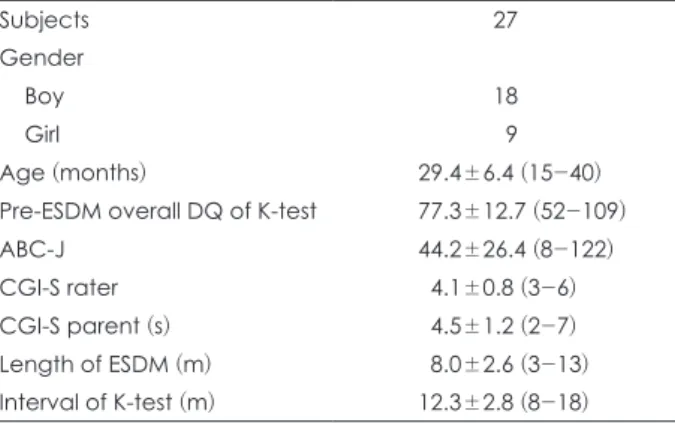
The mean age of the 27 subjects was 29.4±6.4 (15–40) months old at the initiation of ESDM intervention. The mean overall DQ measured by the K-test before the intervention was 77.3±12.7. On average, the intervention lasted 8.0±2.6 months, with a range of 3 to 13 months. The mean K-test inter- val between pre- and post-intervention was 12.3±2.8 months.

Because all subjects completed the K-test within 3 months of initiation and less than 3 months after completing ESDM, the interval for K-tests ranged from 8 to 18 months (Table 1).

The results of the efficacy of ESDM intervention are sum- marized in Table 2.

The Wilcoxon signed-rank test revealed that there were no significant pre-post differences in total DQ (pre: 77.3±12.7/

post: 75.4±13.7), P-M DQ (85.6±14.3/82.3±12.3), or C-A DQ (79.0±14.2/78.2±14.4). However, L-S DQ after the interven- tion was significantly higher when compared to the time be- fore the intervention, 64.8±19.7 vs. 70.8±19.0, p=0.0094.

The mean total ABC-J score decreased from 44.2±26.4 to 22.3±13.7. Statistical significance was found between these two scores using the Wilcoxon signed-rank test.

CGI-S scores rated by our team and caregivers changed

from 4.1±0.8 to 2.9±0.6 and 4.5±1.2 to 2.9±0.9, respectively.

(4)

DISCUSSION

This study demonstrated that ESDM intervention inte- grated into a common developmental support program for young children with ASD in a community setting within Ja- pan could reduce the severity of social impairments and lan- guage delay as assessed by the K-test, and maladaptive behav- iors rated by ABC-J and CGI-S.

Deficits in social communication and social interactions are the core features of ASD. Our results suggest that ESDM intervention utilizing our protocol (75 minutes per session and once per week) could reduce the severity of certain clini- cal symptoms of ASD, such as poor eye contact or impairment in social interaction, as assessed by the K-test. The slight de- crease in the overall DQ of the K-test (77.3±12.7% vs. 75.4±

13.7%) might be attributed to the delayed development in the Postural-Motor and Cognitive-Adaptive domains com-

pared to the children without ASD because the overall DQ is calculated from the estimated DA through various tasks of the K-test divided by the chronological age.

Accumulating evidence suggests that ESDM intervention almost certainly alleviates social interaction deficits in chil- dren with ASD [22,23]. There is a serious shortfall in the med- ical and welfare workforce of young children with ASD in Ja- pan [24]. It is almost impossible for us to provide intensive ESDM interventions to all the referred cases of ASD. Thus, those working in this field are caught in the dilemma of be- ing unable to provide enough therapies to young children with ASD who have the possibility of improving their social skills by receiving ESDM intervention. The present study re- sults suggest that ESDM intervention, which is modified to be practically feasible in our common clinical settings, could help in alleviate deficits in social communication and inter- action in children with ASD.

In Japan, there is a general health check-up at 18 and 36 months of age [25]. Annual statistical data by the Japanese Ministry of Health, Labor, and Welfare reports that more than 95% of all Japanese children at these ages are assessed in terms of their developmental levels at local public health centers every year. If additional research supports the effi- cacy of ESDM in community settings, it might be very effec- tive to initiate it in children with ASD soon after the 18-month health check-up, integrated into the public health system as is done in some European countries [12,26].

Maladaptive behavior is prevalent in children with ASD [27]. It is common for young children with ASD to have self- injurious, aggressive, disruptive, and destructive behaviors.

In this study, we scored the severity of maladaptive behaviors using the ABC-J. As a result, the mean total ABC-J score rat- ed by their mother or another family member decreased from 44.2±26.4 (pre-ESDM) to 22.3±13.7 (post-ESDM). Previous studies have demonstrated a close relationship between im- pairments in social interaction and the prevalence of mal- adaptive behavior in young children with ASD [28]. Our re- sults were consistent with these findings concerning the decreased severity of maladaptive behaviors on ABC-J that was related to the improvement in social interaction as as- sessed by the K-test. In general, maladaptive behaviors ob- served in children with ASD remain or worsen without ap- propriate intervention. Furthermore, specialized therapies for ASD require more expenses than other developmental disorders, especially when they have comorbid behavioral problems [29]. Maladaptive behaviors could be the most se- rious problems that hinder children with ASD from being included in group settings such as group therapies, daycare services, or preschools. Thus, early intervention for behav- ioral problems in children with ASD is essential.

Table 2. Summary of the results

Pre-ESDM Post-ESDM p

ABC-J 44.2±26.4 22.3±13.7* <0.001*

CGI-S rater 4.1±0.8 2.9±0.6* <0.001*

CGI-S parent (s) 4.5±1.2 2.9±0.9* <0.001*

K-test

Overall DQ 77.3±12.7 75.4±13.7 0.197

P-M 85.6±14.3 82.3±12.3 0.132

C-A 79.0±14.2 78.2±14.4 0.420

L-S 64.8±19.7 70.8±19.0* 0.0094*

*Statistically significant. ESDM: Early Start Denver Model, ABC-J:

The Aberrant Behavior Checklist-Japanese version, CGI-S: Clini- cal Global Impression-Severity scale, K-test: The Kyoto Scale of Psychological Development, DQ: developmental quotient, P-M:

Postural and Motor, C-A: Cognitive and Adaptive, L-S: Language and Social

Table 1. Summary of the subjects

Subjects 27

Gender

Boy 18

Girl 9

Age (months) 29.4±6.4 (15-40)

Pre-ESDM overall DQ of K-test 77.3±12.7 (52-109)

ABC-J 44.2±26.4 (8-122)

CGI-S rater 4.1±0.8 (3-6)

CGI-S parent (s) 4.5±1.2 (2-7)

Length of ESDM (m) 8.0±2.6 (3-13)

Interval of K-test (m) 12.3±2.8 (8-18)

The results are expressed as mean±standard deviation. The num-

bers in parentheses mean the ranges. ESDM: Early Start Denver

Model, DQ: developmental quotient, K-test: The Kyoto Scale of

Psychological Development, ABC-J: Aberrant Behavior Checklist-

Japanese version, CGI-S: Clinical Global Impression-Severity

scale

(5)

The CGI-S scores rated by our team and caregivers, ma- jorly their mothers, decreased from 4.1±0.8 to 2.9±0.6 and 4.5±1.2 to 2.9±0.9 (pre- vs. post-ESDM), respectively. These results suggest that caregivers were aware of the significant alleviation of various clinical symptoms related to ASD fea- tures in their children. It has been reported that the level of psychological distress among caregivers of children with ASD is associated with the severity of behavioral problems and clinical symptoms of ASD in their children [30]. Mini- mizing the concerns and anxieties of these individuals is an essential component of therapeutic interventions. To this end, the earlier the ESDM intervention begins, the more ef- fective it becomes in improving the quality of their and the affected children.

This study has several limitations, such as the small sam- ple size and pre-post design without controls. Replication with a larger sample, in a randomized controlled design, and addi- tional measures, such as ADOS-2, are necessary. However, to the best of our knowledge, this is the first study in Japan to demonstrate the efficacy of ESDM intervention in young chil- dren with ASD.

We hope that specialized interventions such as the ESDM adapted to each institution might become one of the standard options for children with ASD and their families in Japan.

Acknowledgments

The authors would like to thank all the subjects and their parents for their participation in this study. We thank all colleagues at the Tokiwa Child Development Center and Tokiwa Developmental Sup- port Center for their assistance during this study, especially Ms. Nie Kaneko and Ms. Ayako Kawachi for their elaborate help in provid- ing ESDM therapy.

Conflicts of Interest

The authors have no potential conflicts of interest to disclose.

Author Contributions

Conceptualization: Yukie Tateno, Kahoru Kumagai, Masaru Tateno.

Data curation: Yukie Tateno, Kahoru Kumagai, Kotaro Nanba, Ayumi Yano, Eri Shiraishi. Investigation: Yukie Tateno, Ryunosuke Monden.

Methodology: Yukie Tateno, Alan R. Teo. Writing-statistics: Masaru Tateno. Writing—original draft: Yukie Tateno. Writing—review & edit- ing: Alan R. Teo, Masaru Tateno.

ORCID iDs

Alan R. Teo https://orcid.org/0000-0002-2393-088X Masaru Tateno https://orcid.org/0000-0002-5084-0193

REFERENCES

1) American Psychiatric Association. Diagnostic and statistical man- ual of mental disorders (DSM-5

®

). 5th ed. Washington, DC: Amer- ican Psychiatric Association;2013.

2) Autism and Developmental Disabilities Monitoring (ADDM) Network, 2020 Community Report on Autism. Centers for Disease Control and Prevention, Atlanta, Georgia;2020.

3) Kim YS, Leventhal BL, Koh YJ, Fombonne E, Laska E, Lim EC, et al. Prevalence of autism spectrum disorders in a total population sample. Am J Psychiatry 2011;168:904-912.

4) Saito M, Hirota T, Sakamoto Y, Adachi M, Takahashi M, Osato- Kaneda A, et al. Prevalence and cumulative incidence of autism spectrum disorders and the patterns of co-occurring neurodevel- opmental disorders in a total population sample of 5-year-old chil- dren. Mol Autism 2020;11:35.

5) Robison JE. Autism prevalence and outcomes in older adults. Au- tism Res 2019;12:370-374.

6) Green J, Garg S. Annual research review: the state of autism inter- vention science: progress, target psychological and biological mech- anisms and future prospects. J Child Psychol Psychiatry 2018;59:

424-443.

7) Dawson G, Rogers S, Munson J, Smith M, Winter J, Greenson J, et al. Randomized, controlled trial of an intervention for toddlers with autism: the Early Start Denver Model. Pediatrics 2010;125:e17-e23.

8) Lord C, Rutter M, DiLavore PC, Risi S. Autism diagnostic obser- vation schedule-WPS (ADOS-WPS). Los Angeles: Western Psy- chological Services;1999.

9) Lord C, Rutter M, DiLavore P, Risi S, Gotham K, Bishop S. Au- tism diagnostic observation schedule–second edition (ADOS-2).

Los Angeles: Western Psychological Services;2012.

10) Lin TL, Chiang CH, Ho SY, Wu HC, Wong CC. Preliminary clini- cal outcomes of a short-term low-intensity Early Start Denver Model implemented in the Taiwanese public health system. Autism 2020;

24:1300-1306.

11) Xu Y, Yang J, Yao J, Chen J, Zhuang X, Wang W, et al. A pilot study of a culturally adapted early intervention for young children with autism spectrum disorders in China. J Early Interv 2018;40:52-68.

12) Colombi C, Narzisi A, Ruta L, Cigala V, Gagliano A, Pioggia G, et al. Implementation of the Early Start Denver Model in an Italian community. Autism 2018;22:126-133.

13) Devescovi R, Monasta L, Mancini A, Bin M, Vellante V, Carrozzi M, et al. Early diagnosis and Early Start Denver Model interven- tion in autism spectrum disorders delivered in an Italian Public Health System service. Neuropsychiatr Dis Treat 2016;12:1379- 1384.

14) Aoki S, Hashimoto K, Ikeda N, Takekoh M, Fujiwara T, Morisaki N, et al. Comparison of the Kyoto Scale of Psychological Develop- ment 2001 with the parent-rated Kinder Infant Development Scale (KIDS). Brain Dev 2016;38:481-490.

15) Koyama T, Osada H, Tsujii H, Kurita H. Utility of the Kyoto Scale of Psychological Development in cognitive assessment of children with pervasive developmental disorders. Psychiatry Clin Neurosci 2009;63:241-243.

16) Washington K. The Bayley Scales of Infant Development-II and children with developmental delays: a clinical perspective. J Dev Behav Pediatr 1998;19:346-349.

17) Aman MG, Singh NN, Stewart AW, Field CJ. The aberrant behav- ior checklist: a behavior rating scale for the assessment of treatment effects. Am J Ment Defic 1985;89:485-491.

18) Ono Y. Factor validity and reliability for the Aberrant Behavior Checklist-Community in a Japanese population with mental retar- dation. Res Dev Disabil 1996;17:303-309.

19) Kaat AJ, Lecavalier L, Aman MG. Validity of the aberrant behav- ior checklist in children with autism spectrum disorder. J Autism Dev Disord 2014;44:1103-1116.

20) Schmidt JD, Huete JM, Fodstad JC, Chin MD, Kurtz PF. An eval- uation of the Aberrant Behavior Checklist for children under age 5.

Res Dev Disabil 2013;34:1190-1197.

21) Guy W. ECDEU assessment manual for psychopharmacology.

Rockville: U.S. Dept. of Health, Education, and Welfare, Public

Health Service, Alcohol, Drug Abuse, and Mental Health Admin-

istration, National Institute of Mental Health, Psychopharmacolo-

(6)

gy Research Branch, Division of Extramural Research Programs;

1976.

22) Sandbank M, Bottema-Beutel K, Crowley S, Cassidy M, Dunham K, Feldman JI, et al. Project AIM: autism intervention meta-analy- sis for studies of young children. Psychol Bull 2020;146:1-29.

23) Fuller EA, Oliver K, Vejnoska SF, Rogers SJ. The effects of the Ear- ly Start Denver Model for children with autism spectrum disorder:

a meta-analysis. Brain Sci 2020;10:368.

24) Tateno M, Inagaki T, Saito T, Guerrero APS, Skokauskas N. Cur- rent challenges and future opportunities for child and adolescent psychiatry in Japan. Psychiatry Investig 2017;14:525-531.

25) Kamio Y, Inada N, Koyama T, Inokuchi E, Tsuchiya K, Kuroda M.

Effectiveness of using the Modified Checklist for Autism in Tod- dlers in two-stage screening of autism spectrum disorder at the 18- month health check-up in Japan. J Autism Dev Disord 2014;44:194- 26) Holzinger D, Laister D, Vivanti G, Barbaresi WJ, Fellinger J. Fea- 203.

sibility and outcomes of the early start denver model implemented with low intensity in a community setting in Austria. J Dev Behav Pediatr 2019;40:354-363.

27) Dominick KC, Davis NO, Lainhart J, Tager-Flusberg H, Folstein S.

Atypical behaviors in children with autism and children with a his- tory of language impairment. Res Dev Disabil 2007;28:145-162.

28) Fulton E, Eapen V, Crnčec R, Walter A, Rogers S. Reducing mal- adaptive behaviors in preschool-aged children with autism spec- trum disorder using the early start denver model. Front Pediatr 2014;

2:40.

29) Buescher AV, Cidav Z, Knapp M, Mandell DS. Costs of autism spectrum disorders in the United Kingdom and the United States.

JAMA Pediatr 2014;168:721-728.

30) Davis NO, Carter AS. Parenting stress in mothers and fathers of

toddlers with autism spectrum disorders: associations with child

characteristics. J Autism Dev Disord 2008;38:1278-1291.

수치

Table 2. Summary of the results

참조

관련 문서