서 론
당뇨병의 유병률은 다른 질환의 유병률과 마찬가지로 연령 증가 와 함께 상승한다. 이러한 사실은 병원에 입원한 고령 환자일수록 당 뇨병을 가지고 있을 가능성이 높다는 것을 말한다.1) 세계보건기구 (World Health Organization)에 따르면 전 세계의 당뇨병 인구가 3억4 천7백만 명으로 추정되고 2012년에는 당뇨병으로 인한 연간 사망 환
자 수가 150만 명으로 추산되었다.2,3)
2012년 국내에서 시행한 국민건강영양조사에 따르면 만 30세 이 상에서 공복혈당이 126 mg/dL 이상이거나 의사 진단을 받았거나 혈 당강하제 복용 또는 인슐린 주사를 투여 받는 당뇨병 환자가 남성에 서는 10.1%, 여성에서는 8.0%로 나타났다.4) 입원한 환자 중 당뇨병이 있는 경우가 그렇지 않은 경우보다 6배나 될 정도로 당뇨병은 흔히 동반되어 있는 질환이다.5) 입원 중 고혈당은 입원 시 진단된 질환이
Original Article
제2형 당뇨병을 가진 입원 환자에서 Regular 인슐린과 Lispro 인슐린 슬라이딩 스케일의 혈당조절 비교
김주혁, 김은정*, 김재인, 오춘옥
부산보훈병원 가정의학과
Comparison between Regular and Lispro Insulin Sliding Scales of Controlling Blood Glucose in Hospitalized Patients with Type 2 Diabetes Mellitus
Joo-Hyuk Kim, Eun-Jeung Kim*, Jane Kim, Chun-Ok Oh
Department of Family Medicine, Busan Veterans Hospital, Busan, KoreaBackground: In the hospital, we use insulin sliding scales for glycemic control when diabetic patients are admitted. This study compares glycemic control with routinely used regular or lispro insulin sliding scales.
Methods: This study investigated 131 type 2 diabetic patients who were admitted between January 2012 and January 2013 (regular insulin group, 69;
lispro insulin group, 62). In this study, we used a t-test to compare the average fasting serum blood glucose values on admission and at discharge in these two groups.
Results: The following variables were compared between the regular and lispro insulin groups: mean age (69.42 ± 6.98 vs. 66.56 ± 9.07 years, respectively), body mass index (24.40± 3.82 vs. 25.11± 3.62 kg/m
2), duration of diabetes mellitus (9.91± 5.59 vs. 11.70± 5.71 years), admission duration (12.22± 7.76 vs. 14.21± 8.03 days), total dose of insulin (17.77± 17.32 vs. 24.39± 24.84 units), daily average dose of insulin (1.85± 1.82 vs.
1.85± 1.61 units), average glucose on admission (190.74± 97.28 vs. 209.54± 48.01 mg/dL), and average glucose at discharge (179.35± 69.15 vs.
197.44± 40.16 mg/dL). There were no significant differences in the decreases in average glucose between the two groups (11.39± 32.01 vs.
12.10± 15.45 mg/dL; P= 0.873).
Conclusion: No significant difference in glycemic control was found in hospitalized type 2 diabetic patients who received either regular or lispro insulin sliding scales.
Keywords: Comparison; Insuling Sliding Scale; Insulin Lispro; Regular Insulin
http://www.kafm.or.kr/kjfp.2015.5.3.343 pISSN 2233-9019 · eISSN 2233-9116 Korean J Fam Pract. 2015;5(3):343-347KJFP
Korean Journal of Family PracticeReceived February 3, 2015 Accepted August 28, 2015 Corresponding author Eun-Jeung Kim
Tel: +82-51-601-6067, Fax: +82-51-601-6339 E-mail: [email protected]
Copyright © 2015 The Korean Academy of Family Medicine
This is an open-access article distributed under the terms of the Creative Commons At- tribution Non-Commercial License (http://creativecommons.org/licenses/by-nc/3.0) which permits unrestricted noncommercial use, distribution, and reproduction in any medium, provided the original work is properly cited.
Joo-Hyuk Kim, et al. Comparison between Regular and Lispro Insulin Sliding Scales
Korean Journal of Family Practice
KJFP
나 합병되어 있는 질환의 이환율과 사망률 증가와 관련이 있다.6) 그 러므로 당뇨병이 있는 환자가 입원을 하게 되면 재원기간이 더 길어 지고 치료비용이 더 들게 된다. 효과적인 치료는 치료비용과 재원일 수를 줄이는 데 있어 중요하다고 할 수 있다.7,8)
이 중 경구 혈당강하제를 복용 중인 제2형 당뇨병 환자는 입원 중 혈당조절을 위해 슬라이딩 스케일 인슐린으로 처방 변환을 하거나 슬라이딩 스케일 인슐린을 추가하고 있다.9,10) 2형 당뇨병 환자에 있 어 표준화된 인슐린 슬라이딩 스케일(insulin sliding scales, ISS)이 언 제 어떻게 시작되었는지는 분명하지 않으나 여러 연구에서 ISS가 혈 당조절의 호전을 증명해 주었거나 이득이 없음을 보여 주었다.11,12) 현 재 ISS는 입원한 당뇨병 환자에서 널리 쓰이고 있으며, 혈당조절의 일 반적인 방법이 되고 있다.9)
ISS를 사용하여 급성질환상태에서 당뇨병성 케톤산증, 고혈당성 고삼투압증후군과 저혈당 등 대사성 합병증을 피하고 감염의 위험 을 감소시켰으며, 중환자실에서 집중적으로 혈당조절을 하여 경과 를 호전시켰다.13) 이러한 사실들은 중환자실에 입원하지 않은 경한 환자에게 있어서도 고혈당조절이 이득이 있는지, 그렇다면 ISS를 사 용하여 혈당조절을 엄격하게 효과적으로 성취할 수 있을지에 대한 연구가 필요하게 되었다. 입원 환자에서 식이나 총 정맥영양 등에 의 해 혈당의 잦은 변동이 있을 시 사용할 수 있는 것이 ISS이다. ISS 중 많이 쓰이는 것이 초속효성 인슐린과 속효성 인슐린이며, 부산보훈 병원에서는 regular와 lispro를 사용 중이었고, 당뇨병이 있는 입원 환 자에게 ISS를 사용하는 데 있어 체계적인 규정 없이 담당의사의 선 호도에 따라 regular 인슐린과 lispro 인슐린 중 선호하는 제제를 사 용하고 있었다. 두 제제로 ISS를 사용함에 있어 어떤 약물이 효과적 인지 비교를 시행한 연구가 있었다. 이 연구에서는 경구혈당강하제 를 끊고 ISS를 사용하여 regular와 lispro, 두 군의 효과를 비교하였으 나 두 군의 확연한 차이는 발견되지 않았다.14) 이번 연구에서는 연구 대상들이 기존 경구혈당강하제를 복용하면서 혈당측정을 시행하여 혈당이 높게 나타났을 시 ISS를 적용하였을 때, lispro 인슐린과 regu- lar 인슐린의 두 제제 중 추후 혈당조절에 있어서 어떤 약물이 비용 대비 효과적인지 비교해보고자 한다.
방 법
1. 연구대상
본 연구는 2012년 1월부터 2013년 1월까지 질병의 조기발견과 혈당 조절을 목적으로 부산시 부산보훈병원에 입원한 당뇨병 환자를 대 상으로 하였다. 내분비내과와 가정의학과 외래를 통해 입원한 환자 로서 총 131명으로 남성은 112명, 여성은 19명이었으며 나이는 34세
이상 87세 이하였다. 환자 중 이전 저혈당 경력이 있었거나 저혈당 가 능성이 높은 환자에게 lispro 인슐린을, 그렇지 않은 경우는 regular 인슐린을 적용하였다. 1형 당뇨병이거나, 이전 저혈당을 인지 못 했던 기왕력이 있거나, 입원 전 인슐린 치료를 받았던 경우는 제외하였다.
또한 재원기간 스테로이드를 복용하였거나, 슬라이딩 스케일 인슐린 을 사용하지 않았거나, 중환자실에 입원하였던 경우도 배제하였다.
2. 연구방법
본원에서는 당뇨병이 합병된 환자의 경우 일반적으로 병동 간호 사들이 하루에 4회(7 AM, 11 PM, 5 PM, 10 PM) 모세혈관을 천자해 식전혈당과 취침 전 혈당을 측정하였다. 휴대용 혈당측정기 blood glucose test meter Glucocard 01 (Arkray Inc., Kyoto, Japan)를 사용하였 고, 측정 가능범위는 10-600 mg/dL이었다. 측정혈당이 250 mg/dL 이 하 시 인슐린을 투여하지 않았고 251 이상 300 mg/dL 이하 시 2 units, 301 이상 350 mg/ dL 이하 시 4 units, 351 이상 400 mg/ dL 이하 시 6 units, 400 mg/dL 초과 시 담당의사 또는 당직의사에게 보고 후 8 units를 복부 피하로 주입하였다. 대부분 환자는 기존 경구혈당강하 제를 복용하면서 혈당이 높게 측정될 시에 ISS를 적용하였고, 용량 은 lispro 인슐린군과 regular 인슐린군 모두 동일하게 사용하였다 (Table 1). 입원할 당시와 퇴원 시 평균 혈당(식전 혈당과 취침 전 혈당) 을 비교하였다.
3. 통계분석
모든 통계분석은 PASW SPSS ver. 18.0 (SPSS Inc., Chicago, IL, USA) 를 이용하였다. Lispro 인슐린군과 regular 인슐린군, 두 집단의 입원 할 당시와 퇴원 시 시행한 평균 혈당의 감소량을 95%의 신뢰구간으 로 하는 t검정(양측 검정)을 사용하여 비교하였다. 통계적 유의성 수 준은 P-value<0.05로 정의하였다.
결 과
1. 조사대상자에 대한 내용
Regular 인슐린군 69명과 lispro 인슐린군 62명으로 총 131명을 대상 으로 하였다. Regular 인슐린군의 연령은 69.42±6.98세였고, body mass index (BMI)는 24.40±3.82 kg/m2, 당뇨병 이환기간은 9.91±5.59년이었 Table 1. Sliding scales of regular or lispro insulin
Finger stick blood glucose (mg/dL)
≤ 250 251-300 301-350 351-400 >400*
Therapy (units) None 2 4 6 8
*Call hospitalist for giving insulin.
김주혁 외. Regular와 Lispro 인슐린 슬라이딩 스케일의 비교 Korean Journal of Family Practice
KJFP
다. 반면 lispro 인슐린군에서는 연령이 66.56±9.07세, BMI는 25.11±
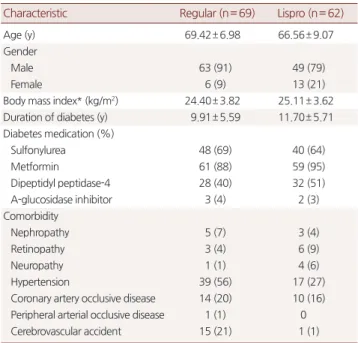
3.62 kg/m2, 당뇨병 이환기간은 11.70±5.71년이었다. 당뇨병 복용약과 합병증에 있어서도 두 군의 차이는 크게 보이지 않았다(Table 2).
2. Regular 인슐린군과 Lispro 인슐린군과의 비교
Regular 인슐린군에서는 재원기간이 12.22±7.76일이었고, 입원기 간 사용한 인슐린 총량은 17.77±17.32 units, 하루 평균 인슐린 사용 량은 1.85±1.82 units이었다. 입원 시 측정한 평균 혈당검사에서는 190.74±97.28 mg/dL, 퇴원 시 평균 혈당은 179.35± 69.15 mg/dL, 평균 혈당 감소량은 11.39±32.01 mg/dL이었고, 반면 lispro 인슐린군에서 는 재원기간이 14.21±8.03일이었고, 입원기간 사용한 인슐린 총량은
24.39± 24.84 units, 하루 평균 인슐린 사용량은 1.85±1.61 units이었 다. 입원 시 평균 혈당은 209.54±48.01 mg/dL, 퇴원 시 평균 혈당은 197.44±40.16 mg/dL, 평균 혈당 감소량은 12.10±15.45 mg/dL이었다.
Lispro 인슐린군의 평균 혈당 감소량과 regular 인슐린군의 평균 혈당 감소량을 비교해 보았을 때 유의확률이 0.05보다 크므로 귀무가설 을 기각할 수 없다. 따라서 입원한 당뇨병 환자들의 평균 혈당 감량 에 있어서 lispro 인슐린군과 regular 인슐린군 사이에는 유의한 차이 가 발견되지 않았다(Table 3).
고 찰
입원 환자군에서 당뇨병은 4번째로 많이 합병된 질환이며,15) 지속 적인 혈당 상승은 원내 사망률과 중환자실 입원율을 높였고 재원기 간을 길게 하였으며,16-18) 뇌졸중 환자에 있어서 예후가 나빴다.19,20) 여 러 연구들에서 당뇨병이 합병되어 있는 중환자나 심장질 환자에서 지속적인 혈당 상승이 나타나는 경우 ISS를 이용하여 적정 혈당을 유 지하였을 때 사망률과 합병증을 감소시켰다는 것을 보여주었다.21-24) 이로써 입원 환자를 대상으로 효과적인 치료는 치료비용과 재원일 수를 줄일 수 있어 집중적인 혈당조절이 필요하였다. 그리하여 입원 중 발생한 고혈당을 억제 또는 조절하기 위해 ISS을 사용하게 되었다.
ISS에 주로 사용하는 인슐린은 초속효성인 lispro 인슐린과 속효성인 regular 인슐린이 있다.
Lispro 인슐린은 기존의 regular 인슐린과 같은 적응증으로 1996년 6월 미국 Food and Drug Administration의 승인을 받았다. Lispro는 recombinant technology를 이용하여 인슐린 B chain의 28번에 위치한 proline과 29번의 lysine의 위치를 치환하였다. Lispro 인슐린은 regular 인슐린에 비하여 접종 부위에서 hexamer에서 monomer로 빠르게 해 리되어 작용발현이 더 신속하며 지속시간이 짧아진 재제이다. 당뇨 Table 2. Patient characteristics
Characteristic Regular (n= 69) Lispro (n= 62)
Age (y) 69.42± 6.98 66.56± 9.07
Gender
Male 63 (91) 49 (79)
Female 6 (9) 13 (21)
Body mass index* (kg/m2) 24.40± 3.82 25.11± 3.62 Duration of diabetes (y) 9.91± 5.59 11.70± 5.71 Diabetes medication (%)
Sulfonylurea 48 (69) 40 (64)
Metformin 61 (88) 59 (95)
Dipeptidyl peptidase-4 28 (40) 32 (51)
A-glucosidase inhibitor 3 (4) 2 (3)
Comorbidity
Nephropathy 5 (7) 3 (4)
Retinopathy 3 (4) 6 (9)
Neuropathy 1 (1) 4 (6)
Hypertension 39 (56) 17 (27)
Coronary artery occlusive disease 14 (20) 10 (16) Peripheral arterial occlusive disease 1 (1) 0
Cerebrovascular accident 15 (21) 1 (1)
Values are presented as mean± standard deviation or number (%).
*Calculated as weight in kilograms divided by height in meters squared.
Table 3. Comparison between regular and lispro insulin sliding scale groups
Group No. Mean± standard deviation Standard error of mean P-value*
Days in hospital Regular 69 12.22± 7.76 0.93 0.151
Lispro 62 14.21± 8.03 1.02
Total amount of insulin Regular 69 17.77± 17.32 2.09 0.077
Lispro 62 24.39± 24.84 3.15
Average daily insulin Regular 69 1.85± 1.82 0.22 0.992
Lispro 62 1.85± 1.61 0.02
Average glucose at admission Regular 69 190.74± 97.28 11.71 0.171
Lispro 62 209.54± 48.01 6.10
Average glucose at discharge Regular 69 179.35± 69.15 8.33 0.074
Lispro 62 197.44± 40.16 5.10
Average glucose decrement Regular 69 11.39± 32.01 3.85 0.873
Lispro 62 12.10± 15.45 1.96
*Calculated by t-test.
Joo-Hyuk Kim, et al. Comparison between Regular and Lispro Insulin Sliding Scales
Korean Journal of Family Practice
KJFP
병에 그동안 쓰여온 regular 인슐린은 혈당을 효과적으로 조절할 수 있으나 그 작용발현이 늦어 식사 30-45분 전에 투여해야 하므로 주 사 후 식사를 거르는 경우 안전성에 문제가 있으며 작용지속시간이 길다는 단점들을 갖고 있다. Lispro 인슐린은 이런 문제점들을 보안 하기 위해 만들어진 제제이다.25,26)
이번 연구에서는 경구혈당강하제를 복용하면서 혈당조절이 되지 않을 때 ISS를 사용할 경우 regular 인슐린과 lispro 인슐린 중 추후 혈 당조절에 있어서 어떤 제제가 더 유익한가를 비교해보았다. Regular 인슐린군에서 입원과 퇴원 시 평균 혈당 감소량은 11.39±32.01 mg/
dL이었고, lispro 인슐린군에서는 입원과 퇴원 시 평균 혈당 감소량은 12.10±15.45 mg/dL로 나타나, regular 인슐린군과 lispro 인슐린군의 평균 혈당 감소량은 통계적으로 유의한 차이가 없었다(P= 0.873).
이번 연구의 제한점으로는 첫째, 대부분 노인들 131명을 대상으로 한 연구로 표본수가 작고, 여성에 비해 남성의 비율이 상대적으로 높 은 집단을 선택함으로써 일반 당뇨병 환자군을 대표할 수 없어 결과 를 일반화하기 어렵다. 둘째, 일개 종합병원에 입원한 집단을 대상으 로 하였고 무작위 추출된 사람이 아니어서 선택 편견이 있을 수 있다 는 점이다. 셋째, 환자 입원 시 식사조절과 운동 등 결과에 영향을 줄 수 있는 교란변수의 존재가 있을 수 있다는 점이다. 그러나 당뇨병을 가진 입원 환자에 있어서 혈당조절에 사용하는 lispro 인슐린이 regu- lar 인슐린보다 평균 혈당 감소효과가 더 크지 않다는 것을 보여 주었 다는 데에 이 연구의 의의가 있다. 본 연구를 통하여 당뇨병 환자가 입원할 경우 저혈당 발생 가능성이 없거나 가능성이 낮을 때는 lispro 인슐린보다 상대적으로 저렴한 regular 인슐린을 먼저 ISS에 사용하 는 것도 좋을 것이라 생각한다.
요 약
연구배경:
당뇨병 환자가 입원하였을 때 혈당조절을 위해 인슐린 슬 라이딩을 통상적으로 사용한다. 흔히 사용되는 인슐린으로 regular 와 lispro 중 혈당조절에 있어 우위를 비교하고자 하였다.방법:
2012년 1월부터 2013년 1월까지 부산보훈병원에 입원한 2형 당 뇨병 환자 131명(regular 69명, lispro 62명)을 연구대상으로 하였다. 두 군의 입원할 당시와 퇴원할 시 평균 혈당과 평균 혈당 감소량을 t검정 을 통해 비교하였다.결과:
두 군의 평균 연령(regular, 69.42± 6.98세; lispro, 66.56±9.07세), 체질량지수(regular, 24.40±3.82 kg/m2; lispro, 25.11±3.62 kg/m2), 당뇨 병 이환기간(regular, 9.91±5.59년; lispro, 11.70±5.71년), 재원기간(reg- ular, 12.22±7.76일; lispro, 14.21±8.03일), 총 인슐린 용량(regular, 17.77±17.32 units; lispro, 24.39± 24.84 units), 하루 평균 인슐린 사용량(reg-
ular, 1.85±1.82 units; lispro, 1.85±1.61 units), 입원 시 평균 혈당(regu- lar, 190.74±97.28 mg/dL; lispro, 209.54±48.01 mg/dL), 퇴원 시 평균 혈 당(regular, 179.35±69.15 mg/dL; lispro, 197.44±40.16 mg/dL)이었다. 두 군의 입원과 퇴원 시 평균 혈당 감소량(regular, 11.39±32.01 mg/dL;
lispro, 12.10±15.45 mg/dL)은 유의한 차이가 없었다(P= 0.873).
결론:
당뇨병을 가진 입원 환자에 있어서 혈당 조절에 사용하는 lis- pro 인슐린이 regular인슐린보다 평균 혈당 감소 효과가 더 크지 않다 는 것을 보여 주었다는 데에 이 연구의 의의가 있다.중심단어:
비교; 인슐린 슬라이딩 스케일; Lispro 인슐린; Regular 인 슐린REFERENCES
1. Bhoraskar A. Inpatient management of diabetes mellitus. J Assoc Physicians India 2011;59 Suppl:29-31.
2. Danaei G, Finucane MM, Lu Y, Singh GM, Cowan MJ, Paciorek CJ, et al.
National, regional, and global trends in fasting plasma glucose and diabetes prevalence since 1980: systematic analysis of health examination surveys and epidemiological studies with 370 country-years and 2.7 million participants.
Lancet 2011;378:31-40.
3. World Health Organization. Health statistics and information systems: esti- mates for 2000-2012: cause-specific mortality [Internet]. Geneva: World Health Organization [cited 2014 Dec 14]. Available from: http://www.who.
int/mediacentre/factsheets/fs312/en/.
4. Korea Ministry of Health and Welfare. Korea health statistics 2012: Korea National Health and Nutrition Examination Survey (KNHANES V-3) [In- ternet]. Cheongju: Korea Centers for Disease Control and Prevention; 2012 [cited 2014 Dec 16]. Available from: https://knhanes.cdc.go.kr/knhanes/in- dex.do.
5. Roman SH, Harris MI. Management of diabetes mellitus from a public health perspective. Endocrinol Metab Clin North Am 1997;26:443-74.
6. Moghissi ES. Insulin strategies for managing inpatient and outpatient hyper- glycemia and diabetes. Mt Sinai J Med 2008;75:558-66.
7. Ahmann A. Comprehensive management of the hospitalized patient with diabetes. Endocrinologist 1998;8:250-9.
8. Hirsch IB, Paauw DS, Brunzell J. Inpatient management of adults with diabe- tes. Diabetes Care 1995;18:870-8.
9. Katz CM. How efficient is sliding-scale insulin therapy?: problems with a
‘cookbook’ approach in hospitalized patients. Postgrad Med 1991;89:46-8, 51-4, 57.
10. MacMillan DR. Insulin adjustment by the sliding scale method: a straw man who won’t stay down? J Ky Med Assoc 1991;89:211-2.
11. Bahlinger MH, Adkins KA. Development and implementation of a stan- dardized sliding scale insulin protocol. J Clin Outcomes Manag 2001;8:31-6.
12. Queale WS, Seidler AJ, Brancati FL. Glycemic control and sliding scale insu- lin use in medical inpatients with diabetes mellitus. Arch Intern Med 1997;
157:545-52.
김주혁 외. Regular와 Lispro 인슐린 슬라이딩 스케일의 비교 Korean Journal of Family Practice
KJFP
13. Van den Berghe G, Wouters P, Weekers F, Verwaest C, Bruyninckx F, Schetz M, et al. Intensive insulin therapy in critically ill patients. N Engl J Med 2001;
345:1359-67.
14. Alfonso A, Koops MK, Mong DP, Vigersky RA. Glycemic control with regu- lar versus lispro insulin sliding scales in hospitalized type 2 diabetics. J Dia- betes Complications 2006;20:153-7.
15. Hogan P, Dall T, Nikolov P; American Diabetes Association. Economic costs of diabetes in the US in 2002. Diabetes Care 2003;26:917-32.
16. Bolk J, van der Ploeg T, Cornel JH, Arnold AE, Sepers J, Umans VA. Im- paired glucose metabolism predicts mortality after a myocardial infarction.
Int J Cardiol 2001;79:207-14.
17. Capes SE, Hunt D, Malmberg K, Gerstein HC. Stress hyperglycaemia and increased risk of death after myocardial infarction in patients with and with- out diabetes: a systematic overview. Lancet 2000;355:773-8.
18. Umpierrez GE, Isaacs SD, Bazargan N, You X, Thaler LM, Kitabchi AE. Hy- perglycemia: an independent marker of in-hospital mortality in patients with undiagnosed diabetes. J Clin Endocrinol Metab 2002;87:978-82.
19. Capes SE, Hunt D, Malmberg K, Pathak P, Gerstein HC. Stress hyperglyce- mia and prognosis of stroke in nondiabetic and diabetic patients: a systemat- ic overview. Stroke 2001;32:2426-32.
20. Kiers L, Davis SM, Larkins R, Hopper J, Tress B, Rossiter SC, et al. Stroke to- pography and outcome in relation to hyperglycaemia and diabetes. J Neurol
Neurosurg Psychiatry 1992;55:263-70.
21. Furnary AP, Gao G, Grunkemeier GL, Wu Y, Zerr KJ, Bookin SO, et al. Con- tinuous insulin infusion reduces mortality in patients with diabetes under- going coronary artery bypass grafting. J Thorac Cardiovasc Surg 2003;125:
1007-21.
22. Goldberg PA, Siegel MD, Sherwin RS, Halickman JI, Lee M, Bailey VA, et al.
Implementation of a safe and effective insulin infusion protocol in a medical intensive care unit. Diabetes Care 2004;27:461-7.
23. Malmberg K. Prospective randomised study of intensive insulin treatment on long term survival after acute myocardial infarction in patients with dia- betes mellitus. DIGAMI (Diabetes Mellitus, Insulin Glucose Infusion in Acute Myocardial Infarction) Study Group. BMJ 1997;314:1512-5.
24. Markovitz LJ, Wiechmann RJ, Harris N, Hayden V, Cooper J, Johnson G, et al. Description and evaluation of a glycemic management protocol for pa- tients with diabetes undergoing heart surgery. Endocr Pract 2002;8:10-8.
25. DiMarchi RD, Chance RE, Long HB, Shields JE, Slieker LJ. Preparation of an insulin with improved pharmacokinetics relative to human insulin through consideration of structural homology with insulin-like growth factor I.
Horm Res 1994;41 Suppl 2:93-6.
26. Campbell RK, Campbell LK, White JR. Insulin lispro: its role in the treat- ment of diabetes mellitus. Ann Pharmacother 1996;30:1263-71.