Daegu 702-701, Republic of Korea
Received November 9, 2004; Accepted December 17, 2004
Oil extract, bioconverted from linoleic acid by a bacterial strain Pseudomonas aeruginosa PR3, and its stepwise chromatographically fractionated dilutions were chemically analyzed by gas chromatography (GC) and thin layer chromatography (TLC), and evaluated for their anti-fungal activities against Botrytis cinerea and Rhizoctonia solani. The extract sample (30µg·ml−1) showed high anti-fungal activity against R. solani (55%) and B. cinerea (53%) as compared to fractionated dilutions. Especially the fractionated dilutions of F2 (60 : 40) showed higher anti-fungal activities against B. cinerea (53%) as compared to R. solani (49%). Rest of fractionted dilutions showed relatively low anti-fungal activities against both the strains R. solani and B. cinerea (F1: 39%-43%, F3: 39%-47%, F4: 17%-49%, F5:
42%-50%) respectively. Oil extract sample showed anti-fungal activity with minimum inhibitory concentration (MIC), ranging from 500 to 1000µg·ml−1. The growth inhibition percentages of oil extract of bioconverted linoleic acid and fractionated dilutions were measured as morphological abnormalities for both R. solani and B. cinerea involving lysis, distortion and swelling in hyphae, and also the screening was carried out using varied oil extract concentrations for the determination of anti- fungal effects on the spore germination of B. cinerea.
Key words: anti-fungal activity, bioconversion, fractionated dilutions, Botrytis cinerea, Rhizoctonia solani
Botrytis cinerea and Rhizoctonia solani are very well known phytopathogens with worldwide spread. The frequent applications of the most effective fungicides resulted in the selection and predominance of the pathogen resistance strain.
B. cinerea “gray mold rot” is a ubiquitous pathogen which causes severe damages in many fruits, vegetables and ornamental crops in pre- and post harvest. The pathogen infects leaves, stems, flowers and fruits. The gray mold disease is very destructive on crops under green house conditions. Elad (1991) showed that B. cinerea developed resistance against specific fungicides (benzimidazoles, dicarboximides, diethofuncarb and sterol biosynthesis inhibitors) within a relatively short time.1)
The most common symptom of R. solani disease is referred to as “damping off”. It causes the below ground plant parts such as seeds, hypocotyls and roots and also capable of infecting the above ground plant parts as pods, fruits, leaves and stems with following diseases as root rot, collar rot, pod rot and web blight.
Additionally many investigations have recently focused on alternatives to synthetic pesticides in order to comply with food safety standards. It would be interesting to study its
effects on medically important fungi for development of new fungicidal agents for preventive treatment of serious fungal infections.
In this regard we started a program aimed at the evaluation of anti-fungal activities of bioconverted oil extract and its chromatographically fractionated dilutions, in hope to find out new natural products to be used in the biocontrol of plant diseases.2-6) We first report here the anti-fungal properties of the bioconverted oil extract of linoleic acid obtained from bioconversion by a bacterial strain Pseudomonas aeruginosa PR3 and its fractionated dilutions.
Materials and Methods
Microorganisms. Pseudomonas aeruginosa PR3 kindly provided by Dr. Hou in USDA/ARS/NCAUR, was grown at 28oC aerobically at 200 rpm on standard medium containing per liter 4 g dextrose, 2 g K2HPO4, 2 g (NH4)2HPO4, 1 g NH4NO3, 0.5 g yeast extract, 0.014 g ZnSO4, 0.01 g FeSO4· 7 H2O and 0.01 g MnSO4· 7H2O.
The fungi tested were obtained from the Korean agricultural culture collection. Cultures of each fungal species were maintained on potato-dextrose-agar (PDA) slants and stored at 5oC. The fungal species used in the experiment were B.
cinerea KACC40573 and R. solani KACC40111.
Chemicals. Linoleic acid with 99+ % purity, Silica Gel 365
*Corresponding author
Phone: +82-53-850-6553, Fax: +82-53-850-6559 E-mail: [email protected]
grade with 60-100 mesh, and silica gel TLC plates were purchased from Aldrich Co. Ltd.. All other chemicals were reagent grade and obtained from commercial sources.
Bioconversion of linoleic acid and its fractionation.
Bioconversion was carried out in 50 ml of standard medium as mentioned by Hou.7) Linoleic acid (0.5 g) as substrate, was added to a 24 h old culture followed by continued incubation for an additional 72 h. The culture broth was acidified to pH 2.0 with 6N HCl followed by immediate extraction twice with an equal volume of ethyl acetate and diethyl ether. The solvent was evaporated from the combined extract with a rotary evaporator and the oil extracts (0.37 g) were obtained.
The oil extracts were fractionated by column chromatography (25 mmÜ300 mm height) packed with silica gel. Elutions were carried out stepwise using 500 ml of hexane: ethyl acetate (80 : 20, 60 : 40, 40 : 60 and 20 : 80, v/v) and methylene chloride: methanol (80 : 20, v/v). Fractionated products F1, F2, F3 and F4 were obtained from hexane : ethyl acetate (80 : 20, 60 : 40, 40 : 60 and 20 : 80, v/v) fractions, respectively, and product F5 obtained from methylene chloride : methanol (80 : 20 v/v) fraction. The bioconversion was monitored by GC and TLC. Oil extracts were esterified with diazomethane and analyzed by an Shimadzu Model GC- 17A Gas Chromatography (Shimadzu; Kyoto, Japan) that was equipped with a Supelco SBP-1 capillary column (15 mÜ 0.32 mm, 0.25µm film thickness). Palmitic acid was added as an internal standard prior to solvent extraction for quantitative analysis. TLC analysis was carried out on TLC silica gel plates for analyzing the fractionated products. Further process for evaluating the pure components in the oil extract and fractions is in progress.
Preparation of spore suspension. The oil extract was used
for evaluating the anti-fungal susceptibility and inhibition of spore germination against a ubiquitous fungi B. cinerea. For these work, the spore suspension of B. cinerea was obtained from a 10 days old culture and mixed with sterile distilled water to obtain a homogenous spore suspension of 1Ü108 spore ml−1.
Determination of anti-fungal activity. Petri dishes 9 cm in diameter containing 20 ml of PDA medium were used for anti-fungal activity assay, performed in solid media by disc diffusion method.8) Sterile Whatman paper discs of 6 mm diameter were pierced in the agar plates, equidistant and near the border, where 30µgÁml−1 oil extract and fractionated dilutions were used. A disc of fungal inoculum 6 mm in diameter was removed from a previous culture of B. cinerea and R. solani and placed upside down in the center of the petri dishes. The plates were incubated at 25oC for 5-7 days, time by which the growth of control would have reached the edge of the plates. Growth inhibition was calculated as the percentage of inhibition of radial growth relative to the control along with anti-fungal effect on fungal mycelium. The plates were used in three replicates for each treatment.
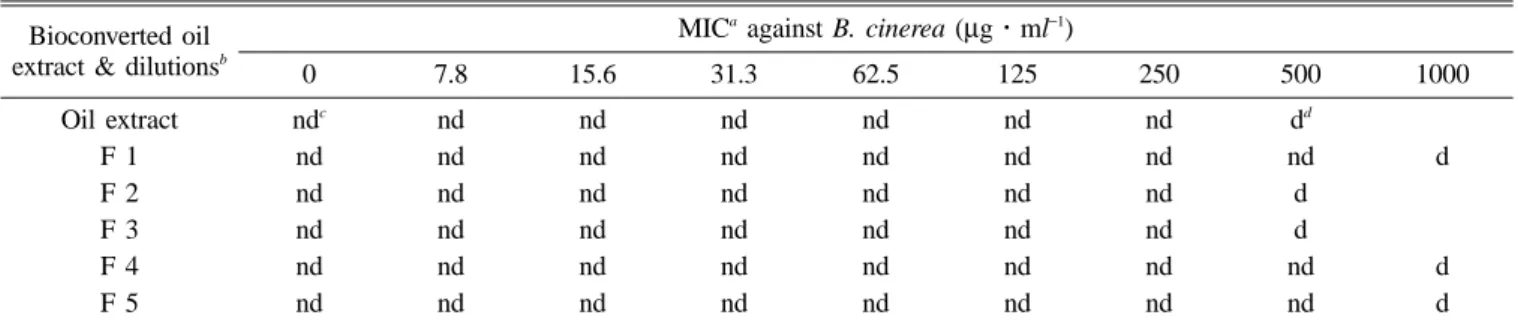
Anti-fungal susceptibility test. The minimum inhibitory concentrations (MICs) of bioconverted oil extract and fractionated dilutions were determined by twofold dilution method against B. cinerea.9) Oil samples were dissolved in 10 ml of 10% DMSO (10 mgÁml−1). This solution was serially diluted with 10% DMSO and was added to PDA to final concentrations of 0, 7.8, 15.6, 31.3, 62.5, 125, 250, 500, 1000 µgÁml−1. The spore suspension of test strain was inoculated in the test tube in PDB medium and incubated for 2-6 days at 25oC. The minimum concentration at which fungal growth was not observed was defined as the MIC (final concentration:
0.5% (w/v)).
Inhibition test of spore germination. Bioconverted oil extract (50µl) was dissolved in (100 µl) DMSO and diluted with sterile distilled water to prepare stock solution which was further diluted to prepare test samples where the final concentration of the DMSO was less than 0.1% (v/v).
Five concentrations of oil extract (1, 5, 10, 20 and 40µgÁ ml−1) and two controls, one sterile distilled water and other Fig. 1. TLC profile of linoleic acid and its bioconverted prod-
ucts by PR3. LA: linoleic acid, LA-H: bioconverted linoleic acid.
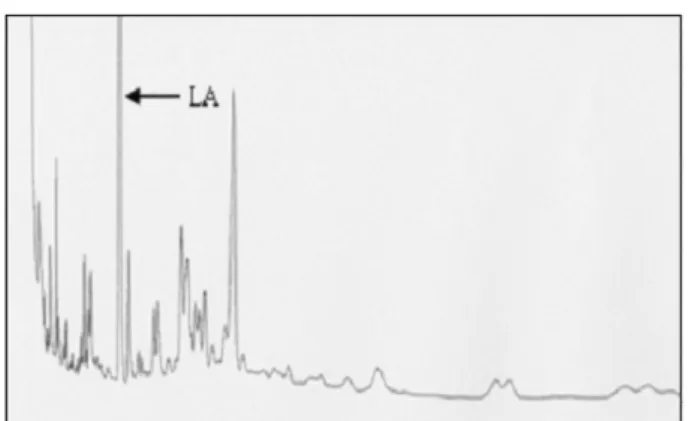
Fig. 2. Gas chromatogram of bioconverted linoleic acid. LA represents linoleic acid.
0.1% (v/v) DMSO in sterile distilled water, were tested for spore germination of B. cinerea.
Results
Bioconversion and anti-fungal assay. Bioconverted oil extract of linoleic acid (30µgÁml−1)as anti-fungal substance(s) was prepared by using bacterial strain P. aeruginosa PR3 and bioconversion rate (74%) was evaluated from residual linoleic acid, which was monitored by GC and TLC as shown in Fig. 1 and Fig. 2.
In our study, we have found that the bioconverted oil extract of linoleic acid (30µgÁml−1)showed high inhibition of mycelium growth against R. solani (56%) and B. cinerea (53%) as compared to the fractionated dilutions as shown in Table 1, Fig. 3 and Fig. 4. F2 among fractions obtained, showed the highest anti-fungal activity against B. cinerea (53%), other fractions also showed the mycelium inhibition in the range of 17% to 53% against R. solani and B. cinerea.
Anti-fungal susceptibility. Minimum inhibitory concentration for B. cinerea was more susceptible to the oil extract (500<
µgÁml−1) as compared to the fractions shown in Table 2. As control, DMSO didnt affect the growth of sample strain at the concentrations used in this study. The sub-inhibitory concentrations defined as the lowest concentration of the fractionated dilutions (F1, F2, F3, F4 and F5) that resulted in low inhibition of visible growth against B. cinerea were 1000>, 500>, 500>, 1000<, 1000<µgÁml−1, respectively. The MICs obtained for F2 and F3 were almost same. The MIC values obtained in this work represent the results of at least three independent experiments.
Inhibition of spore germination. The result obtained from the spore germination test of B. cinerea is shown in Fig. 5. A separate control run simultaneously in the presence of DMSO (0.1% v/v) in water as that used here showed that it didnt inhibit spore germination. However, there was significant inhibition of fungal spore germination by different concentrations (1, 5, 10,
20 and 40µgÁml−1) of the oil extract. B. cinerea showed considerable degree of spore germination inhibition up to 75%
at the oil extract concentration of 10µgÁml−1 and 90-100%
inhibition was observed at 20-40µgÁml−1 concentration of the oil extract. It has also been observed that those spores germinated in the presence of low concentrations of the oil
F 5 26.0 ± 2 22.5 ± 2 42.22 ± 0.04 50.00 ± 0.04
aMycelial growth in mm in the presence of oil extract.
bInhibition ratio (%) = {1−mycelium growth of treatment (mm)/mycelium growth of control (mm)} Ü 100
cFor control, the PDA plates with fungal inoculum were used with linoleic acid.
dF1, F2, F3 and F4 denote hexane : ethyl acetate (80 : 20, 60 : 40, 40 : 60 and 20 : 80), respectively, and F5 denotes methylene : methanol (80 : 20).
Fig. 3. Radial growth inhibition of R. solani (A) and B.
cinerea (B). Mycelium treated with bioconverted oil extract (30 µgÁml−1) after 5-7 days at 25oC.
extract produced small germ tubes as compared to control.
Mycelial abnormalities. In this experiment we found that bioconverted oil extract of linoleic acid showed the anti-fungal activity against the fungal mycelium (hyphae) of R. solani and B. cinerea which resulted as the distortion, lysis and swelling in fungal hyphae as shown in Fig. 6. For observing the results we collected the fungal mycelium from the fungus growing on PDA with concentration (30µgÁml−1) of oil extract and prepared the slides and observed under the microscope. The oil extract showed relatively high anti-fungal activity against the fungal mycelium of R. solani and B. cinerea as compared to control.
Discussion
This report describes the anti-fungal effect of the oil extract and fractionated dilutions on the mycelium and spore germination of phytopathogenic fungi. They exhibited a wide range of anti-fungal activities, affecting different fungi. Here in this experiment, in solid medium the oil extract and fractionated dilutions showed the anti-fungal activities against
R. solani and B. cinerea. The oil extract at the concentration of 30µgÁml−1 showed relatively high anti-fungal activity against R. solani and B. cinerea with about 60% fungal mycelium inhibition. Especially the fraction of F2 showed the almost similar anti-fungal activity as the oil extract against B. cinerea and rest of the fractions also showed the anti-fungal activities but at a little lower inhibition rate. The oil extract also showed high inhibition of spore germination against B. cinerea in liquid medium. Dubey and Mishra, and others also reported the mycelial growth inhibition of seed oils for certain fungi, and also inhibition of spore germination by different testing methods.10-19) The bioconversion process is quite competitive for commercial point of view as it can provide the huge production with higher productivity and higher percentage of yields at low cost processing. As mentioned by others, during the microbial bioconversion of unsaturated fatty acids 50% of production yield for 7,10,12-TOD from ricinoleic acid, 75%
Fig. 4. Effect of (30 µgÁml−1) the oil extract and fractionated dilutions on mycelial growth in solid medium against R. solani and B. cinerea. For control, the PDA plates with fungal inocu- lum were used with the linoleic acid. F1, F2, F3 and F4 denote hexane : ethyl acetate (80 : 20, 60 : 40, 40 : 60 and 20 : 80), respectively, and F5 denotes methylene : methanol (80 : 20).
Fig. 5. Effect of different concentrations of the oil extract on spore germination of B. cinerea.
Table 2. Evaluation of MICs of bioconverted oil extract and fractionated dilutions against B. cinerea Bioconverted oil
extract & dilutionsb
MICa against B. cinerea (µgÁml−1)
0 7.8 15.6 31.3 62.5 125 250 500 1000
Oil extract ndc nd nd nd nd nd nd dd
F 1 nd nd nd nd nd nd nd nd d
F 2 nd nd nd nd nd nd nd d
F 3 nd nd nd nd nd nd nd d
F 4 nd nd nd nd nd nd nd nd d
F 5 nd nd nd nd nd nd nd nd d
aMIC against B.cinerea.
bF1, F2, F3 and F4 denote hexane : ethyl acetate (80 : 20, 60 : 40, 40 : 60 and 20 : 80), respectively, and F5 denotes methylene : methanol (80 : 20).
cnd means no detection of anti-fungal activity.
dd means detection of anti-fungal activity.
for 7,10-DOD from oleic acid, and 45% for 9,10,13 and 9,12,13-THOD from linoleic acid were obtained.20-21)
It appeared that low concentration of the oil extract had little effect on the fungicidal activity but at relatively higher concentration the fungicidal action was very rapid whereas the linoleic acid as control, had no fungal inhibition as shown in Table 1 and Fig 4. The results shown here indicate that the microbially bioconverted oil extract of linoleic acid and its fractionated dilutions represented fungistatic and fungicidal activity with detailed quantitative information on the anti- fungal activity against fungal mycelium and fungal spore germination of R. solani and B. cinerea. This kind of research is being reported here first time for evaluation of anti-fungal substance(s) which might be the better tools in microbial transformation of hydroxyl fatty acids as a landmark achievement. These results suggest the availability of bioconverted oil extract and fractionated dilutions of natural vegetable fatty acid for trials in controlling plant fungal diseases under green house conditions. In order to produce the bioconverted oil extracts of linoleic acid in large quantity and to render the bioprocess feasible and practical we need to further improve the production yield and the process cost.
Studies on the production of the oil extract in a bioreactor and further verification of chemical structures of certain plausible active components are in progress.
Acknowledgments. This work was supported by a grant from Bio Green 21 Program, Rural Development Administration, Republic of Korea.
References
1. Elad, Y. (1991) Multiple resistance to benzimidazoles, dicar- boximides and diethofencarb in field isolates of Botrytis cinerea in Israel. Plant Pathology. 41, 41-46.
2. Khalouki, F., Hmamouchi, M., Younes, C., Soulimani, R., Bessiere, J. M. and Esassi, M. (2000) Anti-microbial and molluscicidal activities of essential oil of Chrysanthemum viscidehirtum. Fitoterapia. 71, 413-416.
3. Schwob, I., Bessiere, J. M., Dherbomez, M. and Viano, J.
(2002) Composition and antimicrobial activity of the essen- tial oil of Hypericum coris. Fitoterapia. 73, 511-513.
4. Hmamouchi, M., Humamouchi, J., Zouhdi, M. and Bes- siere, J. M. (2001) Chemical composition properties of essential oils of five Moroccan Pinaceae. J. Essential Oil Res. 13, 298-302.
5. Lahlou, M., Berrada, R., Agoumi, A. and Hmamouchi, M.
(2001a) The potential effectiveness of essential oils in the control of human head lice in Morocco. International Jour- nal of Aromatherapy. 10, 108-128.
6. Lahlou, M., Berrada, R. and Hmamouchi, M. (2001b) Mol- Fig. 6. Effect of the oil extract on the mycelial hyphae of R. solani and B. cinerea. A-1, B-1 are normal hyphae and A-2, B-2 are abnormal hyphae of R. solani and B. cinerea, respectively, treated with 30 µgÁml−1 of oil extract. A-2 is showing typical hyphal tip swelling and B-2 is lysis. Other abnormalities such as distortion, short septa and coiling of hypal mycelium were also found.
luscicidal activity of thirty essential oils on Bilinus trun- cates. Therapie. 56, 74-75.
7. Hou, C. T. (1995) Microbial oxidation of unsaturated fatty acids. Adv. Appl. Microbiol. 41, 1-23.
8. Rana, B. K., Singh, U. P. and Taneja, V. (1997) Antifungal activity and kinetics of inhibition by essential oil isolated from leaves of Aegle marmelos. J. Ethnopharmacol. 57, 29- 34.
9. Murray, P. R., Baron, E. J., Pfaller, M. A., Tenover, F. C., Yolke, R. H., 1995. Manual of Clinical Microbiology, Vol.
6th ed. ASM, Washington, DC.
10. Dubey, N. K. and Mishra, A. K. (1990) Evaluation of some essential oil against dermatophytes. Indian Drugs. 27, 529- 531.
11. Mishra, A. K. and Dubey, N. K. (1990) Fungitoxicity of essential oil of Amomum subulatum against Aspergillus fla- vus. Economic Botany. 44, 530-533.
12. Rao, B. G. V. N. and Joseph, P. L. (1971) Activity of some essential oils towards phytopathogenic fungi. Riechest Aromen Koerperpflegem. 21, 405-410.
13. Jain, N. K. (1997) Anti-fungal activity of essential oil of Aegle marmelos Correa (Rutaceae). Indian Drugs and Pharmaceutical Industry. 12, 55.
14. Begum, J., Yusuf, M., Chowdhury, J. U. and Wahab, M. A.
(1993) Studies on essential oils for their anti-bacterial and anti-fungal properties. Part 1. Preliminary screening of 35 essential oils. Bangladesh Journal of Science and Indus-
trial Research. 28, 25-34.
15. Pattnaik, S., Subramanyam, V. R. and Kole, C. (1996) Anti- bacterial, anti-fungal activity of 10 essential oils in vitro.
Microbios. 86, 237-246.
16. Arras, G. and Usai, M. (2001) Fungitoxic activity of twelve essential oils against four post harvest citrus pathogens:
chemical analysis of Thymus capitatus (L) Hofmgg oil and its effect in sub atmospheric pressure conditions. Journal of Food Protection. 64, 1025-1029.
17. Anthonov, A., Stewart, A. and Walter, M. (1997) Inhibition of conidium germination and mycelial growth of Botrytis cinerea by natural products. New Zealand Plant Protection Society Paper, 1-7.
18. Carta, C., Moretti M. D. L. and Peana, A. T. (1996) Activ- ity of the oil of Silva officinalis L. against Botrytis cinerea.
Journal of Essential oil Research. 8, 399-404.
19. Shimoni, M. (1993) Growth inhibition of plant pathogenic fungi. Journal of Essential Oil Research. 74, 306-308.
20. Kim, H., Jang, Y. S. and Hou, C. T. (2001) Effect of metal ions on the production of isomeric 9, 10, 13 (9,12,13)-trihy- droxy-11E (10E)-octadecenoic acid from linoleic acid by Pseudomonas aeruginosa PR3. Enzyme and Microbial Tech- nology. 25, 109-115.
21. Kuo, T. M., Kim, H. and Hou, C. T. (2001) Production of a novel compound, 7,10,12-trihydroxy-8(E)-octadecenoic acid from recinoleic acid by Pseudomonas aeruginosa PR3. Cur- rent Microbiology. 43, 198-203.