Dissipation Patterns of Triazole Fungicides Estimated from Kinetic Models in Apple
Ji-Hwan Kim · Jeong-in Hwang · Young-Hwan Jeon · Hyo-Young Kim · Ji-Woon Ahn · Jang-Eok Kim*
Triazole 계 살균제의 사과 중 잔류양상의 Kinetic Model 적용
김지환 · 황정인 · 전영환 · 김효영 · 안지운 · 김장억*
Received: 13 June 2012 / Accepted: 24 August 2012 / Published Online: 31 December 2012
© The Korean Society for Applied Biological Chemistry 2012
Abstract While cultivating crops, it is important to predict the biological half-lives of applied pesticides to ensure the safety of agricultural products. Dissipation patterns of the triazole fungicides, such as diniconazole and metconazole, during the cultivation of apple were established by utilizing the dissipation curve. As well as, the biological half-lives of the pesticides in apples were calculated using the residue amounts of them. The apples were harvested from 0 to 14 days after spraying diniconazole (WP) and metconazole (SC) at a recommended and three times of the recommended dose. Initial concentrations of diniconazole in apple were 0.09 and 0.15 mg/kg at a recommended and three times of the recommended dose, respectively, which were below MRL 1.0 mg/kg established by KFDA. The equations of biological half-life were C
t=0.0811e
−0.179x(half life: 3.9 days) and C
t=0.1451e
−0.148x(half life: 4.7 days), respectively. In case of metconazole, initial concentrations in apple were 0.10 and 0.25 mg/kg, below MRL 1.0 mg/kg, and biological half-life equations were C
t=0.0857e
−0.055x(half life: 12.6 days) and C
t=0.2304e
−0.052x(half life: 13.3 days), respectively. Therefore, when triazole fungicides were applied during the cultivation of apple, the biological half-life need to be calculated with the optimal equation model.
Keywords apple · biological half-life · diniconazole · metconazole · triazole fungicide
서 론
Triazole 계열의 농약은 분자구조 내에 질소 원자를 3개 가진 triazole기를 함유하는 화합물로서 주로 살균제로 사용되고 있으 며(Jeong et al., 2004; Mackay et al., 2006; Tomlin, 2006), 그 사용량이 늘어남에 따라 국내외적으로 적용 작물 중 triazole 계 농약의 잔류양상에 대한 연구가 진행되고 있다(Santoro et al., 2000; Yang et al., 2006; Mohamed et al., 2006; Lee et al., 2009b).
사과재배 시 사용되고 있는 대표적인 triazole 계열 살균제 중 diniconazole은 붉은별무늬병의 방제, metconazole은 갈색무늬병, 겹무늬썩음병, 점무늬낙엽병, 탄저병 등의 방제에 사용되고 있 다(Korea Crop Protection Association, 2011).
사과재배 시 살포된 농약들은 재배기간 중 분해, 휘산 및 강 우 등에 의해서 잔류량이 대부분 감소하지만 출하되는 시점까 지도 그 중 일부가 사과에 잔류할 수도 있다(Kim et al., 2003;
Lee et al., 2005; Park et al., 2009). 사과는 과피를 제거하지 않고 껍질째 섭취하는 경우가 많으므로 사과의 생산단계에서 출 하단계까지 농약의 잔류 양상을 정확히 파악하여 출하시점에서 의 안전성 유무를 평가하는 것은 생산자에게는 재배단계에서 합 리적인 농약의 사용을 유도하고 소비자에게는 안전한 농산물을 공급하는데 꼭 필요하다고 할 수 있다(Kim et al., 2002; 2003;
Ko et al., 2004; Park et al., 2005; Kim et al., 2008; Lee et al., 2008; 2009a; 2009b; Park et al., 2009).
사과의 수확 전 생산단계서부터 작물에 살포한 농약의 경시 적 변화를 미리 측정하고, 생물학적 반감기를 구하는 것은 차 후 출하단계에서 농약 안전성에 대한 지표를 제공할 것이다. 농 촌진흥청에서는 농약 살포 후 통계적 분석을 통해 최고 잔류량 의 반으로 줄어드는데 걸리는 기간을 반감기로 정의하고 있으 며, 우리나라의 경우 국내ㆍ외에서 관행적으로 사용하고 있는 first order kinetic model을 이용하여 산출한 농산물 중 농약의 J.-H. Kim · J.-I. Hwang · Y.-H. Jeon · H.-Y. Kim · J.-W. Ahn · J.-E. Kim
School of Applied Biosciences, Kyungpook National University, Daegu 702-701, Republic of Korea
*Corresponding author (J.-E. Kim: [email protected])
ORIGINAL ARTICLE
반감기를 ‘생물학적 반감기(biological half-life)’라는 용어로 사 용하고 있다(Park et al., 2005). 그러나 first order kinetic model을 일괄적으로 적용하는 것보다 여러 kinetic model을 적 용하여 잔류량의 변화와 시간과의 관계를 도식화하여 상관관계 의 형태를 파악하고, 높은 결정계수(r2)를 갖는 최적의 model을 찾아 이를 이용하여 생물학적 반감기를 산출하는 것이 더 바람 직 할 것으로 생각된다.
따라서 본 연구는 triazole계 살균제 diniconazole과 metconazole 을 사과재배포장에 직접 살포하여 일정 기간별로 사과 중의 농 약 잔류량을 조사하고, kinetic 해석에 따른 합리적인 회귀식과 생물학적인 반감기를 산출하고자 하였다.
재료 및 방법
시약. Diniconazole(99.5%) 표준품은 Dr. Ehrenstorfer GmbH (Germany)로부터, cis-metconazole(98.92%), trans-metconazole (99.84%)의 표준품은 Kureha Co. (Japan)로부터 구입하여 사용 하였으며 시험 농약의 구조는 Fig. 1과 같다. 포장시험에 사용 된 diniconazole은 5% 수화제[빈나리, (주)동방아그로, Korea], metconazole은 20% 액상수화제[살림꾼, (주)동방아그로]이었다.
잔류농약의 분석을 위한 acetone, dichloromethane 및 n-hexane 은 Honeywell Burdick & Jackson Inc. (USA)의 농약잔류분석 용 시약을 사용하였다. 시료의 정제를 위한 충진제 florisil은 Sigma-Aldrich Chemical Co. (USA)사의 F9127 (60-100 mesh, 농약잔류분석용)을 사용하였고, sodium sulfate (GR급) 및 sodium chloride (EP급)는 Junsei Chemical Co., Ltd. (Japan) 에서 구입하여 사용하였다.
시험구 배치 및 약제 살포. 시험포장은 대구광역시 산격동 소 재 경북대학교 부속농장 과수원이었다. 사과에 대한 농약의 살 포는 농약사용지침서의 안전사용기준에 준하여 diniconazole 5%
으로 3회, 2011년 10월 12일에 1회 동력식 분무기를 사용하여 시험구 전체에 균일하게 살포하였다. 약제 살포 2시간 후를 0 일차로 하여 0, 1, 3, 4, 6, 8, 11, 13 및 14일까지 생육상태가 균일한 시료를 15개 이상씩 채취하였다. 채취한 시료는 처리구 별로 포장상자에 개별 포장하여 실험실로 운반 하였으며, 즉시 균질화한 후 플라스틱 용기에 넣고 밀봉하여 분석 전까지 −20
oC의 냉동고에 보관하였다.
농약의 잔류 분석. 사과시료 25 g에 acetone 100 mL를 가한 후 homogenizer로 마쇄·추출하였다. 이 추출액을 감압, 여과 한 후 1 L 분액여두에 옮기고 증류수와 포화 sodium chloride 용액을 일정량 가하여 dichloromethane 50 mL로 2회 분배하였 다. 이 dichloromethane층을 감압농축한 후 florisil glass column (16 mm, I.D.)에 정제하였다. Diniconazole과 metconazole의 추 출 및 분배과정은 동일하였으나 정제과정은 서로 다른 혼합비 의 용출용매를 이용하여 실시하였다. Diniconazole의 정제는 n- hexane 100 mL로 활성화시킨 column에 n-hexane 10 mL로 재 용해한 시료를 가하고 n-hexane/acetone (90/10, v/v) 50 mL로 용출시켜 버린 후, 다시 n-hexane/acetone (80/20, v/v) 70 mL 로 용출시켜 받아 실시하였다. 이 용출액을 40oC 이하의 수욕 상에서 감압 농축하고, 농축된 잔사를 acetone 2.5 mL에 재용해 하여 DB-5 [30 m (L.) × 0.25 mm (I.D.) × 0.25 µm (film thickness)]
column을 장착한 GC-ECD (Shimadzu GC 2010, Japan)로 분 석하였다. Metconazole의 정제는 n-hexane 100 mL로 활성화시 킨 column에 n-hexane 10 mL로 재용해한 시료를 가하고 n- hexane/acetone (95/5, v/v) 100 mL로 용출시켜 버린 후, 다시 n-hexane/acetone (70/30, v/v) 100 mL로 용출시켜 받아 실시하 였다. 이 용출액을 40oC 이하의 수용상에서 감압 농축하고, 농 축된 잔사를 acetone 2.5 mL에 재용해하여 DB-5MS [30 m (L.)
× 0.25 mm (I.D.) × 0.25 µm (film thickness)] column을 장착한 GC-MS (Shimadzu GC 2010 with GC-MS QP2010 Plus, Japan) 로 분석하였다.
결과 및 고찰
회수율 및 검출한계. 무처리 사과시료 25 g에 diniconazole과 metconazole 표준품을 각각 0.1 및 1.0 mg/kg 수준으로 처리하 여 회수율을 시험한 결과는 Table 1과 같았다. Diniconazole 및 metconazole 표준검량선의 결정계수(r2)는 각각 0.9992 및 0.9999로서 정량분석을 위한 양호한 직선성을 나타내었다.
Diniconazole의 회수율 시험 결과는 104.6~114.0% 수준이었으 며 GC-ECD 상에서의 최소검출량은 0.1 ng 이었고 검출한계는 Table 1 Recoveries and limit of detection for diniconazole and metconazole analysis in apple
Pesticide Fortification level (mg/kg)
Recovery (%) MDAb)
(ng)
LODc)
1 2 3 Mean ± SDa) (ng)
Diniconazole 0.1 106.2 107.2 104.6 106.0±2.0
0.1 0.01
1.0 113.0 113.2 114.0 113.4±0.5
Metconazole 0.1 117.3 111.4 116.8 115.2±2.8
0.1 0.01
1.0 116.9 116.3 117.8 117.7±0.6
a)SD, Standard Deviation; b)MDA,Minimum detectable amount; c)LOD, Limit of detection Fig. 1 Chemical structures of diniconazole and metconazole.
0.01 mg/kg이었다. Metconazole의 회수율 시험 결과는 111.4~
117.8%이었고 GC-MS 상에서의 최소검출량은 0.1 ng, 검출한계 는 각각 0.01 mg/kg이었다. 표준품 및 회수율 시험의 분석 chromatogram은 각각 Fig. 2 및 3과 같았으며 시료 중 간섭 peak는 존재하지 않았다.
사과의 증체율 및 기상조건. 경과일수별로 채취된 사과시료는 실험실로 이송직후 개별로 무게를 측정하여 시험기간 중 사과 의 무게변화 및 증체율을 기록하였다. 여러 다른 연구결과와 비 교하여 볼 때 사과는 대부분의 박과류나 엽채류에 비하여 무게 의 증체율이 상대적으로 낮은 것으로 나타났으며(Kim et al., 2002; Lee et al., 2005; 2009a; 2009b; Park et al., 2009) 시 험기간 중 무게의 변화가 거의 없었다. 시험기간 중 포장의 평 균 온도는 15.2±3.6oC, 평균 습도는 55.5±12.2%이었다.
사과 중 농약잔류 양상의 kinetic 해석. 사과에 살포된 농약의 잔류량은 Fig. 4와 같이 살포 후 시간의 경과에 따라 지속적으 로 감소하는 경향을 보였다. Diniconazole의 살포직후 사과 중
잔류량은 기준량 및 3회 처리구에서 각각 0.09 및 0.16 mg/kg 으로 식품의약품안전청에서 사과에 설정한 잔류허용기준인 1.0 mg/kg보다 낮게 나타났으며, metconazole의 최대 잔류량도 처 리직후 기준량 및 3회 처리구에서 각각 0.10 및 0.25 mg/kg으 로 사과에 설정된 잔류허용기준인 1.0 mg/kg보다 낮은 수준으 로 나타났다. Diniconazole과 metconazole의 반감기식은 Table 2와 같았으며 diniconazole의 반감기 곡선은 기준량 처리구에서 y=0.0811e−0.179x, 3회 처리구에서 y=0.1451e−0.148x으로 나타나 반 감기는 각각 3.9일 및 4.7일이었다.
Metconazole의 반감기 곡선은 기준량 처리구에서 y=0.0857e−0.055x, 3회 처리구에서 y=0.2304e−0.052x이었으며 반감기는 기준량 처리 구에서 12.6일, 3회 처리구에서 13.3일이었다. 동일한 triazole 계통의 diniconazole과 metconazole은 주성분의 함량이 각각 5 와 20%로서 함량이 높은 metconazole이 diciconazole에 비하여 반감기가 다소 길게 나타났다.
농약의 잔류량과 시간과의 관계식을 나타내는 model은 크게 Fig. 2 Chromatograms of diniconazole in apple by GC-ECD. (A: diniconazole 10 ng, B: control, C: Recovery 1.0 mg/kg)
Fig. 3 Chromatograms of metconazole in apple by GC-MS (A: metconazole 10 ng, B: control, C: Recovery 1.0 mg/kg).
6가지가 있다. First order kinetic, zero order kinetic 및 second order kinetic model은 시간에 따른 반응 물질의 변화를 표시하 여 반응비, 반응상수, 평균 잔류시간 등을 구할 수 있는 실험식 으로 농약을 비롯한 환경오염 물질의 이동 및 동태를 예측하는 데 주로 활용되는 model이다(Yang et al., 1995; Sparks, 1999). 반면에 power function, elovich 및 parabolic model은 변형시킨 시간과 종속변수 사이의 곡선 맞춤을 위해 사용되는 경험식으로 초기시간(t=o)의 변형에 문제가 있으므로 곡선맞춤 이외의 목적으로는 활용되지 않는 model이기 때문에(Yang et al., 1995; Sparks, 1999) 본 연구에서는 first order kinetic, zero order kinetic 및 second order kinetic model의 적용이 적합하다. 하지만 가장 적절한 model의 선정은 큰 결정계수와 작은 표준오차를 갖는 것을 기준으로 삼기 때문에(Steel and Torrie, 1980; Yang et al., 1995) 낮은 결정계수를 가지는 zero order kinetic model은 이 연구에 적합하지 않은 model이다. 따 라서 first order kinetic과 second order kinetic model을 이용 하여 각각의 결정계수 값을 구하고 kinetic 해석에 따른 합리적 인 회귀식과 생물학적인 반감기를 산출하였다.
First order kinetic model을 사용하여 얻어진 diniconazole과
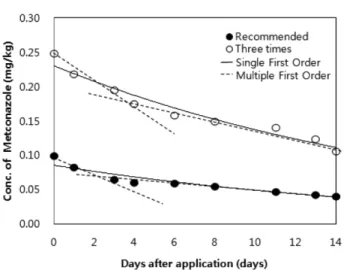
metconazole의 회귀방정식은 Table 2와 같았으며, second order kinetic model을 사용하여 얻어진 두 농약의 회귀방정식은 Table 3과 같았다. 각각의 model을 적용한 결과, diniconazole의 경우 기준량과 3회 처리 모두 first order kinetic model이 적합할 것 으로 판단되었으며 반면에 metconazole의 경우 second order kinetic model이 적합한 것으로 판단되었다. 이는 metconazole의 잔류유형이 Fig. 5와 같이 single first order 보다 multiple first order를 따르기 때문일 것으로 사료된다. 기준량의 경우 약 3일까지는 빠른 분해단계(stepI, r2=0.96)를 보이다 3일 이후 느 린 분해단계(stepII. r2=0.98)로 변화하는 양상을 보이고, 3회 처 리의 경우 약 4일까지는 빠른 분해단계(stepI. r2=0.97)를 보이 다 4일 이후 느린 분해단계(stepII. r2=0.90)로 변화하는 양상을 보여주었다.
현재는 대부분 first order kinetic model를 통해 반감기를 구 하지만 일부 결과는 first order kinetic model에 적합하지 않을 수 있다. Metconazole 기준량의 반감기를 first order kinetic model을 이용하여 산출할 경우 12.6일이지만 second order kinetic model을 이용할 경우 10.7일로 2일 가량이 짧아지는 경 향을 보이고 3회 처리의 경우는 1일 가량이 짧아지는 경향을 Fig. 4 Dissipation patterns of diniconazole and metconazole in apple.
Table 2 Biological half-lives of pesticides in apple by first-order kinetic
Pesticide Application Regression curvea)
Half-life (days)
Equation r2
Diniconazole Recommended Y=0.0811e−0.179x 0.9693 3.9
Three times Y=0.1451e−0.148x 0.9677 4.7
Metconazole Recommended Y=0.0857e−0.055x 0.9242 12.6
Three times Y=0.2304e−0.052x 0.9544 13.3
a)Regression curve, based on the first-order kinetics
Table 3 Biological half-lives of pesticides in apple by second-order kinetic
Pesticide Application Regression curvea) Half-life
(days)
Equation r2
Diniconazole Recommended Y=9.8886x+11.201 0.8416 1.1
Three times Y=3.4695x+6.383 0.8633 1.8
Metconazole Recommended Y=0.9346x+9.977 0.9677 10.7
Three times Y=0.3257x+4.012 0.9505 12.3
a)Regression curve, based on the second-order kinetics
확인할 수 있다.
이와 같은 결과를 통해서 first order kinetic model뿐만 아닌 잔류량과 시간과의 관계에 최적의 model을 찾아낸 후, 이 식의 kinetic 상수를 이용하여 반감기를 산출하면 안전성 평가에 더 욱 정확성을 기할 수 있을 것으로 판단된다.
초 록
사과에 대한 diniconazole과 metconazole의 반감기와 잔류양상 을 조사하였다. Diniconazole과 metconazole의 잔류허용기준은 둘 다 1.0 mg/kg으로서 0일차 기준량과 3회 처리구 모두 잔류 허용기준을 넘지 않았다. 재배기간 중 사과의 잔류농도는 약제 살포 후 14일 경과 시 diniconazole은 기준량 및 3회 처리에서 0.01 및 0.02 mg/kg으로서 각각 88.9 및 93.8%의 농약이 분해 되었다. Metconazole은 각각 0.04 및 0.11 mg/kg으로서 60.0 및 56.0% 정도의 농약 분해율을 보였다. Diniconazole의 사과 중 반감기식은 기중량 처리구에서 y=0.0811e−0.179x (r2=0.9693), 3회 처리구에서 y= 0.1451e−0.148x (r2=0.9677)이었으며 생물학적 반감기는 각각 3.9일 및 4.7일 이었다. Metconazole의 반감기식 은 y=0.0857e−0.055x (r2=0.9242) 및 y=0.2304e−0.052x (r2=0.9544) 이었고 생물학적인 반감기는 각각 12.6일 및 13.3일 이었다.
Metconazole 기준량과 3회 처리의 경우 first order kinetic model 보다는 second order kinetic mode이 더 적합하였으며 반 감기도 기준량에서 2일, 3회 처리에서 1일 감소되는 것을 알 수 있었다. 따라서 각 농약별로 잔류량과 시간과의 관계에 적 합한 model을 찾아 반감기를 산출하는 것이 바람직 할 것으로 생각된다.
Keywords apple · biological half-life · diniconazole · metconazole · triazole fungicide
감사의 글 이 연구는 2011년 국립농산물품질관리원의 ‘생산단계 농산물의 잔류농약 허용기준 설정연구’의 연구비 및 2012학년도 경북대학교 학술 연 구비 지원에 의하여 연구되었음.
참고문헌
Jeong YH, Kim JE, Kim JH, Lee YD, Lim CH, and Heo JH (2004) In Recent Pesticide Science. pp. 37, 203. Sigma press, Seoul, Korea.
Kim MR, Na MA, Jung WY, Kim CS, Sun NK, Seo EC et al. (2008) Monitoring of pesticide residues in special products. Korean J Pestic Sci 12, 323–34.
Kim YS, Park JH, Park JW, Lee YD, Lee KS, and Kim JE (2002) Persistence and dislodgeable residues of chlorpyrifos and procymidone in lettuce leaves under greenhouse condition. Korean J Environ Agric 21, 149–55.
Kim YS, Park JH, Park JW, Lee YD, Lee KS, and Kim JE (2003) Residue levels of chlorpyrifos and chlorthalonil in apples at harvest. Korean J Environ Agric 22, 130–6.
Ko KY, Kim KH, and Lee KS (2004) Residual pattern of procymidone and chlorothalonil in grape during the period of cultivation and storage.
Korean J Environ Agric 23, 47–51.
Korea Crop Protection Association (2011) Pesticides Use Guidelines for 2011.
p. 60, 110. Samjeung press, Seoul, Korea.
Lee EY, Kim DK, Park IY, Noh HH, Park YS, Kim TH et al. (2008) Residue patterns of indoxacarb and thiamethoxam in chinese cabbage(Brassica campestris L.) grown under greenhouse conditions and their estimated daily intake. Korean J Environ Agric 27, 92–8.
Lee EY, Noh HH, Park YS, Kang KW, Kim JK, Jin YD et al. (2009a) Residual characteristics of etofenprox and methoxyfenozide in chinese cabbage. Korean J Pestic Sci 13, 13–20.
Lee HD, Ihm YB, Kwon HY, Kim JB, Kyung KS, Park SS et al. (2005) Characteristics of Pesticide residue in/on cucurbitaceous fruit vegetables applied with foliar spraying under greenhouse. Korean J Pestic Sci 9, 359–64.
Lee JH, Jeon YH, Shin KS, Kim HY, Park EJ, Kim TH et al. (2009b) Biological half-lives of fungicides in Korean melon under greenhouse condition. Korean J Environ Agric 28, 419–26.
Mackay D, Shiu WY, Ma KC, and Lee SC (2006) Nitrogen and sulfur containing compounds and pesticides. In Physical-Chemical Properties and Environmental Fate for Organic Chemicals Volume VI (2nd ed.). pp.
4033, 4086, 4091, 4103. CRC Press, Boca Raton, FL, USA.
Mohamed MA, Mostafa AS, Hayam ML, and Hany HM (2006) Determination of tetraconazole and diniconazole fungicide residue in tomatoes and green beans by capillary gas chromatography. J Pharm Soc Jpn 127, 993–9.
Park DS, Seong KY, Choi KI, and Hur JH (2005) Field tolerance of pesticides in the strawberry and comparison of biological half-lives estimated from kinetic models. Korean J Pestic Sci 9, 231–6.
Park EJ, Lee JH, Kim TH, and Kim JE (2009) Residual patterns of strobilurin fungicides in Korean melon under plastic film house condition. Korean J Environ Agric 28, 281–8.
Santoro A, Scopa A, Bufo SA, Mansour M, and Mountacer H (2000) Photodegradation of the triazole fungicide hexaconazole. Bull Environ Contam Toxicol 64, 475–80.
Sparks DL (1999) In Soil Physical Chemistry (2nd ed.). pp. 135–91. CRC Press, Boca Raton, FL, USA.
Steel RGD and Torrie JH (1980) A Biometrical Approach. In Principles and Procedures of Statistics (2nd ed.). pp. 8–566. McGraw Hill Book Co., New York, USA.
Tomlin CDS (2006) The Pesticide Manual (14th ed.), pp. 263–4, 352–3, 395–
6, 514–5, 519–20, 566–7, 689–90, 882–4, 1052–5. BCPC publication, Hampshire, UK.
Yang G, Liu H, Wang M, Liu S, and Chen Y (2006) Chromatographic characterization and solid-phase extraction on diniconazole-imprinted polymers stationary phase. Reactive & Functional Polymers 66, 579–83.
Yang JE, Park DS, and Han DS (1995) Comparative assessment of the half- lives of benfuresate and oxolinic acid estimated from kinetic models under field soil conditions. Korean J Environ Agric 14, 302–11.
Fig. 5 The single first order and the multiple first order kinetic model (dotted lines) were shown for metconazole.