Printed in the Republic of Korea
요 약. 무용제하에서 α-히드록시 인산염을 합성하기 위해 술팜산은 비용효율이 높고 일반적인 산들의 친환경적인 대안으로 활용되었다. 초음파 조사를 이용하여 더 나은 수율을 얻었고 반응시간이 짧았다.
주제어: α-히드록시 인산염, 술팜산, 초음파 조사, 무용제
ABSTRACT. Sulphamic acid has been exploited as a cost-effective catalyst and green alternative for conventional
acidic materials to synthesize α-hydroxy phosphonates under solvent-free condition. The reaction carried out using ultrasound irradiation with better yields and shorter reaction time.
Keywords: α-Hydroxy phosphonates, Sulphamic acid, Ultrasound irradiation, Solvent-free
술팜산: 초음파 조사를 이용한 α-히드록시 인산염 합성의 효과적인 촉매
Sandip A. Sadaphal, Swapnil S. Sonar, Rajkumar U. Pokalwar, Nanasaheb V. Shitole, and Murlidhar S. Shingare*
Organic Research Laboratory, Department of Chemistry, Dr. Babasaheb Ambedkar Marathwada University, Aurangabad, (M. S.) 431004, India
Corresponding author E
‐
mail address: [email protected] (접수 2009. 3. 10; 수정 2009. 9. 1; 게재확정 2009. 9. 16)Sulphamic Acid: an Efficient Catalyst for the Synthesis of α-Hydroxy Phosphonates Using Ultrasound Irradiation
Sandip A. Sadaphal, Swapnil S. Sonar, Rajkumar U. Pokalwar, Nanasaheb V. Shitole, and Murlidhar S. Shingare*
Organic Research Laboratory, Department of Chemistry, Dr. Babasaheb Ambedkar Marathwada University, Aurangabad, (M. S.) 431004, India
(Received March 10, 2009; Revised September 1, 2009; Accepted September 16, 2009)
INTRODUCTION
Phosphonic acids and their phosphonate deriva- tives are of great interest in organic chemistry due to their biological activity.
1Recently, some new vinyl phosphates have been reported as potent mechani- sm-based inhibitors of phosphates
2-4or phosphodie- sterase.
5-6There are only few reports about synthesis and bioactivity of their analogues with C-P bond, which have been found to have insecticidal
7and antifungal activities.
8Phosphonates,
9α-substituted phosphonate and α-hydroxyphosphonates
10in par- ticular are the quinvalent organophosphorus com- pounds of wide applicability in terms of biological activities. α-Hydroxy phosphonates, especially ena-
ntiomerically pure α-functionalized phosphonates,
11have been used for generating α-substituted phos- phonates such as α-halo phosphonates, synthesis of α-halo substituted alkenes and alkynes, which are important intermediate in organic synthesis.
12-13A number of synthetic methods for the preparation of α-hydroxy phosphonates have been reported during the past two decades.
11, 14-16However, these reported methods have some dis- advantages like use of hazardous, volatile and fla- mmable solvents
16and additional heat source.
17To overcome all these difficulties, in recent year’s sol- vent-free organic-synthesis have been favored to prepare α-hydroxy phosphonates.
Solvent-free reactions attracted more attention in
O H
R R'O P OR' Sulphamic acid
))))))) P
O OR' R
HO OR' OR'
1 2 3
Scheme 1. Reaction Scheme.
comparison with their homogeneous counterparts due to the growing concern for the influence of orga- nic solvent on the environment as well as on human body, economical demands and simplicity in the processes.
18Herein, we wish to report solvent-free synthesis of α-hydroxy phosphonates using cost- effective sulphamic acid catalyst in ultrasound irradi- ation. Sulphamic acid has been used as an efficient catalyst for various reactions such as acetolysis of cyclic ethers,
19esterifecation,
20synthesis of xanthe- nes,
21chemo selective allylation of aldehydes,
22de- protection of acetals
23and Beckmann rearrange- ment.
24Hence, we exploited such efficient catalyst for synthesis of α-hydroxy phosphonates.
EXPERIMENTAL
All the reagents and aromatic aldehydes were commercially obtained and the hetero-aryl aldehy- des were prepared by conventional methods and were purified by recrystallization method. Reactions were carried out in a Bandelin Sonorex (35 KHz) ultrasonic bath. Melting points were determined in open capillaries and are reported uncorrected. The test for the purity of products and the progress of the reactions were accomplished by TLC on Merck silica gel plates. IR spectra (KBr) were recorded on a Perkin-Elmer 1430 spectrometer.
1H NMR spectra were recorded on Varian NMR spectrometer, Model Mercury Plus (400 MHz), Mass spectra [ES-MS]
were recorded on a Water-Micro mass Quattro-II spectrophotometer.
General Procedure:
Aldehyde (1 mmol) and phosphorous reagents (1.25 mmol) were taken in sealed tubes in which added a sulphamic acid (25 mol%) and the reaction mixture was exposed to ultra-wave sonication at room temperature. The completion of reaction was monitored on TLC. After the completion of reaction
the resulting product poured on crushed ice. The products were filtered, dried and recrystallized using alcohol. All the products were confirmed by their spectral analysis.
RESULTS AND DISCUSSION The original work of α-hydroxy phosphonates (Abramov reaction) involved the heating of an alde- hyde or a ketone with trialkylphosphite at 70∼100
o
C for several hours in a sealed tube.
25We attempted a reaction in solvent-free medium. For experimental setup initially we carried out a model reaction of ben- zaldehyde (1 mmol), triethyl phosphite (1.25 mmol) without catalyst at room temperature and we found that the reaction takes about 120 min. with 45%
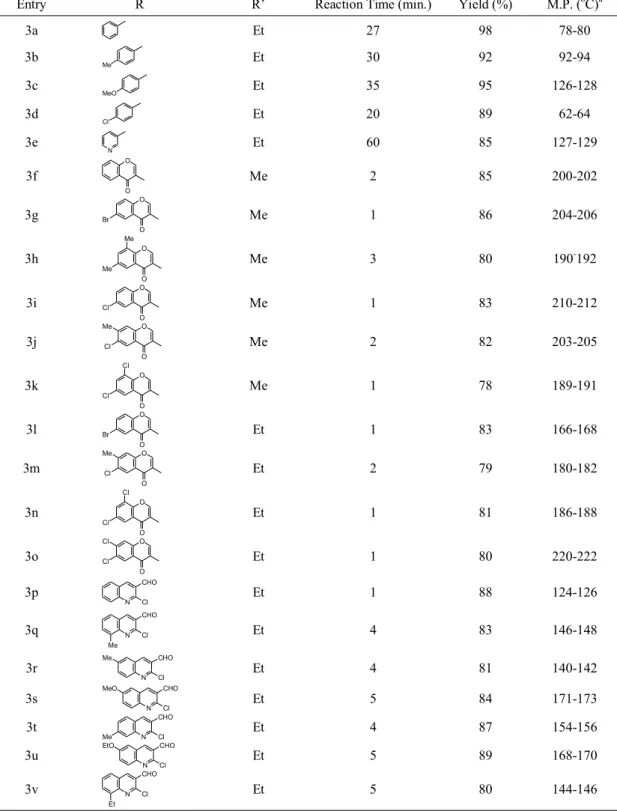
yield. We added a minimum amount of catalyst (5 mol%) to promote the reaction at room temperature with stirring in a sealed tube and the progress of reaction was monitored on TLC and the reaction requires about 100 min. with yield (50%). The results obtained with 5 mol% to 50 mol% catalytic amount of sulphamic acid were shown in (Table 2). Table 2 shows more reaction time required for 5 mol% ca- talyst. As we increase the catalyst proportion about 25 mol% yields were good but above 25 mol% ca- talyst there was no significant change in yields and reaction time. In search of better reaction condition, we carried out same model reaction using ultrasound irradiation with same proportion of reactant and catalyst at room temperature and we observed that the reaction time decreased dramtically (27 min.) with predominant yield. We performed an experi- ment with three various derivatives of aromatic alde- hydes (Table 1, entry 3a, 3b, 3d). The comparative data for room temperature reaction and ultrasound irradiation is illustrated in Table 3. Table 3 clearly indicates the role of ultrasound irradiation in the synthesis of α-hydroxy phosphonates (Scheme 1).
The proposed mechanism of the reaction was shown in the scheme 2. Reaction workup was very easy due to high solubility of catalyst in aqueous media.
Overall the main importance of work is linked to
green chemistry by avoiding use of hazardous sol-
vents reported in previous literature methods. Com-
Table 1. α-hydroxyphosphonates Obtained from the Abramov reaction using Sulphamic acid (25 mol%) as a catalyst (3a-3v).
Entry R R’ Reaction Time (min.) Yield (%) M.P. (oC)a
3a Et 27 98 78-80
3b Me Et 30 92 92-94
3c MeO Et 35 95 126-128
3d Cl Et 20 89 62-64
3e N Et 60 85 127-129
3f
O
O
Me 2 85 200-202
3g
O
O
Br Me 1 86 204-206
3h O
O Me
Me
Me 3 80 190-192
3i
O
O
Cl Me 1 83 210-212
3j
O
O Cl Me
Me 2 82 203-205
3k O
O Cl
Cl
Me 1 78 189-191
3l
O
O
Br Et 1 83 166-168
3m
O
O Cl Me
Et 2 79 180-182
3n O
O Cl
Cl
Et 1 81 186-188
3o
O
O Cl Cl
Et 1 80 220-222
3p N
CHO
Cl Et 1 88 124-126
3q N
CHO
Cl Me
Et 4 83 146-148
3r N
CHO Cl
Me Et 4 81 140-142
3s N
CHO Cl
MeO Et 5 84 171-173
3t N
CHO Cl
Me Et 4 87 154-156
3u N
CHO Cl
EtO Et 5 89 168-170
3v N
CHO
Cl Et
Et 5 80 144-146
aAll physical constants of synthesized compounds compared with lit. Physical constants.
R H O
PO R' O R'
O R'
R H
OH
R OH
P OR'
OR' O R'
O
R OH
P O O
O R' R' OR' H
R P O O O OH
R' R' 1
(I) (II) (III)
3 2
H H
R'OH S
O O O NH2
H S
O O O NH2
S O O O NH2 H S O O O NH2
Scheme 2. Reaction mechanism.
Table 3. Comparison data of room temperature condition and ultrasound irradiation using sulphamic acid (25 mol%) as a catalyst.
Entry R R’ Room temperature Ultrasound irradiation
Time (min.) Yield (%)a Time (min.) Yield (%)a
3a H Et 100 65 27 92
3b 4-Me Et 100 60 30 88
3d 4-Cl Et 80 65 20 90
a Isolated yields.
Table 2. Optimization of the Sulphamic acid catalyst for the benzaldehyde derivative (Table 1, Entry 3a) at room temperature.
Entry Catalyst (mol%.)
Time
(min.) Yield (%)
1 ‐ 120 45
2 5 100 50
3 10 100 50
4 15 100 55
5 20 100 60
6 25 100 65
7 30 100 65
8 40 100 65
9 50 100 65
Entry [2-9] compounds was isolated after the same reaction time.
pounds (3a-3v) including hetro-arylaldehydes were used for all derivatization (Table 1) and time required for aromatic aldehydes were (27∼60 min.) where as the hetro- arylaldehydes required much less time (1 min.∼5 min.). The entries in Table 1 (3f-3v) give quite interesting results with respect to time. On the
basis of reaction time we conclude that the hetro- arylaldehydes gives rapid reaction with the excep- tion of 3-pyridyl aldehydes (3e) over aromatic al- dehydes. This methodology developed was clean, ecofriendly, costless, simple for synthesis of α-hy- droxy phosphonates.
CONCLUSION
In conclusion, we developed a green, efficient, cost-effective and solvent-free method for the syn- thesis of α-hydroxy phosphonates using ultrasound irradiation.
REFERENCES
1. Maryanoff, E. B.; Reitz, A. B. Chem. Rev. 1989, 89, 863.
2. Hang, S. B.; Mullins, T. S.; Shim, H.; Raushal, F. M.
Biochemistry 1997, 36, 9022.
3. Berggren, M. M.; Burns, L. A.; Abraham, R. T.; Powis, G .Cancer Res. 1993, 53, 1862.
4. Cao, X. D.; Moran, E, J.; Siev, D.; Lio, A.; Ohashi,
C.; Mjalli, A. M. M. Bioorg. Med. Chem. Lett. 1995, 5, 2953.
5. Widlanski, T. S.; Myer, J. K.; Stec, B.; Holtz, K. M.;
Kantroewitz, E. R. Chem. Biol. 1997, 4, 489.
6. Stowell, J. K.; Widlanski, T. S. J. Org. Chem. 1995, 60, 6930.
7. Maurer, F.; Riebel, H. J.; Hammann, I.; Behrenz, W.;
Homeyer, B. Ger. Offen. 2533601 1977.
8. Molodykh, Z. V.; Aleksandrova, I. A.; Belyalov, R. U.;
Gazizor, T. K.; Reznik, V. S. Khim.-Farm. Zh. 1990, 24, 136.
9. Drake, G. L.; Calamari, T. A.; Industrial Uses of Pho- sphonates, Hilderbrand, R. L. Ed., CRC Press: Boca Raton, Fla. 1983, 7.
10. Stephen, C. Fields. Tetrahedron 1999, 55, 12237 and references cited therein.
11. Groger, H.; Hammer, B.; Chem. Eur. J. 2000, 6, 9431.
12. (a) Wiemer, D. F. Tetrahedron 1997, 53, 16609; (b) Eymery, F.; Iorga, B.; Savignac, P. Tetrahedron 1999, 55, 13109.
13. Praveen Kumar K. Tetrahedron Lett. 2001, 42, 3219.
14. Lerner, R. A.; Benkovic, S. J.; Schultz, P. G. Science 1991, 252, 659.
15. (a) Olah, G.; Wu, A. J. Org. Chem. 1991, 56, 902; (b) Firouzabadi, H.; Iranpoor, N.; Sobhani, S.; Sardarian, A. R. Tetrahedron Lett. 2001, 42, 4369; (c) Jeanmaire, T.; Hervaud, Y.; Boutevin, B. Phospho., Sul. Silicon Relt. Elt. 2002, 177, 1137.
16. Azizi, N.; Saidi, M. R. Phospho., Sul. Silicon Relt.
Elt. 2003, 178, 1255.
17. Pokalwar, R. U.; Hangarge, R. V.; Maske, P. V.;
Shingare, M. S. Arkivoc 2006, 11, 196.
18. Tanaka, K. F. Chem. Rev. 2000, 100, 1025 and refe- rences cited therein.
19. Gong, W. Z.; Wang, B.; Gu, Y. L.; Liang, Y.; Yang, L.
M.; Shuan Suo, J. Chinese Chem. Lett. 2005, 16, 747.
20. Wang, B.; Gu, Y. L.; Yang, L. M.; Suo, J. S. Catal.
Lett. 2004, 96, 71.
21. Rajitha, B.; Sunil Kumar, B.; Thirupathi Reddy, Y.;
Narsimha Reddy, P.; Sreenivasulu, N. Tetrahedron Lett. 2005, 46, 8691.
22. Yadav, J. S.; Purushothama Rao, P.; Srinivasa Rao, R.; Reddy, P. S. R.; Nagaiah, K.; Prasad, A. R. .Appl.
Catal. A: General 2006, 306.
23. Jin, T. S.; Sun, G.; Li, Y. W.; Li, T. S. J. Chem. Res., Synop. 2003, 1, 30.
24. Sadaphal, S. A.; Markhele, V. M.; Sonar, S. S.; Shin- gare, M. S. J. Korean Chem. Soc. 2008, 52(4), 454.
25. Abramov, V. S. Dokl.AQlkd. Nauk S. S. S. R 1954, 95, 991.
26. (a) Hangarge, R. V.; Shingare, M. S. Mendeleev Co-
mmun. 2003, 2; (b) Madje, B. R.; Patil, P. T.; Shindal- kar, S. S.; Benjamin, S. B.; Shingare, M. S.; Dongare, M. K. Catal Commun. 2004, 5, 353; (c) Shindalkar, S. S.; Madje, B. R.; Hangarge, R. V.; Patil, P. T.;
Dongare, M. K.; Shingare, M. S. J. Korean Chem.
Soc. 2005, 49, 4; (d) Shindalkar, S. S.; Madje, B. R.;
Shingare, M. S. Mendeleev Commun. 2007, 17, 43.
27. (3a): IR (KBr), cm-1: 3425 (-OH), 1220 (-P = O), 1025 (P-O-C), 1H NMR (CDCl3, 400 MHz, δ ppm):
1.10 (t, 3H, O-CH2-CH3), 1.20 (t, 3H, O-CH2-CH3), 4.2 (m, 4H, O-CH2-CH3 and O-CH2-CH3); 4.5 (d, 1H, J = 12 Hz, -CH-OH), 6.00 (bs, 1H, -OH), 7.10-7.40 (m, 5H, Ar-H), ES-MS: m/z 245 (m+H). (3c) IR (KBr) cm-1: 3425 (-OH), 1230 (-P = O), 1025 (P-O-C). 1H NMR (CDCl3, 400 MHz, δ ppm): 1.21 (t, 3H, O-CH2- CH3), 1.27 (t, 3H, O-CH2-CH3), 3.80 (s, 3H, Ar-O- CH3), 4.0 (m, 4H, O-CH2-CH3 and O-CH2-CH3), 4.90 (d, 1H, J = 12 Hz, Ar-CH), 6.9 (d, 2H, J = 8 Hz, Ar-H), 7.40 (dd, 2H, J = 8 Hz, Ar-H). MS: m/z 275 (m+H); (3d): IR (KBr), cm-1: 3420(-OH), 1030 (P-O- C), 1H NMR (CDCl3, 400 MHz, δ ppm): 1.15 (t, 3H, O-CH2-CH3), 1.17 (t, 3H, O-CH2-CH3), 4.10 (m, 4H, O-CH2-CH3 and O-CH2-CH3); 4.60 (d, 1H, J = 12 Hz, -CH-OH), 5.90 (bs, 1H, -OH), 7.40 (d, 2H, J = 8Hz, Ar.H), 7.60 (d, 2H, J = 8 Hz, Ar.H), ES-MS: m/z 279(m+H); (3p): IR (KBr) cm-1: 3246 (-OH),1218 (-P = O), 1033 (-P-O-C). 1H NMR (CDCl3, 400 MHz, δ ppm): 1.2 (t, 3H, O-CH2-CH3), 1.3 (t, 3H, O-CH2- CH3), 4.0 (m, 4H, O-CH2-CH3 and O-CH2-CH3), 5.6 (d, 1H, J = 24 Hz, Ar-CH-P = O), 7.5 (t, 1H, Ar-H), 7.7 (t, 1H, Ar-H), 7.8 (d, 1H, J = 8 Hz, Ar-H), 8.0 (d, 1H, J = 8 Hz, Ar-H), 8.6 (s, 1H, Ar-H). MS: m/z 330 (m+H); (3q): IR (KBr), cm-1: 3278 (-OH); 1218 (-P = O); 1037 (-P-O-C). 1H NMR (CDCl3, 400 MHz, δ ppm): 1.2 (t, 3H, O-CH2-CH3); 1.3 (t, 3H, O-CH2- CH3); 2.4 (s, 1H, -CH-OH ); 2.5 (s, 3H, Ar- CH3 );
4.1 (q, 2H, O-CH2-CH3); 4.2 (q, 2H, O-CH2-CH3);
5.6 (d, 1H, J = 12 Hz, -CH-P = O ); 7.5 (s, 1H, Ar-H);
7.6 (d, 1H, J = 8 Hz, Ar-H); 7.9 (d, 1H, J = 8 Hz, Ar-H); 8.5 (s, 1H, Ar-H,). ES-MS: m/z 344 (m+H) (3r): IR (KBr) cm-1: 3240 (-OH); 1215 (-P = O); 1037 (-P-O-C). 1H NMR (CDCl3, 400 MHz, δ ppm): 1.2 (t, 3H, O-CH2-CH3); 1.3 (t, 3H, O-CH2-CH3); 2.4 (s, 1H, -CH-OH); 2.7 (s, 3H, Ar- CH3); 4.2 (q, 2H, O-CH2-CH3); 4.3 (q, 2H, O-CH2-CH3); 5.6 (d, 1H, J = 24 Hz, -CH-P=O); 7.4 (t, 1H, Ar-H); 7.6 (d, 1H , J=
8 Hz, Ar-H); 7.7 (d, 1H , J = 8 Hz, Ar-H); 8.5 (s, 1H, Ar-H). ES-MS: m/z 344 (m+H) (3s): IR (KBr) cm-1: 3269 (-OH); 1218 (-P = O); 1033 (-P-O-C). 1H NMR (CDCl3, 400 MHz, δ ppm): 1.2 (t, 3H, O-CH2-CH3);
1.3 (t, 3H, O-CH2-CH3); 2.6 (s, 1H, -CH-OH); 3.8
(s, 3H, Ar-O-CH3); 4.1 (q, 2H, O-CH2-CH3); 4.2 (q, 2H, O-CH2-CH3); 5.6 (d, 1H, J = 24 Hz, -CH-P = O); 7.0 (s, 1H, Ar- H); 7.4 (d, 1H , J = 8 Hz, Ar-H);
7.9 (d, 1H , J = 8 Hz, Ar-H); 8.5 (s, 1H, Ar-H). ES-MS:
m/z 360 (m+H) (3t): IR (KBr) cm-1: 3269 (-OH);
1218 (-P = O); 1033 (-P-O-C). 1H NMR (CDCl3, 400
MHz, δ ppm): 1.2 (t, 3H, O-CH2-CH3); 1.3 (t, 3H, O-CH2-CH3); 2.7 (s, 1H, -CH-OH); 3.9 (s, 3H, Ar- OCH3); 4.1 (q, 2H, O-CH2-CH3); 4.2 (q, 2H, O-CH2- CH3); 5.6 (d, 1H, J = 24 Hz, -CH-P = O); 7.2 (d, 1H, J = 8 Hz, Ar-H); 7.3 (s, 1H, Ar-H), 7.7 (d, 1H , J = 8 Hz, Ar-H); 8.5 (s, 1H, Ar-H). ES-MS: m/z 343.9 (m+H).