Serum Adipocytokines Levels and Their Association with Insulin Sensitivity in Morbidly Obese Individuals Undergoing Bariatric Surgery
Astha Sachan
1, Archna Singh
1, Sakshi Shukla
1, Sandeep Aggarwal
2, Ishfaq Mir
1, Rakhee Yadav
1,*
Departments of
1Biochemistry and
2Surgical Disciplines, All India Institute of Medical Sciences, New Delhi, India
Background: Obese adipose tissue secretes a variety of adipocytokines that act as metabolic regulators with complex mechanisms. Our objective was to compare serum concentration of a panel of adipocytokines be- tween obese and non-obese individuals and identify any distinct patterns correlating with insulin sensitivity in obesity.
Methods: We designed a cross-sectional study among obese (body mass index [BMI] ≥30 kg/m
2, n=62) and non-obese (BMI <25 kg/m
2, n=32) individuals to compare circulating levels of the adipokines, such as adipo- nectin and resistin in conjunction with the measurement of the levels of inflammatory cytokines including C-re- active protein (CRP), interleukin (IL)-6, IL-8, monocyte chemoattractant protein (MCP)-1, and tumor necrosis fac- tor (TNF)-α using Luminex multiplex immunoassay with drop array technology. Correlations between circulat- ing adipocytokine levels and those of multiple well-established markers of insulin resistance including homeo- static model assessment of insulin resistance (HOMA-IR), homeostatic model assessment of β-cell function (HOMA-β) and quantitative insulin sensitivity check index were also established.
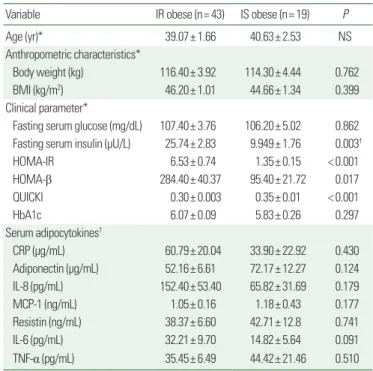
Results: CRP, IL-8, MCP-1, and TNF-α levels were higher in obese than non-obese individuals; the CRP and IL-8 differences were statistically significant. CRP correlated significantly with markers of insulin resistance (fasting plasma insulin, HOMA-IR, and QUICKI), and adiponectin correlated with HOMA-β in obese individuals. We divid- ed the group of obese individuals on the basis of HOMA-IR levels into insulin-resistant (IR; HOMA-IR ≥2.5) and insulin-sensitive (IS; HOMA-IR <2.5) groups; and 43 out of 62 participants were IR despite comparable BMIs. An overall proinflammatory profile was compared between IR and IS obese, though the values were higher in IR obese but the difference was not significant.
Conclusion: Obesity is associated with a general inflammatory milieu and a crosstalk between adipocytokines and insulin resistance is complex as well as multifactorial.
Key words: Obesity, Insulin resistance, Adipocytokines, Inflammation
Received August 21, 2020 Reviewed September 29, 2020 Accepted October 29, 2020
* Corresponding author Rakhee Yadav
https://orcid.org/0000-0002-4405-9595 Department of Biochemistry, All India Institute of Medical Sciences, New Delhi 110029, India
Tel: +91-8826640014 E-mail: [email protected]
INTRODUCTION
The rising incidence and prevalence of overweight and obesity are posing a major challenge to chronic disease prevention and public health across countries.
1Despite significant advances in our understanding of the underlying mechanisms of weight gain and associated comorbidities like insulin resistance and cardiovascular
risk, the prevalence of obesity and metabolic syndrome is escalat- ing at an unprecedented rate.
2Worldwide, obesity has nearly tripled since 1975. Presently, the majority of the world’s population lives in countries in which obesity is responsible for more fatalities than malnutrition and underweight status.
3Overweight conditions and obesity, defined as a body mass index (BMI) of ≥ 30 kg/m
2, had highest prevalence (42.4%) in the United States in 2017–2018.
4In-
Copyright © 2020 Korean Society for the Study of Obesity
This is an Open Access article distributed under the terms of the Creative Commons Attribution Non-Commercial License (https://creativecommons.org/licenses/by-nc/4.0/) which permits unrestricted non-commercial use, distribution, and reproduction in any medium, provided the original work is properly cited.
2017-03-16 https://crossmark-cdn.crossref.org/widget/v2.0/logos/CROSSMARK_Color_square.svg