• 검색 결과가 없습니다.

Airway Improvement with Medium-Term Compression Duration after Right Pulmonary Artery Anterior Translocation

N/A
N/A
Protected

Academic year: 2021

Share "Airway Improvement with Medium-Term Compression Duration after Right Pulmonary Artery Anterior Translocation"

Copied!
4
0
0

로드 중.... (전체 텍스트 보기)

전체 글

(1)

ISSN: 2233-601X (Print) ISSN: 2093-6516 (Online)

− 57 −

Received: July 10, 2017, Revised: October 20, 2017, Accepted: November 1, 2017, Published online: February 5, 2018

Corresponding author: Woo Sung Jang, Department of Thoracic and Cardiovascular Surgery, Keimyung University School of Medicine, 56 Dalseong-ro, Jung-gu, Daegu 41931, Korea

(Tel) 82-53-200-5832 (Fax) 82-53-250-8096 (E-mail) [email protected]

© The Korean Society for Thoracic and Cardiovascular Surgery. 2018. All right reserved.

This is an open access article distributed under the terms of the Creative Commons Attribution Non-Commercial License (http://creativecommons.org/

licenses/by-nc/4.0) which permits unrestricted non-commercial use, distribution, and reproduction in any medium, provided the original work is properly cited.

Airway Improvement with Medium-Term Compression Duration after Right Pulmonary Artery Anterior Translocation

Woo Sung Jang, M.D., Ph.D. 1 , Jae Bum Kim, M.D., Ph.D. 1 , Jae Hyun Kim, M.D., Ph.D. 1 , Hee Jeong Choi, M.D., Ph.D. 2

Departments of

1

Thoracic and Cardiovascular Surgery and

2

Pediatrics, Keimyung University Dongsan Medical Center, Keimyung University School of Medicine

Left main bronchus compression occasionally occurs in patients with cardiac disease. A 19-month-old female patient weighing 6.7 kg was admitted for recurrent pneumonia and desaturation. S he had an atrial septal de- fect (AS D) with a right aortic arch. Her left main bronchus had been compressed between the enlarged right pulmonary artery (RPA) and the descending thoracic aorta for 14 months. We conducted ASD closure and RPA anterior translocation via sternotomy. The left main bronchus compression was relieved despite the me- dium-term duration of compression.

Key words: 1. Congenital heart disease

2. Left main bronchus compression 3. Pulmonary artery anterior translocation 4. Atrial heart septal defects

Case report

A 19-month-old female patient weighing 6.7 kg was admitted for atrial septal defect (ASD) surgery.

She had undergone omphalocele repair during the neonatal period. She had been admitted for pneumo- nia and desaturation at the age of 5 months. Left main bronchus focal narrowing developed at the age of 5 months, based on chest computed tomography (CT). However, the respiratory symptoms and pneu- monic infiltration improved on follow-up chest X-rays, so we did not consider the left main bron- chus to be a major issue. Subsequently, she was ad- mitted 4 times for a recurring lung issue in the left lung field. We rechecked the chest CT and found an enlarged main pulmonary artery (PA) with a right aortic arch, accompanied by a 10-mm ASD com-

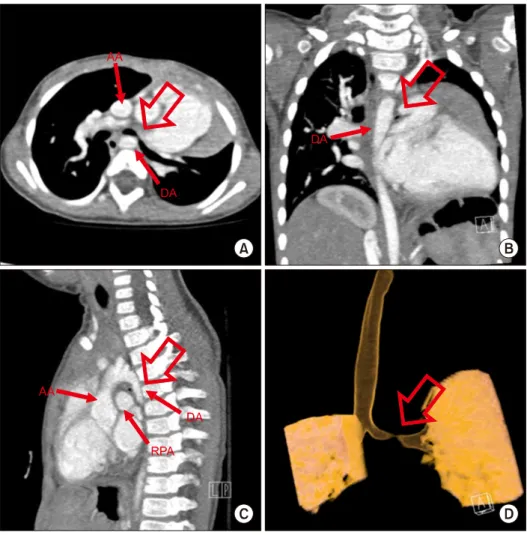
pressed in the left main bronchus between the right-sided descending thoracic aorta and enlarged right PA (RPA) (Fig. 1). The presence of a 10-mm ASD with a significant left-to-right shunt and a tri- cuspid valve regurgitation velocity of 2 m/sec was confirmed on echocardiography.

We considered several surgical options: (1) ASD closure only, (2) ASD closure and aortopexy via right thoracotomy as a staged operation, (3) ASD closure and aortopexy via sternotomy, (4) ASD closure and RPA anterior translocation, and (5) ASD closure and slide tracheoplasty. Among these surgical possibilities, we considered options 1, 3, and 4 to be the best pro- cedures to undertake as the first surgical procedure.

Under general anesthesia, the patient underwent a median sternotomy. We pulled the ascending aorta upward with forceps, avoiding the dissection of other

Korean J Thorac Cardiovasc Surg 2018;51:57-60 □ CASE REPORT □

https://doi.org/10.5090/kjtcs.2018.51.1.57

(2)

Woo Sung Jang, et al

− 58 −

Fig. 1. Preoperative computed to- mography revealed left main bron- chus compression between the en- larged RPA and descending thoracic aorta. (A) Axial view. (B) Coronal view. (C) Sagittal view. (D) Three- dimensional reconstruction view.

The arrow indicates the point of airway narrowing. AA, ascending aor- ta; DA, descending thoracic aorta;

RPA, right pulmonary artery.

Fig. 2. Operative picture of right pulmonary artery anterior translocation.

tissue, and we checked whether the left main bron- chus showed improvement under bronchoscopic guidance. However, we did not observe bronchial improvement. Thus, we decided to perform ASD clo- sure with RPA anterior translocation. We conducted a routine cannulation and extensive PA mobilization to the second PA branch under cardiopulmonary by- pass support. Aortic cross-clamping (ACC) was per- formed. The ASD was closed with a glutaraldehyde- fixed autologous pericardium after a right atrial in- cision was made. The RPA was excised from the posterolateral wall of the main PA under sponta- neous beating after ACC was removed.

The length of the RPA was adequate to make a di-

rect anastomosis, so a direct anastomosis of the ante-

riorly translocated RPA to the main PA was per-

formed (Fig. 2). The cardiopulmonary bypass wean-

ing was smooth. The cardiopulmonary bypass time

and ACC time were 132 and 25 minutes, respectively.

(3)

Airway Improvement after Pulmonary Artery Anterior Translocation

− 59 −

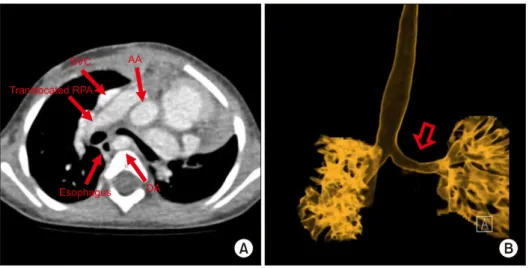
Fig. 3. Postoperative computed to- mography revealed left main bron- chus improvement at 2 months postoperatively. (A) Axial view. (B) Three-dimensional reconstruction view. The arrow indicates the air- way improvement. AA, ascending aorta; DA, descending thoracic aor- ta; SVC, superior vena cava.

The intubation tube was removed on the first postoperative day (POD). However, reintubation was conducted on the third POD due to CO2 retention.

We conducted successful re-extubation on the pa- tient’s fifth POD after extensive lung care. She was discharged on the 14th POD. We conducted post- operative CT angiography 2 months later. We found improvement in the narrowing of the left main bron- chus (5 mm) and no narrowing site in the RPA (Fig.

3) . Improved left lung aeration was shown on a chest X-ray. The patient was doing well as of the lat- est follow-up.

Discussion

Airway compression from congenital heart disease is a major cause of respiratory issues. In such cases, airway relief by aortopexy, RPA anterior trans- location, or sliding tracheoplasty concomitant with intracardiac repair has been successful for relieving airway compression [1-4]. Aortopexy is a surgical method that yields positive results in cases of severe, localized tracheobronchomalacia by pulling the aorta with minimal tissue dissection around the aorta [2,5].

We chose aortopexy as the first surgical option. We did not find airway improvement after pulling the as- cending aorta upward via a median sternotomy ap- proach under bronchoscopic guidance.

Sliding tracheobronchoplasty is also a viable option for airway relief, but it is a surgical option for the relief of congenital tracheobronchial stenosis, caused by features such as a vascular ring or sling, so we did not consider this as a surgical option [6]. In this

patient, the airway compression duration was me- dium-term (approximately 14 months), so we were concerned about the effects of a space-making proce- dure around the compressed tracheobronchus, such as RPA anterior translocation, as compared to aorto- pexy by compressed bronchus traction or sliding tra- cheobronchoplasty by direct tracheobronchial enlar- gement. Almost all reports of space-making proce- dures in patients with a PA sling or vascular ring have involved a relatively short-term airway com- pression duration [7,8]. We did not anticipate airway improvement by space-making during the early post- operative period because of the initial lengthy airway compression. Instead, we anticipated gradual airway improvement with growth. We identified positive air- way improvement in this patient, despite the short- term follow-up.

Initially, we considered only ASD correction if the

aortopexy via median sternotomy failed. However, we

thought that ASD closure alone might be insufficient

to relieve the airway compression from the narrow

space between the right aortic arch and the enlarged

RPA. We then considered aortopexy via right-side

thoracotomy. However, this approach would have re-

quired an additional incision and we were concerned

about possible esophageal complications resulting

from aortopexy due to the right-sided course of the

esophagus. Thus, we decided on anterior transloca-

tion of the RPA. We were concerned with RPA kink-

ing or superior vena cava (SVC) compression at the

SVC-RPA junction after translocation in this pro-

cedure. Therefore, we conducted an extensive mobi-

lization of the RPA to the second branches. We ob-

(4)

Woo Sung Jang, et al

− 60 − served no RPA kinking or SVC compression on the fi- nal follow-up CT.

In conclusion, RPA anterior translocation may im- prove airway compression despite a medium-term compression duration.

Conflict of interest

No potential conflict of interest relevant to this ar- ticle was reported.

References

1. Talwar S, Sharma P, Choudhary SK, Kothari SS, Gulati GS, Airan B. Le-Compte’s maneuver for relief of bronchial compression in atrial septal defect. J Card Surg 2011;26:

111-3.

2. Jang WS, Kim WH, Choi K, et al. Aortopexy with pre- operative computed tomography and intraoperative bron- choscopy for patients with central airway obstruction af- ter surgery for congenital heart disease: postoperative computed tomography results and clinical outcomes.

Pediatr Cardiol 2014;35:914-21.

3. Chang YH, Sung SC, Kim H, Lee HD. Anterior translocation of the right pulmonary artery for relief of airway com- pression in the repair of distal aortopulmonary window and interrupted aortic arch. Ann Thorac Surg 2012;93:

e159-61.

4. Nomura N, Asano M, Mizuno A, Mishima A. Translocation of dilated pulmonary artery for relief of bronchial com- pression associated with ventricular septal defect. Eur J Cardiothorac Surg 2007;32:937-9.

5. Arcieri L, Serio P, Nenna R, et al. The role of posterior aor- topexy in the treatment of left mainstem bronchus compression. Interact Cardiovasc Thorac Surg 2016;23:

699-704.

6. Chung SR, Yang JH, Jun TG, et al. Clinical outcomes of slide tracheoplasty in congenital tracheal stenosis. Eur J Cardiothorac Surg 2015;47:537-42.

7. Backer CL, Monge MC, Popescu AR, Eltayeb OM, Rastatter JC, Rigsby CK. Vascular rings. Semin Pediatr Surg 2016;

25:165-75.

8. Kwak JG, Kim WH, Min J, Lee C, Jang W, Lee CH. Is trache- oplasty necessary for all patients with pulmonary artery sling and tracheal stenosis? Pediatr Cardiol 2013;34:

498-503.

수치

Fig. 1. Preoperative computed to- to-mography revealed left main  bron-chus compression between the  en-larged RPA and descending thoracic  aorta
Fig. 3. Postoperative computed to- to-mography revealed left main  bron-chus improvement at 2 months  postoperatively

참조

관련 문서