D I A B E T E S & M E T A B O L I S M J O U R N A L D I A B E T E S & M E T A B O L I S M J O U R N A L
This is an Open Access article distributed under the terms of the Creative Commons Attribution Non-Commercial License (https://creativecommons.org/licenses/by-nc/4.0/) which permits unrestricted non-commercial use, distribution, and reproduction in any medium, provided the original work is properly cited.
The Risk of Diabetes on Clinical Outcomes in Patients with Coronavirus Disease 2019: A Retrospective
Cohort Study
Seung Min Chung1, Yin Young Lee1, Eunyeong Ha1, Ji Sung Yoon1, Kyu Chang Won1, Hyoung Woo Lee1, Jian Hur2,
Kyung Soo Hong3, Jong Geol Jang3, Hyun Jung Jin3, Eun Young Choi3, Kyeong-Cheol Shin3, Jin Hong Chung3, Kwan Ho Lee3, June Hong Ahn3, Jun Sung Moon1
Divisions of 1Endocrinology and Metabolism, 2Infectious Disease, Department of Internal Medicine, Yeungnam University Medical Center, Yeungnam University College of Medicine, Daegu,
3 Division of Pulmonology and Allergy, Department of Internal Medicine, Respiratory Center, Yeungnam University Medical Center, Yeungnam University College of Medicine, Daegu, Korea
Background: To determine the role of diabetes mellitus (DM) in the coronavirus disease 2019 (COVID-19), we explored the clinical characteristics of patients with DM and compared risk factors such as age, glycemic control, and medications to those without DM.
Methods: This was a retrospective cohort study of 117 confirmed patients with COVID-19 which conducted at a tertiary hospital in Daegu, South Korea. The primary outcome was defined as the severe and critical outcome (SCO), of which the composite out- comes of acute respiratory distress syndrome, septic shock, intensive care unit care, and 28-day mortality. We analyzed what clini- cal features and glycemic control-related factors affect the prognosis of COVID-19 in the DM group.
Results: After exclusion, 110 participants were finally included. DM patients (n=29) was older, and showed higher blood pres- sure compared to non-DM patients. DM group showed higher levels of inflammation-related biomarkers and severity score, and highly progressed to SCO. After adjustment with other risk factors, DM increased the risk of SCO (odds ratio [OR], 10.771;
P<0.001). Among the DM patients, SCO was more prevalent in elderly patients of ≥70 years old and age was an independent risk factor for SCO in patients with DM (OR, 1.175; P=0.014), while glycemic control was not. The use of medication did not affect the SCO, but the renin-angiotensin system inhibitors showed protective effects against acute cardiac injury (OR, 0.048; P=0.045).
Conclusion: The COVID-19 patients with DM had higher severity and resulted in SCO. Intensive and aggressive monitoring of COVID-19 clinical outcomes in DM group, especially in elderly patients is warranted.
Keywords: Aged; COVID-19; Diabetes mellitus; Prognosis; Risk factors; Severe acute respiratory syndrome coronavirus 2
Corresponding authors: June Hong Ahn https://orcid.org/0000-0001-7104-8325 Division of Pulmonology and Allergy, Department of Internal Medicine, Respiratory Center, Yeungnam University Medical Center, Yeungnam University College of Medicine, 170 Hyeonchung-ro, Nam-gu, Daegu 42415, Korea
E-mail: [email protected]
Jun Sung Moon https://orcid.org/0000-0003-1569-3068
Division of Endocrinology and Metabolism, Department of Internal Medicine, Yeungnam University Medical Center, Yeungnam University College of Medicine, 170 Hyeonchung-ro, Nam-gu, Daegu 42415, Korea
INTRODUCTION
The severe acute respiratory syndrome coronavirus 2 (SARS- CoV-2) pandemic virus, which causes pneumonia, originated
in Wuhan, China, in 2019 and is spreading rapidly to other countries [1]. By April 11, 2020, 1,610,909 cases of coronavirus disease 2019 (COVID-19) had been confirmed in 213 coun- tries, and 99,690 COVID-19 patients had died worldwide. The https://doi.org/10.4093/dmj.2020.0105
pISSN 2233-6079 · eISSN 2233-6087
Chinese Center for Disease Control and Prevention reported 81% as mild cases, 14% as severe cases, and 5% as critical cases [2].
Diabetes mellitus (DM) has an estimated prevalence of 9.3%
globally, and is a serious disease that impacts the health status associated with other diseases [3]. In a population-based co- hort study, DM was clearly shown to be associated with in- creased mortality from pneumonia [4], and hyperglycemia on admission is associated with poor clinical outcome for both di- abetic and nondiabetic patients with community-acquired pneumonia [5]. Respiratory tract infections, including bacteri- al pneumonia, influenza, and tuberculosis, are more common, and are more serious in patients with DM than in those with- out DM [6]. The pathophysiology of increased mortality in di- abetic patients with pneumonia is as follows: (1) decreased T lymphocyte response; (2) decreased neutrophil function; (3) depression of the antioxidant system; and (4) disorders of hu- moral immunity by the complement system [6].
Previous studies reported that 25% to 45% of patients with COVID-19 have more than one coexisting disorder. Among them, about 10% of patients in China have DM [7,8]. A recent study showed that diabetic patients are more susceptible to an inflammatory storm, eventually leading to rapid progression and poor prognosis in COVID-19 patients [9].
In this study, we determined the clinical characteristics of COVID-19 patients with DM compared to those without DM.
In addition, we analyzed the severity and clinical outcomes of COVID-19 patients with DM according to age, glycemic con- trol status, and medications.
METHODS
Study design and subjects
We performed a retrospective cohort study of 117 patients with SARS-CoV-2 infection hospitalized at Yeungnam Univer- sity Medical Center, in Daegu, South Korea. This study was conducted in accordance with the tenets of the Declaration of Helsinki, and was reviewed and approved by the Institutional Review Board of Yeungnam University Hospital (YUH IRB 2020-03-057). The requirement for informed consent was waived because of the retrospective study design.
During the study period, all consecutive adult patients (age
>18 years) with SARS-CoV-2 infection admitted to the hospi- tal were eligible for inclusion. SARS-CoV-2 infection was con- firmed by real-time reverse transcriptase-polymerase chain re-
action assay of nasal and pharyngeal swab samples. Patients who were taken to other hospitals and whose final clinical re- sults were unknown were excluded from the analysis. After ex- cluding seven patients, 110 patients were finally included in this study, and 26.4% (n=29) had DM (Fig. 1).
Data collection and definitions
The patients’ electronic medical records were reviewed. Data on patients’ age, sex, comorbidities, symptoms, vital signs, ra- diological findings, severity based on the National Early War- ing Score (NEWS), treatment, and clinical outcomes were col- lected. DM was defined as any of the following criteria: (1) a known history of diabetes; (2) taking oral or injected antihy- perglycemic agents; (3) history of abnormal blood glucose lev- els based on diagnostic criteria for type 2 DM of the Korean Diabetes Association [10]. Data on glycosylated hemoglobin (HbA1c) level, DM duration, oral antihyperglycemic agents (OHAs), insulin, and renin-angiotensin system (RAS) inhibi- tors were collected from patients with DM.
NEWS [11] is an early warning score facilitating the early detection of and response to deterioration of patient’s condi- tion and consists of seven parameters: pulse oximetry, oxygen, pulse, systolic blood pressure, respiration rate, temperature, and central nervous system status. Each parameter is assigned a score of 0 to 3 points. The score reflects the degree to which the parameters differ from the normal range.
Acute respiratory distress syndrome (ARDS) was diagnosed according to the Berlin definition [12]. Septic shock was de- fined according to the Third International Consensus Defini- tions for sepsis and septic shock (Sepsis-3) [13]. Acute cardiac injury was defined as a serum troponin I level above the 99th Fig. 1. Patient selection. COVID-19, coronavirus disease 2019;
DM, diabetes mellitus.
117 Hospitalizations for COVID-19
110 Final COVID-19 hospitalizations
29 COVID-19 with DM 81 COVID-19 without DM 7 (6.0%) transferred out
percentile upper reference limit or new abnormal electrocardi- ography and echocardiography findings [14]. Acute kidney in- jury was defined according to the Kidney Disease Improving Global Guidelines (KDIGO) for acute kidney injury [15].
In this study, we used the term “severe and critical outcome (SCO)” as an index of poor clinical outcome. SCO was defined as the composite outcome of ARDS, septic shock, intensive care unit (ICU) care, and 28-day mortality, referring to the classification of the Chinese Center for Disease Control and Prevention [2].
Statistical analysis
Continuous variables are expressed as mean±standard devia- tion and were compared by Student’s t-test or the Mann-Whit- ney U test. Categorical variables were compared by the chi- squared test or Fisher’s exact test. To determine the effects of DM and medications on SCO, multiple logistic regression analysis was performed after adjusting for covariates. In all analyses, two-tailed P<0.05 was taken to indicate statistical significance. All statistical analyses were performed using SPSS software version 24.0 (IBM Co., Armonk, NY, USA).
RESULTS
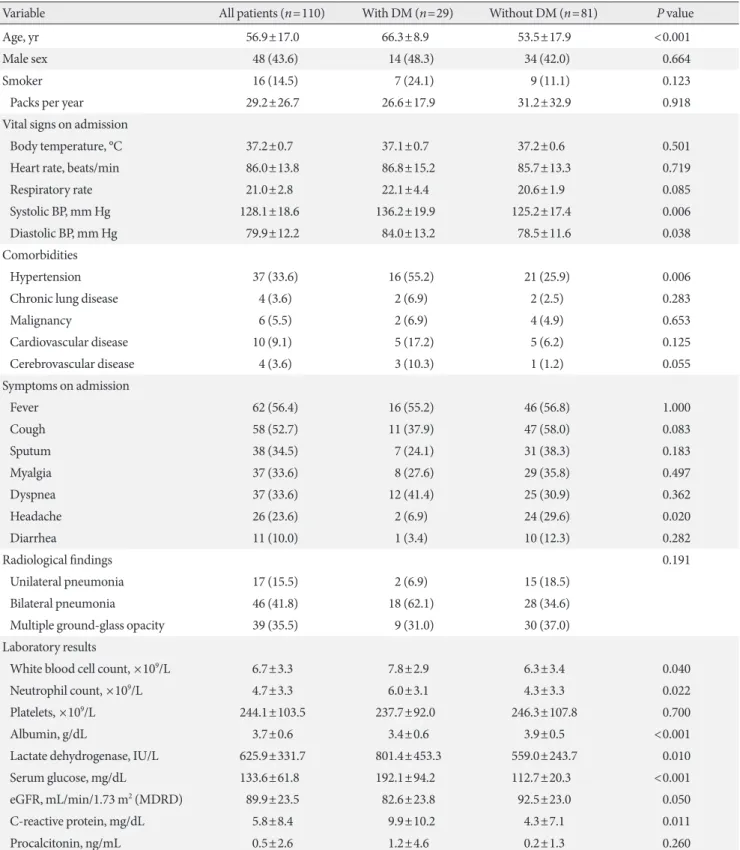
Baseline characteristics and clinical outcomes of COVID-19 patients according to the presence of DM Table 1 shows the baseline characteristics of all patients and a comparison of patients with and without DM. The mean age of the total patient population was 56.9 years and the male to fe- male ratio was 1:1.3. Smokers accounted for 14.5%. A total of 29 patients had DM (26.4%). DM patients had a higher mean age than patients without DM (n=81) (66.3±8.9 years vs.
53.5±17.9 years, respectively; P<0.001). Systolic and diastolic blood pressures were higher in patients with DM than in those without DM (both P<0.05). Hypertension was the most com- mon comorbidity among all participants (33.6%), and more than half of the DM patients had a diagnosis or were taking medication for hypertension. On physical examination, there were no differences in symptoms between groups, except head- aches were more frequent among non-DM patients (P=0.020).
Bilateral pneumonia was common in DM patients, but the dif- ference in radiologic findings (unilateral pneumonia, bilateral pneumonia, and multiple ground-glass opacity) compared to non-DM patients was not statistically significant (P=0.191).
DM patients had higher white blood cell counts, neutrophil
counts, lactate dehydrogenase, serum glucose, and C-reactive protein levels and lower albumin level compared to non-DM patients (all P<0.05).
Table 2 shows the severity, clinical outcomes, and treatment strategy of COVID-19 patients with and without DM. DM pa- tients, compared to subjects without DM, had higher NEWS (4.0±4.2 vs. 1.9±2.1, P=0.015) and rates of progression to mortality (17.2% vs. 1.2%), ARDS (37.9% vs. 8.6%), septic shock (24.1% vs. 1.2%), ICU care (27.6% vs. 6.2%), and acute cardiac injury (27.6% vs. 6.2%) (all P<0.01). In addition, DM patients had higher rates of oxygen and invasive mechanical ventilation treatments (both P<0.01) and prescription of hy- droxychloroquine medication (P=0.022).
The rates of progression to SCO were significantly higher with patients aged ≥70 years old compared to subjects <70 years old (42.3% vs. 9.6%, P=0.01), and in DM patients com- pared to subjects without DM (44.8% vs. 7.5%, P<0.001). The effect of age and DM on the risk of SCO in COVID-19 was an- alyzed (Fig. 2A). After adjustments for age, sex, smoking sta- tus, and the presence of comorbidities, age of ≥70 years old (odds ratio [OR], 7.106; P=0.005) and DM (OR, 10.771; P<
0.001) significantly increased the risk of SCO, whereas hyper- tension, chronic lung disease, and malignancy had no effect on severity of outcomes.
Analysis of factors affecting SCO in COVID-19 patients with DM
We extracted diabetic patients (n=29) and explored the effects of age, DM control status, and medications on clinical out- comes. Twelve were newly diagnosed with DM on admission.
Comparisons of clinical characteristics and outcomes accord- ing to age with a cutoff of 70 years are presented in Table 3.
Compared to DM patients <70 years old (n=18), older DM patients (≥70 years old, n=11) were significantly older (60.9±
6.2 years vs. 75.3±3.6 years, respectively; P<0.001) but there was no difference in sex ratio (P=0.702). The HbA1c and se- rum glucose levels, DM duration, and medication histories of OHAs, insulin and RAS inhibitors were not different between groups (all P>0.05). NEWS was not different between groups (3.3±4.1 vs. 5.3±4.5, respectively; P=0.204), but SCO was more frequent in DM patients ≥70 years old (27.8% vs. 72.7%, re- spectively; P=0.027).
The effects of age, HbA1c, and serum glucose level on SCO in COVID-19 patients with DM were evaluated (Fig. 2B). Af- ter adjustments, age significantly increased the risk of SCO
Table 1. Comparison of baseline anthropometric, symptom, and laboratory characteristics between coronavirus disease 2019 pa- tients with and without diabetes
Variable All patients (n=110) With DM (n=29) Without DM (n=81) P value
Age, yr 56.9±17.0 66.3±8.9 53.5±17.9 <0.001
Male sex 48 (43.6) 14 (48.3) 34 (42.0) 0.664
Smoker 16 (14.5) 7 (24.1) 9 (11.1) 0.123
Packs per year 29.2±26.7 26.6±17.9 31.2±32.9 0.918
Vital signs on admission
Body temperature, °C 37.2±0.7 37.1±0.7 37.2±0.6 0.501
Heart rate, beats/min 86.0±13.8 86.8±15.2 85.7±13.3 0.719
Respiratory rate 21.0±2.8 22.1±4.4 20.6±1.9 0.085
Systolic BP, mm Hg 128.1±18.6 136.2±19.9 125.2±17.4 0.006
Diastolic BP, mm Hg 79.9±12.2 84.0±13.2 78.5±11.6 0.038
Comorbidities
Hypertension 37 (33.6) 16 (55.2) 21 (25.9) 0.006
Chronic lung disease 4 (3.6) 2 (6.9) 2 (2.5) 0.283
Malignancy 6 (5.5) 2 (6.9) 4 (4.9) 0.653
Cardiovascular disease 10 (9.1) 5 (17.2) 5 (6.2) 0.125
Cerebrovascular disease 4 (3.6) 3 (10.3) 1 (1.2) 0.055
Symptoms on admission
Fever 62 (56.4) 16 (55.2) 46 (56.8) 1.000
Cough 58 (52.7) 11 (37.9) 47 (58.0) 0.083
Sputum 38 (34.5) 7 (24.1) 31 (38.3) 0.183
Myalgia 37 (33.6) 8 (27.6) 29 (35.8) 0.497
Dyspnea 37 (33.6) 12 (41.4) 25 (30.9) 0.362
Headache 26 (23.6) 2 (6.9) 24 (29.6) 0.020
Diarrhea 11 (10.0) 1 (3.4) 10 (12.3) 0.282
Radiological findings 0.191
Unilateral pneumonia 17 (15.5) 2 (6.9) 15 (18.5)
Bilateral pneumonia 46 (41.8) 18 (62.1) 28 (34.6)
Multiple ground-glass opacity 39 (35.5) 9 (31.0) 30 (37.0)
Laboratory results
White blood cell count, ×109/L 6.7±3.3 7.8±2.9 6.3±3.4 0.040
Neutrophil count, ×109/L 4.7±3.3 6.0±3.1 4.3±3.3 0.022
Platelets, ×109/L 244.1±103.5 237.7±92.0 246.3±107.8 0.700
Albumin, g/dL 3.7±0.6 3.4±0.6 3.9±0.5 <0.001
Lactate dehydrogenase, IU/L 625.9±331.7 801.4±453.3 559.0±243.7 0.010
Serum glucose, mg/dL 133.6±61.8 192.1±94.2 112.7±20.3 <0.001
eGFR, mL/min/1.73 m2 (MDRD) 89.9±23.5 82.6±23.8 92.5±23.0 0.050
C-reactive protein, mg/dL 5.8±8.4 9.9±10.2 4.3±7.1 0.011
Procalcitonin, ng/mL 0.5±2.6 1.2±4.6 0.2±1.3 0.260
Values are presented as mean±standard deviation or number (%).
DM, diabetes mellitus; BP, blood pressure; eGFR, estimated glomerular filtration rate; MDRD, modification of diet in renal disease.
(OR, 1.175; P=0.014), whereas HbA1c and serum glucose had no effect on SCO. We also evaluated the effects of medications on SCO, acute cardiac injury, and acute kidney injury in COV- ID-19 patients with DM (Fig. 3). The usage of metformin or RAS inhibitors had no effect on SCO, but RAS inhibitors showed protective effects against acute cardiac injury (OR, 0.048; P=0.045).
We investigated whether poor glycemic control affects the prognosis of COVID-19 patients (Supplementary Table 1).
Compared to diabetic patients with HbA1c <8% (n=21), poorly controlled (HbA1c ≥8%, n=8) patients had higher lev- els of HbA1c (6.9±0.5 vs. 10.0±1.9, respectively) and serum glucose (163.9±56.0 vs. 266.4±133.5, respectively), and had longer duration of DM (2.5±3.9 vs. 11.4±12.5, respectively) (all
P<0.05). However, age, sex ratio, medication histories, NEWS, and SCO were not different between groups (all P>0.05).
DISCUSSION
The results of the present study showed that the elderly over 70 years old and the presence of DM significantly impacted the clinical course of COVID-19. Patients with DM showed higher severity scores (NEWS) and more frequently progressed to SCO than patients without DM. Among DM patients, age sig- nificantly affected SCO, and RAS inhibitors showed beneficial effects against acute cardiac injury.
In recent reports of COVID-19 from China, the prevalence of comorbid DM was 7.4% to 20%, and patients with cardio- Table 2. Comparison of clinical outcomes and treatment be-
tween coronavirus disease 2019 patients with and without dia- betes
Variable All
patients (n=110)
With (n=29)DM
Without (n=81)DM P value
Severity scoring
NEWS 2.5±3.0 4.0±4.2 1.9±2.1 0.015
Clinical outcomes
28-day mortality 6 (5.5) 5 (17.2) 1 (1.2) 0.005 ARDS 18 (16.4) 11 (37.9) 7 (8.6) 0.001 Septic shock 8 (7.3) 7 (24.1) 1 (1.2) <0.001 ICU care 13 (11.8) 8 (27.6) 5 (6.2) 0.005 Acute cardiac injury 13 (11.8) 8 (27.6) 5 (6.2) 0.005 Acute kidney injury 9 (8.2) 5 (17.2) 4 (4.9) 0.052 Treatment
Oxygen 38 (34.5) 18 (62.1) 20 (24.7) 0.001
HFNC 10 (9.1) 4 (13.8) 6 (7.4) 0.451
IMV 11 (10.0) 8 (27.6) 3 (3.7) 0.001
CRRT 3 (2.7) 2 (6.9) 1 (1.2) 0.169
ECMO 4 (3.6) 3 (10.3) 1 (1.2) 0.055
Antibiotics 108 (98.2) 27 (93.1) 81 (100.0) 0.068 Lopinavir/ritonavir 106 (96.4) 27 (93.1) 79 (97.5) 0.283 Hydroxychloroquine 91 (82.7) 28 (96.6) 63 (77.8) 0.022 Glucocorticoid 21 (19.1) 8 (27.6) 13 (16.0) 0.270 Values are presented as mean±standard deviation or number (%).
NEWS, National Early Warning Score; ARDS, acute respiratory dis- tress syndrome; ICU, intensive care unit; HFNC, high flow nasal can- nula; IMV, invasive mechanical ventilation; CRRT, continuous renal replacement therapy; ECMO, extracorporeal membrane oxygenation.
Table 3. Comparison of clinical characteristics and outcomes between younger (<70 years) and older (≥70 years) coronavi- rus disease 2019 patients with diabetes
Variable Age <70 yr
(n=18) Age ≥70 yr (n=11) P value
Age, yr 60.9±6.2 75.3±3.6 <0.001
Male sex 9 (50) 4 (36.4) 0.702
HbA1c, % 7.8±1.7 7.36±2.0 0.611
Serum glucose, mg/dL 178.9±69.0 213.6±126.1 0.465
DM duration, yr 2.8±4.4 9.0±11.6 0.133
Newly diagnosed DM 9 (50.0) 3 (27.3) 0.317 Medications
Oral anti-hyperglycemic drugs
No medication 10 (58.8) 3 (30.0) 0.236 On Medication 7 (41.2) 7 (70.0)
Metformin 6 (35.3) 5 (50.0) 0.687
DPP4i 5 (29.4) 1 (10.0) 0.363
Sulfonylurea 2 (11.8) 2 (20.0) 0.613 Others (TZD, SGLT2i, AGI) 2 (11.8) 2 (20.0) 0.613
Insulin 1 (10.0) 0 0.675
RAS inhibitors 8 (47.1) 6 (60.0) 0.695
NEWS 3.3±4.1 5.3±4.5 0.204
Severe and critical outcomea 5 (27.8) 8 (72.7) 0.027 Values are presented as mean±standard deviation or number (%).
HbA1c, glycosylated hemoglobin; DM, diabetes mellitus; DPP4i, di- peptidyl peptidase 4 inhibitor; TZD, thiazolidinedione; SGLT2i, sodi- um-glucose transport protein 2 inhibitor; AGI, α-glucosidase inhibi- tor; NEWS, National Early Warning Score.
aComposite outcome of acute respiratory distress syndrome, septic shock, intensive care unit care, and mortality within 28 days.
metabolic disease had a severe clinical course [16]. Various re- sults have been reported as to whether DM is a significant risk factor for disease progression of COVID-19. Guo et al. [9] re- ported higher levels of inflammation-related biomarkers in DM patients compared to non-DM patients. Zhou et al. [17]
reported significant numbers of patients with DM in the non- survivor group, but the presence of DM did not significantly increase the risk of mortality. Wu et al. [8] reported that, after 40 days of follow-up, the presence of DM increased the risk of progressing to ARDS but did not affect mortality rate. In the present study, patients with DM had high levels of inflamma- tion-related biomarkers and increased risk of SCO, including 28-day mortality. These data indicate that special attention should be paid to COVID-19 patients with comorbid DM.
The impacts of DM on the clinical course of SARS and Mid- dle East respiratory syndrome (MERS) have been verified pre- viously. The presence of DM and fasting plasma glucose level
≥126 mg/dL increased the risk of death in SARS by 6.3 and 3.3
times, respectively, and emphasized that adequate blood glu- cose control during treatment could improve prognosis [18]. In a meta-analysis in MERS cases, DM patients had 1.8 times in- creased risk of death [19]. In diabetic mice exposed to MERS- CoV, the duration of the severe disease phase was prolonged and the recovery was delayed, independently of viral titer, which was due to dysregulation of the immune response [20].
Previous reports and the results of the present study indicated that the progression of COVID-19 is also affected by DM.
Angiotensin-converting enzyme 2 (ACE2) acts as a cellular receptor for SARS-CoV and SARS-CoV2 [21], enabling acute viral replication. Accordingly, the causes of increased suscepti- bility to COVID-19 in diabetic patients was suggested to be re- lated to diminished T cell function, increased susceptibility to cytokine storm, and increased ACE2 expression [22]. In addi- tion, there is emerging evidence that the usage of drugs that increase ACE2 expression, such as RAS inhibitors (ACE inhib- itors and angiotensin II receptor blockers), thiazolidinediones, Age ≥70
Age
7.106 1.828−27.618 0.005
1.175 1.033−1.336 0.014
OR 95% CI P
OR 95% CI P
DM
HbA1c
10.771 2.996−38.726 <0.001
1.258 0.517−3.060 0.612 Hypertension
Chronic lung disease Malignancy
Serum glucose
0.505 0.127−2.014 0.333 2.059 0.147−28.791 0.592 0.465 0.032−6.732 0.575
1.000 0.982−1.019 0.991
0.01 0.1 1 10 100
0.1 1 10
Odds ratio
Odds ratio Severe and critical outcome
(total patients, n=110)
Severe and critical outcome (DM patients, n=29)
A
B
Fig. 2. Diabetes mellitus (DM) and age as a risk factor for severe and critical outcomes in patients with coronavirus disease 2019.
Severe and critical outcomes: composite outcome of acute respiratory distress syndrome, septic shock, intensive care unit care, and mortality within 28 days. Multivariate logistic regression analysis was adjusted by (A) age (<70:≥70 years old), sex, smoking status, and the presence of comorbidities (diabetes mellitus, hypertension, chronic lung disease, and malignancy) in the total number of patients and (B) age (continuous), sex, smoking status, and glycosylated hemoglobin (HbA1c), and serum glucose lev- els among diabetic patients. The odds ratios (ORs) are presented in log10. CI, confidence interval.
and ibuprofen, may accelerate the development of COVID-19 [23]. In addition, glucagon like peptide-1 agonist [24] and atorvastatin [25] upregulate ACE2, so they should be used with caution. In the case of MERS-CoV, dipeptidyl peptidase 4 (DPP4) was shown to be a functional cellular receptor [26], so it was suggested that the use of DPP4 inhibitors may slow the progression of COVID-19 infection [27]. In the present study, neither RAS inhibitors nor metformin exacerbated the course of COVID-19, so the discontinuation or modification of these drugs does not appear to be necessary.
This study had some limitations. First, we included only our experience in a single tertiary center in Korea and recognize that there are limitations to generalizing these findings to other situations. However, the proportion of moderate to high-risk (NEWS ≥5) patients among the participants in this study was about 20%, which was a similar pattern to those of previous studies. Amidst the global pandemic of COVID-19, each country and city is showing quite different outcomes, depend- ing on their healthcare systems and resources [28]. These find- ings may provide insight for the operation of healthcare sys- tems that are similar to those of South Korea. Second, we can- not exclude the effects of glycemic control or DM complica-
tions on prognosis of COVID-19 patients. There are no data regarding the optimal glycemic target for patients with COV- ID-19 and DM, and our study only showed the clinical out- comes according to HbA1c level. In the present study, the poorly controlled group, as defined by HbA1c ≥8%, did not show different outcomes with regard to severity or mortality.
Surprisingly, however, we found that about 40% of the patients in the DM group had been newly diagnosed with DM, indicat- ing heterogeneity within the DM group. Further large-scale studies on glycemic control and COVID-19 prognosis would provide more insight. Meanwhile, healthcare providers should pay attention to the possibility of “hidden diabetes” in COV- ID-19 patients.
This study had some strengths. To our knowledge, this is the first study suggesting effects of antidiabetic medications or gly- cemic control (indicated by HbA1c) on the clinical course of COVID-19. These findings provide insight into factors that af- fect the course of COVID-19 in patients with DM. In contrast to concerns raised previously, OHA and RAS inhibitors did not significantly affect the severity of COVID-19, suggesting that patients with DM do not have to stop taking their medica- tions.
Fig. 3. Effects of (A) metformin and (B) RAS inhibitors on severe and critical outcomes, acute cardiac injury, and acute kidney in- jury in diabetic patients with coronavirus disease 2019. Severe and critical outcomes: composite outcome of acute respiratory dis- tress syndrome, septic shock, intensive care unit care, and mortality within 28 days. Multivariate logistic regression analysis was adjusted by age, sex, smoking status, and glycosylated hemoglobin level. The odds ratios (ORs) are presented in log10. CI, confi- dence interval.
Severe and critical outcome
Severe and critical outcome
0.417 0.050−3.469 0.419
0.566 0.058−5.520 0.625
OR 95% CI P
OR 95% CI P
Acute cardiac injury
Acute cardiac injury
0.298 0.026−3.470 0.334
0.048 0.002−0.937 0.045 Acute kidney injury
Acute kidney injury
0.731 0.041−12.916 0.831
0.160 0.007−3.458 0.242
0.01 0.1 1 10
0.01 0.1 1 10
Odds ratio
Odds ratio Metformin
RAS inhibitors
A
B
In conclusion, COVID-19 patients with DM had higher se- verity and higher rates of severe outcomes, including 28-day mortality, than those without DM. After adjustment for other risk factors, DM was an independent risk factor for SCO in COVID-19 patients. Among patients with DM, older age sig- nificantly increased the risk of SCO but RAS inhibitors and OHA did not affect the outcomes. Given these potentially dev- astating effects of DM, especially in older patients, intensive and aggressive monitoring is needed in COVID-19.
SUPPLEMENTARY MATERIALS
Supplementary materials related to this article can be found online at https://doi.org/10.4093/dmj.2020.0105.
CONFLICTS OF INTEREST
No potential conflict of interest relevant to this article was re- ported.
AUTHOR CONTRIBUTIONS
Conception or design: J.H.A., J.S.M.
Acquisition, analysis, or interpretation of data: S.M.C., Y.Y.L., E.H., K.S.H., J.G.J., J.H.A., J.S.M.
Drafting the work or revising: S.M.C., J.H.A., J.S.M.
Final approval of the manuscript: J.S.Y., K.C.W., H.W.L., J.H., H.J.J., E.Y.C., K.C.S., J.H.C., K.H.L.
ORCID
Seung Min Chung https://orcid.org/0000-0003-3336-7557 June Hong Ahn https://orcid.org/0000-0001-7104-8325 Jun Sung Moon https://orcid.org/0000-0003-1569-3068
ACKNOWLEDGMENTS
The present study was supported by a National Research Foun- dation of Korea grant funded by the Korean government (grant no. NRF-2019M3E5D1A02068242, NRF-2019M3E5D1- A02068104). The funders had no role in study design, data col- lection and analysis, decision to publish or preparation of the manuscript.
We thank the staff who helped to care for the COVID-19 pa- tients at Yeungnam University Medical Center, Daegu, Korea.
REFERENCES
1. Huang C, Wang Y, Li X, Ren L, Zhao J, Hu Y, Zhang L, Fan G, Xu J, Gu X, Cheng Z, Yu T, Xia J, Wei Y, Wu W, Xie X, Yin W, Li H, Liu M, Xiao Y, Gao H, Guo L, Xie J, Wang G, Jiang R, Gao Z, Jin Q, Wang J, Cao B. Clinical features of patients infected with 2019 novel coronavirus in Wuhan, China. Lancet 2020;395:
497-506.
2. Wu Z, McGoogan JM. Characteristics of and important lessons from the coronavirus disease 2019 (COVID-19) outbreak in China: summary of a report of 72,314 cases from the Chinese Center for Disease Control and Prevention. JAMA 2020;323:
1239-42.
3. Saeedi P, Petersohn I, Salpea P, Malanda B, Karuranga S, Un- win N, Colagiuri S, Guariguata L, Motala AA, Ogurtsova K, Shaw JE, Bright D, Williams R; IDF Diabetes Atlas Committee.
Global and regional diabetes prevalence estimates for 2019 and projections for 2030 and 2045: results from the International Diabetes Federation Diabetes Atlas, 9th edition. Diabetes Res Clin Pract 2019;157:107843.
4. Kornum JB, Thomsen RW, Riis A, Lervang HH, Schonheyder HC, Sorensen HT. Type 2 diabetes and pneumonia outcomes:
a population-based cohort study. Diabetes Care 2007;30:2251- 7.
5. McAlister FA, Majumdar SR, Blitz S, Rowe BH, Romney J, Marrie TJ. The relation between hyperglycemia and outcomes in 2,471 patients admitted to the hospital with community-ac- quired pneumonia. Diabetes Care 2005;28:810-5.
6. Casqueiro J, Casqueiro J, Alves C. Infections in patients with diabetes mellitus: a review of pathogenesis. Indian J Endocri- nol Metab 2012;16 Suppl 1(Suppl1):S27-36.
7. Guan WJ, Ni ZY, Hu Y, Liang WH, Ou CQ, He JX, Liu L, Shan H, Lei CL, Hui DSC, Du B, Li LJ, Zeng G, Yuen KY, Chen RC, Tang CL, Wang T, Chen PY, Xiang J, Li SY, Wang JL, Liang ZJ, Peng YX, Wei L, Liu Y, Hu YH, Peng P, Wang JM, Liu JY, Chen Z, Li G, Zheng ZJ, Qiu SQ, Luo J, Ye CJ, Zhu SY, Zhong NS;
China Medical Treatment Expert Group for Covid-19. Clinical characteristics of coronavirus disease 2019 in China. N Engl J Med 2020;382:1708-20.
8. Wu C, Chen X, Cai Y, Xia J, Zhou X, Xu S, Huang H, Zhang L, Zhou X, Du C, Zhang Y, Song J, Wang S, Chao Y, Yang Z, Xu J, Zhou X, Chen D, Xiong W, Xu L, Zhou F, Jiang J, Bai C, Zheng J, Song Y. Risk factors associated with acute respiratory distress syndrome and death in patients with coronavirus disease 2019 pneumonia in Wuhan, China. JAMA Intern Med 2020:e200994.
9. Guo W, Li M, Dong Y, Zhou H, Zhang Z, Tian C, Qin R, Wang H, Shen Y, Du K, Zhao L, Fan H, Luo S, Hu D. Diabetes is a risk factor for the progression and prognosis of COVID-19. Diabe- tes Metab Res Rev 2020:e3319.
10. Kim MK, Ko SH, Kim BY, Kang ES, Noh J, Kim SK, Park SO, Hur KY, Chon S, Moon MK, Kim NH, Kim SY, Rhee SY, Lee KW, Kim JH, Rhee EJ, Chun S, Yu SH, Kim DJ, Kwon HS, Park KS; Committee of Clinical Practice Guidelines, Korean Diabe- tes Association. 2019 Clinical practice guidelines for type 2 dia- betes mellitus in Korea. Diabetes Metab J 2019;43:398-406.
11. Smith GB, Prytherch DR, Meredith P, Schmidt PE, Feather- stone PI. The ability of the National Early Warning Score (NEWS) to discriminate patients at risk of early cardiac arrest, unanticipated intensive care unit admission, and death. Resus- citation 2013;84:465-70.
12. ARDS Definition Task Force, Ranieri VM, Rubenfeld GD, Thompson BT, Ferguson ND, Caldwell E, Fan E, Camporota L, Slutsky AS. Acute respiratory distress syndrome: the Berlin Definition. JAMA 2012;307:2526-33.
13. Singer M, Deutschman CS, Seymour CW, Shankar-Hari M, Annane D, Bauer M, Bellomo R, Bernard GR, Chiche JD, Coo- persmith CM, Hotchkiss RS, Levy MM, Marshall JC, Martin GS, Opal SM, Rubenfeld GD, van der Poll T, Vincent JL, Angus DC. The third international consensus definitions for sepsis and septic shock (Sepsis-3). JAMA 2016;315:801-10.
14. Wang D, Hu B, Hu C, Zhu F, Liu X, Zhang J, Wang B, Xiang H, Cheng Z, Xiong Y, Zhao Y, Li Y, Wang X, Peng Z. Clinical char- acteristics of 138 hospitalized patients with 2019 novel corona- virus-infected pneumonia in Wuhan, China. JAMA 2020;323:
1061-9.
15. Khwaja A. KDIGO clinical practice guidelines for acute kidney injury. Nephron Clin Pract 2012;120:c179-84.
16. Li B, Yang J, Zhao F, Zhi L, Wang X, Liu L, Bi Z, Zhao Y. Preva- lence and impact of cardiovascular metabolic diseases on CO- VID-19 in China. Clin Res Cardiol 2020;109:531-8.
17. Zhou F, Yu T, Du R, Fan G, Liu Y, Liu Z, Xiang J, Wang Y, Song B, Gu X, Guan L, Wei Y, Li H, Wu X, Xu J, Tu S, Zhang Y, Chen H, Cao B. Clinical course and risk factors for mortality of adult inpatients with COVID-19 in Wuhan, China: a retrospective cohort study. Lancet 2020;395:1054-62.
18. Yang JK, Feng Y, Yuan MY, Yuan SY, Fu HJ, Wu BY, Sun GZ, Yang GR, Zhang XL, Wang L, Xu X, Xu XP, Chan JC. Plasma glucose levels and diabetes are independent predictors for
mortality and morbidity in patients with SARS. Diabet Med 2006;23:623-8.
19. Matsuyama R, Nishiura H, Kutsuna S, Hayakawa K, Ohmagari N. Clinical determinants of the severity of Middle East respira- tory syndrome (MERS): a systematic review and meta-analy- sis. BMC Public Health 2016;16:1203.
20. Kulcsar KA, Coleman CM, Beck SE, Frieman MB. Comorbid diabetes results in immune dysregulation and enhanced dis- ease severity following MERS-CoV infection. JCI Insight 2019;4:e131774.
21. Li W, Moore MJ, Vasilieva N, Sui J, Wong SK, Berne MA, So- masundaran M, Sullivan JL, Luzuriaga K, Greenough TC, Choe H, Farzan M. Angiotensin-converting enzyme 2 is a functional receptor for the SARS coronavirus. Nature 2003;
426:450-4.
22. Muniyappa R, Gubbi S. COVID-19 pandemic, coronaviruses, and diabetes mellitus. Am J Physiol Endocrinol Metab 2020;
318:E736-41.
23. Fang L, Karakiulakis G, Roth M. Are patients with hyperten- sion and diabetes mellitus at increased risk for COVID-19 in- fection? Lancet Respir Med 2020;8:e21.
24. Romani-Perez M, Outeirino-Iglesias V, Moya CM, Santisteban P, Gonzalez-Matias LC, Vigo E, Mallo F. Activation of the GLP- 1 receptor by liraglutide increases ACE2 expression, reversing right ventricle hypertrophy, and improving the production of SP-A and SP-B in the lungs of type 1 diabetes rats. Endocrinol- ogy 2015;156:3559-69.
25. Tikoo K, Patel G, Kumar S, Karpe PA, Sanghavi M, Malek V, Srinivasan K. Tissue specific up regulation of ACE2 in rabbit model of atherosclerosis by atorvastatin: role of epigenetic his- tone modifications. Biochem Pharmacol 2015;93:343-51.
26. Raj VS, Mou H, Smits SL, Dekkers DH, Müller MA, Dijkman R, Muth D, Demmers JA, Zaki A, Fouchier RA, Thiel V, Dro- sten C, Rottier PJ, Osterhaus AD, Bosch BJ, Haagmans BL. Di- peptidyl peptidase 4 is a functional receptor for the emerging human coronavirus-EMC. Nature 2013;495:251-4.
27. Iacobellis G. COVID-19 and diabetes: can DPP4 inhibition play a role? Diabetes Res Clin Pract 2020;162:108125.
28. World Health Organization: Coronavirus disease (COV- ID-2019) situation reports. Available from: https://www.who.
int/emergencies/diseases/novel-coronavirus-2019/situation- reports (updated 2020 May 15).