1. Introduction
There are over 7,000 known amphibian species worldwide, of which many are of conservation concern (Bishop et al. 2012). The number of extinct and threatened amphibian species will continue to rise (Stuart et al. 2004). Amphibians are sensitive to various environmental changes because they use both aquatic and terrestrial habitats throughout their lives (Sewell and Griffiths 2009). Therefore, amphibians are useful as indicator organisms in monitoring ecological changes in various environments (Carignan and Villard 2002).
The Japanese tree frog (Hyla japonica) is widely distributed throughout the Korean Peninsula and is a species that lives in various environments, such as urban, rural and mountainous areas (Jang and Suh
2010). Therefore, it is considered as a suitable species for environmental monitoring across a wide range of landscapes. The Japanese tree frog uses rice paddy fields as the main breeding habitat (Park et al. 2017).
Paddy fields are traditionally characterized by a rich flora and fauna, with aquatic plants and invertebrates in the surface water and terrestrial species in the vegetation (Natuhara 2013; Luo et al. 2014). Rice paddies also provide an array of ecosystem services including food security, maintaining and ensuring viability of rural communities, environmental pro- tection, and an aesthetic landscape (Natuhara 2013).
Recently, some paddy-associated amphibian species may be declining in conjunction with area decline and habitat degradation (Tsuji et al. 2011). The economic value of these amphibians is emphasized in crop production because of their function as natural enemies
SHORT COMMUNICATIONS
Diet Composition of Japanese Tree Frog ( Hyla japonica) in a Rice Paddy, South Korea
So Hyun Park, Hyun Lee and Kang-Hyun Cho*
Department of Biological Sciences, Inha University, Incheon 22212, Korea
Received 19 March 2018, revised 19 March 2018, accepted 22 March 2018, published online 31 March 2018
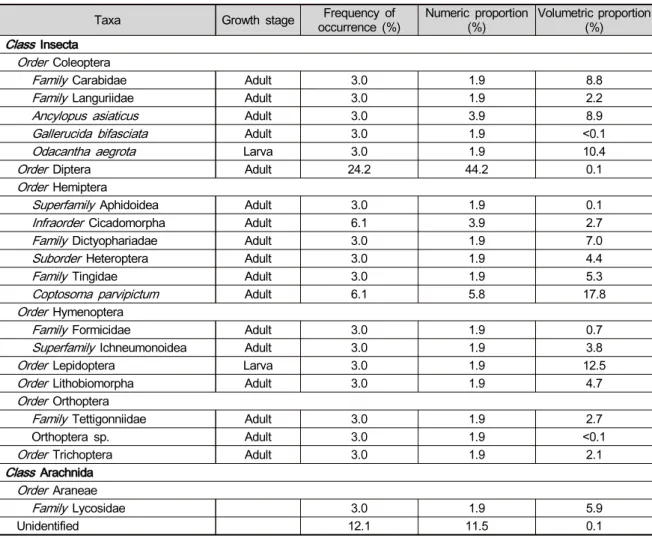
ABSTRACT: Diet composition of amphibians usually reflects the distribution of potential prey within habitats, as well as their diet preference. We identified the diet items of Japanese tree frog ( Hyla japonica) using a stomach flushing method in a rice paddy for the establishment of bio-monitoring systems of landscape changes. During the reproductive period, 71% of calling males had empty stomachs. All prey items in the stomachs belonged to the phylum Arthropoda, from eight orders of Insecta and one order of Arachnida. Among insect prey, the most common items in the stomachs were adults of beetles, flies and bugs, and larvae of butterflies and moths. There was a significant positive correlation between the body mass of Japanese tree frogs and the volume of prey items. Our results can provide a basic framework to guide the monitoring systems using prey identification of Japanese tree frogs.
KEYWORDS: Amphibian, Insect, Prey item, Rural landscape, Stomach flushing
*Corresponding author: [email protected], ORCID 0000-0003-4546-3546
ⓒ Korean Society of Ecology and Infrastructure Engineering. All rights reserved.
This is an open-access article distributed under the terms of the Creative Commons Attribution Non-Commercial License (http://creativecommons.org/licenses/by-nc/3.0/), which permits unrestricted non-commercial use, distribution, and reproduction in any medium, provided the original work is properly cited.