• 검색 결과가 없습니다.

Wearable Human Health-monitoring Band using Inkjet-printed Flexible Temperature Sensor

N/A
N/A
Protected

Academic year: 2021

Share "Wearable Human Health-monitoring Band using Inkjet-printed Flexible Temperature Sensor"

Copied!
5
0
0

로드 중.... (전체 텍스트 보기)

전체 글

(1)

Dong Cheul Han, Han Jae Shin, Se Hyeok Yeom, and Wanghoon Lee

+

Abstract

This paper presents a wearable human health-monitoring band. The band consists of a body temperature detector (BTD) and a hear rate detector (HRD). The BTD and HRD are realized using an inkjet-printed flexible temperature sensor and a commercial heart rate sensor module, respectively. The sensitivity of the fabricated BTD was found to be -31/°C with a linearity of 99.82%. The HRD using the commercial heart rate sensor module has a good performance with a standard deviation of 0.85 between the data of a commercial smart watch and the fabricated HRD.

Keywords: Health-monitoring, Smart band, Inkjet printing, Body temperature, Heart rate

1. INTRODUCTION

Many emerging application domains are being developed for smart living environments that allow interaction among people, the physical environment, and services [1-3].

With the advancements in health monitoring technologies, we envision that future smart homes would monitor not only our environment, but also our vital signs, such as breathing, heartbeat, and body temperature. Especially, daily life monitoring is important to prevent lifestyle diseases, which are expected to cause an increase in the number of patients and elderly people requiring nursing care. Our goal is to monitor and display vital signs and physical activity in daily life to improve the quality of life of users and to realize a smart society.

The measurement of human physiological parameters on a regular basis, apart from that done during hospitalization, could be an important feature in healthcare, influencing healthcare policies and healthcare economics on the one hand and our daily life on the other. Heart rate and body temperature are the key parameters for human health monitoring.

Heart rate is often underestimated due to auscultation or palpation, and therefore, pulse oximetry is recommended for the accurate measurement of heart rate. However, since the heart rate measurement system needs to be small in order to ensure a comfortable fit, optical heart rate sensor modules are currently used to monitor heart rate [4,5].

The monitoring of human body temperature an important tool used by clinicians to diagnose infections, detect fever, monitor thermoregulation functions during surgical procedures, and assess post-surgery recovery [6]. Thermistors and infrared (IR) temperature sensors are widely used to measure human body temperature. There is a demand for flexible temperature sensors that can be used in wearable devices, in order to improve the wearing sensation.

In this study, a wearable band-type remote human health monitoring system is developed. The system consists of a flexible temperature sensor and a heart rate sensor. The health data from the system is transmitted to an external PC. The proposed system is expected to apply to the wearable healthcare fields.

2. EXPERIMENTAL

2.1 Design

The human health monitoring (HHM) band consists of a body temperature detector (BTD) and a heart rate detector (HRD). The HHM band was designed to be worn on the wrist. The flexible temperature sensor, which is developed using inkjet printing, implements body temperature detection. A commercial heart rate Wearable Smart Device Technology Research Center, Gumi Electronics and

Information Technology Research Institute, Cheomdangieop 1-ro 17, Sandong- myeon, Gumi, Gyeongbuk 39171, Korea

+
Corresponding author: [email protected]

(Received: Jul. 25, 2017, Revised: Sep. 26, 2017, Accepted: Sep. 27, 2017)

This is an Open Access article distributed under the terms of the Creative Commons Attribution Non-Commercial License(http://creativecommons.org/

licenses/bync/3.0) which permits unrestricted non-commercial use, distribution,

and reproduction in any medium, provided the original work is properly cited.

(2)

sensor module (Kong-tech, HRM sensor #2) with an LED and photodiode is used for the HRD.

The core case was designed such that both the HRD and BTD can be mounted in the case. The BTD is located on the face jutting out from the bottom of the band to detect the skin temperature, as shown in Fig. 1. The core case of the HHM band has a size of 50 mm × 20 mm × 12 mm.

The pattern and size of the flexible temperature sensor was designed considering the functionality of the proposed band. A film based flexible temperature sensor has a size of 23 mm × 6.5 mm × 0.12 mm, as shown in Fig. 2. To enhance sensitivity and linearity, a mesh type pattern was used for the temperature detecting area.

2.2 Fabrication

A film-based flexible temperature sensor was fabricated using a piezoelectric type inkjet printer (Microfab, Jetlab4) for the BTD.

The pattern of the sensor was printed on the substrate film with the following conditions: nozzle size of 50 m, applied power of - 16 V (600 Hz), spread of 2 mm/s, and drop space of 40 mm.

PEDOT:PSS (Heraeus, CLEVIOS

TM

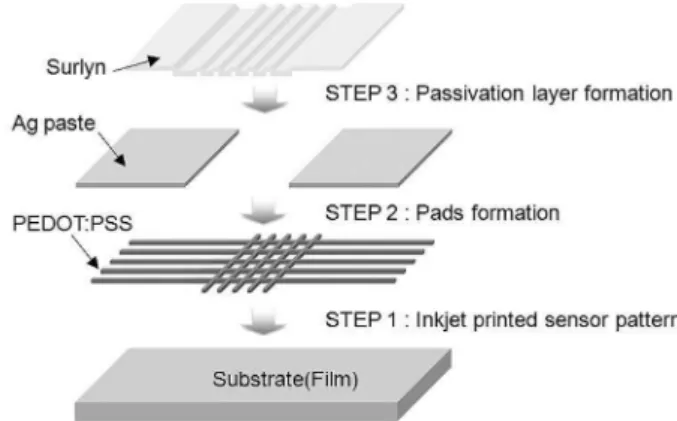
PH500) ink was used for the sensor pattern [7, 8]. The sensor pattern printed film was dried on a hot plate at 120 °C for 10min. Ag-pads were formed at both ends of the printed sensor pattern on the film substrate. Then, in order to isolate it from the influence of environmental factors such as moisture and gas, a passivation layer was formed using

thermoplastic resin (Dupont, Surlyn) [9-11]. Fig. 3 shows the process flow for the fabrication of the flexible temperature sensor for the HHM band. The flexible temperature sensor was fabricated as shown in Fig. 4.

The body temperature data is converted into 16 bit digital data for the BTD. Variations in temperature cause change in the resistance of the flexible temperature sensor, and the voltage divider converts this resistance into a voltage output, as shown in Fig. 5. Both the BTD and HRD are controlled by the main microcontroller (Nordic, nRF51822) for the HHM band.

The HHM band is powered by a lithium ion battery through the USB recharging system. Fig. 6 shows the system board of the HHM band, which consists of the control block, the BLE module, and the connector (05002HR-14C) of the mounted HRD and BTD. The core case was fabricated by using a 3D printer. The Fig. 1. Schematic of core case of the human health monitoring band

with a size of 50 mm ×20 mm×12 mm.

Fig. 2. Schematic of the flexible temperature sensor using inkjet printing technology

Fig. 3. Process flow of the flexible temperature sensor using inkjet printing

Fig. 4. Fabricated flexible temperature sensor for the human health

monitoring band

(3)

case and board were assembled for the HHM.

The monitoring system confirms the health data obtained from the HHM band. The monitoring system consists of the BLE- RS232 dongle and a monitoring program. The BLE module of the band transmits the health data using a USB to serial UART interface circuit device (FT232) to the BLE-RS232 dongle. Then, the dongle transmits the data to the PC via serial UART communication. The transmitted data is displayed on the monitor by the program. The program shows the transmitted data, the state of the battery, body temperature, and heart rate from the HHM band, as shown in Fig. 7.

3. RESULTS AND DISCUSSIONS 3.1 BTD

The output of the fabricated BTD was measured within a temperature range of 10°C to 50°C inside the temperature chamber (C600/70, WEISS). The output of the BTD is the analog to digital converted data of the temperature variation. Fig. 8 shows the output signal of the BTD against the changes in temperature.

As a result of the measurement, the sensitivity of the BTD was found to be -31/°C with a linearity of 99.82% for the analog to digital converted data. However, due to the difference between the measured temperature data of the BTD and the real body temperature, the BTD data of the HHM band was compensated by Fig. 5. Analog-to-digital converting circuit for the BTD

Fig. 6. System board with the BTD and HRD for the human health monitoring band

Fig. 7. Monitoring system with BLE-RS232 dongle and monitor program for the HHM band

(4)

real body temperature.

3.2 HRD

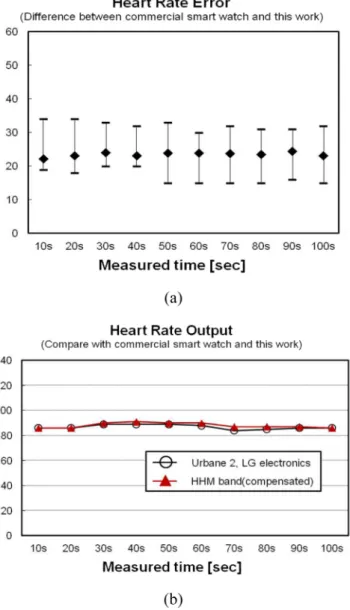
The fabricated HRD measured the heart rate for 100s. The heart rate error was obtained through comparison with a commercial smart watch (Urbane 2, LG electronics). The measured heart rate error is depicted in Fig. 9-(a). The minimum and maximum heart rate errors were measured as 15 and 34, respectively. The output data of the fabricated HRD needs to be compensated for stable heart rate data, because the HRD has an average heart rate error of 23.53 in comparison with the commercial band. Owing to the characteristics of the optical HRM sensor, there could be an error while measuring heart rate. Therefore, ‘sampling’ and

‘equalization’ of the measured results are required to obtain a stable value for precise measurement. The output data of the HRD was equalized to reduce the measurement error. We were able to confirm that the compensated HRD had a good performance, because the standard deviation between the output data of the HRD and the commercial smart watch was 0.85, as shown in Fig.

9-(b).

3.3 HHM band

The HHM band was assembled using components of both the system board and the case. Fig. 10 shows the completed HHM band. When the HHM band is worn, the body temperature and heart rate are measured and displayed on the monitoring system, as shown in Fig. 11. The measured results showed 67/min and 36.72 °C as the heart rate and body temperature, respectively. The Fig. 8. Output of the fabricated BTD in the temperature change. The sensitivity of the BTD was found as -31 / deg. C with the lin- earity of 00.82% in A/D converted data

Fig. 9. The heart rate output comparison between the fabricated HRD and the commercial smart watch (Urbane 2, LG elec- tronics). (a) is the measured heart rate error before com- pensation. And (b) is the comparison with the commercial smart watch and the compensated this work.

Fig. 10. Fabricated human health monitoring band

(5)

specifications of the fabricated HHM band are summarized in Table 1.

4. CONCLUSIONS

Using a body temperature detector and a hear rate detector, a wearable human health-monitoring band was fabricated and evaluated. A flexible temperature sensor and a commercial heart rate sensor module were used as the human temperature detector and heart rate detector, respectively. The human heart rate and temperature can be monitored through the fabricated human health-monitoring band, which is expected to be applied in the field of wearable healthcare.

REFERENCES

[1] X. Zheng and P. Pulli, “Towards high quality mobile ser- vices for senior citizens in smart living environments”, Proc. Of Int. Conf. on Multimed. Ubiquitous Eng., pp. 164- 170, Seoul, Korea, 2007.

[2] A. Kliem, M. Hovestadt and O. Kao, “Security and com- munication architecture for networked medical devices in mobility-aware eHealth environments”, 2012 IEEE Int.

Conf. on Mob. Ser., pp. 112-114, Hawaii, USA, 2012.

[3] A. Kliem, M. Hovestadt and O. Kao, “Security and S. Hori- guchi, K. Oota and H. Takei, “The trend of mobile health- care technology”, J. Inst. Elect. Eng. Jpn., Vol. 132, No. 3, pp. 156-159, 2012.

[4] http://www.rohm.com/web/eu/sensor-shield-support/heart- rate-sensor (retrieved on Sep. 26. 2017).

[5] http://www.ti.com/lit/ds/symlink/afe4403.pdf(retrieved on Sep. 26, 2017).

[6] M. Bock, U. Hohlfeld, K. von Engeln, P. A. Meier, J.

Motsch, and A. J. Tasman, “The accuracy of a new infrared ear thermometer in patients undergoing cardiac surgery”, Can. J. Anesth., Vol. 52, No. 10, pp. 1083-1087, 2005.

[7] W. A. Daoud. J. H. Xin and Y. S. Szeto, “Polyethylene- dioxythiophene coatings for humidity, temperature and strain sensing polyamide fibers”, Sens. Actuators B, Vol.

109, pp. 329-333, 2005.

[8] A. Elschner, “PEDOT: principles and applications of an intrinsically conductive polymer”, Boca Raton, FL:CRC Press, ch. 2, pp. 21-30, 2011.

[9] S. Seethamraju, A. D. Rao, P. C. Ramamurthy and G.

Madras, “Layer-by layer assembly of nafion on surlyn with ultrahigh water vapor barrier”, Langmuir, pp. 14606-14611.

2014.

[10] S. Seethamraju. P. C. Ramamurthy and G. Madras, “Organic passivation layer on flexible surlyn substrate for encap- sulation organic photovoltaics”, Appl. Phys. Lett., Vol. 105, pp.104102, 2014.

[11] G. N. Kopanati. S. Seethamraju. P. C. Ramamurthy and G.

Madras, “Water vapor barrier material by covalent self- assembly for organic device encapsulation”, Ind. Eng.

Chem. Res., Vol 53, pp. 17894-17900, 2014.

Fig. 11. The measured results of the fabricated HHM band. When wearing the HHM band, the body temperature and the heart rate were measured and displayed on the monitoring sys- tem.

Table 1. Specification summary of the HHM band Human health monitoring band

Health Information Temp. & Heart rate

Device Type Wearable band

Core Size 50 mm ×20 mm×12 mm

Measuring Temp. 10 °C - 50°C

Voltage Supply DC 4V

Operating Current 0.18mA

Communication type Bluetooth low energy (BLE)

수치

Fig. 3. Process flow of the flexible temperature sensor using inkjet printing
Fig. 6. System board with the BTD and HRD for the human health monitoring band
Fig. 9. The heart rate output comparison between the fabricated HRD and the commercial smart watch (Urbane 2, LG  elec-tronics)
Table 1. Specification summary of the HHM band Human health monitoring band

참조

관련 문서