http://dx.doi.org/10.46670/JSST.2021.30.1.1 pISSN 1225-5475/eISSN 2093-7563
Machine Learning in FET-based Chemical and Biological Sensors: A Mini Review
Jae-Hyuk Ahn
+Abstract
This mini review summarizes some of the recent advances in machine-learning (ML)-driven chemical and biological sensors. Spe- cific focus is on field-effect-transistor (FET)-based sensors with a description of their structures and detection mechanisms. Key ML techniques are briefly reviewed for an audience not familiar with the basic principles. We mainly discuss two aspects: (1) data analysis based on ML and (2) ML applied to sensor design. In conclusion, the challenges and opportunities for the advancement of ML-based sensors are briefly considered.
Keywords: Machine learning, field-effect transistors, gas sensors, biosensors, and receptors
1. INTRODUCTION
Chemical and biological sensors have been used in a variety of fields, including basic research, medicine, medical diagnosis, and health monitoring. Label-free electrical detection based on field- effect transistors (FETs) have many advantages, such as high sensitivity, small size, and easy integration with electronic circuits [1]. Researchers work to improve the sensitivity and ensure ease of use of the FET-based sensors to extend their use in practical applications. One of the strategies to increase detection sensitivity is to incorporate nanomaterials such as nanoparticles, nanowires, and two-dimensional (2D) materials, which increase the surface- to-volume ratio of the FET channel or strengthen the catalytic effects to sense target molecules [2,3]. The FET-based sensors can be fabricated on a flexible substrate, enabling wearable applications to monitor the health status of humans [4].
Machine learning (ML) is a branch of artificial intelligence that provides computers with the ability to automatically learn from data, identify patterns, and make decisions without being explicitly programmed [5]. Recently, the advances in ML have been driven by three factors: improved computing power, data availability and appropriate algorithms [6]. These advances enable ML techniques to make accurate predictions based on large sets of
data [7].
ML enables researchers to analyze massive sensor data, assisting in designing experiments and new type of sensors [8].
Multidimensional data collected from an array of sensors are sometimes so complicated that humans have difficulty in analyzing them. However, ML algorithms are used to learn from data, recognize patterns, and classify the data. The ability to predict the result of new experiments can be utilized to design new high-performance sensors.
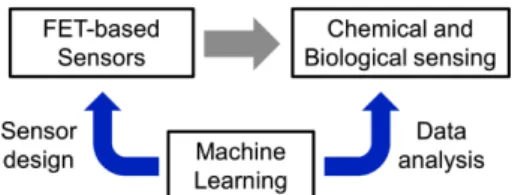
In this mini review, we discuss the effectiveness of ML to advance the technology associated with FET-based sensors (Fig. 1).
2. FET-BASED CHEMICAL AND BIOLOGICAL SENSORS
2.1 Structures
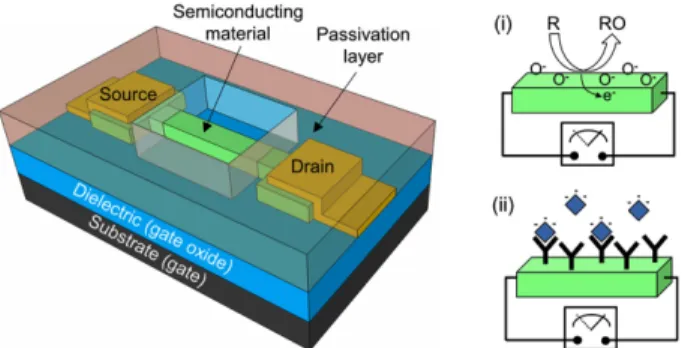
As shown in Fig. 2, a typical FET-based chemical and biological sensor is composed of a semiconducting material, two electrodes (source and drain) connected to the two ends, and a gate electrode that modulates the mobile charge carrier concentration within the
1
Department of Electronics Engineering, Chungnam National Unversity, 99 Daehak-ro, Yuseong-gu, Daejeon 34134, Korea
+