I. Introduction
Matrix metalloproteinases(MMP) are a family of proteolytic enzymes that mediate the degradation of extracellular matrix macromolecules, including inter- stitial and basement membrane collagens, fibronectin, laminin, and proteoglycan core protein.
The major cell types(fibroblasts, keratinocytes, endothelial cells, and macrophages) in periodontal tissue are capable of responding to growth factors and cytokines, as well as to products released from the microbial flora by induction of transcription of one or more MMP genes1).
These MMPs share some common properties: 1) secretion from the cell in a latent form(proenzyme) with its subsequent activation in the extracellualr space; 2) containing zinc cation at the active site; 3) inhibition by chelators of calcium(e.g., EDTA), and zinc(e.g., 1, 10 phenanthroline); 4) inhibition by tis- sue inhibitors of metalloproteinases(TIMP); and 5) degrading at least one component of the extracellu- lar matrix(e.g., collagen)2). One prominent member of these MMPs, MMP-3(stromelysin-1) is capable of degrading the numerous extracellular matrix macro- molecules(ECM) including fibronectin, laminin, pro-
teoglycan core protein, collagen IV, V, IX, X, and elastin3).
Increase of MMP-3 activity associated with several chronic inflammatory disease appear to be the result of specific inductive mechanisms. One of the medi- ators in induction of MMP-3 is interleukin-1(IL-1), cell product that has important regulatory functions mediating the body's response to microbial invasion, inflammation, and tissue injury4,5,6,7). Especially, IL-1 is thought to play a important role in the tissue destruction associated with inflammatory diseases such as rheumatoid arthritis and periodontal disease8,9). As periodontitis is specifically associated with the destruction of periodontal connective tis- sues, it is closely related to both IL-1 and MMPs.
Gingivitis can trigger the initial cascade of peri- odontal destruction. The human gingival fibroblast is prominent cell type in the gingival connective tis- sue and products cytokines inducted by microbial infection in periodontal disease. In the periodontal disease, the upregulation of MMP expression in response to locally released IL-1 may provide one component of this pathologic process. IL-1 has been identified in both the gingiva and gingival crevicular fluids of periodontitis patients10,11). In Vitro,fibrob-
The Inhibitory Effect of Metronidazole and Doxycycline-HCl on proMMP-3 Production in Gingival Fibroblast
Hak-Joo Kim·Ki-Jung Lim·Sang-Mok Kim·Byung-Ock Kim·Kyung-Yoon Han Department of Periodontology, College of Dentistry, Chosun University
대한치주과학회지 : Vol. 30, No. 2, 2000
lasts derived from gingival tissue have shown enhanced production of both MMP-1(collagenase) and MMP-3 with IL-1 stimulation7,12).
Tetracyclines(TCs) and their chemically modified analogues(CMTs) remain useful as antibiotics in periodontal therapy. TCs and CMTs also have non- antimicrobial properties which appear to modulate host response. For example, clinical studies indicat- ed that tetracyclines may be useful in the treatment of certain medical conditions like epidermolysis bul- losa, rosacea, alpha1-antitrypsin-deficiency panni- culitis, pyoderma gangrenosum and other inflamma- tory and bullous skin diseases which do not have a microbial etiology13). It has been proposed that the anti-inflammatory mechanisms are due in part to tetracycline's ability to inhibit leukocyte proliferation and activity and to scavenge hypochlorous acid and superoxide radicals produced by phagocytes14). In that aspect, TCs and CMTs have been shown to inhibit the activity of MMPs and collagenase15,16,17,18). Also, metronidazole is widely used in the treatment of trichomoniasis, tropical ulcer, giardiasis, balantidi- asis, amebiasis, dracunculiasis and acute necrotizing ulcerative gingivitis(ANUG). The previous study19) suggested metronidazole has a marked anti-inflam- matory action, such as early subsidence of pain and inflammatory edema and healing of an ulcer.
In the present study, we investigated the inhibitory effects of metronidazole and doxycycline-HCl, one of the tetracycline analogues, on the proMMP-3 level in human gingival fibroblast cells induced by IL-1β.
II. Material and Method
1. Cell preparation and cultureGingival fibroblasts were obtained from gingival connective tissue of a healthy adult with clinically and radiographically normal periodontal tissues.
The tissue explants were resected and immersed immediately in Hanke's buffered salt solution(HBSS) (GIBCO/BRL, USA) containing antibiotics(penicillin:
1000 U/ml, Streptomycin: 1000㎍/ml, and fungizon:
50㎍/ml)(GIBCO/BRL, USA). The tissue samples were rinsed several times with the same medium and minced to 1×1×1 mm. The minced samples were placed in 60 mm culture plates(NUNC, Netherland) containing culture medium composed of Dulbecco's Modified Eagle's Medium(DMEM) (GIBCO/BRL, USA) with penicillin: 1000 U/ml, Streptomycin: 1000㎍/ml, and fungizon: 50㎍/ml, and 20% heat-inactivated fetal bovine serum(FBS) (GIBCO/BRL, USA). The cells were incubated at 37
℃ in a humidified atmosphere of 95% air and 5%
CO2for 2 weeks. The medium was renewed every 3 or 4 days until the cells were confluent. After 0.25% trypsin/EDTA(GIBCO/BRL, USA) incubation for detachment, the cells were transferred into 90 mm tissue culture plates. The cells were maintained in culture medium with 10% FBS and passaged upon confluence. The cells between the fifth and tenth passages showing a fibroblast-like morpholo- gy under light microscopy were used for the experi- ment.
2. Treatment wit hmetronidazole and doxycycline-HCl
Dense cultures of fibroblasts were treated with 0.25% trypsin. The detached cells were washed once with DMEM supplemented with 10% FBS and diluted to 4×10⁴cells/ml in DMEM supplemented with 10% FBS. A cell suspension of cells was distrib- uted into each well of 6-well plate dish. When the cells reached confluence, the medium was replaced with DMEM supplemented with 0.1% FBS. The cells were then treated with culture medium containing 0.1% FBS alone(as a control) or with increasing con-
centrations(10, 25, 50, 100, 200㎍/ml) of metronida- zole(Sigma, USA) and doxycycline-HCl(Sigma, USA) for an hour prior to adding the recombinant human IL-1β.
3. Treatment with the recombinant human IL-1β
After the incubation, the cell cultures were treated with the optimal concentration(25ng/ml) of recom- binant human IL-1β(R & D systems, Minneapolis, MN) and incubated for 24 hours prior to ELISA.
4. Enzyme-linked immunosorbent assay (ELISA)
After the incubation for 24 hours with antibiotics and IL-1β, cell culture supernatant was obtained, and diluted with sample diluent according to recom- mended dilution rate(1/21).ELISA procedure was performed according to the manual of proMMP-3 ELISA kit(The Binding site, San Diego, CA). Briefly, control or diluted 100㎕ samples were distributed to the microwell plate and incubated for 60 minutes.
After incubation, wells were washed 3 times with washing buffer. The biotinylated antibody 100㎕
was added to each well and incubated for 60 min- utes and washed. The streptavidin peroxidase 100㎕
was added to each well and incubated for 30 min-
utes and washed. The substrate 100㎕ was added to each well and incubated for 10 minutes. Finally, The stopping solution 100㎕ was added to each well, and the optical density was measured at 450nm under the microwell plate reader(Bio-Tek instru- ment, USA). Each assay was carried out in triplicate.
5. Statistical analysis
The difference of obtained data between groups was statistically analyzed by independent t-test, ANOVA and Duncan test. And the percentile change from the control was obtained in the each concentration of metronidazole and doxycycline- HCl.
III. Result
1. proMMP-3 expression inhibited by varying the concentrations of metron- idazole
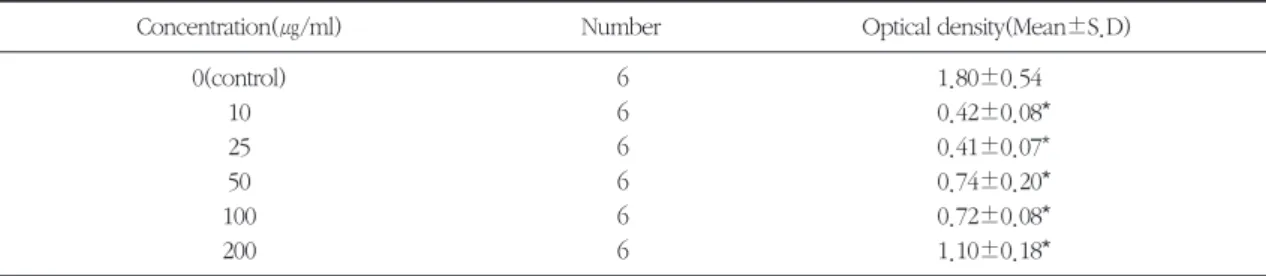
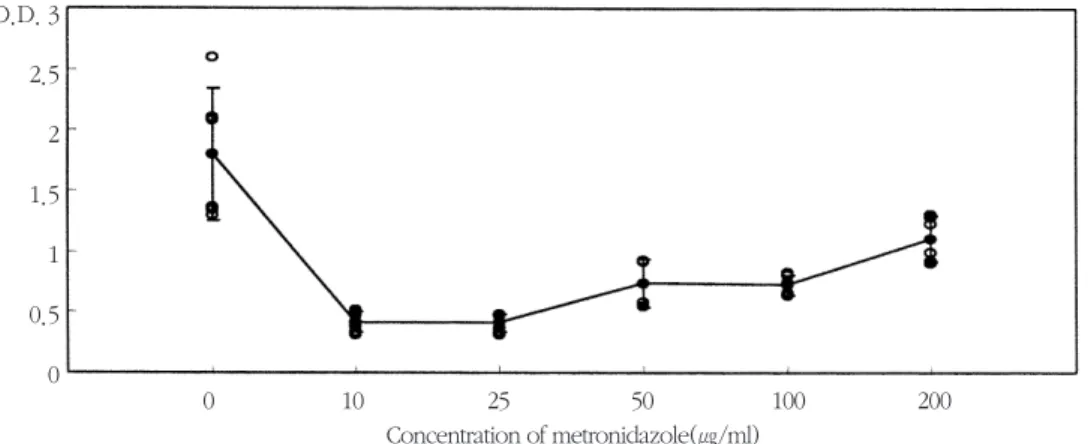
When the cells were incubated with 10, 25, 50, 100, 200㎍/ml of metronidazole and IL-1β, proMMP- 3 expression was significantly decreased in all of the concentration, compared with control without metronidazole(Table 1). The proMMP-3 expression exhibited initial reduction and gradual increase (Figure 1).
Table 1. The optical density of proMMP-3 according to the concentration of metronidazole
Concentration(㎍/ml) Number Optical density(Mean±S.D)
0(control) 6 1.80±0.54
10 6 0.42±0.08*
25 6 0.41±0.07*
50 6 0.74±0.20*
100 6 0.72±0.08*
200 6 1.10±0.18*
*p<0.05: significantly different from the control
2. proMMP-3 expression inhibited by varying the concentrations of doxycy- cline-HCl
When the cells were incubated with 10, 25, 50, 100, 200μg/ml of doxycycline-HCl and IL-1β, proMMP-3 expression was significantly decreased in the concentration below 100㎍/ml, compared with the control without doxycycline-HCl(Table 2). But O.D. 3
2.5 2 1.5 1 0.5
0 0 10 25 50 100 200
Concentration of metronidazole(㎍/ml)
Figure 1. The expression of proMMP-3 according to the concentration of metronidazole O.D.: Optical Density
Table 2. The optical density of proMMP-3 according to the concentration of doxycycline-HCI
Concentration(㎍/ml) Number Optical density(Mean±S.D)
0(control) 6 1.26±0.12
10 6 0.52±0.03*
25 6 0.67±0.06*
50 6 0.73±0.09*
100 6 1.00±0.05*
200 6 1.45±0.10*
*p<0.05: significantly different from the control O.D.
1.8 1.6 1.4 1.2 1 0.8 0.6 0.4
0.2 0 10 25 50 100 200
Concentration of doxycycline-HCI(㎍/ml)
Figure 2. The expression of proMMP-3 according to the concentraion of doxycycline-HCI O.D.: Optical Density
proMMP-3 expression was significantly increased in the cells incubated with 200㎍/ml of doxycycline- HCl. The proMMP-3 expression exhibited initial reduction and gradual increase(Figure 2).
3. Percentile change of proMMP-3 expression from the control
When the percentile changes of proMMP-3 expression between docycycline- HCl and metron- idazole were compared, it was noted that metron- idazole was superior to doxycycline-HCl in inhibito- ry effect(Table 3, Figure 3).
IV. Discussion
IL-1 produced by the macrophages/ monocytes has multiple biological activities and is important in the immune and inflammatory responses.
Especially, IL-1 has been detected in gingival crevic- ular fluid and the gingival tissue affected by peri- odontitis. Several studies have shown that IL-1 stim- ulates the production of collagenase, and the mito- genesis of gingival fibroblasts.
The biological activities of IL-1 are mediated by the binding of specific cell surface receptors. Two
Figure 3. The comparsion between metronidazole and doxycycline-HCI in the inhibitory effect on proMMP-3 producion
Concentraion of metronidazole and doxycycline-HCI(㎍/ml)
Table 3. The percentile change of proMMP-3 by varying the concentration of metronidazole and doxycycline-HCI
Concentraion(㎍/㎖) Metronidazole Doxy-HCI
10 23.89% 41.78%
25 23.45% 53.06%
50 47.18% 58.10%
100 44.45% 80.04%
200 63.89% 115.90%
types of IL-1 receptors(IL-1R) have been identified:
type I is expressed on T cells, epithelial cells, and fibroblasts, and type II is expressed on B cells, macrophages, and myeloid cells. IL-1's actions may be determined by the type of receptors expressed on different types of cells.
Various reagents and cytokines have been found to influence IL-1R expression in various cell types.
PDGF, PGE2, and cAMP-generating reagents up-reg- ulate IL-1R expression in fibroblasts. It has been found that IL-1 itself rapidly up-regulates IL-1R expression in fibroblast20,21). Chieko et al.22)showed that IL-1R expression on the inflamed gingival fibroblast cells stimulated by IL-1β continuously increased. In the previous study, proMMP-3 expres- sion from gingival fibroblast stimulated by IL-1β showed increasing trend corresponding to the IL-1β concentration. Especially, in the concentration over 25ng/ml, proMMP-3 was significantly increased23).
Previous investigation1)of IL-1 regulation of MMP- 3 expression in periodontal ligament fibroblasts sup- ported it's role in the destruction of periodontal tis- sue associated with periodontitis. Because peri- odontitis is clinically distinct from gingivitis, there is necessarily some differences on a cellular level.
Birkedal-Hansen24)summarized the key understand- ing why gingival inflammation may or may not give rise to tissue destruction and attachment loss as fol- lows: 1) different cell types express different com- plements of MMP; 2) different cytokines elicit differ- ent transcriptional effects for MMP genes; and 3) dif- ferent cell types do not necessarily respond in the same fashion to a given cytokine. Present results didn't provide a evidence for the direct effect of the IL-1 in the periodontal ligament. But, as regarding the triggering role of gingival connective tissue inflammation in the periodontal disease, the present study provided another indirect evidence for IL-1 regulation of MMP-3 expression in periodontitis.
In the early to mid-1980s, Golub and co-work- ers17)reported that: 1) tetracyclines could inhibit the activity of mammalian collagenase; and 2) this inhi- bition was unrelated to the antimicrobial efficacy of these drugs. In fact, the initial observation of tetracy- clines' effect on mammalian collagenase has been extended to other metalloproteinases including gelatinase, type IV/V collagenase, and macrophage elastase. Tetracyclines are known to inhibit collage- nases from a variety of cells: neutrophils, macrophages, osteoblasts, chondrocytes, and a wide range of tissues: skin, gingiva, cornea, cartilage, and rheumatoid synovium.
Barry et al.2)summarized that the ability of TCs may 1) indirectly inhibit the activity of extracellular collagenase and other MMPs such as gelatinase; 2) prevent the activation of its proenzyme by scaveng- ing reactive oxygen species generated by other cell types(e.g., PMNs, osteoclasts); 3) inhibit the secre- tion of other collagenolytic enzymes(e.g., lysomal cathepsins); and 4) directly affect other aspects of osteoclast structure and function. Several studies have also documented the therapeutic potential of TCs and CMTs in periodontal disease. In our study, antibiotics were treated before the IL-1β application, and then the inhibition of MMP-3 was quantitatively measured in the pro-enzyme level. The results sug- gest that MMP-3 expression can be inhibited by the antibiotics before the protein synthesis step.
Human fibroblast collgenase(MMP-1) appears to be relatively resistant to tetracyclines treatment25). Since the neutrophils(PMN) likely provide the prin- cipal source of collagenase for tissue destruction during periodontal disease, fibroblast collagenase may be required for normal connective tissue remodeling. So, Barry et al.10,25) suggested that the differential sensitivity of PMN and fibroblast collage- nases to tetracycline treatment may have substantial therapeutic benefits. In this aspect, pharmacologic
concentrations might inhibit the activity of PMN, but not the fibroblast enzyme. Such a selective inhibiton might reduce collagenolytic activity and tissue destruction during inflammation, but not the normal collagen turnover required for the maintenance of tissue integrity. Because the present study was only performed for proMMP-3 expression in the gingival fibroblast, we could not compare the differences between the inhibitory effect of tetracycline and CMTs in gingival fibroblast and PMNs. But it is dis- tinct that MMP-3 originated from gingival fibroblast can play a role in the inflammatory reaction induced by IL-1β of inflammatory cells(PMN, monocyte, macrophage).
Metronidazole and doxycycline-HCl have been used because of not only the antimicrobial property, but also the anti-inflammatory property. Burns et al.26) compared the relative potencies of different collagenase inhibitors including tetracyclines, and reported that doxycycline(with an IC50=15μM) was a more potent collagenase inhibitor than two other tetracyclines, minocycline(IC50=190μM) and tetracy- cline(IC50=15μM). In the safety aspect of a low-dose regimen of these CMTs, Golub et al.16,27)described the effectiveness of a low-dose regimen of minocy- cline in reducing GCF collagenase activity in the periodontal pocket although no significant changes in the make up of the crevicular microflora were detected. In addition, their other study suggested that subgingival plaque microorganisms (Fusobacterium nucleatum, Actinomyces spp, Bacteroides spp) do not develop tetracycline resis- tance when patients are administered a 2 weeks reg- imen of low dose doxycycline capsules. In contrast, when patients were administered regular-dose doxycycline capsules(50mg. b.i.d), the subgingival plaque appeared to become resistant(minimum inhibitory concentration of doxycycline=25-100㎍
/ml in these subjects) to expected tissue fluid lev-
els(1-5㎍/ml) of this antibiotic28).Golub et al.16,29) suggested that a regimen of low-dose CMTs cap- sules may provide a safe and effective adjunct to instrumentation therapy without inducing the side effects(e.g., antibiotic-resistant microorganisms, gas- tro-intestinal upset) in the management of patholog- ic collagenolysis in the periodontal patient. In the present study, when the reduction of MMP-3 expres- sion by metronidazole and doxycycline-HCl was compared through this uncontrolled study, the more potent MMP-3 inhibitor was the metronidazole. The metronidazole showed the inhibitory effect in the all of concentration range. Especially, in comparing with the percentile change of doxycycline-HCl, the inhibitory effect of metronidazole was reached to about 2-fold in each concentration. This result sug- gests that metronidazole may be suitable for the periodontal treatment without any induction of antibiotic-resistant organism and for a long term therapy.
Although the in vivo activities of MMP-3 are still uncertain, the results suggest that low concentration of metronidazole and doxycycline-HCl can inhibit the activity of MMP-3 without antibiotic-resistance in gingival connective tissue with gingivitis and peri- odontitis. Further studies, regarding the drug con- centration in gingival crevice, drug delivery system, and recommended dosage for control of periodon- tal inflammation, are required.
V. Conclusion
The purpose of the present study was to investi- gate the inhibitory effect of metronidazole and doxycycline-HCl on proMMP-3 production in the activated gingival fibroblast by IL-1β. The cultured human gingival fibroblasts(4×10⁴ cell/ml) were treated with metronidazole and doxycycline-HCl at various concentrations(10-200㎍/ml) incubated for 1
hour, and treated with 25ng/ml of IL-1β to induce the MMP-3. The proMMP-3 level was assayed with proMMP-3 ELISA Kit. The following results were obtained through the in vitrostudy
1. Metronidazole inhibited significantly the expression of proMMP-3 in wide range of con- centration from 10 to 200㎍/ml(p<0.05).
2. Doxycycline-HCl inhibited significantly the expression of proMMP-3 at the concentration lower than 100㎍/ml, but increased significant- ly the expression of proMMP-3 at the concen- tration of 200㎍/ml(p<0.05).
3. The percentile change of the proMMP-3 expression was more reduced at metronida- zole treated groups than doxycycline-HCl treat- ed groups.
The results showed that the low concentration of doxycycline-HCl(<100㎍/ml) and metronida- zole(<200㎍/ml) could inhibit effectively the activity of MMP-3 induced by IL-1β in gingival fibroblasts, and suggest that metronidazole and doxycycline- HCl may play important roles in anti-inflammatory effect as well as in antibiotic effect, and metronida- zole may be superior to doxycycline-HCl in inhibito- ry effect.
VI. References
1. Nip, L.H., Uitto, V-J., Golub, L.M.: “Inhibition of epithelial cell matrix metalloproteinases by tetra- cyclines”, J. Periodont. Res., 2288 :: 379-385, 1993.
2. Rifkin, B.R., Vernillo, T.V., Golub, L.M.: “Block- ing periodontal disease progression by inhibiting tissue destructive enzymes: a potential therapeu- tic role for tetracyclines and their chemmically- modified analogs”, J. Periodontol., 6644 :: 819-827, 1993.
3. Preus, H., Tollefsen, T., Mörland, B.: “Effect of tetracycline on human monocyte phogocytosis and lymphocyte proliferation”, Acta. Odontol.
Scand., 4455 :: 297-302, 1987.
. Conca, W., Kaplan, P.B., Krane, S.M.: “Increase in levels of procollagenase mRNA in cultured fibroblasts induced by IL-1β or serum follow c- jun expression and are dependent on new pro- tein systhesis”, J. Clin. Invest., 8833 :: 1753-1757, 1989.
5. Frisch, S.M., Ruley, H.E.: “Transcription of the stromelysin promoter is induced by IL-1 and repressed by dexamethasone”, J. Biol. Chem., 226622 :: 16300-16304, 1987.
6. Ganu, V.S., Hu, S-I., Melton, R., et al.:
“Biochemical and molecular characterization of stromelysin synthesized by human osteoarthritic chodrocytes stimulated with recombinant human interleukin-1”, Clin. Exp. Rheumatol., 1122 :: 489-496, 1994.
7. Richards, D., Rutherford, R.B.: “Interleukin-1 regulation of procollagenase mRNA and protein in periodontol fibroblasts in vitro”, J. Periodont.
Res., 2255 :: 222-229, 1990.
8. McCulloch, C.A.G., Birek, P., Aitken, S., Lee, W.: “Low-dose tetracyclines decrease elastase and B-glucuronidase activities in gingival crevic- ular fluid”, J. Dent. Res., 6699((SSppeecc,, iissssuuee)) :: AADR abst(submitted), 1990.
9. Tatakis, D.S.: “Interleukin-1 and bone metabo- lism: A review”, J. periodontol., 6644 :: 416-431, 1993.
10. Sorsa, T., Uitto, V-J., Suomolainen, M., Vauhkonen, M., Lindy, S.: “Comparison of inter- stitial collagenases from human gingiva, sulcular fluid and polymorphonuclear leukocytes”, J.
Periodont. Res., 2233 :: 386-393, 1988.
11. Stashenko, P., Fujiyoshi, P., Obernesser, M.S., Prostak, L., Haffajee, A.D., Socransky, S.S.:
“Levels of interleukin-1β in tissue from sites of active periodontitis disease” , J. Clin.
Periodontol., 1188 :: 548-554, 1991.
12. Tewari, D.S., Qian, Y., Tewari, M., et al.:
“Mechanistic features associated with induction of metalloproteinases in human gingival fibrob- lasts by interleukin-1”, Arch. Oral. Biol., 3399 ::
657-664, 1994.
13. Okada, Y.N., Nagase, H., Harris, E.D. Jr.: “A metalloproteinase from human rheumatoid syn- ovial fibroblasts that digests connective tissue matrix components”, J. Biol. Chem., 226611 ::
14245-14255, 1986.
14. Richards, D., Rutherford, R.B.: “Interleukin-1 regulation of procollagenase mRNA and Protein in periodontal fibroblasts in vitro”, J. Periodont.
Res., 2255 :: 222-229, 1990.
15. Golub, L.M., Mcnamara, T.F., D'Angelo G., Greenwald, R.A., Ramamurthy, S.: “A nonan- tibacterial chemically-modified tetracycline inhibits mammalian collagenase activity”, J.
Dent. Res., 6666 :: 1310-1314, 1987.
16. Golub, L.M., Lee, H.M., Lehrer, G., et al.:
“Minocycline reduces gingival collagenolytic activity during diabetes: preliminary observations and a proposed new mechanism of action”, J.
Periodontal. Res., 1188 :: 516-526, 1983.
17. Golub, L.M., Ramamurthy, N.S., McNamara, T.F., et al.: “Tetracycline inhibits tissue collage- nase activity: a new mechnism in the treatment of periodontal disease”, J. Periodont. Res., 1199 ::
651-655, 1984.
18. Golub, L.M., Ramamurthy, N.S., McNamara, T.F., Greenwald, R.A., Rifkin, B.R.: “Tetracy- clines inhibit connective tissue breakdown: new therapeutic applications for an old family of drugs”, Critical Reviews in Oral Biology and Medicine., 22 :: 297-322, 1991.
19.Tanga, M.R., Antani, J.A., Kabade, S.S.: “Clinical
evaluation of metronidazole as an anti-inflamma- tory agent”, Int. Surgery., 6600 :: 75-76, 1975.
20.Bonin, P.D., Chiou, W.J., McGee, J.E., Singh, J.E.: “Two signal transduction pathways mediate interleukin-1 receptor expression in balb/c3T3 fibroblasts”, J. Biol. Chem., 226655 :: 18643-18649, 1990.
21.Bonin, P.D., Singh, J.P.: “Moduration of inter- leukin 1 receptor expression and interleukin-1 response in fibroblasts by platelet-derived growth factor”, J. Biol. Chem., 226633 :: 11052- 11055, 1988.
22.Chieko, K-N., Yuichi, I., Takeshi, S.: “Increased expression of interleukin-1 receptors on fibrob- lasts derived from inflamed gingiva”, J.
Periodontol., 6677 :: 1267-1273, 1996.
23.조종희, 김병옥, 한경윤 : “테트라사이클린계 약 물이 치은섬유아세포내 MMP-3의 활성도에 미치 는 영향”, 「대한치주과학회지」, 제29권(4호) ::
617-631, 1999.
24.Birkedal-Hansen H.: “Role of matrix metallopro- teinases in human periodontal disease”, J.
Periodontol., 6644::474-484, 1993.
25.Sorsa, T., Ingman, T., Suomalainen, K., et al.:
“Cellualr source and tetracycline-inhibition of gingival crevicular fluid collagenase in patients with labile diabetes”, J. Clin. Periodontol., 1199 ::
146-149, 1992.
26.Burns, F.R., Stack, M.S., Gray, R.D., Paterson, C.A.: “Inhibition of purified collagenase from alkaline-burned rabbit corneas”, Invest.
Opthalomol. Vis. Sci., 3300 :: 1569-1575, 1989.
27.Golub, L.M., Wolff, M., Vidal, A.M., Ramamurthy, N.S., McNamara, T.F.: “Low-dose minocycline theraphy: effects on crevicular fluid collagenase and subgingival microflora”, IADR abstract. J. Dent. Res., 6666((SSppeecc.. IIssssuuee)) :: 384, 1987.
28.Nakaya, H., Oates, T.W., Hoang, A.H., Kamoi,
K., Cochran, D.L.: “Effect of interleukin-1βon matrix metalloproteinase-3 levels in human peri- odontal ligament cells”, J. Periodontol., 6688 :: 517- 523, 1997.
29.Hönig, J., Rordorf-Adam, C., Seigmund, C., Wiedemann, W., Erard, F.: “Increased inter- leukin-1 beta(IL-1β) concentration in gingival tis- sue from periodontitis patients”, J. Periodontol.
Res., 2244 :: 230-242, 1991.
국문초록
치은섬유아세포에서 proMMP-3 생성에 대한 metronidazole과 doxycycline-HCl의 억제효과
김학주, 임기정, 김상목, 김병옥, 한경윤 조선대학교 치과대학 치주과학교실
치주질환의 진행에 따른 치주조직파괴에 있어 치주조직내 다양한 세포외기질성분을 분해하는 matrix metal- loproteinase-3(MMP-3)는 염증반응에 관여하는 세포들로부터 분비된 interleukin-1β(IL-1β)에 의해 유도될 수 있 다. 이전 연구에서 치주인대세포에서의 MMP-3 생성이 tetracycline 및 tetracycline 유도체에 의하여 억제될 수 있음이 보고되었다.
이 연구의 목적은 metronidazole 및 doxycycline-HCl을 적용한 후 치은섬유아세포에 IL-1β를 적용하여 MMP- 3의 생성을 유도한 후 이들 약물들이 치은섬유아세포의 MMP-3 생성에 미치는 영향을 조사하기 위한 것이다.
건강한 성인으로부터 치주질환이 이환되지 않은 상악 제2대구치 후방의 건강한 치은결합조직을 절취하여 치은섬유아세포를 배양한 후 다양한 농도의 metronidazole (10-200㎍/㎖) 및 doxycyline-HCl(10-200㎍/㎖)을 각
각 적용하여 1시간 배양하고 proMMP-3의 활성화를 유도하기 위하여 25ng/ml의 IL-1β을 투여한 후 24시간 배
양하여 배양된 세포의 상층 배양액을 추출하고 proMMP-3 ELISA kit를 이용하여 비색정량하였다. 비색정량을 통하여 얻어진 자료들은 독립 t-test와 일원분산분석(ANOVA) 및 사후검정으로 Duncan test를 시행하여 다음과 같은 결과를 얻었다.
1. Metronidazole의 경우 10-200㎍/ml의 모든 농도군에서 proMMP-3의 활성도가 억제되었다(p<0.05).
2. Doxycycline-HCl의 경우 100㎍/ml 이하의 농도군에서는 proMMP-3의 활성도가 억제되었으나(p<0.05), 200㎍/ml 농도에서는 proMMP-3의 활성도가 상승되었다(p<0.05).
3. Metronidazole과 doxycycline-HCl의 대조군에 대한 각 실험농도군의 proMMP-3 생성의 감소비율 비교시 모든 농도군에서 metronidazole이 doxycycline-HCl보다 더 높은 감소율을 보였다.
이상과 같은 결과는 metronidazole(10-200㎍/ml)이 doxycycline-HCl(100㎍/ml 이하)보다 더 광범위한 혈중
농도에서 IL-1β의한 인체치은섬유아세포내 MMP-3의 활성도를 효과적으로 억제할 수 있음을 시사하였다.