• 검색 결과가 없습니다.

Motivational Interviewing Training Using Role Play in Dental Hygiene Students

N/A
N/A
Protected

Academic year: 2021

Share "Motivational Interviewing Training Using Role Play in Dental Hygiene Students"

Copied!
10
0
0

로드 중.... (전체 텍스트 보기)

전체 글

(1)

RESEARCH ARTICLE

Received: November 21, 2017, Revised: January 13, 2018, Accepted: January 19, 2018 ISSN 2233-7679 (Online)

Correspondence to: Ye Seul Han

Department of Dental Hygiene, The Graduate School of Namseoul University, 91 Daehak-ro, Seonghwan-eup, Seobuk-gu, Cheonan 31020, Korea Tel: +82-41-580-2560, Fax: +82-41-580-2927, E-mail: [email protected]

It reconstruct the first author’s doctoral thesis in this paper.

Copyright © 2018 by Journal of Dental Hygiene Science

Motivational Interviewing Training Using Role Play in Dental Hygiene Students

Ye Seul Han and Young Sik Cho

Department of Dental Hygiene, The Graduate School of Namseoul University, Cheonan 31020, Korea

The purpose of this study was to develop a motivational interviewing (MI) training program to improve competency in communication and to effect the evaluated changes that would occur in dental students’ counseling techniques as result of the training in the program. The study proceeded through the program via role-play practice, which was explained effectively during the MI program training process. A convenience sample of 43 fourth-year dental hygiene students was recruited. Twenty-two students were randomly assigned to the intervention group and 21 to the control group in the order of recruitment. The theoretical lecture was delivered over 3 hours and the practice was done in parallel by applying cases occurring in clinic settings. The practice was technical training, partner practice, and small group practice. The intervention group received three hour MI lecture while the control group received no lecture. Evaluation through role-play practice was separated according to “researcher’s viewpoint,” “counselor’s role viewpoint,” and “patient’s role viewpoint.” The results of the analysis showed that the intervention group had higher MI skills and ability than the control group. Furthermore, program participants showed positive impressions to the MI training program. The use of coaching sessions improved the MI techniques and counseling skills of dental hygiene students learning MI. The effect of the application of the MI training program was that the MI training improved counseling skills and interviewing abilities. Moreover, continuous training and feedback enhanced MI techniques and core skills. Training using lectures in parallel with practice rather than education through theory alone improved students’ techniques. Application of role play through the combined method of the MI program was confirmed by an effective training method.

Key Words: Communication, Motivational interviewing, Role play

Introduction

According to the Report on the Basic Vocational Skills Standards Development by the Human Resources Deve- lopment Service of Korea 1) , communication is manda- torily included as a basic vocational skill that is emphasized by the workspace. According to the National Skills Standard of the United States, the basic vocational skills include communication skills of reading, writing, listening, and speaking; the National Occupational Standard of the United Kingdom and the Australian Standard Framework also lists communication competence as a critical duty as one of its lower units.

In the dental industry, communication competence is an

important skill used in increasing patient satisfaction and quality of care. The American Dental Hygienists Associa- tion 2) and the Commission on Dental Accreditation 3) both emphasize effective communication in the standard competencies of dental hygienists, and propose to include communication education in their curricula.

In Korea, the National Competency Standard (NCS)

was developed in 2002, and competency-based education

is provided at higher education levels 1) . Recently, the

dental hygiene industry has also introduced classes on

communication, differing significantly from the subjects

of dentistry or dental hygiene in an effort to cultivate

competencies that can be used in the field. Ryu et al. 4)

reported that Korean dental hygiene students have a strong

(2)

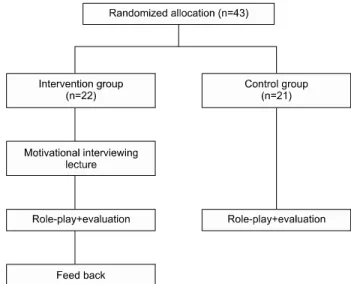
Fig. 1. Overview of procedure.

need for communication classes; a study by Choi et al. 5) presented the need for regular curricula to cover communication improvement within college education.

To obtain results on communication abilities, it is important to secure methods of acquiring knowledge and attitude in the cognitive and affective domains. Bazata et al. 6) explained that health education that results in individual behavioral changes does not simply involve providing advice or recommendations. As such, studies have reported the effectiveness of patient-centric education systems to transfer knowledge on oral health management 7-10) . Motivational interviewing (MI), receiving spotlight in the dental industries, is a counseling method that centers on the interviewee, and has been introduced as a method that utilizes multiple techniques to explore the inner mind of the interviewee and induce behavioral changes 11) . From the early 2000s, MI was introduced to the dental industry, and has become an independent system since 2012 12) . Rollnick et al. 13) experimented with the application of a brief MI from the health aspects to be applied to the clinical field. While MI began to be explored in the context of addiction, its potential for dental applications were explored, and the United States now includes MI in the curricula and textbooks on dentis- try 14,15) . According to Koerber et al. 7) , and Hinz 16) , MI training intervention was found to be effective in advancing interview skills. Woelber et al. 10) conducted MI training for 8 hours with dentistry college students and asked them to manage periodontal patients, and found that participants with MI training had higher interdental hygiene effects.

The training of the MI method must comprise not only lecture-style knowledge transfers, but also wide-ranging experiential opportunities to practice the techniques of interviews and attitudes of interviewers. According to Lane and Rollnick 17) , maximizing the efficiency of MI education intervention required the coupling of theory lectures as well as experience of practice. Particularly, in the field of communication, training methods can include standardized patients and role-play; while the standardized patients training can recreate a real scenario, thus improving task skills, the two did not differ much 17) . Moreover, given similar levels of effects, it was reported

that it would be clinically more efficient to employ role-play, given its potential for reducing costs and easy applications. Therefore, role-play practice is often employed in clinical studies as it is easy to apply 8,18) .

Given that there have been spotlights on the communi- cation competency training, it is necessary to provide such training at the college level. As such, this study aimed to apply the principle of MI training on dental hygiene, without its application to any other models. Moreover, this study aimed to apply the MI training program for dental hygiene students to assess its effects.

Materials and Methods

1. Study subjects

The subjects of this study were fourth-year college

students from Namseoul Unitversity enrolled in faculties

of dental hygiene. The rationale for selecting fourth-year

college students was that they had completed 85% of their

major courses, and they had taken the communications

class, enabling them to deal with patients in hypothetical

scenarios. Out of a total of 45 students, 2 were excluded as

they rescinded participation or were insincere in their

participation, and thus 43 students participated from May

through June 2016. This study was conducted with the

approval of the Institutional Review Board of Namseoul

University (approval no. NSU-160630-02). To ensure that

(3)

Table 1. Intervention Protocol for Motivational Interviewing (MI) Training Program

Domain/contents Substance Time (h)

MI lecture for dental hygienist 3

Definition of MI and brief MI Lecture

Elements of the “MI spirit”

Guiding principles Processes of MI

MI implementation Lecture

Information exchange Practice

Agenda setting Core skills (OARS)

Exploring ambivalence Lecture

Sustain talk & change talk Practice

Decisional balance Readiness ruler

Eliciting and recognizing change talk Lecture

Preparatory change talk Practice

Mobilizing change talk

Strengthening commitment Lecture

Interviewing training by role play 2

Situation 1. Parents to prevent caries in their young children Role play Situation 2. Halitosis patients

Interviewing skill feedback Feedback 2

Self-evaluation of interviewing Practice

Debriefing in small group discussion learning Discussion the control group did not have any disadvantages from

participating in the study, the control group was provided with the same MI training education after the completion of the experiment.

2. Study process

This study was designed as a part of an MI training program for dental hygiene students, where the study was composed of a section that evaluated training effects (Fig.

1). A total of 43 participants were assigned into two groups in the order of their recruitment into the study. The researcher was blindfolded during the selection. The 22 individuals in the intervention group were provided with MI training from a trained researcher. After the intervention was completed, two types of role-play were conducted to evaluate its results. Twenty-one individuals in the control group carried out the two scenarios of role-play. After the completion of the role-play, an evaluation was conducted from the perspectives of the counselor and the patient. The role-plays of the partici- pants were recorded on video, and the researcher

conducted the evaluation based on the video recordings.

3. Training program

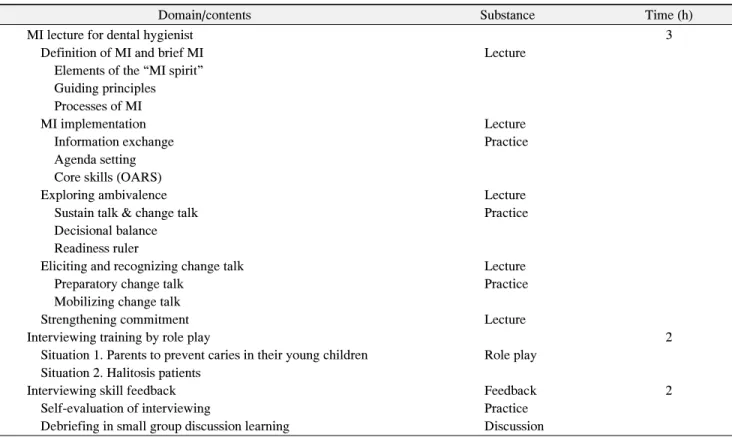
The MI training program is composed of a theoretical

lecture, role-play, and feedback (Table 1). The intervention

group underwent role-plays after the theoretical lecture,

and the control group was provided with the same lecture

after the role-play to ensure that they did not have any

disadvantage from participating in the study. The theo-

retical lecture was conducted over 3 hours, and included

practices that involved the application of clinical-setting

cases. The practices were divided into technique practice,

partner practice, and small-group practice, and the

contents of the practices were appropriately selected. The

lecture was conducted by the researcher, who is a dental

hygienist with MI training. The lecture was delivered

using PowerPoint presentations, and the students were

provided with handouts. The contents of the theoretical

lecture were based on contents compiled by Wilkins 15) ,

and was composed of MI overview, practice, emotions of

both sides, change conversation, maintenance, and

(4)

Table 2. Brief Motivational Interviewing (MI) Training Measurement Tool

Measurers Domain Measure Method

Researcher Number of open-ended questions that counselor Count

Counselor use of brief MI techniques

Set the agenda Yes/No

Assess importance of problem the patient Yes/No

Use the 10 point importance scale Yes/No

Assess confidence of patient in ability to resolve Yes/No

Use the 10 point confidence scale Yes/No

Patient is actively involved in the treatment

Number of questions asked by patient Count

Time and percentage time patient spent talking Count

Patient suggested ways to change Count

Good counselor-patient rapport is established

Patients choice of good adjectives Likert 5

Comfortable Interviewing Likert 5

Counselor Perceived effectiveness of encouraging patient change

Interviewing as helpful to patient Likert 5

Interviewing of affecting patient’s to resolve Likert 5 Good counselor-patient rapport is established

Would patient return to counselor? Likert 5

Patient’s understanding of counselor point of view Likert 5 Counselor’s understanding of patient point of view Likert 5 Counselor competence and interest in task

Counselor enjoyed the interview Likert 5

Counselor says skill use the technique in future Likert 5 Counselor feels confident and skilled in technique Likert 5

Would counselor use to MI? Likert 5

Patient Perceived effectiveness of encouraging patient change

Interviewing as helpful to patient Likert 5

Interviewing of affecting patient’s to resolve Likert 5 Good counselor-patient rapport is established

Would patient return to counselor? Likert 5

Patient’s feelings about interviewing Likert 5

Patient’s understanding of counselor point of view Likert 5 Counselor’s understanding of patient point of view Likert 5 Counselor competence and interest in task

Patient rated counselor as competent Likert 5

reinforcement. Definition of MI and brief MI focused on the explanations of the spirit, principle, and the process of MI. MI implementation included information to be exchanged during the MI process, eye contact, and core skills (OARS). Exploring ambivalence explained the change talk, maintenance talk, decision scale, and readiness scale. Eliciting and recognizing change talk explained the preparations and execution of change talk, and strengthening commitment explained reinforcement methods to maintain the change.

After the theoretical lecture was completed, role-play

was conducted as a part of MI training practice to measure its effects. The role-play involved three-person teams, taking roles of the counselor, the patient, and the filmer.

The first scenario of the role-play was the role of the parent of a young child at risk of cariogenicity, and the second scenario was a patient with bad breath. While the interview was conducted by individuals playing the roles of a counselor and a patient, the filmer filmed the video.

The interview was kept within 10 minutes, and after the

two interviews had ended for each, roles were changed,

with a total of 6 interviews conducted. The role-plays took

(5)

Table 3. Motivational Interviewing (MI) Technique Evaluating Competency

Variable

Intervention group (n=22)

Control group (n=21)

χ

2

p-value

Brief MI techniques

Set the agenda 21 (95.5) 21 (100) 39.093 <0.001 Assess importance 7 (31.8) 0 (0) 49.442 <0.001 Use the 10 point

importance scale

5 (22.7) 0 (0) 58.930 <0.001

Assess confidence 15 (68.2) 0 (0) 19.581 <0.001 Use the 10 point

confidence scale

15 (68.2) 0 (0) 19.581 <0.001

Values are presented as n (%).

90 minutes in total. After the completion of the role-play, the brief MI evaluation scale was utilized to evaluate perspectives of the counselor and the patient. Eighty-six videos were sent to the researcher through e-mail to be evaluated from the perspective of the researcher.

After the role-play evaluations, feedback was provided using the videos. The role-play group members collecti- vely evaluated and discussed the counseling videos. The participants were asked to analyze the distribution of core skill usage and conversation periods for self-evaluation, and the total time taken for feedback was 2 hours.

4. Research tools

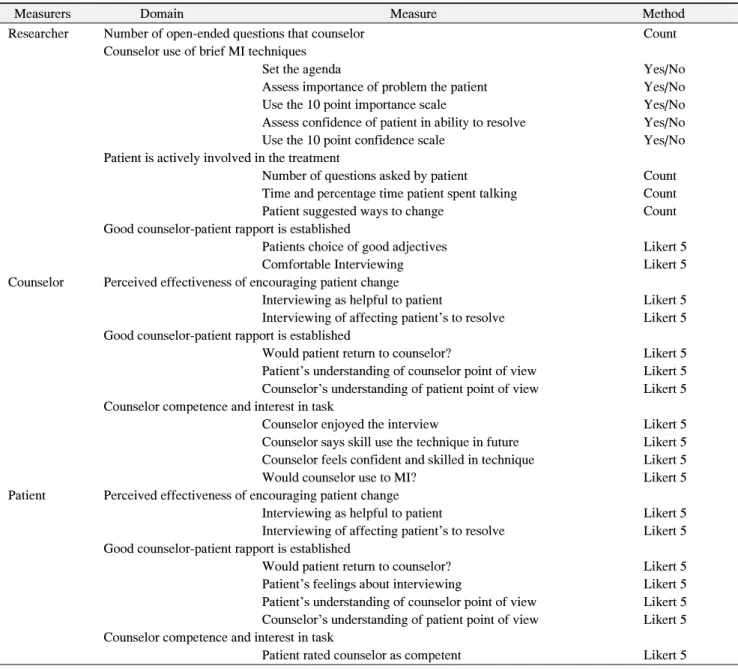
Brief MI training measurement used by Koerber et al. 7) to evaluate dentistry students was modified and used in this study. The composition of the tool was kept the same;

however, in this study it was divided by the researcher and utilized. The ratings were completed from three perspectives, which were counselor, patient, and researcher (Table 2).

1) Evaluation from the researcher perspective The researcher perspective entailed evaluating the MI techniques, patient involvement and rapport establish- ment. The number of open-ended questions was quan- tified; MI techniques included eye contact, assessment of patient’s issue, priorities, and confidence. To understand the patient responses, the number of questions asked by patient, percentage of time the patient spent talking, and the patients’ suggestions to change were quantified. To confirm rapport establishment, the patients’ choice of good alternatives and comfort in being interviewed were evaluated.

2) Evaluation from the counselor perspective

The counselor perspective entailed evaluating the effectiveness of encouraging patient change, rapport esta- blishment, and counseling competence. To confirm the encouragement of patient change, the patients’ responses to the counselor during the interview process was evaluated, and the relationship and understanding of the patient was reviewed for rapport establishment. To confirm the counseling competence of the counselor, the interest, technique, confidence, and intent to use MI were

measured. The measurement was conducted using 5-point Likert scales.

3) Evaluation from the patient perspective

The patient perspective entailed evaluating the effec- tiveness of encouraging patient change, rapport establi- shment and counseling competence. To confirm the encouragement of change by oneself, the responses throughout the interview were evaluated, and the relation- ship and understanding of the counselor was reviewed for rapport establishment. The counselor’s counseling compe- tence was evaluated, and a 5-point Likert scale was used for measurement.

5. Data analysis

The collected data were analyzed using PASW Statistics for Windows 18.0. (IBM Co., Armonk, NY, USA) and the results from two cases per participant were averaged for the analysis. The MI skills from the MI education intervention were analyzed using chi-square goodness-of-fit test. The MI skills and competency comparisons were performed using the Kolmogorov- Smirnov test.

Results

1. Evaluation of MI skills from MI training intervention

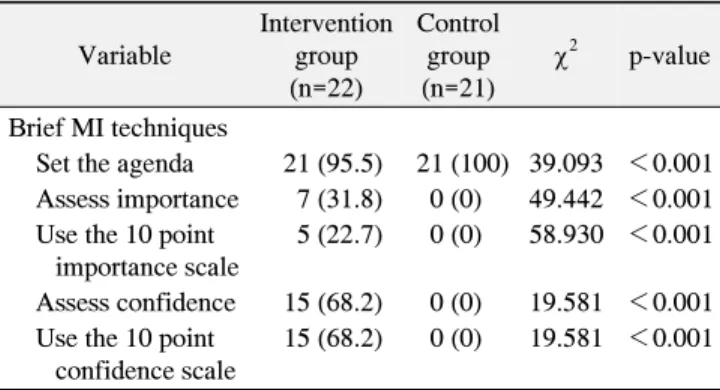
The videos filmed were analyzed after the MI training

intervention, and it was found that the intervention group

utilized the majority of techniques more frequently (Table

(6)

Table 5. Communication Competency in the Assessment of the Counselor’s Role Viewpoint

Variable Intervention group (n=22) Control group (n=21) Z p-value

Interviewing evaluation from counselor’s role viewpoint Effectiveness of encouraging patient change

Interviewing as helpful to patient 3.93±0.42 3.14±0.45 2.214 <0.001

Interviewing of affecting patient 3.93±0.39 3.14±0.55 2.058 <0.001

Total of patient change 3.93±0.37 3.14±0.47 2.214 <0.001

Rapport establishment

Re-interviewing intention 4.02±0.33 3.17±0.56 2.341 <0.001

Patient’s understanding of counselor’s viewpoint 4.02±0.19 3.12±0.47 2.817 <0.001

Counselor’s understanding of patient’s viewpoint 3.98±0.29 3.17±0.60 2.029 0.001

Total of Rapport establishment 4.01±0.23 3.15±0.46 2.497 <0.001

Counselor competence and interest

Enjoyed the interview 4.00±0.58 3.21±0.68 1.894 0.002

Says skill use the technique 3.68±0.85 2.81±0.73 1.916 0.001

Confident and skilled in technique 3.71±0.73 2.57±0.69 1.930 0.001

Intention of use to motivational interviewing 4.02±0.48 3.05±0.67 2.207 <0.001

Total of counselor competence 3.85±0.57 2.91±0.53 2.377 <0.001

Values are presented as mean±standard deviation.

Table 4. Evaluation of the Interviewing Technique according to the Motivational Interviewing (MI) Training Program

Variable Intervention group (n=22) Control group (n=21) Z p-value

Evaluation from researcher’s viewpoint

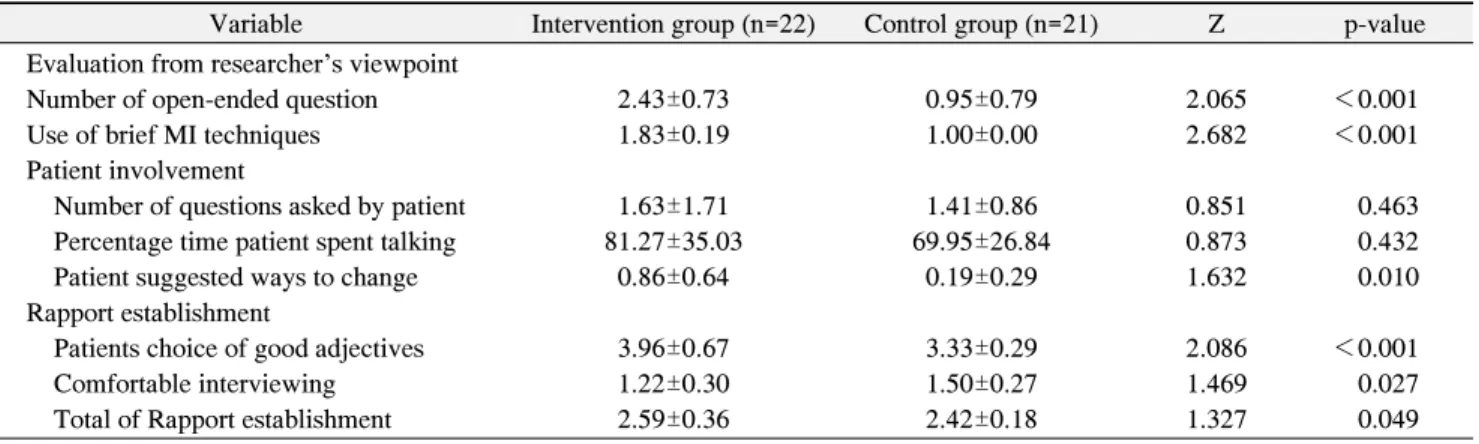
Number of open-ended question 2.43±0.73 0.95±0.79 2.065 <0.001

Use of brief MI techniques 1.83±0.19 1.00±0.00 2.682 <0.001

Patient involvement

Number of questions asked by patient 1.63±1.71 1.41±0.86 0.851 0.463

Percentage time patient spent talking 81.27±35.03 69.95±26.84 0.873 0.432

Patient suggested ways to change 0.86±0.64 0.19±0.29 1.632 0.010

Rapport establishment

Patients choice of good adjectives 3.96±0.67 3.33±0.29 2.086 <0.001

Comfortable interviewing 1.22±0.30 1.50±0.27 1.469 0.027

Total of Rapport establishment 2.59±0.36 2.42±0.18 1.327 0.049

Values are presented as mean±standard deviation.

3). The assessment items included “set the agenda,”

“assess importance,” “use the 10-point importance scale,”

“assess confidence,” and “use the 10-point confidence scale.” More than 95% of both the intervention group (95.5%) and the control group (100.0%) utilized the “set the agenda” skill. In the intervention group, 31.8%

conducted the “assess importance” skill; 22.7% used the

“Use the 10-point importance scale” skill; 68.2% used the

“assess confidence” skill; and 68.2% used the “use the 10-point confidence scale” skill. The control group did not use any technique other than “set the agenda” and the differences between the two groups were statistically

significant.

The researcher analyzed the evaluation of MI skills, and there were differences between the two groups in using open-ended questions, using brief MI techniques, and

“patient suggested ways to change” among items of

patient involvement and in rapport establishment (Table

4). The number of open-ended questions was higher in the

intervention group (2.43±0.73) versus the control group

(0.95±0.79), and there were statistically significant

differences between the two groups. The detailed evalu-

ation on the usage of brief MI skills by the individuals in

the counselor role was quantified from 0 to 5 points,

(7)

Table 6. Communication Competency in the Assessment of the Patient’s Role Viewpoint

Variable Intervention group (n=22) Control group (n=21) Z p-value

Interviewing evaluation from patient’s role viewpoint Effectiveness of encouraging patient change

Interviewing as helpful to patient 4.05±0.48 3.05±0.57 2.192 <0.001

Interviewing of affecting patient 4.00±0.41 2.88±0.47 2.675 <0.001

Total of patient change 4.02±0.43 2.96±0.44 2.519 <0.001

Rapport establishment

Re-interviewing intention 4.14±0.49 3.10±0.37 2.675 <0.001

Enjoyed the interview 3.98±0.52 2.89±0.50 2.512 <0.001

Patient’s understanding of counselor’s viewpoint 4.14±0.52 3.21±0.44 2.363 <0.001 Counselor’s understanding of patient’s viewpoint 4.16±0.47 3.17±0.48 2.512 <0.001

Total of Rapport establishment 4.10±0.46 3.09±0.34 2.824 <0.001

Counselor competence

Patient rated counselor as competent 4.14±0.49 2.86±0.42 2.675 <0.001

Values are presented as mean±standard deviation.

measuring whether they had used a total of 5 skills, resulting in the final score of MI technique measurement.

The results indicated that the intervention group (1.83±0.19) had a higher score than the control group (1.00±0.00), and these results were statistically signifi- cant. Among the sub-items of patient involvement evalu- ation, there were no statistically significant differences in

“number of questions asked by patient” and “percentage time patient spent talking”; however, “patient suggested ways to change” was higher for the intervention group (0.86±0.64) versus the control group (0.19±0.29) with statistically significant differences. The rapport establish- ment between the individuals in counselor and patient roles was higher in the intervention group versus the control group, and the results were statistically significant.

2. Interviewing competency evaluated from the role- play perspective

The results were reviewed from the perspective of the counselor; the intervention group had higher competency scores than the control group and the results were statistically significant (Table 5). Details on encouraging patient change from the counselor perspective were composed of two factors of “Interviewing as helpful to patient” and “Interviewing of affecting patient”; in both factors, the intervention group (3.93±0.37) had higher scores than the control group (3.14±0.47) and the results were statistically significant. Details on the rapport

establishment between the counselor and the patient were composed of “re-interviewing intention” (intervention group 4.02±0.33, control group 3.17±0.56), “patient’s understanding of counselor’s viewpoint” (intervention group 4.02±0.19, control group 3.12±0.47), and “coun- selor’s understanding of patient’s viewpoint” (intervention group 3.98±0.29, control group 3.17±0.60); overall rapport establishment was higher in the intervention group (4.01±0.23) versus the control group (3.15±0.46) with statistically significant differences. Details on the evaluation of counselor competence were divided into

“enjoyed the interview” (intervention group 4.00±0.58, control group 3.21±0.68), “interviewing expertise” (inter- vention group 3.68±0.85, control group 2.81±0.73),

“confidence in interviewing” (intervention group 3.71±0.73, control group 2.57±0.69), and the “intention to use MI”

(intervention group 4.02±0.48, control group 3.05±0.67);

overall, the counselor competence was higher in the intervention group (3.85±0.57) versus the control group (2.91±0.53) with statistically significant differences.

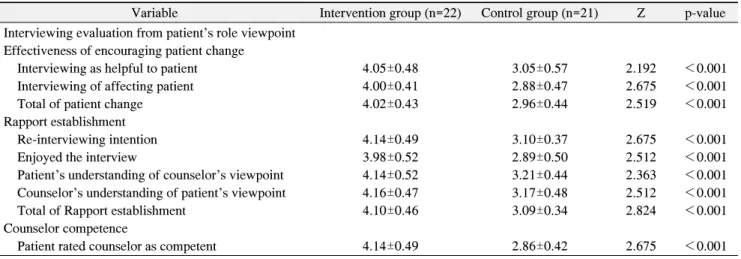
The evaluations from the patient role had higher scores for the intervention group versus the control group, and the results were statistically significant (Table 6). Details on encouraging change from the patient perspective were composed of “interviewing as helpful to patient” (inter- vention group 4.05±0.48, control group 3.05±0.57) and

“interviewing of affecting patient” (intervention group

4.00±0.41, control group 2.88±0.47), and the overall effects

(8)

of encouraging change was higher in the intervention group (4.02±0.43) versus the control group (2.96±0.44) with statistically significant differences. The evaluation of rapport establishment was higher in the intervention group (4.10±0.46) than the control group (3.09±0.34) with statistically significant differences. The factors included

“re-interviewing intention” (intervention group 4.14±0.49, control group 3.10±0.37), “enjoyed the interview” (inter- vention group 3.98±0.52, control group 2.89±0.50),

“patient’s understanding of counselor’s viewpoint” (inter- vention group 4.14±0.52, control group 3.21±0.44), and

“counselor’s understanding of patient’s viewpoint” (inter- vention group 4.16±0.47, control group 3.17±0.48), and the intervention group had higher scores in all factors. To assess the competency of the counselor role, the satisfac- tion of techniques and attitudes of the counselor were measured; the results of the analysis indicated that the satisfaction was higher for the intervention group (4.14±0.49) than the control group (2.86±0.42) with statistically significant differences.

Discussion

This study has applied the MI theory to develop and apply an interview training program for dental hygiene students to evaluate the effectiveness of the program. The MI training program applied in this study is a program that reflects key theories based on basic MI principles, and was developed by collecting new strategies. The results of existing studies, recommending that communication and interview programs should be coupled with theory lectures and practice for effectiveness 5,17,19-21) , support the strategy of this study. As such, this study has provided a number of cases as an indirect practice, and included methods of 2-person group partner practice and 3-person small group discussion and role-play as strategies. Simulation learning has the advantage of recreating real-life scenarios resembling clinical situations in a safe environment, thus increasing the task skills. Moreover, in the field of communication, standardized patients and role-play are used to assume certain situations for learning purposes;

the application of immediate, simulated field practice right after theory learning is known to be effective 20) . Lane and

Rollnick 17) and Rollnick et al. 13) , who organized and reported on literature covering standardized patients and role-play, mentioned that standardized patients and role-play that create hypothetical situations are effective for the improvement in communication competency, and recommended role-play to supplement the limitations of time in practices using standardized patients. As such, the situations created by role-play in this study have been formed to fit the specific situations in Korea by referring to cases covering patient strategies for motivation enhancement, and role-play training was based on scenarios that are commonly faced in dental clinics and hospitals. The content of the program covered the brief MI strategy based on the basic principles of MI, which could be easily used in the clinical field. Rollnick et al. 13) reported on the need for a strategy that included 5- to 15-minute focused interviews, as patients have a unique level of readiness for change and may respond sensitively.

Particularly, patients visiting dental hospitals or clinics tend to visit for the purposes of treatment, rather than of behavioral change, unlike patients visiting other medical facilities. As the goal sought by the patient is firm, it is realistically impossible to conduct counseling for a period of over 50 minutes. Therefore, this study had also set an interview situation through short sessions, thus sessions could be used in clinical settings as well as resolve the objective of the patient. While role-play is heavily influential in communication education, there are no systematic factors or methods in evaluating standardized patient or role-play practices 17) . Therefore, it appeared necessary to develop tools that could be used by the learners and educators in communication practice.

To evaluate the effectiveness of the MI training

program, 43 study participants were recruited. The

participants were fourth-year college students enrolled in

the dental hygiene department at a college in Cheonan,

and they were randomly assigned to the intervention group

and control group depending on the order of their

recruitment. This study assessed communication compe-

tence after the implementation of the program; the

intervention group with education had higher scores in MI

skills and competence. In the MI training technique

competency, both groups had a high ratio of employing

(9)

the “set the agenda” skill, with no differences between groups. The reason why this skill was widely employed appears to be due to the fact that participants are in their fourth year of dental hygiene, having taken classes in communication and public health, which made it easier for them to employ the skill. The extent of using “open-ended questions,” “brief MI techniques,” as well as “patient suggested ways to change” and “rapport establishment”

was higher in the intervention group with education, and they also had higher scores than the control group in competency evaluations of counselor and patient roles.

These results were in line with studies by Spollen et al. 8) , applying the MI program to medical students, and Koerber et al. 7) , applying the program to students in dentistry, both reporting that intervention groups showed higher competence. This study has confirmed the need for efforts such as interview education and program participation to raise communication competence, supported by studies reporting positive results of program intervention.

The principle of inducing behavioral change by increasing the percentage of change talks has been emphasized in MI; Croffoot et al. 22) , who also reported better results in behavioral commitment and inducing change talks in dental hygiene students with MI training.

Their results are similar to those of this study, as the intervention group was found to induce more ways to change for the patient, as well as to ask more open-ended questions. DeBate et al. 23) confirmed the improvements in knowledge, techniques, and self-efficacy through a MI training workshop for college students in dentistry and dental hygiene; Choi et al. 5) reported that college students who have learned communication embrace it as a basic vocational skill and attitude that can improve their career and professionalism. Thus, one is able to conclude that one-time interview education and training aids in improving communication competence, and ongoing training as well as expert and peer feedback would help to gradually increase such competence, while unseen. The application of NCS in college systems has led to the need for varying curricula such as communication, patient management and psychology in dental hygiene, similar to other educational programs for national certifications.

This study has several limitations. Given the lack in the

nature of related fields and the realistic differences between the clinical situations and educational institutions, the MI training program utilized in this study would not present long-term educational effects. This should be supplemented by future studies on the effects of MI training as well as varying methods of education.

Moreover, this study has utilized measurement tools that involve the self-evaluation by participants and analysis by the researcher. This may be influenced by subjective opinions. Therefore, it is necessary to develop a measurement tool that can be applied in the clinical situation in the field of MI.

References

1. Human Resources Development Service of Korea: Standard development of vocational competency, 2004. HRD Korea Publishing, Seoul, pp.13-14, 2014.

2. ADEA Competencies for entry into the allied dental professions: (as approved by the 2011 ADEA House of Delegates). J Dent Educ 81: 853-860, 2017.

3. Commission on Dental Accreditation: Accreditation standards for dental hygiene education programs. ADA, Chicago, pp.12-28, 2016.

4. Ryu DY, Yang HS, Choi YK: Needs and perception of medical communication course in the dental hygiene students.

J Korean Soc Dent Hyg 14: 623-630, 2014.

https://doi.org/10.13065/jksdh.2014.14.05.623

5. Choi YK, Shin BM, Son JH, Park DY: Effectiveness and learning experience of dental communication course training in dental hygiene schools. J Dent Hyg Sci 16: 134-141, 2016.

https://doi.org/10.17135/jdhs.2016.16.2.134

6. Bazata DD, Robinson JG, Fox KM, Grandy S; SHIELD Study Group: Affecting behavior change in individuals with diabetes: findings from the Study to Help Improve Early Evaluation and Management of Risk Factors Leading to Diabetes (SHIELD). Diabetes Educ Dec 34: 1025-1036, 2008. https://doi.org/10.1177/0145721708325767

7. Koerber A, Crawford J, O'Connell K: The effects of teaching dental students brief motivational interviewing for smoking-cessation counseling: a pilot study. J Dent Educ 67:

439-447, 2003.

8. Spollen JJ, Thrush CR, Mui DV, Woods MB, Tariq SG,

(10)

Hicks E: A randomized controlled trial of behavior change counseling education for medical students. Med Teach 32:

e170-e177, 2010.

https://doi.org/10.3109/01421590903514614

9. Curry-Chiu ME, Catley D, Voelker MA, Bray KK: Dental hygienists' experiences with motivational interviewing: a qualitative study. J Dent Educ 79: 897-906, 2015.

10. Woelber JP, Spann-Aloge N, Hanna G, et al.: Training of dental professionals in motivational interviewing can heighten interdental cleaning self-efficacy in periodontal patients. Front Psychol 7: 254, 2016.

https://doi.org/10.3389/fpsyg.2016.00254

11. Miller WR, Rollnick S: Meeting in the middle: motivational interviewing and self-determination theory. Int J Behav Nutr Phys Act 9: 25, 2012.

https://doi.org/10.1186/1479-5868-9-25

12. Miller WR, Rollnick S, Moyers TB: Motivational intervie- wing: helping people change. 3rd ed. Guilford Press, New York, 2013. 211 p.

13. Rollnick S, Heather N, Bell A: Negotiating behaviour change in medical settings: the development of brief motivational interviewing. J Ment Health 1: 25-37, 2009.

https://doi.org/10.3109/09638239209034509

14. Darby ML, Walsh MM: Dental hygiene: theory and practice.

3rd ed. Saunders Elsevier, St. Louis, pp.37-55, 2010.

15. Wilkins EM: Clinical practice of the dental hygienist. 12th ed. Wolters Kluwer, Philadelphia, pp.419-434, 2017.

16. Hinz JG: Teaching dental students motivational interviewing techniques: analysis of a third-year class assignment. J Dent Educ 74: 1351-1356, 2010.

17. Lane C, Rollnick S: The use of simulated patients and role-play in communication skills training: a review of the literature to August 2005. Patient Educ Couns 67: 13-20, 2007. https://doi.org/10.1016/j.pec.2007.02.011

18. White LL, Gazewood JD, Mounsey AL: Teaching students behavior change skills: description and assessment of a new Motivational interviewing curriculum. Med Teach 29:

e67-e71, 2007. https://doi.org/10.1080/01421590601032443 19. Bae SH, Park JS: Development and evaluation of extracu-

rricular coaching programs for improving communication skills and leadership among nursing students. J Korean Acad Soc Nurs Educ 21: 202-214, 2015.

https://doi.org/10.5977/jkasne.2015.21.2.202

20. Kim SJ, Kim HH: Impact of communication competence and empathy abilities on interpersonal relationship abilities among dental hygiene students. J Dent Hyg Sci 13: 304-313, 2013.

21. Chung SH: A study of the TA program and its effects on the development of communication skills for dental hygienist. J Dent Hyg Sci 6: 295-302, 2006.

22. Croffoot C, Krust Bray K, Black MA, Koerber A: Evaluating the effects of coaching to improve motivational interviewing skills of dental hygiene students. J Dent Hyg 84: 57-64, 2010.

23. DeBate RD, Cragun D, Gallentine AA, et al.: Evaluate, assess, treat: development and evaluation of the EAT framework to increase effective communication regarding sensitive oral-systemic health issues. Eur J Dent Educ 16:

232-238, 2012.

https://doi.org/10.1111/j.1600-0579.2012.00747.x

수치

Fig.  1.  Overview  of  procedure.
Table  1.  Intervention  Protocol  for  Motivational  Interviewing  (MI)  Training  Program
Table  2.  Brief  Motivational  Interviewing  (MI)  Training  Measurement  Tool
Table  3.  Motivational  Interviewing  (MI)  Technique  Evaluating  Competency Variable Interventiongroup  (n=22) Controlgroup(n=21) χ 2 p-value Brief MI techniques
+3

참조

관련 문서