신경이과와 신경안과 질환에서 유전학 연구의 최신 지견
최재환
양산부산대학교병원 신경과, 부산대학교 의과대학 신경과학교실
Update on Genetics of Neuro-ophthalmology/neuro-otology
Jae-Hwan Choi, MD
Department of Neurology, Pusan National University Yangsan Hospital, Pusan National University School of Medicine, Yangsan, Korea
The wide availability of next-generation sequencing has enabled a rapid progress in the discovery of genetic variants associated with neurological disorders. However, the contribution of genetic factors in neuro-otologic/neuro-ophthalmologic (NONO) disor- ders is largely unknown due to the low prevalence of familial disorders and the clinical diversity. A detailed clinical characterization of patients and a choice of proper genetic tests are required to identify the genetic contribution in NONO disorders. In this review, we will introduce a genetic approach for NONO disorders and update the evidences to support the genetic contribution in NONO disorders.
Keywords: Genetic studies; Neuro-ophthalmology; Neuro-otology; Next generation sequencing; Gene expression profiling
서 론
2000년대 초 차세대염기서열분석(next-generation sequencing, NGS)이 등장한 이래로 의학 분야에서 유전학 연구의 발전이 가속화 되고 있다. 신경과 분야에서도 운동질환이나 신경근육질환의 유전자 진단이 용이해졌고, 더 나아가 치료제 개발에 대한 연구도 활발히 진 행되고 있다.
1이에 반해 신경이∙안과적 질환에서의 유전학 연구는 상 대적으로 미진한 상태이다. 그 원인으로 복잡한 유전자검사 방법이나 고비용 등이 있겠지만 가장 큰 원인은 비교적 발병 빈도가 높은 흔한 질환(common disease)이 많아 유전인자 외 여러가지 요인들이 병인에 관여할 수 있다는 점이다.
2즉 신경이∙안과적 질환에는 영아안진(in- fantile nystagmus)이나 간헐성실조증(episodic ataxia)과 같이 특정유 전자의 결함으로 발생하는 단일유전자질환(monogenic disease)이 상 대적으로 적은 반면, 우리가 진료실에서 흔히 접하는 양성돌발성체위 현훈이나 메니에르병, 전정편두통 등은 다수의 유전자와 환경적 요인
이 복합적으로 작용하는 다유전자질환(polygenic disease)일 가능성 이 크기 때문에 유전인자의 기여도가 작을 수 있다. 뿐만 아니라 같은 질환 내에서도 발현되는 임상증상이 다양하기 때문에 유전자 검사 를 위한 균일한 환자군의 모집이 어렵다는 점 역시 유전학 연구의 큰 걸림돌이 되고 있다. 하지만 메니에르병이나 전정편두통에서 가족력 을 보이는 경우가 많고, 다양한 원인유전자들이 지속적으로 발표되 고 있기 때문에 신경이∙안과적 질환의 학문적 발전을 위해서는 유전 학 연구가 반드시 필요하다.
2,3본고에서는 신경이∙안과적 질환에서 유전학 연구를 위한 학문적 접근방법과 최신 지견에 대해 살펴보고 자 한다.
유전학적 접근방법
NGS가 상용화되면서 유전자 검사를 쉽게 시행할 수 있지만 NGS 가 질환의 유전적 요인을 모두 규명해주지는 못한다. 실제로 단일유
Correspondence to: Jae-Hwan Choi, MD
Department of Neurology, Pusan National University Yangsan Hospital, 20 Geumo-ro, Mulgum-eup, Yangsan 50612, Korea Tel: +82-55-360-2122, Fax: +82-55-360-2152, E-mail: [email protected]
Received: Oct. 20, 2020 / Accepted: Oct. 20, 2020
REVIEW
전자질환이라 하더라도 NGS를 이용한 분자유전학적 진단율은 평균 25% 정도이다.
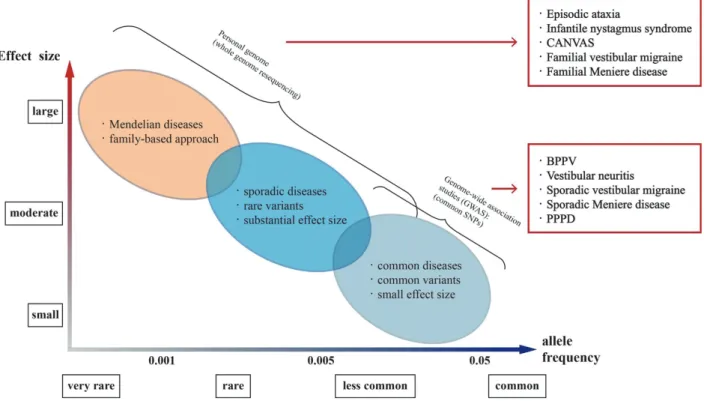
4또한 원인유전자가 명확하지 않은 경우에는 NGS가 큰 도움이 되지 않을 수 있다. 따라서 질환의 유전적 요인을 규명하기 위 해서는 원인유전자의 유무, 유전적 영향력(heritability)과 환경적 요인 등을 파악하여 적절한 분석법을 선택하여야 한다. 즉, 영아안진이나 간헐성실조증과 같은 단일유전자질환이나 가족력이 있는 메니에르 병 또는 전정편두통에서는 NGS 분석법이 유용하다. 반면에 산발성 메니에르병이나 전정편두통, 양성돌발성체위현훈 등과 같이 비교적 발병빈도가 높고, 원인유전자가 명확하지 않은 질환들에서는 특정 단일염기다형성(single nucleotide polymorphism, SNP)을 이용한 유전 체연관분석(genome association study)을 통해 후보유전자를 발굴할 수 있다(Fig. 1). 신경이∙안과적 질환 중에는 산발성으로 발생하는 질 환이 많기 때문에 NGS보다는 연관분석이 더 유용할 수 있다. 하지만 연관분석을 통해 발굴한 후보유전자의 경우 이들 질환에 미치는 영 향력(odds ratio)이 2-3 이하로 작은 것이 대부분이기 때문에, 일정 수 준의 검정력(statistical power)을 가지고 발굴하기 위해서는 연구대상 자의 수를 증가시켜야 한다는 단점이 있다.
이 외 microarray 기법이나 RNA sequencing을 이용한 유전자 발현 프로파일링(gene expression profiling)을 통해 질환의 병인에 관여하 는 유전자를 규명할 수 있다. 이는 질환군과 대조군 사이에 여러 유전
자들의 RNA 발현 차이를 분석하고, 생물정보학적 분석(bioinformat- ics analysis)을 통해 이들 유전자들이 유기적으로 작동하는 생물학적 네트워크(biological network)를 밝혀냄으로써 질환의 병인을 규명하 는 연구방법이다. 이미 암이나 자가면역질환 연구에 널리 사용되고 있 으며, 지금까지 발표된 유전자 발현 연구들의 데이터는 NCBI의 GEO 나 EBI의 ArrayExpress와 같은 공공 데이터베이스에 표준화된 포맷으 로 저장되어 있다.
5,6연관분석과는 달리 적은 수의 환자를 대상으로 도 시행할 수 있으며, 공공 데이터베이스를 활용할 경우 실험을 직접 시행하지 않더라도 가설을 검증할 수 있다는 장점이 있다. 최근에는 메니에르병이나 전정편두통, 전정신경염에서도 유전자 발현 분석 연 구가 발표되고 있어 신경이∙안과적 질환의 병인 분석에 널리 사용할 수 있는 유전자 연구방법으로 여겨진다.
7-10최근 연구결과
영아안진증후군(infantile nystagmus syndrome)
과거에 선천안진(congenital nystagmus)으로 명명되었던 영아안진 은 무홍채증(aniridia)이나 눈백색증(ocular albinism)과 같이 구심시 각계(afferent visual system)의 이상으로 발생하지만, 시각계의 이상 없 이 특발성으로 발생하기도 한다.
11-16영아안진을 일으키는 유전자는
Fig. 1. Application of genetic study according to allele frequencies and effect sizes. BPPV, benign paroxysmal positional vertigo; CANVAS, cerebellar ataxia with neu-
ropathy and bilateral vestibular areflexia syndrome; PPPD, persistent postural-perceptual dizziness.현재까지 100여 가지 이상이기 때문에 유전자 패널을 이용한 NGS가 유전형 진단에 도움이 될 수 있다.
15,16특히 환자가 대부분 영유아이기 때문에 진단을 위한 임상적 검사가 불가능한 경우가 많아, 유전자 패 널을 이용한 NGS로 먼저 유전형을 확립하는 것이 빠른 진단과 적절 한 치료에 도움이 된다.
16원인 유전자는 대부분 구심시각계 질환과 연관되어 있지만, 특발성 영아안진은 FRMD7 유전자 변이에 의해 발 생한다. FRMD7 관련 영아안진은 X-연관(X-linked)으로 유전되며, 특 발성 영아안진의 약 50%를 차지한다. 현재까지 약 90여 개의 변이가 보고되고 있으나 뚜렷한 hot spot은 없는 것으로 알려져 있다. 하지만 최근에 한국인 영아안진 환자들을 대상으로 한 연구에 따르면 9번 엑손의 c.875T>C (p.L292P) 변이가 전체 FRMD7 변이 환자의 50% 이 상을 차지하였고, 이들은 모두 한국 내 특정지역(경상남도) 출신이면 서 12번 엑손에 2개의 SNP (rs6637934, rs5977623)를 공유하고 있어, c.875T>C 변이는 창시자효과(founder effect)로 인한 유전자 변이로 추측할 수 있다.
13FRMD7 유전자의 기전에 대한 연구도 최근에 발표되고 있다. 과거 연구를 통해 FRMD7 단백질은 전정안반사(vestibulo-ocular reflex)와 시선이동반사(optokinetic reflex)에 관여하는 구조물들, 즉 망막이나 시신경, 전정달팽이신경, 전정신경핵, 소뇌 등에서 신경세포골격(neu- ronal cytoskeleton) 형성에 관여하는 것으로 알려졌다. 최근 연구에서 는 좀 더 구체적으로 FRMD7이 Rac1 signaling을 통한 Rho GTPase 경 로를 활성화시킴으로써 신경세포골격 형성을 조절하는 것으로 밝혀
졌다.
17,18또한 마우스 모델에서는 FRMD7 변이가 망막의 starburst 세
포에서 방향특이성을 가진 신경절세포(directional sensitivity ganglion cell)로의 억제성 신경전달(GABA inhibitory pathway)에 영향을 줌으 로써 시선이동반사의 소실을 유발하는 것으로 밝혀졌다.
19,20Cerebellar ataxia with neuropathy and vestibular areflexia syndrome (CANVAS)
소뇌실조, 양측 전정병증과 체성감각소실을 특징으로 하는 CAN- VAS는 대부분 60세 이상의 고령에서 산발적으로 발생하지만, 일부에 서는 형제자매(sibling)에서도 이환되어 있어 상염색체 열성유전(au- tosomal recessive)의 가능성이 제시되어 왔다. 최근에 가족성 CAN- VAS에서 NGS와 Repeat-primed PCR (RP-PCR)을 통해 RFC1 유전자 의 2번 인트론에 AAGGG pentanucleotide 반복이 이대립인자성으로 확장(biallelic repeat expansion)되어 있음을 발표하였다.
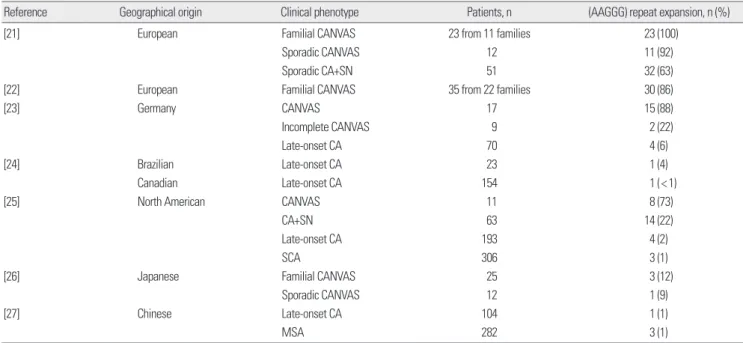
21같은 연구에 서 산발성 소뇌실조 환자들의 22%에서 AAGGG repeat expansion을 확인하였고, 체성감각소실이나 양측 전정병증이 동반되어 있을 경우 검출률이 높아졌다(Table 1). 하지만 AAGGG repeat expansion은 주 로 유럽인 환자에서 검출되고 있으며, 비유럽인을 대상으로 한 연구 에서는 검출률이 낮게 나오고 있다.
21-25특히 아시안인에서는 가족성 CANVAS의 12%에서만 검출되었고, 산발성인 경우에는 8.5%로 더 낮 았다. 따라서 CANVAS에서 AAGGG repeat expansion은 인종 간에 다 른 분포를 보이고 있으며, 특히 유럽인 CANVAS 환자의 발병에 관여
Table 1. Comparison of allele frequencies of RFC1 repeat expansions among different populations
Reference Geographical origin Clinical phenotype Patients, n (AAGGG) repeat expansion, n (%)
[21] European Familial CANVAS 23 from 11 families 23 (100)
Sporadic CANVAS 12 11 (92)
Sporadic CA+SN 51 32 (63)
[22] European Familial CANVAS 35 from 22 families 30 (86)
[23] Germany CANVAS 17 15 (88)
Incomplete CANVAS 9 2 (22)
Late-onset CA 70 4 (6)
[24] Brazilian Late-onset CA 23 1 (4)
Canadian Late-onset CA 154 1 (< 1)
[25] North American CANVAS 11 8 (73)
CA+SN 63 14 (22)
Late-onset CA 193 4 (2)
SCA 306 3 (1)
[26] Japanese Familial CANVAS 25 3 (12)
Sporadic CANVAS 12 1 (9)
[27] Chinese Late-onset CA 104 1 (1)
MSA 282 3 (1)
CA, cerebellar ataxia; CANVAS, cerebellar ataxia with neuropathy and vestibular areflexia syndrome; SCA, spinocerebellar ataxia; MSA, multiple system atrophy; SN, sensory neuronopathy.
할 것으로 여겨진다.
26CANVAS 외 특발성소뇌실조증(idiopathic cere- bellar ataxia)이나 다계통위축증(multiple system atrophy) 환자들을 대 상으로 한 연구결과도 발표되었지만 모두 1% 미만에서 검출되었다.
27전정신경염(Vestibular neuritis)
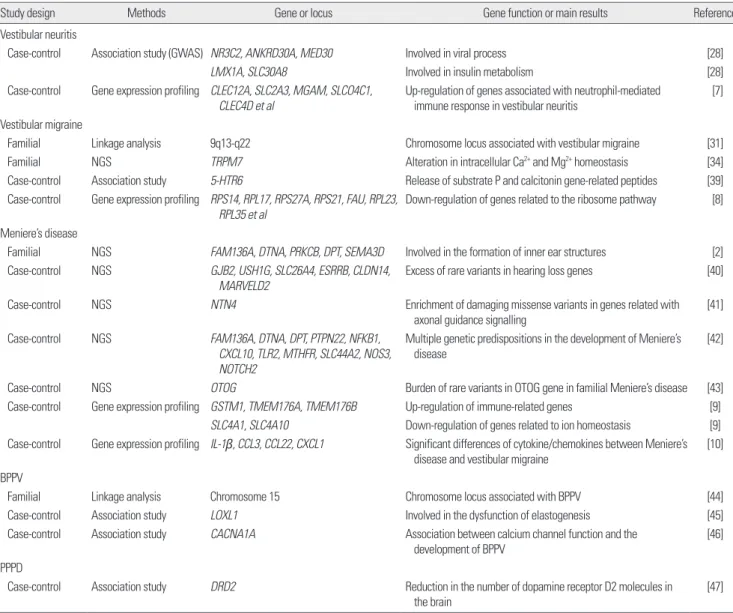
말초전정병증의 원인 질환 중 하나인 전정신경염은 전정신경절에 잠복해있는 바이러스의 재활성화로 발생하는 것으로 알려져 있다. 바 이러스 감염설을 뒷받침하는 동물모델이나 부검 결과가 과거에 다수 발표되었으며, 최근에는 전장유전체 연관분석(genome-wide associa- tion study, GWAS)에서 단순포진바이러스 1형의 재활성화와 관련된 NR3C2 유전자의 SNP (rs186544372)가 전정신경염 환자에서 유의있 게 검출되었다(Table 2).
28그럼에도 불구하고 전정신경염 환자의 혈청이나 뇌척수액 등에서 는 어떤 바이러스 검체도 검출되고 있지 않아 혈관폐색이나 자가면역 반응과 같은 다른 가설들도 제기되고 있다.
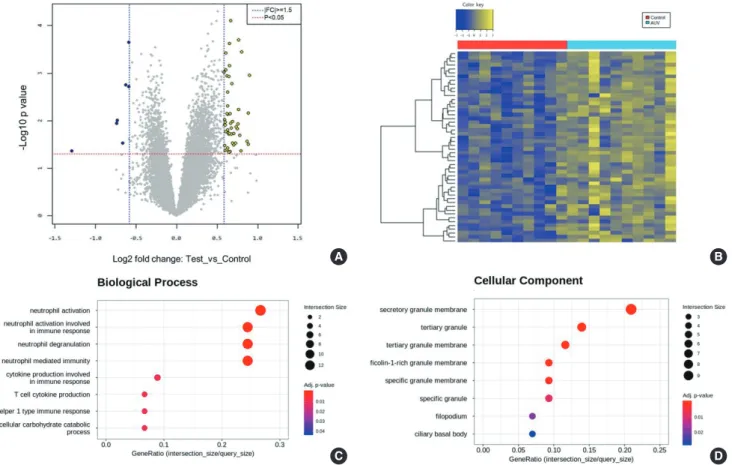
29더구나 microarray 기법 을 이용한 유전자 발현 프로파일링에서도 전정신경염 급성기에 호중 구(neutrophil)를 활성화시키는 유전자들의 발현이 증가되어 있었고, 혈청 neutrophil to lymphocyte ratio (NLR) 역시 정상군에 비해 높게 관찰되었다(Fig. 2). 대개 바이러스 감염에서는 림프구(lymphocyte)가 증가되면서 NLR 수치가 낮아지기 때문에, 위 연구결과는 전정신경염 의 바이러스 감염설과 일치하지 않는다.
7호중구의 활성은 여러 자가 면역질환이나 혈관성 질환들에서 관찰되기 때문에 전정신경염 역시 호중구 매개 반응으로 인한 혈관폐색의 가능성을 생각해 볼 수 있다.
7Table 2. Genetic studies reported in vestibular disorders since 2016
Study design Methods Gene or locus Gene function or main results Reference
Vestibular neuritis
Case-control Association study (GWAS) NR3C2, ANKRD30A, MED30 Involved in viral process [28]
LMX1A, SLC30A8
Involved in insulin metabolism [28]Case-control Gene expression profiling CLEC12A, SLC2A3, MGAM, SLCO4C1,
CLEC4D et al
Up-regulation of genes associated with neutrophil-mediatedimmune response in vestibular neuritis [7]
Vestibular migraine
Familial Linkage analysis 9q13-q22 Chromosome locus associated with vestibular migraine [31]
Familial NGS
TRPM7
Alteration in intracellular Ca2+ and Mg2+ homeostasis [34]Case-control Association study
5-HTR6
Release of substrate P and calcitonin gene-related peptides [39]Case-control Gene expression profiling RPS14, RPL17, RPS27A, RPS21, FAU, RPL23,
RPL35 et al
Down-regulation of genes related to the ribosome pathway [8]Meniere’s disease
Familial NGS
FAM136A, DTNA, PRKCB, DPT, SEMA3D
Involved in the formation of inner ear structures [2]Case-control NGS
GJB2, USH1G, SLC26A4, ESRRB, CLDN14,
MARVELD2
Excess of rare variants in hearing loss genes [40]Case-control NGS
NTN4
Enrichment of damaging missense variants in genes related withaxonal guidance signalling [41]
Case-control NGS
FAM136A, DTNA, DPT, PTPN22, NFKB1, CXCL10, TLR2, MTHFR, SLC44A2, NOS3, NOTCH2
Multiple genetic predispositions in the development of Meniere’s
disease [42]
Case-control NGS
OTOG
Burden of rare variants in OTOG gene in familial Meniere’s disease [43]Case-control Gene expression profiling GSTM1, TMEM176A, TMEM176B Up-regulation of immune-related genes [9]
SLC4A1, SLC4A10
Down-regulation of genes related to ion homeostasis [9]Case-control Gene expression profiling IL-1β, CCL3, CCL22, CXCL1 Significant differences of cytokine/chemokines between Meniere’s
disease and vestibular migraine [10]
BPPV
Familial Linkage analysis Chromosome 15 Chromosome locus associated with BPPV [44]
Case-control Association study
LOXL1
Involved in the dysfunction of elastogenesis [45]Case-control Association study
CACNA1A
Association between calcium channel function and thedevelopment of BPPV [46]
PPPD
Case-control Association study
DRD2
Reduction in the number of dopamine receptor D2 molecules in the brain[47]
BPPV, benign paroxysmal positional vertigo; GWAS, genome-wide association study; NGS, next generation sequencing; PPPD, persistent postural-perceptual dizziness.
전정편두통(Vestibular migraine)
전정편두통은 유병률이 전체 인구의 1%를 차지할 정도로 흔한 전 정질환 중의 하나이며, 최근 국제두통질환분류 제3판에도 진단기준 이 포함되었다. 대부분 산발적으로 발생하지만 상염색체 우성유전 양 상의 가족성 전정편두통이 보고되고 있고, 편두통 아형인 편마비편 두통에서는 여러 원인 유전자들이 알려져 있어, 전정편두통의 발병 에도 유전인자가 관여할 것으로 여겨진다. 지금까지 연관분석(linkage analysis)을 통해 5q35, 9q13-q22, 11q, 22q12 등의 염색체 부위가 전정편 두통과 관련 있을 것으로 밝혀졌으나, 원인 유전자 검출에는 실패했
다.
30-33하지만 최근에 한국인 전정편두통 가계를 대상으로 한 NGS 연
구에서 TRPM7이라는 유전자의 정지돌연변이(nonsense mutation)가 발견되었다(Table 2).
34TRPM7은 transient receptor potential (TRP) 양 이온 채널 중의 하나이며, 특히 세포 내 Ca
2+과 Mg
2+농도를 조절하여 신경세포의 흥분성을 유지하는 역할을 하고 있다. 하지만 정지돌연변
이로 인해 TRPM7 채널의 C말단에 위치하고 있는 kinase domain이 결핍되면, TRPM7 채널의 기능 이상으로 세포 내 Ca
2+과 Mg
2+이온항 상성에 변화가 생기게 되고 흥분성 신경전달물질인 glutamate의 분비 가 증가하여 전정편두통 증상이 발생할 것으로 여겨진다. 실제로 TRPM7 kinase domain이 결핍된 쥐에서 신경세포의 흥분성이 증가되 어 경련, 떨림 증상과 함께 빛이나 소리에 민감한 반응을 보였다.
35또 한 TRPM7 외에도 TRPA1, TRPV1, TRPV4, TRPM8과 같은 다른 TRP 채널들도 편두통과 연관 있는 것으로 알려져 있다.
36-38일부 전정편두통 환자에서 과호흡 시 하향안진이 관찰되며, 대부 분 두진후 하향안진(perverted head-shaking downbeat nystagmus)이 나 중추성체위안진(central positional nystagmus)이 동반되어 소뇌기 능 이상이 제기되고 있다.
8이러한 환자들을 대상으로 한 유전자 발현 프로파일링에서 리보솜 경로(ribosome pathway)와 연관된 유전자들 의 발현이 감소되어 있어, 전정편두통의 병인으로 리보솜 기능이 제시
Fig. 2. Gene expression profiling in acute unilateral vestibulopathy (AUV). (A) Volcano plot of differentially expressed genes (DEGs) between the AUV and control
groups. Yellow and blue points represent up-regulated and down-regulated DEGs, respectively. The x-axis shows the fold changes in gene expression between two groups, and the y-axis shows the statistical significance of the differences. (B) Results of a hierarchial clustering analysis of up-regulated DEGs in AUV group com- pared to control groups. Each group includes ten individuals and each column represents one individual’s sample. Yellow and blue colors indicate high and low relative expression, respectively. (C, D) Results of a Gene Ontology (GO) enrichment analysis of up-regulated DEGs in the AUV group. The top enriched GO terms for the biolog- ical process (C) and cellular component (D) are shown. The enriched terms are ranked according to their GeneRatio values (intersection size: the number of unique DEGs associated with GO terms). The adjusted p-values are labeled in different colors. The results show that the up-regulated DEGs are mostly enriched in terms for neutrophil-mediated immune processes. Adapted from reference [7].A B
C D
되기도 하였다.
8이외 연관연구에서 편두통 발병과 연관이 있는 것으 로 알려져 있는 5-hydroxytryptamine (5-HT) 수용체 중 6번 아형(5- HTR6)에 대한 SNP (rs770963777)이 전정편두통과 관련 있는 것으로 밝혀졌다.
39메니에르병(Meniere’s disease)
메니에르병은 전정질환 중 유전적 인자에 대한 연구가 가장 활발 히 이루어지고 있는 분야이다(Table 2). 이는 메니에르병의 병인이 명 확하게 알려져 있지 않고, 환자의 약 10%에서 상염색체 우성유전 양 상의 가족력을 보이기 때문이다. 과거에는 비교적 빈도가 높은(>5%) SNP를 이용하여 연관분석을 시행하였지만, 최근에는 유전자패널을 이용한 NGS로 1% 미만의 rare variant를 검출하는 연구가 주로 시행되 고 있다. 이는 rare variant일수록 effect size가 커서 실제 병적 변이일 가 능성이 높기 때문이다. 또한 메니에르병과 같은 복합질환의 발생에 있 어서 common disease-common variants 가설보다는 common disease- multiple rare variants 가설이 좀 더 받아 들여지고 있는 추세이다. 이와 같은 방법으로 면역체계와 연관된 유전자나 난청 유전자 그리고 axon guidance signaling pathway에 관여하는 유전자의 rare variant burden 이 메니에르병 발병에 기여하는 것으로 밝혀졌다.
40-43NGS 연구뿐만 아니라 유전자 발현 프로파일링을 통한 메니에르병 의 병인 연구도 최근에 발표되고 있다. RNA sequencing을 이용한 연 구에서는 TMEM176B이나 GSTM1과 같이 면역반응에 관여하는 유 전자의 발현이 메니에르병 환자들에서 높게 검출되었다.
9뿐만 아니라 유전자 발현 분석을 통해 IL-1β, CCL3, CCL22, CXCL1과 같은 사이토 카인이 메니에르병과 전정편두통을 감별하는데 도움이 됨을 알 수 있 었다.
10양성돌발성체위현훈(Benign paroxysmal positional vertigo) 말초전정병증 중 가장 흔한 원인인 양성돌발성체위현훈은 대부분 산발적으로 발생하지만, 드물게 가족력을 보이는 경우도 있다. 상염색 체 우성유전을 보인 가계에서 연관분석(linkage analysis)을 통해 15번 염색체가 관련 있음을 보고하였다(Table 2).
44이후 NGS를 이용한 연 구에서 15번 염색체에 위치하고 있는 LOXL1 유전자의 SNP (rs1078967) 빈도가 정상대조군과 유의 있는 차이를 보였다.
45LOXL1 유전자는 결 체조직 중의 하나인 elastin 생성(elastogenesis)에 중요한 역할을 하며, 박탈증후군(exfoliation syndrome)과 연관이 있는 것으로 알려져 있 다. 따라서 LOXL1 유전자의 변이로 인해 결체조직의 구성에 이상이 발생하면, 타원낭(utricle)내 이석(otoconia)의 점착력(adherence)이 떨 어져 양성돌발성체위현훈이 발생할 수 있다. 이 밖에 간헐성실조증 유전자인 CACNA1A의 SNP (rs2074880) 역시 양성돌발성체위현훈
발병과 연관 있는 것으로 보고되었다.
46지속적체위지각어지럼(Persistent postural perceptual dizziness)
최근에 발표된 연관분석에서 dopamine receptor D2 (DRD2) 유전 자의 SNP (rs1800497)가 지속적체위지각어지럼과 관련 있는 것으로 나타났다(Table 2).47 이는 성격분석 연구에서 신경증(neuroticism)이 지속적체위지각어지럼과 관련 있었고, 해당 SNP (rs1800497)가 신경 증과 연관 있는 유전인자이기 때문이다. 지속적체위지각어지럼 환자 군에서 A1 allele의 빈도가 높게 관찰되었는데, 이는 선조체(striate body)내 DRD2 농도의 감소를 반영하며 이로 인해 신경증 및 지속적 체위지각어지럼 증상이 발병할 것으로 여겨진다.
결 론
분자유전학의 비약적인 발전으로 의학연구에서 유전학적 접근이 용이해졌지만, 신경이∙안과학 분야에서는 아직 체계적인 연구가 시행 되지 못하고 있다. 그 결과 다른 질환들에 비해 알려진 원인 유전자도 적고, 유전자 데이터베이스 구축 역시 미미한 상황이다. 하지만 국내 각 지역마다 해당 분야의 전문가들이 분포되어 있기 때문에 환자 모 집을 위한 연구 네트워크를 잘 구성하고, NGS나 유전자 발현 프로파 일링과 같은 유전자 검사를 적절히 이용한다면 신경이∙안과적 질환 의 발병기전 및 원인규명에 큰 도움이 될 것이다.
감사의 글
본 연구는 한국연구재단의 2018년도 이공학 개인기초연구지원사 업(후속연구지원)의 지원에 의하여 수행됨(과제고유번호 2018R1D1- A1A09081786).
REFERENCES
1. Shieh PB. Advances in the genetic testing of neuromuscular diseases.
Neurol Clin 2020;38:519-528.
2. Roman-Naranjo P, Gallego-Martinez A, Lopez Escamez JA. Genetics of vestibular syndromes. Curr Opin Neurol 2018;31:105-110.
3. Gallego-Martinez A, Espinosa-Sanchez JM, Lopez-Escamez JA. Genetic contribution to vestibular diseases. J Neurol 2018;265(Suppl 1):29-34.
4. Yang Y, Muzny DM, Reid JG, Bainbridge MN, Willis A, Ward PA, et al.
Clinical whole-exome sequencing for the diagnosis of mendelian disor- ders. N Engl J Med 2013;369:1502-1511.
5. Smith A, Farrah K. Gene expression profiling tests for breast cancer: a rapid qualitative review [Internet]. Ottawa (ON): Canadian Agency for
Drugs and Technologies in Health 2019 Apr 18.
6. Perez-Sanchez C, Barbarroja N, Messineo S, Ruiz-Limon P, Rodriguez- Ariza A, Jimenez-Gomez Y, et al. Gene profiling reveals specific molecu- lar pathways in the pathogenesis of atherosclerosis and cardiovascular disease in antiphospholipid syndrome, systemic lupus erythematosus and antiphospholipid syndrome with lupus. Ann Rheum Dis 2015;74:
1441-1449.
7. Oh EH, Rhee JK, Shin JH, Cho JW, Kim DS, Park JY, et al. Neutrophil- mediated immune response as a possible mechanism of acute unilateral vestibulopathy. J Vestib Res 2020 (in press).
8. Oh EH, Shin JH, Cho JW, Choi SY, Choi KD, Choi JH. Episodic vestibu- lar syndrome with hyperventilation-induced downbeat nystagmus. Cere-
bellum 2020 (in press).
9. Sun Y, Zhang D, Sun G, Lv Y, Li Y, Li X, et al. RNA-sequencing study of peripheral blood mononuclear cells in sporadic Ménière’s disease patients:
possible contribution of immunologic dysfunction to the development of this disorder. Clin Exp Immunol 2018;192:33-45.
10. Flook M, Frejo L, Gallego-Martinez A, Martin-Sanz E, Rossi-Izquierdo M, Amor-Dorado JC, et al. Differential proinflammatory signature in ves- tibular migraine and meniere disease. Front Immunol 2019;10:1229.
11. Lee S, Lee SH, Heo H, Oh EH, Shin JH, Kim HS, et al. Impaired DNA- binding affinity of novel PAX6 mutations. Sci Rep 2020;10:3062.
12. Jung JH, Oh EH, Shin JH, Kim HS, Choi SY, Choi KD, et al. Identification of a novel GPR143 mutation in X-linked ocular albinism with marked intrafamilial phenotypic variability. J Genet 2018;97:1479-1484.
13. Choi JH, Jung JH, Oh EH, Shin JH, Kim HS, Seo JH, et al. Genotype and phenotype spectrum of FRMD7-associated infantile nystagmus syn- drome. Invest Ophthalmol Vis Sci 2018;59:3181-3188.
14. Choi JH, Shin JH, Seo JH, Jung JH, Choi KD. A start codon mutation of the FRMD7 gene in two Korean families with idiopathic infantile nystag- mus. Sci Rep 2015;5:13003.
15. Rim JH, Lee ST, Gee HY, Lee BJ, Choi JR, Park HW, et al. Accuracy of next-generation sequencing for molecular diagnosis in patients with in- fantile nystagmus syndrome. JAMA Ophthalmol 2017;135:1376-1385.
16. Thomas MG, Maconachie G, Sheth V, McLean RJ, Gottlob I. Develop- ment and clinical utility of a novel diagnostic nystagmus gene panel us- ing targeted next-generation sequencing. Eur J Hum Genet 2017;25:725- 734.
17. Pu J, Mao Y, Xu L, Zheng T, Zhang B. Stable cell lines of human SH-SY5Y uniformly expressing wild-type or mutant-type FERM domain contain- ing 7 gene. Exp Ther Med 2017;14:2277-2283.
18. Pu J, Dai S, Gao T, Hu J, Fang Y, Zheng R, et al. Nystagmus-related FRMD7 gene influences the maturation and complexities of neuronal processes in human neurons. Brain Behav 2019;9:e01473.
19. Yonehara K, Fiscella M, Drinnenberg A, Esposti F, Trenholm S, Krol J, et al. Congenital nystagmus gene FRMD7 is necessary for establishing a neuronal circuit asymmetry for direction selectivity. Neuron 201;89:177- 193.
20. Jiang L, Li Y, Yang K, Wang Y, Wang J, Cui X, et al. FRMD7 mutations disrupt the interaction with GABRA2 and may result in infantile nystag- mus syndrome. Invest Ophthalmol Vis Sci 2020;61:41.
21. Cortese A, Simone R, Sullivan R, Vandrovcova J, Tariq H, Yau WY, et al.
Biallelic expansion of an intronic repeat in RFC1 is a common cause of late-onset ataxia. Nat Genet 2019;51:649-658.
22. Rafehi H, Szmulewicz DJ, Bennett MF, Sobreira NLM, Pope K, Smith KR, et al. Bioinformatics-based identification of expanded repeats: a non- reference intronic pentamer expansion in RFC1 causes CANVAS. Am J
Hum Genet 2019;105:151-165.
23. Gisatulin M, Dobricic V, Zühlke C, Hellenbroich Y, Tadic V, Münchau A, et al. Clinical spectrum of the pentanucleotide repeat expansion in the
RFC1 gene in ataxia syndromes. Neurology 2020 Sep 1:10.
24. Akçimen F, Ross JP, Bourassa CV, Liao C, Rochefort D, Gama MTD, et al. Investigation of the RFC1 repeat expansion in a Canadian and a Bra- zilian ataxia cohort: identification of novel conformations. Front Genet 2019;10:1219.
25. Aboud Syriani D, Wong D, Andani S, De Gusmao CM, Mao Y, Sanyoura M, et al. Prevalence of RFC1-mediated spinocerebellar ataxia in a North American ataxia cohort. Neurol Genet 2020;6:e440.
26. Tsuchiya M, Nan H, Koh K, Ichinose Y, Gao L, Shimozono K, et al. RFC1 repeat expansion in Japanese patients with late-onset cerebellar ataxia. J
Hum Genet 2020 Jul 21.
27. Wan L, Chen Z, Wan N, Liu M, Xue J, Chen H, et al. Biallelic Intronic AAGGG Expansion of RFC1 is Related to Multiple System Atrophy. Ann
Neurol 2020 Sep 16.
28. Rujescu D, Hartmann AM, Giegling I, Konte B, Herrling M, Himmelein S, Strupp M. Genome-wide association study in vestibular neuritis: involve- ment of the host factor for HSV-1 replication. Front Neurol 2018; 9:591.
29. Greco A, Macri GF, Gallo A, Fusconi M, De Virgilio A, Pagliuca G, et al.
Is vestibular neuritis an immune related vestibular neuropathy inducing vertigo? J Immunol Res 2014;2014:459048.
30. Bahmad F Jr, DePalma SR, Merchant SN, Bezerra RL, Oliveira CA, Seid- man CE et al. Locus for familial migrainous vertigo disease maps to chro- mosome 5q35. Ann Otol Rhinol Laryngol 2009;118:670-676.
31. Peddareddygari LR, Kramer PD, Hanna PA, Levenstien MA, Grewal RP.
Genetic Analysis of a Large Family with Migraine, Vertigo, and Motion Sickness. Can J Neurol Sci 2019;46:512-517.
32. Lee H, Jen JC, Cha YH, Nelson SF, Baloh RW. Phenotypic and genetic analysis of a large family with migraine-associated vertigo. Headache 2008;
48:1460-1467.
33. Lee H, Jen JC, Wang H, Chen Z, Mamsa H, Sabatti C et al. A genome-wide linkage scan of familial benign recurrent vertigo: linkage to 22q12 with evidence of heterogeneity. Hum Mol Genet 2006;15:251-258.
34. Oh EH, Shin JH, Cho JW, Choi SY, Choi KD, Choi JH. TRPM7 as a can- didate gene for vestibular migraine. Front Neurol 2020 (in press).
35. Ryazanova LV, Rondon LJ, Zierler S, Hu Z, Galli J, Yamaguchi TP et al.
TRPM7 is essential for Mg(2+) homeostasis in mammals. Nat Commun 2010;1:109.
36. Carreño O, Corominas R, Fernández-Morales J, Camina M, Sobrido MJ, Fernandez JM et al. SNP variants within the vanilloid TRPV1 and TRPV3 receptor genes are associated with migraine in the Spanish population.
Am J Med Genet B Neuropsychiatr Genet 2012;159B:94-103.
37. Key FM, Abdul-Aziz MA, Mundry R, Peter BM, Sekar A, D’Amato M et al. Human local adaptation of the TRPM8 cold receptor along a latitudi- nal cline. PLoS Genet 2018;14:e1007298.
38. Chen SP, Fuh JL, Chung MY, Lin YC, Liao YC, Wang YF et al. Genome- wide association study identifies novel susceptibility loci for migraine in Han Chinese resided in Taiwan. Cephalalgia 2018;38:466-475.
39. Wu X, Qiu F, Wang Z, Liu B, Qi X. Correlation of 5-HTR6 gene poly- morphism with vestibular migraine. J Clin Lab Anal 2020;34:e23042.
40. Gallego-Martinez A, Requena T, Roman-Naranjo P, Lopez-Escamez JA.
Excess of Rare Missense Variants in Hearing Loss Genes in Sporadic Me- niere Disease. Front Genet 2019;10:76.
41. Gallego-Martinez A, Requena T, Roman-Naranjo P, May P, Lopez-Esca- mez JA. Enrichment of damaging missense variants in genes related with axonal guidance signalling in sporadic Meniere’s disease. J Med Genet 2020;57:82-88. .
42. Oh EH, Shin JH, Kim HS, Cho JW, Choi SY, Choi KD, et al. Rare variants of putative candidate genes associated with sporadic Meniere’s disease in East Asian population. Front Neurol 2020;10:1424.
43. Roman-Naranjo P, Gallego-Martinez A, Soto-Varela A, Aran I, Moleon MDC, Espinosa-Sanchez JM, et al. Burden of rare variants in the OTOG gene in familial Meniere’s disease. Ear Hear 2020 Apr 2.
44. Gizzi MS, Peddareddygari LR, Grewal RP. A familial form of benign par- oxysmal positional vertigo maps to chromosome 15. Int J Neurosci 2015;
125:593-596.
45. Deng M, Liu C, Jiang W, Wang F, Zhou J, Wang D, et al. A novel genetic variant associated with benign paroxysmal positional vertigo within the
LOXL1. Mol Genet Genomic Med 2020:e1469.
46. Pan R, Qi X, Wang F, Chong Y, Li X, Chen Q. Correlations of Calcium voltage-gated channel subunit Alpha1 A (CACNA1A) gene polymor- phisms with benign paroxysmal positional vertigo. Med Sci Monit 2019;
25:946-951.
47. Cui L, Yan Z, Gong L, Tang J, Kong M, Sun F, et al. Association between dopamine receptor D2 Taq IA gene polymorphism and persistent pos- tural-perceptual dizziness. J Vestib Res 2019;29:131-136.